Archives For author

Sermon for the Sunday after Ascension, 8th May 2016
Acts 16:16-34, John 17:20-26

We are marking today the 150th anniversary of the beginning of Reader ministry in the Church. As you know, I’m a Reader. You can tell a Reader in church because they have a blue scarf instead of the black one which ordained ministers have. Readers are lay people in the Church of England who are called by God, theologically trained and licensed by the Church to preach, teach, lead worship and assist in pastoral work, but not ordained. I don’t have a dog collar!

There are things which Readers can’t do; priestly things which I can’t do: those things where the minister is actually interposing himself or herself between us and the divine, mediating for us. I am leading the first part of this service, but I lead you as a deacon, a servant of the congregation and the Minister, just up to the point where the bread and the wine have to be consecrated.

The bread and the wine have to be blessed: and there only an ordained person, somebody who has had hands laid on him or her by the bishop, in the ‘apostolic succession’ from St Peter, will do. But a Reader can preach and be the deacon today – and it’s an honour for me to do it. Let us draw near to Lord in worship!

_____________________________________________________________

Our Archbishops, Justin and John, have written to all the vicars in this country, calling for a ‘great wave of prayer for evangelism during Pentecost’: that as many people as possible in the church should pray, for the renewal of the Holy Spirit and the confidence to share their faith. They have declared a ‘novena’ – a word which is derived from the Latin word meaning ‘nine’ – a novena, a nine-day cycle of prayer, for this purpose.

In the United Benefice, between ourselves and St Andrew’s down the road, there is a programme of prayer events, under the title ‘Thy Kingdom Come’. They are all set out in the leaflet which you got with your pew sheet just now. I hope that you’ll find time to join in some of them. You might want to see the film ‘God is not Dead’ at Spiritual Cinema at 7 o’clock on Tuesday, at Church Gate House.

It seems very apt that, at a time when we are being asked to engage in a great collective act of prayer, our Gospel lesson today is actually a prayer by Jesus: it’s not the Lord’s prayer, not Jesus telling us how to pray, but Jesus actually saying prayers himself, for his followers and disciples, and also for people who would come in future and would believe in him. Jesus’ prayer comes in that part of St John’s Gospel called the Farewell Discourse. Jesus is preparing the disciples for what they will face when he is eventually taken away from them. Jesus will send the Holy Ghost, the Comforter, the Advocate – a word which in Greek has the connotation of a lawyer in court, somebody standing up alongside the accused,representing and supporting them. So the Holy Ghost, the Holy Spirit, will be God’s presence for us now that Jesus is no longer physically here.

And then in the Gospel reading which we are looking at today, the evangelist has Jesus turning from instructing his disciples to making an extensive prayer to his heavenly father. So it seems to be very appropriate that we should have a look at what Jesus himself said when he was saying his prayers. He was praying specifically for his disciples, his followers, ‘They know with certainty that I came from thee; they have had faith to believe that thou didst send me’ (John 17:8, NEB).

Jesus is not, on this occasion, praying for the world. (There’s a big distinction between the world on the one hand and the realm of God on the other). Jesus prays not only for his existing disciples but also for future ones: ‘May they all be one; as thou, father, art in me, and I in thee, so also may they be in us …’ It’s a very intimate prayer. It’s not the sort of prayer which we sometimes pray in our intercessions, although there’s nothing wrong with intercessions. He was not asking for poorly people to be made better or for peace to come in areas of conflict. Instead, this more intimate sort of prayer brought Him closer to God. So in this wave of prayer which the archbishops are proposing, what should we ask for?

I think there’s a clue to the answer in part of the prayer which we said at our Ascension Day service on Thursday night, when we prayed,

‘Hear us as we pray for those among whom we live and work,
Grant that we may be so aware of his presence with us,
that people may take note of us, that we have been with Jesus.’

That’s a quote from the Acts of the Apostles, chapter 4. Peter and the others were going around healing people and doing miracles. There was a query – actually a complaint – about how they came to be doing that. But then it was noticed, that they had been with Jesus.

I think it’s a wonderful idea to behave in such a way that people notice that we have been with Jesus. You might be a bit sceptical at that point and say, well, that is all very nice: the idea that somehow people will think that we have been with this bloke, who was last seen on earth 2000 years ago: I don’t think so!

The heart of Jesus’ prayer is the idea of unification, being at one with God and with Jesus. ‘I ask not only on behalf of these, but also on behalf of those who believe in me through their word, that they may all be one’. The prayer is for unity, the unity between believers and their Lord. God in us, being in God, being in Christ: Christ in us.

In the week of prayer, what are the Archbishops asking us to pray for? It’s for evangelisation and witness; that people should be led to faith and that people should demonstrate their faith, should talk about it. I suppose allied with that is a prayer for people to feel a vocation, to feel called to ministry.

What sort of prayer should we be making? Does it make a difference that there are huge numbers of people praying at the same time – if that is what a ‘wave of prayer’ means? I don’t think it does. I don’t think it matters whether a million people pray, or just one.

Jesus clearly said that it was all right to pray by making requests. ‘If you dwell in me and my words dwell in you, ask what you will, and you shall have it.’ (John 15:7, NEB) That’s not the same as saying you can have whatever you want, however. ‘If my words dwell in you’ means, if you are on the same wavelength, if you are asking for something that is in line with God’s purpose, God’s design for His creation, then your prayer will be answered.

So the prayer that Jesus taught us, the Lord’s Prayer, is like that. We have reverence, respect: ‘Hallowed be thy name’. ‘Thy kingdom come, thy will be done’ is what I’ve just mentioned. We pray, that what God wants, God’s purpose, will be realised. Not what we want, but what God wants.

But sometimes – and I wonder whether this is at the heart of what the Archbishops are suggesting – we can’t just neatly put into words what we want to say to God, and perhaps He comes back to us in the same inarticulate way.

As St Paul said in his letter to the Romans, ‘In the same way the Spirit comes to the aid of our weakness. We do not even know how we ought to pray, but through our inarticulate groans the Spirit himself is pleading for us, and God who searches our inmost being knows what the Spirit means, because he pleads for God’s own people in God’s own way; And we know that all things work together for good to them that love God, to them who are the called according to his purpose’ (Romans 8:26-28, NEB, v. 29, KJV). ‘Inarticulate groans’ are all we need, to talk to God.

This is at the heart of what Jesus’ prayer for his disciples is about. It isn’t a request: no-one is poorly, or in trouble, except Judas Iscariot. He acknowledges that he can’t say any prayers for Judas. ‘Not one of them is lost except the man who must be lost, for Scripture has to be fulfilled’ (John 17:12). Jesus prays that they will be ‘in’ him, as he is ‘in’ the Father.

It’s not something you would say if you were talking about someone else, somebody sitting next to you, or on the other side of the church today, for instance. There’s no sense in which I am ‘in’ Godfrey. We are completely different, separate identities. But Jesus is saying something different. ‘As thou, Father, art in me, and I in thee, so also may they be in us.’ (John 17:21, NEB)

St Paul picks this up when he talks about being ‘in Christ’. It’s usually explained that this means, having Christ in you: having his words in your heart – somehow, being with him still, even though He has ascended from his human incarnation. It betokens a unity, a unity between believers and their Lord. God in us: being in God, being in Christ, Christ in us. Take Jesus’ words to heart.

If we ‘draw near with faith’, people may indeed take note of us, that we ‘have been with Jesus.’ Now that is really something to pray for.

Sermon for Evensong on the Fifth Sunday after Easter, 1st May 2016 Zephaniah 3:14-20
‘Sing, O daughter of Zion; shout, O Israel; be glad and rejoice with all the heart, O daughter of Jerusalem.

The Lord hath taken away thy judgments, he hath cast out thine enemy: the king of Israel, even the Lord, is in the midst of thee: thou shalt not see evil any more.’ (Zephaniah 3:14-15)
Zephaniah, in his short book – it has only three chapters – gives a snapshot of the story of the Israelites in the Old Testament. The people of God having turned away from the Lord and worshipped the Baals, God would punish them. The description of the punishment takes two and a half chapters out of the three chapters in the book! Then the ‘remnant of Judah’, the ones who were spared, suddenly find that God looks kindly on them and they are saved.
What a strange idea the people of the Old Testament seem to have had about God! As they saw things, God took sides. They were the chosen people: therefore they expected God to favour them and help them to overcome their enemies. In the weeks after Easter, at Morning Prayer during the week, Common Worship offers as a canticle ‘The Song of Moses and Miriam’, taken from Exodus chapter 15.
Here is some of it.
‘I will sing to the Lord, who has triumphed gloriously,

the horse and his rider he has thrown into the sea.
The Lord is my strength and my song

and has become my salvation.
This is my God whom I will praise,

the God of my forebears whom I will exalt.
The Lord is a warrior,

the Lord is his name.
Your right hand, O Lord, is glorious in power:

your right hand, O Lord, shatters the enemy.
At the blast of your nostrils, the sea covered them;

they sank as lead in the mighty waters.
In your unfailing love, O Lord,

you lead the people whom you have redeemed.’
And so on. ‘The Lord is a warrior’: ‘your right hand, O Lord, shatters the enemy’.
Quite apart from the divine sneeze – ‘At the blast of your nostrils’, this sounds very strange – quite unlike how we think of God. What about God’s love for all mankind? Surely we were, we are told, all made in the image of God. How can He favour one lot over against another?
God, in the Old Testament, does seem to be a kind of superhero, a sort of almighty trump card. If you have God on your side, you will prevail, you will succeed. Clearly this God, the one who comes down in a cloud or in a fiery pillar and speaks to Moses, is a sort of superman, who has a direct relationship with His chosen people, through his prophets. Prophecy is speaking the words of God, is being God’s mouthpiece.
But we really don’t believe in that kind of God any more. The God who blows people away with a ‘blast of his nostrils’ is of a piece with the image of heavenly king, sitting on some kind of magic carpet throne above the clouds. He didn’t really survive the Age of the Enlightenment. A God like that is limited in time and place. He is ‘up there’, or ‘out there’. That’s not consistent with being all-powerful, the creator from nothing, ‘Almighty, Invisible, God only wise’.
The thought is that Jesus has changed our outlook on God. God has come to us, our interface with God isn’t in a burning bush or through a prophet, but by His being a man like us, human as well as divine. Easy to say, but really difficult fully to understand.
Now this week, on Thursday evening we will remember and celebrate Christ’s Ascension. ‘While they beheld, he was taken up, and a cloud received him out of their sight’ (Acts 1:9). Up – He goes up, He ascends. He went up, He ascended. And then ‘two men stood by them in white apparel; which also said, Ye men of Galilee, why stand ye gazing up into heaven?’ (Acts 1:10-11)
In one way, it looked as though Jesus had gone up, gone up to a heaven above the clouds. But then these angelic figures contradict it. The ‘heaven’, where Jesus has gone, isn’t up above the clouds. Ye men of Galilee, why stand ye gazing up into heaven?’
Indeed, the lifting up on Ascension Day is not the same as lifting up was generally understood to be, something shameful, being lifted up on a cross. In the Jewish tradition, to be lifted up was a sign of shame.
Today is Rogation Sunday, so called because the name is derived from the Latin word for ‘calling’ or ‘asking for something’. In anticipation of Jesus’ Ascension on Thursday, we call on God, we anticipate Jesus’ Ascension on Thursday. It is a time of reflection and contemplation. For the farmers, the call to God is in the context of springtime, a call for God to bless their crops and make their flocks thrive.
Going to heaven is at the heart of our faith. What did happen to Jesus? Indeed, what does happen to anyone who dies? In St Paul’s first letter to the Thessalonians [1 Thess. 4:14-17], and in the beginning of Acts, we read this rather enigmatic reference to Jesus returning to us from the same direction as he went off to. ‘Lo He comes, with clouds descending’ as Charles Wesley’s wonderful hymn puts it.
He’s not ‘up there’ in a conventional sense. God, Jesus, transcends space and time. He is ‘at the ground of our being’, as Paul Tillich put it. It’s something of absolutely central importance. Think of all the things which we confront today. There are elections on Thursday as well as Ascension Day – and a referendum, the outcome of which could radically change our country’s place in the world. There is the most catastrophic war going on in Syria. Our doctors feel so strongly that they are going on strike. What difference does it make, where Jesus ascended to, or whether there is a heaven?
Think of all those Bible lessons that you have at funerals, when people have to confront this ultimate question. Is there life after death? Think of St Paul’s great first letter to the Corinthians, in particular chapter 15. If there is no resurrection, then Jesus wasn’t raised from the dead, and our faith is in vain. But He was raised: Paul lists all the people who saw him, who met him, in that amazing time. They were witnesses, witnesses just as serious, just as certain, as in a court of law.
And Jesus’ resurrection is the ultimate incarnation. Because He entered into our human life, and because He was resurrected, so we will be resurrected. There is life after death. But Paul is properly cautious about exactly how it will happen.
He says, ‘So also is the resurrection of the dead. It is sown in corruption; it is raised in incorruption: It is sown in dishonour; it is raised in glory: it is sown in weakness; it is raised in power: It is sown a natural body; it is raised a spiritual body. There is a natural body, and there is a spiritual body.’ (1 Cor 15:42-44)
Now frankly that is hugely, hugely important. God is involved in our world: God cares for us. There is life beyond death. And Jesus, as he met again his faithful followers, after He rose from the dead, tells them – tells us – not to skip over it, but to
‘Go ye therefore, and teach all nations, baptising them in the name of the Father, and of the Son, and of the Holy Ghost:

Teaching them to observe all things whatsoever I have commanded you: and, lo, I am with you always, even unto the end of the world’ (Matt. 28:18-20). It was the Great Commission, the great challenge. Our faith isn’t a quirky weird little secret society. It can give hope to all people, and that hope is the ‘sure and certain hope’ of eternal life.
So on this May Day, Rogation Sunday, ‘Sing, O daughter of Zion; shout, O Israel; be glad and rejoice with all the heart, O daughter of Jerusalem.’ Among all the challenges, there is hope. Just don’t keep it to yourself.

Sermon for the Fourth Sunday of Easter, 17th April 2016
Acts 9:36-43, John 10:22-30
Last Sunday I was in Bristol visiting my elder daughter Emma. I went to her local church, Saint Paul’s, Clifton, where I am always made very welcome. It’s a Victorian church where the University choir sings during term time and where there are some lovely mosaics, which are said to be of national importance. They have a congregation of all ages where all sorts of backgrounds and professions are represented.
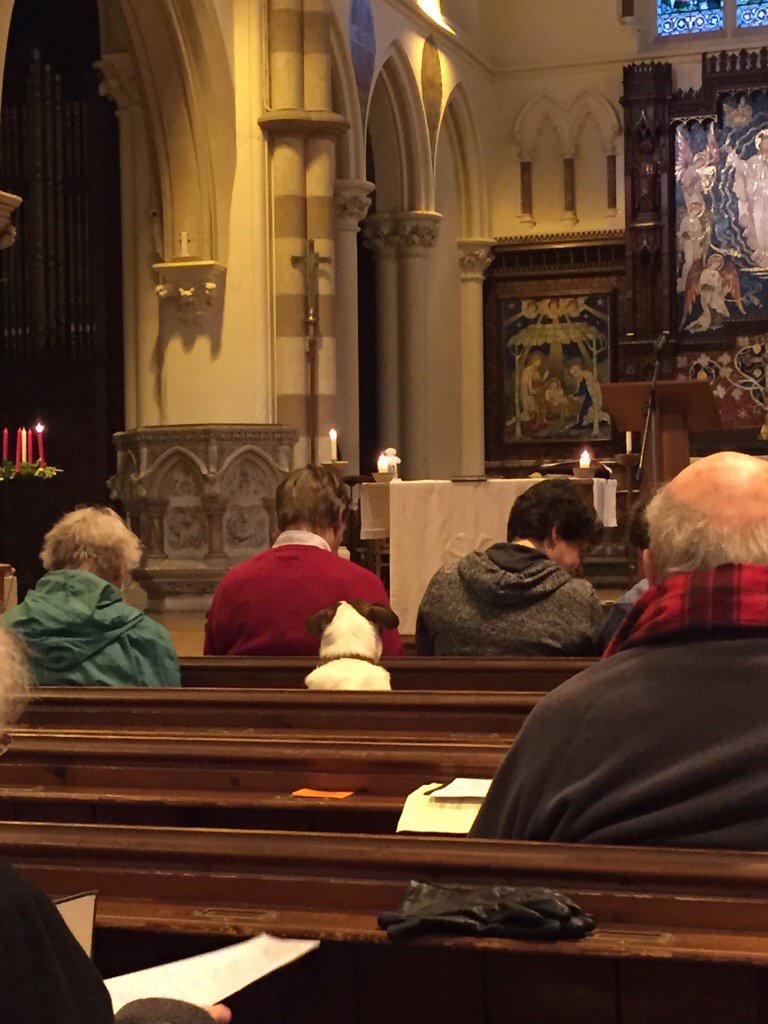
Not all the congregation is human! There is a lovely dog called Bonnie, who comes with two older ladies and sits between them in the third pew. She is a sort of mix-up terrier and she is 13 years old. She is always very well behaved. She doesn’t bark and she wags her tail as you pass on your way to receive communion. Bonnie stays in for the sermon, but the children go out. They are called the Fishes.
As well as the Rector and a couple of curates, together with my brother Reader and now friend, Derek Jay, there are also a couple of retired ministers in the congregation, and it was one of them, Father Paul Hawkins, who took the service last Sunday. He has had a distinguished career in the church. He retired to Bristol from being vicar of St Pancras, Euston Road, where he ministered among others to the students and dons of UCL. Before then he had been chaplain at Eton and at Sidney Sussex College, Cambridge.
So our preacher was definitely someone who was used to addressing a congregation of reasonably learned people. The service was advertised as being a ‘creative Eucharist’. I should say to you straightway that St Paul’s is what I would call a ‘normal’ church. It’s middle of the road; fairly traditional, with 8 o’clock Communion according to the Book of Common Prayer, the Eucharist at 10:30 according to Common Worship (order one), and they regularly have Evensong and Compline. There aren’t any weird and wonderful services or worship songs, so far as I know.
So I was not quite sure what ‘creative Eucharist’ was. I debated with myself whether I could risk going, but in the end, based on all the previous times I have been to Saint Paul’s in Clifton, I came to the conclusion that it would not be too weird, and I went along. When I got the service sheet and the hymnbook and everything, I realised that it was a normal Eucharist, at least so far as the liturgy was concerned. Common Worship, order one, no problem.
Bonnie the dog was there as usual in the third row, and she seemed quite content with the idea of creative Eucharist. What was the creative bit all about? Well, of course, it was the sermon. To some extent we all had to create it.
Father Paul was preaching about the earlier part of Acts chapter 9, the end of which we had as our New Testament lesson today. Last week, just as we did, they had the story of Saint Paul being struck down on the road to Damascus, and the gospel was the story in Saint John chapter 21, the story of the disciples going fishing and not catching anything, until they were met in the morning by Jesus standing on the seashore suggesting – giving them the hottest tip – where they should cast their net.

Bonnie, the faithful dog, is ready for the sermon, at St Paul’s, Clifton.

 
The disciples suddenly recognised that it was Jesus. Peter put his clothes on and jumped into the sea. (Previously he had not been wearing anything. I’ve always thought that this was rather strange because I thought usually you take your clothes off to go swimming, rather than the other way round. Be that as it may.) The people with Saint Paul on the way to Damascus were speechless. They could hear the voice speaking to Paul but they could see no one.
The point was that in St John’s Gospel and also in the Acts of the Apostles, there are a number of instances where people do not recognise that it is the risen Jesus who is present. Think, for instance, of Mary Magdalene at the empty tomb, thinking that Jesus was the gardener.
Then came the creative bit. Father Paul asked us all to turn to our neighbours – even to people we didn’t know, which was pretty revolutionary for normal Anglicans – well, certainly creative – and to talk about whether we could remember any occasions when we had been conscious of being in the presence of the risen Jesus. He gave us five minutes.
Then Father Paul went round with a microphone asking people to share their stories. Pretty terrifying – but fortunately, he didn’t pick on me. Actually he didn’t pick on anyone – there were enough keen ones putting their hands up anyway.
What would you have said? I had the rather prosaic thought that I can’t really imagine bumping into Jesus Christ these days, for example in Waitrose. He’s been dead for 2,000 years. Yes – I know. ‘Dead’ as we would understand it in the normal way.
The congregation’s views were pretty varied. Another retired minister in the congregation put his hand up and said, ‘This is a pretty difficult question.’ Father Paul said, ‘Okay, let’s move on’. But he did let his colleague say a few more words! But for other people, it was clear that they commonly did feel the presence of the risen Jesus, even in commonplace circumstances, such, indeed, as in the supermarket.
I have to confess that my mind went a complete blank, and I was saved by Derek, my fellow Reader, who was sitting behind me. He too was thinking about Waitrose: but he had a lovely story of a customer ahead of him in the checkout queue, who was perhaps a little mentally disturbed, or who was at any rate rather muddled, and who was beginning to hold up the queue. Before anybody could say anything, or become impatient or rude, the lady manning the checkout gently took over emptying the person’s basket and totting everything up, in a kindly way, so that the slow-moving customer was not embarrassed. She made her feel that nothing was wrong and that what she had been doing was perfectly all right. You could see the face of Jesus in that checkout bod.
It seems to me that this question is such a big question it is well worth carrying on looking at it this week, in the light of today’s Bible readings as well. St Peter was perhaps a bit like one of those super Christians who put their hands up in the service last week. No doubt in his mind: no doubt in theirs.
No doubt in St Peter’s mind. Tabitha, Dorcas, was a leading Christian. She was described as a disciple. All those people, who suggest that the church should be led only by men, should remember Dorcas. She was one of the leaders of the early church, one of the innermost circle, the disciples. Her name in Greek means ‘gazelle’: you imagine her to be a gracious and graceful lady.
But she had been seriously ill and had actually died. The story is very like the story of Jairus’ daughter whom Jesus raised from the dead in rather a similar way. He said, ‘Talitha cumi’, which is Aramaic for ‘damsel, arise’ – or, if you must have it in the stumbling prose of the New Revised Standard Version, ‘Little girl, get up.’
‘Talitha’: very like ‘Tabitha’ here. And the story is rather similar. Jesus and Peter are both doing roughly the same thing. Both are doing something miraculous, raising somebody from the dead. We have no idea how it worked. But you can say that God was at the heart of it.
‘Talitha, cumi.’ ‘Tabitha, arise’. ‘Damsel, arise.’ Compare Mark chapter 5 with our reading from Acts, chapter 9. So do we meet the risen Jesus, and if so do we recognise it? Well, things happen, and you realise that God is in them. My fellow reader, Derek in Bristol, was much better at doing the creative sermon than I was. He realised that, in the kindly face of the lady at the checkout, you could see the face of Jesus.
Then again, there is this rather strange story about the Archbishop of Canterbury which came out this week, that a newspaper thought that it is terribly important that they should find out who his natural father was. They persuaded the poor old Archbishop to have a DNA test which proved that his natural father was not Mr Welby but someone else. I can imagine that it must have been very unsettling, to say the least, especially since the whole story was played out in the full glare of publicity.
But Archbishop Justin took it all in his stride. This was perhaps not because he was, or rather is, some kind of superhumanly strong individual, but simply because he quietly told us that, for him, the most important parent is his heavenly father, and the most important family for him was the family of Jesus Christ, the church. What a nice man. But is it, also, another of those moments where perhaps we can glimpse the face of Jesus himself?
I am not going to make you be creative today, because I am sure that you are all much better at it than I am. But the church moved from the experience of those early disciples, the ones who had actually encountered the risen Jesus face-to-face, including Mary Magdalene, St Paul and doubting Thomas and the disciple whom Jesus loved and St Peter, recognising Jesus on the shore; for them it was straightforward. If a preacher had come up to them and asked whether they had experienced the risen Jesus, they could say ‘Yes’ to that.
We could understand that without any kind of explanation. But then Jesus eventually left, at the Ascension, and then came Pentecost, Whit Sunday, when the Holy Spirit came among them. Now is the period when we are looking forward to those huge steps in the life of the church.
We are a bit like those early church members in Joppa – and we are a bit like the Jews that Jesus encountered in the portico of Solomon, who didn’t get who he was. ‘How long will you keep us in suspense? If you are the messiah, say so plainly.’ Jesus answered, ‘I have told you, but you do not believe.’
It’s not something that everybody can see. It’s not something which is easy to understand. It needs people like Archbishop Justin and my friend Derek Jay, the Reader in Bristol, gently to point out how Jesus is really still with us. St Paul called it being ‘in Christ’. What he meant was, having Christ in him.
Remember what Christ himself said in Saint Matthew’s Gospel. ‘Lord, when was it that we saw you hungry and fed you, or thirsty and gave you a drink: A stranger, and took you home: naked, and clothed you? When did we see you ill or in prison, and come to visit you?’ And the king will answer, ‘I tell you this, anything you did for one of my brothers here, however humble, you did for me.’ Jesus is there. He is there for us to meet. You do not need to be particularly creative. You just need to keep your eyes open.

Sermon for Evensong on the second Sunday of Easter, 3rd April 2016
Wisdom 9:1-12

It’s one of those classic ways of passing time or getting off to sleep, if you’ve woken up in the middle of the night. You are the heir to the throne: you’re going to be king. God appears to you in a dream, and says, ‘What would you like? You can have anything you like.’

Of course, being a good Bible student, you will immediately be reminded of the story of Solomon and his dream in 1 Kings 3 or 2 Chron. 1. What did Solomon ask for? Solomon asked for wisdom. He might have used the words which were in our lesson today, from the book called ‘The Wisdom of Solomon’. He said, ‘God of my fathers, and Lord of mercy, who hast made all things with thy word,
And ordained man through thy wisdom, that he should have dominion over the creatures which thou hast made, …
Give me wisdom, ..’

Solomon did not ask for riches, or power, or any of the other kingly trappings – although God was so pleased with his choice, with his asking for wisdom, that he did give him all the other good things as well.

These days we don’t really think much about wisdom, or in those sort of terms. We don’t talk about people being ‘wise’ men. ‘Wise’ tends to be more of a cynical pejorative – he is just a ‘wise guy’. But wisdom, on proper reflection, is not just knowledge, but discernment and the ability to choose the right thing to do in circumstances where it is very difficult to know what is the right thing to do. Perhaps, indeed, we ought to look at wisdom again.

When you watch the pictures on the news showing the government minister meeting the steelworkers at Port Talbot, and you hear the ministers saying that they will do everything that they can do, lots of questions come crowding into one’s mind. If you thought along the lines of the author of the book of Wisdom, you could imagine the government ministers praying that Wisdom would come and help them out.

We don’t think that it was actually Solomon who wrote the book, but it was someone much later, writing in his honour: a Greek, most likely in Alexandria, who could have been writing about the same time as Jesus Christ. The Book of Wisdom was very much influenced not just by Jewish history, but also by Greek philosophy, especially by Plato and the Stoics. There is the Platonic idea of the essences of things being real as well as their manifestations. So we understand what it is for something to be a table, because we have an idea, a concept, an essence, of tables, in our minds.

So similarly Wisdom, the idea of Wisdom, to put it in Plato’s terms, almost has an independent existence all of its own – or rather of her own. If you are called Sophie or Sophia, you are named after the Greek word for wisdom. In the wisdom literature in the Bible, the books like the Wisdom of Solomon or Proverbs or Ecclesiastes, wisdom is personified; wisdom is a being in her own right, who can guide you into the correct path in order to follow the will of God.

So a government minister looking at the crisis in the steel industry would no doubt be very pleased to have a guiding figure, a Mrs Wisdom, at his or her side. What is the right thing to do? What are the principles which should inform one’s decision? Is it right that the only thing that matters is the law of the market, and, moreover, the law of the market worldwide? If so, it is tough, but it should just be a question whether our steel plant can make steel cheaper than anyone else. That wouldn’t give much hope to the people in Port Talbot.

But what if the market is modified, by tariffs, for example? Should we protect our steel producers by erecting a tariff barrier? There are arguments for and against. Does the fact that thousands of people will lose their jobs, does that outweigh in importance all the other considerations? Wouldn’t it be nice to have a gentle feminine voice in one’s ear saying, ‘Choose this; avoid that. This is the way that the problem will be solved.’

But how do you know whether you have got it right? Solomon, of course, demonstrated wisdom right at the beginning, when the two women came, both claiming to be the mother of a particular baby. How to tell which was the right mother? So he proposed to chop the baby in half and give each mother half a baby. It soon became clear which was the real mother. Wouldn’t it be nice if all wisdom calls were so simple? [1 Kings 3:16-28]

I’m sure that the ministers would indeed be really delighted if it was really possible to invoke the assistance of some goddess-like creature who would hold their hands and point them in the right direction.

The Wisdom of Solomon was a book which the early Christians liked, because they thought that it pointed forward to Jesus and the coming of the Holy Spirit. The lesson says, ‘Who ever learnt to know thy purposes, unless thou hadst given him wisdom and sent thy holy spirit down from heaven on high?’ (Wisdom 9:17) Wisdom is bound up with the Holy Spirit.

The Book of Wisdom is not a canonical book. Not every Bible has it in. It’s in the Apocrypha. If you look in the Articles of Religion in the back of your prayer book, Article 6, on page 613, you will see the list of canonical books which were the books which were supposed to contain everything necessary for salvation, and the other books which ‘the church doth read for example of life and instruction in manners’, include the Book of Wisdom. St Paul considered Christ to be the wisdom of God. There is something very closely connected, between the idea of Wisdom and the idea of the Holy Spirit, the essence of God at work.

Just before Christmas in the early Roman church at Vespers (which became part of our Evensong), before the Magnificat they sang an Antiphon, an ‘O’ Antiphon: O Adonai, O Root of Jesse, O Key of David: and the first Antiphon was ‘O Sapientia’, ‘O Wisdom’, in Latin.

‘O Wisdom, coming forth from the mouth of the Most High,
reaching from one end to the other mightily,
and sweetly ordering all things;
come and teach us the way of prudence.’

That is ‘O Sapientia.’

We can get something out of the idea of wisdom personified, of O Sapientia, even today. Wisdom, for a government minister, ought not to be just a question of making sure they take all the right theories, the right political dogmas, into consideration. True wisdom means they should consider in the round, from all angles, whether that dogma is right, whether it is kind enough to the people whose lives it affects.

The spirit of wisdom is surely the Holy Spirit. So to consider Wisdom, we must consider the Spirit as well. What would Jesus do? What is the will of God? Where is the Holy Spirit leading? In the chapels in the Welsh valleys tonight, their prayers will be rising. Let us pray with them, and let us pray in particular that the true spirit of Wisdom will come among those who have the power, either to save those communities or to turn their backs on them. They do it in our name. Let us hope that they, in their power and good fortune, will appreciate how those strong men in their Welsh valleys really do need them to have, not just clever theories, but true wisdom.

I’m very happy to reproduce this paper, which my dear friend John Schofield has written in the St Mark’s CRC (Centre for Radical Christianity) Newsletter, Spring 2016.

John Schofield, CRC Chair writes

Dear Friends,
As we begin a year in which there is the distinct possibility of a referendum on the question of our membership of the European Union, it is salutary for Christians to think about the origins of what has become the EU as we know it, and the part Christians, and the Christian worldview, played in its creation.
In Europe in the late 1940s and early 1950s the cry went up: Why? Why did the war to end all wars not end all wars? Why has this happened again? And from this was born the determination to do things differently, to have faith in God as salvifically interacting with the world, in humanity as redeemable, and in the power of reconciliation. It is no accident that Christians were deeply involved in the processes that led to the European Union being formed. People for whom God pitching tent among us, the cross and the Easter message are at the heart of faith, understood that something different had to arise. Three in particular should be mentioned: a Frenchman, Robert Schuman; an Italian, Alcide de Gasperi; a German, Konrad Adenauer. David Edwards wrote of them that
they all had a passionate sense of Europe’s unity. But they were also tough and determined politicians. They had collaborated in the European Coal and Steel Community from 1952. The coals of fire which warmed their commitment to the reconstruction of Europe in unity had been left in their hearty by the experience of the defence of “Christian civilization” or “Christian principles” or “Christian values” against Nazi, Fascist or Communist evils….This Christian influence in the shaping of society has been surprisingly and movingly strong.
and elsewhere in the book he says:
the word Christian in the title of (their political parties) has meant most obviously “attempting to reconcile”.
It is my belief that, however much this vision has got bogged down in an over heavily bureaucratised machine in Brussels, of which many are deeply suspicious, the vision itself must not be lost; and we, as followers of Jesus who brought reconciliation, should still be seeking to do all that we can to enable human flourishing through reconciled lives. This can best be done in concert with our European partners, rather than in little Englander isolation.
I believe that as Christians we have a vision to pursue. And we must do it in practical ways, particularly through staying at the heart of Europe. It’s that vision, based on the hard won reconciliation of God to the world, the world to God, that bringing of new life through death in reconciliation, which must urge us on, not forgetting the past, but neither being in the power of the past.  
I still remember being at a meeting in the 1990s about my then diocese’s desire to build deeper relationships with churches in Europe. We were telling one another how our interest in Europe really began. One – an incurable romantic – told of doing some work at Heidelberg University in the late 70’s. One evening he was with a multinational group of people on the ramparts of Heidelberg castle, with the moon picking out the silver stream of the river Neckar flowing down towards the Rhine. Together they sang Gaudeamus Igitur – and at that moment he knew he was a European, sharing a common culture and a common destiny,
And I told of being in Berlin as an 18 year old in 1966 on a visit organised by the London Diocesan Youth Council, and spending a day on the other side of the wall, during which we met some East German Christians from an organisation called Action Reconciliation. And on that day it dawned on me that it really mattered that I was a European every bit as much as these people I was sitting with and talking to were Europeans. I also realised in this meeting of Christians in a communist country that Christianity really is all about reconciliation, and that being a Christian means a great deal more than just being an Anglican. Christ calls people in every nation; in Europe, Christ calls people particularly to work together “that it may not happen again.” That day, my being a Christian and my being a European came together, and has never left me. This year, as we face being inundated by words about staying in or coming out, I still hold to that vision of hope in Christ, and of hope in our brothers and sisters in Christ across this great continent of ours. We who are the Church are called on to look beyond the narrow boundaries of personal or national self-interest.  
Of course, not even the most passionate pro-European can ignore the need for reform: the bullying treatment of Greece by the Eurozone members, the patchy and at times xenophobic response to the refugee crisis, the inevitable magnification of the bureaucratic mind given the sheer size that the union has now reached; all of these things need attention. But the greater good, the continuingly necessary response to the history of Europe in the twentieth century, the impetus to do something positive: all these should keep the Christian mind focused on the vision that set the European Union going, and that is increasingly necessary today.
Happy new year, freues neu Jahr, bonne année, felice anno nuovo, to you all.
John

http://www.stmarkscrc.co.uk

Sermon for Evensong on Palm Sunday, 20th March 2016
Isaiah 5:1-7, Luke 20:9-19

Did you see the Shetland pony this morning? The children made a beautiful tableau and there was a Shetland pony pretending to be a donkey for them to ride on, to make a procession, to remember Jesus as he rode into Jerusalem for the last week. It’s really a bittersweet message. For that lovely hour or two, Jesus led a procession of people who believed that he was God’s chosen saviour, God’s chosen saviour in a triumphal sense, like a Roman general returning in triumph from conquests overseas, leading a procession into the capital.

But the sad thing is that that was then, but the mood darkened very quickly thereafter. The clouds started to gather and Jesus started to challenge Jerusalem. This parable, the parable of the vineyard, some of which, on one level, was simply a retelling of the story from the prophet Isaiah, sets the tone.

Holy Week is about divine judgement; for God, against God. For man, against man: ‘Judge eternal, throned in splendour’. Isaiah made a prophecy of the kingdom of Israel and the Kingdom of Judah – the vineyard of the Lord of hosts is Israel, and the men of Judah are the plant he cherished – ‘He looked for righteousness but found it denied, for righteousness but heard cries of distress.’ [Is. 5:7, NEB] Jesus put out this story as a challenge. You are the chosen people, Israel. You have all the advantages. God has done everything he can to make the vineyard a good one.

Then he let it, to professional winemakers, tenants. Those tenants are the human race. The human race rejected God’s son and eventually killed him. What will God do? What will the landlord of the vineyard do? If we, who are tenants in his vineyard, have a lease on life in this world? What will God do if we have killed his son? It is a truly terrifying prospect.

Even so, we don’t really appreciate its force these days. This morning I said my theme was that we know what comes next. There was a sort of spoiler alert. We know that after the Passion, after Jesus’ terrible suffering, after Jesus dies, after God is killed, God rises again in glory on Easter morning.

Maybe we can’t really help knowing what comes next, but still, we ought to appreciate the force of the Passion story. We ought to appreciate that we are still like the tenants in the vineyard. If we have no care for God, if we do the things which killed Jesus, if we have no love for him and no love for each other, if we pursue false gods, then we are like those hard-hearted people who figured that it was to their advantage to free Barabbas and crucify the son of God.

Whatever we have been doing by way of Lenten reflection, in prayer and abstinence in the last four weeks, in this week of all weeks we should remember that we are tenants in God’s vineyard.

Maybe, just as with a new story, if we know what happens, we should keep it to ourselves – spoiler alert! – we should actually be cautious about saying we know what happens next. What will the owner of the vineyard do? We’re very cavalier. We just carry on. We live our lives as we’ve always done. We don’t receive the stranger, and take him in: we don’t give him clothes, when he’s shivering with cold. Is he a real refugee, or just a migrant?

But Jesus wouldn’t have made that distinction. In that time of final judgment, when Jesus separates the sheep and the goats, he will decide, he will judge, by what we have done for the hungry, for the thirsty, for the homeless stranger, for the person with no clothes. [See Matt. 25:31f]

It is disgraceful that there are still thousands of people in Calais and Dunkirk who are marooned without proper habitation, without washing facilities and proper sanitation. These are people whose homes in Syria have been bombed, whose families have been decimated. Some of the children in the camp actually have a legal right to join relatives in this country, but it’s not happening.

We are going to take the Foodbank van over there soon. There was some confusion at first, and we couldn’t find out how to get access to the camp; but now we have established contact with the local Guildford charity, Guildford People to People, and we’ll be able to get in. Many of you have already given clothes and blankets, which is great. I’ll let you know if there are any other needs which we can supply. We must do it. Jesus will ask us, when he was a stranger, a refugee, what did we do?

Then again there was another terrible story in the paper this week. An MP, Stella Creasy, had actually thrown the chief exec of a charity out of her office – called a policeman to throw him out of the Houses of Parliament – because she was so cross with him.

His charity had sold some flats which it owned, all of which had been occupied for years by poorer people who thought that the charity was looking after them. The charity sold the flats to a developer, who promptly gave all the poor tenants notice to quit. The MP raised this with the chief exec of the charity. Was it not wrong that their old tenants, old people, should be made homeless in this way? He shrugged his shoulders and said,’It happens’. All that mattered was that they had raised a lot of money by selling the flats. ‘It happens’ is what people say, far too often. We have to try to stop ‘it’ happening. ‘It’ is the sort of thing which has killed the son in the vineyard.

Let’s not be like the tenants in the vineyard. Let’s not do the things that kill the landlord’s son. Jesus was challenging us, us just as much as he was challenging his contemporary audience. We must not throw Him out; we mustn’t leave him shivering outside; we must make room in our hearts for Him.

Sermon for Mattins on Palm Sunday, 20th March 2016

Zechariah 9:9-12, 1Cor.2:1-12
We know what happens next. Or as people say nowadays, ‘Spoiler alert!’ ‘Ride on, ride on in majesty’. If you’ve just been to the family Eucharist at 10 o’clock, and seen the lovely tableau which the children presented, and maybe you have admired the Shetland pony on your way out, you will know why, when you were little, Palm Sunday was one of the best Sundays in the year to go to church. Donkeys are, alas, in rather short supply these days: there are now rather strict rules about what you have to do if you are going to carry a donkey around.

Mind you, in Stoke D’Abernon, many of the Mums do have the right vehicle for towing a horse box. Somewhere around here there is even a Range Rover with the registration number KT11 MUM! Anyway at St Mary’s we have had a lovely Shetland pony, and I am sure that Jesus would not have turned his nose up at a ride on him.

Processions are fun. Walking down the hill in a happy throng following someone riding on a Shetland pony was a very jolly thing to do. You can wave your palm leaves and your palm crosses. People do get quite carried away when they get caught up in supporting somebody who seems to take away their cares and blot out the annoyances that they have to put up with.

It’s quite noticeable, for example, that Donald Trump seems to have caught the imagination of a lot of people who feel left out by mainstream politics in the United States. They feel that big government doesn’t listen to them. Trump is their champion.

The Israelites had been in exile, and then under foreign domination, in their own country, for hundreds of years. At the time of Jesus, of course, the Romans were in charge and the Jews were second-class citizens. They were looking forward to the coming of a messiah, a deliverer, a king who was going to liberate them. They looked back to the various prophecies in Isaiah: the servant king, and in Zechariah was this strange image of a king coming on a donkey.

The basic model for the procession was what Roman generals did when they came back from foreign wars. If they had been successful, they were granted the right to have what was called a ‘triumph.’ A triumph was a magnificent procession through the centre of Rome, parading their captives and soaking up the applause of the people.

You can see that it would very much depend on your point of view how such a procession, with Jesus at its head, would be viewed. Even though Jesus was riding on a donkey, it might look rather challenging to the powers that be. In Palestine at that time, the ‘powers that be’ were both the Romans and the Jews, (the Pharisees and the scribes), because the Jews had a form of self rule, under the overall authority of the Romans. So if this big procession came over the hill from Bethany and down the Mount of Olives, it’s fairly understandable that both the Jewish authorities and the Romans might well have found it disturbing.

Even today, although we are supposed to be very liberal in our approach to free speech, you have to get permission for a demo to take place. You can’t just have a procession through the centre of the village, so that it blocks the traffic. For people in authority, processions are a sign of discontent.

There was a raw energy about to this crowd. In St John’s Gospel, we are told that the people were particularly excited because they had heard about Jesus bringing Lazarus back to life from the dead. Jesus, riding on a donkey, was a fulfilment of Zechariah’s prophecy. It all added up to a moment of great hope for the people. A man who could bring a dead man back to life could certainly be the king that they were looking for, to throw off the yoke of Roman rule so that Jerusalem would be liberated again.

But we know what comes next. ‘Ride on, ride on, in lowly pomp ride on – to die.’ A huge amount of the New Testament is devoted to the events of next week, Holy Week. A quarter of St Luke’s gospel; a third of Saint Matthew and St Mark and nearly half of St John’s Gospel. This is what Christianity is all about. And certainly, in this week, it is not about a triumph. It is not about conquest. It is more like a catalogue of suffering and failure.

When you’re little, you can only really take in nice stories about people riding on the back of donkeys. Good Friday is not something that we go into in great detail with our children. It is in a very real sense what in the cinema would attract an X rating. It is something which is too shocking. What we are talking about is the death of God, people putting to death the man who was also God. Five days earlier this man was being feted as the returning hero, as the Messiah, the king from over the water.

Nevertheless he, this same man, was going to be strung up on a cross along with common criminals.

Saint Paul says that the authorities would never have done it if they had known the full story. ‘We speak the wisdom of God in a mystery which none of the princes of this world knew; for had they known it, they would not have crucified the Lord of glory.’ [1 Cor. 2:8]

In Spiritual Cinema next week, on Tuesday, we intend to show the shortened, animated version of Ben Hur. We debated what would be an appropriate film to show during Holy Week. One film which we have shown in the past, which I felt was perhaps the very best one, was Mel Gibson’s The Passion of the Christ. A few years ago, we actually showed it in St Andrew’s Church, in the church itself.

For those who haven’t seen it, it is a very harrowing film, because it does show, in a very realistic way, exactly what happened to Jesus; how he was flogged, humiliated and ultimately crucified. Somehow it brings home to you the awfulness of what he suffered in a way that cold print on a page just can’t do. It would be a shocking film if you were watching somebody – just anybody – suffering in that way. Nobody should be treated in such a brutal and bestial way. But Jesus did suffer in that way, and he was the son of God.

The contrast with the jolly man on a donkey could not be more profound and more complete. We know what happened next. What must it feel like if you have just committed the most terrible crime, and realise what you have just done? What will the Judge say? What will your sentence be? What if that crime is to kill the son of God?

Oh, you say, but we didn’t. We weren’t there. It was the bad people, even the Jews. But in a sense, we were there. In a sense, the turnover, from his triumph to his downfall and being lifted up on the cross, was entirely predictable. It made sense in human terms to the powers that be. It wasn’t specifically because they were Jews or because they were Romans or whomever. They were just ordinary fallible human beings. They didn’t recognise his divinity. Pontius Pilate having the inscription put over the cross, naming Jesus as the King of the Jews, says it all. In one sense, he was the king of the Jews, but in that the Jews were the chosen people of God he was also king of heaven.

In Lent we have been encouraged to reflect, to deny ourselves, maybe to fast, and to pray. Now in this week, this Holy Week, we are invited to think about the full awfulness of what Jesus suffered, and why he suffered it. Maybe we should do it without a spoiler alert. Maybe we should say, we don’t know what comes next. Maybe we aren’t too comfortable. If Jesus died for all of us, for all of humankind, we should reflect that the sort of evil which pushed Jesus on to the cross is still with us.

People are still hurting each other, pursuing gain without thought for the loss to someone else that that gain entails. We are still returning an eye for an eye and a tooth for a tooth. We are still going by on the other side. We are still worshipping false gods.

‘Ride on, ride on in majesty. In lowly pomp, ride on to die.’

Sermon for Evening Prayer for the Prayer Book Society, Guildford Branch, on Saturday 12th March 2016 at the Founders’ Chapel, Charterhouse Jeremiah 20:7-18, John 11:17-27

Jeremiah said,
Wherefore came I forth out of the womb to see labour and sorrow, that my days should be consumed with shame? (Jer.20:18)

What happened to the covenant, the special relationship between the Lord’s chosen people and their God? They are held captive, exiles in Babylon. Psalm 137: By the waters of Babylon, we sat down and wept.

It was a time of sad reflection. Had their God abandoned them? What would look like an exile from the Promised Land today? It’s difficult to empathise with the exiles in the Old Testament, not only because there’s a gap of nearly 3,000 years, but also because we aren’t in exile: in fact, we are very much at home. In Surrey we can almost pretend that we are in the Promised Land.

But does it mean that we can’t feel something of what Jeremiah was crying out against? Is the whole world like the Promised Land today? It’s sad, but it’s not. There are even parallels with the mass exile of the chosen people, of the Jews, in the current mass migration and refugee exodus from Syria and other troubled parts of the Middle East and Africa.

The Babylon into which the Jewish exiles went was, just as we are, relatively stable and affluent. But it didn’t feel that way. The mere fact of being in exile was a bitter fate.

And then we have heard, in our second lesson, the most complete answer to such a time of despair. If the logical implication of an imperfect life, a life of suffering, is its eventual death, then victory over death is its antidote, the confirmation that the suffering was not in vain.

Lazarus has died. Both his sisters, Mary and Martha, are distressed. Jesus doesn’t arrive until Lazarus has been dead for four whole days.

Both sisters clearly believe that, if Jesus had been there in time, he would have been able to stop Lazarus dying. That in itself is a remarkable thing to believe: but Jesus had demonstrated amazing powers of healing already.

And indeed, even though Lazarus has been walled up in the tomb for four days, Jesus calls him out, and Lazarus comes back to life.

But you know all this. What has it got to do with us in Guildford Diocese today, enthusiasts for the BCP as we are?

Jeremiah is all about a people who had abandoned their covenant with God, had become separated from God, eventually literally: they were driven out of the Promised Land into exile after Nebuchadnezzar had captured Jerusalem for a second time in 587BC.

The story of the raising of Lazarus has a metaphorical significance (leaving aside the question exactly what happened), that it is one of the occasions when Jesus said ‘I am’ something. Here, ‘I am the resurrection and the life’. Death has no more power.

Jesus is God’s sign that we can come back from our spiritual exile. If we believe, we will no longer be separated from God, and we will have eternal life.

Can we know what happened? It’s striking that it’s made very clear that Lazarus had definitely died. Jesus knew that was the real position. Lazarus wasn’t just asleep. Nevertheless Jesus delayed going to him. When he finally arrived, Lazarus had been in the tomb for four days. The body would have begun to decay, and to smell. Lazarus was emphatically dead; but equally emphatically, we are told that he came alive again out of the tomb. Lazarus was among the guests at the dinner party for Jesus where Mary anointed Jesus’ feet with pure nard. Lazarus was definitely alive. We have to understand it as best we can.

You might think that such a message, or such a phenomenon, would have been a cause for universal rejoicing. But it wasn’t. The Pharisees said among themselves, ‘If we let him thus alone, men will believe on him: and the Romans shall come and take away both our place and nation’. The Romans had devolved to the Jews the day-to-day government of Palestine. If the people, the Jews, honoured Jesus rather than the Chief Priest and the Pharisees, the Romans might take away from the Pharisees the job of administration of the country.

I have to observe that this important passage in the lead up to Christ’s passion looks rather artificial, if it’s meant to be an eyewitness account. If Jesus had indeed raised a man, who had died and been in the tomb for four days, back to life, surely what the Romans might or might not do with the local government would seem to be of relatively minor importance. It does seem that what this story, of the raising of Lazarus, signifies, is much more important than just the minutiae of provincial government.

What Lazarus’ story really signifies, is that God is present with us. We are not alone, we are not separated. We’re no longer in exile.

Never mind what the Pharisees did: we can respond, we can respond to such a wonderful revelation, in several ways. The first is worship. This little congregation is gathered together because we want to uphold and support the use of the Prayer Book in worship: we think we will have better words with which to approach the Almighty, if we use the Book of Common Prayer.

And if that brings us together in fellowship, that’s good. ‘Where two or three are gathered together in my name, there I am in the midst of them’, (Matt. 18:20). We could say that the Prayer Book, for us, is a kind of conduit of God’s grace. As we meet together and worship, using Cranmer’s ancient and beautiful words, we pray for God’s grace.

Nothing we can do can earn that grace, that eternal salvation, but we have the assurance that if we believe and trust in Him, we will be saved, we will receive the grace of God.

And the way we will receive God’s grace will be through the Holy Spirit coming among us. How can we tell? How can we tell if the Holy Spirit has in fact, come among us?

Remember what St Paul wrote to the Galatians.
‘But the fruit of the spirit is love, joy, peace, longsuffering, gentleness, goodness, faith, meekness, temperance;’ (Gal. 5:22-3). Our Lent reflection today should be whether we do exhibit those qualities – and how as Christians we are dealing with the opposite of the works of the Spirit, the works of the flesh.

A person called Jack Monroe Tweeted this week:

‘Does anyone else get overwhelmed?

….

Hope too much?

Calais, welfare reform, ESA, food banks.

My heart is just broken.’

ESA stands for employment and support allowance, the benefit which has replaced incapacity benefit. ESA is a much harder benefit to claim than incapacity benefit, primarily because the medical test – the work capability assessment – is very much harsher. The government has just announced that it is going to make it even harder for disabled people to claim this benefit, and thereby to save over £1billion – that is, £1billion will be taken away from the already reduced amount given to disabled people.

Incidentally, in my work as manager of a food bank, I recently came across a statistic, that over 2,000 people have died after being declared fit for work and denied disability benefit under this new regime. 2,000 people: fit for work: dead.

Where does that all fit in? Fit in with our salvation as Christians, I mean. What are our various churches doing? Are you happy about the cuts in benefits for disabled people? What about Calais? Are you following the Diocesan links to Guildford: People to People and the other charities coordinating help for the refugees? Perhaps we should have a PBS collection for Calais. What do you think? Let’s talk about it over tea in a minute or two.

The link that I’m trying to follow is that our love of the Prayer Book is fine, and very understandable, but it ought to be seen as something which leads us to God’s grace, grace in our worship. Worship which is just ‘having a nice time’ isn’t proper worship, and isn’t worthy of the Almighty. Let’s exhibit some of the fruits of the spirit as well.

The Competition and Markets Authority has issued a thousand-page report about the ‘market’ in household energy – electricity and gas. It says that many people don’t regularly switch between ‘suppliers’, and therefore don’t pay the best possible (in this context, this means ‘cheapest’) price for their gas and electricity.

It is assumed that it is a good thing to have no loyalty to a supplier, but simply always to seek out the cheapest price. Why? Is there no value in stable relationships? Do all the ‘suppliers’ offer the same service, so that the only difference between them is price?

The fact that there is a ‘market’ in domestic energy is the result of political dogma. We used to have national, state-owned utilities. You bought your gas and electricity from the people who really supplied it – who had built power stations and explored for gas, that is, the state. But this was said to be ‘inefficient’ and the cost of investment was part of public borrowing, again said to be a ‘bad thing’. For Thatcherism, it is public-bad, private-good. This is not self-evidently true.

Leaving aside any analysis of this dogma – which analysis would begin with the fact that governments can borrow, and therefore invest, at lower cost than any private entity – the mischief that I want to highlight is the immorality of this elevation of ‘the market’ to being the only reason for behaving in a certain way: here, buying electricity and gas.

Why should one look only at whether something is the cheapest, in deciding whether to buy it? What about whether I have built up a good relationship with my existing supplier? This applies not just to utilities. Why do I buy spare parts for my coffee machine at a shop locally rather than direct from the manufacturer, more cheaply, over the Internet? The answer is that my local shop gives a good and reliable service, and I have a relationship with them. I feel that I am a valued customer. Why do I buy one make of car rather than another – and, more to the point, why do I usually buy the same make over and over again? It has to do with loyalty, relationships. Price has little to do with it.

This seems to me to be very important. If our behaviour is dictated to by ‘the market’, we are valuing that above more moral considerations based on our personal relationships. The quintessential statement of the importance and value of personal relationships is this: ‘Love thy neighbour as thyself.’

That, surely, is far more important than ‘the market’. But the way that people are ranking the market higher than any other reason for acting in a particular way, is an important factor in the breakdown of society. If all we care about is price, we will ignore people, good people, on our doorstep. They are our neighbours. The neighbour principle does not just apply to Good Samaritan-type activities. We have to care about people more than prices.

10th March 2016

Sermon for Evensong on the Fourth Sunday of Lent, 6th March 2016
Isaiah 40:27-41:13; 2 Timothy 4:1-18.

Among the dreaming spires of Oxford – in the ivory towers – there has been an almighty row between a student movement and my old college, Oriel, which in turn has excited the unwelcome attentions of the Daily Telegraph and some former students, who are so cross that they have stopped giving money to the College – at least that’s what the leak from the Senior Common Room published in the Telegraph said, so it must be true.

It’s all about Cecil Rhodes. There’s a statue of him high up on the bit of Oriel College which faces on to the High Street. The statue is so high up, in fact, that most of us who were there for three or four years in the 1960s can’t say we ever really registered the fact that it was there. Rhodes was an Oriel man, and he left a substantial benefaction to the College in his will, which was used to build the building which has his statue on it. Rhodes also founded the Rhodes Scholarships, which have brought all sorts of scholars from the Commonwealth and the USA to study at Oxford. It’s well documented, incidentally, that among the earliest Rhodes scholars was a black American, and the terms of Rhodes’ gift expressly ruled out discrimination on the grounds of race in awarding the scholarships. [Nigel Biggar (2016): Rhodes, Race and the Abuse of History, http://www.standpointmag.co.uk/node/6388/full%5D

But, the protesters say, Rhodes was a bad man, who was involved in the worst aspects of colonial oppression. He was almost guilty of slavery, and, they say, he was a racist.

So there has been a great argument about whether Oriel should take down the statue. Although it hasn’t been put this way exactly, the point seems to be that people are arguing that if, according to today’s standards, our benefactor was a bad man, that taints his gifts, even though at the time he gave them, he was not judged to be a particularly bad man according to the moral standards then. A bad man can’t give a good gift, they say, even though at the time he gave it, he wasn’t regarded as a bad man.

The argument rages on. I was thinking about it when I saw the Bible lessons for this service. A Christian minister – for instance Timothy, the young man to whom two epistles are addressed – must uphold authentic doctrine and good teaching, and not be led astray by fads and crazes: ‘For the time will come when they will not stand wholesome teaching, but will follow their own fancy and gather a crowd of teachers to tickle their ears.’ (2 Timothy 4:3, NEB)

The young minister must be steadfast, and stand up to hardships in support of his ministry. He will be strengthened in his calling by the Lord. The prophet Isaiah says, ‘But they that wait upon the Lord shall renew their strength; they shall mount up with wings as eagles; they shall run, and not be weary; and they shall walk, and not faint.’ (Isaiah 40:31) The Epistle echoes this. ‘Notwithstanding the Lord stood with me, and strengthened me; that by me the preaching might be fully known, and that all the Gentiles might hear: and I was delivered out of the mouth of the lion.’ (2 Timothy 4:17)

So the young minister, the young evangelist, will be strengthened in his calling, supported by God in his work. Or her work, indeed. This Lent we are being encouraged to consider a calling to ministry in our church. The Diocesan newspaper, The Wey, which you can pick up on your way out tonight, has as its main headline on the front page, ‘Who me …..? A vicar?’ [http://www.cofeguildford.org.uk/about/communications/the-wey/details/the-wey—march-april-2016]

St Paul’s two letters to Timothy and his letter to Titus, called the Pastoral Epistles (‘epistle’ means ‘letter’ – from the Latin epistola) are chiefly concerned with the character which a Christian minister needs to have. As well as being of good character – ‘blameless, the husband of one wife, vigilant, sober, of good behaviour, given to hospitality, apt to teach; not given to wine, …. not greedy of filthy lucre’ [1 Timothy 3:2-3] – a minister must stick to sound doctrine. But how to know what is sound doctrine?

St Paul’s letters are full of controversies, reflecting the various arguments which must have sprung up among the early Christians. Think of all his arguments about whether Christians needed to be circumcised; whether, once baptised, a Christian need not worry about living a morally upright life – because they were already ‘saved’. Could one earn salvation by doing good works? They argued about all these.

What was the right answer? At the time of the Reformation, a thousand years later, the Reformers liked verse 16 of 2 Timothy chapter 3: ‘All scripture is given by inspiration of God, and is profitable for doctrine, for reproof, for correction, for instruction in righteousness’.

‘All scripture is given by inspiration of God.’

So that means, if it’s in the Bible, it must be right. The Bible is the Word of God. But wait: these fine sentiments, in what says it is ‘St Paul’s’ Letter to Timothy, are reckoned by scholars not in fact to have been written by St Paul from his prison cell in Rome at all. These were what are called ‘pseudonymous’ letters, letters written after the style of St Paul, and in order to be more persuasive, claiming to have been written by him, but in fact not. The language, and references to things which the earliest church didn’t have, such as bishops, have led the academic commentators to say that these Pastoral Epistles aren’t really by St Paul.

So what is true? Does the truth – or what is right and good – change over time? Is there merit in the argument put forward by the Rhodes Must Fall campaign, that what may have been good once upon a time, need not still be so? We have to acknowledge, for example, that the Church of England in the late 18th and early 19th centuries saw nothing wrong in slavery. The grand buildings at the heart of Bristol and Liverpool were built with profits from the slave trade, and the traders were church-goers. John Newton, who wrote the great hymn, ‘Amazing Grace’, was originally the captain of a slave ship.

Then gradually people’s understanding – Christian people’s understanding – changed. William Wilberforce and the members of the Clapham Sect, who worshipped at Holy Trinity, Clapham Common, began to understand that their Christian belief would lead them to recognise that all are made in the image of God, that we are all – equally – God’s creatures.

I wonder what people will say about us in 100 years. Adam Gopnik, in his recent radio talk, ‘A Point of View’ [http://bbc.in/1QwPjC9], has suggested that in years to come, our generation will be criticised for extreme cruelty to animals, the animals that we eat, like chickens, cows and sheep.

I wonder whether our inclination towards nationalism, not just in opposition to the EU, but also in relation to migration, might be criticised as being like the Victorians’ attitude to slavery – or at least their attitude towards their colonial subjects. Why are we any more entitled to live in wealth and comfort, just because we have been born in England, than someone who was born in Syria, or Iraq, or Afghanistan? Are we really?

I wonder. I wonder what St Paul – or, dare one say, what Jesus Himself – would say. Have you got itchy ears?