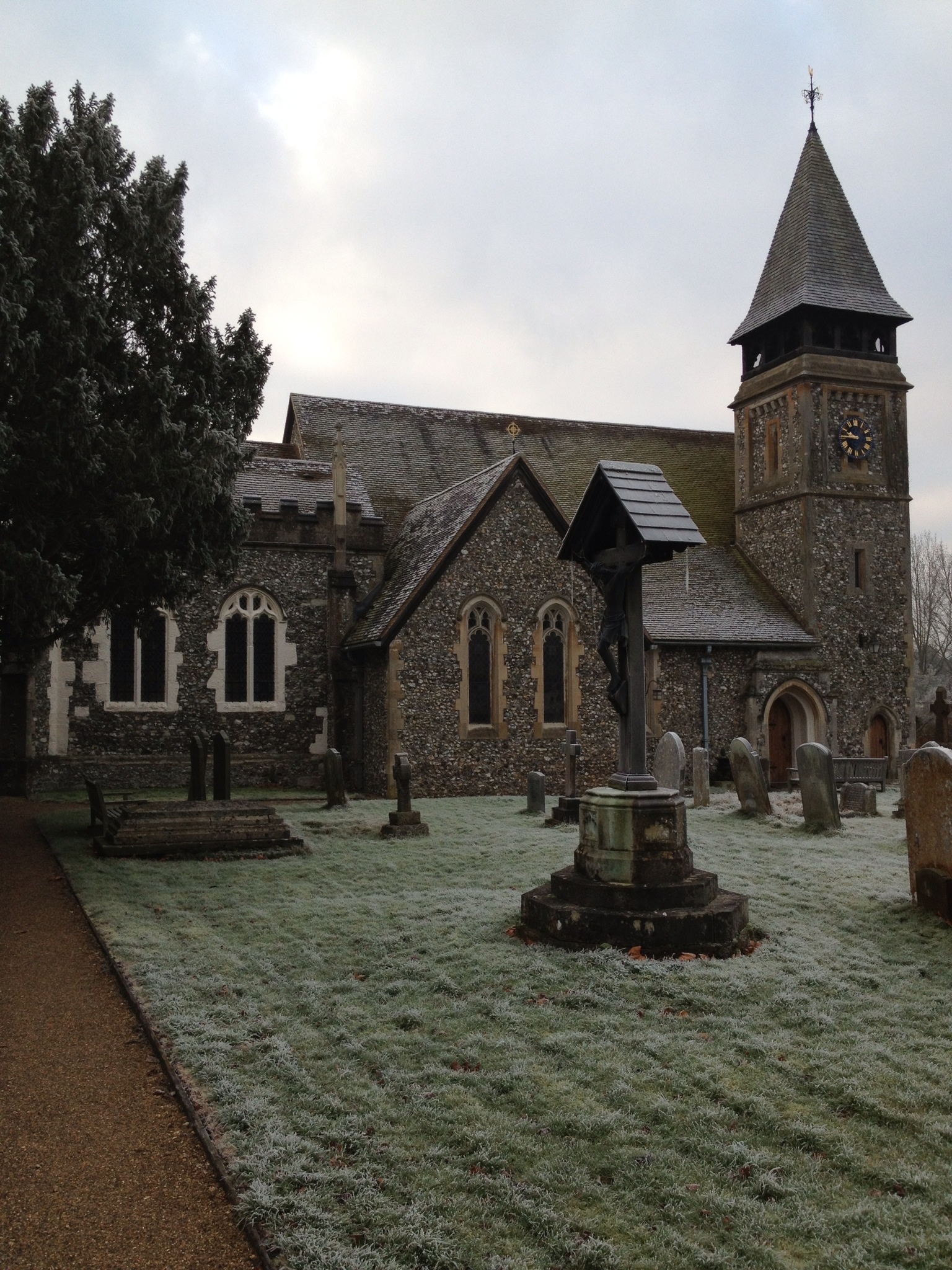
Sermon for Evensong at St Mary’s on the Feast of Christ the King, 25th November 2012
Galatians 3:28 ‘There is neither Jew nor Greek, there is neither bond nor free, there is neither male nor female: for ye are all one in Christ Jesus’.
Tonight I am going to break one of the rules which I set myself in my preaching, which is that I try always to say something about the lessons which are set in the lectionary for the day. Today as we heard, we had the story of Belshazzar’s Feast and the writing on the wall in Daniel, and in the NT lesson from Revelation we were reminded of the overwhelming power of God: ‘I am the Alpha and the Omega’, the beginning and the end.
But, apart from reflecting on the difference between the ‘principalities and powers’ of which Belshazzar, King of the Chaldeans, was one, and The Lord God, almighty, invisible, only wise, which will prompt us to reflect that God is far more powerful and important than the meaning of any particular way of life, I want tonight to deal with something less earth-shaking, but nevertheless important for us in the Church of England today. That is, the question of women bishops.
I am sure that we all know that on Tuesday the governing body of the church, the General Synod, the Church’s parliament, voted against the proposal to allow the ordination of women as bishops, subject to a safeguard for those parishes which did not want the oversight of a female bishop, that in the arrangements for episcopal oversight, due ‘respect’ would be paid to the reasons why those parishes felt as they did. To say that the Synod ‘voted against’ the proposal to allow women to become bishops is misleading. The Synod voted overwhelmingly in favour of it, but under the Standing Orders, the constitutional rules which the church has adopted for the Synod, the vote was six short of the majority needed under those rules for the proposal, the Measure, as it was called, to be passed.
The General Synod has three ‘houses’, for bishops, clergy and laity respectively. They are not houses like the House of Commons or the House of Lords, separate chambers in which each group votes: it is more a question of having groups within the one Synod body, a certain maximum number of bishops and clergy, and enough lay people to reflect the Protestant character of the C of E – it was controlled not by the Pope, but originally by the King, Henry VIII, and the king’s powers have now passed to the people. There are 470 members; 47 bishops, 194 clergy and 206 lay members.
Under the Standing Orders of the General Synod, (SO 35(d)(i)(1)), a vote finally to approve a Measure which provided for permanent changes in the ordinal (the rules for ordination of clergy), requires not a simple majority, but a two-thirds majority of all three houses.
Although 42 of the 44 dioceses in the C of E, including our Diocese of Guildford, have voted in favour of women bishops, and although the requisite 2/3 majority was obtained in the houses of bishops and clergy, in the house of laity the result was 132 in favour and 74 against, six short of the majority required by Standing Orders.
We have four lay members of General Synod from Guildford Diocese. I wrote to three of them before the vote, and two replied. After the vote, as there doesn’t seem to be any published list of votes cast, I asked them to tell me how they voted. So far they have not told me how they voted; however, from the correspondence I had with them beforehand, I think that it is likely that at least those three of our representatives voted against the Measure. I think that it is somewhat odd that at least a half of the votes which doomed the Measure came from a diocese, Guildford, whose parishes solidly supported it. It is a peculiar form of democracy, which allows these so-called representatives to vote completely contrary to the overwhelming wish of their constituents. [The official voting record, issued after this sermon was preached, confirms that three lay members from Guildford voted against the Measure.]
So much for the nuts and bolts of what happened on Tuesday. What are the main schools of thought for and against women bishops?
The first minority group opposed are the so-called traditionalists, or Catholic fundamentalists. They say that, as Jesus, the head of the church, was male, his vicars, which literally means those who stand in his place, from St Peter downwards, must also be male. They also advance the view that the patriarchal society which existed at the time of Jesus is the immutable model for all human society, still valid today. So men are the leaders, the hunter-gatherers who go out to work, and women are the home-makers, whose role is to support the males, produce and rear children.
The traditionalists don’t seem to have any difficulty with the thought that the head of the Church of England is the monarch, which of course for the last sixty years has been a woman – and indeed in the reigns of Queens Elizabeth I, Mary and Victoria, there has been a substantial history of female overall leadership of the C of E.
The second dissenting group are the so-called Conservative Evangelicals, who believe that the Bible is the literal Word of God, and that because St Paul in his first letter to Timothy, 2:12, wrote, ‘I suffer not a woman to teach, nor to usurp authority over the man, but to be in silence …’, women cannot be in leadership positions in the church – and some evangelicals also refer to a sentence in the following chapter of the same letter to Timothy, 3:1f, where for example the King James Bible translates the passage as, ‘If a man desire the office of a bishop, he desireth a good work’. ‘If a man …’ In fact this is a wrong emphasis. ‘Man’ in the King James usually just means ‘person’.
The Greek original simply says, ‘If someone aspires ..’ (ει τις … ορεγεται). There is no gender defined – although in the passage St Paul goes on to describe the qualities which a bishop needs, ‘above reproach, faithful to one wife, sober, temperate, courteous, hospitable and a good teacher’, and so on in the same vein. Clearly there, St Paul assumes that bishops will be male, although commentators have pointed out that this passage is about the moral qualities required, against a background which reflected the make-up of society 2,000 years ago. In that sense, the background assumed in these passages is descriptive, describing how things were, rather than prescriptive, saying how they ought to be.
Be that as it may, both these groups, the traditionalists and the conservative evangelicals, are implacably opposed, not just to women bishops, but also to women priests. To them it doesn’t matter that they are a tiny minority – the six people whose votes brought down the Measure amounted to 1.27% of the members of the General Synod. These opponents of women in ministry don’t care if they are a minority, don’t care if the world outside thinks that their views are outdated or inhumane. They believe that tradition, in the case of the the traditionalists, and a literal interpretation of St Paul’s teaching in one of his letters, in the case of the conservative evangelicals, are reasons which trump any more secular or even legalistic considerations, such as equal-rights legislation (although the churches currently have an exemption from complying with it).
But what about the vast majority in the C of E? Are we just wishy-washy liberals who bend to the force of public opinion rather than keeping to the true theological position? Of course you know that I certainly believe that it is right that the church has women in ministry, and that there should be women bishops. And of course you know that I am indeed a liberal in the church: but I would hope no-one would ever think of me as wishy-washy!
I believe that in fact there are excellent theological reasons for women bishops. It is not a question of being in tune with modern society. I see that Bishop Tom Wright, the evangelical theologian, has written an article this week in the Times in which he says that it would indeed be wrong just to follow the dictates of society, and he insists that there must be Biblical authority for what the church does. But he finds that, rather than the Bible ruling out the possibility of women bishops, in fact there is substantial Biblical authority for women having a perfectly good right to be bishops. (See http://www.fulcrum-anglican.org.uk/page.cfm?ID=759)
St Paul’s messages on bishops are not as weighted against women as the conservative evangelicals argue. The passages in his first letter to Timothy, about a woman not being fit to teach, are based on an argument that because in the Garden of Eden it was the woman who was beguiled by the serpent, and who led Adam into sin, so women can’t be trusted to teach in public. But does anyone seriously believe that the story of the Garden of Eden in Genesis is anything other than a picturesque fable?
On the other hand, in his letter to the Galatians, 3:28, comes this famous passage. ‘There is neither Jew nor Greek, there is neither bond nor free, there is neither male nor female: for ye are all one in Christ Jesus.’ There is no need to explain that! It should dispose of the whole question.
In St Paul’s greatest letter, to the Romans, at 16:7, he addresses a woman called Junia as an ‘apostle’: surely at that time that was the highest level, the highest status, in the early church. If you were an apostle, then surely you could be a bishop, like the other apostles – certainly like Peter.
In this closing chapter of his great letter to the Romans, St Paul sends greetings to a number of other women who he clearly regards as leaders in the church there, such as Phebe, whom he calls a ‘deacon’, Priscilla and Aquila, who were willing to risk their necks, literally, to save him; Mary, Tryphena and Tryphosa, Persis ‘the beloved’, who are all said to have ‘laboured in the Lord’; and he entrusts the letter to be carried to Rome, and no doubt to be read out to the Roman church, to the deacon, Phebe, who was travelling to Rome on business. In other words, St Paul trusted the safe carriage and exposition of his greatest letter to a woman. So much for women not being allowed to teach!
And of course there are other examples of leading women in the early church – for instance Lydia in Acts 16:13.
But surely what is most striking of all is that at the heart of the most important event in the whole of Christianity, Jesus’ resurrection, it was not the male disciples to whom he appeared, but ‘Mary Magdalene and the other Mary’ (Matt. 28:1, for example). These women, women, announced to the disciples the most important event in world history. If Jesus himself chose women to convey the earliest Gospel, the quintessential Good News, surely He would be happy for them to be leaders of his church.
I agree with Tom Wright that the justification for there being women bishops, for Christians, doesn’t depend on what he calls ‘Fake Ideas of Progress’, but on the Bible. I would rather say that those ideas of progress, according to which men and women are all equal in God’s sight (Heb. 4:13), are themselves in accordance with Bible precedent, rather than being somehow opposed to it.
So what is the church to do? In particular, is there anything that we in Stoke D’Abernon can do, about the perverse and unrepresentative decision of the General Synod this week?
I think that there is. The Synod has been in effect taken over by minority interests, in the way that all democratic bodies risk being infiltrated by activists. In order to become a member of General Synod, a lay person has to be first a member of a Deanery Synod, and then the Diocesan Synod. These are not seen as very exciting jobs – so the normal middle-of-the-road people don’t put themselves forward. That has to change.
It is really as a result of apathy, a sin of omission, that these people, whose views are not representative of the majority of ordinary church-goers in our diocese, have got themselves on to General Synod. I wrote to one of them, whose views were clearly against women bishops, pointing out that as one of our representatives, surely he should subordinate his personal views to the expressed view of his constituents when he voted. He replied that, if we didn’t like the way he voted, we could vote him out at the next General Synod election. I think that that is exactly how this vote was lost. People like this man, one of our, Guildford Diocese, representatives, put their own esoteric minority views ahead of the majority view, and thereby stymied it.
I do hope that we remember this: that you and I, the lay people in this Diocese, should not stand idly by. Let’s get ourselves into the Synod and make sure that nothing so undemocratic, and so unbiblical, ever happens again.
Remember, ‘There is neither Jew nor Greek, there is neither bond nor free, there is neither male nor female: for ye are all one in Christ Jesus.’