Archives for posts with tag: Babylonians

Sermon for Mattins and Morning Prayer (Principal Service) at All Saints Church, Penarth, 5th October 2025

Habakkuk 1.1-4; 2.1-4

Psalm 37.1-9

2 Timothy 1.1-14

Luke 17.5-10

It’s a pity that we don’t have lantern slides at 8 o’clock, because I could show you the picture on the slide which is going to be shown at 10 o’clock when I start to preach the sermon then. It’s a sort of shovel, or it could be a large spoon, with round things in it, quite small.

I wondered whether they were my favourite special-treat breakfast cereal, Grape-Nuts – I should explain that I didn’t choose the pictures, as Susannah is leading the service at 10 as well as this one – but I suspect that at 8 o’clock we need to stay away from pictures and screens and things like that, and just keep our worship simple and our pictures in our heads, where, of course, those of you who listen to the wireless know that the best pictures are.

What is in the big spoon? I asked Susannah and she told me that they were mustard seeds, picking up a reference to the Gospel reading, the New Testament lesson today. I have to say that it rather threw me, because I thought mustard and cress was something which you grew on a face flannel on the bathroom windowsill, but apparently this is what mustard seeds really look like.

The lessons are all about how we confront a world which is going wrong, which is going against us. The Old Testament lesson, from the prophet Habakkuk, comes from a time around 600 BC when the Assyrians had overrun the northern kingdom of Israel, and all that was left of God’s chosen people were the two tribes of Judah and Benjamin, together with the survivors from the massacre when the Assyrians invaded the northern kingdom, who had fled to Jerusalem to take refuge there.

Habakkuk was preaching when the Babylonians were beginning to sweep down on Palestine; they are the Chaldeans, if you read a bit more beyond one of the bits that we have for our lesson, which is in two bits, the first four verses of chapters one and two respectively. If you read on in chapter 1, beyond where it says

Devastation and violence confront me;

strife breaks out, discord raises its head,

……

for the wicked outwit the righteous,

and so justice comes out perverted.

Habbakuk goes on in his prophecy by saying

Look, you treacherous people, look:

here is what will astonish you and stun you,

for there is work afoot in your days

which you will not believe when it is told you.

It is this: I am raising up the Chaldaeans,

that savage and impetuous nation,

who cross the wide tracts of the earth

to take possession of homes not theirs.

Terror and awe go with them;

their justice and judgement are of their own making.

Their horses are swifter than hunting-leopards

And he goes on to say how terrifying they are in all sorts of other ways. Obviously they fulfilled the American strategic objective for a successful army in the invasion of Iraq, ‘shock and awe’.

But this terrible army had its limitations.

Their whole army advances, violence in their hearts;

a sea of faces rolls on;

they bring in captives countless as the sand.

Kings they hold in derision,

rulers they despise;

they despise every fortress,

they raise siege-works and capture it.

A terrifying picture. Who could stand against them? But then –

Then they pass on like the wind and are gone;

and dismayed are all those whose strength was their god.

People who believe that ‘might is right’ turn out to be completely mistaken; and the key words in Habakuk’s prophecy come in the second chapter, in our second part of the lesson, [2:4]

Look at the proud!
 Their spirit is not right in them,
 but the righteous live by their faith.

It’s an idea that St Paul picked up on in two of his letters. In his great letter to the Romans, [1:17], he said that in the gospel of Jesus

is revealed God’s way of righting wrong, a way that starts from faith and ends in faith; he says, as Scripture says, ‘he shall gain life who is justified through faith’.

In the letter to the Galatians [3:11], where St Paul is drawing a distinction between following the provisions of the Jewish law, just carrying out the 10 Commandments, and having faith, saying that the way to salvation is through faith, he says that

It is evident that no one is ever justified before God in terms of law; because we read, ‘he shall gain life who is justified through faith’.

I’m not sure why the compilers of the Lectionary decided that we should have a lesson from the second letter to Timothy rather than one of these passages from Romans or Galatians, (which clearly reference the passage in Habbakuk), but certainly in the passage from the second letter to Timothy, St Paul celebrates that the fact that Timothy and his mother and his granny, Eunice and Lois respectively, all had strong faith.

But you might be a little bit puzzled about exactly what this faith is. It’s pretty clear that it’s not what we would call blind faith, just believing that something is true without any evidence for it. If that was true, you might never take another paracetamol ever again; or even worse, you might try to cure Covid by drinking some bleach. But we are not talking about President Trump’s belief system; this is a word which has more of a connotation of trust about it. It’s not so much about believing that something is the case, but rather, trusting in God to produce a good outcome, to right the wrongs. It’s very close to hope. Hope in the Lord. Trust in the Lord. As Isaiah puts it [14:31]:

but those who look to the Lord will win new strength,

they will grow wings like eagles;

they will run and not be weary,

they will march on and never grow faint.

They will soar, on wings like eagles: they will ‘mount up with wings like eagles’.

Just now our world looks a bit like what it must have looked like to Habakkuk; there is a lot going wrong. There are terrible wars, invasions; the rule of law looks to be under threat in places: –

devastation and violence confront me;

strife breaks out, discord raises its head,

…..

for the wicked outwit the righteous,

and so justice comes out perverted.

We can think of plenty of places and cases today, where those words would be very apt. We are going to have a vigil later on today here to pray for the people of Palestine; equally our prayers should go for the other places in the world where there is no peace and where the rule of law does not securely run: Ukraine and the south of Sudan chief among them, as well as Gaza and the West Bank; and all those places where people are held hostage or are fleeing violence and persecution and are becoming refugees.

We need to trust in the Lord, to pray with confidence and realise the power of prayer, even if our faith is only the size of one of Susannah’s mustard seeds, or a spoonful of Grape-Nuts. It doesn’t matter. You can rely on God to put things right in the end. Let us pray that he will use us in his service to that good end.

Amen.

Hugh Bryant
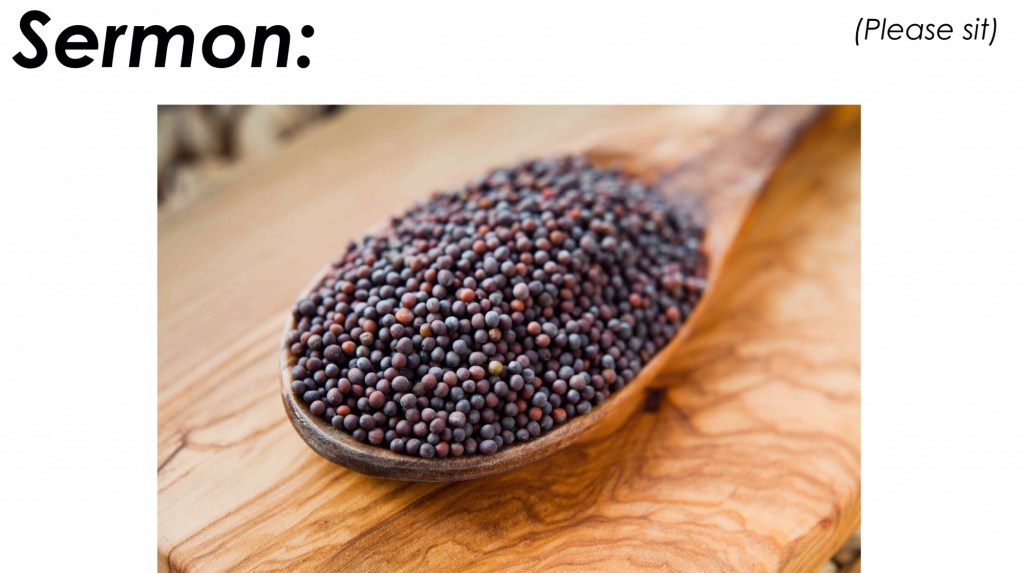
From the PowerPoint slides at the 10 o’clock service. What are those little beads?

Sermon for Evensong on the Sunday after Christmas-Day, 30th December 2018

Isaiah 61; Galatians 3:27-4:7 (http://bible.oremus.org/?ql=412935020)

Do you remember when Jesus started to read in the synagogue – it’s in Luke 4, from verse 17 – and he read out from the Book of the prophet Isaiah, and then said, ‘This day is this scripture fulfilled in your ears.’ In other words, He was the Messiah, which Isaiah had prophesied about, had foretold in our lesson tonight, chapter 61, and chapter 61 was what Jesus was reading out.

That prophecy is all about the salvation of Israel, deliverance from its oppressors, from the Assyrians, the Babylonians, the Egyptians – and latterly, it would be, from the Romans – deliverance from slavery; because the Israelites were the chosen people of God, and God would keep his promise to them.

That’s as you would expect. Jesus was Jewish, he was an Israelite. He was brought up in the Jewish culture. The gospel of St Matthew, aimed at a Jewish readership, is at pains to set out his genealogy, tracing it back to King David, son of Abraham.

But truly, if the story of Jesus had just been a Jewish story, just been a story about Israelites, that story would have remained a footnote in history. But the genius of St Paul was to realise that the one true God is the god of everyone. There isn’t just a god for the Jews, or for another national group – or in those days, for the Romans. God is far bigger than any question of nationality or origin.

And so we have this great passage in the Letter to the Galatians:

There is neither Jew nor Greek, there is neither bond nor free, there is neither male nor female: for ye are all one in Christ Jesus. [Gal. 3:28f]

Just as Isaiah had prophesied,

I will make an everlasting covenant with them.
And their seed shall be known among the Gentiles, and their offspring among the people”

God’s chosen people are no longer to be regarded as being just the Israelites, but rather all those who are ‘in Christ Jesus’, who are Christians. They are God’s chosen people now. ‘Their seed shall be known among the Gentiles’, just as much as among the Jews.

Paul’s mission to the ‘nations’, (which is what the Latin-based word ‘gentile’ means), to the non-Jews, opened the door to Christianity becoming a universal religion, and there is no bar in it to anyone on the grounds of nationality, or colour, or origin: being, and becoming, Christian, and indeed that key expression in St Paul’s thought, being ‘in Christ Jesus’, is integral to the way he understands God: that God is at the heart of everything, the ultimate creator and sustainer of all our being.

But although Jesus’ coming as the Messiah meant that we should look wider than just the sons of Abraham, the Israelites, in order to find who are God’s chosen people, nevertheless, in Isaiah’s prophecy, there are some key truths which, maybe, started as distinctive Jewish or Israelite concerns, but nevertheless now have a worldwide or universal importance.

Important among these is the concept of justice.

‘.. to proclaim liberty to the captives, and the opening of the prison to them that are bound;

To proclaim the acceptable year of the Lord, and the day of vengeance of our God’

This is all about the rule of law. In the Jewish Law, the ‘acceptable year’ is the Jubilee year, is the year one-in-seven when debts were forgiven; when people were allowed a new start. Not that the law disappeared, but that its application was tempered with mercy. ‘The quality of mercy is not strained’, if you prefer Shakespeare. [The Merchant of Venice, Act IV, Scene 1]

‘For I the Lord love judgment, I hate robbery for burnt offering’. Don’t go out and pinch your neighbour’s things so as to be able to afford to put more in the collection plate. The Lord loves judgment. The Lord loves the law. Do the right thing. And the right thing is a message of renewal and, as I have observed so often, and particularly in Advent, the message of the Bible is one which is full of the counter-intuitive, it is often contrary.

See, Isaiah foretells opposites: ‘ … beauty for ashes, the oil of joy for mourning, the garment of praise for the spirit of heaviness’. This is not a message of despair: this is a message of hope. But it is hope based upon a fresh appreciation, on repentance, on throwing away the old truisms; casting off slavery; slavery, which means forcing people to work for less than they need in order to pay the rent and to buy food. And look, in this vision of justice, Isaiah sees that

strangers shall stand and feed your flocks, and the sons of the alien shall be your plowmen and your vinedressers.’

Strangers. Sons of the alien. That is what the Millennium looks like. There is nothing wrong with people coming and joining our society and doing useful jobs. But note that, both in Isaiah and in St Paul, it’s not the case that origins and nationality are obliterated. It’s more a question that there is no hierarchy of worth, based on nationality or origin.

‘There is neither Jew nor Greek, neither bond nor free, neither male nor female.’

It doesn’t literally mean that. It means that the connotations of being Jewish, or the connotations of being Greek, what it means to be in slavery, what it means to be free, what it means to be a man, what it means to be a woman, do not include connotations of worth: or to put it another way, they are all equally worth.

It doesn’t mean to say that they are all the same. But it means that you can’t say, just because somebody is from a particular country, for that reason, they are less entitled to share in the world’s riches than someone who is from Hollywood – or from the British Hollywood, Cobham.

So as we begin 2019 on Tuesday these are very timely lessons. In the good society there is no room for xenophobia or nationalism – although we can celebrate our differences and enjoy the riches of each other’s culture. We can explore new foods, new literature, new ways of looking at things, that come from different places of origin.

I was blessed, earlier in my life, in having ten years of fairly constant travel, to all sorts of other countries. I really enjoyed learning about different ways of life and making friends with people in other countries. But today, there is a worldwide movement against this, based on nationalism and xenophobia. Freedom of movement, for our young people to be able to do as I did, to travel freely throughout the world, to live and work and different places; and the other side of that coin, for people from other countries to be able to come freely here, to make their life here if they want to do so, by working hard and contributing to our society, that freedom is being overtaken, overtaken by narrow nationalism.

We should recognise that there is ‘neither Jew nor Greek’ in the Kingdom of God: that we are all sons and daughters of God, descendants of Adam and Eve: and Jesus is the second Adam, ‘a second Adam to the fight’ as the hymn puts it. He is really Everyman – He is for everyone.