Sermon for Mattins and Morning Prayer (Principal Service) at All Saints Church, Penarth, 5th October 2025
Habakkuk 1.1-4; 2.1-4
Psalm 37.1-9
2 Timothy 1.1-14
Luke 17.5-10
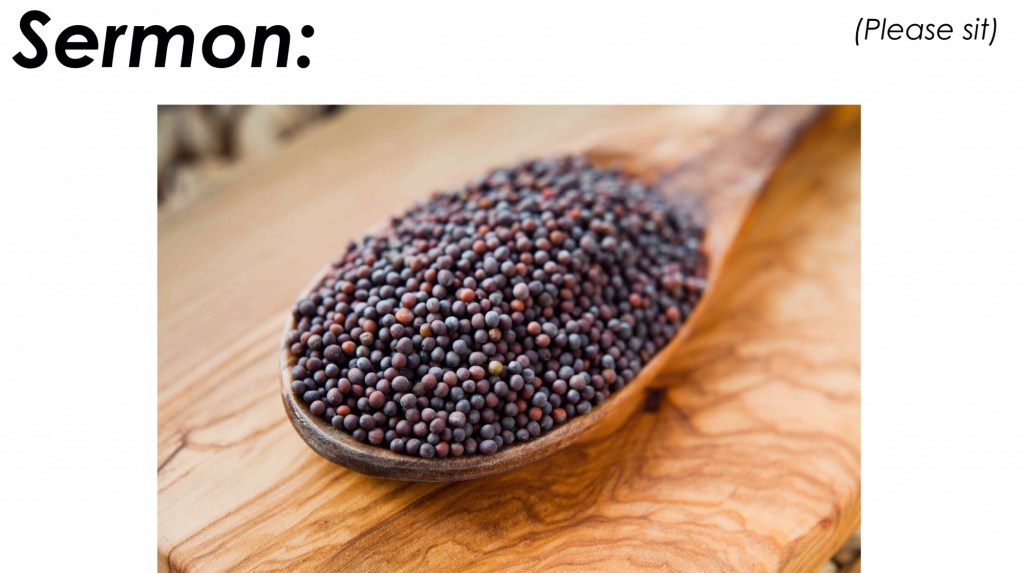
It’s a pity that we don’t have lantern slides at 8 o’clock, because I could show you the picture on the slide which is going to be shown at 10 o’clock when I start to preach the sermon then. It’s a sort of shovel, or it could be a large spoon, with round things in it, quite small.
I wondered whether they were my favourite special-treat breakfast cereal, Grape-Nuts – I should explain that I didn’t choose the pictures, as Susannah is leading the service at 10 as well as this one – but I suspect that at 8 o’clock we need to stay away from pictures and screens and things like that, and just keep our worship simple and our pictures in our heads, where, of course, those of you who listen to the wireless know that the best pictures are.
What is in the big spoon? I asked Susannah and she told me that they were mustard seeds, picking up a reference to the Gospel reading, the New Testament lesson today. I have to say that it rather threw me, because I thought mustard and cress was something which you grew on a face flannel on the bathroom windowsill, but apparently this is what mustard seeds really look like.
The lessons are all about how we confront a world which is going wrong, which is going against us. The Old Testament lesson, from the prophet Habakkuk, comes from a time around 600 BC when the Assyrians had overrun the northern kingdom of Israel, and all that was left of God’s chosen people were the two tribes of Judah and Benjamin, together with the survivors from the massacre when the Assyrians invaded the northern kingdom, who had fled to Jerusalem to take refuge there.
Habakkuk was preaching when the Babylonians were beginning to sweep down on Palestine; they are the Chaldeans, if you read a bit more beyond one of the bits that we have for our lesson, which is in two bits, the first four verses of chapters one and two respectively. If you read on in chapter 1, beyond where it says
Devastation and violence confront me;
strife breaks out, discord raises its head,
……
for the wicked outwit the righteous,
and so justice comes out perverted.
Habbakuk goes on in his prophecy by saying
Look, you treacherous people, look:
here is what will astonish you and stun you,
for there is work afoot in your days
which you will not believe when it is told you.
It is this: I am raising up the Chaldaeans,
that savage and impetuous nation,
who cross the wide tracts of the earth
to take possession of homes not theirs.
Terror and awe go with them;
their justice and judgement are of their own making.
Their horses are swifter than hunting-leopards
And he goes on to say how terrifying they are in all sorts of other ways. Obviously they fulfilled the American strategic objective for a successful army in the invasion of Iraq, ‘shock and awe’.
But this terrible army had its limitations.
Their whole army advances, violence in their hearts;
a sea of faces rolls on;
they bring in captives countless as the sand.
Kings they hold in derision,
rulers they despise;
they despise every fortress,
they raise siege-works and capture it.
A terrifying picture. Who could stand against them? But then –
Then they pass on like the wind and are gone;
and dismayed are all those whose strength was their god.
People who believe that ‘might is right’ turn out to be completely mistaken; and the key words in Habakuk’s prophecy come in the second chapter, in our second part of the lesson, [2:4]
Look at the proud!
Their spirit is not right in them,
but the righteous live by their faith.
It’s an idea that St Paul picked up on in two of his letters. In his great letter to the Romans, [1:17], he said that in the gospel of Jesus
is revealed God’s way of righting wrong, a way that starts from faith and ends in faith; he says, as Scripture says, ‘he shall gain life who is justified through faith’.
In the letter to the Galatians [3:11], where St Paul is drawing a distinction between following the provisions of the Jewish law, just carrying out the 10 Commandments, and having faith, saying that the way to salvation is through faith, he says that
It is evident that no one is ever justified before God in terms of law; because we read, ‘he shall gain life who is justified through faith’.
I’m not sure why the compilers of the Lectionary decided that we should have a lesson from the second letter to Timothy rather than one of these passages from Romans or Galatians, (which clearly reference the passage in Habbakuk), but certainly in the passage from the second letter to Timothy, St Paul celebrates that the fact that Timothy and his mother and his granny, Eunice and Lois respectively, all had strong faith.
But you might be a little bit puzzled about exactly what this faith is. It’s pretty clear that it’s not what we would call blind faith, just believing that something is true without any evidence for it. If that was true, you might never take another paracetamol ever again; or even worse, you might try to cure Covid by drinking some bleach. But we are not talking about President Trump’s belief system; this is a word which has more of a connotation of trust about it. It’s not so much about believing that something is the case, but rather, trusting in God to produce a good outcome, to right the wrongs. It’s very close to hope. Hope in the Lord. Trust in the Lord. As Isaiah puts it [14:31]:
but those who look to the Lord will win new strength,
they will grow wings like eagles;
they will run and not be weary,
they will march on and never grow faint.
They will soar, on wings like eagles: they will ‘mount up with wings like eagles’.
Just now our world looks a bit like what it must have looked like to Habakkuk; there is a lot going wrong. There are terrible wars, invasions; the rule of law looks to be under threat in places: –
devastation and violence confront me;
strife breaks out, discord raises its head,
…..
for the wicked outwit the righteous,
and so justice comes out perverted.
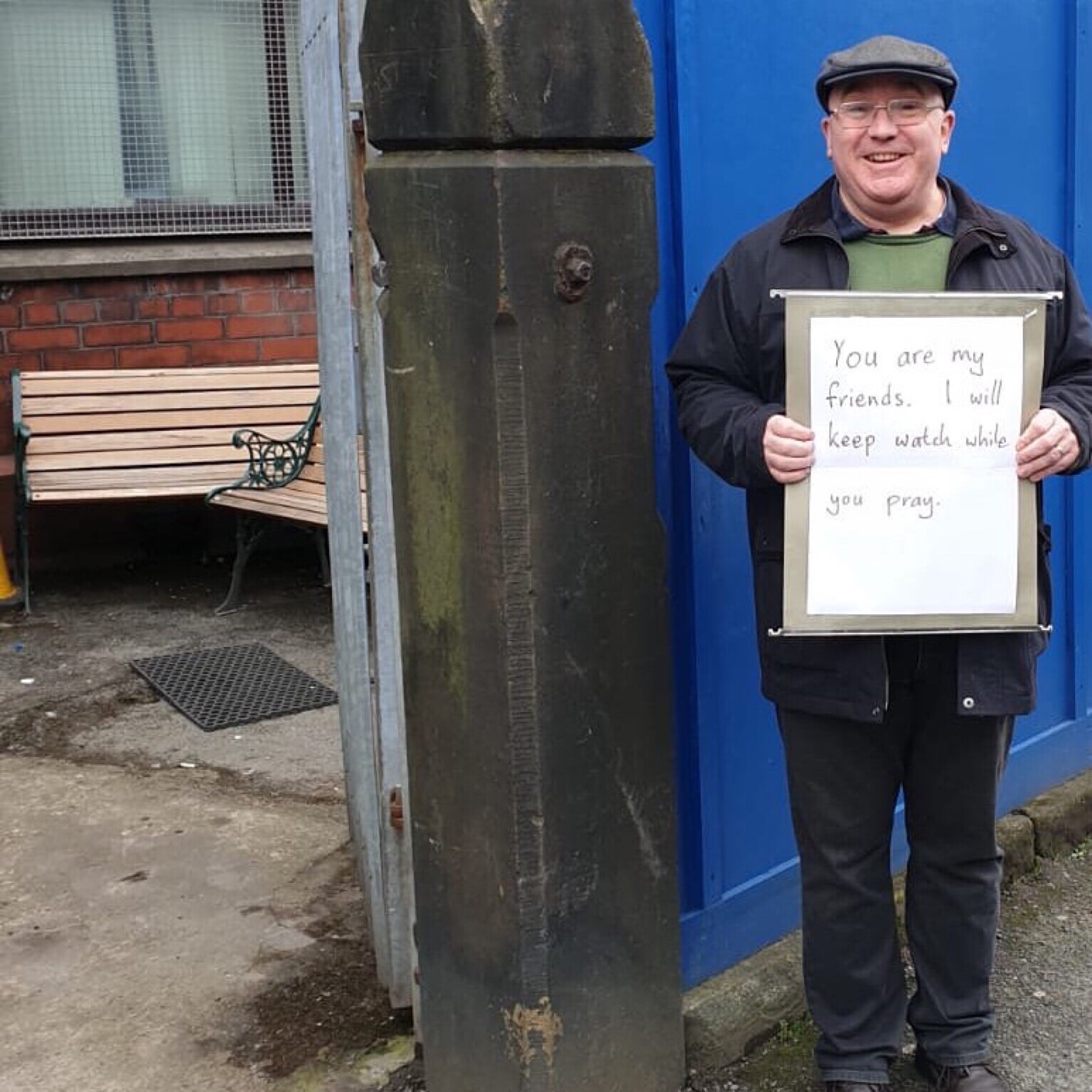
We can think of plenty of places and cases today, where those words would be very apt. We are going to have a vigil later on today here to pray for the people of Palestine; equally our prayers should go for the other places in the world where there is no peace and where the rule of law does not securely run: Ukraine and the south of Sudan chief among them, as well as Gaza and the West Bank; and all those places where people are held hostage or are fleeing violence and persecution and are becoming refugees.
We need to trust in the Lord, to pray with confidence and realise the power of prayer, even if our faith is only the size of one of Susannah’s mustard seeds, or a spoonful of Grape-Nuts. It doesn’t matter. You can rely on God to put things right in the end. Let us pray that he will use us in his service to that good end.
Amen.
Hugh Bryant
 hughdbryant