Archives for posts with tag: Bible

Sermon for the second week in Lent, preached on 20th February 2024


Genesis 41.46 – 42.5
Galatians 4.8-20

Can we swap places for a minute? Would you come up here and see things as your preacher does, or maybe on your way out, let me know what you feel? We’ve got to deal with two stories today, the first one being Joseph and the amazing Technicolor Dreamcoat.

Joseph’s brothers were jealous of his natty outfit, his coat of many colours, and when they were all on a journey through the desert, they chucked him into a pit, intending to sell him into slavery to the next bunch of traders coming through with their camel train. But unfortunately for them, some other spice traders came across him, pulled him out of the pit and took him away to Egypt. where they sold him to the Egyptian government, to Pharaoh, as a slave.

But Joseph prospered. He did a good job, and eventually, with various twists and turns in the story, he ended up being effectively Pharaoh’s viceroy, running the administration of the country. His secret was that he could interpret dreams. He was a kind of diviner, a seer.

He saw the future in a dream and realised that the crops would fail, and he would need to build up a stockpile of grain, if widespread famine in Egypt was to be avoided; so when the crops duly failed, and the famine broke out, Joseph sold grain to all and sundry and became more and more influential, owning more and more land as people run out of money and had to give him their land in return for food.

Among the people who were affected by the famine was Jacob, living in Canaan. Jacob was Joseph’s father, but he had been told that Joseph had died, torn apart by wild beasts, his brothers having shown their father the coat of many colours, stained with the blood of animals, to simulate the remains of a tussle to the death.

Jacob sent the brothers over to Egypt from Canaan, where they were, to buy grain, not knowing that they were about to buy it from the brother whom they thought they had abandoned to an unknown fate in the desert.

They didn’t know it was that long lost brother that they were buying from, and as you will remember, there is a thrilling story full of suspense about Joseph toying with his awful brothers, and making them think that they were going to be wrongly accused of stealing a whole load of grain from Pharaoh so that they would meet a dreadful fate. Then, at the last minute, the tables were turned and Joseph revealed himself as their brother.

You can imagine that it must’ve been a real ‘Oh something moment’ for them, quite a shock. Imagine how they must have felt. They must have thought that the most likely thing would be would be for their younger brother, who was now in such a powerful position, to get his own back on them; that it would not turn out well for them.

The lovely thing is, in this story, that Joseph didn’t do that. In fact he forgave his brothers, and invited them to bring their father over from Canaan to where they could live in Egypt in a land of plenty. Joseph didn’t blame them because, according to the account in the book of Genesis, he reasoned that his whole story, being abandoned and sold into slavery, and then working his way up with Pharaoh so that he became the head of the government of Egypt, was God’s will, was what God had intended, and no humans, certainly not his brothers, were really responsible or to be blamed.

What a wonderful story! That’s one of the two pieces we are looking at this morning. The other one is part of Saint Paul’s great letter to the Christians in Galatia, which is part of modern day Turkey. This reads almost like one side of a telephone conversation.

We don’t really know what Paul was responding to, and what the Galatians were saying to him. We can only try to draw inferences from what he is saying.

You wouldn’t pick this passage in the letter to the Galatians. I think if somebody asked you what the letter is all about, the bits which everybody quotes are the passage where he says that you are all sons of God in union with Christ Jesus. ‘Baptised into union with him, you have all put on Christ as a garment. There is no such thing as Jew and Greek, slave and free, male and female. You are all one person in Christ Jesus’. That comes at the end of chapter 3. and then, at the end of chapter 5, he talks about the signs of being led by the Holy Spirit. ‘The harvest of the spirit is love, joy, peace, patience, kindness, goodness, fidelity, gentleness, and self-control’. These are the qualities that come when you are a good Christian.

But these two famous passages are not what we are looking at today. This bit is all about the Galatians kind-of hedging their bets about what they really believed in.

They would be Greeks living in the Roman Empire, and you would remember that every Roman house had its household gods, Lares and Penates, and of course, in the Greek world, there was the Pantheon, on Mount Olympus; Zeus, and Hera, and all the other gods, each one representing and upholding a particular sphere of influence: so Ares, or Mars, was the god of war, for example.

The big difference between the theology of the Romans and Greeks and Judeo-Christian theology, (because Christianity originated in Judaism – Jesus was a Jew) was that whereas the Greeks and Romans worshipped lots of different gods, the Christians, as well as the Jews, worshipped one God, one true God, and by and large, they did not make statues or paint pictures of the one true God. He didn’t really have a name – ‘I am who I am’, he said – and certainly in the Jewish tradition, only priests could see God and not be burned up in the experience. ‘Immortal, invisible, God only wise’ sums it up.

But the Galatians wanted to have it both ways. They wanted to go back to the old gods as well, just in case. And St Paul got very cross with them. He said it was a retrograde step and that they would no longer be able to be saved and gain eternal life, if they were enslaved by their worship of elemental spirits, as he called them. it could just have been earth, wind, fire, and water, the basic elements, but whatever it was, Saint Paul was very frustrated by the Galatians’ wanting to worship those elemental spirits as well as the one true God as revealed in Jesus Christ.

So on the one hand, we have the story of Joseph and the amazing Technicolor Dreamcoat, and all the other, a rather bad-tempered rocket written by Paul to the Galatians.

So – imagine you are up here. What do you say about those two passages? What lessons can we draw from them? I would be tempted, I have to say, to draw out how generous Joseph was. He was almost as saintly as Jesus wanted us to be in his Sermon on the Mount. Love your enemies. Turn the other cheek. Certainly not an eye for an eye and a tooth for a tooth where those awful brothers were concerned.

But I suspect that in the wider sweep of the story of the people of Israel, Joseph’s kindness rather gets blotted out. This is all part of the story of Israel being enslaved, and then freed, and then finding a place in the promised land, building the temple, having the temple knocked down, being enslaved again in Babylon, and so on, until eventually, at the time of the second temple, they are established in Palestine.

It’s very tempting to try to draw parallels with what’s happening in the same area today. Just imagine what the possibilities would be if Mr Netanyahu took a leaf out of Joseph’s book and showed compassion and forgiveness. But if you and I swapped places and you had drawn that conclusion, I’m not sure that people would give you an easy ride as they were shaking your hand on the way out at the end of the service. They might say you’d stretched things rather a lot.

And what about Saint Paul and the Galatians? Apparently, according to Paul, they were volunteering to be enslaved again by worshipping the elemental spirits, rather than the one true God. What would you say about that? It’s a different kind of slavery from the slavery which the Israelites endured in Egypt and in Babylon. This is more an intellectual slavery, abandoning their principles and hedging their bets spiritually.

And, in passing, you might want to observe that Saint Paul’s letters, particularly this sort of letter where he takes a congregation of Christians to task for something that he thinks they are doing wrong, is a sort of communication which I don’t think we would get in today’s world. Because St Paul is in effect telling the Galatians what to believe.

We go to great lengths to ensure that we don’t interfere with everyone’s freedom to believe whatever they want to. We regret the history of the missionaries. Who would say now, ‘Don’t believe in Scientology or Mormon, but stick to the real stuff?’ Alternatively, when we are thinking of Islam or Judaism, we are at great pains not to say that people mustn’t be Muslims or Jews, but that people should be only Christians.

No, instead, we emphasise that all three religions, called the religions of the book, effectively worship the same one true God. We just approach that one true God in slightly different ways. So we wouldn’t be tempted to write the sort of letter that St Paul has written if we found, for example, that somebody had converted from Christianity to Islam. Nevertheless, in certain countries the reverse move, from Islam to Christianity or Judaism, is something which is condemned, indeed, sometimes bringing the death penalty.

That happens in Pakistan or Iran, but we don’t tell people what to believe. We have to some extent therefore changed from Saint Paul’s approach. What do you think? What do we make of that?

So those are your reflection points for this second week of Lent. What lessons could we draw from the story of Joseph and the amazing Technicolor Dreamcoat, and what do you think St Paul was up to in his frankly rather tough letter to the Galatians? Would it wash today? Let’s swap places and you can tell me the answers.

Amen.

Sermon for Morning Prayer on 21st April 2024, Fourth Sunday of Easter

Acts 4:5-12, 1 John 3:16-24

I want you to think about the morning after the morning after the morning after the night before. Or possibly, the morning after that.

Think of something that has happened, something that you’ve been involved in, that was really a big deal. Something that really made a difference.

Maybe it was the day you got married, if you did. Or the day when you won an Olympic gold medal. Or the day when something really momentous happened in the world outside. Perhaps you can even remember Armistice Day, or perhaps more likely, the day after the Brexit referendum. In all those cases, things changed; things changed really radically for ever. Nothing would be the same again. In our Bible lessons today the context is another of those enormous events as we enter into the world of the very first Christians, in the first, the earliest, churches.

The momentous event was of course Easter, Jesus’ resurrection. They had either experienced meeting the risen Christ themselves or they had met people who had. That’s one reason why I always find it very exciting to read the Acts of the Apostles, written by St Luke, as book 2 of his gospel, in effect; and St Luke was certainly around at the earliest time even if he didn’t actually meet Jesus. St Paul describes him as the ‘beloved physician’ and there are certainly moments in the Acts of the Apostles, describing St Paul’s journeys, where the third-party narrative, ‘they’ did this, ‘they’ did that, turns to ‘we’ did it, so we can infer that Luke was there.

So it is a very immediate, personal account of what it was like to be an early Christian. And so we are seeing the Easter people, the first Easter people, picking up their lives and carrying on after the amazing events of Easter. And we hear that they ‘met constantly to hear the apostles teach, and to share the common life, to break bread and to pray. A sense of awe was everywhere and many marvels and signs were brought about through the apostles’. They held everything in common, as we heard in one of the lessons a couple of weeks ago.

And then the part which we heard read today: Peter and John had healed a man who had been crippled from birth, who was begging at the gate of the temple. Peter said, ‘I have no silver or gold; but what I have I give you; in the name of Jesus Christ of Nazareth, walk!’ And the man who had been crippled from birth sprang up, stood on his feet and started to walk.

Needless to say it attracted a lot of attention, and Peter said this to the crowd: ‘Why stare at us as though we had made this man walk by some power or godliness of our own? The God of Abraham, Isaac and Jacob, the God of our fathers, has given the highest honour to his servant Jesus… And the name of Jesus, by awakening faith, has strengthened this man, whom you see and know, and his faith has made him completely well.’

The chief priests and the Sadducees, just as they had done with Jesus himself, took exception to this and considered it to be blasphemy. They arrested Peter and John and put them in prison. And the passage describes what happened when they were asked to explain themselves.

It’s very reminiscent of a similar episode when Jesus himself was tackled about healing somebody on the sabbath day. Again, to use a contemporary expression, the disciples pushed back against the criticism. What was wrong with healing somebody who was sick? You might be tempted to say, what does it matter who the doctor was? Just be grateful that the cure worked. But the high priests were concerned that Peter and John were giving credit to Jesus in a blasphemous way. But they insisted that it was Jesus who was the divine agent and it was the sick man’s faith in Jesus which had brought on his healing.

Let’s go back a minute to the question of the morning after the morning after the morning after the night before. Nothing was the same after Easter. Whom could you trust? There were so many people claiming that they were the true believers, that they had an inside track to understanding the story of Jesus.

So let’s look at the first letter of John, the first ‘Epistle General of John’ as the King James Bible puts the heading. It’s possible that the John who wrote the letter was the apostle, or certainly was the same person who wrote Saint John’s Gospel. Although he would have had to be pretty old, it’s not impossible. Some scholars do think that all three of them are the same individual.

Again we are in the world of the very early church, and it’s clear that in that world it was commonly expected that the end of the world was round the corner, and all the references to salvation and eternal life referred to a last judgement at the bar of heaven which was just about to happen. All the more reason, the early Christians felt, to be sure that you were a true believer, that you were one of the people who were truly saved, the elect.

And this is what the letter, John’s first letter, is all about. In one of my Bibles there’s a sub-heading describing the letter as a ‘recall to fundamentals’. It begins with these words: ‘It was there from the beginning; we have heard it; we have seen it with our own eyes; we looked upon it, and felt it with our own hands; and it is of this we tell. Our theme is the word of life. This life was made visible; we have heard it and bear our testimony; we here declare to you the eternal life which dwelt with the Father and was made visible to us.’ Do you remember the beginning of St John’s Gospel? ‘In the beginning was the word’. And it is all about love. The ‘word’ is Jesus, and Jesus is love; and the key to being saved is whether you are ‘in Christ’, which is a rather mysterious expression which is generally reckoned to mean whether Christ is in you.

In John’s First Letter there are a series of illustrations of what it means to be in Christ and to be in the light of Christ. ‘A man may say I am in the light; but if he hates his brother, he is still in the dark.’ Only the man who loves his brother dwells in the light. And then this great passage that we had read to us as the second lesson, contrasting two examples, one, the greatest example, that greater love hath no man…, And we ought to lay down our lives for one another, the supreme sacrifice; and the other, because we can’t be in a position to offer a supreme sacrifice every day, the everyday salvation, the everyday expression of love, which you will remember from the sentences before the traditional Holy Communion service, ‘Whoso hath this world’s good, and seeth his brother have need, and shutteth up his compassion from him, how dwelleth the love of God in him?’ If a man has enough to live on, and yet, when he sees his brother in need, shuts up his heart against him, how can it be said that the divine love dwells in him? That’s how it works. God is love.

God is love; God: Father, Son and Holy Spirit. If we are in Jesus, in the Son, we are in love, love is in us; and the test of that is how we show that love. Let us love our brothers and sisters, let us love our neighbours. If we are Easter people, if we are like those early Christians on the day after the day after the day of the great event, what difference does it make to us? Is it still buzzing in our minds? Does it still draw us irresistibly to do things that we didn’t do before? Let us pray that it does.

Amen.

https://bible.oremus.org/?ql=575175148

Genesis 2:15-17, 3:1-7; Romans 5:12-19

The first Sunday in Lent,  in preparation for the great Easter climax: a time of spiritual reflection, renewal, fasting. We are preparing for the events which revealed God’s love for humanity. God’s love, indeed, for fallen humanity, we often say. and that’s what our Bible readings this afternoon are about. The lesson from Genesis is sometimes described as the story of the Fall, and Christ’s passion and death, followed by his glorious resurrection, described in terms of sacrifice and redemption, salvation. Salvation for fallen humanity.

We know these stories. We know the story of Adam and Eve, and we know Paul’s famous passage contrasting Adam, who brought sin into the world, with the free gift, the grace of God, in giving us Jesus Christ. and I’m sure that as you’ve heard the lessons, as they were beautifully read just now, even if you aren’t word perfect in your memory, they were pretty familiar. 

But in the spirit of Lenten reflection, perhaps not in a full-on 40 days in the wilderness sense, but nevertheless, in the hope that it makes you quietly go away and think about this, let’s have a closer look at the Fall and the ‘free gift’.

Let’s look at the Fall. What did Adam and Eve do wrong? I remember when I first heard this bit of Genesis, where God tells Adam that he can eat the fruit of all the other trees, but not this funny tree called the tree of the knowledge of good and evil; I wondered what its fruit looked like. It’s one clue that this is not meant to be a scientific explanation of anything, that one of the key elements is that there is this mysterious tree. It’s not just a plum tree or an apple tree. 

But then again, what is wrong? What is wrong with getting to know the difference between right and wrong? The idea seems to be that, before the Fall, before the act of disobedience, humans, or at least the first humans, Adam and Eve, didn’t know the difference between right and wrong. They were in some kind of primordial innocence – but they were immortal, or at least that seems to be the implication, because the threat that God makes is that if they disobey him and eat the fruit of the tree of good and evil, “you shall die”. Later on in Genesis, it says, “you shall get your bread by the sweat of your brow until you return to the ground, for from it, you were taken. Dust you are, and to dust you shall return.” You will remember that phrase from the Ash Wednesday service.

But why should it be a bad thing to know the difference between good and evil? And is there any obvious link between acquiring an innate moral sense and becoming mortal? Without wanting to sound flippant, I do think that this is a fairytale. Or perhaps, to put it more positively, it’s a myth, a story told to illustrate a point. So I suppose the attractiveness of it, why it is such a compelling story, is that indeed, we are very drawn to sympathise with Eve. As the serpent says, “when you eat of the  fruit of the tree, your eyes will be opened, and you will be like God, knowing good and evil.“

 The woman saw that “the tree was good for food, and that it was a delight to the eyes, and that the tree was to be desired to make one wise”. 

What on earth is wrong with any of that? The only thing you can find in the text is that God told them not to do it. You might say that there was more to it. There was a suggestion that, as a consequence of them doing it, they would become mortal. 

Alternatively, (and I think this comes out from Saint Paul’s discussion that we will go on to look at in a minute), it’s not that they will become mortal, so much as that God will kill them. There will be a death penalty for their disobedience. They were always mortal, because that’s the nature of being human: but if they disobey God, God will punish them, he will inflict death upon them. Perhaps that is closer to the true meaning.

It’s all painfully like stuff we remember from childhood. ‘Why do I have to stop throwing bread rolls at my brother when we are having our breakfast?’

 Answer, ‘Because I told you not to.’

‘ Why not?’

 ‘Because if you carry on doing that, you will get a thick ear.’

The way that this is written, makes us realise that it isn’t the ability to tell wrong from right that is the problem – that ability is always a good thing – but it’s how Adam and Eve acquired this ability that got them into trouble. 

The important thing is that they disobeyed God. They went off in another direction away from where God had directed them. The problem is not that they knew the difference between good and evil, but that they had become estranged from God. They had ploughed their own furrow; they thought they knew better than God what to do. That is why it is described as sin. What Adam and Eve did was sinful. Sinfulness isn’t necessarily doing something which is morally wrong, so much as becoming cut off from God. 

That’s what Paul picks up on in his letter to the Romans. ‘Just as sin came into the world through one man, and death came through sin’, is what he says, not ‘bad things or doing bad things’ came into the world – and incidentally, St Paul seems to be a bit shaky on gender equality, because he only seems to blame Adam, whereas it looks as though the Fall was proximately caused by Eve: anyway, we’ll leave that for another day. 

St Paul sees the Fall as alienation from God, as sin, not just doing bad things. He repeats what Genesis says about the consequence of sin being death. I can’t help feeling that perhaps Paul reasons backwards from Jesus’s rising from the dead, from Jesus‘s resurrection, from his conquering death, as it is sometimes called, to infer that mortality was the consequence of sin, that alienation from God, disobedience to God, made one mortal.

That seems to be the logic, although I have to say, it’s one part of these passages that you either believe or not, because there’s nothing you can do to prove or disprove whether God made previously immortal people into mortals. 

Be that as it may, Paul contrasts the idea that Adam brought sin into the world – and as Paul says he is not treating Adam as a particular person, but, as the lesson says, “Adam, who was a type of the one who was to come“, or, as another translation [NEB] puts it, “Adam foreshadows the Man who was to come”– either way, it was not particularly Adam – or Eve – who was responsible, but mankind in general going away from the commandments of God.

The Greek word for sin is άμαρτια, which means missing the mark, shooting, and missing the target; Paul then goes on to talk about the effect of what he calls “the law“, that sin existed before the law, but until the law came along, you couldn’t measure how much sin there was. He means law in the sense not of statutes passed by government, but the Jewish law, which is intended to give direction, how to comply with God’s commandments. 

So, if you disobey the Jewish law, which is in the first five books of the Old Testament, and summed up in the 10 Commandments, then you have broken the law, not in the sense of being a burglar or a murderer, (although if you were one of those, you would be contravening some of the 10 Commandments) – but more importantly, you are committing sins, things which drive you apart from God. 

So Paul contrasts the beginning of sin, the Fall, the fall from grace, by Adam, the prototype man, he contrasts that with God’s gift, his grace, his free gift, to fallen mankind, in giving us his son, Jesus Christ.

Paul contrasts judgement following one trespass, which brought condemnation, and the free gift following many trespasses, which brings justification. 

‘Justification’ is a technical term in the Bible. It means being on good terms with God. Sometimes theologians translate it as being right with God, so as to pick up the connotation of justice; but it is more like what an engineer or a carpenter, or a toolmaker, might understand as justification: bringing a work piece into alignment with another work piece, justifying that piece with its intended place. 

You adjust something so that it fits. 

It’s that kind of relationship that St Paul is talking about here: not a question of being acquitted in a court of law. This all comes in the context where Paul has introduced the idea of “justification through faith“. The idea that you’re not put right with God by doing good deeds necessarily, although good deeds are a good thing to do anyway, but that you depend on God’s generosity. 

He is not so much rewarding us as being gracious to us, giving us what is translated as a “free gift” It’s a Greek word, which is translated as a free gift, but it also really means a ‘gifty thing’, a δωρημα as opposed to a δωρον. It’s the essence of generosity, the essence of giving, rather than just a particular present. And that squares again with the idea that we are being put right with God, being brought into adjustment, into a good fit.

Just one more puzzle, before I leave you to carry on musing on these really rich passages with so many things to ponder over. That is the consequence of the free gift. Saint Paul says that those who receive the free gift of righteousness are saved. They “exercise dominion in life” it said in our lesson, through that one man, Jesus Christ. It’s the conquest of life over death. We have the gift of eternal life. That’s what salvation is. 

You need to go on and do some homework and read the 15th chapter of Saint Paul’s first letter to the Corinthians to give you more detail about what eternal life is and how it works. Jesus showed that it is possible, by himself rising from the dead. St Paul gives you some very believable analogies to explain in more detail how we can expect eternal life to come about.

So those are some ideas which you might want to reflect on as you begin your journey into Lent this year. All the Fs, the Fall and the Freebie, the Free Gift.

And just one more thing, for those of you who have been tackling me about this.  What am I going to do by way of giving things up for Lent? I like to follow an idea which a former Lord Mayor of London had a good few years ago, called the absent guest scheme. 

Whenever I go out for a meal or some other refreshment, I keep a note of the bill and then, at the end of Lent, I calculate what it would’ve cost to have had another person present at each of these occasions, an ‘absent guest’. I tot up what the total cost of the absent guests would have been and give it to my chosen charity for that Easter.

This year I will be giving it, I hope, to the United Nations Relief and Works Agency, UNRWA, for their work in Gaza.

Sermon for Mattins on 21st November 2023

Bible readings: see https://bible.oremus.org/?ql=567498722

‘Ah, Assyria, the rod of my anger—
   the club in their hands is my fury!’

The club, the rod of anger, are for beating up Israel, because they have done what is evil in the sight of the Lord. You could say this is where we often come in when we are studying the Old Testament. The Old Testament has this overriding theme, of the relationship between God and his chosen people: to what extent his chosen people follow him and obey his commandments, in which case he brings them prosperity, or do evil in the sight of God or perhaps worship other gods, in which case God punishes them.

It’s not an image of God which is particularly like the one which we normally have, of a God of love in the person of Jesus Christ. This is entirely different. God is saying, through his prophet Isaiah that there will be a war. The Assyrians will attack Israel. God will use the Assyrians to carry out punishment of the Israelites on God’s behalf. They will be the rod of his anger and the club in their hands represents God’s fury.

But the king of Assyria is not just a supine servant acting on behalf of God. Because he gets above himself.

‘Against a godless nation I send him,
   and against the people of my wrath I command him,
to take spoil and seize plunder..’
  
But then a couple of verses later:

‘But this is not what he intends,
   nor does he have this in mind;
but it is in his heart to destroy,
   and to cut off nations not a few.’

So the king of Assyria is not just after the Israelites under orders from God but he wants to go wider. He has already captured Carchemish and Arpad and Damascus, and now he has his sights on Calno and Hamath and Samaria.

‘Are not my commanders all kings? 
Is not Calno like Carchemish?
   Is not Hamath like Arpad?
   Is not Samaria like Damascus?’

It’s quite eerie to hear these names, some of which we would still associate with violence and suffering today, 3000 years later. Isaiah’s prophecy continues that when the Lord has finished all his work on Mount Zion and Jerusalem, sorting out the Israelites, and punishing them for their faithlessness, he will punish the arrogant boasting of the king of Assyria.

And you hear all about what the king of Assyria has to say:

‘By the strength of my hand I have done it,
   and by my wisdom, for I have understanding;
I have removed the boundaries of peoples,
   and have plundered their treasures;
   like a bull I have brought down those who sat on thrones. 
My hand has found, like a nest,
   the wealth of the peoples;
and as one gathers eggs that have been forsaken,
   so I have gathered all the earth’.

This is the boast of the king of Assyria. And then you have this striking image about the relative merits of weapons as against those who wield them.

‘Shall the axe vaunt itself over the one who wields it,
   or the saw magnify itself against the one who handles it?’

Again it makes us think of things today. When the Ukrainians were crying out for better weapons and our government agreed to send them Challenger 2 tanks and Storm Shadow missiles, somehow that seemed to be almost more of a consideration than the bravery of the soldiers who would use those weapons. One can’t go too far with that analogy, because obviously without the right weapons, a soldier is not able to fight at all.

But here in this passage from Isaiah the point that the prophet is making, that the king of Assyria is effectively God’s secret weapon, still requires that he must not get above himself. He still has to follow God’s orders. As between God and the Israelites, Assyria is the weapon, not the commander. So God will cut him down to size.

‘Therefore the Sovereign, the Lord of hosts,
   will send wasting sickness among his stout warriors,
and under his glory a burning will be kindled,
   ……
The remnant of the trees of his forest will be so few
   that a child can write them down.’

Chilling imagery. What is it for? We really don’t have, as far as I can see, any equivalent today. People just don’t talk in those terms. We tend to think of prophets, if we think of them at all, as people who foretell the future. But that’s plainly not what Isaiah is doing here. Isaiah is the mouthpiece of God.

We really are a long way away when we read this. Isaiah was writing around 700BC – BCE – so 2,700 years ago. I’m not sure that there is any prophecy of this type these days. But if not, it’s even more difficult for us to make anything of what Jesus says in our New Testament lesson. How could we tell, if somebody claims to be a prophet, whether they are genuine? If someone pops up and tells us that God wants us to do something or other, the question arises, is he or she a false prophet?

If church leaders want to do particular things, are they following the word of God, or God’s command, or not? Jesus simply said, by their fruits you shall know them. So if somebody tells you that God wants you to do something which isn’t likely to turn out well, then Jesus suggests that you can take it that it is not genuine prophecy.

Perhaps although talking about prophecy seems to come quite strangely to us, nevertheless it could be good to look at what the implications are, in spiritual terms, of what people are telling us is a good thing to do.

In the first chapter of Isaiah’s prophecy, he identifies what it looks like to be godless.

‘Your rulers obey no rules and are hand in glove with thieves. Everyone loves a bribe and is greedy for his profit. They never defend the rights of the orphan and the widow’s cause never comes up before them.’

Again it’s frighteningly contemporary. Perhaps we should think again about prophets and prophecy. If you go away and have a little read of the first few chapters of the book of Isaiah, you will immediately stumble on the passages which we often read during Advent and at Christmas about the coming of the Messiah, about Emmanuel, God with us.

‘For to us a child will be born, to us a son will be given. The government rests upon his shoulders
and his name shall be
wonderful, counsellor, mighty God,
everlasting father, prince of peace.’

But we haven’t got there yet. As we move towards Advent, this picture, of God’s anger with his chosen people, is something which we need to reflect on and pray about, because it is uncomfortably close to home.

Sermon at Evensong on 15th October 2023 at All Saints Church, Penarth

Bible readings referred to:

https://bible.oremus.org/?ql=564029064

Writing a sermon this week has been a challenge. In the face of the terrible events in Israel and Palestine, it doesn’t seem right for me just to give you a more or less academic, measured exposition of two Bible lessons, coupled with some observations on the words of the psalm, unless that analysis and exposition in some way bears on how we as Christians should respond to the crisis in the Middle East.

I am not going to add much to the huge number of more or less wise words which have been written or said by commentators, journalists and scholars, who all know far more than I do. 

But starting with our Bible readings; how can a sentence such as the beginning of our new Testament lesson, “See what love the father has given us, that we should be called children of God”, say anything about the bestial violence perpetrated by Hamas and the disproportionate retribution meted out by Israel? I honestly think that the only thing we can say is that two wrongs do not make a right. But that doesn’t take away the wrongness of either of the wrongs.

I suggest that there will be no chance of restoring peace unless the parties understand where the actions being taken are supposed to lead. What is the ultimate objective? Granted, of course, that Israel has the right to defend itself, what should that mean, precisely? Does the objective justify breaking international law? Cutting off fresh water, food and power, and forcing the civilian population of an area to leave, are said, by representatives of the United Nations, of the World Health Organisation and of the EU, to be breaches of that law.

Everybody can trade historical references. Moses leading the Jews into the ‘promised land’. The Balfour Declaration in 1917, according to which there would be created a national home for the Jews in Palestine, on the express understanding that no harm would be done to the indigenous inhabitants, to the Palestinians, by the arrival of the Jews; the creation of the state of Israel, following a revolt against British rule, carried out by what we would regard as a terrorist organisation, the Stern Gang, in which Yitzhak Shamir, who became the prime minister of Israel, figured prominently, in the end of the 1940s; The Six-Day War; the Yom Kippur War; the Camp David agreement; the two state solution; they are all earnestly rehearsed by somebody or other in relation to this crisis.

Not all – not many – Palestinians are terrorists; they don’t all belong to Hamas. Not all Jews are Zionists, supporting the occupation of settlements on the West Bank in contravention of United Nations resolutions. 

But the world stands by. 

What does it mean for a government to say they ‘stand with’ Israel? Does it mean that they turn a blind eye if the international law against making war on civilians is ignored? They are happy to condemn Hamas for exactly the same crime, for that is the nature of Hamas’ terrorism, that they made war on civilians.

So what does St John say in his first letter? He says that ‘everyone who commits sin is guilty of lawlessness’, and that ‘sin is lawlessness’. It’s not specified in the Greek text which law is being referred to, just ‘law’. The New English Bible dares to say that it is the law of God. Thou shalt love the Lord thy God with all thy heart, and with all thy soul, and with all thy strength. And thou shalt love thy neighbour as thyself. 

That is the essence of the law of God. But it doesn’t actually say that here. It just says that committing sin is to be lawless, is to break the law. So that could also be the law of man, including international law. So you could say that, according to St John’s first letter, a lot of what is going on in the Middle East, on both sides, is sinful.

But, as the editor of the Church Times, Paul Handley, says in his editorial this week, ‘The conventions of war are fictions. They apply a veneer of civilisation to violence, but they lure people into the confused business of judging relative guilt and innocence. There is, of course, no difference between an infant in Kibbutz Kfar Aza, stabbed to death by a Hamas militant, or an infant in a flat in Gaza City, killed by a retaliatory Israeli missile strike.’

Our psalm today is that wonderful vision of God knowing every bit about us, even before we were made, and saying that we are “fearfully and wonderfully made”. But looking at what’s going on in Gaza, and just outside, that isn’t really the psalm that we would choose.“My God, my God, why have you forsaken me?” – Psalm 22, seems much more apt. But, maybe, there is still ground for hope. 

Recent history has at least two wonderful examples, where people who were mired in conflict, bitterly hating one another, and committing atrocities, found ways to bring about peace; in apartheid South Africa, and in Northern Ireland during the time of the troubles. In Northern Ireland they made the Good Friday agreement, and in South Africa, Nelson Mandela got Archbishop Tutu to run the Truth and Reconciliation Commission.

Just as Saint John says, “What we will be has not yet been revealed“, rather in the way that St Paul said, in his first letter to the Corinthians, that, although today we see ‘as through a glass, darkly’, then we shall see him face-to-face: so John also says, “We must not be like Cain who was from the evil one and murdered his brother…. We know that we have passed from death to life because we love one another”. Can we bring love back to the Middle East?

The former Israeli ambassador in London, Mark Regev, was interviewed on Newsnight by Mark Urban. When asked how he would justify invading Gaza and killing civilians as well as Hamas fighters, he said, ‘What else would you do? If the world sees that Hamas can attack Israel and Israel does nothing, Israel will no longer be safe’.

But what if there was truth and reconciliation? What if Israel made Gaza something other than a giant prison camp; what if the Palestinians were able to travel freely and engage in economic activity without restraint? Then surely Israel need no longer feel threatened by what the editor of the Church Times describes as ‘a young Gazan man, brutalised from childhood by the deprivations inflicted by Israel and infected by the murderous ideology of the Hamas organisation’.

Then I believe we could have sure and certain hope, that we will see the present things as sinful as they are; hope that we will see ourselves as the Lord sees us, and that peace will come again through the lawfulness of love. 

Let it be so: Lord, hear our prayer.

Sermon for Mattins on 3rd Sept 2023 at All Saints Church, Penarth

Romans 12:9-21

Matthew 16:21-28

https://bible.oremus.org/?ql=560606098

What does it mean to be a Christian? Is it one of those organisations that have a rule book or a constitution which you have to keep to if you are going to be a member? Some people say that they think that what’s really valuable about Christianity is that it provides a moral compass that people can live by, especially today, when even in public life people do things and say things that perhaps in the past we wouldn’t have thought possible.

I won’t try to trace that pattern through recent history, in case I say something wrong about one of your heroes; but I think one could mention in passing things like former President Trump continuing to repeat a patently untrue story about having won the last election, for example: and I think it would be fair enough to have in mind some of the things that former prime ministers of recent years have said as well, as being ‘economical with the actualité’, as somebody once described it. You hear people say, ‘Things are going to the dogs’: ‘The policeman are getting smaller’: ‘Nobody knows the difference between right and wrong any more’.

So it’s interesting to come across what almost looks like a rule book for being a Christian, in what St Paul wrote to the Christians in Rome. ‘Let love be genuine; hate what is evil, hold fast to what is good’. ‘Rejoice in hope, be patient in suffering, persevere in prayer. Contribute to the needs of the saints; extend hospitality to strangers.’ It reminds us of Jesus’s own Sermon on the Mount (Matthew 5). St Paul says do not repay anyone evil for evil, for example. Live in harmony with one another – and in the Sermon on the Mount, Jesus says don’t just go tit for tat, an eye for an eye, a tooth for a tooth, but turn the other cheek; if someone wants your shirt, give him your coat as well. If a ‘man in authority’ makes you go one mile, go with him two. Give when you are asked to give and don’t turn your back on someone who asks for a loan. Jesus and Paul are pretty similar. This is the moral philosophy of Jesus Christ. Saint Paul, writing to the Romans, was probably writing before any of the gospels were written down, so it’s pretty clear that what he was saying reflected what all the early Christians held to by way of their moral beliefs.

I was thinking about that when I started listening to one of those radio programmes where the Archbishop of Canterbury interviews various people. I don’t know whether you’ve come across them, on BBC Radio 4, but I heartily recommend them. They are absolutely fascinating. The interviews are with a very wide variety of people. I think it’s true to say that most of them are top people, leaders, in one way or another, but they’re not necessarily people who would immediately spring to mind as wanting to have a public chat with the Archbishop of Canterbury.

A person like that was a lady called Dr Susan Blackmore, whom I’m sure some of you will know far better than I do: she was certainly a new one on me. It turns out that she is a ‘psychologist who is interested in the paranormal and matters spiritual’, according to the BBC, and who is keen on ‘Zen meditation’.

A lot of the people that Archbishop Justin interviews are not actually believers but are atheists, and Dr Blackmore is one like that. What struck me was that she and Justin Welby both seemed largely to believe in the same moral principles: they would both, I think, have recognised the same things as being good and bad; and if you took the labels off I think that Dr Blackmore would have been quite happy with most of the moral ideas outlined by Saint Paul – and indeed, by Jesus himself. She certainly believes that mankind is capable of altruism, going the extra mile and so on, being generous to strangers, and also, to some extent, in being ultimately generous: ‘greater love hath no man’ and all that, sacrificing oneself for your friend.

Then a very interesting moment in the conversation happened. These two people, who appeared to be identikit decent middle-class English people, with plenty of goodwill towards their fellow men and women, suddenly came to something which clearly stopped both of them in their tracks.

That was this: Dr Blackmore asked the Archbishop, “Hey, look: what would happen if it turned out that you discovered that there was good scientific evidence that the resurrection of Jesus Christ never happened, and that Jesus had died just like any one of us – and stayed dead?” Clearly Dr Blackmore expected him to say that it wouldn’t matter too much; that he had a ‘belief in the round’ and that he would still be a Christian even if it turned out that Jesus was just another bloke, perhaps a prophet, as Muslims believe.

But Archbishop Justin didn’t say that. He said, “Well, if Jesus wasn’t resurrected from the dead, it would be over. All my Christianity would be washed up instantly.” He said that it might be possible, perhaps, that he would revert to a kind of agnostic position about whether there was a God, in the sense of an ultimate creator, but he was quite clear that, just like St Paul, he believes that the whole thing depends on the resurrection of Jesus. In his first letter to the Corinthians Paul says, “If Christ was not raised, then our gospel is null and void” (1 Cor. 15:14).

It isn’t the case that Christians believe in a sort of generalised creator, a creative force, some kind of ill-defined spiritual positive force, what William Paley in the 17th century referred to as the divine watchmaker: a creator, who, sure enough, created the world and everything in it, and just like a watchmaker he had made the mechanism and set it off, and away it went without any further interference from him. That’s not Christianity.

Christianity is about Christ; and that crunch moment is what we see in the story from Saint Matthew’s Gospel, with Saint Peter trying to talk Jesus out of going to suffer and die in Jerusalem. Jesus knew what was waiting for him, and he told the disciples about it. Peter reacted as I think any of us might have reacted if we’d been there. He didn’t want to see this good man, who’d taught him so much and had shown him so many wonderful things, hurt in any way.

But he didn’t get it. Peter acknowledged Jesus as his Messiah, as his heavenly king come on Earth. But he didn’t really know how that worked. He probably had a picture in mind of something more like an earthly king, a King David or a Roman emperor in triumph; and of course, Jesus turned everything upside down, as he always did. The triumph was a triumph over suffering. He had to suffer first, before his triumph, because he wasn’t a king who was above all suffering, but was rather a king who was at the heart of everything, suffering what his people suffered – and worse.

It might be interesting at that point just to look back to the differences between how St Paul saw morality as it affects Christians – and how Jesus himself did ; and to compare it with somebody like Dr Blackmore the psychologist, who denied that there was any such thing as free will, but seemed to be able to recognise good and evil nevertheless. She certainly didn’t acknowledge that there was a God, or that Jesus was in any way divine. I think that, although she didn’t actually say so, she didn’t believe in the resurrection.

But if you say that you don’t believe that people can choose what they do freely, because you’re determined, pre-programmed, so you are fixed by your evolution, your genes and your experience, then is there any real meaning to good and evil? Dr Blackmore is left looking down an empty hole. On the other hand Saint Paul can say, “Hold fast to what is good”, because he can point to what Jesus has said, and through Jesus, in Jesus, Saint Paul recognised ultimate reality, a justification for everything.

Justin Welby said that when he was 19, in his second year at university, a friend had taken him to church and then on to supper, during which the friend had been telling him about the cross and the resurrection of Jesus, and the Archbishop said there was suddenly a ‘sense of presence’ in the room. “I’m not sure how to explain that,” he said, and his friend had apparently said, “What do you want to do now?” The Archbishop had said, “Whatever it is, it is good – and I need to cooperate with it”.

It’s perhaps a bit like John Wesley, walking down Aldersgate Street to a Bible study meeting, to study one of St Paul’s letters, and he said he was feeling a little bit reluctant, perhaps because he had done too much Bible study that day, and then all of a sudden he ‘felt his heart strangely warmed’. He had a strong feeling that Jesus, God, was there and that He did care, personally, for him.

Dr Blackmore by contrast, when she was 19, had one of those out of body experiences – although she did say she was smoking cannabis at the time – but apparently she experienced a very real feeling of going down a tunnel with a light at the end, which is an experience which quite a number of other people have testified to, but which doesn’t necessarily lead you to believe in God.

So what is it that makes you a Christian as opposed to someone who does Zen meditation? The difference is Jesus. The difference is the unique history of Jesus. After this we will say the creed – we’ll say, “I believe”- and there is nothing like it. Maybe there are some bits that you find difficult to understand or even to believe. But taken as a whole it is like the constitutional document for being a Christian.

I believe. I believe in God the father Almighty. I believe in Jesus Christ, who was crucified, died and was buried. On the third day he rose again. There is nothing like it. Frankly we wouldn’t be here, and there wouldn’t be people in church all round the world, if that was some kind of illusion, if it hadn’t happened.

As the Archbishop himself said, there are today about 85 million Anglicans, let alone the other denominations, Roman Catholics, Baptists, Methodists, Lutherans, Pentecostals, Orthodox, and although in Western Europe and in the northern hemisphere generally, fewer people are coming to Christ, in the world as a whole Christianity it’s still far and away the biggest and fastest-growing religion.

Christ is coming to more and more people. More and more people are being confronted by this amazing story and realising that they can’t make sense of their lives without in some meaningful way coming to terms with it. And they realise that coming to terms with it isn’t necessarily a picnic.

As Jesus himself said, ‘If any want to become my followers, let them deny themselves and take up their cross and follow me’. It’s not a prosperity gospel. It can be tough, but once you’ve confronted it – once it’s confronted you – then your life is changed forever. If you do the things that St Paul recommends, your love will be genuine, you will rejoice in hope, you will be patient in your suffering; and, so far as it depends on you, if it is possible, (because Paul is a realist), you will live ‘peaceably’ with all.

That’s a perfect context for this service. What we are doing is celebrating, praising, the God who came to us in the form of a man, went through terrible suffering, died, in the most horrible and undeniable way, and then, on the third day, he rose again. So today we must give him our praise; and we must show our love, love for God and love for each other.

A Sermon for Evensong at All Saints, Penarth, on the First Sunday of Easter, 16th April 2023

Lessons: https://bible.oremus.org/?ql=548333336 

Daniel 6:1-23; Mark 15:46 – 16:8

This is the first Sunday in the 50 days from Easter to Whitsunday, Pentecost. So where are we now, one week on from Easter Sunday? Well, leaving aside for a minute the story of Daniel in the lions’ den, in our Bible readings, in the Lectionary, we are at the very end of Saint Mark’s gospel. 

But before we start looking at that, you might wonder why our first lesson was the wonderful story of Daniel in the lions’ den, and you will, no doubt, be relying on me to pull out a suitable lion story.

Many people see lions in their mind’s eye as just bigger versions of ginger tomcats, and just as lovable. Just like the lion you can see on YouTube in a lovely little documentary which was made in the 1960s (https://youtube.com/playlist?list=PLx1gRyewAnQZhBqiNNP-u9V9sUsi36ebK), about a couple of likely lads living in swinging London; in Chelsea, who acquired a lion cub from Harrod’s pet department. In those days the ‘well-known Knightsbridge corner store’ even had a pet department, where you could buy a lion cub. 

And they christened him Christian, Christian the Lion, which was rather nice, and took him home to their flat. Once he’d settled in, they put him on a lead and took him for walks up and down the King’s Road, perhaps stopping to exchange the time of day with Mick Jagger as he stepped out of his elegant house on Cheyne Walk.

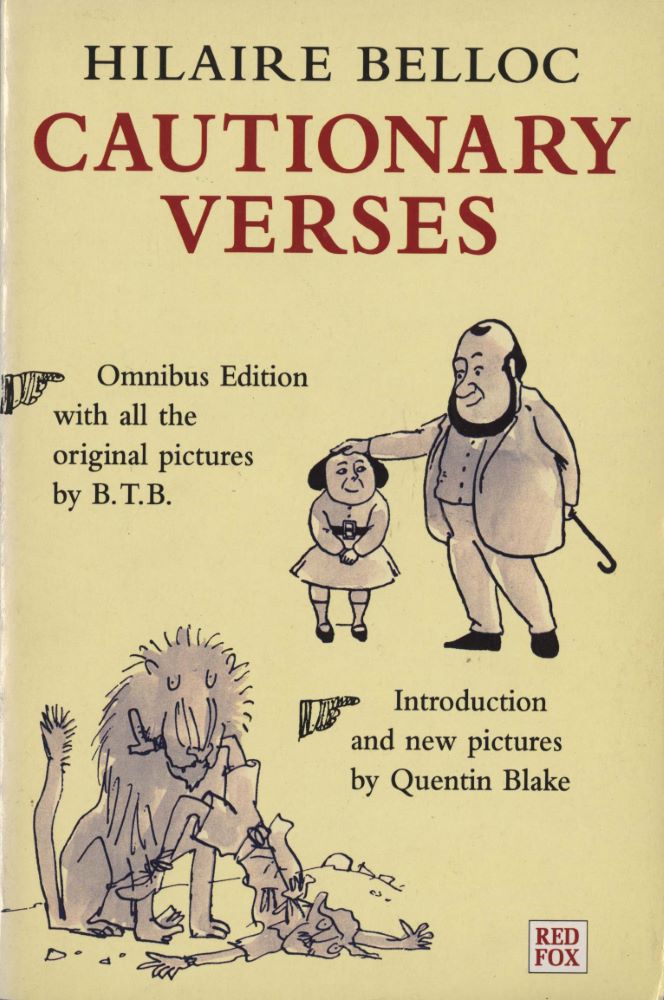
Christian the Lion stopped being a lovable cub and got rather too big to go out safely without the risk of his taking a leaf out of Hilaire Belloc’s book. 

I am sure you will remember Hilaire Belloc’s ‘Cautionary Tale’ of Jim, who ran away from his nurse and was eaten by a lion. Shall I read it to you?

There was a Boy whose name was Jim; 

His Friends were very good to him. 

They gave him Tea, and Cakes, and Jam, 

And slices of delicious Ham, 

And Chocolate with pink inside, 

And little Tricycles to ride,

And read him Stories through and through, 

And even took him to the Zoo- 

But there it was the dreadful Fate 

Befell him, which I now relate.

You know – at least you ought to know, 

For I have often told you so- 

That Children never are allowed

To leave their Nurses in a Crowd;

Now this was Jim’s especial Foible, 

He ran away when he was able, 

And on this inauspicious day

He slipped his hand and ran away! 

He hadn’t gone a yard when – Bang! 

With open Jaws, a Lion sprang, 

And hungrily began to eat

The Boy: beginning at his feet.

Now just imagine how it feels 

When first your toes and then your heels, 

And then by gradual degrees, 

Your shins and ankles, calves and knees, 

Are slowly eaten, bit by bit.

No wonder Jim detested it!

No wonder that he shouted “HI!‟

The honest keeper heard his cry, 

Though very fat he almost ran

To help the little gentleman. 

“Ponto!” he ordered as he came

(For Ponto was the Lion’s name), 

“Ponto!” he cried, with angry Frown. 

“Let go, Sir! Down, Sir! Put it down!”

The Lion made a sudden Stop, 

He let the Dainty Morsel drop, 

And slunk reluctant to his cage, 

Snarling with Disappointed Rage. 

But when he bent him over Jim 

The Honest Keeper’s eyes were dim. 

The Lion having reached his head, 

The Miserable Boy was dead.

When Nurse informed his parents, they 

Were more Concerned than I can say:- 

His Mother, as she dried her eyes, 

Said, “Well- it gives me no surprise, 

He would not do as he was told!” 

His Father, who was self- controlled, 

Bade all the children round 

attend To James’ miserable end, 

And always keep a hold of Nurse 

For fear of finding something worse.

Hilaire Belloc (1907) Cautionary Tales, 

included in Cautionary Verses, Omnibus Edition, (1993) London, Jonathan Cape

Thinking of Daniel’s escape from the den of lions, the story  of Jim is a very good illustration of the fact that lions are not nice pussy cats; although in distinct contrast the story about Christian the lion does have a happy ending – perhaps I should issue a spoiler alert at this point. 

The two chaps gave Christian to Joy Adamson of ‘Born Free’ fame for her to introduce the lion to the wild in Africa. A couple of years later they went to Kenya, and perhaps showing that touching faith in leonine good nature, which they had originally exhibited when they adopted Christian, they went for a walk in the bush in the hope of seeing lions, and, incredibly, a large male lion did appear, and he came bounding towards them. I think any normal people would have turned tail and fled; but not these two. They stood there, and this mighty king of the jungle leaped up and put his paws around their necks, licking them and embracing them. He was Christian, he remembered them, and he loved them.

Well, in the middle of all these nice lion stories, we mustn’t forget where we came in, which is, after all, one of the nicest lion stories, the one about Daniel in the den of lions. King Darius is tricked by jealous courtiers into having to condemn Daniel to what was normally a bloody fate, by being locked up in a den of lions overnight. 

The great king Darius was terribly distressed. Should he uphold the law which he had made, his interdict, or should he spare Daniel who had become his most trusted administrator? And he decided he had to uphold the rule of law, the immutable law of the Medes and the Persians. 

Poor Daniel had to be condemned. It was pretty ironic that Daniel had been condemned for worshipping the one true God, but the king figured that the only way Daniel could be saved was by praying to that same God, and indeed so he was, protected by an angel from being eaten by the lions.

But why do we remember Daniel at Easter? I think because, here again, after shutting somebody up in a place of death they rolled away the stone blocking the entrance and the dead man came out alive. 

What about Jesus’ empty tomb? What happened to Daniel was nothing like as mysterious. Certainly if all you have to go on is Saint Mark’s gospel and this original so-called short ending, what happened is that the three ladies, the two Marys and Salome, found that the stone sealing the tomb had been rolled away and a young man in white was  sitting inside, who told them that Jesus had been raised and that he was not there. 

The young man was presumably an angel too; he had been promoted from lion-taming duties by this time, and he told the ladies to go and tell the disciples and Peter that Jesus was going ahead of them to Galilee where they would see him. And they fled in terror, and in fact told no one. The last words were, “…and they said nothing to anyone; for they were afraid”. 

The original Greek words have intrigued scholars ever since. Literally it does not say, “for they were afraid”. It says, “they were afraid, for…” Or “they were afraid, because…”. It looks as though something is missing; but is that something all the material that’s in the other gospels, for instance about the two men in white and Mary hearing a familiar voice, thinking it was the gardener and and then recognising her teacher, and so on? Perhaps not. Then Mark would have made a gospel which really spoke to people like us, people who haven’t experienced the miracle of resurrection with their own eyes. 

It is generally accepted that Mark is the earliest gospel, so this is the one which most closely reflects what the earliest Christians said about what happened on Easter morning. There is a lot more to come, when we do look at the other gospel accounts, in the weeks to come. 

But I expect you’re not really sitting down and reading great tomes about it just now. One week on from a really happy Easter Sunday, as we come back to church today, it has still got a gently vague, happy buzz to it. 

The Lord is risen; he is risen indeed! We’ve just sung ‘Jerusalem the Golden’, but perhaps in this Easter season we will also sing ‘Ye Choirs of new Jerusalem’, which has this splendid verse: 

How Judah’s Lion burst his chains,

and crushed the serpent’s head;

and brought with him, from death’s domains,

the long-imprisoned dead.

The lion. The Lion of Judah. We haven’t even mentioned C.S. Lewis, and Aslan, the lion who stands for Jesus in The Lion, the Witch and the Wardrobe. The Lord is risen. He is risen indeed. 

Sermon for Evensong on the third Sunday of Lent, 12 March 2023, at Saint Peter’s, Old Cogan

https://bible.oremus.org/?ql=545542568‘

Put on the whole armour of God…; the breastplate of righteousness…; the shield of faith…; the helmet of salvation, and the sword of the Spirit.’

My favourite toy shop – yes, my favourite toy shop – isn’t Hamleys in Regent Street but it’s in Zürich and in a number of other places in Switzerland under the name Franz Carl Weber. It’s a very old shop; it’s been going since 1881. It is a truly wonderful toy shop. 

The top floor is very well stocked with model railways at one end and dolls at the other end, so there is no sexist hierarchy. Then on the floors going down, are pedal cars and bikes, dressing up clothes, board games and construction toys: there is Lego and Playmobil but, alas, no more Meccano. There’s absolutely everything for kids in there and indeed there is quite a lot for their grandpas to enjoy as well. 

But there is one small category of stuff that Franz Carl Weber does not stock. I wonder if you can imagine what it is. Well, the answer is that Franz Carl Weber, the best toy shop in the world, I think, does not stock anything to do with war or weapons. There isn’t even a spud gun to be had in there. No toy soldiers; no World of Warfare games, no Airfix kits of warplanes; nothing to do with war or weapons. 

I’ll come back to the toy shop without any toy soldiers in a minute. But I just want to look at something else we haven’t got at the moment, which is any hymns today. Sometimes that’s quite a good thing; because it’s rather like listening to the radio – you know, ‘the pictures are much better on the radio’ than on the TV – because they are in your head. That goes for other things that you can hear in your mind’s ear, if I can put it that way. So what would be our hymn?  I would suggest the one that immediately springs to mind is a great one of Charles Wesley’s, 

Soldiers of Christ arise, 

and put your armour on. 

Strong in the strength which God supplies 

through his eternal Son. 

Stand then in his great might, 

with all his strength endued, 

but take to arm you for the fight 

the panoply of God.

The panoply, the complete kit of weapons, the suit of armour; for this is a hymn based on our reading from Saint Paul’s letter to the Ephesians. And it’s a rousing hymn: that I certainly remember being very popular with us when I was at school.

And in one sense, what’s not to like? Either about our lesson, or about Charles Wesley’s poetic rendering of it? Stand up to evil; be armour-plated in your resistance, use the best weapons you have, to stand up for the good guys. It’s pretty topical, in the context of the Ukraine. There’s lots in the newspapers, on the TV and on the radio, comparing the weapons used by the Russians with those supplied to the Ukrainians by the Western nations. 

There’s something quite celebratory about the respective descriptions of the Russian and western tanks that we and some of the other European nations – and, indeed, the United States – will be sending – in fact I think that we are already sending, for the Ukrainians to use. 

There has been quite a lot of learned discussion about the relative merits of the Western weapons as against the weapons used by the Russian invaders. I am sure that most 15-year-old boys would be able to give you a detailed rundown of the respective specifications of the Russian T90 as against the Challenger 2 or the Leopard 2 tanks, or the Abrams.

You know, I used to rather like playing with toy soldiers and those Britain’s model field guns which shot out a sliver of lead as a shell. My friend John DeVille, when we were eight or nine, had the most marvellous model 18 inch ‘naval howitzer’ which reproduced all the main things that a real field gun did. You could lay the barrel at the right elevation and tracking; the shells were little masterpieces of brass with a spring inside them and the lead projectile which you put in the breach and then fired, then ejecting the casing. The whole thing was about eight or 9 inches long and it went with our toy soldiers, which were predominantly lead or die-cast, painted in enamel and colourful in their fine uniforms. 

But there was a problem. The problem was, what to do if there was a battle. Then you would actually shoot your wonderful naval howitzer or model 25-pounder at the army which you had lined up against them. But I didn’t want to break any of my soldiers and I didn’t want to damage the opposition’s half-track truck that I was very proud of. So this was a war without casualties. 

And after a bit it began to dawn on me that there is no such thing, that those beautiful soldiers would get smashed up. Some of them would lose arms and legs – and heads. Some of them would not get up again. 

And I want to suggest to you, in all humility, that St Paul may have been a bit up the pole here, in this famous passage from his letter to the Ephesians. In celebrating weapons of war, even when they are used in a good cause, he is missing what Jesus himself said. ‘Love your enemies. Turn the other cheek.’ 

Oh, but surely, you will say, Saint Paul is being a realist. The way of love is just not practical, and you do need the shield of faith, the helmet of salvation and the sword of the spirit; and indeed you may say that this is exactly in line with the Old Testament as well. 

Look at our lesson from the book of Joshua, where God says to Joshua, 

‘There shall not any man be able to stand before thee all the days of thy life: …Be strong and of a good courage: ..Only be thou strong and very courageous, … that thou mayest prosper whithersoever thou goest.’

And you will remember that this led on, once the Israelites had crossed over the Jordan, to their encounter with the Amalekites where, rather surprisingly, God took them to task for having shown mercy to the people whom they defeated. 

But the thing that perhaps St Paul didn’t really get, but which Franz Carl Weber, when he set up his toy shop in 1881, did understand, is the point about my not wanting any of my toy soldiers to be broken. Mr Weber realised that you can’t have a war without breaking soldiers; that the use of weapons does not bring about victory, but it is, rather, a sign of failure. 

Paul paints a picture which looks like a Roman centurion in his armour, and perhaps, as he was the ‘ambassador in chains’ imprisoned in Rome when he wrote the letter, he might have seen a victorious general coming back from a campaign and being granted what was called a triumph, leading the people whom he had conquered, their kings and generals, in chains through the streets of Rome. His centurions would be in their best uniform.

But war never really leads to triumph. Away from the soldiers marching in their dress uniforms there are the broken ones, maimed and dead on the battlefield. And at this time, when we are now confronting again the feeling that we have to wage war, in order to defend civilisation against the attack of the Russians, we don’t know what victory should really look like. 

And at this time of Lent we have to realise that the conflict that Jesus entered into, in trying to bring about his kingdom of love, ended on the battlefield. Jesus was one of the fallen. 

But the other message of Lent points to the triumph, the real triumph, of Easter. Be of good cheer and I will support you. Do the right thing and I will support you, is God’s message to Joshua. The prophet Isaiah, (or perhaps more correctly the first of the three prophets writing under the name), had a vision of the kingdom in which they would ‘beat their swords into ploughshares, and they would not learn war any more.’ 

Then, on God’s holy mountain, the sword of truth will have more truth than sword; the breastplate of faith, more faith than breastplate, and the helmet of salvation, more salvation than helmet. Let it be so! Let us pray for peace and love in place of war. With that peace and love, we can have the ‘sure and certain hope of the resurrection to eternal life’ which comes at Easter.

A distinguished evangelical whom I know expresses unease if, following the liturgy, he has to invite the faithful to ‘bless the Lord’. It offends his sense of the divine heirarchy: all right to invite the Lord to bless us, but not the other way round. Blessing can only be conferred by the greater upon the lesser. As a humble Reader, I know this to be true. I am not supposed to bless the congregation, but to pray, with them, that we may all be blessed.

But. I think that there is an English usage, albeit perhaps archaic, which swaps subject and object. ‘I’ll learn you!’ is an example. It means, colloquially, ‘I’ll teach you’.

I think that this curious idiom occurs in God-talk as well. In the Common Worship version of the Magnificat, Luke 1:54 is expressed as

He has come to the aid of his servant Israel,
to remember his promise of mercy,…

To’ remember here is problematical. It implies not that He is remembering – not as the NRSV suggests in cross-references to Genesis 8:1 and Psalm 98:3, or indeed as the AV and BCP translate the Greek ‘μνησθηναι ελέους, καθώς ελαλησεν προς τους πατέρας ήμων´, ‘He remembering his mercy …’, but rather that the use of ‘to’ implies that He causes Israel to remember, almost as if he had said, ‘I’ll learn them …’

If I am right in this, then I see nothing to worry my evangelical friend if he has to ‘bless the Lord’. It means, ‘May the Lord bless us’. Of course it is always possible that the sublime language of the BCP and AV is also a better translation than the sometimes stumbling prose of Common Worship or its cousin the NRSV ‘Anglicised Edition’ [sic]. But that is above the pay grade of humble Readers, I am told. May we always count our blessings.

Hugh Bryant

Reader in the Church in Wales

Advent

22nd December 2022

Sermon for Evensong on 20th November 2022 at All Saints, Penarth: Christ the King

1 Samuel 8:4-20: John 18:33-37: Psalm 72. See https://tinyurl.com/ydmp6t26

This Sunday the church celebrates ‘Christ the King’.

Kings. God save the King! King’s Counsel: King Charles III – and now today, in the church, we are celebrating Christ the King. Actually, the church has only had a feast of Christ the King since 1925, when Pope Pius XI first made it a festival in the Roman Catholic Church; and in 1969, Pope Paul VI determined that the right time for the festival would be the last Sunday before Advent, at the end of the church year.

Now, never mind whether you are a Catholic or an Anglican or a Methodist or a Baptist, you will probably be using the same readings from the Bible this weekend for the various services in your church, and thinking about Christ the King. We Anglicans have something else, earlier than the feast of Christ the King, to celebrate at the same time. I’ll come back to it.

You might think that I was going to pick up on what Samuel has said in our Old Testament lesson about the the disadvantages of kings, of absolute monarchy. If you were reading it in the King James version, you would see that Samuel warns the Israelites that if they make somebody a king, among other bad things, he will “take your daughters to be confectionaries”. In the rather more down-to-earth version which we have been using, the confectionaries have become “perfumers”, but either way you wouldn’t want your daughter to become perfumers or confectionaries to the King. That sort of king has a distinct whiff of slavery about him.

Now today, I think if you read some of the newspapers, the ones that have a rather bigger section about the royal family than my beloved Guardian, there are quite often articles which speculate on what in the old days the Queen, and now the King, might be thinking about the various things that the government is getting up to. And perhaps people might start to think that a wise king would be preferable to yet another Prime Minister. But then we remember that we have a constitutional monarchy. For us the King is just a figurehead, even if he is an inspiring one.

But it’s interesting to look back at the argument about the pros and cons of being a king that was going on between Samuel and the elders of Israel. They said, ‘Give us a king to govern us’. And then there is this fascinating sentence, “Samuel prayed to the Lord, and the Lord said to Samuel, ‘Listen to the voice of the people and all that they say to you. For they have not rejected you, but they have rejected me from being king over them.’’’ It’s God speaking – and He says that the people have rejected the idea that He, God, should be their ruler, their king.

The way that they thought about God in those days was that He was much more like a kind of Marvel comic superhero than what we think God is. Having the Lord on your side in those days was a huge advantage, for instance in a battle, and they didn’t seem to be worried about the thought that He might be much bigger than just a superhuman supporting one side against the other. So a king could even be God. God could be a king. It gives a historical background to the idea of the ‘divine right of kings’ – that the first King Charles claimed, for instance.

So it wouldn’t have seemed strange to the Israelites to hear that God had said that they had rejected him, God, from being their king over them. But it’s strange to us. We would think of God as being bigger than any king.

Now when Jesus is being questioned by Pontius Pilate, it’s perhaps a rather different kind of strangeness which we notice. Surely it is pretty strange to ask somebody whether they are a king. I think it’d be pretty hard to miss, certainly in normal circumstances. I mean, I am not assuming that people who were kings went around with crowns on their heads so you’d be able to recognise them as royals, but even so you would have thought that it would have been pretty obvious to Pontius Pilate whether Jesus was a king or not.

Indeed, Jesus does query this. ‘Was that a question that occurred to you or has somebody else suggested it?’ And Pilate, who always seems to me to be a pretty common-sense sort of person, says that he doesn’t really get it. He says, ‘Your own nation, the Jews and chief priests, have handed you over to me. It looks a bit of an unlikely thing to do to a king. So what have you done?’

Jesus replies that he’s not a temporal ruler, a ruler in this world, a political figure, in which case he says he would certainly have been able to call upon his followers to fight off the Jews, and keep him from being handed over to them. In the normal course of things if he was at risk of being seized by the Jews in some ignominious way, it wouldn’t sit very easily with the idea that he was, or might have been, the king of the Jews.

So you’ve got two angles on being a king. One in the Old Testament, and the other one from the time of Christ; but in neither case does the idea of what it was to be a king at that time really square with what we understand about kings.

In the Old Testament, a king could also be a God, or even God himself. Bear in mind that the Jews were unique in worshipping just one God, whereas most of the others, like the Egyptians or the Babylonians, worshipped lots of different gods. The Jews worshipped Yahweh as their God, just the one God.

We have learned that when a new king was consecrated in Egypt or Babylon, the priest would declare an oracle from one of the national gods over the new king, and what he would say was, ‘You are my son, I am your father.’ That’s the god speaking through the priest. So in Babylon and Egypt, they believed that being a king was even being the son of a god.

That is the same formula that the prophet Nathan used when he consecrated David as the king of the Jews. If you look at 2 Samuel 7:14, through the prophet Nathan, God says about King David, ‘I will be a father to him and he shall be a son to me’. So King David is expressed to be a son of God.

So that’s the background to what on the face of things is rather an odd conversation between Pontius Pilate and Jesus. Pontius Pilate, who is just a normal bloke in this, doesn’t understand that in the Jewish tradition, to be the king means much more than just being an earthly ruler.

In a sense, Pontius Pilate stands for all of us. He saw this remarkable man, who had no crown, no entourage, no motorcade, no trappings of majesty about him – rather the reverse – but nevertheless, he was being accused of holding himself out as being the king of the Jews.

What made it so serious was that to the Jews it would have meant Jesus was holding himself out as being the son of God. Since they didn’t recognise him, they thought that it was blasphemy. Everybody got it wrong. It’s another illustration of the way that Jesus was a king, but a king in an entirely different sense.

Think of the idea of the Servant King in Isaiah 52:13 – 53:12, picked up in St Mark’s gospel 10:45 where Jesus says that ‘the Son of Man did not come to be served, but to serve’, for example, and what Jesus said about the first becoming the last and the last becoming first (Matt. 20:16).

The more I think about this, the more I realise this is like so many other things that we learn about Jesus. In a sense, he was a king, but in other senses he was much more modest. I think we can learn from him on all sorts of levels as a result. God isn’t like superman. He doesn’t necessarily weigh in on one side or another. But equally he is not a normal king. He doesn’t have the trappings of office and he doesn’t rule in the sense that King Charles rules, or even like an actual absolute monarch – as King Zog of Yugoslavia did, perhaps.

Instead Jesus defined his kingship in relation to something he called the truth. ‘Everyone who belongs to the truth listens to my voice’. And Pontius Pilate came up with the sort of thing that you might hear from Piers Morgan: ‘What is truth?’ It’s a good challenge.

That’s all very interesting, you might say. All that stuff about being a king. But at the beginning you did say that the Feast of Christ the King is a celebration. How are we supposed to go about celebrating? You get the answer in the first collect, the first prayer of the day, which Beth will say. It goes, “Stir up, we beseech thee, Lord, the wills of thy faithful people”. So today is not just Christ the King Sunday. It is sometimes called “Stir-up Sunday”. This is the day when you are supposed to start mixing the Christmas pudding. That is something to celebrate. I wonder, if you are stirring up a Christmas pudding, if it makes you what Samuel called a ‘confectionary’. Why not be a confectionary? A confectionary for King Jesus, indeed. Keep stirring!