Archives for posts with tag: Black Lives Matter

Sermon for Morning Prayer on the Feast of Matthew, Apostle and Evangelist, 21st September 2025, at St Dochdwy’s Church, Llandough, and St Augustine’s Church, Penarth

2 Corinthians 4.1-6

1 Therefore, since it is by God’s mercy that we are engaged in this ministry, we do not lose heart. 2 We have renounced the shameful things that one hides; we refuse to practise cunning or to falsify God’s word; but by the open statement of the truth we commend ourselves to the conscience of everyone in the sight of God. 3 And even if our gospel is veiled, it is veiled to those who are perishing. 4 In their case the god of this world has blinded the minds of the unbelievers, to keep them from seeing the light of the gospel of the glory of Christ, who is the image of God. 5 For we do not proclaim ourselves; we proclaim Jesus Christ as Lord and ourselves as your slaves for Jesus’ sake. 6 For it is the God who said, ‘Let light shine out of darkness’, who has shone in our hearts to give the light of the knowledge of the glory of God in the face of Jesus Christ.

Matthew 9.9-13

9 As Jesus was walking along, he saw a man called Matthew sitting at the tax booth; and he said to him, ‘Follow me.’ And he got up and followed him.

10 And as he sat at dinner in the house, many tax-collectors and sinners came and were sitting with him and his disciples. 11 When the Pharisees saw this, they said to his disciples, ‘Why does your teacher eat with tax-collectors and sinners?’ 12 But when he heard this, he said, ‘Those who are well have no need of a physician, but those who are sick. 13 Go and learn what this means, “I desire mercy, not sacrifice.” For I have come to call not the righteous but sinners.’

Last Saturday I was in London at Southwark Cathedral. Actually it wasn’t just because I wanted to make friends with their relatively new but already fairly famous cathedral cat, Hodge – named after Samuel Johnson’s cat. Hodge arrived after their definitely famous Doorkins Magnificat died in September 2020. Doorkins got a beautiful funeral at the Cathedral, which you can still see on YouTube [https://youtu.be/sdCtdqmdgtI?si=o6h6htHMFt6xoTn5], led by the previous Dean, Andrew Nunn. 

Incidentally I am on another catty mission, which perhaps some of you could help me with, maybe even come with me, to our own cathedral in Llandaff, where I would like to meet the new cathedral cat there, called Frank. Frank is a black cat and so is Hodge. Anyway, I was delighted to meet Hodge during the day I was in the Cathedral. 

But really, the reason why I was there – with your support, because very generously our Ministry Area paid the registration fee – was to attend the ‘Festival of Preaching’ which was held that day, organised by the Church Times, with the help of the current Dean of Southwark, Mark Oakley, and the vicar of St Martin in the Fields, Sam Wells, both of whom I’m sure you will have come across on ‘Thought for the Day’ on Radio 4 if nowhere else. 

The theme of the day was ‘preaching truth to power’. The keynote speaker, who also led Holy Communion and preached, was the Bishop of Washington DC, Mariann Edgar Budde. 

You will remember, I am sure, that she is the bishop whom President Trump criticised for being ‘nasty’ when she used her sermon at the National Cathedral, in a service for the presidential inauguration, to implore Donald Trump to “have mercy upon” immigrants and LGBTQ+ individuals. 

I’ll read you what was in the Guardian, 22 Jan 2025, under the splendid headline,‘Trump criticises ‘nasty’ bishop ….’. The Guardian’s Anna Betts wrote:

‘[S]he made headlines for urging Trump during her sermon to show mercy to “gay, lesbian and transgender children” from all political backgrounds, some of whom, she said, “fear for their lives”.

‘She also used her sermon to ask that Trump grant mercy to families fearing deportation and to help those fleeing war and persecution.

‘She emphasised the contributions of immigrants, telling the president: “The vast majority of immigrants are not criminals,” adding that they were “good neighbours” and “faithful members of our churches, mosques and synagogues, gurdwara and temples”.

“Our God teaches us that we are to be merciful to the stranger, for we were once strangers in this land,” she said. [Exodus 22:21, et al.]

This is not the first time that [Bishop Mariann] has called out and clashed with Trump.

During Trump’s first term, [Bishop Mariann] published an opinion piece in the New York Times. In the June 2020 article, she expressed outrage over Trump’s appearance in front of St John’s Episcopal church in Washington DC, when he held up a Bible for a photo after federal officers used force to clear a crowd of peaceful protesters demonstrating against the death of George Floyd.

[Bishop Mariann] wrote that Trump had “used sacred symbols to cloak himself in the mantle of spiritual authority, while espousing positions antithetical to the Bible that he held in his hands”.’

Nasty bishop indeed! I remember watching on TV as Bishop Mariann preached at the inauguration service and being very stirred by how she had indeed spoken truth to power. It’s a challenge that has faced Christians ever since the earliest days when Jesus was with his disciples. Today we celebrate his calling one of them, Matthew, but the story comes with an important challenge to Jesus, about the people he associated with.

‘Sitting down at meat with publicans and sinners’, if you’re old enough to remember how the old Bible used to put it. Because I was brought up a Methodist, I assumed that this was theological authority for taking the pledge, that anything to do with pubs and their landlords – publicans – was reprehensible, and Jesus was being challenged for associating with pub landlords, I thought. Disappointingly, our modern translation says they’re not pub landlords but tax gatherers; still bad guys but possibly less reprehensible. After all, you might be able to avoid going to the pub, but not the taxman. Death and taxes, you know.

Jesus emphasised the need to engage with these unsavoury citizens and not just people who were on his side. He was there for people who had not seen the light. That’s what Paul is on about as well. In a hostile environment ‘we do not lose heart’, he says. ‘…by the open statement of the truth we commend ourselves to the conscience of everyone in the sight of God. … even if … the god of this world has blinded the minds of the unbelievers, to keep them from seeing the light of the gospel of the glory of Christ’. 

Nasty people doing nasty things and wrongly accusing good Christians of being nasty. How do we manage this conflict? How do we speak truth in the face of powerful opposition?

Coincidentally, while I was in Southwark Cathedral, not far away a huge demonstration was going on, led by the man who calls himself Tommy Robinson, addressed by Elon Musk by video link on giant screens telling people to be ready to fight; wrapping themselves in Union Jacks and blaming anybody who did not look like them – they were all white – for anything that wasn’t going well in their lives, and shouting that the country was going to rack and ruin. 

They didn’t want immigrants, they didn’t want black people, and it would seem they weren’t very keen on the law, because unfortunately there was considerable violence against the police. I came across numbers of them at London Bridge station on my way home. They were scary. They were nasty too. I could see black people on the platform looking nervous. Fortunately there were policemen around and no trouble actually ensued, but the whole atmosphere was menacing. Theirs was another kind of power. How would you speak to people like this, to them, to the power of the mob? 

Really it was a world away from the civilised discourse at the front of the nave of Southwark Cathedral which I had just come from. Hanging from the ceiling of the Cathedral was a huge installation of paper doves, each one inscribed with a prayer for peace. The only noise, when it came, was the music of the hymns that we sang and the anthems sung by the choir. 

Elon Musk’s participation in the fascist demonstration, by video link, demonstrated how that malign power of the extreme Right had crossed the Atlantic. It was somehow fitting that we had another American to show us how she had, with God’s help, stood up against it. No prizes for knowing which was the nasty American last Saturday.

I have no easy solutions to lay in front of you, but one message which came loud and clear was that it is very important that we should not just shut ourselves in our churches with our heads in our bibles, however faithfully, and not realise the need to engage, the need to preach truth to power.

There is such a lot going on in the world today which would not have gladdened the heart of Jesus. Our voices in the churches, speaking truth to power, need to be heard. We are specially praying today for the situation in the Middle East, for the release of hostages, for the cessation of violence, for the provision of enough food and water and the reconstruction of houses. 

There is going to be a vigil of witness led by ++Cherry at the Senedd on Wednesday at 12.30. If anyone else would like to go, I will be going along with Jimmy and Susannah, and would be very happy to give lifts if anyone needs one. We are planning a vigil for peace in this Ministry Area also, on 5th October in the evening, at  All Saints.

Jesus first, then his disciples, and then his ‘meta-disciple’, Saint Paul, his second-order disciple, the great theologian, all knew the importance of preaching truth to power. Let us pray that we are given the Lord’s help and encouragement in continuing that important work.  Amen.

Hugh Bryant
‘Rule, Britannia,

Britannia rules the waves,

And Britons never, never, never

Shall be slaves.’

The fuss about not having the words to ‘Rule, Britannia’ and “Land of Hope and Glory“ at the Last Night of the Proms this year is not something which should be dismissed as “cringing embarrassment about our history“, as the Prime Minister, Boris Johnson, has described it. 

This is not something which only bleeding-heart liberals, so-called, have raked up; it is, though, a surprise. These quasi-national anthems, thumpingly delivered to 6,000 people in the Royal Albert Hall, are deeply embedded in our culture. It feels a bit unnatural to be parsing them in detail to see what they actually mean. 

They are surely, it will be said, just harmless noise, collectively joined in by everybody at occasions like the Last Night of the Proms, where we celebrate our Britishness. Why make a fuss? The problem is that when the Prime Minister talks about our stopping ‘our embarrassment about our history’, we ought to ask, “Who are ‘we’, who are being told not to be embarrassed about ‘our’ history?”

Nesrine Malik, of the Guardian, has written a very cogent article (see https://www.theguardian.com/commentisfree/2020/aug/24/british-hypocrisy-migrants?CMP=Share_iOSApp_Other) about British hypocrisy in the context of questions of race. There is widespread support for the idea behind Black Lives Matter; and I think that most British people are appalled at what has come out about the WINDRUSH scandal; but, as Nesrine Malik has pointed out, very few people seem to make the connection between Black Lives Matter, racial profiling by the police, the ‘hostile environment’ so-called (euphemistically retitled the ‘compliant’ environment) pursued by the Home Office in relation to immigration, and the fact that there is a huge majority in parliament for the party which is responsible for these reprehensible policies. This has done nothing to improve the lot of black people, and indeed the situation is arguably worse now. 

So who are “we”, for whom Boris Johnson thinks “… it’s time we stopped our cringing embarrassment about our history”? And who are the ‘Britons’ who ‘never … shall be slaves’? I’ve been to the Last Night of the Proms. There were very few black people there. To the extent that a cultural tradition is being celebrated it is not the cultural tradition of everyone in the UK. The ‘we’ that Boris Johnson refers to are not black Britons. To “rule the waves” (something which modern maritime law, for reasons of safety at sea, makes very difficult in the English Channel, for example), is an expression which can only make sense in the context of empire. 

But why on earth should one nation have any right to rule over any others? This is a completely outdated concept, susceptible to the usual zero-sum analysis: forasmuch as it is good to rule, it is correspondingly worse to be ruled – and in this country today we have representatives who have experienced both. 

Only one side could worry about having any ‘cringing embarrassment’ about their history. For the other side, their history is all about the indignities of being ruled. 

By all means let us learn about it, not in unthinking celebration, but in the same way that Germans are encouraged to ensure that they do not forget the history of the Holocaust. By the same token, we should not forget what we did to our colonial subjects in the past. 

You see, it’s absolutely vital to identify your point of view. 

If you are a white Anglo-Saxon you have a view of history which is entirely different from what a black person of African or Indian or West Indian heritage will have. Neither white nor black is inherently more worthy.

So if people come forward to say that it is wrong to suppress ‘wholesome songs which draw the nation together’, such as ‘Land of Hope and Glory’ and ‘Rule, Britannia’, this should be challenged. They do not draw all the nation together, but only some of it, the white Anglo-Saxon bit. The others, a substantial minority, are not drawn together so much as repelled and made to feel alien in their own country.

I freely admit that, because I am an elderly white Anglo-Saxon, it hadn’t occurred to me that there was a bad side to ‘Rule Britannia’ and ‘Land of Hope and Glory’. But (apart from the fact that they are hopelessly corny, and ‘Land of Hope and Glory’ is horribly pompous) they are bad; in the light of our raised consciousness now, perhaps as a result of Black Lives Matter, we know better. Just as racist football chants have been outlawed on the terraces, middle-class colonialist racist and nationalist anthems equally should be put aside. 

Surely there is a challenge for the Poet Laureate or another poet – Roger McGough, say – to bring out some new words to the old tunes. What would a modern ‘Rule Britannia’ celebrate? Surely not world domination. 

Instead, a national anthem (or its surrogate) should surely be celebrating our friendship with other nations and our reliability as trading partners; our upholding the rule of law, both internally and internationally; and our charitable outlook, welcoming refugees. Now where is John Betjeman, when we need him most?

Hugh Bryant

Luke 1:46-55 – The Magnificat – see http://bible.oremus.org/?ql=464171095

‘And Mary said, ‘My soul doth magnify the Lord’. Really? Is that really what Mary, the mother of Jesus, said? Now what Mary is reported by Luke as saying, saying to the other rather unlikely mother, Elisabeth, the wife of Zechariah, was, of course, not transcribed from a dictaphone recording. Dr Luke was writing it up, 40 or 50 years later. These are the words that Luke felt that Mary would most likely have said, after the angel Gabriel had visited her and told her that she would have a baby who would be the Son of God. Picture the scene. ‘Hello Mary! I’m an angel. Call me Gabriel. You’re going to have a baby. He is going to be the Son of God.’ Y’know. As you do.

As you do? No – you don’t. It’s not a normal thing. What would you have said, if you were in Mary’s place? Some of Mary’s words are, indeed, what you’d expect her to have said: but other bits are more hypothetical, more speculative; they come more from St Luke, from Luke reflecting on the true meaning of the earth-shattering event which Mary was about to undergo. On the one hand, there is nothing too far-fetched about having Mary say, ‘My spirit rejoices’ because ‘.. he has looked with favour on the lowliness of his servant’. She’s saying, God has chosen me, an ordinary girl, to do the second most important thing for the world after its original creation. That is the sort of thing you’d have expected Mary to have said.

But what about this other bit: ‘… he has scattered the proud in the imagination of their hearts’, or ‘He has brought down the powerful from their thrones, and lifted up the lowly;

he has filled the hungry with good things, and sent the rich away empty’? Is that really something that Mary would have said? Because those are really quite revolutionary ideas. Let’s think a bit about them.

When Mary was visited by the angel Gabriel, so far as we know, the rich were still comfortably situated; the Emperor, the Roman emperor, still had his clothes – and his mighty armies. The lowly were still poor and lowly. The hungry were still hungry. God hadn’t actually done any of the things which Mary was supposed to be celebrating.

St Luke was putting words into Mary’s mouth, thinking what Gabriel’s visit to Mary really meant. It meant that God wanted to upset the established order. Luke knew what Jesus was going to do, what the true values would be, in the Kingdom of God. No more inequality; no more rich people getting more in one day than whole countries’ worth of what ordinary people could earn in their lifetimes.

You know that Jeff Bezos, the boss of Amazon, is said to have ‘earned’ – well, earned; perhaps a better word would be ‘come by’, or ‘trousered’, or ‘blagged’ – $14billion in one day, recently. And, incidentally, he tried to reduce the salaries of his employees on the same day. What a hero. Now God, according to Mary in the Magnificat, would definitely ‘send the rich away empty’. That means Mr Bezos. Amazon Prime to Amazon Zero. God will send the rich away empty.

Mary’s words, Mary’s rant, even, is a vision of the Kingdom of God. What do we think about that? Do we just hope, and pray, that things will eventually, miraculously, become fairer, and no-one will want for anything? Because if so, after 2,000 years, we’re still waiting. Or do we believe that God needs people, people to be His hands and feet, to be his eyes and ears?

If that’s how it’s supposed to work, then what the the Kingdom needs is activists. It needs people who are prepared to work really hard to change things for the better. Maybe their activism will even verge on being revolutionary. Activists. So who are these activists? Are there any activists about today?

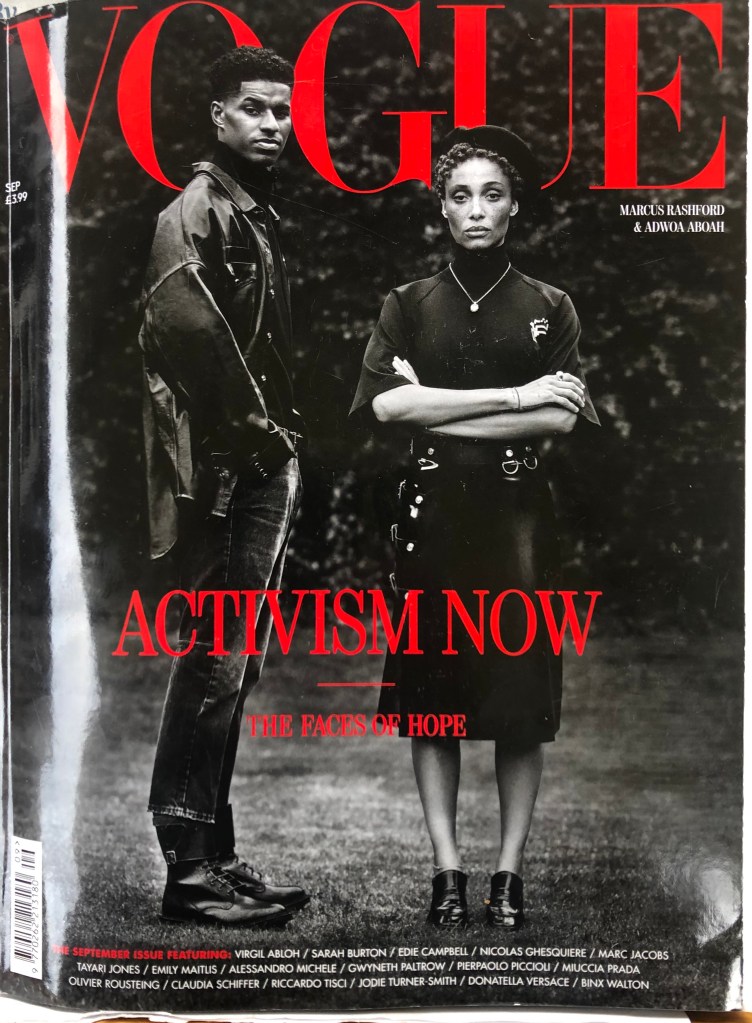
I found some the other day, in what might seem to be a rather unlikely place. They were in ‘Vogue’ magazine. Yes really, ‘Vogue’. I’m hoping we can show the cover of the latest edition on our screen. There it is.

There on the front cover with the supermodel Adwoa Aboah, is Marcus Rashford, the Manchester United footballer, who made a fuss and persuaded the government to provide school meals for poor children during the holidays; and inside there are many more people who are called the ‘faces of hope’, working in many ways as activists to bring hope where previously there was none.

I assure you that I’m not a secret employee of the publishers Condé Nast. I’m not on commission based on how many copies of Vogue you buy. But it is worth a look. There are many inspiring stories – and, reflecting the rise of Black Lives Matter, for once the stars in this glossiest magazine are all black. Beautiful black people.

Hmm. In the Song of Songs the bride sings – as you can hear in Monteverdi’s Vespers of 1610 – ‘Nigra sum, sed formosa’, ‘I am black, but beautiful’. ‘But’ beautiful. That’s the only false note in that beautiful song. Not ‘but’ beautiful, but ‘and’ beautiful is what it should be. And the editor of ‘Vogue’ has celebrated that. He is Edward Enninful, and he is an activist.

What else about these activists? A common feature of all their stories is that they all say their activism builds a sense of community, or having values and friendship in common with each other. So would the Blessed Virgin Mary count as an activist today?

I’m sure she would – maybe in a similar way to some of the beautiful people portrayed in ‘Vogue’, as icons to be followed, to be copied. Faces of hope.

Because what else does this make you think about? Surely we can loop back from our world today to the first century AD. The stories of the activists in Vogue are very reminiscent of the stories of the early Christians. They were activists; they were a community; they had everything in common. They would lift up the lowly and fill the hungry with good things. Build up your community – support your local food bank, say – isn’t that just another way of saying, ‘Love your neighbour’?

That might prompt you to think again about Mary’s song, Mary’s rant, the Magnificat, as it’s called. Because ‘magnificat’ is Latin for ‘bigged up’, ‘magnified’, ‘made more of’; as the hymn puts it: ‘Tell out, my soul, the greatness of the Lord’. And the Magnificat, sung by a cathedral choir, is one of the highlights in Evensong, that lovely service, that you can hear on Radio 3 twice a week – this afternoon at 3 and then on Wednesday at the same time – or on any day in the Cathedral at 5.30 (in normal times). It’s something you might just let flow over you in its beauty. Well, you mustn’t stop enjoying the Magnificat – but do remember that it is a call to action, to be an activist, for God.

When I first started to train as a Reader (the Diocese likes to call us ‘licensed lay ministers’), the vicar of St Andrew’s Cobham, where I was worshipping, said to me, when he asked me to do my first sermon, that it should be eight minutes long. Eight minutes is still the target, even now. Keep an eye on your watches, but I have to warn you, there may be more. Eight minutes, right?

Jesus said to the first 12 disciples, as he sent them out,

‘Go nowhere among the Gentiles and enter no town of the Samaritans, but go rather to the lost sheep of the house of Israel. As you go, proclaim the good news, the kingdom of heaven has come near’. …

‘Cure the sick, raise the dead, cleanse the lepers, cast out demons. You received without payment; give without payment.’ (Matt. 10:5-8)

It’s practical stuff. The kingdom of heaven has come near. It isn’t a message about heaven in the sense of it being at the last judgement, after we die; this is the here and now. The kingdom of heaven is here, and what it implies is not particularly spiritual either. Cure the sick, raise the dead, cleanse the lepers.

Most of that today would equate to being an instruction to become a doctor or a nurse. ‘Curing the sick’ is just that – become a doctor or a nurse; ‘raising the dead’ looks totally miraculous, but today there are cases where people who have been given up for dead are actually revived and brought back to life through the exercise of expert medical knowledge. ‘Cleansing the lepers’. ‘Cleansing’ meant that by curing the leprosy you removed the disfigurement from the faces of people who had been sufferers. Their faces were clean, unblemished, again. And ‘casting out demons’ is what we would understand today as psychiatry.

The Holy Land then was a land under foreign occupation. I think that suggests a way we might understand this rather odd instruction that Jesus gives, about where the disciples should concentrate on going, going to the lost sheep of the house of Israel rather than to the Gentiles or the Samaritans.

That doesn’t sit very well with our understanding of Christianity. Christ was – is – Lord of all. He was God in human form, true God, the Almighty, the creator of all there is, seen and unseen, not just of the Jews.

I think the way to understand what Jesus said, seeming to favour the Jews, is simply that the Jews were the lost sheep because of the fact that they were under the oppressive rule of the Romans. ‘Gentiles’, which means ‘nations’, is a shorthand expression for the Romans, because lots of nations became Roman citizens. So Jesus wanted his disciples at least initially to concentrate on people who needed help, on the oppressed, not on their oppressors.

Oppressed people. I think it’s time to come clean, to let you into the secret, what that’s got to do with my trying to preach for eight minutes. Time’s nearly up. Eight minutes. Not yet for this sermon, actually.

It’s how long it took for that policeman to kill George Floyd. ‘I can’t breathe’, he said. And amazingly, other policemen, who were standing around, and even bystanders, who were filming the scene on their phones, just watched and did nothing: they let him die. They let him be killed. Nobody really thought of him as a human being. He was a black man, and as such, he wasn’t counted as being, really, human.

A great movement has sprung up in reaction to this terrible crime, to point out that it is the tip of an iceberg and that black lives matter. It is because Mr Floyd was black that he was treated as subhuman. What would Jesus do? His lost sheep of Israel, I’m pretty sure, would today include plenty of black people.

This part of Surrey isn’t a very racially mixed area. Our congregation today doesn’t seem to have any black faces in it. It ought to have. I can assure you that there are black people around, and the important thing is that they are just like us. They are human beings.

Down the road from Whiteley Village and Saint James’s in Weybridge is St Mary Oatlands, where there is a very wonderful vicar called Folli Olokose. He is a French national, born and brought up in Nigeria. He is a black man. At St Andrew’s in Cobham there is a deacon, shortly to become a curate, Dr Moni Babatunde; born in Nigeria and brought up in Wimbledon, living in Cobham for the last 20 years or so. A black lady. And it’s not just black vicars. There are many other black families living around us.

In a way, it’s not right to go into the question ‘where they came from’. It ought not to make any difference. The only reason I mention African or Indian or Caribbean heritage is simply to emphasise the fact that they are black people. They are not being treated equally. Dr Babatunde told me that when her son passed his driving test, she took him on one side and quietly gave him some advice on what to do if – when – he is stopped by the police. For eight minutes.

He is a talented young man who has just achieved first class honours in philosophy at Nottingham University and is now doing the law conversion course in order to become a solicitor. But even so his mother has had to warn him how to conduct himself so as not to get arrested. Because he is black.

So there it is. Eight minutes. Time to die. Time to live. Time for the kingdom of heaven to come near. But let’s do something about it.