Archives for posts with tag: Good Shepherd

Sermon for 4th October 2020 – St Michael and All Angels (transferred from 29th September); St Francis of Assisi: Animal Welfare Sunday: on Zoom

Revelation 12:7-12; Luke 15:3-7 (see http://bible.oremus.org/?ql=468720899)
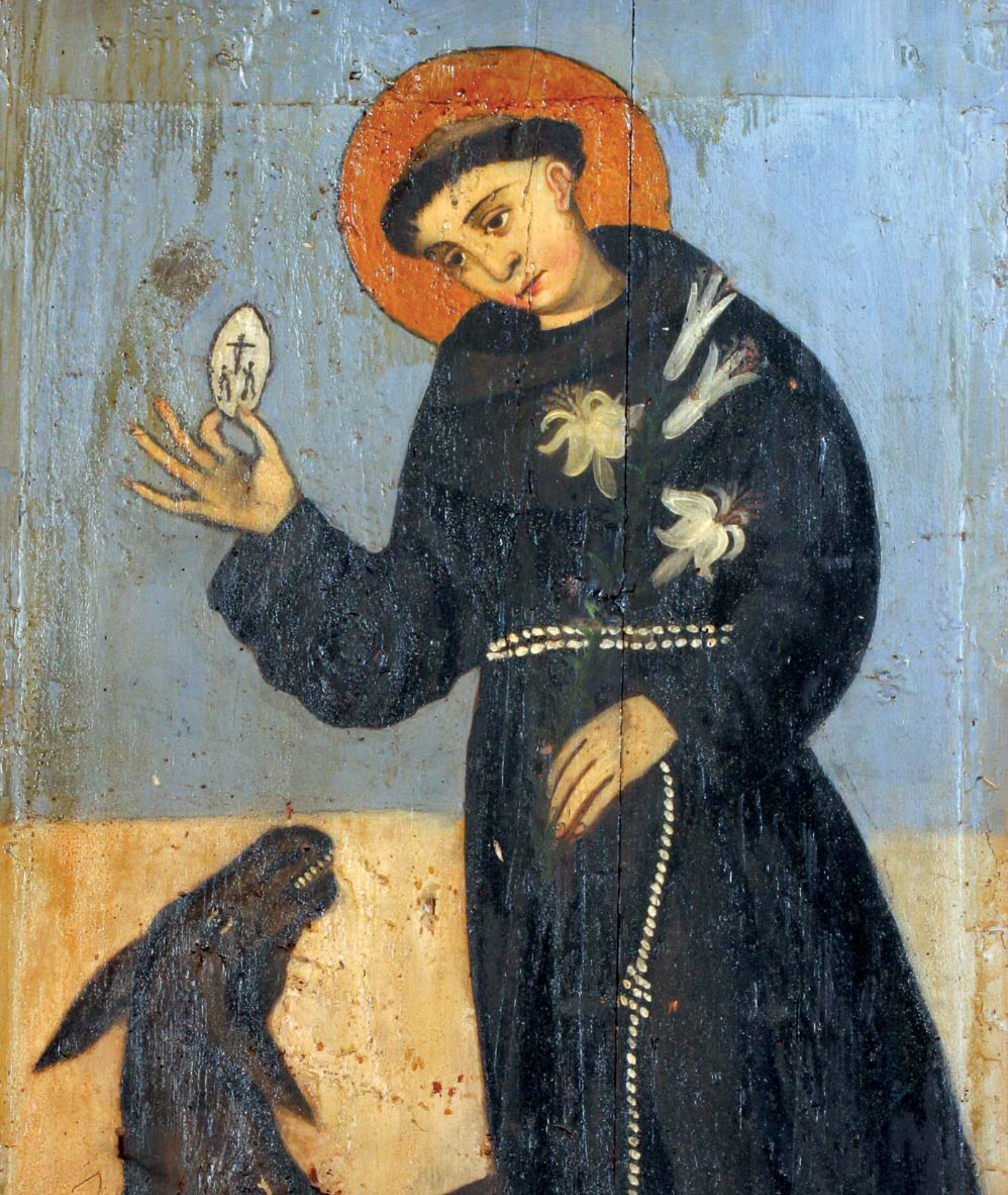
St Francis of Assisi (unknown artist), from https://www.britannica.com/biography/Saint-Francis-of-Assisi/images-videos, accessed 8th October 2020

Today we commemorate St Michael and All Angels, and St Francis and his love for animals. 

Blessings of the animals and pet services are usually great fun, especially for the children – although perhaps a bit less so for their parents, who have to catch the hamsters, cats and other exotic creatures which escape from their baskets during the service. We don’t have that problem, because all our pets are with us at home and they are only appearing and being blessed, like us, on Zoom. But I still think that it is important that our beloved animals, our furry friends, should have the benefit of a blessing at least once a year. In saying Saint Francis’ prayer and in blessing the animals, as we’re going to do, we are giving thanks for all God’s work in creation. 

But what about those angels? I am what is called a liberal theologian, which means (among other things) that I am not wedded to taking everything in the Bible absolutely literally. I think this passage about war breaking out in heaven and the battle between Michael and his angels and the Dragon, known as Satan and the Devil on other occasions, is a good case in point. I dare say if we were in the south of Italy, where they are more used to miracles, we would hear this lesson from the book of Revelation without batting an eyelid. We wouldn’t be too troubled about exactly where heaven was or what the Dragon really represented – or indeed possibly who the Devil was. But we do understand the contrast between good and evil and the way in which frequently, in order to uphold the right and the good, there has to be a battle. 
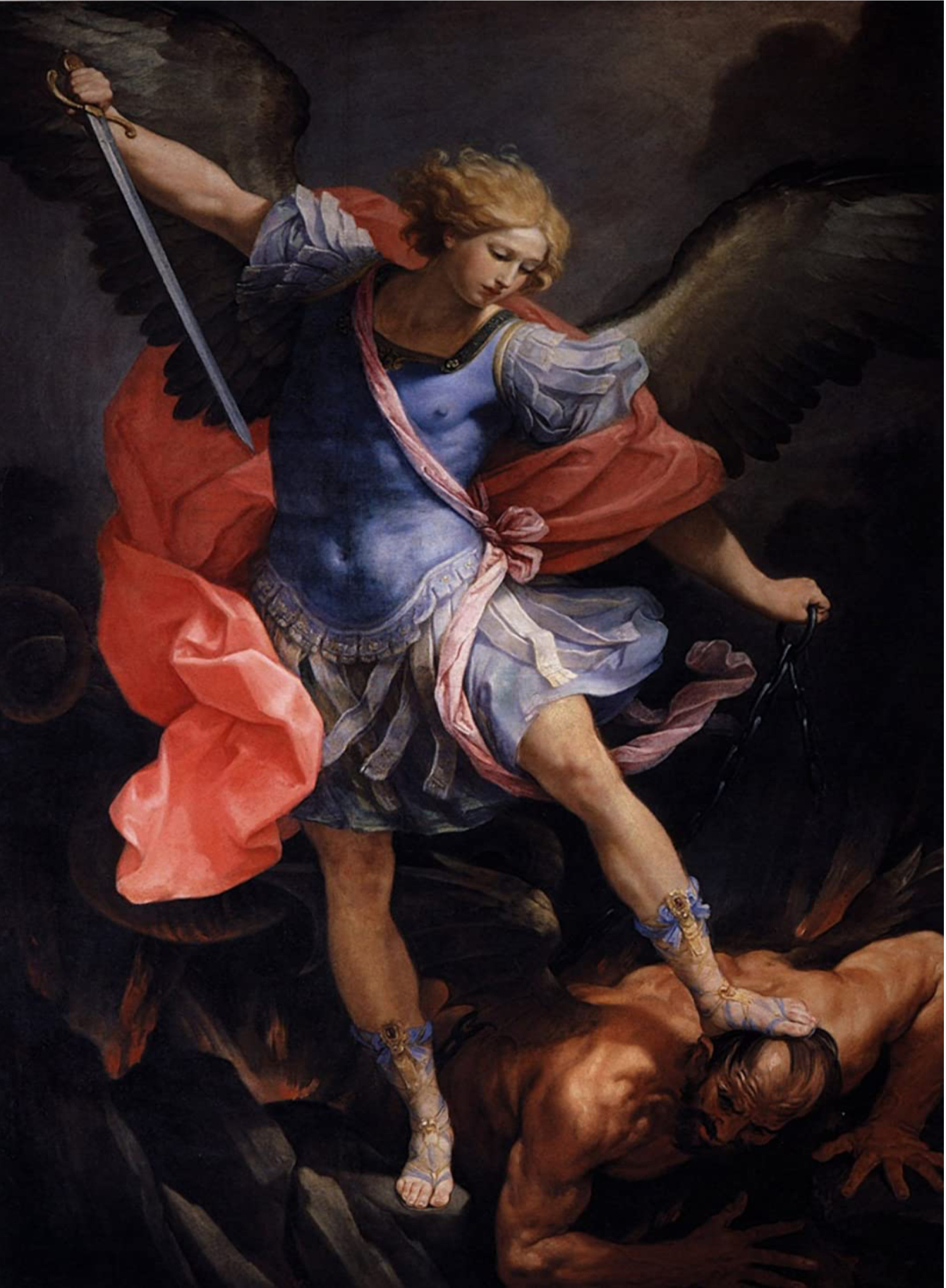
‘Guido Reni’s resplendently theatrical depiction of St Michael, part Roman soldier, part ballet dancer, was painted in 1635 and can be seen in the church of Santa Maria della Consolazione in Rome.’ (Andrew Graham-Dixon at https://www.andrewgrahamdixon.com/archive/itp-238-st-michael-archangel-by-guido-reni.html, accessed 8th October 2020)

We will notice in passing that it is not George who slays the Dragon but Michael, although the stories are a bit similar. Also there is seemingly a second fight. It’s not just Michael. The good angels have conquered the serpent as well, the Dragon, ‘by the blood of the Lamb, by the word of their testimony and by their willingness to die’ for the cause.

So there are perhaps two stories here. One is the story of the war in heaven between Archangel Michael and the great dragon, a.k.a. Lucifer, the devil; and the other, where salvation is achieved and victory over evil by the blood of the lamb. 

In Jewish tradition there is this idea of a scapegoat, which could also be a ‘scape-lamb’; you read in Leviticus chapter 16 how this is supposed to work sacramentally, where all the sins of the people are symbolically loaded on the back of a lamb or a goat which is then cast off into the desert. In a sacramental sense, the scapegoat ‘takes the burden’ of the people’s sins, and dies for those sins. You can say that the lamb died for the sake of the people’s sin. It is very similar to the idea of what Jesus has done, ‘dying for our sins’ on the cross.
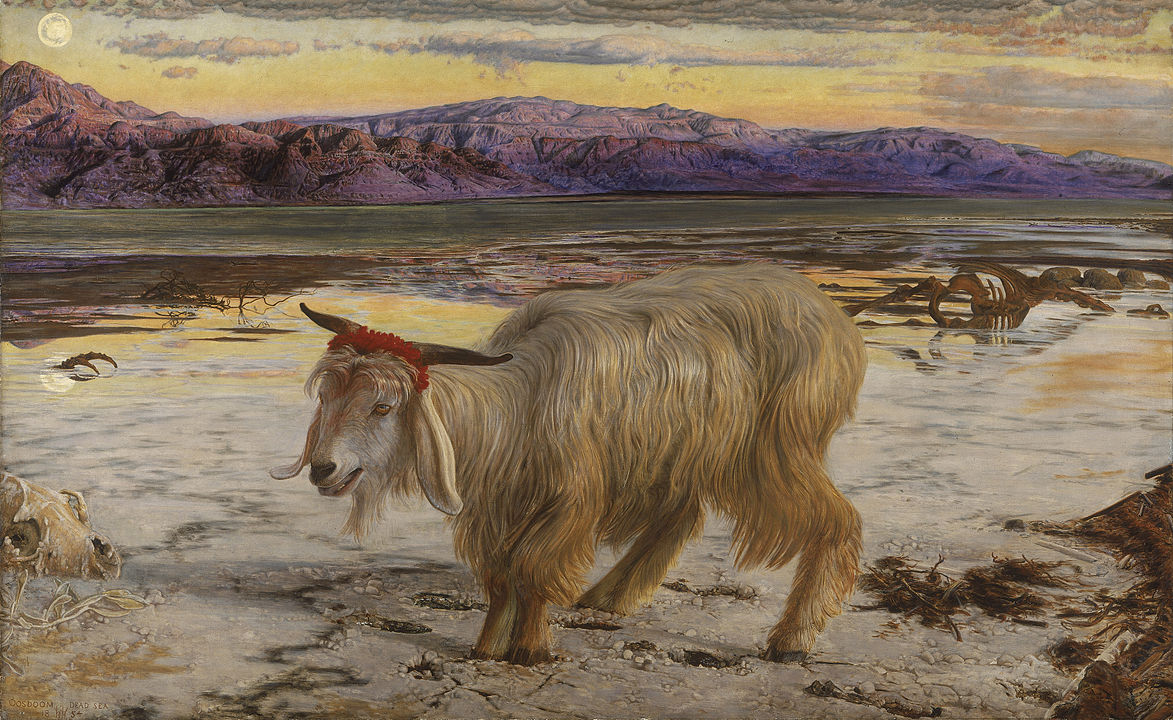
The Scapegoat, by William Holman Hunt (1854-1856) in the Lady Lever Art Gallery, Port Sunlight

Liberal theologians like me have difficulty with the idea that a loving God would have demanded a human sacrifice, but certainly we can follow the development of the idea of the ‘atonement’, as it is called, by Jesus on the cross, by looking at the Jewish tradition of the scapegoat. 

You might think, from this story of the scapegoat, that people at the time of Jesus might not have been very nice to animals. But I don’t think we can necessarily draw that conclusion. There are many instances in the Bible where Jesus appears to love and care for animals. In the sermon on the Mount: ‘Behold the fowls of the air: they sow not, neither do they reap, nor gather into barns; yet your heavenly Father feedeth them’ [Matt.6:26]; and as we can see in the parable of the lost sheep and indeed the other parable of the good Shepherd, Jesus certainly didn’t just think of lambs in the context of sacrifice, but rather as animals to love and care for. 

And this is one of the things which produced Saint Francis of Assisi’s distinctive theology, his famous preaching to the animals and his love for all creation. ‘Brother Sun’ and ‘Brother Moon’, for instance. So on this feast of Saint Francis of Assisi it’s entirely right that we should bless the animals and bring them before the Lord in prayer. In a minute I will ask you to find your pets or pet pictures and put them up for a blessing.

But first, a final thought. This is the last of these Zoom Eucharists and we have become, I think, a proper little congregation. A proper little flock. Soon we will return to the various churches that we came from, as they are able to reopen for worship.

It seems to me that it would be nice to do something, to give some tangible expression to our gathering in the name of the Lord, every Sunday for the last few months. We could, of course, pass the plate round, and we would have to do it virtually using PayPal or something similar. But I think I’ve got a better idea. 

It occurred to me that on the day when we are blessing the animals, we should try to help our various zoos – Regent’s Park,  Whipsnade, Chester and Bristol (where I still hear Johnny Morris in my head) and all the others. They are all having a very hard time. Feeding all the animals at Regent’s Park, at London Zoo, for example, costs £1 million per month. So my suggestion is that, as we give thanks for creation and all the wonderful animals that the Lord has created, we should all consider taking a trip to the nearest zoo to where we are in the next week or two. I think that zoos are eminently safe places to visit even in the Covid epidemic, and the price of admission, if enough people turn up, will help to restore their finances. [Donations – https://tinyurl.com/y2m75jd4, https://www.chesterzoo.org/support-us/, https://bristolzoo.org.uk/save-wildlife/bristol-zoological-society-appeal, or to help a wonderful zoo in Hamburg, https://www.hagenbeck.de/de/_news/tierpark/Unterstuetzung_FAQ.php ]

We shouldn’t forget that the animals themselves will be very pleased to see us, because, as we ourselves have found, being locked down in quarantine with nobody to see is very lonely and no fun. I think that Jesus the Good Shepherd would want you to find out where your nearest zoo is and go and see all the lovely animals in it, very soon. 

Blessing of the Animals

Now we are going to bless all animals. If you have any with you, or any pictures of animals whom you used to have, please do bring them into the picture.

Blessed are you, Lord God, maker of all living creatures. 

You called forth fish in the sea, birds in the air and animals on the land. 

You inspired Saint Francis to call all of them his brothers and sisters. 

We ask you to bless all animals, and those which are or were our pets. 

By the power of your love, enable them to live in peace and harmony. 

May we always praise you for all your beauty in creation. 

Blessed are you, Lord our God, in all your creatures!

A reflection

John 10:1-10 – http://bible.oremus.org/?ql=455280521

One of my friends has started putting pictures of sheep on her Instagram page. Every day she puts up a picture of a different sheep. At first I wondered whether I wasn’t really getting the hang of the Instagram, and that there was a message about the sheep that I wasn’t seeing. Perhaps there were some words somewhere which I was not seeing on my screen. So, after about five different sheep pictures, I asked her, “What’s with all the splendid sheep on your Instagram?” She answered, “I have always loved sheep. I’m fed up with the negative news, so I just set myself a challenge to post at least one sheep each day to remind myself of the Good Shepherd.’ That really says it all. Maybe I should just stop there. Sheep are good animals. They are a Good Thing. But perhaps I should elaborate a little bit.

I have to say that I’m not a country person, so the only times that I have met sheep face-to-face have been at Bockett’s Farm with my children and my grandson, little Jim. Actually, now you come to mention it, when I was little, on holiday in North Wales, I do remember another time: stopping for a picnic on the Horseshoe Pass near Llangollen, when a couple of sheep climbed into Dad’s car and tried to have the picnic that we were having. But they were very nice about it and they didn’t bite anybody; just our sandwiches.

I don’t really know what the ‘sheepfold’ is that our Gospel reading talks about. I thought sheep just roamed about in a field, and every now and again got rounded up by the shepherd and his sheep dog, to be taken off to have their coats shorn and and be put through a sheep dip.

In Jesus’s story, there isn’t a sheepdog. But there is somebody, who is called the ‘door-keeper’ or the ‘gatekeeper’. Where these sheep live, this sheepfold, it sounds a bit like an hotel. Indeed the King James version of the Bible identifies the chap who lets the sheep in and out, this gatekeeper, as the ‘porter’. I’ve got visions of one of those little Paris hotels with a porter at the reception who gives you your key, or of an Oxford college, where again, the man at the door is called the porter. But that’s maybe a bit grand – for a sheep. Maybe they did things differently, in first century Palestine.

Jesus does use sheep quite often in his parables and teaching. Think of the parable of the lost sheep, or the wolf in sheep’s clothing. Or the crowds, that Jesus pities, because they are like ‘sheep without a shepherd’. Immediately after the story which we have as our lesson today, he goes on to talk about being the Good Shepherd.

These references to sheep do give you confidence that God cares for us. Jesus is God, and he is also the good Shepherd; so we can be confident that he will look after us.

Here Jesus says that he is “the gate for the sheep”. Not just the gatekeeper, but the gate itself. Before he came to be the gatekeeper, or the gate, all sorts of people got into the sheepfold, who were not proper shepherds. They may have been just rustlers and thieves.

But when Jesus became the gatekeeper, then he was properly careful about the ones he allowed in. We are reminded about the Great Judgement at the end of time in St Matthew ch 25, the sorting out of the sheep from the goats: remember, you see, the sheep are the good ones. And by the way: just as there aren’t any sheep dogs in these stories, there aren’t any black sheep either; so I don’t have to talk about exceptions that prove the rule.

The straightforward idea is that we are in his Great Congregation – because ‘congregation’ is another sheep-y word. Grex, gregis, in Latin, which is the ‘greg’ bit in the word ‘congregation’, means a herd or a flock. A flock of sheep. We are the great congregation, the great flock. We are the sheep belonging to the Good Shepherd.

And Jesus says, ‘Whoever enters the sheepfold through me will be saved; going out and coming in through me, the sheep will find somewhere good to graze’. …. ‘I am there in order ‘… that you, (the sheep), may have life, and may have it abundantly.’

You can see why lambs are something we often think about at Easter, in the springtime, when they are playing in the fields, when the flowers are coming out; because it is usually a wonderful time of regeneration, a time for having life abundantly.

But it is rather poignant today, when there is so much sadness and worry about the terrible coronavirus epidemic; against that background I think it is especially welcome that we should be able, for a few minutes this morning, to fix our minds on a nice, warm, woolly, sheep. I think Jesus would have approved. That sheep stands for all sorts of good things to come.

Sermon for Evensong on the Sunday of Epiphany, 5th January 2014
John 2:1-11 The Wedding at Cana in Galilee – Christ Reveals his Glory

You might wonder why our lesson just now was about the wedding at Cana in Galilee rather than Jesus’ visit from the Wise Men, given that this Sunday is our celebration of Epiphany; Epiphany, which means showing off, revealing.

This morning indeed the Gospel was the story of the Wise Men: the last of the traditional Christmas stories. It’s the lesson for the twelfth day of Christmas. Our decorations are supposed to be taken down tonight, Twelfth Night. Christmas is over. The season of Epiphany begins.

In the Epiphany season, next week we mark the baptism of Christ, and three weeks after that, the Presentation of Christ in the Temple, Candlemas – when we are going to have a special Evensong here at St Mary’s. In between, in a fortnight, on 19th January, there will be our Christingle service in the morning before Mattins, and – as this is another traditional Epiphany theme – there will be the annual Week of Prayer for Christian Unity service in the evening, at the Methodist chapel, instead of Evensong here.

The candles, the Christingles and at Candlemas, are symbolic of the Epiphany light, the enlightenment, that the coming of God’s kingdom brings. ‘Arise, shine; for your light has come,’ says Isaiah in our first lesson. It is all about showing, showing to the world that Jesus is here.

The wedding at Cana fits in with this. The evangelist says that Jesus turning the water into wine was his first miracle, ‘and he revealed his glory.’ Revealed, manifested. Epiphany.

That’s all very familiar. Emmanuel, God with us. ‘O come, O come, Emmanuel’. But what does it really mean, mean to us today?

Time was, when the idea of light, the idea of enlightening people, was seen differently. In the 17th and 18th centuries, the time of the Enlightenment with a capital E, it was the time of Erasmus and the Humanists. They believed that the world could be completely understood through the use of reason, reasoning and logic. That went for knowledge of God as well: whatever we could know about God, we could know only by the use of our intellect – the same way in which we learned about animals and geology and so on.

It led some theologians and philosophers to look at the findings of scientific enquiry, like Darwin’s work on evolution, and to reach the conclusion that life on earth may have been started by God, but that we could not know much more about this God than that He is an ultimate first cause, a creator from nothing, an unmoved mover.

Reason could take you to a belief in that rather limited god, the divine creator – but not much further. You could not know much about what such a god was like. Most importantly, there seemed to be no evidence that God had done anything more than just starting the process off. No evidence that God had any interest in human life, or in particular, that He cares for us.

That’s quite a contradiction with the things that we say we believe in our worship. Look at the Magnificat:

‘He hath shewed strength with his arm: he hath scattered the proud in the imagination of their hearts.
He hath put down the mighty from their seat: and hath exalted the humble and meek.
He hath filled the hungry with good things: and the rich he hath sent empty away.’

That’s not a description of a laissez-faire god, of an unmoved mover who has, frankly, just moved on: it’s a description of an interventionist God, a God who cares for social justice. God with us. God with us, who does not stand idly by in the face of injustice, in the face of poverty and exploitation.

Somebody like Richard Dawkins might say, the Magnificat is just pretty words. It doesn’t really mean anything. Science can’t lead you to believe in a God, or at least in a God who has any personal interest in us.

At the time of the Enlightenment, in the 18th and early 19th centuries, the answer to the deists, as they were called – to the people who said that God was just the creator, a blind watchmaker, and nothing more – the answer was that our religion is revealed religion. There are things beyond what reason can tell us, things nevertheless revealed to us, revealed to us by God.

One sort of revelation is the sort of thing which we are celebrating today. Turning the water into wine was a demonstration, an epiphany. Did it really happen? It can’t be proved. But one thing you can say is that if it did happen, then it was a complete contradiction of the idea that God has moved on, that He doesn’t care.

If God has manifested Himself, has showed Himself to us, in the person of Jesus, then it can’t be true that He doesn’t care for us. Jesus is the Good Shepherd. He in turn calls on his flock to be good sheep. In the parable of the Good Samaritan, in Jesus’ new commandment, that we love one another, He calls on us to live like people who recognise that they have God in their midst, God with us, Emmanuel.

‘Whoso have this world’s good, and seeth his brother have need, and shutteth up his compassion from him, how dwelleth the love of God in him?’ (1 John 3:17). You’ll remember that from the Communion service. It goes on, ‘My little children, let us not love in word, neither with the tongue; but in deed and truth.’

It was, and still is, a revolutionary message. By turning the water into wine, by manifesting himself in his divine nature, Jesus was challenging the powers that be, both spiritual – the Pharisees and the scribes – and temporal, the Romans. They both had a vested interest in the established order – ‘the rich man in his castle, the poor man at his gate’. To upset it was dangerous. In the story of the Wise Men, Herod ‘was troubled, and all Jerusalem with him,’ when the Wise Men told him of the new king’s birth.

Similarly today. Let’s not be too ‘political’, or upset the status quo, people say. Look at all those respectable people who say they are all right, they have no need to believe: there is nothing missing in their lives. They never say, like the bod in the Alpha Course poster, ‘Is that all there is?’ But they have no proper roots, no real understanding of what is good. Instead, they tend to cling to status and possessions. There is nothing else, for them, nothing else to cling on to.

But a Christian has faith, a Christian has faith that there is more, there is a reality beyond what we can reach simply by the exercise of reason, excellent though that is. Our prayers are answered; we know we are not alone. It is reasonable, it makes sense, after all, for us to read the miracle stories, to open our minds to analogy, to metaphor, and to see God, revealed.

‘He hath shewed strength with his arm: he hath scattered the proud in the imagination of their hearts.
He hath put down the mighty from their seat: and hath exalted the humble and meek.’

The Lord is here: His Spirit is with us – but we mustn’t ignore Him. It must make a difference – we must change. That’s what Epiphany calls us to do.

‘He hath filled the hungry with good things: and the rich he hath sent empty away.’ Now what are we going to do?