Archives for posts with tag: Inclusive Church

See https://bible.oremus.org/?ql=610162457

Rejoice! Let me speak to you in Latin. ‘Laetare Hierusalem et conventum facite omnes qui diligitis eam: gaudete cum laetitia…’ : it means, ‘ … be ye glad for Jerusalem, all ye that delight in her: exult and sing for joy with her,’..

It says on your pew sheet that today is Mothering Sunday. So what is all this Latin stuff – ‘Laetare’ – all about? This is also, and indeed it has been for a lot longer than it has been Mothering Sunday, what is called ‘refreshment’, or Rejoice! Sunday, which is what the Latin word ‘laetare’ means: laetare, ‘rejoice!’

Traditionally, pink vestments can be worn by the priest on Refreshment Sunday, so it’s also known as Rose Sunday. It’s halfway through Lent, and it’s a chance to relax the rigours of fasting. So if you have been denying yourself, today you have no need to lay off the Ferrero Rocher and vino di tavola rosso di Toscana. Today, you can indulge without feeling guilty.

Mothering Sunday is an old mediaeval concept, which fell into disuse, but was revived during the last century by a lady called Constance Adelaide Smith, a vicar’s daughter, who picked up on plans in the USA to introduce Mother’s Day, which came to fruition in the USA in 1914. Miss Smith wrote a booklet called ‘The Revival of Mothering Sunday’ in 1921, and it started to be celebrated again in the UK around that time, on the fourth Sunday in Lent, Refreshment Sunday.

The rather formidable Miss Smith campaigned for Mothering Sunday to be a celebration of a number of various aspects of motherhood: these were ‘Mother Church’ (the church where you were baptised), ‘mothers of earthly homes’, Mary, the mother of Jesus; and Mother Nature. It is a very wide spread of people and places and things, all to be celebrated as being aspects of motherhood, motherhood to rejoice in on Mothering Sunday.

I think it’s fair to say that these days we mainly think of it as a day to celebrate our mothers, ‘mothers of earthly homes’. It’s a nice opportunity to make a fuss of them, for those of us who still have mothers around, or if not, at least to think about and remember our wonderful mothers.

At this point I must say that in the midst of all this happy celebration, for quite a number of people Mothering Sunday or Mother’s Day are not happy times. If you are a mother who has lost a child, or who has not been able to have a child, this is not a time you want to celebrate. We should pause, and take that to the Lord in prayer. If any of you are suffering in that way, I hope you will excuse my carrying on in a way that may not suit the way you feel. You are not forgotten, and you are in our prayers today.

I don’t think that you really need a homily from me on how to be nice to your mother or to be nice about her. But I would just like to take a minute or two to look at a couple of the things that come up in our Bible readings. I’m struck that in two of them the interesting thing is that the compilers of the Lectionary have selected passages, which come just after, in one case, and just before, in the other, verses which are perhaps more familiar to us and more significant than the ones which have been selected.

The first story, from the first book of Samuel, is the story of the birth of Samuel to his mother, Hannah – obviously today, one of the common themes is stories of mothers – and it is a bit like the story of the birth of John the Baptist to his mother, Elisabeth. Neither woman had been blessed with children for a number of years.

Hannah was praying to the Lord for children, and eventually her prayers were answered. In her prayers, she had said she would dedicate any son who was born to the Lord as what was called a Nazarite. This meant that she would give him over to the priests of the Temple to become somebody who was dedicated, set apart, for the Lord in the Temple. He would not be allowed to cut his hair, touch strong drink, and a whole load of other restrictions, which are all set out in the law of Moses in the book of Numbers.

But the bit which you might expect the story to go on to tell us, is what Hannah did to celebrate, because she sang a song. The song that she sang is very similar to another song in the Bible. She sang:

‘My heart rejoices in the Lord. …

Strong men stand in dismay…

Those who faltered put on new strength …

Those who had plenty sell themselves for a crust,

The hungry grow strong again.’

It has strong echoes of Mary’s song, the Magnificat, that everybody will remember from Evensong.

‘My soul doth magnify the Lord,
and my spirit hath rejoiced in God my Saviour.…..

He hath shewed strength with his arm.
He hath scattered the proud in the imagination of their hearts.
He hath put down the mighty from their seat
and hath exalted the humble and meek. ….

He hath filled the hungry with good things.
And the rich he hath sent empty away.’

Clearly, Mary knew her Bible, and she remembered Hannah’s song from the story of the birth of Samuel. And not only that, but in these songs the two mothers-to-be really forecast the way that God wants us to do things. The last shall be first. The humble and meek shall be raised up. The hungry shall be filled up with good things. A really important message. Think what the world would be like if we really followed it.

And then, in our reading from Saint Paul’s letter to the Colossians, ‘..[C]lothe yourselves with compassion, kindness, humility, meekness, and patience..’, all those lovely ideas about how Christians should treat one another. ‘Clothe yourselves with love, which binds everything together in perfect harmony.’

Wonderful words; but the ones, that are not captured by our reading, come just one verse above.

‘There is no question here of Greek and Jew, circumcised and uncircumcised, barbarian, Scythian, slave and freeman; but Christ is all, and is in all.’

No such thing as Jew and Greek. This is the first sign of Christianity bursting out from being just a small denomination within Judaism.

Anybody could become a Christian. Christ was, is, there to become a saviour for anyone. It’s the origin of Inclusive Church, which is a charity that the Ministry Area Committee have decided to register our churches with. Of course, we know that we are inclusive, we welcome everybody: but we will also have signs outside, and we will do lots of practical things, to let everybody know that they can come in, and that they will be welcome.

The Lord is here. His spirit is with us. His spirit is for everybody, whatever they look like, wherever they come from.

I suppose if you go away and do your homework and read the lessons at home, you will come and tackle me to say that, when I was mentioning things that weren’t in the lessons, I should have mentioned not just the bit that comes before our lesson from Colossians. but also the bit after, because it has St Paul’s rather infamous words, “Wives, be subject to your husbands“, and to be fair, “Husbands, love your wives, … children, obey your parents, for that is pleasing to God, and is the Christian way“, and so on. Given that there is nothing really about mothers in the lesson from Colossians that we heard, it is quite important to remember that St Paul did include, in this great letter, his own ideas on what makes for happy families.

But then perhaps in our Gospel reading, there is the most moving reference to a mother in the Bible, the story of Jesus on the cross, and what he said, while the three Marys were standing there.

More Latin – ‘Stabat Mater dolorosa’: ‘His sad mother was standing there’; the Marian Hymn, as it’s called. Some of us will no doubt be able to hear in our heads one or other of the beautiful musical settings, by Palestrina, or Charpentier or Vivaldi, among many others right up to today, including James McMillan and Karl Jenkins.

When I was looking at this heart-rending scene in my mind, it did slightly remind me of another time when his family was mentioned, in Saint Matthew’s Gospel chapter 12, at the end of the chapter, where he was speaking to the crowd when his mother and brothers appeared, and someone said, “Your mother and brothers are here outside, and want to speak to you”. Jesus said, “Who is my mother? Who are my brothers?” And, pointing to the disciples, he said, “Here are my mother and my brothers. Whoever does the will of my heavenly father is my brother, my sister, my mother.“

This is different; it’s more simple than that; it’s just the story of Jesus, as he was dying on the cross, making sure that his mother was looked after by the disciple whom he loved, (who is sometimes identified with John the Evangelist). It looks as though his earthly father, Joseph, was no longer there, and had perhaps died already.

What a nice example Jesus was setting. Even in a moment of the most acute pain and suffering, he took time and made sure that his mother was looked after. I don’t think there’s anything I can say to improve on that. ‘I was glad’ – and I hope that today, you mothers, and children of mothers, on this Mothering Sunday, are glad too.

Amen.

Hugh Bryant
Genesis 2:18-24, Mark 10:2-12

Sermon preached at All Saints Church, Penarth, on 6th October 2024

https://bible.oremus.org/?ql=595219558

I want to share with you that sometimes when I am thinking about what I am going to say in one of these sermons I have a distinct sensation of cognitive dissonance. I’m sure you all know what that is. You see something, you feel something, and somebody tells you what it is – but their description doesn’t square with what you are feeling, or seeing, or hearing. That’s cognitive dissonance. And I get that feeling quite often when we say our prayers together in church. 

We pray for our ‘broken world’. I don’t really get it. I open the curtains in the morning and the sun is shining – well, sometimes it is – and the birds are singing, and the cats are lying in wait for the birds; the milkman has just come and the paperboy is just delivering my copy of the Guardian. I would be tempted to say that all is well with the world: well, at least it is with my world. It’s not broken – and I thank the Lord for it. Of course if I was waking up in the middle of Gaza or Beirut or Kyiv, or any of those other places where there is terrible death and destruction as a result of war, then I wouldn’t say that. But somehow or other I don’t think it’s the world that is broken; it’s more us. It’s more what we do that’s going wrong.

I felt that same sort of ‘pull’ in two different directions when I was reading our lessons for today. The story of Adam and Eve, where Eve is created from Adam’s rib, in order for her to be a companion for Adam, and then Jesus laying down the law about divorce – ‘Don’t do it’, he said – well, in both of those cases I had that sense of unreality. I don’t believe that all women are descended from an offshoot of the original man, and equally, it doesn’t ring true to me that Jesus, who was so compassionate and understanding in so many other ways, should be so uncompromising about marriage breakdown. 

And then again, when I took another look at these topics, I realised that there is so much that people disagree about here that I could be here for hours and still not really scratch the surface. What is the theology of men and women? What is the Christian way to approach that huge area that we call ‘sex’? 

Let me just try to tackle a couple of things: if you think that this is something that we should come back to, then maybe we should think about putting together a discussion group, or even a sermon series. But I would just caution everybody that this does seem to be an area where there are no very easy answers which everyone agrees about, and there is really quite some potential for putting people off. I’ll try to be careful.

The Ministry Area Council – what we are used to refer to as the PCC – the Parochial Church Council, has decided that the churches in this Ministry Area should join an organisation called Inclusive Church, where the name tells you all about what it does. We want to be able to say, hand on heart, that our churches welcome everyone, whatever they look like, whatever they say their pronouns are, and whatever their gender and sexual orientation may be, because we believe that the biggest thing in our Christian witness, following Jesus, is to carry out his commandment of love, to love our neighbours as ourselves. 

So having said all that, here are a couple of thoughts. First, the apparently simple idea that God made them male and female. I have a feeling that my doctor daughters would want to add some footnotes to that. The first half – God made them – is reasonable shorthand for the process of creation, and it surely covers evolution as well. 

But the second bit – male and female – is now understood in a very nuanced way, because the scientists now understand that people may be physically endowed with organs which normally go with one sex or the other, but also, whatever their physical characteristics; that people may, again as a matter of the way they are made, be inclined to be more or less male or female in their sexual orientation. Gender and sexuality are seen as distinct, as two different things.

So scientists talk about a spectrum of sexuality between being absolutely male and being absolutely female, in the way that people feel themselves to be, quite separately from the gender with which they were born. 

And that also includes sexual attraction. There is again a spectrum. I was going to go on to say, ‘and scientists consider that xyz is the case’, but I think to be fair one has to say straightway that there may be differences of scientific understanding, for instance between scientists in most countries in Africa, and those in most countries in northern Europe and the USA, on the question of sexual orientation. 

The majority of western scientists say that sexual orientation is something that you are born with, and it is not something you can learn – or unlearn. 

But if you were in Uganda or Nigeria, for example, homosexuality is regarded as a crime, something which is voluntary, learned. They believe that people choose to be hetero- or homosexual, not that they are made one way or the other.

Provided that you are a straightforward male-oriented person in a male body or female-oriented in a female body, you’re fine. But if you are at all different from any of those parameters, on the various spectrums which run from those basic positions to the logical extremes of being bisexual or transsexual, things are much more difficult. Are you allowed to use bathrooms which are appropriate for the way you feel yourself to be, irrespective of your physical gender? What if you feel yourself to be female, but still have the body of a man, say?

And of course there are the vexed questions of whether the church should marry people of the same sex, or whether there should be homosexual priests and whether they themselves can be married. 

People find references in the book of Leviticus which they bring forward to say that anything other than basic boy-meets-girl is an ‘abomination’. They conveniently forget that in the same passages all sorts of other bits of behaviour, which no-one would take exception to these days, are identified as being impure in a religious context. Try this, from Leviticus chapter 19:

You shall not plant your field with two kinds of seed. You shall not put on a garment woven with two kinds of yarn.’

It’s clearly ‘of its time’, and not something which we would abide by today – or that we would even vaguely consider to be sinful. And after all, if we are trying to love our neighbours, think what someone else might feel like, if he or she was in one of those different categories. What does it feel like? In the end, everyone is human. Everyone is a neighbour. Everyone deserves to be loved. That’s the important thing about being ‘male and female’.

On the question of divorce, if you compare what Jesus is reported to have said about divorce here in St Mark’s Gospel, with what he said in St Matthew’s Gospel and what St Paul says about marriage in his first letter to the Corinthians, things are not so simple: the three accounts aren’t all the same, they don’t just say that marriage is for a man and a woman and that there should not be any divorces. 

Matthew said that Jesus added a caveat that there shouldn’t be any divorce unless the wife commits adultery (but he doesn’t say anything about straying husbands), and St Paul brings up another situation where one of the parties isn’t a Christian and there are tensions as a result. Paul feels that it’s okay to let a marriage between a Christian and a non-Christian break up if that becomes a bone of contention. 

Bear in mind that the story in Saint Mark’s Gospel of what Jesus said was written down much later than what Saint Paul wrote to the Corinthians. Saint Paul’s letter to the Corinthians probably came 40 years before any of the gospels were written down, so the idea that there isn’t an absolute prohibition on divorce probably reflects the time of Jesus more clearly than the rather fierce quote that appears in Mark’s gospel. 

We have to say that that fierce quote, suggesting that Jesus said that anyone who gets divorced, male or female, is eternally condemned, just doesn’t chime with everything else we know about Jesus. 

I would suggest that Jesus would say that there is room for forgiveness. I hope that I am right in saying that, because, I’m ashamed to say, I am sinful in that way too, as I have been divorced. So I pray that, in all this area, we can follow Jesus more nearly, and love each other more dearly, day by day. 

Amen.

Sermon for Evensong on the Fifth Sunday after Easter, 26th May 2019

Zephaniah 3:14-20; Matthew 28:1-10, 16-20 (see http://bible.oremus.org/?ql=425693885) – But what about the Bigots?

‘Sing, O daughter of Zion; shout, O Israel; be glad and rejoice with all the heart, O daughter of Jerusalem.’

You can tell, even without reading the whole book, that this passage at the end of the book of the prophet Zephaniah turns things around. The first two chapters of the book are not joyful; they are more like lamentations. The kingdom of Israel, the people who made the exodus from Egypt, who had David and Solomon as kings, had split into two kingdoms, the northern kingdom called Israel, and the southern kingdom, Judah, in which was Jerusalem.

In 721 BC the northern kingdom was destroyed by the Assyrians. Zephaniah was prophesying some time after that, probably about 100 years later, in Jerusalem. The sub-heading in one of my Bibles on this passage is, ‘Doom on Judah and her neighbours’; so the first part of the book is all about how the kingdom of Israel, which has become the province of Judah, has gone to pot.

The great day of the Lord is near, …

That day is a day of wrath, a day of trouble and distress, a day of wasteness and desolation, …. And I will bring distress upon men, that they shall walk like blind men, because they have sinned against the Lord: (Zephaniah 1)

Why is the Lord cross with his people? Zephaniah says,

“Woe to her that is filthy and polluted, to the oppressing city!

She obeyed not the voice; she received not correction; she trusted not in the Lord; she drew not near to her God.’ (Zephaniah 3:1-2)

This was all nearly 3000 years ago, but there are definite resonances with things that are happening here today. I wrote this sermon originally on Friday, and I didn’t think we would know the outcome of the EU election until after 8 o’clock tonight, as we have to wait until all polling stations in all EU member states are closed – and most of the countries are having their vote today.

I suspect that it will turn out to have been a strange business, and whatever the outcome, we will all continue to have a more or less uneasy feeling that something is wrong with our society, and with our country, at the moment.

Whether it goes as far as the sort of thing that Zephaniah was prophesying about is obviously a moot point, but it seems to me that it’s not controversial to say that, wherever you are in relation to modern politics, whatever you believe in, this is a time to be concerned and worried.

The idea that comes from Zephaniah in the part which was our first lesson today, ‘Sing, O daughter of Zion’, … ‘be glad and rejoice’, is something which I think we would all respond very well to. We would love to feel that everything was right with the world, and that we could relax and be joyful.

Unfortunately, we’re not there yet. I don’t think that it’s going to help very much for me to try to spell out to what extent any of the competing parties and interest groups – ‘interest groups’, because the Brexit Party isn’t a political party, it’s actually a limited company – it isn’t going to be easy or productive at this stage to try to relate aspects of each of these people to the eternal verities which we are trying to understand and to carry out in our Christian witness.

It’s no good trying to say whether one or other party or interest group is better or worse at trying to bring the various parts of society back together, so as to finish the various arguments which have so divided people. It isn’t even worth it at this stage to try to express a view on what is going to help people materially, or perhaps more realistically, to hurt them least, in the various proposals advanced by the various parties. People are not listening to rational arguments.

What would Jesus say? I really don’t know. But I think it’s worth reminding everyone that it’s a good question. If we sit down quietly and try to work through the various propositions which have been put to us, from the time of the referendum three years ago until now, it might be a very good exercise to look at each one in the light of that question.

What would Jesus have done? What would Jesus have thought about these various things?

I went on Thursday night to our friends at St Martin’s in East Horsley for a talk which they had organised, by the long-serving former MP, Chris Mullin, who is well known for his many books, including ‘A very British Coup’, which was made into a TV series. After he had given his talk, from the audience a lady stood up and, I think, rather shocked everybody. I should tell you that the audience was about 30 people, and they could easily have been from here. Normal bods, tending towards the middle-aged if not slightly elderly; middle-class, middle-aged, respectable people. When this lady stood up, asked her question and made her point, she looked exactly the same as everyone else. But she wasn’t.

She told us that although she had grown up in this country, had lived here for many years and had worked as a solicitor for a City firm, she was not English. She was German, and her father had been head of the UK division of the great German engineering company Siemens, which has a number of factories here, and has had for many years. She is married to an Englishman. After the referendum result, her husband had said that he thought that it was not going to very nice for their family to carry on living in England – meaning, not very nice for his wife, for his German wife. So they now live in Spain. There they have recently bought a new car. One of their neighbours, she said, wondered whether it was going to be a Range Rover, and said he hoped that it wasn’t – because they didn’t want to see anyone buying anything British for the time being.

And I, as I think some of you will already have heard, had a similar experience shortly after the Brexit referendum when I went to Hamburg, and some of my German friends, several of whom have been friends for 30 or more years, all said more or less the same thing to me, the same simple sentence: they said, ‘But we thought that you were our friends’. Imagine how I felt.

No more comments on that. We all have strong views. But what would Jesus say about it? I wonder.

Let’s move on to our second Bible lesson, from St Matthew’s Gospel. It’s the resurrection story, the empty tomb, which we have read about in St John’s and St Mark’s Gospels already, during this Easter time.

For some reason the compilers of the Lectionary have missed a bit out. You’ll notice that, in St Matthew chapter 28, tonight we have heard verses 1 to 10 and then 16 to 20. The missing bit is a story, which appears only in St Matthew’s Gospel, about the chief priests bribing the Roman soldiers who had been set to guard the tomb – and again, we read about these guards only in this Gospel – bribing these soldiers to spread a story that Jesus’ disciples had come in the dead of night and taken Jesus’ body away. The passage ends, ‘This story is still told among the Jews to this day’. Perhaps that’s why it’s left out now in our lessons, as it could be taken as a a point against Judaism.

That’s one bit which is unique to St Matthew, not too crucial. But the other unique bit is far better known. It is the Great Commission, as it is called.

Go ye therefore, and teach all nations, baptising them in the name of the Father, and of the Son, and of the Holy Ghost:

Teaching them to observe all things whatsoever I have commanded you: and, lo, I am with you always, even unto the end of the world.

It is the great call to Evangelism, to spreading the Good News, the ‘Evangelia’,(Ευαγγελία) the Greek word for good news. Jesus assured us that He is still with us: he said, ‘... lo, I am with you always, even unto the end of the world.’

I began this sermon with a rather gloomy recital of the prophet Zephaniah’s words of lamentation about the godless state of the people of Israel in Jerusalem, and I invited comparisons with the state of our nation today. I invited you to think what Jesus might have to say about it. That is a really tough question.

But what about the Great Commission? How are we doing on that one? Our British reserve tends to make us rather coy about announcing our Christianity to people in public. But increasingly, people are growing up without having read the Bible or been to Sunday School. It’s important, therefore, that we have our family services at St Mary’s and that our PCC is beginning to think about having a youth worker. We invited Esther Holley, the children and young people’s minister from St Andrew’s in Cobham, to come and talk to us about her work, and we all found her account inspiring. As a result of Esther’s work, St Andrew’s has a solid group of children and some teenagers. But nothing stands still. Esther has been accepted for ordination training, so they will be looking for her successor soon. Maybe we should start making moves in this direction too.

And finally, on the question how we are carrying out Jesus’ commission to ‘teach all nations’, I think that it is vitally important that we maintain the warmest welcome, here at St Mary’s, to our services, to our church family, and to our other activities based around St Mary’s Hall, the best church hall for miles around.

I personally would like us to look at joining an organization called ‘Inclusive Church’, which encourages churches not just to be welcoming to all, but to advertise that they are. It’s the old story of the two milkmen competing for business (you can tell it’s an old story, because competition on the same milk round disappeared years ago), and one milkman put a big banner on his milk float saying, ‘We deliver milk every day’. Of course his competitor did the same thing, but they didn’t advertise it. The milkman with the banner doubled his sales!

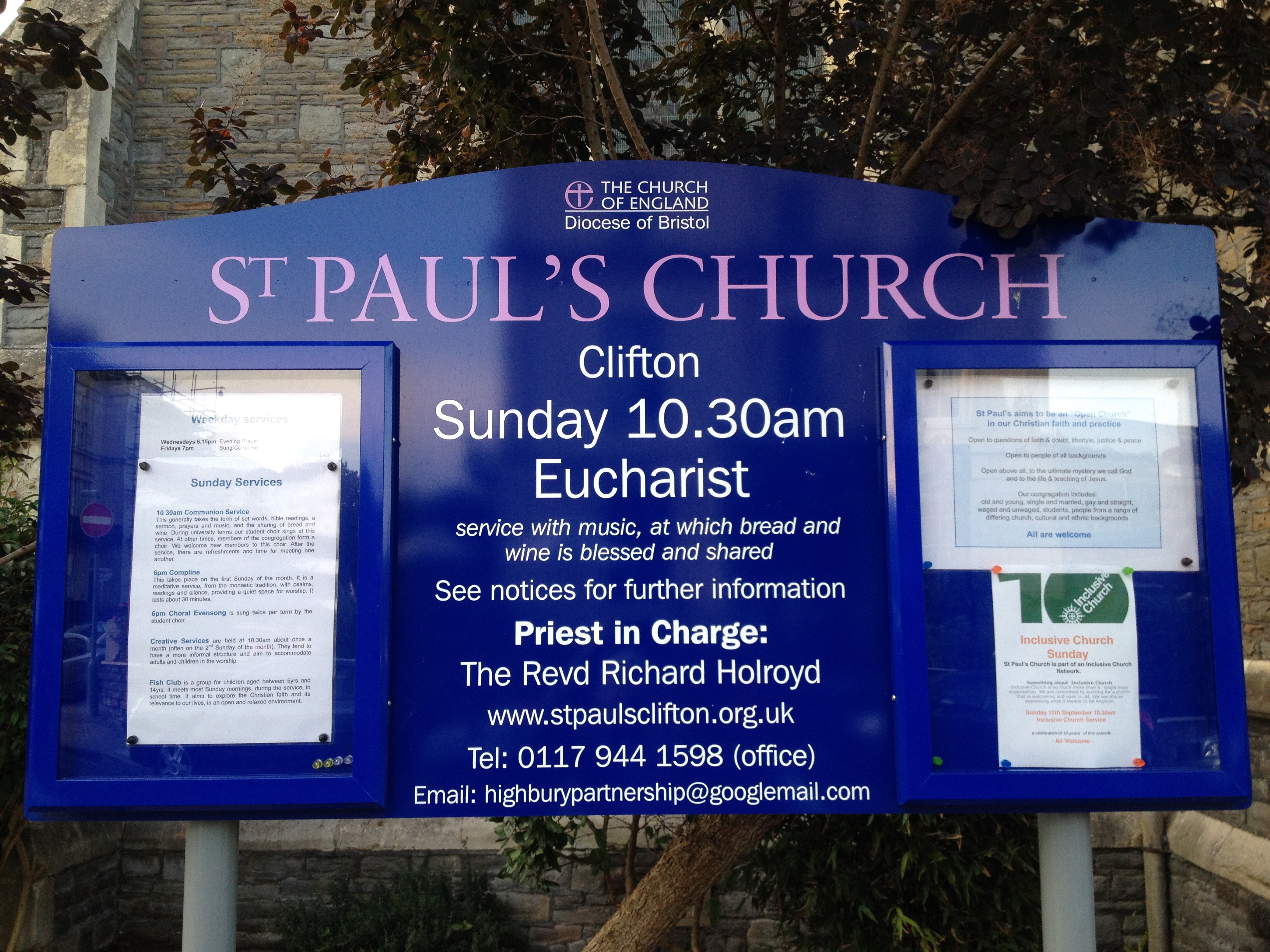
The same reasoning, I think, would work for us. If I have moved into this area and I’m looking for a church to go to: if I’m going through a tough time in my life and I’d like to find somewhere to say prayers: if I want my kids to learn what’s in the Bible: what will St Mary’s be like inside? Now if there’s a big sign outside saying that everyone is welcome – and I’ve put a picture of an Inclusive Church sign from another church with my sermon on the website [see above] – then people can feel confident, and they will dare to open our door and come in.

I know that not everyone agrees with this idea. Some people say we are already a really welcoming church. No need to join organisations or advertise – although I would gently say that it’s noticeable that we have no black people in our congregation. Somebody once even said to me, in this context, ‘But what about the bigots? We mustn’t upset the bigots!’

Well that perhaps takes me full circle, to the outcome of the European election. What about the bigots? What would Jesus say? I think he would say, ‘Look who I have lunch with already. People get shirty that I sit down with tax gatherers and sinners. But they are welcome!’

Sermon for Evensong on the First Sunday in Lent, 10th March 2019

Psalm 119:73-88; Jonah 3; Luke 18:9-14

Turning is sometimes a bit controversial. ‘The lady is not for turning’ they said about a former Prime Minister. The current Prime Minister is praised for the fact that she ploughs on and does not turn from her desired path. It’s supposed to be a very good thing to be single-minded and steadfast, and not to deviate from your objectives.

But actually, a major theme of Lent is in direct contradiction with this. Lent is, among other things, about repentance, repentance meaning changing your mind, μετανοια in Greek. There’s a good example of it in our first reading from Jonah, about the city of Nineveh, the ancient Assyrian city in upper Mesopotamia, located on the outskirts of the present-day Iraqi city of Mosul. On the banks of the River Tigris, Nineveh was at the heart of the earliest human civilisation.

God didn’t like what was going on in Nineveh. He instructed the prophet Jonah to go there and denounce them, tell them the error of their ways. Jonah didn’t want to face them, and decided to run away to sea instead; but the ship got caught in a storm, and the sailors were deciding, by casting lots, whom they should chuck overboard to lighten the ship. Poor old Jonah drew the short straw. They asked him more about himself: where he came from and what he was supposed to be doing. 

Jonah told them that he worshipped the one true God, who made both sea and land. He also told them that he was escaping from this god. ‘What shall we do with you,’ they asked, ‘to make the sea go down?’ Because the storm was getting worse and worse. Jonah said, ‘Take me and throw me overboard: and the sea will go down.’ Jonah said that he knew it was his fault that their ship had been hit by this great storm, because he, Jonah, had disobeyed God. Well, they chucked Jonah over the side, and Jonah was swallowed up and saved by being in a whale.

Then he emerged from the whale, came back and had another go. This time he did carry out what God had instructed him to do, and he went to Nineveh to tell them the error of their ways. That’s where we come in and pick up the story. When Jonah had warned them that in forty days their city would fall – impliedly, because of their evil deeds – they changed; they repented. The king of Nineveh arose from his throne and covered himself in sackcloth and ashes. He spread a decree through Nineveh, telling the population not to eat or drink, but rather to show their penitence and turn from their evil ways. 

God saw what they’d done, that they’d turned from their evil ways, and ‘God repented of the evil’, he changed his mind about it, and he decided not to destroy the city. Changing your mind, here, is a sign of magnanimity, generosity of heart. God is, by definition, omnipotent. He can do anything. He has no need to change his mind. But he did. It wasn’t a sign of weakness. And so was the way the King of Nineveh reacted to Jonah’s preaching. He didn’t dig in his heels and pretend that what they were doing was right. He was big-hearted enough to admit that they were doing wrong, and they needed to change. 

Knowing that you’re right, and the other fellow is wrong, is all part of this. In the New Testament, Jesus has this telling story about the Pharisee and the publican, the privatised tax-man. Even Margaret Thatcher – of revered memory, of course – never tried to privatise the Inland Revenue: but the ancient Romans did. It was just like Capita or any other other outsourcing people. They incentivised the private tax collectors. You got to keep a percentage of what you collected, so, the more you collected, the more you earned. 

Peter Mandelson and New Labour would have been fine with it. They’re supposed to have said, ‘We’re relaxed about people getting filthy rich’. Just imagine. What a great franchise opportunity. No wonder the people hated the ‘publicans’, the tax collectors. But this publican had an attack of conscience. Although he was working within the rules, he knew it was wrong. 

But the respectable bod, the Pharisee, paraded his virtue and charitable giving. He thanked God that he wasn’t a sinner like the publican, an extortioner, unjust – and sleeping with other men’s wives as well. A thoroughly bad lot. But he, the Pharisee, was just fine. He didn’t do any of the bad things that the publican did. But even so, Jesus reckoned that the bad old taxman was the one who was more worthy of salvation. All he said was, ‘God be merciful to me a sinner’. Jesus reckoned he would get that mercy.

I think this is a lesson for us today. What do we feel about whether we should let people whom we disagree with, or worse, whom we think are doing something evil, worship with us and be part of our church community? There’s an article in this week’s Church Times by the Dean of St Paul’s, Dr David Ison [See https://www.churchtimes.co.uk/articles/2019/8-march/comment/opinion/the-looking-glass-world-of-the-judgemental]. It is focused on the question whether LGBT people can be denied Holy Communion, because allegedly they are sinners, the question whether they are ‘worthy’ to receive. But it could equally be about anyone whose beliefs don’t chime with ours. I know that, for example, I disapprove very strongly of UKIP, and what I think it stands for. I think that in many ways UKIP is actually evil. But I know there are people who come to this church who support UKIP. Dr Ison says, in effect, that when we examine our consciences, we are all to some degree ‘unworthy’. We are all like the people in Jesus’ parable. It would be wrong for me to parade my supposed virtue in contrast with the sins of those whose views I disapprove of. Like the King of Nineveh, I must change my mind, I must repent.

A few years ago I tried to persuade the PCC at Cobham to make St Andrew’s an Inclusive Church, capital I and capital C – part of the Inclusive Church network. It would involve not just being inclusive, welcoming all sorts of people: certainly LGBT, lesbian, gay, bisexual and transsexual – or ‘intersex’, the ‘I’ in LGBTI, but also telling the outside world, putting a statement of welcome for all, in public, outside on the church notice board. 

And not just LGBTI people would be welcome: black people, foreign people, people in scruffy clothes, people who might be homeless dossers, just coming in to be warm. Anyone. If your church belongs to the Inclusive Church network, there’s a sign outside to tell people, whoever they are, that they are welcome.

Do you know how I got on with my proposal to St Andrew’s PCC? Any ideas?  I lost, 19 votes to 2. They said, ‘Of course we’re inclusive. But we mustn’t offend the bigots by making it too obvious’! We mustn’t offend the bigots. Really. That’s what they said. Now I think that Inclusive Church is right within the ambit of what Jesus was talking about with his parable of the Pharisee and the tax-man. Even though the tax-man probably wasn’t ‘worthy’, he was welcome – welcome not just in the church, but even in the Kingdom of Heaven. 

I really think that our churches should be genuinely open and welcoming, and as Dean Ison says, you can’t start to exclude people because they don’t measure up to your personal standards, however apparently scriptural those standards might be. I know from talking to people who have felt shy about coming to a church, because they are worried that they are ‘different’ in some way, that it makes a big difference if the church has a sign outside which confirms publicly that there is a welcome inside for everyone, however different, or even defective, they might appear to some people to be. 

For me, one thing that means is learning to welcome even the UKIP people. It means changing my mind: repenting. During this Lent, what do you think you might change your mind about? Are you like the Pharisee, or like the publican? Or are you like the King of Nineveh, even? I hope and pray that you are.

Amen.

Hugh Bryant

Sermon for Evensong on the Second Sunday in Advent, 10th December 2017

1 Kings 22:1-28, Romans 15:4-13 – see http://bible.oremus.org/?ql=379774448 for the text of the lessons

I went on Friday evening to a church meeting. ‘Tell me something new,’ you will no doubt say. ‘That’s what you do – you’re a Reader, for heaven’s sake!’ True – and moreover, the speaker at the meeting was a vicar. But it’s worth telling you about, I think. The thing which struck me, even before the speaker opened his mouth, was the crowd of people who had come to hear him.

As well as the ‘usual suspects’ that belong to the church, there were almost half as many again – I think there were about 70 people there – quite a few of whom I either didn’t recognise at all, or who I knew were people who had some background of going to church but who don’t, so far as I know, belong to any of the local churches now.

The topic was definitely to do with church. It was billed as a curry evening (originally a ‘men’s curry evening’, but I’m glad to say, it got widened out to include ladies too), with a speaker, Revd Dave Tomlinson, from St Luke’s, West Holloway [http://www.saintlukeschurch.org.uk], and his topic was ‘Everyone is Welcome’.

Dave Tomlinson – and he is ‘Dave’, (what with being a Scouser and that), does a ‘Thought for the Day’ slot on the Chris Evans breakfast show on Radio 2 called ‘Pause for Thought’, and has written some quite well-known books, for example ‘How to be a Bad Christian’ and ‘The Bad Christian’s Manifesto’ [2012, 2014, Hodder & Stoughton], and now ‘Black Sheep and Prodigals’, which has just been published. He sets himself out to be a vicar for people who don’t think of themselves as religious, people who might say they were, in the new-age phrase, ‘spiritual but not religious’.

What he says is that Christians are, in bare essentials, following a spiritual practice, what he calls ‘a way of approaching life’, based on the life and teachings of Jesus. [Tomlinson D., 2014, The Bad Christian’s Manifesto, London, Hodder & Stoughton, p.245]. What they’re not necessarily doing, though, is belonging to a particular church or following particular theologies or rituals. There shouldn’t be, he says, any barriers or ‘qualifications’ required before one can become a Christian.

It certainly seems to be an approach which gets people interested, and indeed, got them in, got them to turn out, on a cold Friday night. In a good sense, it was evangelism – although I think most of those who came would have already called themselves Christians, but not actually coming to church in a number of cases.

In a very real sense, you could say that, in another age, Dave Tomlinson could have been regarded as a prophet. You know, a prophet, meaning someone through whom God speaks. Not in the sense illustrated in our Old Testament lesson, where the king of Israel and the king of Judah, the northern and southern kingdoms of the Jewish people, when they were contemplating trying to take back from the Syrian invaders the town of Ramoth-Gilead, consulted four hundred prophets, who all said that the attack would be successful and they would capture the town.

However, Jehoshaphat, the king of Judah, the southern kingdom, rather oddly asked if there was a ‘prophet of the Lord besides’, that they could ask. It implies that the 400 so-called ‘prophets’ that the story mentions, were not real prophets, speaking the words of the one true God, but were rather more in the way of magicians, soothsayers, inspired more by folk superstition than by God. So instead of them, they dug out Micaiah, who was a real prophet, and he warned the kings, correctly, that the attack they planned would end in disaster. They didn’t take any notice.

Dave Tomlinson’s approach is perhaps more in line with our second reading, from St Paul, in his letter to the Romans. He doesn’t specialise in predictions, military or otherwise: instead, he tries to impart truth, without fear or favour. It doesn’t matter what denomination you are; Paul and the disciples’ mission to spread the gospel, the good news of Christ, didn’t just go to their fellow-Jews, but also to other groups, to the ‘Gentiles’, the non-Jews – and all, both lots, would be equally welcome to follow Jesus.

It’s a very important message. Today, the second Sunday in Advent, is the day when traditionally the church remembers the prophets: like Micaiah, and Ezekiel, Isaiah, Hosea, Amos and all those. But it might be good also to celebrate and listen to modern-day prophets, like Dave Tomlinson, because his approach looks to have been very productive, on Friday night’s showing: people actually did bother to turn out and listen to what he said – even people who don’t usually come to church.

The key, according to Revd Dave, is for Christians to be caring – to love their neighbours – and for them not to set much store by superficial distinctions and divisions. I think that there are lessons there for us at St Mary’s too. People have said that we’ve done a good job in moving away from a time when St Mary’s was run as a sort of club, where strangers weren’t really welcomed, to the warm, friendly place we now are. That’s good; but how are we to keep up the momentum and engage with our parish community so that we will still be around as a church to proclaim the Gospel when we relative oldies are long gone?

Dave Tomlinson says he’s not especially bothered by how well ‘qualified’ people are in relation to Jesus Christ. He gives everyone, confirmed or not, Holy Communion if they want it. He doesn’t regard every word in the Bible as literally having been dictated by the Almighty. He is willing to accept anyone, however ‘sinful’ they may have been. Famously, he conducted the gangster Reggie Cray’s funeral, for example.

But it’s plain from looking at his church’s website that he doesn’t regard any one style of worship or liturgy as being the be-all and end-all. They do sung Evensong just like us. I think that they might agree with us that there’s a lot to be said for worshipping in a way that is familiar, that we’re used to – and that we think is worthy. If you are forever tut-tutting about banal words or suboptimal rock music instead of sublime harmonies, you’re being led away from bringing yourself to the Almighty and instead getting distracted by earthly trivia.

What we do here is to build on familiar foundations. Many people come here and, even if they haven’t been to church for a long time, may well remember a hymn or some of the liturgy, from their schooldays, or university chapel, perhaps. I think that’s all good.

I think that it’s important also, where newcomers are concerned, to make sure that everyone ‘knows the drill’: when to stand up, when to sit down; is there a collection? Do you have to wear any special clothes? – and so on. (Only I have to dress up!)

This all comes from the idea of being welcoming and inclusive. Of course, Jesus didn’t actually build any churches, so in his eyes, the concept of ‘bums on seats’ in churches wouldn’t have meant much to him. But for us, it is important. If we are going to reach out to people and bring them into our church family, we need to show that we are truly open and inclusive to ‘all sorts and conditions of men’.

Revd Dave Tomlinson was one of the founders of the organisation called ‘Inclusive Church’. Although it was founded as a reaction against the sad events which led to Dr Jeffrey John first being offered to be Bishop of Reading, and then having it taken away because of his sexual orientation as a gay man, Inclusive Church now goes much wider.

Its statement of belief says: “We believe in inclusive Church – church which does not discriminate, on any level, on grounds of economic power, gender, mental health, physical ability, race or sexuality. We believe in Church which welcomes and serves all people in the name of Jesus Christ; which is scripturally faithful; which seeks to proclaim the Gospel afresh for each generation; and which, in the power of the Holy Spirit, allows all people to grasp how wide and long and high and deep is the love of Jesus Christ.”

When a church joins the Inclusive Church network, it is encouraged to put up a sign outside to tell people that, inside, if they come in, they will really be welcome. For someone who feels they are in some way different, perhaps because of race, or sex, or disability, it’s very reassuring to see that there’s a clear offer of hospitality on the outside of the church.You don’t have to ‘risk it’ by going in somewhere where you might not fit in.

Well, you might be wondering about where this church meeting that I went to was; this curry session, addressed by Revd Dave Tomlinson, which attracted so many people including people who’ve drifted away from the church: where was it? It was, as you’ve probably guessed, just down the road, in our sister church, St Andrew’s, in Cobham.

When I was a member of the PCC there, there was a motion for the Church to affiliate to, to join, the Inclusive Church network. I spoke as passionately as I could in favour. Apart from the person who had proposed the motion, I was the only one. The vote was 22 to 2 against. Now that they’ve listened to Dave Tomlinson, I wonder if some of the stalwarts down the road will revisit that decision. Because, you see, I think that the message, the message of Jesus and the prophets, that God welcomes us all, that all are welcome, is still vital. What do you think? Should our PCC think about it, as part of our vision for social engagement? In all humility, I hope so.