Archives for posts with tag: Jerusalem

Sermon for Mattins and Morning Prayer (Principal Service) at All Saints Church, Penarth, 5th October 2025

Habakkuk 1.1-4; 2.1-4

Psalm 37.1-9

2 Timothy 1.1-14

Luke 17.5-10

It’s a pity that we don’t have lantern slides at 8 o’clock, because I could show you the picture on the slide which is going to be shown at 10 o’clock when I start to preach the sermon then. It’s a sort of shovel, or it could be a large spoon, with round things in it, quite small.

I wondered whether they were my favourite special-treat breakfast cereal, Grape-Nuts – I should explain that I didn’t choose the pictures, as Susannah is leading the service at 10 as well as this one – but I suspect that at 8 o’clock we need to stay away from pictures and screens and things like that, and just keep our worship simple and our pictures in our heads, where, of course, those of you who listen to the wireless know that the best pictures are.

What is in the big spoon? I asked Susannah and she told me that they were mustard seeds, picking up a reference to the Gospel reading, the New Testament lesson today. I have to say that it rather threw me, because I thought mustard and cress was something which you grew on a face flannel on the bathroom windowsill, but apparently this is what mustard seeds really look like.

The lessons are all about how we confront a world which is going wrong, which is going against us. The Old Testament lesson, from the prophet Habakkuk, comes from a time around 600 BC when the Assyrians had overrun the northern kingdom of Israel, and all that was left of God’s chosen people were the two tribes of Judah and Benjamin, together with the survivors from the massacre when the Assyrians invaded the northern kingdom, who had fled to Jerusalem to take refuge there.

Habakkuk was preaching when the Babylonians were beginning to sweep down on Palestine; they are the Chaldeans, if you read a bit more beyond one of the bits that we have for our lesson, which is in two bits, the first four verses of chapters one and two respectively. If you read on in chapter 1, beyond where it says

Devastation and violence confront me;

strife breaks out, discord raises its head,

……

for the wicked outwit the righteous,

and so justice comes out perverted.

Habbakuk goes on in his prophecy by saying

Look, you treacherous people, look:

here is what will astonish you and stun you,

for there is work afoot in your days

which you will not believe when it is told you.

It is this: I am raising up the Chaldaeans,

that savage and impetuous nation,

who cross the wide tracts of the earth

to take possession of homes not theirs.

Terror and awe go with them;

their justice and judgement are of their own making.

Their horses are swifter than hunting-leopards

And he goes on to say how terrifying they are in all sorts of other ways. Obviously they fulfilled the American strategic objective for a successful army in the invasion of Iraq, ‘shock and awe’.

But this terrible army had its limitations.

Their whole army advances, violence in their hearts;

a sea of faces rolls on;

they bring in captives countless as the sand.

Kings they hold in derision,

rulers they despise;

they despise every fortress,

they raise siege-works and capture it.

A terrifying picture. Who could stand against them? But then –

Then they pass on like the wind and are gone;

and dismayed are all those whose strength was their god.

People who believe that ‘might is right’ turn out to be completely mistaken; and the key words in Habakuk’s prophecy come in the second chapter, in our second part of the lesson, [2:4]

Look at the proud!
 Their spirit is not right in them,
 but the righteous live by their faith.

It’s an idea that St Paul picked up on in two of his letters. In his great letter to the Romans, [1:17], he said that in the gospel of Jesus

is revealed God’s way of righting wrong, a way that starts from faith and ends in faith; he says, as Scripture says, ‘he shall gain life who is justified through faith’.

In the letter to the Galatians [3:11], where St Paul is drawing a distinction between following the provisions of the Jewish law, just carrying out the 10 Commandments, and having faith, saying that the way to salvation is through faith, he says that

It is evident that no one is ever justified before God in terms of law; because we read, ‘he shall gain life who is justified through faith’.

I’m not sure why the compilers of the Lectionary decided that we should have a lesson from the second letter to Timothy rather than one of these passages from Romans or Galatians, (which clearly reference the passage in Habbakuk), but certainly in the passage from the second letter to Timothy, St Paul celebrates that the fact that Timothy and his mother and his granny, Eunice and Lois respectively, all had strong faith.

But you might be a little bit puzzled about exactly what this faith is. It’s pretty clear that it’s not what we would call blind faith, just believing that something is true without any evidence for it. If that was true, you might never take another paracetamol ever again; or even worse, you might try to cure Covid by drinking some bleach. But we are not talking about President Trump’s belief system; this is a word which has more of a connotation of trust about it. It’s not so much about believing that something is the case, but rather, trusting in God to produce a good outcome, to right the wrongs. It’s very close to hope. Hope in the Lord. Trust in the Lord. As Isaiah puts it [14:31]:

but those who look to the Lord will win new strength,

they will grow wings like eagles;

they will run and not be weary,

they will march on and never grow faint.

They will soar, on wings like eagles: they will ‘mount up with wings like eagles’.

Just now our world looks a bit like what it must have looked like to Habakkuk; there is a lot going wrong. There are terrible wars, invasions; the rule of law looks to be under threat in places: –

devastation and violence confront me;

strife breaks out, discord raises its head,

…..

for the wicked outwit the righteous,

and so justice comes out perverted.

We can think of plenty of places and cases today, where those words would be very apt. We are going to have a vigil later on today here to pray for the people of Palestine; equally our prayers should go for the other places in the world where there is no peace and where the rule of law does not securely run: Ukraine and the south of Sudan chief among them, as well as Gaza and the West Bank; and all those places where people are held hostage or are fleeing violence and persecution and are becoming refugees.

We need to trust in the Lord, to pray with confidence and realise the power of prayer, even if our faith is only the size of one of Susannah’s mustard seeds, or a spoonful of Grape-Nuts. It doesn’t matter. You can rely on God to put things right in the end. Let us pray that he will use us in his service to that good end.

Amen.

Hugh Bryant
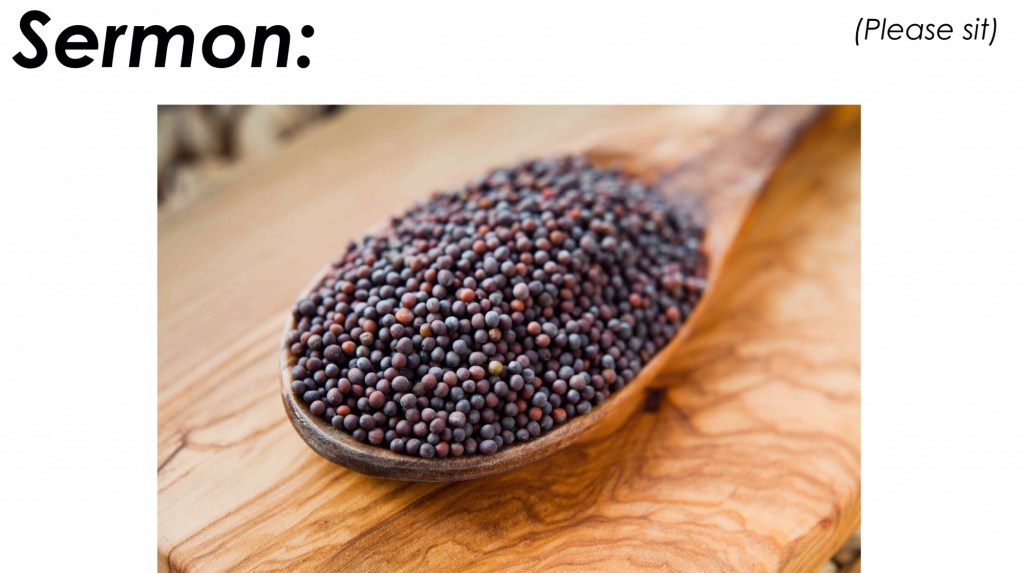
From the PowerPoint slides at the 10 o’clock service. What are those little beads?

Sermon preached by Hugh Bryant at St Peter’s Church, Old Cogan, on 14th January 2024

Jerusalem the Golden

Isaiah 60:9-22 – https://bible.oremus.org/?ql=572149666

‘Jerusalem the Golden with milk and honey blest’. I have to share with you that when I was little and I first heard this hymn, of course I was struck by how joyful and beautiful everything in it was, but nothing was more striking to me than the fact that Jerusalem was the home of my favourite biscuit.

I’m not sure that you can get them any more, but Jacob’s Milk and Honey, in those days, was the biscuit that I really liked. It was a bit like a jammy dodger, but it was oval rather than round. ‘Jerusalem the golden, with milk and honey blest’. Whatever else this wonderful place had, it had the best biscuit. Also, of course, chapter 60 in Isaiah, which Bernard of Cluny must have had in mind when he was writing our hymn in the 12th century, originally in Latin, had some very memorable lines for a little boy, which the compilers of the lectionary have chosen to omit tonight. We have started at verse nine, but I think you ought to know what you are missing. Here is some of the beginning of chapter 60 of Isaiah.

’60 Arise, shine; for thy light is come, and the glory of the Lord is risen upon thee.
2 For, behold, the darkness shall cover the earth, and gross darkness the people: but the Lord shall arise upon thee, and his glory shall be seen upon thee.
3 And the Gentiles shall come to thy light, and kings to the brightness of thy rising.
……..’
And then this immortal verse:

‘6 The multitude of camels shall cover thee, the dromedaries of Midian and Ephah; all they from Sheba shall come: they shall bring gold and incense; and they shall shew forth the praises of the Lord.’

The dromedaries of Midian and Ephah: dromedaries, please: not ‘young camels’ as the modern translation limply puts it. But that might have been all right when I was eight or nine years old, but what about ‘Jerusalem the golden’ today?

I wouldn’t be surprised if you had a slight feeling of unreality when I started talking about childish enthusiasms for particular types of biscuit, in the context of Jerusalem. Equally, the visions of Jerusalem shown to the Jews in Isaiah’s prophecy, on their return from exile in Babylon at the beginning of the sixth century BC, when scholars think Isaiah 60 was likely to have been written, just seem totally different from what we see today.

Jeremy Bowen, the BBC Middle East, editor, has written that, following the war of independence of Israel in 1948, and the Six Days war in 1967, ‘the Jews and the Arabs went about their business and the weight of the conflict never lifted. Israelis scrabbled to build a new state while Palestinians mourned the loss of the one they never had.’ [Bowen, J., (2022), The Making of the Modern Middle East, London, Picador; page 45].

The holy places of the three monotheistic religions, the religions of the book, so-called, Christianity, Judaism, and Islam, are all in Jerusalem, right on top of each other. For as long as most of us can remember, the Holy Land has not been entirely peaceful. there have been major wars, the Six Days War, the Arab-Israeli war.

The occupied territories on the West Bank, which did belong to Jordan, were seized by Israel in 1967: the United Nations resolutions, forbidding the Israelis from creating settlements in the occupied lands, have been ignored, and there has been a constant undercurrent of violence. When Mr Guterres, the United Nations Secretary General, indicated that he believed that the trouble had not started on seventh October, he was pointing to the terrible history of violence between the Israelis and the Palestinians over many years.

Specifically in Gaza, in 2009 Israel bombed the Gaza Strip systematically over a period of 22 days in a campaign which they called Operation Cast Lead. It killed 1400 Palestinians and on the Israeli side there were 13 casualties. What is going on now is even worse.

I have been following the proceedings in the International Court of Justice, where South Africa has started a case against Israel alleging that Israel is guilty of genocide in Gaza, and that ‘provisional measures’ to preserve the rights of either party, as they are defined in the statutes of the International Court, article 41, are being sought, which would have the effect, if the parties would obey such an order, of bringing about a ceasefire.

The Israelis have sent a full team of lawyers to appear in the Hague before the court, including several leading British barristers. They say that South Africa’s claim that Israel is guilty of genocide is wrong, for three reasons. First, that under the Genocide Convention 1948, there needs to be an intention to bring about genocide. Israel has no such intention, they say. Second, the Convention requires that there be a dispute between the parties which has not been resolved, and, they say, there is no dispute in being between South Africa and Israel. And then, finally, that what Israel is doing is self defence and not genocide.

Probably the most powerful speech from the South African side was by an Irish barrister, Blinne Ní Ghrálaigh KC, who made the most powerful speech [see https://youtu.be/yhsWyBWGoCU?si=GjVSf6PyqnHYEoC%5D, which ended up quoting a sermon which was preached at Christmas by the Reverend Dr Munther Isaac, the minister at the Evangelical Lutheran Church in Bethlehem, who is a Palestinian.

The sermon is called “Christ in the rubble.” It is available to see on YouTube and I highly recommend it. [See https://youtu.be/aEGiANa0-oI?si=whdmciTT00C6is-t%5D South Africa’s counsel, Blinne Ní Ghrálaigh KC, quoted this at the end of her address.

‘I want you to look in the mirror and ask, where was I when Gaza was going through a genocide?’

She produced staggering figures of the numbers, killed and injured, including 9000 children killed by the Israeli army, and a number of quotations from Israeli politicians suggesting that they want to drive all Palestinians out of Gaza and raze it to the ground. Dr Isaac, in his sermon, raised the issue of complicity: that Western nations, that he characterised as ‘the Empire’, (by analogy with the Roman Empire) are standing idly by or even supporting genocide, by providing arms and other support.

Clearly, there are strong arguments on both sides, but one thing which we must surely agree on, is that the current situation has nothing to do with that golden Jerusalem, with milk and honey blest.

Isaiah’s prophecy is so different.

‘I will appoint Peace as your overseer
   and Righteousness as your taskmaster. 
Violence shall no more be heard in your land,
   devastation or destruction within your borders;
you shall call your walls Salvation,
   and your gates Praise. 
The sun shall no longer be
   your light by day,
nor for brightness shall the moon
   give light to you by night;
but the Lord will be your everlasting light,
   and your God will be your glory.’

What a wonderful vision that is. Now all we need to do is to turn it into a realistic hope.

What shall we do to bring peace to the Middle East? I think that bringing things before the International Court of Justice is a good and constructive step. Others have suggested that there should be boycotts for as long as the genocide goes on.

If you agree with Dr Isaac and many other commentators, indeed, that it is genocide, then maybe there should be no more pilgrimages to the Holy Land, and we should stop buying Jaffa oranges. As the author Naomi Klein has pointed out, a campaign of boycott, divestment and sanctions was very effective in bringing about the ending of apartheid in South Africa. [See https://www.theguardian.com/commentisfree/2024/jan/10/only-outside-pressure-can-stop-israels-war-crimes?CMP=Share_iOSApp_Other%5D

As Prof. Vaughan Lowe, KC, one of the counsel for S. Africa, said to the International Court of Justice, however awful the attack on October 7 was, 9000 Palestinian children killed, and countless others maimed, and continuing to be killed and maimed, along with tens of thousands of their mothers, cannot under any circumstances be justified as self defence. [See the verbatim record at https://www.icj-cij.org/sites/default/files/case-related/192/192-20240111-ora-01-00-bi.pdf%5D

Let us pray.

Let us pray to you Lord, that your will be done and that you will bring about peace in your Holy Land, and in particular, in Gaza, today.

Amen.

Sermon for Mattins on 21st November 2023

Bible readings: see https://bible.oremus.org/?ql=567498722

‘Ah, Assyria, the rod of my anger—
   the club in their hands is my fury!’

The club, the rod of anger, are for beating up Israel, because they have done what is evil in the sight of the Lord. You could say this is where we often come in when we are studying the Old Testament. The Old Testament has this overriding theme, of the relationship between God and his chosen people: to what extent his chosen people follow him and obey his commandments, in which case he brings them prosperity, or do evil in the sight of God or perhaps worship other gods, in which case God punishes them.

It’s not an image of God which is particularly like the one which we normally have, of a God of love in the person of Jesus Christ. This is entirely different. God is saying, through his prophet Isaiah that there will be a war. The Assyrians will attack Israel. God will use the Assyrians to carry out punishment of the Israelites on God’s behalf. They will be the rod of his anger and the club in their hands represents God’s fury.

But the king of Assyria is not just a supine servant acting on behalf of God. Because he gets above himself.

‘Against a godless nation I send him,
   and against the people of my wrath I command him,
to take spoil and seize plunder..’
  
But then a couple of verses later:

‘But this is not what he intends,
   nor does he have this in mind;
but it is in his heart to destroy,
   and to cut off nations not a few.’

So the king of Assyria is not just after the Israelites under orders from God but he wants to go wider. He has already captured Carchemish and Arpad and Damascus, and now he has his sights on Calno and Hamath and Samaria.

‘Are not my commanders all kings? 
Is not Calno like Carchemish?
   Is not Hamath like Arpad?
   Is not Samaria like Damascus?’

It’s quite eerie to hear these names, some of which we would still associate with violence and suffering today, 3000 years later. Isaiah’s prophecy continues that when the Lord has finished all his work on Mount Zion and Jerusalem, sorting out the Israelites, and punishing them for their faithlessness, he will punish the arrogant boasting of the king of Assyria.

And you hear all about what the king of Assyria has to say:

‘By the strength of my hand I have done it,
   and by my wisdom, for I have understanding;
I have removed the boundaries of peoples,
   and have plundered their treasures;
   like a bull I have brought down those who sat on thrones. 
My hand has found, like a nest,
   the wealth of the peoples;
and as one gathers eggs that have been forsaken,
   so I have gathered all the earth’.

This is the boast of the king of Assyria. And then you have this striking image about the relative merits of weapons as against those who wield them.

‘Shall the axe vaunt itself over the one who wields it,
   or the saw magnify itself against the one who handles it?’

Again it makes us think of things today. When the Ukrainians were crying out for better weapons and our government agreed to send them Challenger 2 tanks and Storm Shadow missiles, somehow that seemed to be almost more of a consideration than the bravery of the soldiers who would use those weapons. One can’t go too far with that analogy, because obviously without the right weapons, a soldier is not able to fight at all.

But here in this passage from Isaiah the point that the prophet is making, that the king of Assyria is effectively God’s secret weapon, still requires that he must not get above himself. He still has to follow God’s orders. As between God and the Israelites, Assyria is the weapon, not the commander. So God will cut him down to size.

‘Therefore the Sovereign, the Lord of hosts,
   will send wasting sickness among his stout warriors,
and under his glory a burning will be kindled,
   ……
The remnant of the trees of his forest will be so few
   that a child can write them down.’

Chilling imagery. What is it for? We really don’t have, as far as I can see, any equivalent today. People just don’t talk in those terms. We tend to think of prophets, if we think of them at all, as people who foretell the future. But that’s plainly not what Isaiah is doing here. Isaiah is the mouthpiece of God.

We really are a long way away when we read this. Isaiah was writing around 700BC – BCE – so 2,700 years ago. I’m not sure that there is any prophecy of this type these days. But if not, it’s even more difficult for us to make anything of what Jesus says in our New Testament lesson. How could we tell, if somebody claims to be a prophet, whether they are genuine? If someone pops up and tells us that God wants us to do something or other, the question arises, is he or she a false prophet?

If church leaders want to do particular things, are they following the word of God, or God’s command, or not? Jesus simply said, by their fruits you shall know them. So if somebody tells you that God wants you to do something which isn’t likely to turn out well, then Jesus suggests that you can take it that it is not genuine prophecy.

Perhaps although talking about prophecy seems to come quite strangely to us, nevertheless it could be good to look at what the implications are, in spiritual terms, of what people are telling us is a good thing to do.

In the first chapter of Isaiah’s prophecy, he identifies what it looks like to be godless.

‘Your rulers obey no rules and are hand in glove with thieves. Everyone loves a bribe and is greedy for his profit. They never defend the rights of the orphan and the widow’s cause never comes up before them.’

Again it’s frighteningly contemporary. Perhaps we should think again about prophets and prophecy. If you go away and have a little read of the first few chapters of the book of Isaiah, you will immediately stumble on the passages which we often read during Advent and at Christmas about the coming of the Messiah, about Emmanuel, God with us.

‘For to us a child will be born, to us a son will be given. The government rests upon his shoulders
and his name shall be
wonderful, counsellor, mighty God,
everlasting father, prince of peace.’

But we haven’t got there yet. As we move towards Advent, this picture, of God’s anger with his chosen people, is something which we need to reflect on and pray about, because it is uncomfortably close to home.

From a Sermon for All Saints and All Souls, 5th November 2023

By Hugh Bryant

I think we need to give some time, as Christians, not only to the Saints and to the souls of our faithful departed, but also to all the other people who have died and tragically are still dying today, in circumstances where we need to cry out to the Lord and pray for his comfort and relief.

Until a month ago if I had been preaching this sermon, I would’ve mentioned first the war in Ukraine, and indeed I still do so. We will pray for a just and peaceful outcome to that terrible conflict. The same is true of the conflicts in Syria, Yemen and the Sudan.

But I suppose that, particularly as it is happening in or near to places we read about or have made pilgrimages to in the Holy Land, the conflict that is uppermost in our minds today, and which is exercising us so much, is the tragic conflict in Israel and Palestine, and particularly in Gaza – and in the area just outside Gaza where the conflict began, with the terrible attack on the people in the kibbutz and the music festival, by Hamas.

There are saints and souls here as well. In our Old Testament lesson some of us will probably have been moved by the thought that our reading comes in the middle of a passage in Isaiah [chapter 66] where the prophet sets out a vision of the new earth, of the new Jerusalem, of God’s holy mountain; a vision perhaps of heaven. A vision of the promised land, where God’s chosen people will come ‘on horses and chariots’, (and also on ‘dromedaries’, you’ll be pleased to know.) They will come ‘to my holy mountain, Jerusalem’, says the Lord.

But what is happening in Israel and Palestine does not look like what is supposed to be happening on God’s holy mountain. There are Christians caught up in this as well. Admittedly the number of Christians living in the Holy Land has diminished greatly, but there are Palestinian and Israeli Christians as well; and Saint George’s Cathedral in Jerusalem. What do the Christians say? What would Jesus say?

In all the discussions about whether there have been breaches of international law there is a key concept, we are told, which is ‘proportionality’. In self defence, is the response proportional? It sounds very like what Jesus was talking about in the Sermon on the Mount. An eye for an eye and a tooth for a tooth.

Scholars have told us that the principle of an eye for an eye and a tooth for a tooth, which comes in Exodus chapter 21, Leviticus 24 or Deuteronomy chapter 19, means not that there is carte blanche to take revenge without restraint but that, just as in international law, any retaliation must be strictly in proportion, so only one eye for one eye and only one tooth for one tooth.

Let us look at what has happened and what is happening in the light of that. Leave aside for a minute what principles Hamas may have followed to justify their initial attack – and of course we have heard from the United Nations Secretary General Mr Guterres and others that it didn’t come from nowhere, but only after many years of oppression of the people of Gaza.

But leaving that on one side, Hamas killed just under 2000 people, but at the last count Israel has killed over 9000 people, of whom 4000 have been children; and it is not the case that they have been retaliating just against their enemies, because it’s quite clear that only a very small minority of the people in Gaza belong to Hamas. So even according to the Jewish law as set out in Exodus, Leviticus and Deuteronomy, the law of ‘an eye for an eye’, it looks as though what Israel has been doing is wrong. And it follows that it is a clear breach of international law. As indeed was the initial Hamas attack, because, however frustrated and oppressed the people of Gaza may be, nothing would justify the violence which Hamas meted out on seventh October.

So where are the saints? What should we, as Jesus’ saints, say? Jesus had an answer. As reported in Saint Matthew’s Gospel chapter 5, Jesus said, ‘You have heard that it was said, an eye for an eye and a tooth for a tooth. But I say to you, do not resist an evildoer. But if anyone strikes you on the right cheek, turn the other also… And again, you have heard that it was said, you shall love your neighbour and hate your enemies. But I say to you, love your enemies and pray for those who persecute you.’

Just imagine what might happen if Israel adopted that strategy! They would no longer be trying to annihilate Hamas, and if so, Hamas would surely no longer want them to be erased from the earth – it would no longer be an eye for an eye. The Good Friday Agreement shows that it can happen.

So when we pray for all saints and all souls, let us pray also that Jesus’ message, the message of love and peace, will finally be listened to, and that there will be peace in the Holy Land.

Sermon for Mattins (Morning Prayer) on 3rd October 2023 at All Saints Church, Penarth

Readings: https://bible.oremus.org/?ql=563256396

It occurred to me that you might be a bit fed up if I spent the next 10 minutes talking about the Last Supper, Jesus shocking the disciples and forecasting that one of them was going to betray him, but then going on to celebrate very first Holy Communion. I think it will be a bit of an anticlimax to hear a sermon all about that and then not to receive communion, but as you know, we are not doing a holy communion service this morning.

If we look at our other lesson, the reading is from the prophet Ezekiel who was writing from exile in Babylon, making a prophecy about the circumstances under which God’s chosen people the Israelites would return to Jerusalem. Our reading comes after a few lines in which Ezekiel mentions that the existing people, who are currently in Jerusalem, have suggested that the Israelites should go away and find somewhere else. It resonates; it’s sad, even today.

It does have the well-known lines about the Lord promising to the Israelites that when they come to Jerusalem he will give them ‘one heart and put a new spirit within them’; he will remove the ‘heart of stone’ from them and give them a ‘heart of flesh’ so that they may ‘follow God’s statutes and keep his ordinances, and obey them’, so that ‘they shall be his people and he will be their God.’

In one sense the whole of the Old Testament is all about the history of Israel’s being obedient and then disobedient to the Lord their God and all the various consequences thereof. Again, I think it doesn’t really fit for me to go into that in more detail this morning. We would need a learned seminar at least.

So if I’m not going to spend a lot of time on our lessons – I hope that you will forgive me for so doing – what do I want to dwell on? Perhaps it’s not strictly true, that I am completely ignoring our readings, because I saw something in the passage from Ezekiel, which sparked a thought within me, which I hope will be worth our pursuing together. That is that after Ezekiel has finished his prophecy, we are told that the cherubim lifted up their wings ‘with the wheels beside them.’

If you go to the beginning of the book of Ezekiel, in the first chapter, he says that he was among the exiles by the River Chebar, and the heavens were opened, and he saw visions of God. He saw extraordinary visions of four living creatures, the cherubim, with four wings, and four different faces each; and there were wheels.

It was sometimes described as the vision of the chariot. ‘When they moved, [the wheels] moved in any of the four directions without veering’. Perhaps the mechanical engineers in our congregation will be able to confirm that this is, perhaps, one of the earliest references to Ackermann steering that we’ve come across in literature.

But anyway, there is something on wheels; and that’s what piqued me, because in among all the other things we have to deal with at the moment in our lives, there are a lot of people exercised about something on wheels, namely, the 20 mile an hour speed limit.

Now, I want you to be immediately reassured; I am not about to turn into Jeremy Clarkson, or side vehemently with one or other of the parties in the Senedd, on this issue: but it did seem to me that it was a good opportunity for us to discuss how we put our faith into practical effect in today’s world.

Is there a Christian way to look at the 20 mile an hour speed limit? I suppose the key to all this, if we are Christians, is to ask, what would Jesus do? If Jesus was around today, how would he approach the 20 mile an hour speed limit? What is the Christian approach to it?

This is a bit like when I was studying Latin and Greek at school and university and we had to do prose composition; you might be given the Times editorial from a couple of days earlier and asked to put it into the Latin of Tacitus or the Greek of Demosthenes. Our teachers delighted in finding modern passages with things that didn’t exist in classical antiquity, such as trains and aeroplanes. What is the Ancient Greek equivalent of Concorde?

It’s just the same problem that we have in this case, wondering what Jesus would have done about the 20 mile an hour limit. What sort of car would Jesus be driving? So far as I know, the only form of locomotion which Jesus used was a variety of ponies, starting with Shanks’ and extending to the famous ass on Palm Sunday.

Presumably there were horses and carts, but the only ones that we hear about in the Bible are chariots, predominantly in a warlike context. In Psalm 20, for instance, ‘…some trust in chariots, some in horses, but we will make mention of the name of the Lord our God.’

But I don’t think that a chariot is really a parallel with a motor car today, or even with an SUV, come to think of it. If that was the case, Jesus would have been rumbling about in a tank or an armoured fighting vehicle. I certainly don’t think that I see Jesus riding on a Challenger II on his way into Jerusalem. No, it looks as though Jesus was much more often travelling at 4 mph, walking pace, or alternatively, at maybe 5 knots in a fishing boat on the sea of Galilee.

So what is the underlying message, which we could draw a parallel with, over the gap of 2000 years? I would like to suggest that it is a message about slowing down, that whatever form of locomotion we are using, whether it is on foot or in a car, or in a chariot or on a train, or in a boat, the message of the 20 mph zone is to slow down, and moreover, to slow down for reasons given which have to do with care for our environment and so as to avoid harm to our neighbours, by not running them over.

I think that when we consider God’s creatures and caring for them, slowing down will be good for all creatures, not only cutting down the number of people knocked down on the road, but it will also be good for animals; cats and squirrels, for example.

Do you think that Jesus would go along with this sort of reasoning? I wonder if, by contrast, there were actually any experiences that Jesus would have had, which would have given him a taste for speed. On the water, the only thing I can think of again points to slowing down, when he stilled the storm, so force 10, 70 mph, winds dropped to a pleasant breeze.

As you can see, I am beginning to think that Jesus is coming out as Captain Slow, but maybe there are other factors that I haven’t taken into account. Maybe there is such a thing as Captain Too Slow. What do you think Jesus would have done? Let us dwell on that with a little prayer, every time we set our speed limiter to 20 in the car.

Amen.

Hugh Bryant

Sermon preached at St Peter’s, Old Cogan, on 14th May 2023: the Sixth Sunday after Easter

Zechariah 8.1-13
Revelation 21.22 – 22.5

See https://bible.oremus.org/?ql=556703225

‘The third day he rose again from the dead;

He ascended into heaven’…

This bit of the Creed neatly marks where the church is after Easter and before Ascension Day, which is this coming Thursday.

At first, when I was thinking what I was going to say to you at this point, I had a real feeling of cognitive dissonance, if I can call it that, between our Bible readings, with their visions of heaven or the Heavenly City, and what seems to be going on in the world around us today. 

Archbishop Justin made an impassioned speech in the House of Lords the other day, pointing out how a Bill intended to stop people crossing the Channel in little boats contradicts morality and international law as well as being profoundly inhumane; and then I read in the paper that we are going to supply to the Ukrainians cruise missiles called Storm Shadow which cost

 £2 million each. 

So many thoughts were swirling around in my brain. On the one hand there is no price which one can put on preserving freedom and defeating invaders: on the other, it is interesting to know that apparently we in the UK have about 1000 of these missiles, £2,000m, £2 billion-worth, and yet we are told we can’t afford to pay our doctors and nurses and all the other public servants properly. 

They say that, if you met all the public service pay demands at present being put forward, in full, it would cost about the same amount, £2 billion. How to judge which is the right course to take? Missiles to defend Ukraine, or paying our public servants? 

In the face of these terrible dilemmas maybe the thing to do is to clear one’s head by drawing close to the Lord in prayer and coming to the Lord’s house at 3 o’clock on Sunday, as we have, and bringing our worship and prayers.

But isn’t this just escapism? Maybe not. Our Bible readings today have, I think, a heavenly flavour. 

‘On the holy mount stands the city he founded. 

Glorious things are spoken of you, city of God.’ 

‘Glorious things of thee are spoken, Zion city of our God’, as the hymn says.

And we have Zechariah’s prophetic vision of the city of God. 

‘I will return to Jerusalem, and will dwell in the midst of Jerusalem; Jerusalem shall be called the faithful city and the mountain of the Lord of hosts shall be called the holy mountain.’

Or you could stay in heaven itself and follow the vision of John in the Book of Revelation. 

‘I saw no temple in the city, for its temple is the Lord God the Almighty and the Lamb. And the city has no need of sun or moon to shine on it, for the glory of God is its light, and its lamp is the Lamb’.

I think these days we tend to rather shy away from talking much about heaven, because we feel that it is very much beyond our comprehension. What would you say, if somebody tackled you as you were coming out of the church today, and said, “It looks like you are a churchgoer, a Christian, can you tell me anything about heaven?” Well certainly if that was me being tackled in that way, I think I’d find it quite challenging. 

One might start to say things like, ‘That it is where God lives’ – and then immediately you’d worry that God lives everywhere, by definition. There isn’t a particular place where he lives. Or perhaps, ‘It’s where people go after they die’.  Again, it’s quite difficult to work out the geography of that. Or just, a place above the skies, out of our sight. Again, mundane considerations might intrude.

When Yuri Gagarin, the first astronaut, returned to earth (and he was a Christian), President Khrushchev asked him whether he had seen anything above the clouds in the realms of space. Did he encounter God? Gagarin said, no, unfortunately he hadn’t seen anything divine up there.

Well maybe you can do better than I can, but I think that in principle it’s quite a tricky question. If we stay with the idea that heaven is where God is at home, say, if that’s not too vague, here in these Bible readings we have two versions; it seems that Zion, where not only God, but God’s chosen people, the Israelites, live, on the one hand is heavenly and on the other hand, earthly.

On the one hand we have the city and temple of Zion; that seems to be an earthly place; and on the other hand we have the vision of heaven in Revelation, where the heavenly city has no temple in it. It’s not a place for God to visit like the temple on Earth, because God is the temple. 

God’s presence gives it its light and makes it glorious. It has the river of the water of life flowing from the throne of God and of the Lamb through the middle of the street and on either side of the river is the tree of life with its 12 kinds of fruit, reflecting the 12 tribes of Israel, and the leaves of the tree of life for the healing of the nations. Naturally-occurring medicine, like aspirin.

You could miss that word ‘nations’ – it means not just the chosen people, in fact, not the chosen people at all, but all the other people who are cut off from from the Jews, the Israelites: people like us. Both the new Zion on earth and the sort of heaven that we perhaps naturally think of beyond the skies are open to the ‘nations’ as well as to the Israelites. 

Maybe neither of them is literally true, in the sense that you could go there and take pictures, but nevertheless I think there are real things we can see which are very relevant in our lives today.

In Psalm 87:  ‘Very excellent things are spoken of thee, O Zion, the city of God. I, the Lord will record Egypt and Babylon as among them that are my friends. Behold the sons of Philistia, Tyre and Ethiopia.’

These are not just Israel or Judah, and in some instances they even look like enemies of the Israelites. Philistia, Philistines, Egypt – where they were enslaved. Babylon – where they were enslaved, again. Enemies have become friends in the new Zion, in heaven on earth. Strangers in our midst. Refugees. ‘Behold the sons of Philistia, Tyre and Ethiopia.’

Look again at Zechariah’s vision. ‘Old men and old women shall again sit in the streets of Jerusalem.’ It’s been pedestrianised. ‘And the streets of the city shall be full of boys and girls playing in its streets.’ An idyllic scene; but here’s the thing. Even though it actually seemed impossible to the ‘remnant of this people’ in those days, ‘Should it also seem impossible to me?’ says the Lord of hosts. 

Think of all the politicians, not just on one side, who tell you that something or other which would otherwise improve the lot of the people, isn’t possible, isn’t practical.

For instance, ‘I would love to abolish student fees,’ says Keir Starmer,  ‘but I can’t make a commitment because it may be that practical considerations get in the way’. It seems impossible. 

But the Lord of hosts points out that he is God, and nothing is impossible for him. ‘For before those days there were no wages for people or for animals, nor was there any safety from the foe for those who went out or came in’. It sounds like today. Cost of living crisis. War. Crisis in our public services: not enough money. But look:

‘ There shall be a sowing of peace. The vine shall yield its fruit, the ground shall give its produce and the skies shall give their dew; and I will cause the remnant of this people to possess all these things.’

The chosen people had been taken off to Babylon. ‘By the waters of Babylon we sat down and wept.’  The Temple had been destroyed and quite a lot of them had drifted away and married local girls. The ones that were left were called the ‘remnant’ of the chosen people. 

Remember what happened in 1945. Our country was completely broke. But somehow the National Health Service was founded, millions of council houses were built and the welfare state started. 

Zechariah could have been forecasting, prophesying, about that as well as, instead of, what he actually was forecasting about, which was what would happen to the Israelites as they returned after their exile. He was writing in about 530 BC; but what he was saying, that there should be a ‘sowing of peace’, could apply today. 

‘Should it seem impossible to me?’ asks the Lord of hosts. Surely not: God can do anything, and with his help, so can we.

Sermon for Evensong at All Saints, Penarth, on the 6th Sunday after Trinity, 16th July 2023

2 Samuel 7:18-29

Luke 19:41 – 20:8

See https://bible.oremus.org/?ql=556283310 

When I was little, my folks, especially my Dad, were very fond of a TV show which I think went out on Sunday nights, called the Dave Allen Show. It featured an Irish comedian called Dave Allen. I remember the way the shows always ended. Dave Allen would be sitting on top of a high stool, nursing a glass of Irish whiskey and, somewhat improbably, smoking a cigarette. He would say some warm words of farewell to his audience, and as the applause died down, he would sign off with the same greeting every week: – “May your God go with you”. 

I’ve always found that rather intriguing. It seemed to me that Dave Allen had this picture of everyone having their own private God in their pocket, almost like some kind of super talisman or a piece of ‘Kryptonite’, if you prefer a Superman analogy. Maybe he just wanted to acknowledge the fact that, in his audience of millions, there would be people who had many different beliefs, followed different religions – which is perhaps another way of saying that they followed different gods.

And certainly, when we look at the story of King David making his prayer to God, after he had asked the prophet Nathan to consult God about whether he should make a house for God, now that he himself as a king had a nice house made of cedar wood, in that context, in those days, it looks as though when David was thanking him, for all that he had done for him and the people of Israel, that he was their God, and not a god for anyone else. Indeed it did look as though your religious belief then was all about finding a god who was stronger than your enemy’s god or even your neighbour’s god.

The people of Israel had come in to the promised land out of Egypt; and they had quite a lot of fighting to do against the indigenous people whom they displaced. I don’t want to get involved in discussing Zionism on this occasion, but I did want to point out that people have seemed to have understood what it is to be a God, or to be God, in a fairly local, parochial, sort of way. So they worshipped the one true God partly, we could say, in a Dave Allen sort of way. He was their God, and it was the foundation of their success, or at least of the survival of Israel.

The prophet Nathan told King David that he had consulted God and God did not want David to make a house for him, but David did bring the Ark, the Ark of the Covenant, to Jerusalem, to his capital city, so there was a sense in which God was local; the Israelites’ God, supporting them against the other people and their gods. But God told Nathan that up to that time he had never lived in a house, but rather had lived in a tent or a tabernacle. 

There was a sense in which God and the king were tied up with each other. God wasn’t based anywhere, but He was with the king. It’s a very persistent idea, the idea of the divine right of kings, even in our history. So by having the Ark of the Covenant in his capital, David, in one sense, had God behind him, or possibly, in the Dave Allen sense, somewhere even closer.

But we might feel that’s not quite right, I think. Because surely God is much bigger than that. If he is all powerful, all knowing, the creator – and he may not be ‘he’ or just ‘he’ alone; for instance he could be he, she, they – or all of them. And indeed when David makes his prayer – which was our Old Testament lesson – you can see that he understands how much bigger God is than anything else. 

‘Therefore you are great, O Lord God; for there is no one like you, and there is no God besides you, according to all that we have heard with our ears’. 

But at the same time David also thinks that God is in his pocket too:

‘Who is like your people, like Israel? Is there another nation on earth whose God went to redeem it as a people, and to make a name for himself, doing great and awesome things for them, by driving out before his people nations and their gods?’

My God is mightier than you other people’s gods.

Then along came Solomon and built the first temple. So although God had told Nathan that he didn’t need a house, nevertheless eventually he got one. That temple lasted 400-odd years from 957BC till 587 when the Israelites were captured by the Babylonians and taken into exile. ‘By the waters of Babylon we sat down and wept.’ And the temple was destroyed. Fortunately, 70-odd years later, Cyrus, the Persian king, liberated them from the Babylonians and let them go back and rebuild the temple. It was finished in 515BC. It was God’s house, the place where the Ark of the Covenant was kept; where worship took place and sacrifices were made.

We come back to it 500 years later, when we read in our New Testament lesson from Saint Luke’s gospel, which is a passage taken just after the Palm Sunday story, and Jesus prophesies the overthrow and destruction of Jerusalem. He went on to throw out the moneychangers and people doing business of one kind or another within the bounds of the temple. “My house shall be a house of prayer; but you have made it a den of robbers”. It was an accurate prophecy because the Romans destroyed the temple in 70AD.

The beginning and end of the story of the Temple, the House of God, and the two different ways of thinking of God, living in a house or being over all houses, not confined, were mentioned in one of the first great Christian sermons, when St Stephen went through the history of the people of Israel and their God in the Book of Acts chapter 7. He said, 

‘Yet the Most High does not dwell in houses made by human hands; as the prophet says,
 “Heaven is my throne,
   and the earth is my footstool.
What kind of house will you build for me, says the Lord,
   or what is the place of my rest? 

Did not my hand make all these things?”’ 

He’s quoting Nathan, from our Old Testament lesson.

So where does God live? Is he defined by time and place? Today I don’t think we worry much about asking that question. It seems pretty obvious to us, I think, that the divine can’t be limited in time and space. By definition, someone who is all powerful, all knowing, eternal. But still, I don’t know whether we spend enough time – or any time really – thinking about who it is that we are praying to. Is it God who lives in a house, or is it that God who is characterised by those ‘omni’ words; omnipresent, omniscient, omnipotent?

I don’t think people will necessarily fight you, these days, about whether God is a partisan God – whether our God is stronger than your God – as opposed to tackling you about whether he exists at all. If that happens, if you encounter Richard Dawkins, or one of his acolytes in the new atheists, then it might be tempting to say that your belief is divinely sanctioned; you, as a Christian, sense His real presence. 

But how do you know? How do you know it’s God? It’s the question Jesus was asked. ‘Tell us by what authority you are doing these things. Who is it who gave you this authority?’ Jesus gave quite a tricky answer.  

But we wouldn’t hesitate, surely, knowing what we do. We would say he got his authority from heaven. Then the question is the question Jesus asked. If you think that I get all this stuff from heaven, why don’t you take any notice? 

Fortunately that’s not where we came in. Instead we are back with Dave Allen. Where is our God? Does our God go with us? I pray – I believe – that He does. The Lord is here. His Spirit is with us. Everywhere.

A Sermon for Evensong at All Saints, Penarth, on the First Sunday of Easter, 16th April 2023

Lessons: https://bible.oremus.org/?ql=548333336 

Daniel 6:1-23; Mark 15:46 – 16:8

This is the first Sunday in the 50 days from Easter to Whitsunday, Pentecost. So where are we now, one week on from Easter Sunday? Well, leaving aside for a minute the story of Daniel in the lions’ den, in our Bible readings, in the Lectionary, we are at the very end of Saint Mark’s gospel. 

But before we start looking at that, you might wonder why our first lesson was the wonderful story of Daniel in the lions’ den, and you will, no doubt, be relying on me to pull out a suitable lion story.

Many people see lions in their mind’s eye as just bigger versions of ginger tomcats, and just as lovable. Just like the lion you can see on YouTube in a lovely little documentary which was made in the 1960s (https://youtube.com/playlist?list=PLx1gRyewAnQZhBqiNNP-u9V9sUsi36ebK), about a couple of likely lads living in swinging London; in Chelsea, who acquired a lion cub from Harrod’s pet department. In those days the ‘well-known Knightsbridge corner store’ even had a pet department, where you could buy a lion cub. 

And they christened him Christian, Christian the Lion, which was rather nice, and took him home to their flat. Once he’d settled in, they put him on a lead and took him for walks up and down the King’s Road, perhaps stopping to exchange the time of day with Mick Jagger as he stepped out of his elegant house on Cheyne Walk.

Christian the Lion stopped being a lovable cub and got rather too big to go out safely without the risk of his taking a leaf out of Hilaire Belloc’s book. 

I am sure you will remember Hilaire Belloc’s ‘Cautionary Tale’ of Jim, who ran away from his nurse and was eaten by a lion. Shall I read it to you?

There was a Boy whose name was Jim; 

His Friends were very good to him. 

They gave him Tea, and Cakes, and Jam, 

And slices of delicious Ham, 

And Chocolate with pink inside, 

And little Tricycles to ride,

And read him Stories through and through, 

And even took him to the Zoo- 

But there it was the dreadful Fate 

Befell him, which I now relate.

You know – at least you ought to know, 

For I have often told you so- 

That Children never are allowed

To leave their Nurses in a Crowd;

Now this was Jim’s especial Foible, 

He ran away when he was able, 

And on this inauspicious day

He slipped his hand and ran away! 

He hadn’t gone a yard when – Bang! 

With open Jaws, a Lion sprang, 

And hungrily began to eat

The Boy: beginning at his feet.

Now just imagine how it feels 

When first your toes and then your heels, 

And then by gradual degrees, 

Your shins and ankles, calves and knees, 

Are slowly eaten, bit by bit.

No wonder Jim detested it!

No wonder that he shouted “HI!‟

The honest keeper heard his cry, 

Though very fat he almost ran

To help the little gentleman. 

“Ponto!” he ordered as he came

(For Ponto was the Lion’s name), 

“Ponto!” he cried, with angry Frown. 

“Let go, Sir! Down, Sir! Put it down!”

The Lion made a sudden Stop, 

He let the Dainty Morsel drop, 

And slunk reluctant to his cage, 

Snarling with Disappointed Rage. 

But when he bent him over Jim 

The Honest Keeper’s eyes were dim. 

The Lion having reached his head, 

The Miserable Boy was dead.

When Nurse informed his parents, they 

Were more Concerned than I can say:- 

His Mother, as she dried her eyes, 

Said, “Well- it gives me no surprise, 

He would not do as he was told!” 

His Father, who was self- controlled, 

Bade all the children round 

attend To James’ miserable end, 

And always keep a hold of Nurse 

For fear of finding something worse.

Hilaire Belloc (1907) Cautionary Tales, 

included in Cautionary Verses, Omnibus Edition, (1993) London, Jonathan Cape

Thinking of Daniel’s escape from the den of lions, the story  of Jim is a very good illustration of the fact that lions are not nice pussy cats; although in distinct contrast the story about Christian the lion does have a happy ending – perhaps I should issue a spoiler alert at this point. 

The two chaps gave Christian to Joy Adamson of ‘Born Free’ fame for her to introduce the lion to the wild in Africa. A couple of years later they went to Kenya, and perhaps showing that touching faith in leonine good nature, which they had originally exhibited when they adopted Christian, they went for a walk in the bush in the hope of seeing lions, and, incredibly, a large male lion did appear, and he came bounding towards them. I think any normal people would have turned tail and fled; but not these two. They stood there, and this mighty king of the jungle leaped up and put his paws around their necks, licking them and embracing them. He was Christian, he remembered them, and he loved them.

Well, in the middle of all these nice lion stories, we mustn’t forget where we came in, which is, after all, one of the nicest lion stories, the one about Daniel in the den of lions. King Darius is tricked by jealous courtiers into having to condemn Daniel to what was normally a bloody fate, by being locked up in a den of lions overnight. 

The great king Darius was terribly distressed. Should he uphold the law which he had made, his interdict, or should he spare Daniel who had become his most trusted administrator? And he decided he had to uphold the rule of law, the immutable law of the Medes and the Persians. 

Poor Daniel had to be condemned. It was pretty ironic that Daniel had been condemned for worshipping the one true God, but the king figured that the only way Daniel could be saved was by praying to that same God, and indeed so he was, protected by an angel from being eaten by the lions.

But why do we remember Daniel at Easter? I think because, here again, after shutting somebody up in a place of death they rolled away the stone blocking the entrance and the dead man came out alive. 

What about Jesus’ empty tomb? What happened to Daniel was nothing like as mysterious. Certainly if all you have to go on is Saint Mark’s gospel and this original so-called short ending, what happened is that the three ladies, the two Marys and Salome, found that the stone sealing the tomb had been rolled away and a young man in white was  sitting inside, who told them that Jesus had been raised and that he was not there. 

The young man was presumably an angel too; he had been promoted from lion-taming duties by this time, and he told the ladies to go and tell the disciples and Peter that Jesus was going ahead of them to Galilee where they would see him. And they fled in terror, and in fact told no one. The last words were, “…and they said nothing to anyone; for they were afraid”. 

The original Greek words have intrigued scholars ever since. Literally it does not say, “for they were afraid”. It says, “they were afraid, for…” Or “they were afraid, because…”. It looks as though something is missing; but is that something all the material that’s in the other gospels, for instance about the two men in white and Mary hearing a familiar voice, thinking it was the gardener and and then recognising her teacher, and so on? Perhaps not. Then Mark would have made a gospel which really spoke to people like us, people who haven’t experienced the miracle of resurrection with their own eyes. 

It is generally accepted that Mark is the earliest gospel, so this is the one which most closely reflects what the earliest Christians said about what happened on Easter morning. There is a lot more to come, when we do look at the other gospel accounts, in the weeks to come. 

But I expect you’re not really sitting down and reading great tomes about it just now. One week on from a really happy Easter Sunday, as we come back to church today, it has still got a gently vague, happy buzz to it. 

The Lord is risen; he is risen indeed! We’ve just sung ‘Jerusalem the Golden’, but perhaps in this Easter season we will also sing ‘Ye Choirs of new Jerusalem’, which has this splendid verse: 

How Judah’s Lion burst his chains,

and crushed the serpent’s head;

and brought with him, from death’s domains,

the long-imprisoned dead.

The lion. The Lion of Judah. We haven’t even mentioned C.S. Lewis, and Aslan, the lion who stands for Jesus in The Lion, the Witch and the Wardrobe. The Lord is risen. He is risen indeed. 

Sermon for the Third Sunday of Lent, 7th March 2021

John 2:13-22

‘My house is the house of prayer – but you have made it a den of thieves.’ The story about Jesus turning out the moneychangers and people selling animals and birds for sacrifice in the temple is one that we are all very familiar with, probably particularly the ‘den of thieves’. But you’ll realise that the version of the story which was our gospel today doesn’t actually contain those words, ‘den of thieves’. The ‘den of thieves’ version appears in all in all the other gospels, in Matthew, Mark and Luke [Matt. 21:12-17, Mark 11:15-17, Luke 19:45-48], but not in St John’s Gospel, which we read from today.

Here in St John’s account, Jesus ejected from the Temple all the various people selling things there, saying, ‘…you must not turn my father’s house into a market’ [NEB]. In St John’s Gospel, the people that Jesus kicked out of the temple were not thieves, but were simply people running a market, a shop – the word in Greek, το εμπορίον, is the same as our ‘emporium’ – running a shop in a place where they should not have done. Maybe that can give us an idea what Jesus thought about commerce and places of worship. So how should the church interact with the market?

I went once to a very interesting seminar on charity fundraising, and one of the speakers was the Revd Dr Sam Wells, whom I’m sure a lot of you will have heard on ‘Thought for the Day’ in the morning. He is the vicar of St Martin in the Fields in Trafalgar Square.

Sam Wells’ contribution to the seminar was all about the commercial activities of Saint Martin in the Fields. For example the church runs, and charges for, concerts, and they have a big restaurant in the crypt in the basement. Dr Wells was robustly in favour of his church’s commercial activities because, he said, it made it possible for them to do more charitable things than if they just had to rely on what people put in the collection plate. And I’m sure no-one thinks that St Martin’s is a den of thieves!

Perhaps we get a better idea what Jesus was driving at from the context of the story in the Bible. In St John’s Gospel this story of the cleaning out of the temple comes at the beginning of the gospel, immediately after the story of the turning of water into wine at the wedding in Cana in Galilee. In the other gospels the story comes right at the end just before Jesus’ trial and crucifixion.

Whereas, in the other three gospels, the ‘cleansing’ of the temple was taken as a provocation by the Jewish authorities, leading on to Jesus’ trial, in John’s account the emphasis is much more on the bit about rebuilding of the temple in three days, looking forward to Jesus’ resurrection after three days, with a sort of pun on the word ‘temple’, so that it’s not only the building, but also the physical body of Jesus, and his resurrection – the quintessential sign of his divine nature – that they are talking about.

The way that the first three gospels look at it, they emphasise the den of thieves, the corruption, the cheating; but in St John’s Gospel Jesus simply says you mustn’t be running a shop, any shop, in the temple. There is no suggestion in John’s account that the shopkeepers were ripping people off. It was just that commercial activity wasn’t appropriate in the temple.

If Jesus’ saying about pulling down and rebuilding the temple in three days was a metaphor, a metaphor for his own death and resurrection, was the chucking out of all the paraphernalia of animal sacrifice perhaps not also a metaphor, a metaphorical way of showing that God no longer needed to be appeased, bought off, by being given the carcasses of poor innocent dead animals and birds?

If we see God in that light, instead of a God to be feared, who has to be bought off by sacrifices, Jesus’ message is that after him, divine retaliation and retribution will not be the way forward, but that forgiveness and hope are the ways of the kingdom.

I don’t think we should picture the Temple with any old shops in it – surely these were special shops, just selling what you needed for the worship in the temple. It wasn’t a question of opening a branch of Marks & Spencer in a side chapel of the temple.

But even so, Jesus was passionately opposed to having those shops in the Temple. For him I think it was the whole question of values, and possibly false values, implicit in the idea of markets. Are markets really the only way which we have to reach a fair assessment of the value of something? Do you value things only because they have a certain value in the marketplace?

Take footballers, for instance. Footballers are exceptional in all sorts of ways, but one of them is that leading footballers have a very visible price tag. They are bought and sold almost like a commodity. We are not quite back in the world of the slave trade but, you know, people refer to each of the stars by reference to the cost of their last transfer. We say that a player ‘cost £20 million’. One of you, I’m sure, will be able to tell me immediately what David Beckham’s last transfer cost or what some of the current stars have cost their clubs. The other side of this, of course, is that when a footballer gets near the end of his career, he will get a free transfer. But – does that mean he’s not worth anything at all any more?

Is it right to value something or somebody highly only because they have a big price tag? Surely we’re not really talking about those kind of deals. Granted there are silly prices for exceptional things like football transfers, but still, surely it is all right to buy and sell ordinary things honestly for fair value. Or all right, provided you don’t have your shop in a place of worship.

Jesus doesn’t appear to have anything against people earning money, after all. There’s the story about the labourers in the vineyard (Matt. 20:1-17), getting the daily rate for the job irrespective of whether they have worked all day or just in the last hour. The argument was about how much they should be paid, not whether being paid at all was the right thing.

Because Jesus said that, if the one who works just for the last hour gets paid the same as the one who worked all the day, it shows that in his Kingdom the first shall be last and the last first – and so market values don’t work in heaven.

So what about the here and now? How should we value someone? Do I hear 1 per cent, for a nurse or a doctor? Or 40 per cent, for Dominic Cummings? What would our Lord say? What price would he put on those NHS angels?

But even though we might well say that doctors and nurses are worth more than any footballer, we need to remember the eternal truths about this. In this week’s Church Times, Dr Cally Hammond, the chaplain of Gonville and Caius, says, ‘Our relationship with God is not a financial transaction.’

She is surely right. You can’t buy your way to heaven in the Temple gift shop. Perhaps heaven is, like Kronenbourg – you know, ‘reassuringly expensive’. Or maybe not.

Hugh Bryant

Sermon for Evensong on the ninth Sunday after Trinity, 18th August 2019

Isaiah 28:9-22, 2 Corinthians 8:1-9 – see http://bible.oremus.org/?ql=433037279 – Not Just a Crown Jewel

Whom shall he teach knowledge? and whom shall he make to understand doctrine? them that are weaned from the milk, and drawn from the breasts. (Isaiah 28:9)

Sometimes I expect you are slightly puzzled by our Bible readings at Evensong. Even the language of Shakespeare might need a little bit of explanation. This is how the New English Bible renders it.

Who is it that the prophet hopes to teach,

to whom will what they hear make sense?

Are they babes newly weaned, just taken from the breast?

It could be a taunt thrown back by the drunken prophets of Judah at Isaiah. J.B. Phillips has translated it as, ‘Are we just weaned … Do we have to learn that The-law-is-the-law-is-the-law, The rule-is-the-rule-is-the-rule…?’. [Quoted by Derek Kidner in The New Bible Commentary, 4th edition 1994, reprinted 2007, Nottingham, Inter-Varsity Press, p 650.]

The background to this prophecy in Isaiah is the situation in Jerusalem between 740 and 700 BCE the two kingdoms of the Israelites, the North, Samaria, and the South, Judah, were being threatened by Assyria – ‘The Assyrian came down like a wolf on the fold’, if you remember Byron’s poem. In 734 the kings of Damascus and Samaria tried to force Jerusalem to join a coalition against Assyria. This ‘Syro-Ephraimite’ war is the background to the main prophecies of Isaiah. So our passage is prophecy addressed to the rulers in Jerusalem.

14 Listen then to the word of the LORD, you arrogant men

who rule this people in Jerusalem.

15 You say, ‘We have made a treaty with Death

and signed a pact with Sheol:

so that, when the raging flood sweeps by, it shall not touch us;

for we have taken refuge in lies

and sheltered behind falsehood.’

16 These then are the words of the Lord GOD:

Look, I am laying a stone in Zion, a block of granite,

a precious corner-stone for a firm foundation;

he who has faith shall not waver.

17 I will use justice as a plumb-line

and righteousness as a plummet;

hail shall sweep away your refuge of lies,

and flood-waters carry away your shelter.’ (Isaiah 28:14-17, NEB)

Godfrey, in some of his sermons recently, has been introducing a ‘that was then: this is now’ angle on what he is preaching about. It’s perhaps a bit tempting, to compare Isaiah’s criticism of the rulers of Judah, whom he criticised as being ‘liars’, and indeed earlier on as ‘complete drunkards’, tempting to compare them with some contemporary politicians today.

What is our prophetic duty at this time? What would Jesus say? What would Isaiah say if he were around today? One thing seems pretty clear, that God wants nothing to do with lies and deception. It’s perhaps sobering to realise that, in 721, the Assyrians did conquer Samaria, the Northern Kingdom, shortly after Isaiah had prophesied; and just over a century later, the Southern Kingdom also fell and the people were largely deported to Babylon. So these ‘scoffers’, whom Isaiah railed against, didn’t end well.

As has been said very well by Godfrey, this is a time of great anxiety, for just about all of us. Nobody knows what is going to happen with our way of life, with our country, and with our relationships with the rest of the world. We don’t like the signs of xenophobia, racism and extreme nationalism that the populist politicians in this country and abroad seem to have encouraged.

These are not just questions of taste. People are getting hurt; refugees are being abandoned on the high seas by populist politicians who seem to have completely forgotten the milk of human kindness, let alone the law of the sea. On the Mexican border with the USA, our closest allies are separating young children from their parents and putting them in cages without any sanitation.

Where should our church fit in, how should we deal with all this? Our second lesson tonight, from 2 Corinthians, is, in effect, about planned giving to the church. I’m sure everybody will be groaning away at that: but even 2,000 years ago, when St Paul was writing to the congregation in Corinth, he was telling them all about the generosity of other new Christian churches in Macedonia. There’s a wonderful piece of Greek which is really untranslatable in the second verse of our lesson, saying that the Macedonians have excelled in generosity although they are poor – the words mean ‘rich from poverty’ – εἰς τὸ πλοῦτος τῆς ἀπλότητος αὐτῶν· It’s the same idea as in Jesus’ story of the widow’s mite (Mark 12:41-44, Luke 21:1-4).

Not that they gave nothing; but that they gave much more than, as poor people, they might be expected to give. Stephen Chater is speaking to as many of us as possible, encouraging everybody to ‘Count ourselves in’. Count me in, so far as supporting our church’s financial position is concerned.

But I suspect that we ought to consider something a bit wider as well. And if we do consider something wider, it will surely lead us on to the sort of sacrificial giving which St Paul praises here.

On September 8th we will open the church at the beginning of the ‘Crown Jewels of Cobham’ scheme organised by Cobham Heritage. We will encourage people to come and look at our beautiful church, along with the other places locally which have been called ‘crown jewels’, (about which you’ll find a nice booklet on your way out if you haven’t already got one).

There’s absolutely nothing wrong with that. I’m sure it’ll be very enjoyable and everybody will have a wonderful time working out whether our brass knights in front of the altar are the real thing or some very clever reproduction. If you haven’t made up your own mind which it is, and you’d like to come and look close up, do come after the service and have a look in the sanctuary. The Sir Johns, D’Abernon, Senior and Junior, are ready to welcome you!

But the thing is that, as a parish church, we surely have a place in the community. We aren’t just a monument to be admired. We have indeed affirmed that in our PCC and at our parish ‘awayday’ a little while ago now.

What we come to church to do is not just to love God, but it is also to love our neighbour as ourself. And at present we haven’t got any settled outward-social-concern or giving projects. They might not just be questions of money – although it usually does involve some money – but there is also the question of a ‘warm embrace’ for our neighbours, as that wonderful local Christian figure Derek Williams, who has sadly just died, used to put it.

At St Mary’s we do a lot of good already in supporting the Foodbank, for example, not only with money but also by providing three of the five trustees who manage it.

There are other important local charities that do a lot of good in this area, that we might want to involve ourselves more closely with as well.

Oasis – sometimes called Oasis Children’s Charity – exists to put families back together and restore the self-confidence of family members who have suffered from break-ups, in particular involving domestic violence. That’s a terrible scourge, which unfortunately is very prevalent in Surrey. Surrey has, if not the highest level of domestic violence in the country, something very close to it, according to those who work in this field. The local authority delegates some important social work functions to Oasis – but at the same time they have cut their funding. Could we help?

We have now, in and around Cobham, Oxshott, Stoke D’Abernon and the immediate vicinity (meaning the areas that the Foodbank covers), I think there are nine of them, Syrian refugee families, who are being helped in various highly practical ways by the local refugee welcome charity called Elmbridge CAN. Maybe we could get involved there.

I was excited to hear that one of our ‘Mums’ has discovered that some local children, some no more than 11 years old, are being left at home on their own in the holidays because Mum and Dad are both out at work. What about a ‘holiday club’ in St Mary’s Hall, with some interesting things to do with friends around – maybe the odd outing, to Bockett’s Farm perhaps – and all with some responsible adults to supervise? If you’re interested, talk to Kelly McConville or Emma Tomalin. The objective is to have the holiday club ready for the Christmas holiday.

And last on my list of local charitable initiatives, there is the Safe Places scheme, which I mentioned last week. The idea is that there will be a network of places to which somebody feeling vulnerable or in a crisis, who wants to find a quiet, safe place for an hour or so, can go to, directed by an app on their phone and social media publicity. It’s an initiative started by Elmbridge Borough Council in response to a national movement; and the churches have been invited to be at the heart of it. After all, churches have been places of refuge since the beginnings of Christianity.

So far, I’m sad to say, people have reacted rather negatively to the idea of St Mary’s becoming a place of refuge, to the effect that ‘We don’t have many people passing by this church, just to drop in: so really, it isn’t worth the effort’.

The point about not being on the beaten track seems to me to be a misapprehension. The whole point is that we should make our church a beacon, a beacon of hope, to which people are attracted. We can use modern technology and social media to help with this. I hope we can think more about becoming a Safe Space.

And then there are all the things abroad that we could consider getting involved in.

In view of the refugee crisis, perhaps we should look at the work of the United Nations High Commissioner for Refugees, UNHCR, or one of the great Christian overseas charities, Christian Aid (not just for Christian Aid Week, but year-round), or World Vision or Oxfam or Save the Children, for example.

I would like to get us talking about this. These things won’t happen overnight, but, as a growing church, we should have some of them on our agenda. The wonderful thing is that, if we look outside ourselves, we will grow, and God will give us the strength. It’s like that wonderful film ‘Field of Dreams’ and the man who dreamed about bringing the legendary Babe Ruth to life again – ‘If you build it, he will come’. And in a more mundane way, in the church, many people come to faith by ‘doing stuff’ – belonging and then believing.

Remember what Isaiah said:

‘Now therefore be ye not mockers, lest your bands be made strong’

‘Lest your bands be made strong’ – lest all those things you’re worried about overwhelm you.

Instead we must love God – and not forget to love our neighbour – if our church is indeed to become a ‘cornerstone in Zion’, a precious corner-stone, a sure foundation, at this worrying time of uncertainty. I pray that with God’s grace, it will happen. And do let’s talk about it.