Archives for posts with tag: Magnificat

See https://bible.oremus.org/?ql=610162457

Rejoice! Let me speak to you in Latin. ‘Laetare Hierusalem et conventum facite omnes qui diligitis eam: gaudete cum laetitia…’ : it means, ‘ … be ye glad for Jerusalem, all ye that delight in her: exult and sing for joy with her,’..

It says on your pew sheet that today is Mothering Sunday. So what is all this Latin stuff – ‘Laetare’ – all about? This is also, and indeed it has been for a lot longer than it has been Mothering Sunday, what is called ‘refreshment’, or Rejoice! Sunday, which is what the Latin word ‘laetare’ means: laetare, ‘rejoice!’

Traditionally, pink vestments can be worn by the priest on Refreshment Sunday, so it’s also known as Rose Sunday. It’s halfway through Lent, and it’s a chance to relax the rigours of fasting. So if you have been denying yourself, today you have no need to lay off the Ferrero Rocher and vino di tavola rosso di Toscana. Today, you can indulge without feeling guilty.

Mothering Sunday is an old mediaeval concept, which fell into disuse, but was revived during the last century by a lady called Constance Adelaide Smith, a vicar’s daughter, who picked up on plans in the USA to introduce Mother’s Day, which came to fruition in the USA in 1914. Miss Smith wrote a booklet called ‘The Revival of Mothering Sunday’ in 1921, and it started to be celebrated again in the UK around that time, on the fourth Sunday in Lent, Refreshment Sunday.

The rather formidable Miss Smith campaigned for Mothering Sunday to be a celebration of a number of various aspects of motherhood: these were ‘Mother Church’ (the church where you were baptised), ‘mothers of earthly homes’, Mary, the mother of Jesus; and Mother Nature. It is a very wide spread of people and places and things, all to be celebrated as being aspects of motherhood, motherhood to rejoice in on Mothering Sunday.

I think it’s fair to say that these days we mainly think of it as a day to celebrate our mothers, ‘mothers of earthly homes’. It’s a nice opportunity to make a fuss of them, for those of us who still have mothers around, or if not, at least to think about and remember our wonderful mothers.

At this point I must say that in the midst of all this happy celebration, for quite a number of people Mothering Sunday or Mother’s Day are not happy times. If you are a mother who has lost a child, or who has not been able to have a child, this is not a time you want to celebrate. We should pause, and take that to the Lord in prayer. If any of you are suffering in that way, I hope you will excuse my carrying on in a way that may not suit the way you feel. You are not forgotten, and you are in our prayers today.

I don’t think that you really need a homily from me on how to be nice to your mother or to be nice about her. But I would just like to take a minute or two to look at a couple of the things that come up in our Bible readings. I’m struck that in two of them the interesting thing is that the compilers of the Lectionary have selected passages, which come just after, in one case, and just before, in the other, verses which are perhaps more familiar to us and more significant than the ones which have been selected.

The first story, from the first book of Samuel, is the story of the birth of Samuel to his mother, Hannah – obviously today, one of the common themes is stories of mothers – and it is a bit like the story of the birth of John the Baptist to his mother, Elisabeth. Neither woman had been blessed with children for a number of years.

Hannah was praying to the Lord for children, and eventually her prayers were answered. In her prayers, she had said she would dedicate any son who was born to the Lord as what was called a Nazarite. This meant that she would give him over to the priests of the Temple to become somebody who was dedicated, set apart, for the Lord in the Temple. He would not be allowed to cut his hair, touch strong drink, and a whole load of other restrictions, which are all set out in the law of Moses in the book of Numbers.

But the bit which you might expect the story to go on to tell us, is what Hannah did to celebrate, because she sang a song. The song that she sang is very similar to another song in the Bible. She sang:

‘My heart rejoices in the Lord. …

Strong men stand in dismay…

Those who faltered put on new strength …

Those who had plenty sell themselves for a crust,

The hungry grow strong again.’

It has strong echoes of Mary’s song, the Magnificat, that everybody will remember from Evensong.

‘My soul doth magnify the Lord,
and my spirit hath rejoiced in God my Saviour.…..

He hath shewed strength with his arm.
He hath scattered the proud in the imagination of their hearts.
He hath put down the mighty from their seat
and hath exalted the humble and meek. ….

He hath filled the hungry with good things.
And the rich he hath sent empty away.’

Clearly, Mary knew her Bible, and she remembered Hannah’s song from the story of the birth of Samuel. And not only that, but in these songs the two mothers-to-be really forecast the way that God wants us to do things. The last shall be first. The humble and meek shall be raised up. The hungry shall be filled up with good things. A really important message. Think what the world would be like if we really followed it.

And then, in our reading from Saint Paul’s letter to the Colossians, ‘..[C]lothe yourselves with compassion, kindness, humility, meekness, and patience..’, all those lovely ideas about how Christians should treat one another. ‘Clothe yourselves with love, which binds everything together in perfect harmony.’

Wonderful words; but the ones, that are not captured by our reading, come just one verse above.

‘There is no question here of Greek and Jew, circumcised and uncircumcised, barbarian, Scythian, slave and freeman; but Christ is all, and is in all.’

No such thing as Jew and Greek. This is the first sign of Christianity bursting out from being just a small denomination within Judaism.

Anybody could become a Christian. Christ was, is, there to become a saviour for anyone. It’s the origin of Inclusive Church, which is a charity that the Ministry Area Committee have decided to register our churches with. Of course, we know that we are inclusive, we welcome everybody: but we will also have signs outside, and we will do lots of practical things, to let everybody know that they can come in, and that they will be welcome.

The Lord is here. His spirit is with us. His spirit is for everybody, whatever they look like, wherever they come from.

I suppose if you go away and do your homework and read the lessons at home, you will come and tackle me to say that, when I was mentioning things that weren’t in the lessons, I should have mentioned not just the bit that comes before our lesson from Colossians. but also the bit after, because it has St Paul’s rather infamous words, “Wives, be subject to your husbands“, and to be fair, “Husbands, love your wives, … children, obey your parents, for that is pleasing to God, and is the Christian way“, and so on. Given that there is nothing really about mothers in the lesson from Colossians that we heard, it is quite important to remember that St Paul did include, in this great letter, his own ideas on what makes for happy families.

But then perhaps in our Gospel reading, there is the most moving reference to a mother in the Bible, the story of Jesus on the cross, and what he said, while the three Marys were standing there.

More Latin – ‘Stabat Mater dolorosa’: ‘His sad mother was standing there’; the Marian Hymn, as it’s called. Some of us will no doubt be able to hear in our heads one or other of the beautiful musical settings, by Palestrina, or Charpentier or Vivaldi, among many others right up to today, including James McMillan and Karl Jenkins.

When I was looking at this heart-rending scene in my mind, it did slightly remind me of another time when his family was mentioned, in Saint Matthew’s Gospel chapter 12, at the end of the chapter, where he was speaking to the crowd when his mother and brothers appeared, and someone said, “Your mother and brothers are here outside, and want to speak to you”. Jesus said, “Who is my mother? Who are my brothers?” And, pointing to the disciples, he said, “Here are my mother and my brothers. Whoever does the will of my heavenly father is my brother, my sister, my mother.“

This is different; it’s more simple than that; it’s just the story of Jesus, as he was dying on the cross, making sure that his mother was looked after by the disciple whom he loved, (who is sometimes identified with John the Evangelist). It looks as though his earthly father, Joseph, was no longer there, and had perhaps died already.

What a nice example Jesus was setting. Even in a moment of the most acute pain and suffering, he took time and made sure that his mother was looked after. I don’t think there’s anything I can say to improve on that. ‘I was glad’ – and I hope that today, you mothers, and children of mothers, on this Mothering Sunday, are glad too.

Amen.

Hugh Bryant
Sermon for the Morning Service at All Saints Church, Penarth

On 7th April 2024

Acts 4:32-35; John 20:19-31 https://bible.oremus.org/?ql=579426284

You hear that people who go to church describe themselves as Easter people. We are Easter people. I presume that means that, as Christians, our lives have been touched by the momentous events of Easter all those years ago. It has been made a huge difference to our lives and to the way that we carry on. The biggest thing about Easter – not really an elephant in the room, but something altogether bigger – is Jesus’ resurrection from the dead.

Jesus definitely died, and he died in a way which really doesn’t leave it open to anyone to say that he wasn’t really dead. If you die by crucifixion you are most definitely absolutely dead. He was then put in a tomb which was sealed with an enormous rock and put under guard by the chief priests and the Pharisees, who had been given permission to do so by Pilate because they said they were afraid that the Christians would steal his body. So I think we can be sure that he was definitely buried in a grave which would not be easy to get at.

And then on the third day, as we celebrated last Sunday, the stone had been rolled away, the grave was empty, and Jesus had somehow risen from the dead. He saw Mary Magdalene and Mary the mother of James and Joanna, and perhaps other women who had gone to the tomb to dress the body, who all went to tell the disciples. They were not believed initially. ‘The story appeared to them to be nonsense.’

Some versions of the gospel add that Peter took it on himself to rush back to the tomb, and he found it empty and realised what had happened. But the other disciples were sceptical until Jesus appeared to two people on the way to Emmaus and they brought the news back to the disciples. And then Jesus appeared to all of them in the way that we had described to us in Saint John’s Gospel just now. On the first day of the week; when the doors of the house were locked; somehow Jesus got in and stood among them, giving them a chance to touch him and realise that he wasn’t a ghost.

And Jesus stood among them and said, ‘Peace be with you.’ That’s one thing that you will miss this morning. We only share the peace when we’re having holy communion. I’m afraid we’re not doing that today. But this is where sharing the peace comes from. It’s a way of reminding ourselves of that appearance among the disciples, appearance by the risen Lord, Jesus resurrected from the dead.

They saw and they believed. They didn’t know how he had been resurrected, but they had no doubt that he had been. And then along came Thomas, officially known as ‘Thomas the Twin’ but known almost universally afterwards as ‘Doubting Thomas’. Because Thomas just couldn’t believe that Jesus had risen from the dead. Then we have this really powerful story, which I think really appeals to lots of us – it certainly appeals to me – showing how Thomas came to believe, because he saw and touched Jesus, in a way which I think we can all understand. He almost stood for Everyman at that moment. He could be any of us.

And then Jesus said this marvellous thing. ‘Blessed are those who have not seen and yet have come to believe.’ That means all of us. We haven’t seen Jesus. We haven’t touched him. But to a greater or lesser extent, we Christians all believe. We believe that he rose from the dead. That makes a huge difference.

If you accept that this is possible, that that happened, that there is a life after death, that is going to make a big difference to you. But it probably isn’t going to make as much difference as it did to the disciples who actually saw him and touched him. They didn’t have any doubt. They believed.

So what effect did it have on them? One effect, one major effect, was what we have heard described in our reading from the Acts of the Apostles, that ‘those who believed were of one heart and soul’ and ‘no one claimed private ownership of any possessions. There was not a needy person among them,’ for ‘as many as owned lands or houses sold them’ and brought the proceeds of what they sold to be put into the common fund.

It looks like an early form of communism: at which point some of you may start to fidget and mutter about not mixing politics and religion – but perhaps another way of looking at it is to compare this passage with some of the Sermon on the Mount: that Jesus seems to have been talking in a utopian way, not a practical way. Turning the other cheek; not going for an eye for an eye but loving your enemies: just not practical, you might say. Just as you might well say that although a form of communism looks to be ideal, our experience in the last 2000 years has told us that it’s just not practical.

Perhaps meeting Jesus risen from the dead had made the disciples feel that they could do anything, that they could ignore practicalities and just go for whatever was the best and most ideal thing. What do we, 2000 years later, we who have not seen and yet have come to believe, are we able to do idealistic things? Maybe looking again at Thomas we might have to admit that although we do believe, perhaps our belief is not as strong as Thomas’ became – once he had touched the Lord.

Maybe we do still have a few doubts, and therefore to some extent in our lives we still play safe. So although living in a commune and sharing everything sounds great in some ways, we are cautious about throwing caution to the winds and selling up. But there is something there. There is definitely something which we could say. In the context of the extreme difference between rich and poor that the neoliberalism of the last 40 years or so, has produced, the emphasis on individualism, that everyone has the seeds of their own success in them, all you have to do is to get on your bike, as one of the politicians said at the time, all that is beginning to ring rather hollow, because just like the commune which the apostles operated, it doesn’t really work. It doesn’t make us love our neighbours or, increasingly, love God.

So now in this Easter season, when we are Easter people, let’s think hard about what that really means and whether we can say, ‘Lord I believe; help thou mine unbelief’[Mark 9:24]. That still means we believe, and it still means we can do something to show that we believe. Tomorrow it will be the Festival of the Annunciation, the angel announcing to Mary that she will be the mother of the son of God. The Bible lesson will be the Magnificat, which is arguably one of the greatest revolutionary texts in all of literature.

’He hath put down the mighty from their seat:

and hath exalted the humble and meek.

He hath filled the hungry with good things:

and the rich he hath sent empty away.’ [Luke 1]

Maybe Thomas was on to something. No doubt about it.

A distinguished evangelical whom I know expresses unease if, following the liturgy, he has to invite the faithful to ‘bless the Lord’. It offends his sense of the divine heirarchy: all right to invite the Lord to bless us, but not the other way round. Blessing can only be conferred by the greater upon the lesser. As a humble Reader, I know this to be true. I am not supposed to bless the congregation, but to pray, with them, that we may all be blessed.

But. I think that there is an English usage, albeit perhaps archaic, which swaps subject and object. ‘I’ll learn you!’ is an example. It means, colloquially, ‘I’ll teach you’.

I think that this curious idiom occurs in God-talk as well. In the Common Worship version of the Magnificat, Luke 1:54 is expressed as

He has come to the aid of his servant Israel,
to remember his promise of mercy,…

To’ remember here is problematical. It implies not that He is remembering – not as the NRSV suggests in cross-references to Genesis 8:1 and Psalm 98:3, or indeed as the AV and BCP translate the Greek ‘μνησθηναι ελέους, καθώς ελαλησεν προς τους πατέρας ήμων´, ‘He remembering his mercy …’, but rather that the use of ‘to’ implies that He causes Israel to remember, almost as if he had said, ‘I’ll learn them …’

If I am right in this, then I see nothing to worry my evangelical friend if he has to ‘bless the Lord’. It means, ‘May the Lord bless us’. Of course it is always possible that the sublime language of the BCP and AV is also a better translation than the sometimes stumbling prose of Common Worship or its cousin the NRSV ‘Anglicised Edition’ [sic]. But that is above the pay grade of humble Readers, I am told. May we always count our blessings.

Hugh Bryant

Reader in the Church in Wales

Advent

22nd December 2022

Commentary on ‘Identities are reduced to politics’ by Angela Tilby, Church Times, 6th November 2020: https://www.churchtimes.co.uk/198908

Hugh Bryant

Angela Tilby has written about being made to feel uncomfortable. She says, ‘We are all gradually being persuaded that to make anyone feel “uncomfortable” is tantamount to a hate crime’.

What she is talking about is not comfort in the sense of warmth or a nice armchair. The contrary – what it is to be uncomfortable, in the sense she intends – is the opposite of being ‘comfortable in one’s own skin’; and that ‘skin’ is not the characteristic of an individual but of a group, of ‘class, colour, ethnicity, or religion’.

In other words, it’s not a good thing to make people feel uncomfortable on the basis of those generic characteristics, of what they are, as opposed to anything which they may have done or said. Tilby says, ‘This is why I regularly feel uncomfortable at hymns and preachy prayers that glare unforgivingly at various social injustices’.

What brought me up short in her article was this reference to a feeling of discomfort at ‘hymns and preachy prayers that glare unforgivingly at various social injustices’.

This is something I have often wondered about. For instance, I have often wondered about people who profess to be Christians in positions of power, who, in the exercise their power, do things which would seem to contradict Jesus’ commandments, (usually the commandment to love thy neighbour as thyself).

A case in point, I have thought, was Prime Minister May, who is said to be a regular churchgoer, but who created and promoted a policy of a ‘hostile environment’ for intending immigrants, leading to various inhumane consequences including the EMPIRE WINDRUSH scandal. What did Mrs May do in church? Was she asleep there? I wondered. The policy which she promoted was something which hurt people, which ruined innocent people’s lives. How could a practising Christian justify doing such a thing?

What is a preacher to say? I think that Canon Tilby is really aiming not at certain hymns and prayers, but rather at what is said from the pulpit. I’m not sure what hymns she has in mind – ‘Fight the good fight’, or maybe the suppressed verse in All Things Bright and Beautiful: ‘The rich man in his castle, the poor man at his gate …’ It might well be uncomfortable to sing that, and it might well be uncomfortable – certainly for the rich man – to hear it. Is there anything wrong in this? Specifically, does the hymn ‘glare unforgivingly at social injustices’? If it did, I feel, contrary to Canon Tilby, that it is a good thing. The injustices deserve to be glared at.

To pray for wrongs to be righted isn’t ‘preachy’, I would suggest. If the prayer is of the ‘Oh Lord, won’t you buy me a Mercedes-Benz’ type, it’s clearly inappropriate, not because it makes anyone uncomfortable, but because you can’t tell the Almighty what to do. Thy kingdom come: Thy will be done. Thy will. Or see Psalm 115: ‘Our God is in heaven; He does as He pleases’.

Some would say that this is political, and therefore to be avoided. I have to reply that Christianity – and, for that matter, Judaism – is political. The Magnificat (Luke 1:46-55), for instance, is a revolutionary manifesto in twelve sentences, and there are many other examples. Jesus would have us sell our possessions and give money to the poor: would have us welcome strangers: become servants, rather than the masters that many of us are.

It is said, however, that a Church of England congregation often represents the Conservative Party at prayer. Bishops and clergy, by contrast, tend to vote Liberal Democrat or Labour. Perhaps this is because the ministers actually read, study and inwardly digest the liturgy and Bible lessons which they lead, whereas their flock follow, if not blindly, seemingly without much appreciation that acceptable worship does not involve a prosperity gospel!

But what if light dawns, say during a well-expressed sermon, and the hearer realises that the evil which the preacher is criticising – the social injustice, even – is something in which they, the listener, are complicit? This may indeed be uncomfortable. But surely it is all right, for ‘our God is a consuming fire’ (Hebrews 12:29). Unless our devotion is tested in that fire, it may not be worth that much.

But is it a ‘hate crime’ to make someone uncomfortable in that sort of way? The essence of a hate crime, I would suggest, is to do harm to someone because he or she represents a racial or national type and for no other reason. Because someone is black, or LGBTi, say. What Canon Tilby is suggesting is that some hymns or prayers, in praying for relief from certain types of oppression or inequality, themselves oppress some people (or make them uncomfortable).

That would require the person discomfited to be in some way oppressive or otherwise reprehensible, as opposed to their doing something oppressive.

Canon Tilby mentions being a woman; but I cannot think that ipso facto she is worthy of chastisement as such – if at all. If she is being made to feel uncomfortable, it is not because of what she is, but because of something she may feel she ought not to have done – and that she resents being reminded of.

Put another way, as the Roman Catholics say, hate the sin but pardon the sinner. So a prayer or a hymn directed against social injustice is not a ‘hate crime’. It invokes the aid of the Almighty against the evil but does not condemn the person who does that evil. It is not directed against what that person is; but rather it may well call down condemnation on what they do.

14th November 2020

Luke 1:46-55 – The Magnificat – see http://bible.oremus.org/?ql=464171095

‘And Mary said, ‘My soul doth magnify the Lord’. Really? Is that really what Mary, the mother of Jesus, said? Now what Mary is reported by Luke as saying, saying to the other rather unlikely mother, Elisabeth, the wife of Zechariah, was, of course, not transcribed from a dictaphone recording. Dr Luke was writing it up, 40 or 50 years later. These are the words that Luke felt that Mary would most likely have said, after the angel Gabriel had visited her and told her that she would have a baby who would be the Son of God. Picture the scene. ‘Hello Mary! I’m an angel. Call me Gabriel. You’re going to have a baby. He is going to be the Son of God.’ Y’know. As you do.

As you do? No – you don’t. It’s not a normal thing. What would you have said, if you were in Mary’s place? Some of Mary’s words are, indeed, what you’d expect her to have said: but other bits are more hypothetical, more speculative; they come more from St Luke, from Luke reflecting on the true meaning of the earth-shattering event which Mary was about to undergo. On the one hand, there is nothing too far-fetched about having Mary say, ‘My spirit rejoices’ because ‘.. he has looked with favour on the lowliness of his servant’. She’s saying, God has chosen me, an ordinary girl, to do the second most important thing for the world after its original creation. That is the sort of thing you’d have expected Mary to have said.

But what about this other bit: ‘… he has scattered the proud in the imagination of their hearts’, or ‘He has brought down the powerful from their thrones, and lifted up the lowly;

he has filled the hungry with good things, and sent the rich away empty’? Is that really something that Mary would have said? Because those are really quite revolutionary ideas. Let’s think a bit about them.

When Mary was visited by the angel Gabriel, so far as we know, the rich were still comfortably situated; the Emperor, the Roman emperor, still had his clothes – and his mighty armies. The lowly were still poor and lowly. The hungry were still hungry. God hadn’t actually done any of the things which Mary was supposed to be celebrating.

St Luke was putting words into Mary’s mouth, thinking what Gabriel’s visit to Mary really meant. It meant that God wanted to upset the established order. Luke knew what Jesus was going to do, what the true values would be, in the Kingdom of God. No more inequality; no more rich people getting more in one day than whole countries’ worth of what ordinary people could earn in their lifetimes.

You know that Jeff Bezos, the boss of Amazon, is said to have ‘earned’ – well, earned; perhaps a better word would be ‘come by’, or ‘trousered’, or ‘blagged’ – $14billion in one day, recently. And, incidentally, he tried to reduce the salaries of his employees on the same day. What a hero. Now God, according to Mary in the Magnificat, would definitely ‘send the rich away empty’. That means Mr Bezos. Amazon Prime to Amazon Zero. God will send the rich away empty.

Mary’s words, Mary’s rant, even, is a vision of the Kingdom of God. What do we think about that? Do we just hope, and pray, that things will eventually, miraculously, become fairer, and no-one will want for anything? Because if so, after 2,000 years, we’re still waiting. Or do we believe that God needs people, people to be His hands and feet, to be his eyes and ears?

If that’s how it’s supposed to work, then what the the Kingdom needs is activists. It needs people who are prepared to work really hard to change things for the better. Maybe their activism will even verge on being revolutionary. Activists. So who are these activists? Are there any activists about today?

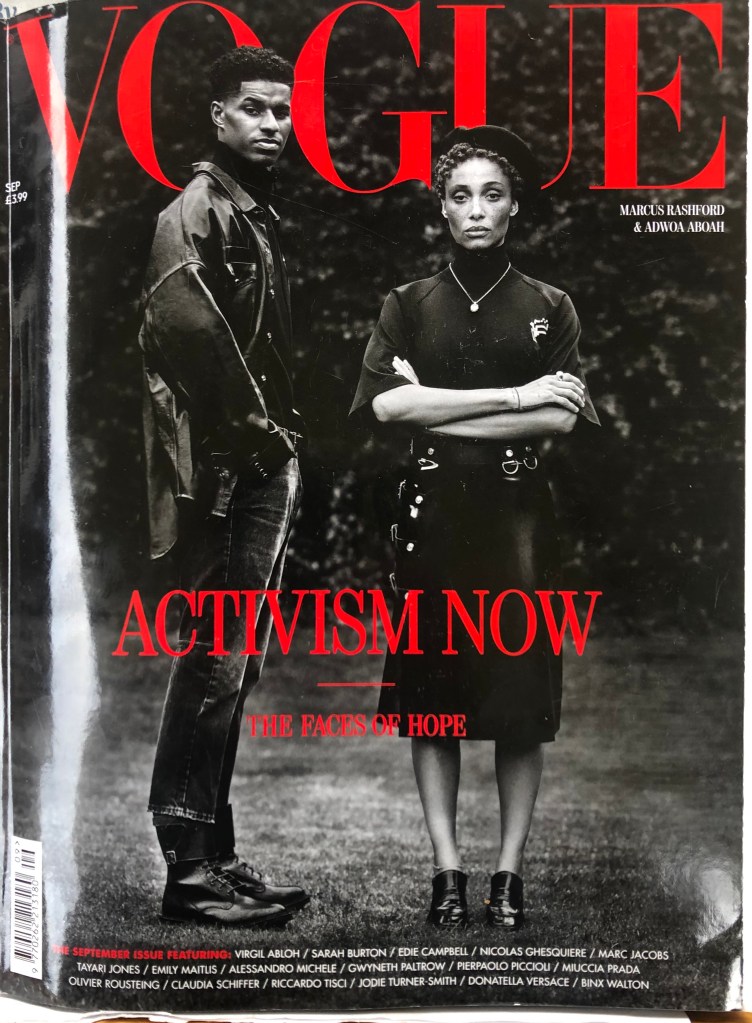
I found some the other day, in what might seem to be a rather unlikely place. They were in ‘Vogue’ magazine. Yes really, ‘Vogue’. I’m hoping we can show the cover of the latest edition on our screen. There it is.

There on the front cover with the supermodel Adwoa Aboah, is Marcus Rashford, the Manchester United footballer, who made a fuss and persuaded the government to provide school meals for poor children during the holidays; and inside there are many more people who are called the ‘faces of hope’, working in many ways as activists to bring hope where previously there was none.

I assure you that I’m not a secret employee of the publishers Condé Nast. I’m not on commission based on how many copies of Vogue you buy. But it is worth a look. There are many inspiring stories – and, reflecting the rise of Black Lives Matter, for once the stars in this glossiest magazine are all black. Beautiful black people.

Hmm. In the Song of Songs the bride sings – as you can hear in Monteverdi’s Vespers of 1610 – ‘Nigra sum, sed formosa’, ‘I am black, but beautiful’. ‘But’ beautiful. That’s the only false note in that beautiful song. Not ‘but’ beautiful, but ‘and’ beautiful is what it should be. And the editor of ‘Vogue’ has celebrated that. He is Edward Enninful, and he is an activist.

What else about these activists? A common feature of all their stories is that they all say their activism builds a sense of community, or having values and friendship in common with each other. So would the Blessed Virgin Mary count as an activist today?

I’m sure she would – maybe in a similar way to some of the beautiful people portrayed in ‘Vogue’, as icons to be followed, to be copied. Faces of hope.

Because what else does this make you think about? Surely we can loop back from our world today to the first century AD. The stories of the activists in Vogue are very reminiscent of the stories of the early Christians. They were activists; they were a community; they had everything in common. They would lift up the lowly and fill the hungry with good things. Build up your community – support your local food bank, say – isn’t that just another way of saying, ‘Love your neighbour’?

That might prompt you to think again about Mary’s song, Mary’s rant, the Magnificat, as it’s called. Because ‘magnificat’ is Latin for ‘bigged up’, ‘magnified’, ‘made more of’; as the hymn puts it: ‘Tell out, my soul, the greatness of the Lord’. And the Magnificat, sung by a cathedral choir, is one of the highlights in Evensong, that lovely service, that you can hear on Radio 3 twice a week – this afternoon at 3 and then on Wednesday at the same time – or on any day in the Cathedral at 5.30 (in normal times). It’s something you might just let flow over you in its beauty. Well, you mustn’t stop enjoying the Magnificat – but do remember that it is a call to action, to be an activist, for God.

A Reflection at Easter, April 2020

By Hugh Bryant

‘The language around COVID-19 has sometimes felt trite and misleading. You do not survive the illness through fortitude and strength of character, whatever the Prime Minister’s colleagues’ll tell us. And the disease is not a great leveller, the consequences of which everyone, rich or poor, suffers the same. This is a myth which needs debunking. Those serving on the front line right now, bus drivers and shelf stackers; nurses, care home workers, hospital staff and shopkeepers, are disproportionately the lower-paid members of our workforce. They are more likely to catch the disease because they are more exposed. Those who live in tower blocks and small flats will find the lock-down tougher; those in manual jobs will be unable to work from home. This is a health issue with huge ramifications for social welfare, and it’s a welfare issue with huge ramifications for public health. Tonight, as France goes into recession, and the World Trade Organisation warns the pandemic could provoke the deepest economic downturn of our lifetimes, we ask what kind of social settlement might need to be put in place to stop the inequality becoming even more stark.’ (Emily Maitlis, introducing ‘Newsnight’, BBC Two, 8th April 2020.)

That was such a grown-up and eloquent comment on the COVID-19 plague, that my first reaction was to scratch around to see whether Emily Maitlis had been quoting some eminent philosopher or grand old man or a woman of world affairs when she introduced ‘Newsnight’ on BBC2 on Wednesday night. But my instinct was unworthy. She is a very talented journalist in her own right and those are her words.

Her words are among the most apt and most challenging words in the torrent of verbiage which the first week of lockdown has produced. I can’t really get excited by this procession of metropolitan sophisticates discovering the joys of birdsong and blue-skies-without-aeroplanes, empty roads and silence.

I’m sure there is a place for all those good things, but somehow I don’t think that, when this is all over, historians will look back and celebrate stumbling prose about the unaccustomed joys of birdsong. Instead our generation will be judged on how we dealt with this ‘health issue with huge ramifications for social welfare, [or] …welfare issue with huge ramifications for public health’, as Emily Maitlis so eloquently put it.

It seems extraordinarily apt that Emily Maitlis said what she did on the eve of Maundy Thursday. For Christians, Maundy Thursday is the day when they remember Jesus washing the disciples’ feet. The son of God, arguably the most important man who has ever lived, doing the same sort of thing that a care home worker does, washing the dirty bits, becoming a servant. As we have seen in this COVID-19 plague, the sort of thing that Jesus was doing can become very dangerous. So dangerous that only people who don’t matter are put in the line of risk. Only the expendable ones, although nobody spells this out. As Emily Maitlis said, the bus drivers, the shelf stackers, nurses, care home workers, hospital staff and shopkeepers. The government has advertised jobs in the new Nightingale Hospital at the Excel Centre including receptionists at £37,500 per annum, when at the same time nurses and doctors, after years of training, start at less than £25,000.

Somebody will say that the market justifies this, that there are fewer people willing to be receptionists in the Nightingale hospital than there are willing to be doctors and nurses in that dangerous place. Therefore by the inexorable laws of supply and demand the willing, the brave, are worth less than those in short supply. Put that way, the proposition looks quite indefensible. How could the market, even if it is correct in identifying shortages in that way, be the only guide to the value of these vital people’s work?

But wait a minute. How does the market account for the fact that there is a shortage of doctors and nurses, tens of thousands of doctors and nurses? Either the market is not functioning properly, as their value is not rising to reflect their scarcity, in which case all these political statements based on “realism” and “the market” are not true, or the market as an index of value is not actually accurate. Either way there is a glaring injustice. As Emily Maitlis put it, ‘… what kind of social settlement might need to be put in place to stop the inequality becoming even more stark?’ How are people to be valued in future?

Christians have a number of pointers in front of them, particularly at this time in Holy Week and Easter. So much of what Jesus did and said was counterintuitive and back-to-front. Before he was born, when an angel announced to Mary that she would be the mother of the Messiah, what she said, “My soul doth magnify the Lord, and my spirit hath rejoiced in God my saviour…’: this speech, this aria, this canticle, is one of the most subversive, even one of the most revolutionary, passages in the whole of literature. ‘For he hath regarded the lowliness of his handmaiden’. God chose an ordinary young girl; he selected her knowing that she was one of the little people. ‘He that is mighty hath magnified me’. The omnipotent, the divine, the greatest power, has chosen me, small and insignificant, and made me great.

‘He hath put down the mighty from their seat: and hath exalted the humble and meek.

He hath filled the hungry with good things: and the rich he hath sent empty away.’

This is what God is doing. This is the implication of his having chosen someone not special, just an ordinary girl; but having chosen that person to be the mother of the divine incarnation, God with us. God in human form. She wasn’t in any way rare or perfect or uniquely suited to this job. She was just an ordinary girl from a humble background. God’s choice implies a direct challenge to the value system that we have had and we have in our world today. The Magnificat shows up and challenges head-on the great divide in our society between the rich and the poor, between the great and the little people.

That was before Jesus was born. The Magnificat points to how he is going to operate. It points forward to the Sermon on the Mount, the longest sustained piece of counterintuitive argument that you are ever going to come across. The Beatitudes: ‘blessed are the – poor: blessed are the meek. Not ‘blessed are the people in large houses riding about in Lamborghinis’. (See Matt. 5,6 and 7 http://bible.oremus.org/?ql=453535527)

In one sense I disagree with Emily Maitlis. She says, ‘And the disease is not a great leveller, the consequences of which everyone, rich or poor, suffers the same.’ I know – indeed I passionately agree with – what she means. But in one important sense, there is equality. We are all – wherever in the world we come from – we are all creatures of God, made in His image. The virus is not a leveller, as Emily Maitlis rightly says. It affects all humans – and, unfortunately, tigers too.

Where it does not level us is shown by what happens when the virus has struck someone. Then it depends where you are and how wealthy you are, either as an individual or because you belong to a rich society, whether you will get full treatment. Even so, so far we have not yet discovered a cure, so even with the best treatment in an intensive care unit in a European or American or Far Eastern teaching hospital, you may still die – but you will be made as comfortable as possible, and you will have the very best chance of survival.

If on the other hand Coronavirus strikes and you are in a refugee camp on the border of Syria, in Jordan perhaps, or if you live in the slums of Calcutta or Bombay, or in many parts of Africa, there are far fewer doctors, far fewer hospitals, and no money or National Health Service to pay for your treatment. In the USA, except in one or two enlightened states such as Massachusetts, unless you can afford to buy expensive health insurance, no-one will treat you.

But perhaps the reason why this is so wrong, and why this is a ‘health issue with huge ramifications for social welfare’, is that there is no good reason why some people should be so much better off than others – or rather, that so many people should be so much worse off than the fortunate few. Why should there be any entitlement in an accident of birth? Rich and poor, G7 or Third World, we are all susceptible to COVID-19. But if we are all liable to suffer, should we not all share the means of salvation?

Rowan Williams, former Archbishop of Canterbury, spoke recently about the objective of the Good Life (with a capital G and L) being, not, as theologians and philosophers from Aristotle to Thomas Aquinas have argued, ‘human flourishing’ (ευδαιμονία) but rather, the objective, the objective of the Good Life, is to be safe. Safe. Safe from harm. Safe from disease. Safe from hunger.

Again, Christians can turn to the teaching of Jesus. Think of the Great Judgment in St Matthew chapter 25 (from verse 31), the division of the sheep and the goats, the saved – the ones who are safe – and those condemned to eternal damnation. Hunger. Thirst. Disease. They are at the heart of it. What did you do for them? No suggestion that some hungry people, or thirsty people, or poorly people, might deserve to be safe, to be saved, more than others. Absolutely not. Jesus says that He is in all of us, however lowly.

Again, just as God chose the humble Mary, so ‘the righteous will [say]…, “Lord, when was it that we saw you hungry and fed you, or thirsty and gave you drink, a stranger and took you home, or naked and clothed you? When did we see you ill or in prison, and come to visit you?” And the king will answer, “I tell you this: anything you did for one of my brothers here, however humble, you did for me”. (Matt. 25:37-40, NEB). (Jesus would surely have wanted to be explicitly gender-neutral if he had been saying this today, and would surely have said, ‘anything you did for one of my brothers and sisters here, however humble, you did for me.’)

So at this Easter time, when we remember Jesus’ amazing self-abasement, his humbling himself to wash the disciples’ feet, and then his enduring the most terrible torture and death – being the most important man on earth, but beaten and strung up to die with common criminals, as a common criminal, because that was actually his rank, his lowly position in society – and then rising in triumph, leaving the empty tomb: when we reflect on that extraordinary sequence of events, the Triduum, the Three Days, we can realise that there is an alternative. There is an alternative to the dominion of the market. There is an alternative to people who know the price of things but not their value. The fact that Jesus beat death – and that must be about the most counterintuitive thing he ever did – has given us hope: the ‘sure and certain hope of the resurrection to eternal life’. And that is for everyone, for everyone who could possibly catch COVID, wherever they are and whatever flag they fly.

Emily Maitlis concluded, asking ‘what kind of social settlement might need to be put in place to stop the inequality becoming even more stark’. That is the most important thing we have to do when the medical campaign against COVID-19 has been won. It is a huge challenge: but Jesus has given us hope, hope that we can do it. The Easter message is one of hope, and of salvation, that we can make that Good Life, where all people, everywhere, are safe.

‘To be a Christian is to be attentive to signs of God’s action in the world, and this is especially true in Holy Week and at Easter when – the faithful believe – Jesus by his death and resurrection revealed the nature of God’s relationship with humanity.’ Sometimes one finds profound theological statements in unlikely places. That sentence was from the first editorial in the Guardian on Wednesday 17th April. It is perhaps a slightly different way of putting the profound words ‘God so loved the world that He gave His only son …’

The three hours’ devotion service on Good Friday is concerned with sacrifice, about Jesus’ sacrifice, his terrible suffering and death. The service is unlike any other one in our Christian year. What makes it special is that we try to get really close to Jesus in his last hours, to understand what happened to him and what he did; as we often say in a theological context, to walk alongside him, or maybe rather to have him walk alongside us, in his time of trial.

To say the service is unlike any other one is not quite right, because every time we celebrate Holy Communion we remember Jesus’ sacrifice – ‘in the same night that he was betrayed, he took bread, and when he had given thanks to thee, he broke it and gave it to his disciples… and likewise after supper he took the cup; and when he had given thanks to thee, he gave it to them, saying, Drink ye all of this, for this is my blood of the new covenant’. The heart of the Eucharist service is a memorial of the Last Supper, before Jesus’s crucifixion and death. I’m not in any way trying to take away the significance of the holy Eucharist, but I am saying that the Good Friday service takes you further and takes you deeper in understanding, or rather, shall we say, in appreciating, what Jesus went through.

What I am going to try to do now is to address that question of understanding. I hope that you will more fully appreciate what Jesus suffered, what he went through; and to some extent you will understand why, at least in the historical sense of who did what to whom.

I’m not going to touch on the mechanics of the crucifixion or the literal historical data; what I want to concentrate on is trying to explain it. Why did Jesus have to die?

Perhaps today it’s more a question ‘Why did He die?’, not necessarily why he had to die. You could say, following the words of the Creed, that Jesus’ death was for us – ‘who for us men and for our salvation came down from heaven and was incarnate by the Holy Ghost and the Virgin Mary and was made man, and was crucified also for us under Pontius Pilate’. Jesus himself said that ‘greater love hath no man than that he should lay down his life for his friend’. (I am quoting from the Book of Common Prayer, 1662, and the Authorised Version of the Bible, 1611, so it is necessary to point out that ‘man’ means ‘human being’). Or again, we hear that Jesus is the ‘propitiation for our sins’, making up for what we have done that is sinful.

There is a powerful romantic theme that occasionally people do heroic things where they suffer in somebody else’s place. St Paul, in his letter to the Romans [5:7-8], contrasts what you might call ordinary heroism, risking your life or even losing your life, to save someone else whom you might not know particularly well, but have nothing against, and what Jesus appears to have done, which is to give his life not for just anybody but for people who definitely don’t deserve it, who are sinners.

We don’t really talk about ritual sacrifice much these days. The idea of going to a temple and slaughtering some animal to give it ritually to God is completely alien to us in our modern world. But I think we know how it was supposed to work: that nobody could measure up to God’s perfect standard, and to the extent that you fell short – an example of falling short would be Adam and Eve in the garden of Eden – to the extent that you fell short you had to ask God for forgiveness, to make it up to him, to turn away God’s wrath.

This is allied with the idea of the Last Judgement, either at the end of the world, (if we can imagine that), or at the end of a person’s life. And again, although we couldn’t really describe with any certainty what to expect at that End Time, as it is called, there is a very common idea that there will be some kind of last judgement; and indeed in the Bible at the end of St Matthew’s Gospel there is a picture of the last judgement, the division of the sheep from the goats. ‘The Son of Man shall come in his glory and all the holy angels with him. Then shall he sit upon the throne of his glory and before him shall be gathered all nations. And he shall separate them one from another as a shepherd divideth the sheep from the goats’ (Matthew 25:31-32). In that context, Jesus is taking the punishment that sinful man would otherwise deserve.

But there is a little question mark. It is easy to miss this, but particularly in the context of this very solemn, contemplative service, when we are trying to get as close as we can to follow in Jesus’s footsteps on the way to the place of the Skull, Golgotha, where he was crucified, the little niggle, if you like, is quite a major issue in fact. It is this. God gave his only son. What does the word ‘gave’ mean, here? God is, after all, the creator and sustainer of everything and

everyone. Did He give his only son over to be hurt, to be whipped, to be insulted, to be humiliated, to be tortured and ultimately killed in the most bestial way? Because if he did that, how can we say that God is a loving God, that God wants the best for all of us, and if there is evil in the world, it has come in against God?

As you know, sin isn’t just, isn’t really at all, a question of doing bad things. It has a very particular meaning. It is about being separated, divided off from God, cut off from God. And the ‘salvation’ that we talk about, that we believe in, the eternal life – ‘so that everyone who believes in him may not perish but have eternal life’ – that salvation is coming together with God, being united eternally. So in that context how could God give his nearest and dearest over to be horribly hurt and then killed? Something doesn’t add up.

At the very least it looks as though there is a paradox. How could the good God hurt anyone, least of all his own son? And if you were concerned about that, put yourself in Jesus’ position. You would feel uniquely deserted. We will say, towards the end of this service, the terrible words of Psalm 22: ‘My God, my God, why have you forsaken me?’ It’s what Jesus said as he suffered. There is no more terrible protest in the whole of literature. ‘My God, my God, why have you forsaken me?’

But at the end of the Stations of the Cross, these days the last station is usually the station of the Resurrection. These days, particularly since the Roman Catholics dusted off the old idea in their second Vatican Council in the sixties, the most important message to the world from Easter is the message of what they call the Paschal Mystery, the ‘unity of the death and resurrection of Jesus’. The Paschal mystery; the mystery is that unity, that putting together, of opposites; that everything to do with Jesus is the opposite of what you would expect.

Think of the Sermon on the Mount. Love your enemies. Turn the other cheek. Don’t retaliate. The exact opposite of the normal thing to do. In the Beatitudes, everything is back to front. ‘Blessed are the poor in spirit.’ You would have thought in the context of being close to God himself – the most theological situation you could possibly be in – that the last thing you would possibly want, in heaven with God, is to have weedy people round you who have no particular spiritual gifts. But they are blessed. ‘Theirs is the kingdom of heaven’. That’s crazy.

It’s more straightforward to understand ‘Blessed are they that mourn’. For ‘They shall be comforted’. That is a contrast, but it is an understandable one. You might hope for comfort. Jesus assures it.

But ‘Blessed are ye when men shall revile you and persecute you, and shall say all manner of evil against you falsely for my sake. Rejoice and be exceeding glad, for great is your reward in heaven.’ Doesn’t sound happy – but happiness is assured.

Think of the Magnificat, the most revolutionary text this side of Karl Marx. ‘He hath put down the mighty from their seat, and exalted the humble and meek. He hath filled the hungry with good things, and the rich he hath sent empty away.’ ‘The rich man in his castle, the poor man at his gate.’ Why don’t we sing that verse of ‘All things bright and beautiful’ any more? Mrs Alexander wasn’t saying it was right when she wrote that verse. We shouldn’t just shut it away. It’s shocking, and it’s meant to be.

There’s a sort of tension on Good Friday, there’s another sort of paradox; in a very sacramental way, for Jesus to be uniquely alive, alive in a new way that no-one had ever seen before, the opposite had to be true. He had to be very, very dead. But except in the very minimal sense that God, the creator and sustainer of all things, must be behind everything, everything that happens, I think we can explain Jesus’ suffering, not in terms of cruelty by his father, but in terms of the waywardness of sinful man.

When you look at the details of the trial before Pontius Pilate, there isn’t an inevitability about what happens. It is the active badness, the active sinfulness of the chief priests and scribes which catches Jesus. Pilate gave them a good way out if they had got carried away by the mob, by offering Jesus as the prisoner to be released in the traditional way at Passover time. But they positively chose – it was deliberate – to release the bad man and to kill off the good one. It was another paradox, and another counterintuitive.

But as you go through the Good Friday service, metaphorically walking behind the cross with Jesus, I do suggest that you can hold your head high and recognise him truly as your king, because that tomb will definitely be empty. This is Jesus working out the way to salvation: salvation, a relationship with God, a close relationship with God. That tomb will definitely be empty.

One implication of that is that there’s no need for a priest to stand between us and God. Jesus is the great high priest, who has opened the sanctuary to us. In the letter to the Hebrews [chapter 10], we will hear that the Lord says ‘I will remember their sins and their lawless deeds no more,’ and the letter goes on to say, ‘where there is forgiveness there is no longer any offering for sin. Therefore my friends since we have confidence to enter the sanctuary by the blood of Jesus, by the new and living way, that he opened for us through the curtain, let us approach with a true heart in full assurance of faith, with our hearts sprinkled clean from an evil conscience’.

It’s not a question of buying off God’s wrath. It’s the other way round. God will raise Jesus from the dead, in the Easter morning miracle that we will joyfully celebrate. There it is. There is forgiveness and there is no longer any offering for sin. There will no longer be any blood sacrifice.

But first we must follow Jesus. To come out into his blessed light, we must follow him into the darkness.

This is an edited version of a reflection originally given by Hugh Bryant at the Three Hours’ Devotion service at St Mary’s Church, Stoke D’Abernon, on 19th April 2019.

Sermon for Evensong on the Fourth Sunday of Advent, 23rd December 2018

Isaiah 10:33-11:10, Matthew 1:18-25

‘In the bleak midwinter’; ‘Snow had fallen, snow on snow’; ‘Good King Wenceslas looked out … deep and crisp and even’. But Bethlehem is a hot place, dusty rather than snowy. I suppose carols and hymns can be rather an unreliable source of proper geographical information. ‘And did those feet .. walk upon England’s green and pleasant land?’

I don’t suppose they sing ‘Jerusalem’ in Italy, or in France or in Germany. Or if they do, presumably those feet were walking in the Black Forest or on the Palatine Hill, or maybe, in the Bois de Boulogne. There is, if we are literal about it, quite a lot of nonsense which we happily tolerate at this time of year. Things that appear to go completely contrary to common sense; like snow in Bethlehem. It probably was quite cold at night in the stable, once the sun had gone down. But there certainly wasn’t any snow.

One of the things that these carols are doing is assimilating the story of the birth of Jesus into our homes, or rather into an idealised version of our homes, because even here in England a white Christmas is, of course, very rare. I think it’s a fairly safe assumption that we won’t have one this year either.

And as well as the carols, the Bible readings that we traditionally use at this time also contain things which look contrary. Isaiah’s wonderful vision of the peaceful life on ‘God’s holy mountain’, after the Rod of Jesse, the Saviour, has beaten the Assyrians, and saved God’s chosen people, isn’t just a pastoral idyll.

It deliberately puts almost impossible companions together. The wolf and the sheep; the leopard, the kid; the calf, the young lion, the cow and the bear – the little child, leading them, like a party of schoolchildren following their teacher around the Tower of London, say.

Or perhaps it’s a classroom, full of these unlikely neighbours, who are not busily eating each other, but they are sitting attentively in class, being kept in good order by a little boy, like my two-year old grandson Jim. In your dreams, Sunshine!

Well, yes; in Isaiah, in Isaiah’s dreams. In the words of the prophet, telling his hearers what God has spoken to him and said, that the Rod of Jesse would come and slay the Assyrians, and then that they ‘would not hurt or destroy on God’s holy mountain.’

Interesting that it is on a mountain, on a high place. The Greek gods were on a mountain too; on Mount Olympus. And in the Old Testament, the heathen gods, the Baals and the Astartes of the Chaldeans, were worshipped with sacred poles, which were ‘in the high places’. ‘High places’ was almost a synonym for where God lived. We ourselves look up, look up to heaven, because conventionally, God lives in Heaven, and Jesus sits at God’s right hand ‘on high’, we say. Think of our Psalm this evening.

Unto thee I lift up mine eyes:

O thou that dwellest in the heavens. [Ps. 123]

But again, it’s not literally true. Yuri Gagarin, the first astronaut, was said by Nikita Krushchev to have gone into space ‘but not to have seen God there’. The early astronauts didn’t find a man with a white beard sitting on a golden throne and floating above the clouds. John Gillespie Magee’s wonderful poem, which is often read at the funeral of a pilot, ‘High Flight’, comes to mind. ‘Oh, I have slipped the surly bonds of earth … put out my hand and touched the face of God’. And so, on God’s holy mountain, children can safely play with cockatrices, vipers, and with asps, cobras. ‘Sheep may safely graze’.

It’s a much better outlook for the Israelites. The Messiah would come along and free them from slavery. The Rod of Jesse would mete out retribution to all their foes. That’s something that we can certainly relate to. ‘If only ..’, we say. If only: what would you call in the Rod of Jesse to do in your life? But maybe we are too comfortable, too well settled to really empathise with how the Israelites must have felt.

But there are people who are in exile, who are not free, who may even be subjected to slavery, even today, not far away. On Friday I did my first Father Christmas duty of this Christmas, up at Brooklands College, where there is a project for children who are asylum seekers and refugees. I gave out splendid big stockings full of goodies donated by the supporters of the project and by Elmbridge CAN, our local refugee support group, to 26 young people, teenagers and in their early 20s, who had come from Eritrea, from Syria, Ukraine, from Kurdistan, Iraq, from Afghanistan. Some were black Africans, some were Arabs, a couple were Chinese, and a couple were white Europeans. Many do not know whether they will be allowed to stay.

Some were learning to read and write for the first time; although typically, the ones who hadn’t been able to read and write were amazingly good at mental arithmetic. They were learning English, of course, and learning how to fit in with English society. The first words that they are taught are ‘please’, ‘thank you’, and ‘sorry’, because none of those are necessarily expressions that you come across in some of the countries that they have come from. Part of Father Christmas’ visit was a huge lunch, of Middle Eastern and African delicacies, that one of the volunteers from Elmbridge CAN had made. For about half the children, this would be their only meal that day. One meal, if you’re lucky. This is in Weybridge!

So pictures of the Israelites, in exile and under the oppressor’s boot, could still in certain circumstances be a picture of contemporary life, for refugees and asylum seekers today. Think what life in the refugee camps must be like, in Jordan, for example. No snow there, either!

As well as the mythical snow on this fourth Sunday of Advent, just on the eve of Christmas itself, St Matthew tells us the story of the other half of the Annunciation. This isn’t about Mary but about Joseph her betrothed. Again, the Christmas story is so familiar that we perhaps gloss over the bits that seem rather unlikely. Joseph’s original reaction when he finds out that his wife-to-be is pregnant, although he has had nothing to do with it, is what you might expect. His first thought is that the wedding is not going to happen.

Who is the Angel Gabriel? Have you met any angels recently? Or at all? It seems to depend a bit on where you come from and what you’re used to. In Africa and in Southern Europe, people are much more ready to believe in the existence of angels than perhaps we are. I don’t think that we can explain the Virgin Birth in the same way that we could explain how to bake a perfect soufflé – or whatever it is they do on the Great British Bake-Off.

But look at it functionally. Jesus definitely lived. He was a human being, although during his life and afterwards, things happened which have led us to believe that he was more than human, that he was divine as well as human. So somehow he must have been born, been conceived. All the things that show that he was really born, that he really was human, just like the other miracles, turning water into wine, miraculously healing sick people, raising Lazarus from the dead – none of those can be explained: so Jesus’ conception is equally mysterious and impossible to understand.

But notice how Jesus’ earthly parents, wonderfully, accepted the situation; and of course Mary said the Magnificat, which we’ve just sung together. God has chosen me; God has magnified me; God has made a big thing out of me.

Is it just a pretty story, then? Is it just a convenient excuse to have a nice time at Christmas? Think about what Mary said. Think about the message of the Magnificat, and the message of Isaiah, about the animals on ‘God’s holy mountain’. ‘He has put down the mighty from his seat, and exalted the humble and meek.’ Are we the mighty? Or are we the ‘humble and meek’?

We need to think about it, and to do something. Perhaps the other thing about God’s holy mountain is that a little child shall lead them. Shall we say that that is the Christ Child? You know, in snowy Bethlehem? And another thing. ‘No crying he makes’. This is some baby!

High Flight

Oh! I have slipped the surly bonds of Earth

And danced the skies on laughter-silvered wings;

Sunward I’ve climbed, and joined the tumbling mirth

of sun-split clouds, — and done a hundred things

You have not dreamed of — wheeled and soared and swung

High in the sunlit silence. Hov’ring there,

I’ve chased the shouting wind along, and flung

My eager craft through footless halls of air….

Up, up the long, delirious, burning blue

I’ve topped the wind-swept heights with easy grace.

Where never lark, or even eagle flew —

And, while with silent, lifting mind I’ve trod

The high untrespassed sanctity of space,

– Put out my hand, and touched the face of God.

John Gillespie Magee (1922-1941)

Sermon for Evensong on the second Sunday of Easter, 3rd April 2016
Wisdom 9:1-12

It’s one of those classic ways of passing time or getting off to sleep, if you’ve woken up in the middle of the night. You are the heir to the throne: you’re going to be king. God appears to you in a dream, and says, ‘What would you like? You can have anything you like.’

Of course, being a good Bible student, you will immediately be reminded of the story of Solomon and his dream in 1 Kings 3 or 2 Chron. 1. What did Solomon ask for? Solomon asked for wisdom. He might have used the words which were in our lesson today, from the book called ‘The Wisdom of Solomon’. He said, ‘God of my fathers, and Lord of mercy, who hast made all things with thy word,
And ordained man through thy wisdom, that he should have dominion over the creatures which thou hast made, …
Give me wisdom, ..’

Solomon did not ask for riches, or power, or any of the other kingly trappings – although God was so pleased with his choice, with his asking for wisdom, that he did give him all the other good things as well.

These days we don’t really think much about wisdom, or in those sort of terms. We don’t talk about people being ‘wise’ men. ‘Wise’ tends to be more of a cynical pejorative – he is just a ‘wise guy’. But wisdom, on proper reflection, is not just knowledge, but discernment and the ability to choose the right thing to do in circumstances where it is very difficult to know what is the right thing to do. Perhaps, indeed, we ought to look at wisdom again.

When you watch the pictures on the news showing the government minister meeting the steelworkers at Port Talbot, and you hear the ministers saying that they will do everything that they can do, lots of questions come crowding into one’s mind. If you thought along the lines of the author of the book of Wisdom, you could imagine the government ministers praying that Wisdom would come and help them out.

We don’t think that it was actually Solomon who wrote the book, but it was someone much later, writing in his honour: a Greek, most likely in Alexandria, who could have been writing about the same time as Jesus Christ. The Book of Wisdom was very much influenced not just by Jewish history, but also by Greek philosophy, especially by Plato and the Stoics. There is the Platonic idea of the essences of things being real as well as their manifestations. So we understand what it is for something to be a table, because we have an idea, a concept, an essence, of tables, in our minds.

So similarly Wisdom, the idea of Wisdom, to put it in Plato’s terms, almost has an independent existence all of its own – or rather of her own. If you are called Sophie or Sophia, you are named after the Greek word for wisdom. In the wisdom literature in the Bible, the books like the Wisdom of Solomon or Proverbs or Ecclesiastes, wisdom is personified; wisdom is a being in her own right, who can guide you into the correct path in order to follow the will of God.

So a government minister looking at the crisis in the steel industry would no doubt be very pleased to have a guiding figure, a Mrs Wisdom, at his or her side. What is the right thing to do? What are the principles which should inform one’s decision? Is it right that the only thing that matters is the law of the market, and, moreover, the law of the market worldwide? If so, it is tough, but it should just be a question whether our steel plant can make steel cheaper than anyone else. That wouldn’t give much hope to the people in Port Talbot.

But what if the market is modified, by tariffs, for example? Should we protect our steel producers by erecting a tariff barrier? There are arguments for and against. Does the fact that thousands of people will lose their jobs, does that outweigh in importance all the other considerations? Wouldn’t it be nice to have a gentle feminine voice in one’s ear saying, ‘Choose this; avoid that. This is the way that the problem will be solved.’

But how do you know whether you have got it right? Solomon, of course, demonstrated wisdom right at the beginning, when the two women came, both claiming to be the mother of a particular baby. How to tell which was the right mother? So he proposed to chop the baby in half and give each mother half a baby. It soon became clear which was the real mother. Wouldn’t it be nice if all wisdom calls were so simple? [1 Kings 3:16-28]

I’m sure that the ministers would indeed be really delighted if it was really possible to invoke the assistance of some goddess-like creature who would hold their hands and point them in the right direction.

The Wisdom of Solomon was a book which the early Christians liked, because they thought that it pointed forward to Jesus and the coming of the Holy Spirit. The lesson says, ‘Who ever learnt to know thy purposes, unless thou hadst given him wisdom and sent thy holy spirit down from heaven on high?’ (Wisdom 9:17) Wisdom is bound up with the Holy Spirit.

The Book of Wisdom is not a canonical book. Not every Bible has it in. It’s in the Apocrypha. If you look in the Articles of Religion in the back of your prayer book, Article 6, on page 613, you will see the list of canonical books which were the books which were supposed to contain everything necessary for salvation, and the other books which ‘the church doth read for example of life and instruction in manners’, include the Book of Wisdom. St Paul considered Christ to be the wisdom of God. There is something very closely connected, between the idea of Wisdom and the idea of the Holy Spirit, the essence of God at work.

Just before Christmas in the early Roman church at Vespers (which became part of our Evensong), before the Magnificat they sang an Antiphon, an ‘O’ Antiphon: O Adonai, O Root of Jesse, O Key of David: and the first Antiphon was ‘O Sapientia’, ‘O Wisdom’, in Latin.

‘O Wisdom, coming forth from the mouth of the Most High,
reaching from one end to the other mightily,
and sweetly ordering all things;
come and teach us the way of prudence.’

That is ‘O Sapientia.’

We can get something out of the idea of wisdom personified, of O Sapientia, even today. Wisdom, for a government minister, ought not to be just a question of making sure they take all the right theories, the right political dogmas, into consideration. True wisdom means they should consider in the round, from all angles, whether that dogma is right, whether it is kind enough to the people whose lives it affects.

The spirit of wisdom is surely the Holy Spirit. So to consider Wisdom, we must consider the Spirit as well. What would Jesus do? What is the will of God? Where is the Holy Spirit leading? In the chapels in the Welsh valleys tonight, their prayers will be rising. Let us pray with them, and let us pray in particular that the true spirit of Wisdom will come among those who have the power, either to save those communities or to turn their backs on them. They do it in our name. Let us hope that they, in their power and good fortune, will appreciate how those strong men in their Welsh valleys really do need them to have, not just clever theories, but true wisdom.

Sermon for the Fourth Sunday in Advent, 20th December 2015

Luke 1:39-55

Not long ago there was a feature running in our parish magazine ‘Together’ about favourite hymns. Today I want to talk about another hymn, which wasn’t mentioned: perhaps the favourite hymn in all of Christianity. This is far bigger than ‘Shine, Jesus, Shine’ or ‘Love Divine’.

In the Gospel, that I have just read, we heard it. It’s the Song of Mary, which is often referred to by its old Latin name, Magnificat. ‘Magnificat’ means ‘magnifies’, ‘makes bigger’.

Every evening, about 6 o’clock, in every cathedral in this country, a really good choir (because all our cathedrals have super choirs) will sing this beautiful song, using the words from the Book of Common Prayer – words which were written half-way through the sixteenth century, as a translation from the Latin of St Jerome, which was itself a translation from the Greek that St Luke the doctor actually wrote his Gospel in.

And every Sunday at Evensong, at six o’clock at our sister church, St Mary’s in Stoke D’Abernon, there too, we sing the Magnificat. It could be the number one hymn in the Church of England – and versions of it are sung by churches all over the world. Magnificat might even be the most-loved hymn in Christianity.

Evensong in cathedrals – which is broadcast as Choral Evensong on BBC Radio 3 on Wednesdays and Sunday afternoons – it’s on this afternoon at 3, if you want to listen, this time from Chester Cathedral [ http://www.bbc.co.uk/programmes/b06rwy7p%5D – is reported to be the service where the congregations have grown most in the Church of England in recent years: not, actually, a modern service, but a service which can trace its origins back to the fourth century, and which was first set out, in the form we use today, in 1549.

The music which they sing is really beautiful. Choral Evensong, in every cathedral, every night, with a wonderful choir in every one, is a secret gem. More and more people are discovering it.

These are the words of the Magnificat that they sing:

My soul doth magnify the Lord :
and my spirit hath rejoiced in God my Saviour.

For he hath regarded :
the lowliness of his handmaiden.

For behold, from henceforth :
all generations shall call me blessed.

For he that is mighty hath magnified me :
and holy is his Name.

And his mercy is on them that fear him :
throughout all generations.

He hath shewed strength with his arm :
he hath scattered the proud in the imagination of their hearts.

He hath put down the mighty from their seat :
and hath exalted the humble and meek.

He hath filled the hungry with good things :
and the rich he hath sent empty away.

He remembering his mercy hath holpen his servant Israel :
as he promised to our forefathers, Abraham and his seed for ever.

OK, some words we ought to explain a bit. ‘He … hath holpen his servant Israel’. ‘Holpen’ means helped.

He has ‘regarded the lowliness of his handmaiden’: he has looked favourably on her, he has held her in high regard, we might say.

And presumably you all know what a handmaiden is. Mary was a ‘lowly handmaiden’. She wasn’t one of the great and good.

‘For he that is mighty hath magnified me’. There’s that ‘magnifies’ word again. This time it’s not Mary ‘magnifying’ God, but her saying how God has magnified her.

And then the ‘purple passage’.
‘He hath put down the mighty from their seat :
and hath exalted the humble and meek.

He hath filled the hungry with good things :
and the rich he hath sent empty away.’

Can you, really, see Mary, a teenager, a simple country girl, singing this song? Are they the sort of words which would just come tripping off the tongue of a teenager?

Not for the first time our Bible doesn’t really put this – even in a modern translation, like we used for the lessons – in the sort of language we would use today. ‘Tell out, my soul, the greatness of the Lord’, in Bishop Timothy Dudley-Smith’s hymn which we’ve just sung, isn’t actually a very good translation either – although Bishop Timothy got it from my favourite modern Bible, the New English Bible.

The meaning is really better expressed by what a teenager today might say: ‘Deep in my heart, I big up the Lord’. I big Him up: that’s exactly right. Mary isn’t saying that she is somehow making God bigger – because God is bigger than anything – but she is bigging Him up, she is telling out His greatness.

Giles Fraser, who often does Thought for the Day on the Today programme, who was at one time philosophy tutor at Wadham College, Oxford and Canon Chancellor of St Paul’s, who got fired for trying to make friends with the Occupy protesters camped out on the Cathedral doorstep, he, Giles Fraser, reckons that the Magnificat is one of the most powerful revolutionary texts. In September, he Tweeted, ‘BTW I don’t think [that] the Red Flag [is] anywhere near as revolutionary as the Magnificat’. [https://twitter.com/giles_fraser/status/643049147919110144]

Remember what Mary said. It could indeed be rather revolutionary.

‘He hath put down the mighty from their seat :
and hath exalted the humble and meek.

He hath filled the hungry with good things :
and the rich he hath sent empty away.’

In these short lines, Giles Fraser thinks there is a revolutionary blueprint. There are some shades of Jesus’ encounter with the Rich Young Man. Jesus turns everything on its head. The last shall be first and the first shall be last [Matt. 20:16].

I said earlier that perhaps Mary didn’t think up her famous song all by herself. As a regular worshipper in the synagogue, she would have remembered the song that Hannah, the mother of the prophet Samuel, sang, thanking God for his birth. You can read it in the first Book of Samuel, chapter 2. ‘My heart rejoices in the Lord,’ she sings. ‘The Lord makes a man poor, he makes him rich, he brings down and he raises up. He lifts the weak out of the dust, and raises the poor … to give them a place among the great, …’

It’s very like the Magnificat. There is the difference that Mary uses a past tense: God did these things, he put down the mighty from their seat, and so on, whereas Hannah uses the present tense, he does these things. God is capable of bringing the rich and powerful down, and he is capable of building up the poor and meek. Hannah’s emphasis is more on what God can do, rather than on what he has done. Mary on the other hand says what He has done.

Both songs are songs, hymns, of praise for God. They are hymns of gratitude: ‘Now thank we all our God.’ And given that Mary undoubtedly started on one of the bottom rungs of society, it’s not surprising that from her point of view, she emphasised how God has humbled the rich and powerful from time to time.

So – do sample Choral Evensong, either on the wireless or – better – by going along in person, on Sunday evening to St Mary’s, or indeed on any weeknight to Guildford Cathedral. And when you hear, indeed when you sing, the Magnificat, do spare a thought for the handmaidens, spare a thought for the people who have to come to the Foodbank. You could be surprised at what might happen.