Archives for posts with tag: peace

Sermon for the Morning Service at All Saints Church, Penarth

On 7th April 2024

Acts 4:32-35; John 20:19-31 https://bible.oremus.org/?ql=579426284

You hear that people who go to church describe themselves as Easter people. We are Easter people. I presume that means that, as Christians, our lives have been touched by the momentous events of Easter all those years ago. It has been made a huge difference to our lives and to the way that we carry on. The biggest thing about Easter – not really an elephant in the room, but something altogether bigger – is Jesus’ resurrection from the dead.

Jesus definitely died, and he died in a way which really doesn’t leave it open to anyone to say that he wasn’t really dead. If you die by crucifixion you are most definitely absolutely dead. He was then put in a tomb which was sealed with an enormous rock and put under guard by the chief priests and the Pharisees, who had been given permission to do so by Pilate because they said they were afraid that the Christians would steal his body. So I think we can be sure that he was definitely buried in a grave which would not be easy to get at.

And then on the third day, as we celebrated last Sunday, the stone had been rolled away, the grave was empty, and Jesus had somehow risen from the dead. He saw Mary Magdalene and Mary the mother of James and Joanna, and perhaps other women who had gone to the tomb to dress the body, who all went to tell the disciples. They were not believed initially. ‘The story appeared to them to be nonsense.’

Some versions of the gospel add that Peter took it on himself to rush back to the tomb, and he found it empty and realised what had happened. But the other disciples were sceptical until Jesus appeared to two people on the way to Emmaus and they brought the news back to the disciples. And then Jesus appeared to all of them in the way that we had described to us in Saint John’s Gospel just now. On the first day of the week; when the doors of the house were locked; somehow Jesus got in and stood among them, giving them a chance to touch him and realise that he wasn’t a ghost.

And Jesus stood among them and said, ‘Peace be with you.’ That’s one thing that you will miss this morning. We only share the peace when we’re having holy communion. I’m afraid we’re not doing that today. But this is where sharing the peace comes from. It’s a way of reminding ourselves of that appearance among the disciples, appearance by the risen Lord, Jesus resurrected from the dead.

They saw and they believed. They didn’t know how he had been resurrected, but they had no doubt that he had been. And then along came Thomas, officially known as ‘Thomas the Twin’ but known almost universally afterwards as ‘Doubting Thomas’. Because Thomas just couldn’t believe that Jesus had risen from the dead. Then we have this really powerful story, which I think really appeals to lots of us – it certainly appeals to me – showing how Thomas came to believe, because he saw and touched Jesus, in a way which I think we can all understand. He almost stood for Everyman at that moment. He could be any of us.

And then Jesus said this marvellous thing. ‘Blessed are those who have not seen and yet have come to believe.’ That means all of us. We haven’t seen Jesus. We haven’t touched him. But to a greater or lesser extent, we Christians all believe. We believe that he rose from the dead. That makes a huge difference.

If you accept that this is possible, that that happened, that there is a life after death, that is going to make a big difference to you. But it probably isn’t going to make as much difference as it did to the disciples who actually saw him and touched him. They didn’t have any doubt. They believed.

So what effect did it have on them? One effect, one major effect, was what we have heard described in our reading from the Acts of the Apostles, that ‘those who believed were of one heart and soul’ and ‘no one claimed private ownership of any possessions. There was not a needy person among them,’ for ‘as many as owned lands or houses sold them’ and brought the proceeds of what they sold to be put into the common fund.

It looks like an early form of communism: at which point some of you may start to fidget and mutter about not mixing politics and religion – but perhaps another way of looking at it is to compare this passage with some of the Sermon on the Mount: that Jesus seems to have been talking in a utopian way, not a practical way. Turning the other cheek; not going for an eye for an eye but loving your enemies: just not practical, you might say. Just as you might well say that although a form of communism looks to be ideal, our experience in the last 2000 years has told us that it’s just not practical.

Perhaps meeting Jesus risen from the dead had made the disciples feel that they could do anything, that they could ignore practicalities and just go for whatever was the best and most ideal thing. What do we, 2000 years later, we who have not seen and yet have come to believe, are we able to do idealistic things? Maybe looking again at Thomas we might have to admit that although we do believe, perhaps our belief is not as strong as Thomas’ became – once he had touched the Lord.

Maybe we do still have a few doubts, and therefore to some extent in our lives we still play safe. So although living in a commune and sharing everything sounds great in some ways, we are cautious about throwing caution to the winds and selling up. But there is something there. There is definitely something which we could say. In the context of the extreme difference between rich and poor that the neoliberalism of the last 40 years or so, has produced, the emphasis on individualism, that everyone has the seeds of their own success in them, all you have to do is to get on your bike, as one of the politicians said at the time, all that is beginning to ring rather hollow, because just like the commune which the apostles operated, it doesn’t really work. It doesn’t make us love our neighbours or, increasingly, love God.

So now in this Easter season, when we are Easter people, let’s think hard about what that really means and whether we can say, ‘Lord I believe; help thou mine unbelief’[Mark 9:24]. That still means we believe, and it still means we can do something to show that we believe. Tomorrow it will be the Festival of the Annunciation, the angel announcing to Mary that she will be the mother of the son of God. The Bible lesson will be the Magnificat, which is arguably one of the greatest revolutionary texts in all of literature.

’He hath put down the mighty from their seat:

and hath exalted the humble and meek.

He hath filled the hungry with good things:

and the rich he hath sent empty away.’ [Luke 1]

Maybe Thomas was on to something. No doubt about it.

‘But I thought you were our friends’, said a German friend when I was in Hamburg soon after the Brexit referendum in June 2016. ‘So did I – and you are’, I answered, churning with embarrassment.

Since then I have been puzzled and disappointed by the fact that not everyone, whom I would have expected to be, is solidly opposed to Brexit, which fact, in my view, flies in the face of the EU’s worth, as the most successful movement for peace, security and comity between peoples ever in Europe. 

I believe that the European Union has brought 70 years of peace in Europe; that it has brought about a consensus, which has become law in all member states, that human rights (defined by a British-drafted convention) shall be upheld and the exploitation of workers outlawed; introduced limits on working hours and requirements for the active provision of safe places in which to work and play. It is an area where students can study freely in any member country, and academics are free to work in whatever nationality of university they choose. The vision of Europe United seems to me to be profoundly Christian, in that it espouses the idea of a brotherhood of mankind, that all humans are children of God and dear to Him, irrespective where they come from. This is the ‘human values’ side of EU membership, if I can put it like that.

There are economic benefits of membership in the EU, based on free trade and the absence of customs duties for movement of goods between EU countries, as well as freedom of movement and common standards for food and various types of hardware: the ‘four freedoms’ – movement of goods, capital, services and labour – guaranteed by the Single European Act of 1993. The ‘single market’ this has created has become one of the biggest trading blocs in the world.  None of the proposed forms of Brexit would avoid major harm to the UK economy when compared with the status quo.  This is the economic side of EU membership. We are better off remaining where we are. It is true that the nations who are members have given up some of their individual sovereignty, but this is in return for being part of a much greater collective whole, and therefore they are actually more powerful as such than they would be on their own.

But yet there are people who, one would think, would agree with all this and be enthusiastic about it, but who favour Brexit. One such is Revd Canon Dr Giles Fraser, and another (probably) is Jeremy Corbyn. There has recently been a podcast discussion between Giles Fraser and Baron Glasman, Dr Maurice Glasman, the founder of the so-called ‘Blue Labour’ movement (listen at https://itunes.apple.com/gb/podcast/confessions-with-giles-fraser-unherd/id1445038441?mt=2&i=1000426741962) in which they both ‘confessed’ – or rather, celebrated – that they were both in favour of Brexit, despite both being generally in favour of the ‘human values’ side of the EU. Both are Labour Party members, and both practise their religious faiths.

This was – is – because they both see the EU as a powerful instrument of neoliberal economics, under which the rich get richer and the poor poorer, big corporations have unfettered power to harm our lives, and the values of the market trump all others. They both see value in nationhood and patriotism, and they believe that the rules of the Single Market would prevent a future Labour government from giving state aid including borrowing to invest in the steps necessary to rectify the effects of the current Conservative government’s austerity programme. They distance themselves from the overtones of racism and xenophobia which often seem to arise in the context of Brexit.

Fraser is, otherwise, a caring social liberal. His most recent article for the ‘UnHerd’ website created by the founder of ‘Conservative Home’, Tim Montgomerie, is ‘Why Brexit Britain should welcome more Refugees’ [https://unherd.com/2019/01/why-brexit-britain-should-welcome-more-refugees/]. 

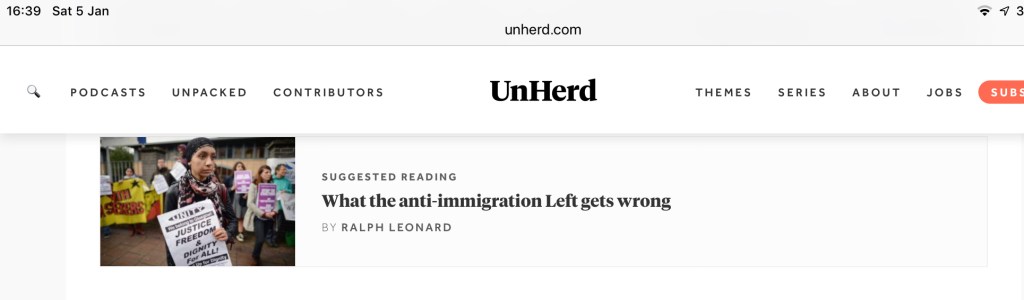
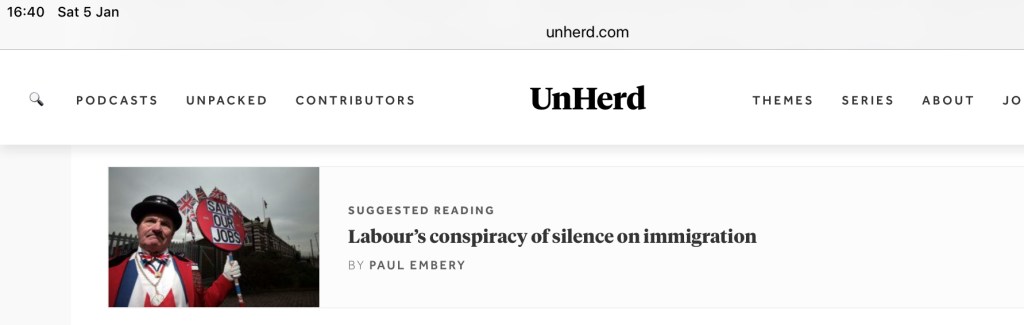
As an aside, I am rather unsure whether I like ‘UnHerd’. Apart from Giles Fraser, its contributors all seem to be right-wing. In the body of Fraser’s article are suggestions for further reading. I show these links above. One gets an uneasy feeling that this is not really an enlightened, liberal publication in the way that Dr Fraser’s previous home, the Guardian, is. Some of the images used are quite disturbing. ‘Economic rationalists … immigration’ is alongside a picture of our leading black – British – politician, Diane Abbott. ‘How bigoted is Brexit?’ appears alongside a picture of orthodox Jews playing what looks like a playground game. In both cases, one asks why these images were used, if there is not some appeal to unenlightened instincts.

Pace what the Brexit faction alleges, the EU is democratic, and upholds democracy. There is an elected European Parliament and an elected Council of Ministers, which bodies are sovereign. The European Commission is the civil service, the administrative arm, of the EU. Its powers are analogous with those of our British civil service as between themselves and the elected bodies. We currently enjoy considerable influence on the policy-making of the EU. Brexit would deny us any representation or control of EU policy in future. In ‘taking back control’, Britain would risk being governed by people who are not so committed to human rights, for example. One recalls that when he was a justice minister, Dominic Raab wanted to abolish the Human Rights Act.

It seems to me that we would have more chance of being able to put right the cruel excesses of austerity if we are inside the EU and able to benefit from its collective strength. If Jeremy Corbyn feels that, if he were Prime Minister, he would be able to negotiate more favourable Brexit terms than those obtained by Theresa May, then surely he ought to be confident that, among his many socialist colleagues in European parties, if we remained in the EU, he would be able to build a consensus away from neoliberalism.  After all, just as neoliberalism has failed in the UK, it has clearly not succeeded in several parts of the EU: certainly in Greece, and probably also in Italy, Spain and Portugal, the case for a change to Keynsian economics is strong. Note, incidentally, that the leading economist and former Finance Minister of Greece, Prof. Yanis Varoufakis, does not think that either his own country, Greece, or the UK, where he teaches, should leave the EU. Reform from within is the better route.

The argument that EU rules on state aid would frustrate Labour policy on rebuilding a fair and humane welfare state has been demolished by the leading competition lawyer, George Peretz QC. See https://www.theguardian.com/commentisfree/2018/dec/27/four-reasons-jeremy-corbyn-wrong-eu-state-aid. 

Now, with weeks to go before the date recklessly set by the government for Britain to leave the EU, I do hope that those respected thinkers on the Left such as Giles Fraser and Baron Glasman, as well as the Labour leadership, will come round to a similar view to that held by Yanis Varoufakis, that reform from within is possible, that the EU need not necessarily always be in thrall to neoliberalism, and that Brexit is ‘a disaster for Britain’ – see https://www.yanisvaroufakis.eu/2018/12/22/talking-brexit-bernie-and-left-internationalism-with-yanis-varoufakis-vice/. Then the Labour Party can solidly oppose Brexit and ensure that the Article 50 clock is stopped in order to allow a further referendum to take place, in which the people can decide whether they really want to make our country catastrophically poorer and less influential in the world, by leaving the EU (either under the current May ‘deal’ or without a deal), or whether, now that they can see what Brexit actually involves, they would prefer to remain in the EU.  Then I can hope to greet my friend in Hamburg and be recognised again as his true friend.

Hugh Bryant

5th January 2019 

Sermon for Evensong on Remembrance Sunday 2015

Isaiah 10:33-11:9; John 14:1-29
‘We will remember them.’ This has been a time of remembrance today, looking back in remembrance on all those brave people who have given their lives in the service of their country in war. Now in the evening of the day, ‘at the going down of the sun,’ it is time perhaps for us to look forwards, and reflect on the question of peace.
‘The wolf also shall dwell with the lamb, and the leopard shall lie down with the kid; and the calf and the young lion and the fatling together; and a little child shall lead them …. They shall not hurt nor destroy in all my holy mountain.’ This beautiful and mystical scene is the prophecy of Isaiah. And then in St John’s Gospel, ‘In my father’s house are many mansions …. Peace I leave with you, my peace I give unto you: not as the world giveth, give I unto you. Let not your heart be troubled, neither let it be afraid.’
When I started to study Latin and Greek, the Latin was Julius Caesar, De Bello Gallico (‘about the war in Europe’), and the Greek was Xenophon’s Anabasis, another history of war. Julius Caesar, as you know, invaded Britain in 55 and 54BC – less than a century before the time of Christ. It was definitely a warlike time throughout the Roman Empire.
Jesus grew up surrounded by wars. Before then the world of the Old Testament was permeated with lots of violence and wars. The story of the exodus from Egypt was very violent and the entry into the promised land equally involved a number of battles.
In the passage we have read from St John’s Gospel, Jesus says, ‘If you love me, you will keep my commandments.’ Presumably, that includes ‘Thou shalt not kill’. But even so, Jesus himself also said, ‘I came not to bring peace but a sword’ (Matt. 10:34). So would Jesus have belonged to the Peace Pledge Union, and worn not a red poppy, but a white one, today? Just as today most people see war as something to be avoided if possible, but never to be ruled out as a last resort, in Jesus’ time, war was an unavoidable fact of life.
Following St Thomas Aquinas, the church developed a doctrine of the ‘Just War’. (See Summa Theologiae 40.1). This is what Aquinas says. ‘If a war is to be just, three things are needed. It must be waged by the due authorities, for those who may lawfully use the sword to defend a commonwealth against criminals disturbing it from within may also use the sword of war to protect it from enemies without. … the cause must be just, …. And those waging war must intend to promote good and avoid evil.’
It might be instructive to compare these principles with the principles laid down in the United Nations Charter allowing a modern nation lawfully to declare war – or at least to make war, even without a declaration – on another. These days the requirements for a war to be just are: that it should be in self defence; or because a treaty obliges us to wage war to protect another nation – as we were obliged by treaty to protect Poland at the beginning of WW2 – or because the approval of the United Nations has been obtained.
But the original ‘just war’ principles are still influential. War can only be waged lawfully by a sovereign nation: you cannot have private wars, vendettas, as they have in Sicily between Mafiosi. The cause must be just. A nation can’t wage war simply in order to benefit itself. So Hitler’s quest for Lebensraum, literally, ‘living space’, territorial aggrandisement, was not a legitimate occasion for making war.
And the means employed must be proportionate. Proportionality is an old legal principle dating back at least to the lex talionis, an eye for an eye, (Deut .19:21): the point is that it is just an eye for an eye, not more. There were similar provisions even earlier, in Babylonian law and the laws of Hammurabi.
There must also be a reasonable expectation that the war will be successful. This does still come, perhaps, from Aquinas. He says, “The Lord’s words, ‘I say to you, offer the wicked man no resistance’, [Matt. 5:39 ] must always be borne in mind, and we must be ready to abandon resistance and self defence if the situation calls for that.” (Summa Theologiae 40.1) Pyrrhic victory might not be lawful. In the Sermon on the Mount, Jesus certainly went much further than the Lex Talionis.

Are we content that there is, or there can be, such a thing as a just war? Does it matter that some of the wars which have been waged, at least arguably, as just wars, have not achieved their objectives? See for example the situation in Iraq today, or even more tragically, in Afghanistan.
Is it reasonable to ask, what would Jesus do? Would he have something to say, for instance, about the doctrine of mutually assured destruction, (the rationale behind the holding of nuclear weapons), or of ‘shock and awe’ as used in Iraq. Would these doctrines square with the doctrines of just cause and proportionality in the case of MAD, or proportionality, in the case of ‘shock and awe’?
The theory of nuclear deterrence does not depend on the rightness of one’s cause. The opponent is deterred not because we are right, but because we can kill him. Perhaps it is proportional to respond to a threat of global annihilation – with what? With a threat of global annihilation. But perhaps that simply illustrates that the principle of proportionality is inadequate in the context of nuclear weapons. And again, what about a nuclear suicide bomber? MAD will not affect them.
I for one was very encouraged when Parliament refused to back military action in Syria. It seemed to me that the criteria for a just war were indeed not properly met. There was no threat against this country, so as to raise a question of self-defence. There was no treaty obligation to help some of the Syrians against the Syrian government – how could there be? And what was the likelihood of success – if indeed one could agree on what would constitute success? Of course, the question may come up again soon.
So much of our Remembrance Day liturgy and poetry was inspired by WW1. That was supposed to be ‘the war to end all wars’ – which must be a perfect example of Aquinas’ second test for a just war, that the cause must be just. There can surely be no more righteous cause than the eradication of war for the future.
But even in this most worthy objective, war was not a solution. Indeed the seeds of the Second World War were sown in the aftermath of the First one. Can we honestly point to many wars and say they have really achieved anything?
Perhaps universal pessimism is not justified: it was vital that Nazism had to be defeated: war was the only way to do it; the war succeeded. The war on Nazism succeeded at least in that the military threat to this country was removed – it was justified according to the principle of self defence.
But one cannot change people’s minds by war against them. Just as there are still people who are Nazis, even in this country, and there certainly are still Nazis in mainland Europe, it is certainly arguable that people have been inspired to take up terrorism by their believing that the West has waged war unjustly in the Middle East.
This is a terribly difficult area. Clearly we can be, and we are, really thankful for the bravery and sacrifice of our soldiers, sailors and airmen. That is the main purpose of Remembrance Sunday. But it is much more difficult to know where our duty lies as Christians in the face of the threats to peace which the world now faces.
We must say our prayers, we must pray for world peace. But also we must be alert, we must scrutinise everything that is done in our name, especially if warlike acts are being prepared. ‘At the going down of the sun’ we will remember. We must remember – and because of what we remember, we must be careful. And we must be just.