Archives for posts with tag: Pharisee

Sermon for Evensong on the First Sunday in Lent, 9th March 2025

At St Peter’s Church, Old Cogan

Jonah 3

Luke 18:9-14

https://bible.oremus.org/?ql=608348962

Last Wednesday, Ash Wednesday, I did some shopping in one of our local supermarkets. I accidentally walked down the aisle containing wine and beer, and stumbled across Beaujolais Villages from one of the finest Burgundy producers, rather curiously marked as ‘clearance’ – at less than half the normal price. 

Now on the first day of Lent this was rather a challenge. Could I resist buying it at less than half price? On Ash Wednesday it was the start of Lent, and one of the things which one is supposed to do is to give things up, to fast. What was I supposed to do about this wonderful wine bargain? 

At the same time I was starting to think about this service, and what I would say to you in my sermon. I looked at our Bible lessons prescribed for today, and came across the third chapter of the little book of Jonah.

A little like Louis Jadot’s fine Beaujolais, the passage chosen wasn’t quite what I had expected. That was nothing about the whale. If I asked you what you associate with the name of Jonah, I would be mighty impressed if the name ‘Nineveh’ was on your lips instead of something about a whale. 

Our lesson today tells you about Jonah going and uttering a prophecy to the people of Nineveh who have been misbehaving in a sinful way, telling them that God had warned that they would come to a bad end if they did not mend their ways. The ruler of Nineveh told the people to put on sackcloth and ashes, to put on visible signs of repentance, and to turn back to the true God. But you have to know that this is Jonah’s second go at this task from God. The first time around, when God was telling him to give this bad news to the people of Nineveh, he ran away, bought a passage on the ship and then, as a result of the ship being caught in a storm, he drew the short straw and was chucked overboard so as to lighten the load on the ship and to save it from being overwhelmed by the waves. And he was eaten up by a whale.

At this point when I am talking about the book of Jonah, as an ancient maritime lawyer I always use the opportunity to mention this as an early instance of the legal doctrine of general average, an “extraordinary sacrifice made to preserve the safety of the ‘maritime adventure’”, as the Marine Insurance Act1906, which is still good law, puts it; although general average doesn’t involve chucking people over the side as opposed to cargo or the ship’s tackle, of course, or making a special payment for services to prevent the ship being lost. So I won’t mention that particularly here but rather we should concentrate on Jonah’s encounter with the whale.

I’m not sufficiently up on marine biology to be able to express a view on how plausible this is as a literal account, but I think it is fine as a colourful illustration of how God might intervene to persuade somebody who was a bit reluctant. Jonah having been spat out safely, as you are, if you’re eaten by a whale, after three days, he was indeed persuaded, and he went and undertook his task. He told the people of Nineveh how awful they were, how they needed to change their ways, to repent: a bit like what we are supposed to do in Lent, I suppose. 

You can see why Jonah was reluctant. Being the bearer of bad news is never a popular thing to do, especially when you are speaking truth to power. It’s something we’ve noticed in recent days in the way in which our various leaders are not telling President Trump what time of day it is. 

Not but what Jonah, no doubt emboldened by his whaling experience, did deliver his message to the people of Nineveh, and he received a reception which was entirely different from what he had feared. God had noticed the fact that the people of Nineveh had changed their ways, and he did not punish them. 

So – what should we do? How should we change our ways in the 40 days leading up to Easter? What about fasting? Well, another thing to put into the mix is that we mustn’t crow about whatever it is that we do do; so if you are able to write a cheque for an eye-watering amount of money to the United Nations High Commissioner for Refugees, say, or even, maybe, for the Penarth Ministry Area, such that you make that gift instead of treating yourself to a holiday in Gstaad for skiing, you mustn’t talk about it. You mustn’t crow about it. Think about the Pharisee and the publican. All you should do is to ask the Lord for forgiveness because you are a sinner. Whatever sins you have committed, you just say, quietly and privately, ‘Have mercy on me, a sinner.’

I guess that bears on how you should conduct yourself at charity auctions. Maybe you will have to appoint a proxy to bid for you next time you are minded to go and support Welsh Rugby at some appropriate dinner or other, but I leave that to your discretion.

What about that Beaujolais? Well I offer this as a true story which may or may not inspire you. I know that I am very bad at giving things up, but equally I’m not sure that my giving things up really has any benefit to anybody else except possibly me. But I am enormously comforted by a verse in Isaiah about fasting. Let me quote it to you.

‘Is not this the fast that I choose: to loosen the bonds of injustice, to undo the thongs of the yoke, to let the oppressed go free, and to break every yoke? Is it not to share your bread with the hungry, and bring the homeless poor into your house; when you see the naked, to cover them, and not to hide yourself from your own kin?’ (Isaiah 58: 6,7)

Now I do think that that is more my kind of fast. So what I usually do – and I am going to do it this Lent – is, every time I eat out, (and that includes pies on the motorway), I will keep a note of what I spend; and at the end of Lent I will look at all those bills and work out what it would have cost to invite another person to join me each time: an absent guest, if you like. I will tot up the cost of the absent guests and I will give that to the United Nations High Commissioner for Refugees. Maybe that’s a sort of fast that you could undertake too. 

Oh – and, yes, about the Beaujolais. I bought three. 

Amen.

Hugh Bryant

Sermon for Holy Communion on the Second Sunday of Easter, 28th April 2019

Revelation 1:4-8, Acts 5:27-32, John 20:19-32

http://bible.oremus.org/?ql=423140630

_____________________________________________________

This Sunday our Bible readings take us back vividly to the life of the apostles just after the Crucifixion and Resurrection. Each passage illustrates a different angle. First in the Book of Revelation.

What is your favourite hymn? A little while ago there was a series in the parish magazine – well, actually in the old parish mag, before the beautiful St Mary’s Quarterly came out, of course – anyway, the series was on ‘favourite hymns’. People were invited to pick their favourite hymn and to explain what it was they liked about it. What would my favourite hymn be? One strong contender in my heart would be ‘Lo! He comes with clouds descending’, one of Charles Wesley’s greatest hymns. It’s number 31 in our hymn book, if you want to look it up.

Like many hymns, it contains several sermons and profound theological insights. It’s based on our first lesson, from the Book of Revelation, which says:

Look! He is coming with the clouds;

   every eye will see him,

even those who pierced him;

   and on his account all the tribes of the earth will wail.

So it is to be. Amen.

The hymn covers the same ground – in rather better poetry, I think.

The Book of Revelation is a book about the End Time, a vision of heaven, a vision of the divine. It’s a vision of God, and of Jesus sitting at his right hand, ‘up there’. Since Bishop John Robinson’s great little book ‘Honest to God’, or Don Cupitt’s BBC series called ‘The Sea of Faith’ in the early 1980s, we haven’t tended to see God as a man with a white beard sitting on top of the clouds. Even if we weren’t influenced by Bishop John Robinson or by Don Cupitt, you might remember that according to President Krushchev, when Yuri Gagarin, the first man in space, returned to earth, he is supposed to have mentioned that he hadn’t seen God ‘up there’. The great vision in Revelation is a metaphorical one; its truth is not literal. Our reading from it says

Every eye will see him,

even those who pierced him.

‘Those who pierced him.’ We have to be careful not to take early accounts of the passion and resurrection of Jesus as being very anti-Jewish. The Pharisees and the Sadducees, the Sanhedrin, the ‘the whole body of the elders of Israel’, did, as a matter of bare facts, cause Jesus to be crucified: but as Jesus himself said, they did not know what they were doing. They were not consciously killing the Son of God. In the early encounter between the Jewish authorities and the disciples which we heard about in the words of Acts chapter 5, if you read a bit more of the chapter after this, you’ll see that it isn’t simply a question of a brush between the Jewish leaders and the apostles, not simply – or at all, actually – a kind of repeat of the persecution which had resulted in Jesus’ death. The full story tells that the High Priest and the Sadducees, motivated by jealousy, arrested the apostles and put them in prison. But ‘an angel of the Lord’ opened the doors of the prison and let them out during the night, so that when they went to get them in the morning, the police reported that they’d found the prison locked, but no apostles inside. They’d gone back to teaching in the Temple. They sent the police and fetched them to appear before the Council – but without using any force, ‘for fear of being stoned by the people’.

Then comes the passage which was our second reading, the exchange between the High Priest’s group, the Sadducees, and Peter. They asked, ‘Why did you ignore our injunction to prevent you from preaching?’ …. And the answer was, ‘We must obey God rather than men.’ Then Peter went on to rehearse the crucifixion story. ‘The God of our fathers raised up Jesus whom you had done to death’, and most important, ‘We are witnesses’. The Sadducees, extraordinarily, wanted to kill them. They couldn’t cope with how popular the gospel message had already become. To the apostles, it must have felt horribly reminiscent of the time immediately before the crucifixion.

But then another Jewish leader, a Pharisee called Gamaliel, a ‘teacher of the law held in high esteem by all the people’, stood up in the Sanhedrin council and said, ‘Keep clear of these men, I tell you; leave them alone. For if this idea of theirs or its execution is of human origin, it will collapse; but if it is from God, you will never be able to put them down, and you risk finding yourselves at war with God.’ These were wise words – and they came as much from a Jewish source as any of the cruel Sadducees’ threats. Both sentiments came from Jewish sources, enlightened, Gamaliel, or cruel, the Sadducees. You can’t really blame the Jews. They really had no idea what the big picture was.

A quick look back, before we move on to consider Doubting Thomas. An ‘angel of the Lord’ organised the apostles’ gaol break. What was this angel? Given that the name ‘angel’ means ‘messenger’ in the original Greek, rather than thinking about angels as being superheroes like Superman, let’s think instead that they could just have been ordinary Christians, doing the will of the Lord. You can understand quite a few of these apparently supernatural terms in natural, normal terms. Most likely it was just ordinary humans who got them out of jail – but in so doing, they were doing the work of God. But of course, if you want to believe in angels as something magical, between gods and mere men, fair enough. I’ve got no proof either way.

Then we do go on to think about Doubting Thomas. The story of Doubting Thomas has strengthened so many people’s faith. It certainly did mine. ‘Blessed are those who have not seen and yet have come to believe’. That’s us. We haven’t been able to do what Thomas did and verify empirically that they were encountering the risen Jesus. Our understanding, our trust in the whole Gospel, has to have been based on things we ourselves haven’t seen.

The essence of that faith is that Jesus rose from the dead. That’s not just an extraordinary miracle, something to amaze and delight you, which is really what the word ‘miracle’ meant originally, (something to amaze and delight), but also most crucially it means that God, however we understand him to be, the unmoved mover (according to Aristotle), the creator and sustainer, the Almighty, all-powerful, all knowing, He, has a relationship with the human race, with us.

God is bigger and infinitely more detailed than I, certainly, can comprehend. The Bible says, in St John’s Gospel, Jesus is quoted as saying, that whoever has seen him has seen the father (John 14:9). I suppose if you take literally the passages which have Jesus sitting at the right hand of God the Father in heaven, then those glorious images of a heavenly palace above the clouds will resonate with you.

But I think that I am too much a prosaic, matter-of-fact person to believe literally that that is how things are. I’m with Yuri Gagarin. I don’t actually think that God lives above the clouds, or indeed that he can be tied down to a particular time or place. Except of course he can. He can be tied down in a sense to the time and place of Jesus. If we didn’t know about Jesus we wouldn’t know anything at all about God except in purely functional terms, making stuff, creation, and knowing stuff, omniscience, and so on. And the story of Thomas is the most powerful expression of this.

But hang on a minute: if God isn’t somewhere, if there isn’t a sort of Mount Olympus somewhere, with God and his angels and Jesus together on top of the clouds on their thrones in some glorious palace which looks just as we would imagine 20th Century Fox and perhaps one of those great directors like David Lean would portray it, larger-than-life for sure; if that’s not the way it is, and if Jesus was not saying something completely fanciful, when he said that if we have seen him we have seen the father, then can we actually know God a bit more after all?

I wonder whether the angels are a clue. As I said earlier on, when the angel of the Lord came to let St Peter and the apostles out of the gaol, I did just wonder who the angel was. It occurred to me that, just as we say that the Holy Spirit – which is God in one form – just as we say that the Holy Spirit is in our church, is in all of us, and that we are called ‘the body of Christ’, here today as well, so it means that angels, messengers of God, could be ordinary people, just as Jesus was an ordinary human being in one sense.

So we could be angels. Surely we are angels, when the Spirit is at work in us and when we do God’s work. I’ve preached before about saints. I’ve made the point that the saints are all of us Christians. Another hymn:

For all the saints who from their labours rest,

Who thee by faith before the world confessed.

That’s us. We are in that wonderful ‘apostolic succession’, as it’s sometimes called, from the earliest Christians; and thousands and thousands of new Christians are coming forward every minute, who haven’t seen, but yet believe.

Well that’s great. It’s a very major thing – and we could stop it there and go away from this service feeling perhaps that we’d come a little closer to God. But the other major thing that we must consider is that, if we are to be saints and angels, real saints and angels, we must behave like them.

So today in a society where there is a terrible xenophobia, where people say things against immigrants, ignoring the fact that they are human beings like us, where people blame those who go to food banks, for being in some sense feckless or undeserving, where we turn our backs as a country on our relationships and treaties with other countries, where we fail to take our fair share of refugees, where we allow a government ministry to uproot people who have being here working and making their lives among us for decades, and send them to countries which they have not seen for those decades, on the grounds that they are in some way here illegally, where there are so many instances of our society’s meanness and failure properly to provide for those who are less fortunate than ourselves, where we justify it by shrugging our shoulders and saying that it is all very sad but there isn’t enough money to go round; but then, miraculously, the government finds billions for Brexit.

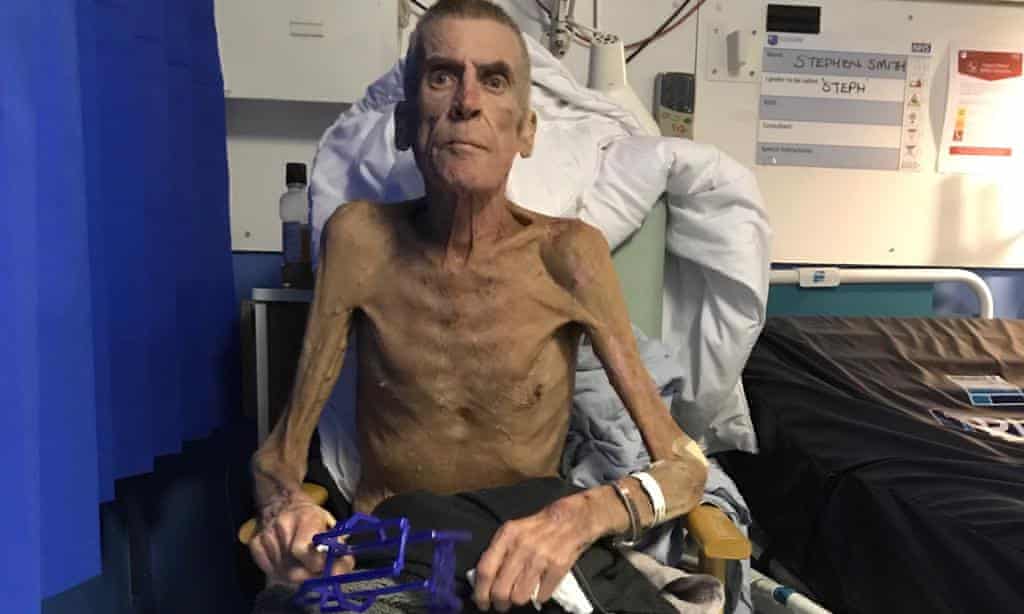
Yes, what I’m saying is political; but it is not intended to be party political. It’s true whether you’re Labour or LibDem or Conservative. The important thing is that we’re Christians. I’m saying that, as Christians, we should have a view on these things. We should call them out; we should stand against them, because we are Christians. We should, if we have a spare room, consider welcoming some refugees to stay with us when they first arrive. We should tell our politicians that it’s not acceptable not to put sprinklers in high rise council blocks like Grenfell Tower, (even though government ministers have promised to do it); tell our politicians it’s not acceptable not to pay proper compensation to the people whose lives have been ruined by the Windrush scandal; it’s not acceptable that thousands of people – last year, over 4,000 – are denied benefits on the grounds that they are fit to work, and then are so ill that they die within three months of that decision. It’s not acceptable that the newspapers should be full of pictures of a poor man, Stephen Smith, so emaciated that his bones are sticking out, so obviously desperately ill, denied benefits, on the ground that he is ‘fit to work’: he died. But not until he had won an appeal in court, as 70% of the appeals are won. [See https://www.theguardian.com/commentisfree/2019/apr/22/stephen-smith-benefits-system-dying]

This institutional meanness doesn’t just come out of the air. Just as we are saints and angels with the Holy Spirit in us, we have God’s power in us. We are not impotent. We have God’s power to do something about it. We need to speak to our MP, to write letters, to demonstrate on the streets if necessary, to rise up.

So today the message, the Easter message, is that we have seen the Lord. We have seen him at work in our fellow saints and angels. Let us join them, let us take that divine power and use it.

Stephen Smith

Sermon for the Second Sunday of Lent, 17th March 2019

Genesis 15:1-12, 17-18, Philippians 3:17-4:1, Luke 13:31-35

As we woke up on Friday, to hear the news about the terrible shootings in the mosques in Christchurch in New Zealand, the New Zealand Prime Minister, Mrs Ardern, made a moving statement about the fact that it seems clear that the 50 people killed were the victims of a racist, Islamophobic terrorist. Mrs Ardern said, ‘Many of those who will have been directly affected by this shooting will be migrants, they will be refugees here. They have chosen to make New Zealand their home and it is their home. They are us.’

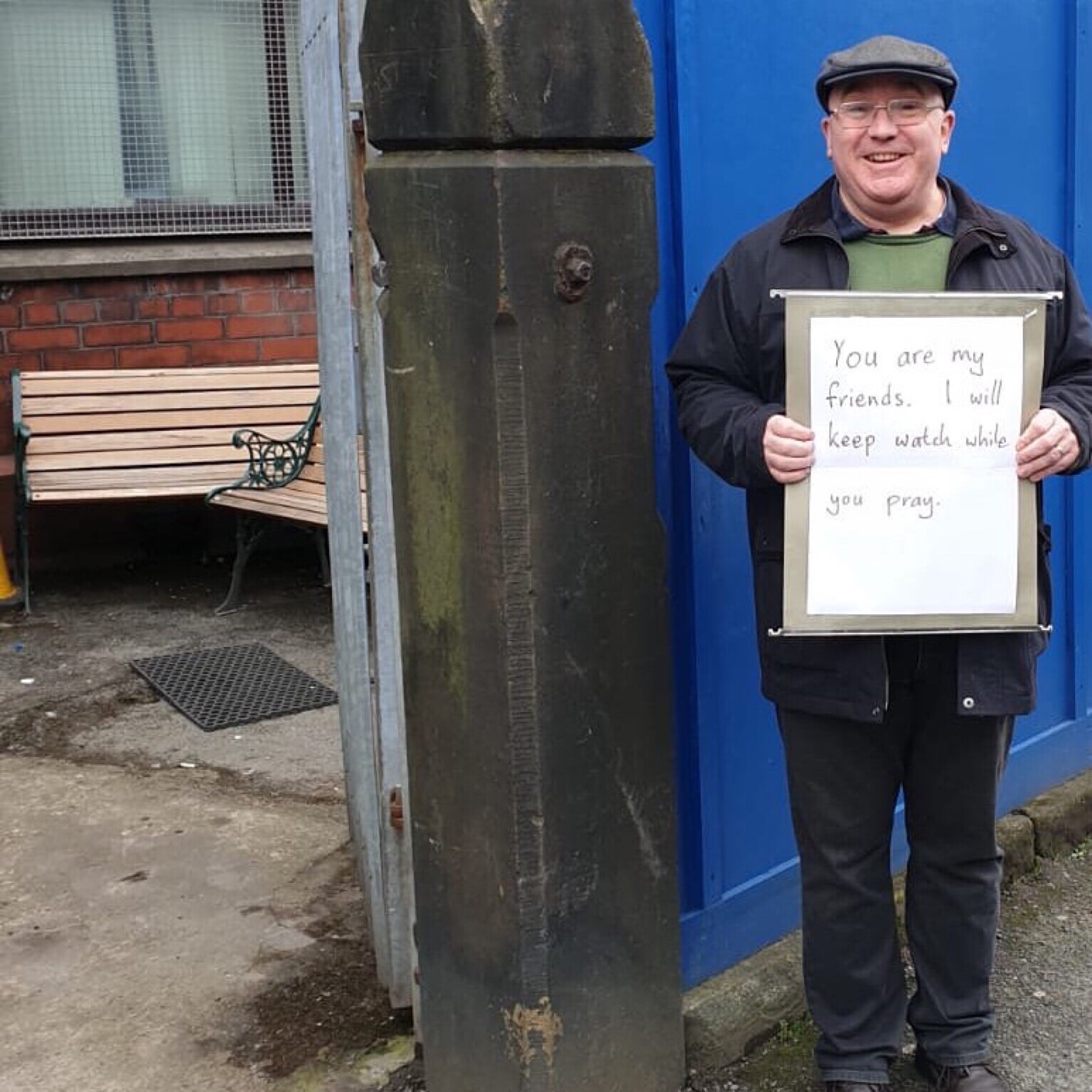
A bit later on, a picture appeared on Twitter [reproduced above] of a man who, if I can say this, did not look like a Moslem, but rather like Andy Capp in the cartoons, in a flat cap, standing smiling outside a mosque in Manchester with a placard which said, ‘You are my friends. I will keep watch while you pray.’

Terrible atrocities do sometimes seem to bring out beautiful and uplifting thoughts, like those of Mrs Ardern and of the man in the flat cap outside the mosque in Manchester.

In our Lent study groups we are going through the Beatitudes, the ‘blessed are they’ sayings which Jesus spoke at the beginning of the Sermon on the Mount in Matthew 5.

The second one, perhaps the right one at a time of tragedy, is ‘Blessed are those who mourn, for they will be comforted.’ This is one of those short sentences that contains impossibly dense and complicated ideas. On the face of things, for somebody to be mourning, to be sad, to be heartbroken, is not in any sense the same as to be fortunate, which is what the word translated as ‘blessed’ means.

How lucky for you that you are heartbroken; what a wonderful thing it is that you are in floods of tears. Clearly there’s something which doesn’t add up. Try telling the distraught people that were on the TV from New Zealand that they were in some way blessed or fortunate. But really it means, as it says, that those who mourn will be blessed, will be comforted in future: and that is a message of hope after all.

St Paul, in his letter to the Philippians, condemns those who live as enemies of the cross of Christ. Earlier in the chapter we had as our reading, he identifies the people that he condemns. He says, ‘Beware of those dogs and their malpractices. Beware of those who insist on mutilation – I will not call it ‘circumcision’’. Beware of people who tell you you have to become a Jew in order to become a true Christian.

Nevertheless, Paul was proud to tell everybody that he had been circumcised and that he was an Israelite of the tribe of Benjamin, a Hebrew born and bred, and a Pharisee [Phil. 3:5]. He’d thrown it all over, after his Road-to-Damascus experience, and in his letters, for example to the Galatians and to the Romans, he made the point that, in the kingdom of heaven, there is no difference between Greeks, (Gentiles), and Jews.

The Israelites had been the chosen people of God, and the others, the Gentiles, the ‘nations’, were the great unwashed. But St Paul’s mission was to bring the good news of Jesus precisely to those Gentiles, to those who were not circumcised. He said, ‘Our citizenship is in heaven.’ Ordinary nationality doesn’t apply in heaven.

But originally, Paul – and Jesus – were Jews, sons of Abraham, descendants of Abraham. The word of the Lord came to Abraham and said, ‘Look toward heaven and count the stars; because that’s how many your descendants will be.’ The sons of Abraham. They were Israelites, the chosen people of God.

The gunman is supposed to have said that one of his reasons for shooting Moslems was because he saw them as strangers, ‘invaders’. At the beginning of this week in morning prayers we were reading from the Book of Deuteronomy, where Moses speaks the words of the Lord, a prophecy about offering sacrifice of the first fruits of the land, the land of milk and honey, which the Israelites have been led into, the promised land. Moses tells them to say in their prayers that they are descended from ‘a wandering Aramean’, or from ‘a Syrian ready to perish’, that they have been led into Egypt and then eventually out of Egypt again, as strangers in the land. Even they, the chosen people, started out as strangers.

There are many passages in the Book of Deuteronomy, and in the Jewish Law generally, which St Paul would have been very familiar with, which impose on Jews a duty to care for a stranger that is within their gates, to care for strangers along with orphans and widows. That is the spirit that Mrs Ardern has so eloquently reminded us of. It is not a spirit of antipathy towards immigrants and refugees, not against strangers, not against people who are different from ourselves.

This is such a difficult area. There are so many apparent paradoxes. The Jews, refugees, made it to the promised land; they went to the holy city, Jerusalem, and set up the temple there. ‘Jerusalem the golden, with milk and honey blest’.

But Jesus points out that, because that is where the council, the Sanhedrin, is based, it is only in Jerusalem that he can be condemned, and that Jerusalem is a city that kills prophets, that throws stones at people who are sent to it.

Mrs Ardern was one of those world leaders, like Mrs Merkel in Germany, who has dared to extend a welcome to refugees. She still extends that welcome. But what about us? The challenge to us today is surely not to be fixated with ‘taking back control’, with restricting immigration and upholding national identity, however important some of those things might seem to be at first.

Jesus said, ‘Strive to enter in at the strait gate. Struggle to get in through the narrow door. For I tell you that many will try to enter and not be able to. You may stand outside and knock: say, ‘Sir, let us in.’ But he will only answer, ‘I do not know where you come from.’ [Luke 13:24]

Where do we come from? You could say that Jesus makes getting into the kingdom of heaven seem like a refugee trying to come ashore in Italy, or trying to get through at the Hungarian border or even being caught up in our own Government’s ‘hostile environment’ at Heathrow today. Contrast that with what Mrs Ardern said. ‘ … They will be refugees here. They have chosen to make New Zealand their home. It is their home. They are us.’

The challenge for us as Christians is to raise our sights above the earthly ghastliness which stems from narrow nationalism, and to seek what is truly heavenly. ‘Blessed are those who mourn, because they will be comforted.’ Let us pray that, with God’s help, we can become channels of peace, so that we too can say that they are our friends, and that we will keep watch while they pray.