Archives for posts with tag: refugees

Sermon for Evensong on 16th June 2024

Jeremiah 7.1-16; Romans 9.14-26

https://tinyurl.com/5xdpyys2

On Friday night I was nearly on the wireless. On BBC Radio 4. Completely by chance I had heard, when I was listening to the news in the morning, that Any Questions, which is not to be confused with the TV programme Question Time, and is much more venerable – it is apparently the oldest continuously running radio programme anywhere in the world, 76 years old, so it’s even older than me – that Any Questions was coming that same night to Newport to Newport Cathedral, to Saint Woolos’. There were a few places still available in the audience. I quickly booked a ticket and went over there. When you arrive, you are given a card to complete and hand in, with any suggested questions which you might have for the panel. Some of you may well have listened to the programme on Friday night or possibly when it was repeated at lunchtime yesterday.

The panel was a distinguished group, mostly Welsh people, two socialists, one Plaid Cymru and the other, less socialist, Labour; Boris Johnson’s press spokesman (who actually had had a long and distinguished career as political correspondent for the BBC before working for the Conservatives), a champion of industry with a strange name, and the Conservative Secretary of State for Wales who had apparently had a career as an amateur boxer, fighting under the name the Tory Tornado. It was all chaired by Victoria Derbyshire.

It came out that all the panel had gone to Oxford, except, of course, for the ‘Tornado’. Presumably most of them had gone to Jesus College, so there was a high degree of courtesy and comity between them, despite some very different views. Shortly before the programme began the producer appeared and called out eight names of people who had been selected to put their questions to the panel. I was very excited to learn that my question had been chosen, and I was number six. So we sat at the front clutching little bits of paper on which our questions had been nicely re-typed by the BBC; but alas, by the time they had dealt properly with question number five, the hour was up and I, together with the last two questioners, was left on the bench.

Before my turn there had been some very interesting questions, one involving bets on the likelihood of a conservative victory and the willingness of the panel members to ‘have a flutter’; on whether the allegedly inferior performance of the NHS in Wales was to be attributed to underfunding from Westminster or to mismanagement, by the party of Nye Bevan; about the potential effects of imposing VAT on private school fees; about which party’s manifesto would provide growth and stability; and finally, before my turn, there was this question.

A lady called Julie Pearce asked, ‘Where have honesty truth and integrity gone in politics, and do you think politics has deteriorated as a result?’The politicians on the panel predictably danced on pinheads, and perhaps the apologist for the most egregious immoralist in recent politics, Boris Johnson, produced the most ingenious evasion, when he turned immediately to discussing the merits and demerits of Lloyd George 100 years ago, whom he praised as the greatest Welsh prime minister, even though he was at the same time spectacularly immoral, he said.

Interestingly, none of the panel identified either themselves or other members as exhibiting any tendencies towards vice. Exceptionally, they were all as pure as the driven snow, we were asked to believe. As I sat there in the cathedral, I pondered what we as Christians at All Saints might have said in response to this question. Our Bible readings today are very relevant. The passage from Jeremiah is a prophecy in which God puts words into the mouth of the prophet chastising the men of Judah for their immoral behaviour. Although they went to worship in the temple, they still needed to mend their ways and their doings, the Lord said. Deal fairly with one another, do not oppress the alien, the orphan, and the widow, shed no innocent blood, and do not chase after false gods.

That could be very relevant even today. Deal fairly with one another: don’t just go for the cheapest thing on the internet and do our local shops out of business.

Don’t oppress the alien, the orphan and the widow: surely refugees – aliens – ought to be welcome and we should recognise that immigration is a good thing; after all, quite apart from whether we should offer safety and sanctuary, immigrants supply much-needed skills in industry, in the NHS and in our social services.

Does the policy of a ‘hostile environment’ and sending people to Rwanda in breach of the Refugee Convention amount to ‘oppressing the alien’? What do we do for orphans and widows? How does the two-child benefit cap fit in? What about social care and nurseries?

God isn’t having any. This is what he says: ‘You steal, you murder, you commit adultery and perjury, you burn sacrifices to Baal, you run after other gods whom you have not known; then you come and stand before me in this house, which bears my name, and say, ‘We are safe’; safe, you think, to indulge in all these abominations.’ And he says he will ‘fling them away out of his sight’ as he previously thrown away the people of Ephraim. No prayers would avail to save them.

That was the fierce prescription in the Old Testament. Did things become softer and more understanding after the coming of Jesus? St Paul’s letter to the Romans suggests not. But Paul comes at it from a different angle. Does God’s willingness to punish immorality mean that God is unjust? Paul says that it is up to God whether or not to punish somebody, and it does not depend on what he calls ‘man’s will or effort’. So why does God punish some people, or rather, allow them to be harmed? What are the rules? Is God just capricious, harming some people without a good reason?

Interestingly Paul doesn’t answer that. Instead, he suggests that it’s almost impertinent for us to ask that kind of question. ‘Who are you, sir, to answer God back? Can the pot speak to the potter and say, ‘Why did you make me like this?’? Surely the potter can do what he likes with the clay. Is he not free to make out of the same lump two vessels, one to be treasured, the other for common use?’

We have to recognise that God is bigger than we can understand, beyond our comprehension. As Jesus showed and taught, things are sometimes not what they seem, and values can be turned upside-down. The last shall be first … And being the chosen people of God may not protect you. Again, there are things happening today which might fit into this kind of analysis.

What about the war in Gaza? Does it make a difference that today’s Israelis say, as some of them surely do, that Hamas is like the Amalekites, previous occupants of the Promised Land, whom God told Saul and the Israelites, as told in the first book of Samuel [1Samuel 15:2-4], utterly to destroy – and God took them to task when they left some of them alive? Does that justify what the Israeli army is doing in Gaza?

Or we should consider what Paul points out in what the prophet Hosea said; [Hosea 2:23]: he said, ‘As it says in the Book of Hosea: ‘Those who were not my people I will call My People, and the unloved nation I will call My Beloved. For in the very place where they were told “you are no people of mine”, they shall be called Sons of the living God.’

The message is that just because one goes through the motions of worship, or goes to the temple, to the biggest cathedral, to the poshest church, it doesn’t somehow sanitise the things we do. We must love our neighbours, and worship just the one true God.

And we mustn’t use God as an excuse either. Fergal Keane, the veteran BBC war correspondent, was interviewed recently, and he said this: “It takes human beings to inflict injustice, pain, and cruelty on others. And it is too much of a cop-out to say ‘I blame it all on religion.’ That allows us, people with freedom of choice, off the hook. There are many places where faith has been manipulated, used as a banner, a suit of armour, as something to drive people on to hate their neighbours.” [https://www.churchtimes.co.uk/246585]

Perhaps that’s all a bit deep for Any Questions. But we should keep asking questions – and saying our prayers.
People who are fleeing violence and persecution, who have no safe place to live, are willing to risk their lives and to pay thousands of pounds to risk drowning in freezing seas as they cross the Mediterranean and the English Channel.

It is not a question of ‘pull factors’. These are people fleeing – they are subject rather to ‘push’ factors, if anything. Some of them choose to seek asylum in the UK, but this is a smaller number than those who have gone to France, Italy, Germany and Greece. All those countries have granted asylum to greater numbers than those trying to reach the UK.

Refugees who choose to come to the UK usually do so because they speak English or have relatives already living here. When they have been allowed to remain here and work, the statistic is that on average immigrants pay 10% more tax – and earn and spend that much more – than indigenous Britons. The NHS would not survive without its many thousands of immigrant doctors and nurses. 

There is no ‘legal’ way to claim asylum in the UK. There is no way to apply unless you are already in the UK. Under the Refugee Convention 1951 refugees are not obliged to claim asylum in the first place where they flee to, but if they do claim asylum in a country, that country is obliged under the Convention to consider their claim. It would be a breach of the Convention to deport asylum seekers to an offshore processing centre, as Australia did.

But we miss the point if we get bogged down in the mechanism of how asylum claims are made. The point is that since time immemorial people have fled from country to country, from continent to continent, if the place where they were born becomes dangerous or they are unable to earn enough to feed themselves. A distinction is made between asylum seekers and ‘economic migrants’, but it is specious. If you have been driven from your home in fear of your life, of course you are an ‘economic migrant’ as well. 

The point is that this migration in search of safety and prosperity is all right. Immigration is a Good Thing. Why am I entitled to live in the UK? Because I was born here. But does that entail entitlement? I think not. The fact that I was born here is sheer luck. 

So why should I try to assert entitlement to live here as against other human beings who happen not to have been born here, but rather have been born in poor or dangerous places? If I benefit, by sheer luck, from living in the fifth-richest country in the world, why should other human beings, who are not so lucky, not join me in this earthly paradise? What right have I to deny them?

But, people say, our islands are too crowded. We can’t afford to share our schools and hospitals and universities with foreigners. This is nonsense. The indigenous population of the UK is shrinking in numbers, as our birthrate is too low. We need more people – not just doctors and nurses (although we certainly need them, to fill the shortage of over 100,000 staff in the NHS today), but we need people in all walks of life, professions and trades.

We have plenty of room. Half an hour from the centre of London in any direction one is in green countryside. The same is true of all our conurbations. There may be 67m people in the UK, but there is plenty of room for more – and plenty of need for the economic boost that extra people will create.

But ‘they’ won’t integrate, they say. They keep themselves to themselves and some don’t even learn English. But do we try to get to know them? Do we welcome them into our homes – or do we ostracise them, shrinking away from them and avoiding contact? No wonder they are separate – we drive them away into themselves. The latest racism scandal, affecting Yorkshire cricket, could, in some aspects, have been repeated all over the country.

Yet our politicians compete to be ‘tough’ on immigration. Disgracefully, Theresa May started a ‘hostile environment’ policy towards immigrants which continues under Priti Patel. Imagine what it must feel like: driven out of your homeland in fear of your life, you reach the country which drafted the Human Rights Convention and most of the Refugee Convention, which welcomed the Jewish refugee children fleeing Nazi Germany in the Kindertransport – and you are received, not with a compassionate welcome, but with a ‘hostile environment’.

With climate change, this pressure of population, shifting from poverty and violence towards comfort and abundance, from Africa and the Middle East towards northern Europe, will be many times greater. People will flee those countries where it is 50 degrees in the shade. And again, they will benefit the northern countries where they go to.

But we are a democracy, and 55% of those polled say they are against immigration, and would vote for politicians who are ‘tough’, who restrict immigration and show a hostile face to poor asylum seekers. This unenlightened, if not actually racist, attitude is said to prevail in the ‘Northern Red Wall’ of parliamentary seats formerly held by Labour and now narrowly Conservative, because these voters supported Brexit, largely in order to stop immigration. The Conservatives are afraid of offending these voters, and Labour want to regain their affections, so neither party dares to tell the electors what is right and good.

This will not do. There is room in a democracy for elected representatives to offer leadership and inspiration. They ought not lamely to follow their constituents’ unenlightened and unjustified bigotry. Most of these people have never met an immigrant, let alone tried to get to know one. If he or she is wearing medical scrubs and cures their pain, they conveniently forget that it was a ‘foreigner’ who helped them. 

The same goes for all that fruit that didn’t get picked, all those lorries that didn’t get driven, all those plumbing jobs which didn’t get done. All done by immigrants – until Brexit stopped freedom of movement and the ‘hostile environment’ was the best the government could offer in order to ‘take control’.

So much of this is attributable to fears of the unknown, or the ‘other’. Surely our leaders can address this. The people of the Red Wall are racists, if they are so, because of what they don’t know. What they don’t know they fear and shun. We need to challenge this. 

No Red Wall temporary Tory is happy to see children, their mothers and fathers, drowning in the freezing English Channel. Even at this lowest common level, their common humanity is something we can all recognise. So if they are like us in not wanting to be drowned, what other similarities are there? 

They are human beings, in every respect just like us. They love their children; they feel hunger, and cold, if they are not in their houses. Just like we do. They enjoy having nice meals to eat; they love music and stories. Just as we would miss these things if we were deprived of them, so do they.

Immigrants and refugees are just as much entitled to live in a safe place – indeed, in our safe place – as we are. It is just our good luck that we got here first.

Think of Emma Lazarus’ words on the foot of the Statue of Liberty: 

‘Give me your tired, your poor, 

Your huddled masses yearning to breathe free, 

The wretched refuse of your teeming shore, 

Send these, the homeless, tempest-tost to me, 

I lift my lamp beside the golden door!’

And think of what Jesus said.“When the Son of Man comes in his glory, and all the angels with him, then he will sit on the throne of his glory. All the nations will be gathered before him, and he will separate people one from another as a shepherd separates the sheep from the goats, and he will put the sheep at his right hand and the goats at the left. 

Then the king will say to those at his right hand, ‘Come, you that are blessed by my Father, inherit the kingdom prepared for you from the foundation of the world; for I was hungry and you gave me food, I was thirsty and you gave me something to drink, I was a stranger and you welcomed me, I was naked and you gave me clothing, I was sick and you took care of me, I was in prison and you visited me.’  

Then the righteous will answer him, ‘Lord, when was it that we saw you hungry and gave you food, or thirsty and gave you something to drink?  And when was it that we saw you a stranger and welcomed you, or naked and gave you clothing?  And when was it that we saw you sick or in prison and visited you?’  And the king will answer them, ‘Truly I tell you, just as you did it to one of the least of these who are members of my family, you did it to me.’ 

Then he will say to those at his left hand, ‘You that are accursed, depart from me into the eternal fire prepared for the devil and his angels; for I was hungry and you gave me no food, I was thirsty and you gave me nothing to drink, I was a stranger and you did not welcome me, naked and you did not give me clothing, sick and in prison and you did not visit me.’  

Then they also will answer, ‘Lord, when was it that we saw you hungry or thirsty or a stranger or naked or sick or in prison, and did not take care of you?’  Then he will answer them, ‘Truly I tell you, just as you did not do it to one of the least of these, you did not do it to me.’”

(Matthew 25:31-45)

Which do you think our leaders resemble today? The sheep, or the goats? And, for that matter, what do you think the British electorate looks like? ‘Come on’, they might say. ‘When was it that we saw you hungry and gave you food, or thirsty and gave you something to drink?  And when was it that we saw you a stranger and welcomed you, or naked and gave you clothing?  And when was it that we saw you sick or in prison and visited you?’ Because ‘you’, in this, are a refugee, or an immigrant. 

We need leaders, politicians, who have the guts to dare to remind everyone what that mythical British character is supposed to be all about. Fair play; protect the underdog; not, certainly not, to meet him as he emerges freezing from the sea with a ‘hostile environment’.

Hugh Bryant

25th November 2021

Sermon for 1030 Eucharist at St Mary, Oatlands on 21st October 2020

Acts 16:6-12; 2 Timothy 4:5-17; Luke 10:1-9 (http://bible.oremus.org/?ql=470148758)

On Sunday we were remembering Saint Luke, the ‘beloved physician’, as Saint Paul describes him in his second letter to Timothy, the one who wrote not only the Gospel according to Saint Luke but also the Acts of the Apostles, I want to carry on remembering St Luke this morning, looking at the same Bible passages as we used on Sunday.

Folli [Revd Folo Olokose] treated us to a theological masterclass in his sermon on Sunday. I don’t want to go over exactly the same ground again, but he did make some points which I will just briefly mention, particularly for anyone who was not there on Sunday.

Folli took, as the heart of his sermon, the name of the person to whom Saint Luke dedicates his two books, Theophilus. Who was Theophilus? Folli argued that it is a name for a type of person, not someone in particular – not who, but what. It literally means, ‘a friend of God’. It could mean any of us.

All the other things which might seem to make us different from each other, such as our education, our physical characteristics, or the ability to run a four-minute mile, are all things which can come and go, and might depend on where you have been born, who your parents were. However, being God’s friend is something which lasts forever, and which any of us can be.

So Folli argued that, in dedicating his books to Theophilus, Luke was in fact dedicating them to all of us, to all who love God. And we see from today’s lessons that Luke was a companion of Saint Paul on his travels. ‘We did this..’, rather than ‘they did it’, in the passage from Acts 16 which was one of the lessons prescribed for Sunday.

During the night Paul had a vision: there stood a man of Macedonia pleading with him and saying, ‘Come over to Macedonia and help us.’ When he had seen the vision, we immediately tried to cross over to Macedonia, being convinced that God had called us to proclaim the good news to them.

We set sail from Troas and took a straight course to Samothrace, the following day to Neapolis, and from there to Philippi, which is a leading city of the district of Macedonia and a Roman colony. We remained in this city for some days.’

Luke says, ‘We’. He was there, travelling with St Paul. In a wider sense, who are ‘we’ in this context? From Paul’s letter to the Romans, ‘… there is no distinction between Jew and Greek, because the same Lord is Lord of all…’ (Romans 10:12).

So in our lesson today, Luke reports on Jesus sending his disciples out ahead of him, to prepare people for him coming and preaching among them. Roughly the same report comes in St Matthew’s Gospel too.

You might note that Jesus instructs the apostles, ‘Do not move around from house to house’. I had a bit of an unholy thought – do you think our Lord might have had tier 2 or tier 3 in mind?

Of course they didn’t have a plague then. Sending them out they were a bit like Billy Graham’s people, arranging one of his crusades, securing the venues and booking the hotels – although Jesus stipulated that it should all be done on a shoestring – but what was the message that Jesus was going to preach?

The message wasn’t going to be about life after death. Jesus hadn’t died at this stage. Let’s look at the Gospels where Jesus sends out his disciples to do the Billy Graham thing, that is, our Gospel passage today from St Luke, chapter 10, where Jesus sends out 70 or 72 apostles, and St Matthew chapter 10, where he only sends out 12 apostles.

By the way, the word ‘apostle’ comes from the Greek verb αποστέλλω, which means ‘I send out’, so an αποστολος, the noun from it, means someone sent out, in the same sense that an ambassador is sent out.

The other difference is that in St Matthew’s account, Jesus wanted the apostles just to go to the ‘lost sheep of the house of Israel’, and not to go to the non-Jews, the Gentiles and Samaritans, whereas in St Luke’s gospel the only thing that mattered was whether they were welcomed or not.

Given that Luke and Paul were together for some time, and that actually Paul wrote his letters, like the letter to the Romans, before any of the Gospels were written, I’m inclined to say that Luke’s account is more likely. Paul’s idea that there was no difference between Jew and Greek, between Jews and non-Jews, Gentiles, seems to me to be more in line with what Jesus was teaching.

In St Luke’s Gospel, immediately after the 70 are sent out, we read the story of the Good Samaritan. The point is, it doesn’t matter what nationality he was. He cared for his neighbour, for the person he found hurt on the road. Surely Jesus wouldn’t have warned the apostles off having to do with Samaritans, if he was going to praise the Good Samaritan in his next breath, as He did.

Bear in mind that St Matthew’s Gospel is generally reckoned to have been aimed at a Jewish readership, whereas St Luke probably wasn’t a Jew and was writing for everyone – for ‘Theophilus’. And St Paul definitely had the same idea. No such thing as Jew and Greek.

One thing that these two accounts, in Matthew and Luke, do have in common is that the apostles were sent out just after Jesus preached his great Sermon on the Mount. You know, all those great challenges: love your enemies, turn the other cheek. Think of the lilies of the field: they neither spin nor weave: yet Solomon in all his glory was not arrayed like one of these. Don’t worry about material comforts. The Lord will provide.

Surely, you might say, the sermon on the Mount is great in theory, but not really doable. Impractical instructions. How literally can we take what Jesus said? Why would we have armies, if we really always turned the other cheek?

And according to St Luke, it was all for Theophilus. For anyone who loves God. No one has any special qualification to receive God’s blessing.

So if we are thinking about Jesus’ teaching as he sent out the apostles, and the idea that in God’s sight we are all equal, neither Jew not Greek, can I pose a question for you to think about?

My question is about refugees, about ‘migrants’. If we believe that it is true that all people, from any nationality, are equal in the sight of God, why should we be entitled to live in bounteous Surrey in England whereas a person from another country – Syria or Afghanistan or South Sudan, say – has to pass rigorous checks before they are let in? Why are they not equally entitled?

Is it because they will overwhelm our public facilities, schools, hospitals and so on? Is that true? They will be a drain on our economy, some people say. The statistics say that immigrants contribute 15% more in tax than people who were born here. Or, should we sift out the applications so that we only let in people with a certain minimum level of qualifications?

But just a minute. I wasn’t born in the UK only because I’d won an Oxford scholarship. What does ‘Theophilus’ mean? Are British people more entitled to salvation than, say, Ethiopians? In St Luke’s terms, both could be ‘Theophilus’.

What do you think? It might be a good idea to imagine that we could be like the people on the road to Emmaus, that we might suddenly meet Jesus. What would we say to Him? Would we justify to Jesus what we do, keeping poor immigrants out of ‘our’ country? Even if our country is supposed to be ‘full’, how would we, who have so much, justify drawing up the drawbridge against people who have so little?

I’m not telling you what to think. We have quite a few refugees who’ve come to this area, and we have a local charity to help refugees, Elmbridge CAN. Through them I’ve had refugees and, yes, ‘economic migrants’ staying for a few months in my own spare room. I felt that I was being called to help them. They are all now settled – productively. Should we be doing more of that sort of thing for refugees?

Well, I hope that is food for thought. Please do keep on thinking about St Luke and Theophilus. Theophilus. Everyone.

A Reflection at Easter, April 2020

By Hugh Bryant

‘The language around COVID-19 has sometimes felt trite and misleading. You do not survive the illness through fortitude and strength of character, whatever the Prime Minister’s colleagues’ll tell us. And the disease is not a great leveller, the consequences of which everyone, rich or poor, suffers the same. This is a myth which needs debunking. Those serving on the front line right now, bus drivers and shelf stackers; nurses, care home workers, hospital staff and shopkeepers, are disproportionately the lower-paid members of our workforce. They are more likely to catch the disease because they are more exposed. Those who live in tower blocks and small flats will find the lock-down tougher; those in manual jobs will be unable to work from home. This is a health issue with huge ramifications for social welfare, and it’s a welfare issue with huge ramifications for public health. Tonight, as France goes into recession, and the World Trade Organisation warns the pandemic could provoke the deepest economic downturn of our lifetimes, we ask what kind of social settlement might need to be put in place to stop the inequality becoming even more stark.’ (Emily Maitlis, introducing ‘Newsnight’, BBC Two, 8th April 2020.)

That was such a grown-up and eloquent comment on the COVID-19 plague, that my first reaction was to scratch around to see whether Emily Maitlis had been quoting some eminent philosopher or grand old man or a woman of world affairs when she introduced ‘Newsnight’ on BBC2 on Wednesday night. But my instinct was unworthy. She is a very talented journalist in her own right and those are her words.

Her words are among the most apt and most challenging words in the torrent of verbiage which the first week of lockdown has produced. I can’t really get excited by this procession of metropolitan sophisticates discovering the joys of birdsong and blue-skies-without-aeroplanes, empty roads and silence.

I’m sure there is a place for all those good things, but somehow I don’t think that, when this is all over, historians will look back and celebrate stumbling prose about the unaccustomed joys of birdsong. Instead our generation will be judged on how we dealt with this ‘health issue with huge ramifications for social welfare, [or] …welfare issue with huge ramifications for public health’, as Emily Maitlis so eloquently put it.

It seems extraordinarily apt that Emily Maitlis said what she did on the eve of Maundy Thursday. For Christians, Maundy Thursday is the day when they remember Jesus washing the disciples’ feet. The son of God, arguably the most important man who has ever lived, doing the same sort of thing that a care home worker does, washing the dirty bits, becoming a servant. As we have seen in this COVID-19 plague, the sort of thing that Jesus was doing can become very dangerous. So dangerous that only people who don’t matter are put in the line of risk. Only the expendable ones, although nobody spells this out. As Emily Maitlis said, the bus drivers, the shelf stackers, nurses, care home workers, hospital staff and shopkeepers. The government has advertised jobs in the new Nightingale Hospital at the Excel Centre including receptionists at £37,500 per annum, when at the same time nurses and doctors, after years of training, start at less than £25,000.

Somebody will say that the market justifies this, that there are fewer people willing to be receptionists in the Nightingale hospital than there are willing to be doctors and nurses in that dangerous place. Therefore by the inexorable laws of supply and demand the willing, the brave, are worth less than those in short supply. Put that way, the proposition looks quite indefensible. How could the market, even if it is correct in identifying shortages in that way, be the only guide to the value of these vital people’s work?

But wait a minute. How does the market account for the fact that there is a shortage of doctors and nurses, tens of thousands of doctors and nurses? Either the market is not functioning properly, as their value is not rising to reflect their scarcity, in which case all these political statements based on “realism” and “the market” are not true, or the market as an index of value is not actually accurate. Either way there is a glaring injustice. As Emily Maitlis put it, ‘… what kind of social settlement might need to be put in place to stop the inequality becoming even more stark?’ How are people to be valued in future?

Christians have a number of pointers in front of them, particularly at this time in Holy Week and Easter. So much of what Jesus did and said was counterintuitive and back-to-front. Before he was born, when an angel announced to Mary that she would be the mother of the Messiah, what she said, “My soul doth magnify the Lord, and my spirit hath rejoiced in God my saviour…’: this speech, this aria, this canticle, is one of the most subversive, even one of the most revolutionary, passages in the whole of literature. ‘For he hath regarded the lowliness of his handmaiden’. God chose an ordinary young girl; he selected her knowing that she was one of the little people. ‘He that is mighty hath magnified me’. The omnipotent, the divine, the greatest power, has chosen me, small and insignificant, and made me great.

‘He hath put down the mighty from their seat: and hath exalted the humble and meek.

He hath filled the hungry with good things: and the rich he hath sent empty away.’

This is what God is doing. This is the implication of his having chosen someone not special, just an ordinary girl; but having chosen that person to be the mother of the divine incarnation, God with us. God in human form. She wasn’t in any way rare or perfect or uniquely suited to this job. She was just an ordinary girl from a humble background. God’s choice implies a direct challenge to the value system that we have had and we have in our world today. The Magnificat shows up and challenges head-on the great divide in our society between the rich and the poor, between the great and the little people.

That was before Jesus was born. The Magnificat points to how he is going to operate. It points forward to the Sermon on the Mount, the longest sustained piece of counterintuitive argument that you are ever going to come across. The Beatitudes: ‘blessed are the – poor: blessed are the meek. Not ‘blessed are the people in large houses riding about in Lamborghinis’. (See Matt. 5,6 and 7 http://bible.oremus.org/?ql=453535527)

In one sense I disagree with Emily Maitlis. She says, ‘And the disease is not a great leveller, the consequences of which everyone, rich or poor, suffers the same.’ I know – indeed I passionately agree with – what she means. But in one important sense, there is equality. We are all – wherever in the world we come from – we are all creatures of God, made in His image. The virus is not a leveller, as Emily Maitlis rightly says. It affects all humans – and, unfortunately, tigers too.

Where it does not level us is shown by what happens when the virus has struck someone. Then it depends where you are and how wealthy you are, either as an individual or because you belong to a rich society, whether you will get full treatment. Even so, so far we have not yet discovered a cure, so even with the best treatment in an intensive care unit in a European or American or Far Eastern teaching hospital, you may still die – but you will be made as comfortable as possible, and you will have the very best chance of survival.

If on the other hand Coronavirus strikes and you are in a refugee camp on the border of Syria, in Jordan perhaps, or if you live in the slums of Calcutta or Bombay, or in many parts of Africa, there are far fewer doctors, far fewer hospitals, and no money or National Health Service to pay for your treatment. In the USA, except in one or two enlightened states such as Massachusetts, unless you can afford to buy expensive health insurance, no-one will treat you.

But perhaps the reason why this is so wrong, and why this is a ‘health issue with huge ramifications for social welfare’, is that there is no good reason why some people should be so much better off than others – or rather, that so many people should be so much worse off than the fortunate few. Why should there be any entitlement in an accident of birth? Rich and poor, G7 or Third World, we are all susceptible to COVID-19. But if we are all liable to suffer, should we not all share the means of salvation?

Rowan Williams, former Archbishop of Canterbury, spoke recently about the objective of the Good Life (with a capital G and L) being, not, as theologians and philosophers from Aristotle to Thomas Aquinas have argued, ‘human flourishing’ (ευδαιμονία) but rather, the objective, the objective of the Good Life, is to be safe. Safe. Safe from harm. Safe from disease. Safe from hunger.

Again, Christians can turn to the teaching of Jesus. Think of the Great Judgment in St Matthew chapter 25 (from verse 31), the division of the sheep and the goats, the saved – the ones who are safe – and those condemned to eternal damnation. Hunger. Thirst. Disease. They are at the heart of it. What did you do for them? No suggestion that some hungry people, or thirsty people, or poorly people, might deserve to be safe, to be saved, more than others. Absolutely not. Jesus says that He is in all of us, however lowly.

Again, just as God chose the humble Mary, so ‘the righteous will [say]…, “Lord, when was it that we saw you hungry and fed you, or thirsty and gave you drink, a stranger and took you home, or naked and clothed you? When did we see you ill or in prison, and come to visit you?” And the king will answer, “I tell you this: anything you did for one of my brothers here, however humble, you did for me”. (Matt. 25:37-40, NEB). (Jesus would surely have wanted to be explicitly gender-neutral if he had been saying this today, and would surely have said, ‘anything you did for one of my brothers and sisters here, however humble, you did for me.’)

So at this Easter time, when we remember Jesus’ amazing self-abasement, his humbling himself to wash the disciples’ feet, and then his enduring the most terrible torture and death – being the most important man on earth, but beaten and strung up to die with common criminals, as a common criminal, because that was actually his rank, his lowly position in society – and then rising in triumph, leaving the empty tomb: when we reflect on that extraordinary sequence of events, the Triduum, the Three Days, we can realise that there is an alternative. There is an alternative to the dominion of the market. There is an alternative to people who know the price of things but not their value. The fact that Jesus beat death – and that must be about the most counterintuitive thing he ever did – has given us hope: the ‘sure and certain hope of the resurrection to eternal life’. And that is for everyone, for everyone who could possibly catch COVID, wherever they are and whatever flag they fly.

Emily Maitlis concluded, asking ‘what kind of social settlement might need to be put in place to stop the inequality becoming even more stark’. That is the most important thing we have to do when the medical campaign against COVID-19 has been won. It is a huge challenge: but Jesus has given us hope, hope that we can do it. The Easter message is one of hope, and of salvation, that we can make that Good Life, where all people, everywhere, are safe.

Sermon for Evensong on the ninth Sunday after Trinity, 18th August 2019

Isaiah 28:9-22, 2 Corinthians 8:1-9 – see http://bible.oremus.org/?ql=433037279 – Not Just a Crown Jewel

Whom shall he teach knowledge? and whom shall he make to understand doctrine? them that are weaned from the milk, and drawn from the breasts. (Isaiah 28:9)

Sometimes I expect you are slightly puzzled by our Bible readings at Evensong. Even the language of Shakespeare might need a little bit of explanation. This is how the New English Bible renders it.

Who is it that the prophet hopes to teach,

to whom will what they hear make sense?

Are they babes newly weaned, just taken from the breast?

It could be a taunt thrown back by the drunken prophets of Judah at Isaiah. J.B. Phillips has translated it as, ‘Are we just weaned … Do we have to learn that The-law-is-the-law-is-the-law, The rule-is-the-rule-is-the-rule…?’. [Quoted by Derek Kidner in The New Bible Commentary, 4th edition 1994, reprinted 2007, Nottingham, Inter-Varsity Press, p 650.]

The background to this prophecy in Isaiah is the situation in Jerusalem between 740 and 700 BCE the two kingdoms of the Israelites, the North, Samaria, and the South, Judah, were being threatened by Assyria – ‘The Assyrian came down like a wolf on the fold’, if you remember Byron’s poem. In 734 the kings of Damascus and Samaria tried to force Jerusalem to join a coalition against Assyria. This ‘Syro-Ephraimite’ war is the background to the main prophecies of Isaiah. So our passage is prophecy addressed to the rulers in Jerusalem.

14 Listen then to the word of the LORD, you arrogant men

who rule this people in Jerusalem.

15 You say, ‘We have made a treaty with Death

and signed a pact with Sheol:

so that, when the raging flood sweeps by, it shall not touch us;

for we have taken refuge in lies

and sheltered behind falsehood.’

16 These then are the words of the Lord GOD:

Look, I am laying a stone in Zion, a block of granite,

a precious corner-stone for a firm foundation;

he who has faith shall not waver.

17 I will use justice as a plumb-line

and righteousness as a plummet;

hail shall sweep away your refuge of lies,

and flood-waters carry away your shelter.’ (Isaiah 28:14-17, NEB)

Godfrey, in some of his sermons recently, has been introducing a ‘that was then: this is now’ angle on what he is preaching about. It’s perhaps a bit tempting, to compare Isaiah’s criticism of the rulers of Judah, whom he criticised as being ‘liars’, and indeed earlier on as ‘complete drunkards’, tempting to compare them with some contemporary politicians today.

What is our prophetic duty at this time? What would Jesus say? What would Isaiah say if he were around today? One thing seems pretty clear, that God wants nothing to do with lies and deception. It’s perhaps sobering to realise that, in 721, the Assyrians did conquer Samaria, the Northern Kingdom, shortly after Isaiah had prophesied; and just over a century later, the Southern Kingdom also fell and the people were largely deported to Babylon. So these ‘scoffers’, whom Isaiah railed against, didn’t end well.

As has been said very well by Godfrey, this is a time of great anxiety, for just about all of us. Nobody knows what is going to happen with our way of life, with our country, and with our relationships with the rest of the world. We don’t like the signs of xenophobia, racism and extreme nationalism that the populist politicians in this country and abroad seem to have encouraged.

These are not just questions of taste. People are getting hurt; refugees are being abandoned on the high seas by populist politicians who seem to have completely forgotten the milk of human kindness, let alone the law of the sea. On the Mexican border with the USA, our closest allies are separating young children from their parents and putting them in cages without any sanitation.

Where should our church fit in, how should we deal with all this? Our second lesson tonight, from 2 Corinthians, is, in effect, about planned giving to the church. I’m sure everybody will be groaning away at that: but even 2,000 years ago, when St Paul was writing to the congregation in Corinth, he was telling them all about the generosity of other new Christian churches in Macedonia. There’s a wonderful piece of Greek which is really untranslatable in the second verse of our lesson, saying that the Macedonians have excelled in generosity although they are poor – the words mean ‘rich from poverty’ – εἰς τὸ πλοῦτος τῆς ἀπλότητος αὐτῶν· It’s the same idea as in Jesus’ story of the widow’s mite (Mark 12:41-44, Luke 21:1-4).

Not that they gave nothing; but that they gave much more than, as poor people, they might be expected to give. Stephen Chater is speaking to as many of us as possible, encouraging everybody to ‘Count ourselves in’. Count me in, so far as supporting our church’s financial position is concerned.

But I suspect that we ought to consider something a bit wider as well. And if we do consider something wider, it will surely lead us on to the sort of sacrificial giving which St Paul praises here.

On September 8th we will open the church at the beginning of the ‘Crown Jewels of Cobham’ scheme organised by Cobham Heritage. We will encourage people to come and look at our beautiful church, along with the other places locally which have been called ‘crown jewels’, (about which you’ll find a nice booklet on your way out if you haven’t already got one).

There’s absolutely nothing wrong with that. I’m sure it’ll be very enjoyable and everybody will have a wonderful time working out whether our brass knights in front of the altar are the real thing or some very clever reproduction. If you haven’t made up your own mind which it is, and you’d like to come and look close up, do come after the service and have a look in the sanctuary. The Sir Johns, D’Abernon, Senior and Junior, are ready to welcome you!

But the thing is that, as a parish church, we surely have a place in the community. We aren’t just a monument to be admired. We have indeed affirmed that in our PCC and at our parish ‘awayday’ a little while ago now.

What we come to church to do is not just to love God, but it is also to love our neighbour as ourself. And at present we haven’t got any settled outward-social-concern or giving projects. They might not just be questions of money – although it usually does involve some money – but there is also the question of a ‘warm embrace’ for our neighbours, as that wonderful local Christian figure Derek Williams, who has sadly just died, used to put it.

At St Mary’s we do a lot of good already in supporting the Foodbank, for example, not only with money but also by providing three of the five trustees who manage it.

There are other important local charities that do a lot of good in this area, that we might want to involve ourselves more closely with as well.

Oasis – sometimes called Oasis Children’s Charity – exists to put families back together and restore the self-confidence of family members who have suffered from break-ups, in particular involving domestic violence. That’s a terrible scourge, which unfortunately is very prevalent in Surrey. Surrey has, if not the highest level of domestic violence in the country, something very close to it, according to those who work in this field. The local authority delegates some important social work functions to Oasis – but at the same time they have cut their funding. Could we help?

We have now, in and around Cobham, Oxshott, Stoke D’Abernon and the immediate vicinity (meaning the areas that the Foodbank covers), I think there are nine of them, Syrian refugee families, who are being helped in various highly practical ways by the local refugee welcome charity called Elmbridge CAN. Maybe we could get involved there.

I was excited to hear that one of our ‘Mums’ has discovered that some local children, some no more than 11 years old, are being left at home on their own in the holidays because Mum and Dad are both out at work. What about a ‘holiday club’ in St Mary’s Hall, with some interesting things to do with friends around – maybe the odd outing, to Bockett’s Farm perhaps – and all with some responsible adults to supervise? If you’re interested, talk to Kelly McConville or Emma Tomalin. The objective is to have the holiday club ready for the Christmas holiday.

And last on my list of local charitable initiatives, there is the Safe Places scheme, which I mentioned last week. The idea is that there will be a network of places to which somebody feeling vulnerable or in a crisis, who wants to find a quiet, safe place for an hour or so, can go to, directed by an app on their phone and social media publicity. It’s an initiative started by Elmbridge Borough Council in response to a national movement; and the churches have been invited to be at the heart of it. After all, churches have been places of refuge since the beginnings of Christianity.

So far, I’m sad to say, people have reacted rather negatively to the idea of St Mary’s becoming a place of refuge, to the effect that ‘We don’t have many people passing by this church, just to drop in: so really, it isn’t worth the effort’.

The point about not being on the beaten track seems to me to be a misapprehension. The whole point is that we should make our church a beacon, a beacon of hope, to which people are attracted. We can use modern technology and social media to help with this. I hope we can think more about becoming a Safe Space.

And then there are all the things abroad that we could consider getting involved in.

In view of the refugee crisis, perhaps we should look at the work of the United Nations High Commissioner for Refugees, UNHCR, or one of the great Christian overseas charities, Christian Aid (not just for Christian Aid Week, but year-round), or World Vision or Oxfam or Save the Children, for example.

I would like to get us talking about this. These things won’t happen overnight, but, as a growing church, we should have some of them on our agenda. The wonderful thing is that, if we look outside ourselves, we will grow, and God will give us the strength. It’s like that wonderful film ‘Field of Dreams’ and the man who dreamed about bringing the legendary Babe Ruth to life again – ‘If you build it, he will come’. And in a more mundane way, in the church, many people come to faith by ‘doing stuff’ – belonging and then believing.

Remember what Isaiah said:

‘Now therefore be ye not mockers, lest your bands be made strong’

‘Lest your bands be made strong’ – lest all those things you’re worried about overwhelm you.

Instead we must love God – and not forget to love our neighbour – if our church is indeed to become a ‘cornerstone in Zion’, a precious corner-stone, a sure foundation, at this worrying time of uncertainty. I pray that with God’s grace, it will happen. And do let’s talk about it.

‘But I thought you were our friends’, said a German friend when I was in Hamburg soon after the Brexit referendum in June 2016. ‘So did I – and you are’, I answered, churning with embarrassment.

Since then I have been puzzled and disappointed by the fact that not everyone, whom I would have expected to be, is solidly opposed to Brexit, which fact, in my view, flies in the face of the EU’s worth, as the most successful movement for peace, security and comity between peoples ever in Europe. 

I believe that the European Union has brought 70 years of peace in Europe; that it has brought about a consensus, which has become law in all member states, that human rights (defined by a British-drafted convention) shall be upheld and the exploitation of workers outlawed; introduced limits on working hours and requirements for the active provision of safe places in which to work and play. It is an area where students can study freely in any member country, and academics are free to work in whatever nationality of university they choose. The vision of Europe United seems to me to be profoundly Christian, in that it espouses the idea of a brotherhood of mankind, that all humans are children of God and dear to Him, irrespective where they come from. This is the ‘human values’ side of EU membership, if I can put it like that.

There are economic benefits of membership in the EU, based on free trade and the absence of customs duties for movement of goods between EU countries, as well as freedom of movement and common standards for food and various types of hardware: the ‘four freedoms’ – movement of goods, capital, services and labour – guaranteed by the Single European Act of 1993. The ‘single market’ this has created has become one of the biggest trading blocs in the world.  None of the proposed forms of Brexit would avoid major harm to the UK economy when compared with the status quo.  This is the economic side of EU membership. We are better off remaining where we are. It is true that the nations who are members have given up some of their individual sovereignty, but this is in return for being part of a much greater collective whole, and therefore they are actually more powerful as such than they would be on their own.

But yet there are people who, one would think, would agree with all this and be enthusiastic about it, but who favour Brexit. One such is Revd Canon Dr Giles Fraser, and another (probably) is Jeremy Corbyn. There has recently been a podcast discussion between Giles Fraser and Baron Glasman, Dr Maurice Glasman, the founder of the so-called ‘Blue Labour’ movement (listen at https://itunes.apple.com/gb/podcast/confessions-with-giles-fraser-unherd/id1445038441?mt=2&i=1000426741962) in which they both ‘confessed’ – or rather, celebrated – that they were both in favour of Brexit, despite both being generally in favour of the ‘human values’ side of the EU. Both are Labour Party members, and both practise their religious faiths.

This was – is – because they both see the EU as a powerful instrument of neoliberal economics, under which the rich get richer and the poor poorer, big corporations have unfettered power to harm our lives, and the values of the market trump all others. They both see value in nationhood and patriotism, and they believe that the rules of the Single Market would prevent a future Labour government from giving state aid including borrowing to invest in the steps necessary to rectify the effects of the current Conservative government’s austerity programme. They distance themselves from the overtones of racism and xenophobia which often seem to arise in the context of Brexit.

Fraser is, otherwise, a caring social liberal. His most recent article for the ‘UnHerd’ website created by the founder of ‘Conservative Home’, Tim Montgomerie, is ‘Why Brexit Britain should welcome more Refugees’ [https://unherd.com/2019/01/why-brexit-britain-should-welcome-more-refugees/]. 

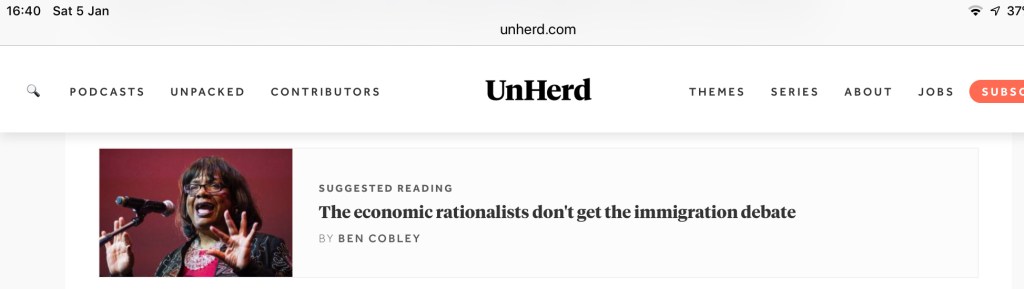
As an aside, I am rather unsure whether I like ‘UnHerd’. Apart from Giles Fraser, its contributors all seem to be right-wing. In the body of Fraser’s article are suggestions for further reading. I show these links above. One gets an uneasy feeling that this is not really an enlightened, liberal publication in the way that Dr Fraser’s previous home, the Guardian, is. Some of the images used are quite disturbing. ‘Economic rationalists … immigration’ is alongside a picture of our leading black – British – politician, Diane Abbott. ‘How bigoted is Brexit?’ appears alongside a picture of orthodox Jews playing what looks like a playground game. In both cases, one asks why these images were used, if there is not some appeal to unenlightened instincts.

Pace what the Brexit faction alleges, the EU is democratic, and upholds democracy. There is an elected European Parliament and an elected Council of Ministers, which bodies are sovereign. The European Commission is the civil service, the administrative arm, of the EU. Its powers are analogous with those of our British civil service as between themselves and the elected bodies. We currently enjoy considerable influence on the policy-making of the EU. Brexit would deny us any representation or control of EU policy in future. In ‘taking back control’, Britain would risk being governed by people who are not so committed to human rights, for example. One recalls that when he was a justice minister, Dominic Raab wanted to abolish the Human Rights Act.

It seems to me that we would have more chance of being able to put right the cruel excesses of austerity if we are inside the EU and able to benefit from its collective strength. If Jeremy Corbyn feels that, if he were Prime Minister, he would be able to negotiate more favourable Brexit terms than those obtained by Theresa May, then surely he ought to be confident that, among his many socialist colleagues in European parties, if we remained in the EU, he would be able to build a consensus away from neoliberalism.  After all, just as neoliberalism has failed in the UK, it has clearly not succeeded in several parts of the EU: certainly in Greece, and probably also in Italy, Spain and Portugal, the case for a change to Keynsian economics is strong. Note, incidentally, that the leading economist and former Finance Minister of Greece, Prof. Yanis Varoufakis, does not think that either his own country, Greece, or the UK, where he teaches, should leave the EU. Reform from within is the better route.

The argument that EU rules on state aid would frustrate Labour policy on rebuilding a fair and humane welfare state has been demolished by the leading competition lawyer, George Peretz QC. See https://www.theguardian.com/commentisfree/2018/dec/27/four-reasons-jeremy-corbyn-wrong-eu-state-aid. 

Now, with weeks to go before the date recklessly set by the government for Britain to leave the EU, I do hope that those respected thinkers on the Left such as Giles Fraser and Baron Glasman, as well as the Labour leadership, will come round to a similar view to that held by Yanis Varoufakis, that reform from within is possible, that the EU need not necessarily always be in thrall to neoliberalism, and that Brexit is ‘a disaster for Britain’ – see https://www.yanisvaroufakis.eu/2018/12/22/talking-brexit-bernie-and-left-internationalism-with-yanis-varoufakis-vice/. Then the Labour Party can solidly oppose Brexit and ensure that the Article 50 clock is stopped in order to allow a further referendum to take place, in which the people can decide whether they really want to make our country catastrophically poorer and less influential in the world, by leaving the EU (either under the current May ‘deal’ or without a deal), or whether, now that they can see what Brexit actually involves, they would prefer to remain in the EU.  Then I can hope to greet my friend in Hamburg and be recognised again as his true friend.

Hugh Bryant

5th January 2019 

Sermon for Evensong on the Fourth Sunday of Advent, 23rd December 2018

Isaiah 10:33-11:10, Matthew 1:18-25

‘In the bleak midwinter’; ‘Snow had fallen, snow on snow’; ‘Good King Wenceslas looked out … deep and crisp and even’. But Bethlehem is a hot place, dusty rather than snowy. I suppose carols and hymns can be rather an unreliable source of proper geographical information. ‘And did those feet .. walk upon England’s green and pleasant land?’

I don’t suppose they sing ‘Jerusalem’ in Italy, or in France or in Germany. Or if they do, presumably those feet were walking in the Black Forest or on the Palatine Hill, or maybe, in the Bois de Boulogne. There is, if we are literal about it, quite a lot of nonsense which we happily tolerate at this time of year. Things that appear to go completely contrary to common sense; like snow in Bethlehem. It probably was quite cold at night in the stable, once the sun had gone down. But there certainly wasn’t any snow.

One of the things that these carols are doing is assimilating the story of the birth of Jesus into our homes, or rather into an idealised version of our homes, because even here in England a white Christmas is, of course, very rare. I think it’s a fairly safe assumption that we won’t have one this year either.

And as well as the carols, the Bible readings that we traditionally use at this time also contain things which look contrary. Isaiah’s wonderful vision of the peaceful life on ‘God’s holy mountain’, after the Rod of Jesse, the Saviour, has beaten the Assyrians, and saved God’s chosen people, isn’t just a pastoral idyll.

It deliberately puts almost impossible companions together. The wolf and the sheep; the leopard, the kid; the calf, the young lion, the cow and the bear – the little child, leading them, like a party of schoolchildren following their teacher around the Tower of London, say.

Or perhaps it’s a classroom, full of these unlikely neighbours, who are not busily eating each other, but they are sitting attentively in class, being kept in good order by a little boy, like my two-year old grandson Jim. In your dreams, Sunshine!

Well, yes; in Isaiah, in Isaiah’s dreams. In the words of the prophet, telling his hearers what God has spoken to him and said, that the Rod of Jesse would come and slay the Assyrians, and then that they ‘would not hurt or destroy on God’s holy mountain.’

Interesting that it is on a mountain, on a high place. The Greek gods were on a mountain too; on Mount Olympus. And in the Old Testament, the heathen gods, the Baals and the Astartes of the Chaldeans, were worshipped with sacred poles, which were ‘in the high places’. ‘High places’ was almost a synonym for where God lived. We ourselves look up, look up to heaven, because conventionally, God lives in Heaven, and Jesus sits at God’s right hand ‘on high’, we say. Think of our Psalm this evening.

Unto thee I lift up mine eyes:

O thou that dwellest in the heavens. [Ps. 123]

But again, it’s not literally true. Yuri Gagarin, the first astronaut, was said by Nikita Krushchev to have gone into space ‘but not to have seen God there’. The early astronauts didn’t find a man with a white beard sitting on a golden throne and floating above the clouds. John Gillespie Magee’s wonderful poem, which is often read at the funeral of a pilot, ‘High Flight’, comes to mind. ‘Oh, I have slipped the surly bonds of earth … put out my hand and touched the face of God’. And so, on God’s holy mountain, children can safely play with cockatrices, vipers, and with asps, cobras. ‘Sheep may safely graze’.

It’s a much better outlook for the Israelites. The Messiah would come along and free them from slavery. The Rod of Jesse would mete out retribution to all their foes. That’s something that we can certainly relate to. ‘If only ..’, we say. If only: what would you call in the Rod of Jesse to do in your life? But maybe we are too comfortable, too well settled to really empathise with how the Israelites must have felt.

But there are people who are in exile, who are not free, who may even be subjected to slavery, even today, not far away. On Friday I did my first Father Christmas duty of this Christmas, up at Brooklands College, where there is a project for children who are asylum seekers and refugees. I gave out splendid big stockings full of goodies donated by the supporters of the project and by Elmbridge CAN, our local refugee support group, to 26 young people, teenagers and in their early 20s, who had come from Eritrea, from Syria, Ukraine, from Kurdistan, Iraq, from Afghanistan. Some were black Africans, some were Arabs, a couple were Chinese, and a couple were white Europeans. Many do not know whether they will be allowed to stay.

Some were learning to read and write for the first time; although typically, the ones who hadn’t been able to read and write were amazingly good at mental arithmetic. They were learning English, of course, and learning how to fit in with English society. The first words that they are taught are ‘please’, ‘thank you’, and ‘sorry’, because none of those are necessarily expressions that you come across in some of the countries that they have come from. Part of Father Christmas’ visit was a huge lunch, of Middle Eastern and African delicacies, that one of the volunteers from Elmbridge CAN had made. For about half the children, this would be their only meal that day. One meal, if you’re lucky. This is in Weybridge!

So pictures of the Israelites, in exile and under the oppressor’s boot, could still in certain circumstances be a picture of contemporary life, for refugees and asylum seekers today. Think what life in the refugee camps must be like, in Jordan, for example. No snow there, either!

As well as the mythical snow on this fourth Sunday of Advent, just on the eve of Christmas itself, St Matthew tells us the story of the other half of the Annunciation. This isn’t about Mary but about Joseph her betrothed. Again, the Christmas story is so familiar that we perhaps gloss over the bits that seem rather unlikely. Joseph’s original reaction when he finds out that his wife-to-be is pregnant, although he has had nothing to do with it, is what you might expect. His first thought is that the wedding is not going to happen.

Who is the Angel Gabriel? Have you met any angels recently? Or at all? It seems to depend a bit on where you come from and what you’re used to. In Africa and in Southern Europe, people are much more ready to believe in the existence of angels than perhaps we are. I don’t think that we can explain the Virgin Birth in the same way that we could explain how to bake a perfect soufflé – or whatever it is they do on the Great British Bake-Off.

But look at it functionally. Jesus definitely lived. He was a human being, although during his life and afterwards, things happened which have led us to believe that he was more than human, that he was divine as well as human. So somehow he must have been born, been conceived. All the things that show that he was really born, that he really was human, just like the other miracles, turning water into wine, miraculously healing sick people, raising Lazarus from the dead – none of those can be explained: so Jesus’ conception is equally mysterious and impossible to understand.

But notice how Jesus’ earthly parents, wonderfully, accepted the situation; and of course Mary said the Magnificat, which we’ve just sung together. God has chosen me; God has magnified me; God has made a big thing out of me.

Is it just a pretty story, then? Is it just a convenient excuse to have a nice time at Christmas? Think about what Mary said. Think about the message of the Magnificat, and the message of Isaiah, about the animals on ‘God’s holy mountain’. ‘He has put down the mighty from his seat, and exalted the humble and meek.’ Are we the mighty? Or are we the ‘humble and meek’?

We need to think about it, and to do something. Perhaps the other thing about God’s holy mountain is that a little child shall lead them. Shall we say that that is the Christ Child? You know, in snowy Bethlehem? And another thing. ‘No crying he makes’. This is some baby!

High Flight

Oh! I have slipped the surly bonds of Earth

And danced the skies on laughter-silvered wings;

Sunward I’ve climbed, and joined the tumbling mirth

of sun-split clouds, — and done a hundred things

You have not dreamed of — wheeled and soared and swung

High in the sunlit silence. Hov’ring there,

I’ve chased the shouting wind along, and flung

My eager craft through footless halls of air….

Up, up the long, delirious, burning blue

I’ve topped the wind-swept heights with easy grace.

Where never lark, or even eagle flew —

And, while with silent, lifting mind I’ve trod

The high untrespassed sanctity of space,

– Put out my hand, and touched the face of God.

John Gillespie Magee (1922-1941)

Sermon for Mattins on the Seventh Sunday after Trinity, 15th July 2018

Deuteronomy 28:1-14; Acts 28:17-31

‘I’m the urban spaceman, baby; I’ve got speed

I’ve got everything I need

I’m the urban spaceman, baby; I can fly

I’m a supersonic guy’ [Neil Innes, 1968]

The great Bonzo Dog Doo-Dah Band reached number five in the hit parade, in the UK charts, in 1968, with that song, ‘I’m the urban spaceman’. The writer of the song, Neil Innes, that you might remember from children’s TV programmes, is still performing, and occasionally he still sings that song. He was at the Claygate Music Festival last year; and very good he was, too.

What is success, in life? What does it mean to be a ‘supersonic guy’? For the Israelites in the Old Testament, having come out of Egypt, crossed over the Red Sea, and then being stuck in the desert for a long time maybe not literally 40 years, but that’s what the Bible says – everything paled into insignificance when compared with the need for them to get to the Promised Land, the place of safety, the land overflowing with milk and honey. That must be the same sort of feeling that you have if you are stuck in a refugee camp in Jordan, say. Northern Europe must look pretty decent as an ultimate destination: you might well use such expressions as ‘the promised land’ in talking about that.

But interestingly, what Moses says God has told him is slightly more complicated, and if anything, even better. If the Israelites will keep to their bargain with God,

[I]f thou shalt hearken diligently unto the voice of the Lord thy God, to observe and to do all his commandments which I command thee this day….

… all these blessings shall come on thee, and overtake thee, ….. Blessed shalt thou be in the city, and blessed shalt thou be in the field. … And the Lord shall make thee plenteous in goods, in the fruit of thy body, and in the fruit of thy cattle, and in the fruit of thy ground, in the land which the Lord sware unto thy fathers to give thee.[Deut. 28:1- 3,11]

In other words, if you worship God, you will do well. If you go through the list of blessings, it is very much a promise of prosperity.

Blessed shall be the fruit of thy body, and the fruit of thy ground, and the fruit of thy cattle, the increase of thy kine, and the flocks of thy sheep. [Deut. 28:4]

Of course, the converse is true.

[I]f thou wilt not hearken unto the voice of the Lord thy God, …. all these curses shall come upon thee, and overtake thee:

Cursed shalt thou be in the city, and cursed shalt thou be in the field.

Cursed shall be thy basket and thy store.

They are the other side of the coin. Instead of blessings, you will get cursed.

Cursed shall be the fruit of thy body, and the fruit of thy land, the increase of thy kine, and the flocks of thy sheep.

Cursed shalt thou be when thou comest in, and cursed shalt thou be when thou goest out. [Deut.28:15-19]

Compare all that with the blessings that Jesus goes into in chapter 5 of St Matthew’s Gospel.

Blessed are the poor in spirit: for theirs is the kingdom of heaven.

Blessed are they that mourn: for they shall be comforted.

Blessed are the meek: for they shall inherit the earth.

Blessed are they which do hunger and thirst after righteousness: ….

Blessed are the merciful: ..…

Blessed are the pure in heart: …

Blessed are the peacemakers: .…

And then follows Jesus’ great Sermon on the Mount – which isn’t a ‘prosperity gospel’. It doesn’t say, ‘Do all these good things, and they will make you rich – or powerful, or successful.’

Take no thought for your life, what ye shall eat, or what ye shall drink; ….

Behold the fowls of the air: for they sow not, neither do they reap, nor gather into barns; yet your heavenly Father feedeth them. [Matt. 6:25-26]

So who is it who is talking? In the Book of Deuteronomy, God is talking to Moses; or rather God is giving a message to the Israelites through Moses, who is a prophet.

In the New Testament, even though Jesus says, in the Sermon on the Mount, that He has not come to ‘abolish the Law or the prophets’, (and the Law includes a lot of the principles laid down in Deuteronomy, for example); nevertheless the whole accent has changed: indeed, you could almost think that God had changed.

The kingdom of God, to the Christians, is not really like the Promised Land was to the Israelites. It isn’t really a place, and there aren’t any special foods. No milk and honey – although perhaps quinoa is a sort of manna: who knows? As Christians, we aim instead to seek the kingdom of Heaven and to gain eternal life.

In both cases, whether we’re following the Old Testament God, or whether we are Christians, it’s a good thing to do what we believe God has commanded us to do.

If we are Old Testament Israelites, it’s pretty straightforward. God has made a contract with us, a covenant: if you do such-and-such, then I will do such-and-such in return – a solemn agreement. You mustn’t worship anyone except me; you must follow the other nine commandments and all the second-order rules and regulations which are set out in the first five books of the Old Testament. If you do that, God says, ‘I’ll make you successful and secure in the Promised Land. If you don’t, I will punish you.’

St Paul, in effect, tried to reconcile and make sense of these two visions, it’s very interesting to see how St Paul got on, on his way to Rome to appear before the emperor. He got some of the local Jewish people together – they were keen to hear what he had to say, because they had heard about the Christians, whom they thought of as a sect of the Jewish community – but they hadn’t heard any good things.

They were a bit suspicious. Paul laid out the whole story, from Moses up to and including the life of Jesus. In his teaching, he was telling them about God. And off they went, afterwards, discussing what he had said.

Some believed the things which were spoken, and some believed not. [Acts 28:24]

Paul remembered that Isaiah had also observed that some people’s ears were completely closed to any kind of enlightenment. He could tell them about the Kingdom, but they wouldn’t listen. That’s pretty similar to what happens today. Not a lot has changed. Some people believe, and some people don’t.

I sometimes think that perhaps that has to do with our not really knowing who or what God is. We blithely read stories in the Bible, where God said this, and God did this, and that – on the face of it, some very human-sounding things. Making a contract, making a covenant, for example.

But at the same time, God is said to be all-powerful, all-knowing: to be feared, even. I’m not sure that He really speaks to people in the way that you read about in the Old Testament; and in particular, speaking to the people through the prophets. I think that we would, to some extent, not recognise some of the aspects of God as He is put in the Old Testament.

He is said to speak through Moses; He is said to make things all right; he endorses the idea of material prosperity, especially in the Promised Land; he favours some people over others; and He is to be feared. In a lot of the Old Testament, just as in our lesson, there isn’t a lot about love. God is a fearsome god rather than a loving god. ‘God so loved the world ..’ is very much a New Testament message.

The other interesting thing is that the objective in the New Testament is not the Promised Land, so much as to be ‘saved’, to gain eternal life. Is that a selfish message? Is one supposed to turn in on oneself in order to draw near to God?

If you believe and trust in God now, as opposed to 3,000 years ago, do you indeed become the ‘Urban Spaceman’?

I wake up every morning with a smile upon my face

My natural exuberance spills out all over the place

I’m the urban spaceman, I’m intelligent and clean

Just as we haven’t seen any burning bushes or received tablets from heaven recently, I’m rather worried that a lot of what we are, blithely, reading in our Bibles and letting flow over us, without perhaps challenging it, engaging with it, is open to an ultimate question.

I never let my friends down

I’ve never made a boob

I’m a glossy magazine, an advert in the tube

I’m the urban spaceman, baby; here comes the twist–

I don’t exist…

Too many people think of God as the urban spaceman; and too many people know what comes at the end. We don’t follow the Urban Spaceman. Frankly, we don’t follow the God of Moses much. Do we follow the gospel of Jesus?

It won’t take us to the promised land. But it will change us. If you believe and trust in Him, you will want to follow Jesus’ two vital commandments, to love God – and to love your neighbour as yourself. Think how they were, even when they had St Paul himself preaching to them. Which side of the line would you be on? Is this something you can believe in – or not? I hope and pray that you can.

Sermon for Evensong on the Fourth Sunday after Easter, 29th April 2018

Isaiah 60:1-14, Revelation 3:1-13

I’m not sure whether Jerusalem is a good thing. ‘Jerusalem the golden, with milk and honey blest’: as some of you will know, always puts me in mind of my favourite biscuit when I was little: Huntley and Palmer’s Milk and Honey biscuit, which was a bit like a superior jammy dodger. No, what I have in mind now is that the idea of Jerusalem covers all sorts of things. It is a place: for sure it is a place today, which President Trump has designated as the place where the United States will have its embassy, as though it were the capital of Israel – although it isn’t. There is the place in ancient times which Isaiah, the third of the three authors who together make up the book of the prophet Isaiah, writing in the sixth century before Christ, made the more or less mythical capital of the promised land, the city of the Lord, the ‘Zion’ of the holy one of Israel. Zion is the name of the hill on which the city of David, the centre of Jerusalem, was built. It was the place for the temple and was, in a sense, where God lived.

So it goes on to have a meaning as the heavenly city, the kingdom of heaven; which is the idea in our reading from Revelation. ‘Him that overcometh’, the elect, the chosen ones, ‘him … will I make a pillar in the temple of my God, … and I will write upon him the name of my God, and the name of the city of my God, which is the new Jerusalem, which cometh down out of heaven from my God’. We still talk about people being ‘pillars’, ‘pillars of the church’. They are the stalwarts, the usual suspects, on the PCC and Deanery Synod.

That mythical new Jerusalem was adopted by William Blake, of course, in his great hymn,” And did those feet in ancient time, walk upon England’s mountains green? … I will not cease from mental fight, nor shall my sword sleep in my hand, until we have built Jerusalem in England’s green and pleasant land.’

In some ways that all sounds very admirable and harmless. The picture in Isaiah of the holy city, ‘The multitude of camels shall cover thee, the dromedaries of Midian and Ephah; all they from Sheba shall come: they shall bring gold and incense’ is a wonderful picture. You may wonder, of course, what a dromedary is. And I have to tell you that Hilaire Belloc, in his ‘Bad Child’s Book of Beasts’ gets the dromedary completely wrong. He says,

The Dromedary is a cheerful bird:

I cannot say the same about the Kurd.

Hilaire Belloc, Complete Verse, collected edition (1954), reprinted 1991, London, Pimlico, p.237 n

A Kurd, you know, people who live on the borders between Turkey and Iraq: Kurds, not animals at all! But also, dromedaries are not birds, not birds at all. They are a sort of small camel. Mind you, The Bad Child’s Book of Beasts is probably not a good source of zoological information. I can’t resist reading you what Hilaire Belloc says about the tiger, just before the entry about the dromedary. It comes after his description of the lion.

The Tiger on the other hand, is kittenish and mild,

He makes a pretty playfellow for any little child;

And mothers of large families (who claim to common sense)

Will find a Tiger well repay the trouble and expense.

Oh dear. Well, Isaiah correctly thought of dromedaries as a species of camel. ‘The multitude of camels shall cover thee, the dromedaries of Midian and Ephah’. Everyone will come to the holy city, not only the Jews but also the Gentiles: ‘The Gentiles shall come to thy light.., the forces of the Gentiles shall come unto thee.’

‘Therefore thy gates shall be open continually; they shall not be shut day nor night; that men may bring unto thee the forces of the Gentiles, and that their kings may be brought.’

This is a clue to the problem which I want to go into now. It’s the idea of a homeland or nationality; it’s a very strong idea in many people. Scotsmen go all over the world but keep their Scottishness; they always celebrate St Andrew’s Night and Burns Night. But nationality is not an entirely benign idea. The problem seems to come when people are on the move. Obviously, as we are in church, we can think of the Jews, the people of Israel, leaving the land of Egypt and the land of Babylon –

‘By the waters of Babylon

We sat down and wept: when we remembered thee, O Sion.’ Psalm 137.

They longed for the Promised Land. Then, as we know, the promised land story was effectively repeated, but without any parting of the Red Sea or anything, following the Balfour Declaration of 1917. Palestine was declared to be a national home for the Jews – and there’s been trouble ever since, between the Israelites and the people they displaced, the Palestinians.

In this country, maybe William Blake’s new Jerusalem has to some extent already been built. I noticed that an MP called Kemi Badenoch, whose parents were Nigerian, was saying on ‘Any Questions’ on Friday that she thought that Britain was a very attractive country for people to come to and settle in; and that we are a welcoming people. I have to say, having heard the awful stories of what has happened to many of the ‘Windrush people’, I thought she was being rather generous; but nevertheless, the idea is there. It seems to be a similar one to the one in Isaiah: that if we have ‘built Jerusalem, in England’s green and pleasant land’, then not only the Israelites, but also the Gentiles will be welcome to it:

‘.. thy gates shall be open continually; they shall not be shut day nor night’

so presumably that means that not only the people who were born here, but also other people from outside – in this context, the ‘Gentiles’ – should be able to get into the Holy City.

But then again, perhaps the Holy City is spiritual, a spiritual concept rather than a literal, physical one, so we should rather look at the sort of vision that St John the Divine shares with us in Revelation. A place for the people who prove worthy of salvation:

‘Because thou hast kept the word of my patience, I also will keep thee from the hour of temptation, which shall come upon all the world..’

If you are one of the saved, then you are going to be welcome in the City of God, new Jerusalem. This new Jerusalem is in heaven, or it ‘comes down from heaven’. I think that, as soon as you see the word ‘heaven’, it’s a signal that this is a spiritual concept rather than a literal, physical one.

The Son of Man, Jesus, appearing to St John the Divine, telling him to write down his letters to the Seven Churches of Asia, is a sort of preparation for the Day of Judgement. Watch out! ‘I know thy works’. You aren’t everything that you’re cracked up to be. Be careful, if you want to go to the new Jerusalem.

So I wonder whether the idea of the new Jerusalem resonates with us at all today. Is it in ‘England’s green and pleasant land’? If so, are the Gentiles allowed in – with their camels and dromedaries, bringing their gold and silver? Who are the ‘Gentiles’ today? Are they just us, who happen not to be Jewish? or should we be like the church at Philadelphia – by the way, you know what ‘Philadelphia’ means in Greek: it means ‘brotherly love’ or ‘brotherly affection’ – and of course that includes sisters too. Αδελφός means a brother, and αδελφή a sister, so Φιλαδέλφεια means brotherly or sisterly love.

So are we going to be like the people in Philadelphia? Although they have ‘a little strength’, they’re not very strong, they have ‘kept my word’ and have not ‘denied my name’. They will be welcome in the new Jerusalem. We know what we have to do. Open the gates!

L

Sermon for Evensong on the Third Sunday of Easter, 22nd April 2018

Exodus 16:4-15; Revelation 2:12-17

Salvation. What is it to be ‘saved’? After the glorious Easter story of Jesus’ resurrection, it seems logical to move on from celebrating his, Jesus’, triumph over death to his promise that we too will be ‘saved’, to a life after death. In the Book of Revelation, we find a vision of what that might look like. I’m often rather dismissive about heaven being a place above the clouds where you meet a kindly old man with a white beard. But actually the beginning of the Book of Revelation is one source of that quaint image of the divine. This is how the book begins.

I was in the Spirit on the Lord’s day, and heard behind me a great voice, as of a trumpet,

Saying, I am Alpha and Omega, the first and the last: and, What thou seest, write in a book, and send it unto the seven churches which are in Asia; ….

And I turned to see the voice that spake with me. … one like unto the Son of man, clothed with a garment down to the foot, and girt … with a golden girdle.

His head and his hairs were white like wool, as white as snow; … out of his mouth went a sharp two-edged sword: and his countenance was as the sun shineth in his strength [Rev. 1:10-14]

But even if it comes from the Bible, that picture of heaven is just a best effort to imagine something beyond the scope of human knowledge. There are rational objections to the idea of heaven being above the clouds – not least the evidence of the early astronauts, who didn’t bump into angels or anything like that. The Book of Revelation is, I’m sure, spiritually inspired, but I don’t think we’re meant to take it literally.

But it’s a vision of heaven, of what life after death might be like, the seven churches in Asia meeting Jesus the Judge Eternal, who decides what he likes and dislikes about them.

The church in Pergamum almost gets a clean bill of health. They are steadfast. They stood up to persecution, and one them, Antipas, became a martyr for the Gospel. But

‘I have a few things against thee, because thou hast there them that hold the doctrine of Balaam, who taught Balac to cast a stumbling block before the children of Israel’.

This is a reference to an episode in the story of the Exodus of the Israelites from Egypt, in the Book of Numbers, chapter 22.

‘And the children of Israel set forward, and pitched in the plains of Moab on this side Jordan by Jericho.

And Balak the son of Zippor saw all that Israel had done to the Amorites.

And Moab was sore afraid of the people, because they were many: and Moab was distressed because of the children of Israel.

And Moab said unto the elders of Midian, Now shall this company lick up all that are round about us, as the ox licketh up the grass of the field. And Balak the son of Zippor was king of the Moabites at that time.

He sent messengers therefore unto Balaam the son of Beor to Pethor, which is by the river of the land of the children of his people, to call him, saying, Behold, there is a people come out from Egypt: behold, they cover the face of the earth, and they abide over against me:

Come now therefore, I pray thee, curse me this people; for they are too mighty for me: peradventure I shall prevail, that we may smite them, and that I may drive them out of the land’ …

The story of the Exodus from Egypt and the entry into the Promised Land is a great one. Parting the waters of the Red Sea; annihilating the Amorites. And a constant theme is that the Israelites must keep their covenant, their contract, with God, so that He will protect them, will save them.

If you remember the story, the Israelites didn’t really appreciate where they were going. They ‘murmured’ among themselves. They hadn’t got enough to eat. Why did they leave Egypt? And Moses put their complaints in prayer to God, and God sent vast numbers of quails for them to eat. I’m not sure how they were presented, these quails. I’ve always imagined them arriving ready cooked, sort of chicken-in-the-basket. And then God sent manna, the divine bread.

What was it that the Judge Eternal thought was reprehensible about Balak and Balaam? You’ll remember that Balak, king of the Moabites, wanted Balaam to curse the Israelites, to curse Jacob, because he thought that there were too many of them, too many likely to come in as immigrants.

‘Behold, there is a people come out from Egypt: behold, they cover the face of the earth, and they abide over against me:

Come now therefore, I pray thee, curse me this people; for they are too mighty for me’.

The Moabites didn’t want immigrants to come into their country.

‘[B]ehold, they cover the face of the earth’, they said. Keep them out. Vote for Brexit. Maybe support UKIP.

Well, remember what the Judge Eternal felt. He was quite happy with the people from the church at Pergamum, except to the extent that they followed the

‘ …doctrine of Balaam, who taught Balac to cast a stumbling-block before the children of Israel’.

You’ll remember the story of Balaam’s donkey, who pulled up in awkward places because she could see an angel, holding a double-edged sword, blocking her path. But it was all right for the Israelites, who were refugees, to come in, to be immigrants.

It makes a difference whose point of view you adopt. If you’re with the Israelites, you are entering the Promised Land – and you don’t want to mix with the people whom you’ll find there.

The people like the Amalekites and the Moabites, the Palestinians, are being turfed out, displaced, by the Israeli settlers. They not unnaturally don’t want the Israelites to come in and displace them.

How difficult it is to find the right answers here! Are immigrants, asylum seekers, a good thing? Are they going to overwhelm the indigenous population?

Now shall this company lick up all that are round about us, as the ox licketh up the grass of the field.’

As they discovered with their encounter with the Amalekites, the Israelites were following a fierce, tough God. The fierce God wanted them to exterminate the Amalekites in their quest for Lebensraum in the Promised Land. So much for controlled immigration. You remember: God blamed Israel, because Israel had spared a few people, a few Amalekites. God was angry not because they had gone on a killing spree, but because they hadn’t; they hadn’t exterminated the Amalekites. [1 Samuel 15]

Nowadays surely we find that story strange, and challenging. Surely God would be merciful? But no, He is portrayed as wanting to kill every last Palestinian, or rather, Amalekite. It doesn’t look right. It doesn’t look fair. But it was the Promised Land. And they were rewarded with celestial food, manna from heaven.

There’s an echo of that in the Book of Revelation. The churches who prove faithful, and don’t fall for the temptations of illicit sex and other bad behaviour, will get the ‘secret manna’. That must be “I am the bread of life’ in St John’s Gospel, chapter 6. Jesus is the bread of life. ‘Feed on Him in your hearts by faith with thanksgiving’.

So what about immigrants? Are you on the side of the Israelites, or of the Moabites – or even the poor old Amalekites? Are you running away from slavery, in Egypt – or Syria – or are you upholding a policy of ‘creating a hostile environment’ for immigrants?

As the shocking cases of the ‘EMPIRE WINDRUSH migrants’ show, creating a ‘hostile environment’ for immigrants is practically impossible to do in the way apparently intended here, to deter people who are not deemed to be ‘worthy’ immigrants. Unless you set up barriers which challenge all who seek to come in, it will be a lottery whether you catch the ones you want to. But if you set up that hostile barrier, you will obstruct many people who are perfectly legitimate. It also seems that the only class of people who have been consistently mistreated by the ‘hostile environment’ policy are black people.

There haven’t been any dreadful miscarriages of justice involving white people who came over from Australia, or Canada, or South Africa 50 years ago, and never bothered to keep hundreds of documents just in case, 50 or even 70 years after they arrived, got jobs, paid taxes, and raised children here, somebody challenged them to prove they were entitled to be here. There don’t seem to be any of those cases against white people.

The big irony here is that even today, the story of the Promised Land is still controversial. The Palestinians who lost their homes after the Balfour Declaration, and who have been pushed out even more by the foundation of the ‘settlements’ in modern Israel, can be excused for being negative about immigration. But people who stand up for them against the Zionists find themselves labelled as antisemitic.

What would Jesus do? Where is the salvation here? I think that to be ‘saved’ here doesn’t just mean getting up there with the Son of Man with his white robe and snowy beard. It surely means also being ‘saved’ from being deported to a country you’ve never seen; it surely means also finding a better balance between today’s Moabites in Palestine, worried about being overwhelmed by Zionist immigrants, and the people on the run from civil war in Syria, who so desperately need places of refuge.

Manna from heaven? Well, food for thought anyway.