Archives for posts with tag: war

Sermon for Mattins and Morning Prayer (Principal Service) at All Saints Church, Penarth, 5th October 2025

Habakkuk 1.1-4; 2.1-4

Psalm 37.1-9

2 Timothy 1.1-14

Luke 17.5-10

It’s a pity that we don’t have lantern slides at 8 o’clock, because I could show you the picture on the slide which is going to be shown at 10 o’clock when I start to preach the sermon then. It’s a sort of shovel, or it could be a large spoon, with round things in it, quite small.

I wondered whether they were my favourite special-treat breakfast cereal, Grape-Nuts – I should explain that I didn’t choose the pictures, as Susannah is leading the service at 10 as well as this one – but I suspect that at 8 o’clock we need to stay away from pictures and screens and things like that, and just keep our worship simple and our pictures in our heads, where, of course, those of you who listen to the wireless know that the best pictures are.

What is in the big spoon? I asked Susannah and she told me that they were mustard seeds, picking up a reference to the Gospel reading, the New Testament lesson today. I have to say that it rather threw me, because I thought mustard and cress was something which you grew on a face flannel on the bathroom windowsill, but apparently this is what mustard seeds really look like.

The lessons are all about how we confront a world which is going wrong, which is going against us. The Old Testament lesson, from the prophet Habakkuk, comes from a time around 600 BC when the Assyrians had overrun the northern kingdom of Israel, and all that was left of God’s chosen people were the two tribes of Judah and Benjamin, together with the survivors from the massacre when the Assyrians invaded the northern kingdom, who had fled to Jerusalem to take refuge there.

Habakkuk was preaching when the Babylonians were beginning to sweep down on Palestine; they are the Chaldeans, if you read a bit more beyond one of the bits that we have for our lesson, which is in two bits, the first four verses of chapters one and two respectively. If you read on in chapter 1, beyond where it says

Devastation and violence confront me;

strife breaks out, discord raises its head,

……

for the wicked outwit the righteous,

and so justice comes out perverted.

Habbakuk goes on in his prophecy by saying

Look, you treacherous people, look:

here is what will astonish you and stun you,

for there is work afoot in your days

which you will not believe when it is told you.

It is this: I am raising up the Chaldaeans,

that savage and impetuous nation,

who cross the wide tracts of the earth

to take possession of homes not theirs.

Terror and awe go with them;

their justice and judgement are of their own making.

Their horses are swifter than hunting-leopards

And he goes on to say how terrifying they are in all sorts of other ways. Obviously they fulfilled the American strategic objective for a successful army in the invasion of Iraq, ‘shock and awe’.

But this terrible army had its limitations.

Their whole army advances, violence in their hearts;

a sea of faces rolls on;

they bring in captives countless as the sand.

Kings they hold in derision,

rulers they despise;

they despise every fortress,

they raise siege-works and capture it.

A terrifying picture. Who could stand against them? But then –

Then they pass on like the wind and are gone;

and dismayed are all those whose strength was their god.

People who believe that ‘might is right’ turn out to be completely mistaken; and the key words in Habakuk’s prophecy come in the second chapter, in our second part of the lesson, [2:4]

Look at the proud!
 Their spirit is not right in them,
 but the righteous live by their faith.

It’s an idea that St Paul picked up on in two of his letters. In his great letter to the Romans, [1:17], he said that in the gospel of Jesus

is revealed God’s way of righting wrong, a way that starts from faith and ends in faith; he says, as Scripture says, ‘he shall gain life who is justified through faith’.

In the letter to the Galatians [3:11], where St Paul is drawing a distinction between following the provisions of the Jewish law, just carrying out the 10 Commandments, and having faith, saying that the way to salvation is through faith, he says that

It is evident that no one is ever justified before God in terms of law; because we read, ‘he shall gain life who is justified through faith’.

I’m not sure why the compilers of the Lectionary decided that we should have a lesson from the second letter to Timothy rather than one of these passages from Romans or Galatians, (which clearly reference the passage in Habbakuk), but certainly in the passage from the second letter to Timothy, St Paul celebrates that the fact that Timothy and his mother and his granny, Eunice and Lois respectively, all had strong faith.

But you might be a little bit puzzled about exactly what this faith is. It’s pretty clear that it’s not what we would call blind faith, just believing that something is true without any evidence for it. If that was true, you might never take another paracetamol ever again; or even worse, you might try to cure Covid by drinking some bleach. But we are not talking about President Trump’s belief system; this is a word which has more of a connotation of trust about it. It’s not so much about believing that something is the case, but rather, trusting in God to produce a good outcome, to right the wrongs. It’s very close to hope. Hope in the Lord. Trust in the Lord. As Isaiah puts it [14:31]:

but those who look to the Lord will win new strength,

they will grow wings like eagles;

they will run and not be weary,

they will march on and never grow faint.

They will soar, on wings like eagles: they will ‘mount up with wings like eagles’.

Just now our world looks a bit like what it must have looked like to Habakkuk; there is a lot going wrong. There are terrible wars, invasions; the rule of law looks to be under threat in places: –

devastation and violence confront me;

strife breaks out, discord raises its head,

…..

for the wicked outwit the righteous,

and so justice comes out perverted.

We can think of plenty of places and cases today, where those words would be very apt. We are going to have a vigil later on today here to pray for the people of Palestine; equally our prayers should go for the other places in the world where there is no peace and where the rule of law does not securely run: Ukraine and the south of Sudan chief among them, as well as Gaza and the West Bank; and all those places where people are held hostage or are fleeing violence and persecution and are becoming refugees.

We need to trust in the Lord, to pray with confidence and realise the power of prayer, even if our faith is only the size of one of Susannah’s mustard seeds, or a spoonful of Grape-Nuts. It doesn’t matter. You can rely on God to put things right in the end. Let us pray that he will use us in his service to that good end.

Amen.

Hugh Bryant
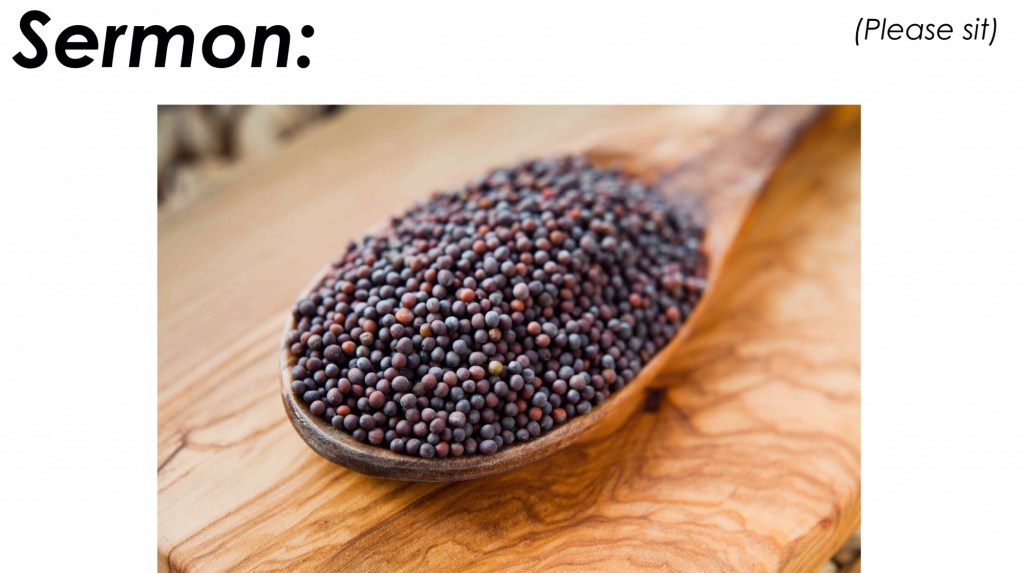
From the PowerPoint slides at the 10 o’clock service. What are those little beads?

Sermon for Evensong on the 22nd Sunday after Trinity, 12th November 2017 at St Mary’s, Stoke D’Abernon

Judges 7:2-22; John 15:9-17 – see http://bible.oremus.org/?ql=377554049

This morning we held our Remembrance Day Services. Godfrey, in his sermon, said that, when he had first been ordained, in the 1970s, people had not expected remembrance services to carry on being held after the year 2000. There would be no-one still alive who had served in either of the World Wars. So the memory, the ‘remembrance’, would just be an impersonal one, a collective celebration of something we had learned about from history. It would be like our celebration of the 500th anniversary of Martin Luther and the beginning of the Reformation, or Guy Fawkes Night, perhaps.

But as Godfrey pointed out, since the end of WW2, there has been only one year during which members of the British armed forces have not been engaged in conflict, somewhere in the world. So there is still a reason to be thankful for their bravery, to remember them, and to pray that, through our bringing to mind their sacrifice, we will gradually and finally turn away from war and strife.

Now in this evening service, as we turn towards the ending of this day of remembrance, I want to reflect on some of the many things that challenge us – or which, I suggest, ought to challenge us, as we enter the 100th year after the promise was made that the First World War was the ‘war to end all wars’. Because, 99 years later, very sadly, that still isn’t true. Wars haven’t ended.

So I want to reflect, to look carefully at some of the things we have said and done in relation to war, and see if perhaps we can discern any factors which might help towards bringing peace in future. You may not agree that I am asking the right questions: but I hope that what I say may start you thinking critically and, I hope, constructively. I very much doubt whether there are any automatically right answers here, at least so far as mortal men and women are concerned, but I think we ought to try.

Love one another. On Remembrance Sunday. Lest we forget. And, to pick up both our lessons tonight, you don’t need a big army to win a battle against overwhelming odds, if God is on your side.

How to make sense of all this. This morning we stood in silence by the war memorial and tried to commemorate all those who, in one sense, had not loved one another. They had killed each other. We honoured those who fell. We do honour, usually, those who fell fighting, fighting for our side. We don’t usually pray for the people who were the enemy, although there have been good exceptions, like the prayers at the service in Westminster Abbey after the Falklands War, for example, when the then Archbishop of Canterbury insisted that there should be prayers for the Argentines too.

After all, Jesus said, ‘Love your enemies, and pray for those who persecute you,’ (Matt. 5:44). But we – and mankind generally – never have. Indeed, we love to rake up, in a rather triumphal way, the history of the First and Second World Wars. We thank our ancestors for being brave and standing up against the enemy – Germany in both cases – and keeping us independent.


The enemy’ wasn’t just Germany, in fact: it also included Turkey, Japan, Austria, and Italy as well, at various times. Most of those countries have been friends and allies for far longer than they were enemies in one or other of the World Wars. The same countries, at different times, have been both allies and enemies.

It’s difficult to generalise about countries, whether they are always going to be friends or foes. But what we can say about most wars is, that in most cases, it wasn’t personal. Even in the terrible trench warfare of WW1, people weren’t fighting people whom they knew, and whom they’d fallen out with.

That should perhaps be something we could think about, when we’re tempted to think of the Germans as baddies, or someone makes a joke about them not having a sense of humour or wanting to extend their territory round a swimming pool on holiday. People were not fighting people they hated personally, but fighting for ideas, or for their country’s sovereignty. Our soldiers fought because our leaders thought that otherwise, we would be overrun by Germany – sovereignty; and, in WW2, to avoid being turned into Nazis, a question of ideas. Remember the Christmas Day truce in 1914, when the soldiers got out of their trenches and played football, exchanged cigarettes and gifts. They had nothing personal against each other.

Again, I think that, as we reflect on the sad fact that no amount of ‘Remembrance’ has stopped wars from breaking out, we might try to identify some of the ideas which seem to have led to war. Sovereignty, for instance: not wanting someone else, foreigners, to dictate our laws. But think about this. A pooling, a watering down, of sovereignty, to some extent, in the European Union, has brought about the longest ever unbroken period of peace in Europe. And every treaty between countries, for any purpose, involves the parties giving up a little of their individual autonomy in order to agree together.

And allied to that, perhaps we should reflect on what it is that makes us British, or French, or Chinese, or whatever nationality we are. In the majority of cases, it is an accident of birth. There is no special distinction, it confers no special entitlement by itself, just to be born. You certainly might say that the miracle of life itself, of being brought to birth, is itself hugely valuable. But whether you’re born in poverty in a Calcutta slum or in a mansion on St George’s Hill, that fact of itself doesn’t entitle you to do better or worse than another human being.

We are all children of God, equally. So aggressively putting up barriers to keep people out of ‘our’ country – and I’ve put the word ‘our’ in inverted commas, because although people use that expression, ‘our’ country, I’m not sure what it really should mean – aggressively keeping others out may not be a good, or a right, thing to do. But millions of people have died, effectively to uphold that principle.

We sense that there must be some reasonable limit, some reasonable extent of nationalism. In WW2, we would not have wanted our government to be in Berlin, or to have had to speak German instead of being able to speak English, (loudly if necessary, if people don’t understand us), to everyone we meet, wherever we happen to be. So where is the right balance?

The bravery and sacrifices made in the World Wars kept us free, and we are thankful. But if today the same instincts for independence result in our driving out from our midst people who have come to live and work here, and who provide such valuable contributions to our health service, to our farmers, in our hotels and restaurants and so on, if those people feel we no longer welcome them and accept them, this is not the ‘love’ that Jesus was talking about. It was αγάπη [agape], brotherly love, charity and kindness that he meant.

‘Greater love hath no man .. Jesus’ next sentence in St John’s Gospel, after the great command that we should love one another, is ‘Greater love hath no man than this, that a man lay down his life for his friends.’ As Canon Giles Fraser pointed out on the radio on Friday, some war memorials don’t say ‘lay down his life for his friends’, but ‘for his country’ instead. But really, the context in the Bible is, of course, that Jesus is looking forward to his own death, to the crucifixion. ‘As I have loved you, so you must love each other.’

That is a sacrificial kind of love. Making sacrifices, even the ultimate sacrifice, for someone you love. There are all those stories of heroism and sacrifice in war.

Jack Cornwell, the under-age naval hero who stayed at his post during the Battle of Jutland, severely wounded himself, even though everyone around him had been killed or wounded, quietly waiting for orders.

My own relative, Dr John Fisher, who won the MC at Arnhem as a medic, by going into a minefield to treat wounded soldiers, laying a tape behind him so that the stretcher bearers could safely get through the minefield to the casualties and bring them to safety. Every step could have been his last, if he had trodden on a mine. But he was willing to risk death, in order to save others. He survived, fortunately.

Or other heroes, who weren’t soldiers. ‘Maximilian Kolbe was a Polish priest who died as prisoner 16770 in Auschwitz, on August 14, 1941. When a prisoner escaped from the camp, the Nazis selected 10 others to be killed by starvation in reprisal for the escape. One of the 10 selected to die, Franciszek Gajowniczek, began to cry: My wife! My children! I will never see them again! At this Maximilian Kolbe stepped forward and asked to die in his place. His request was granted’. [ http://auschwitz.dk/kolbe.htm]

We should try always to remember them, and to be grateful for their sacrifice. And as well, we should realise that Jesus wasn’t just talking about supreme, life and death, sacrifices. Love means giving things up for your friends, small sacrifices as well as big ones.

And what about Gideon, and his battle against the Midianites? Why did he go through this bizarre process of whittling his army down to 300 champions only, instead of the thousands he had at his disposal? God didn’t want the Israelites to be so powerful that they could boast that their own strength had brought them victory. To show the power of God, they had to be seen to win against impossible odds.

But the puzzling thing is the thought that, as so often in war, it is said that both sides are praying to God, to the same God, that their side will prevail. Will God support one side against the other? And if so, why? It is a version of the theological conundrum called ‘theodicy’ (θεοδικη), the question why a good God would allow bad things to happen. The answer in this story from the Old Testament is that God favours his chosen people, the people who worship him rather than any other, false gods.

There is also the story of the Roman emperor Constantine at the battle of the Milvian Bridge in the fourth century, who had a dream about Jesus Christ and decided to paint his soldiers’ shields with a symbol of the cross. They won the battle, and Constantine, in gratitude, adopted Christianity as the official religion of the Roman Empire – which was a major factor in making Christianity spread throughout the world.

But – but there’s something uneasy about this rather crude, almost superstitious approach to God. Having God as a kind of nuclear weapon, the ultimate ‘game changer’, seems wrong. Granted that we believe that God cares for us, knows all of our names, and so on: but why would He almost justify a war, by determining its outcome? Or to put it another way, why would the good God become involved in the evil that is warfare? The hymn says, ‘Who is on the Lord’s side?’ Not, ‘Whose side is the Lord on?’

Enough for one Sunday evening, I think. Lest we forget. Let us love one another, as Jesus has loved us.