Archives for posts with tag: Zechariah

Sermon preached at St Peter’s, Old Cogan, on 14th May 2023: the Sixth Sunday after Easter

Zechariah 8.1-13
Revelation 21.22 – 22.5

See https://bible.oremus.org/?ql=556703225

‘The third day he rose again from the dead;

He ascended into heaven’…

This bit of the Creed neatly marks where the church is after Easter and before Ascension Day, which is this coming Thursday.

At first, when I was thinking what I was going to say to you at this point, I had a real feeling of cognitive dissonance, if I can call it that, between our Bible readings, with their visions of heaven or the Heavenly City, and what seems to be going on in the world around us today. 

Archbishop Justin made an impassioned speech in the House of Lords the other day, pointing out how a Bill intended to stop people crossing the Channel in little boats contradicts morality and international law as well as being profoundly inhumane; and then I read in the paper that we are going to supply to the Ukrainians cruise missiles called Storm Shadow which cost

 £2 million each. 

So many thoughts were swirling around in my brain. On the one hand there is no price which one can put on preserving freedom and defeating invaders: on the other, it is interesting to know that apparently we in the UK have about 1000 of these missiles, £2,000m, £2 billion-worth, and yet we are told we can’t afford to pay our doctors and nurses and all the other public servants properly. 

They say that, if you met all the public service pay demands at present being put forward, in full, it would cost about the same amount, £2 billion. How to judge which is the right course to take? Missiles to defend Ukraine, or paying our public servants? 

In the face of these terrible dilemmas maybe the thing to do is to clear one’s head by drawing close to the Lord in prayer and coming to the Lord’s house at 3 o’clock on Sunday, as we have, and bringing our worship and prayers.

But isn’t this just escapism? Maybe not. Our Bible readings today have, I think, a heavenly flavour. 

‘On the holy mount stands the city he founded. 

Glorious things are spoken of you, city of God.’ 

‘Glorious things of thee are spoken, Zion city of our God’, as the hymn says.

And we have Zechariah’s prophetic vision of the city of God. 

‘I will return to Jerusalem, and will dwell in the midst of Jerusalem; Jerusalem shall be called the faithful city and the mountain of the Lord of hosts shall be called the holy mountain.’

Or you could stay in heaven itself and follow the vision of John in the Book of Revelation. 

‘I saw no temple in the city, for its temple is the Lord God the Almighty and the Lamb. And the city has no need of sun or moon to shine on it, for the glory of God is its light, and its lamp is the Lamb’.

I think these days we tend to rather shy away from talking much about heaven, because we feel that it is very much beyond our comprehension. What would you say, if somebody tackled you as you were coming out of the church today, and said, “It looks like you are a churchgoer, a Christian, can you tell me anything about heaven?” Well certainly if that was me being tackled in that way, I think I’d find it quite challenging. 

One might start to say things like, ‘That it is where God lives’ – and then immediately you’d worry that God lives everywhere, by definition. There isn’t a particular place where he lives. Or perhaps, ‘It’s where people go after they die’.  Again, it’s quite difficult to work out the geography of that. Or just, a place above the skies, out of our sight. Again, mundane considerations might intrude.

When Yuri Gagarin, the first astronaut, returned to earth (and he was a Christian), President Khrushchev asked him whether he had seen anything above the clouds in the realms of space. Did he encounter God? Gagarin said, no, unfortunately he hadn’t seen anything divine up there.

Well maybe you can do better than I can, but I think that in principle it’s quite a tricky question. If we stay with the idea that heaven is where God is at home, say, if that’s not too vague, here in these Bible readings we have two versions; it seems that Zion, where not only God, but God’s chosen people, the Israelites, live, on the one hand is heavenly and on the other hand, earthly.

On the one hand we have the city and temple of Zion; that seems to be an earthly place; and on the other hand we have the vision of heaven in Revelation, where the heavenly city has no temple in it. It’s not a place for God to visit like the temple on Earth, because God is the temple. 

God’s presence gives it its light and makes it glorious. It has the river of the water of life flowing from the throne of God and of the Lamb through the middle of the street and on either side of the river is the tree of life with its 12 kinds of fruit, reflecting the 12 tribes of Israel, and the leaves of the tree of life for the healing of the nations. Naturally-occurring medicine, like aspirin.

You could miss that word ‘nations’ – it means not just the chosen people, in fact, not the chosen people at all, but all the other people who are cut off from from the Jews, the Israelites: people like us. Both the new Zion on earth and the sort of heaven that we perhaps naturally think of beyond the skies are open to the ‘nations’ as well as to the Israelites. 

Maybe neither of them is literally true, in the sense that you could go there and take pictures, but nevertheless I think there are real things we can see which are very relevant in our lives today.

In Psalm 87:  ‘Very excellent things are spoken of thee, O Zion, the city of God. I, the Lord will record Egypt and Babylon as among them that are my friends. Behold the sons of Philistia, Tyre and Ethiopia.’

These are not just Israel or Judah, and in some instances they even look like enemies of the Israelites. Philistia, Philistines, Egypt – where they were enslaved. Babylon – where they were enslaved, again. Enemies have become friends in the new Zion, in heaven on earth. Strangers in our midst. Refugees. ‘Behold the sons of Philistia, Tyre and Ethiopia.’

Look again at Zechariah’s vision. ‘Old men and old women shall again sit in the streets of Jerusalem.’ It’s been pedestrianised. ‘And the streets of the city shall be full of boys and girls playing in its streets.’ An idyllic scene; but here’s the thing. Even though it actually seemed impossible to the ‘remnant of this people’ in those days, ‘Should it also seem impossible to me?’ says the Lord of hosts. 

Think of all the politicians, not just on one side, who tell you that something or other which would otherwise improve the lot of the people, isn’t possible, isn’t practical.

For instance, ‘I would love to abolish student fees,’ says Keir Starmer,  ‘but I can’t make a commitment because it may be that practical considerations get in the way’. It seems impossible. 

But the Lord of hosts points out that he is God, and nothing is impossible for him. ‘For before those days there were no wages for people or for animals, nor was there any safety from the foe for those who went out or came in’. It sounds like today. Cost of living crisis. War. Crisis in our public services: not enough money. But look:

‘ There shall be a sowing of peace. The vine shall yield its fruit, the ground shall give its produce and the skies shall give their dew; and I will cause the remnant of this people to possess all these things.’

The chosen people had been taken off to Babylon. ‘By the waters of Babylon we sat down and wept.’  The Temple had been destroyed and quite a lot of them had drifted away and married local girls. The ones that were left were called the ‘remnant’ of the chosen people. 

Remember what happened in 1945. Our country was completely broke. But somehow the National Health Service was founded, millions of council houses were built and the welfare state started. 

Zechariah could have been forecasting, prophesying, about that as well as, instead of, what he actually was forecasting about, which was what would happen to the Israelites as they returned after their exile. He was writing in about 530 BC; but what he was saying, that there should be a ‘sowing of peace’, could apply today. 

‘Should it seem impossible to me?’ asks the Lord of hosts. Surely not: God can do anything, and with his help, so can we.
Luke 1:46-55 – The Magnificat – see http://bible.oremus.org/?ql=464171095

‘And Mary said, ‘My soul doth magnify the Lord’. Really? Is that really what Mary, the mother of Jesus, said? Now what Mary is reported by Luke as saying, saying to the other rather unlikely mother, Elisabeth, the wife of Zechariah, was, of course, not transcribed from a dictaphone recording. Dr Luke was writing it up, 40 or 50 years later. These are the words that Luke felt that Mary would most likely have said, after the angel Gabriel had visited her and told her that she would have a baby who would be the Son of God. Picture the scene. ‘Hello Mary! I’m an angel. Call me Gabriel. You’re going to have a baby. He is going to be the Son of God.’ Y’know. As you do.

As you do? No – you don’t. It’s not a normal thing. What would you have said, if you were in Mary’s place? Some of Mary’s words are, indeed, what you’d expect her to have said: but other bits are more hypothetical, more speculative; they come more from St Luke, from Luke reflecting on the true meaning of the earth-shattering event which Mary was about to undergo. On the one hand, there is nothing too far-fetched about having Mary say, ‘My spirit rejoices’ because ‘.. he has looked with favour on the lowliness of his servant’. She’s saying, God has chosen me, an ordinary girl, to do the second most important thing for the world after its original creation. That is the sort of thing you’d have expected Mary to have said.

But what about this other bit: ‘… he has scattered the proud in the imagination of their hearts’, or ‘He has brought down the powerful from their thrones, and lifted up the lowly;

he has filled the hungry with good things, and sent the rich away empty’? Is that really something that Mary would have said? Because those are really quite revolutionary ideas. Let’s think a bit about them.

When Mary was visited by the angel Gabriel, so far as we know, the rich were still comfortably situated; the Emperor, the Roman emperor, still had his clothes – and his mighty armies. The lowly were still poor and lowly. The hungry were still hungry. God hadn’t actually done any of the things which Mary was supposed to be celebrating.

St Luke was putting words into Mary’s mouth, thinking what Gabriel’s visit to Mary really meant. It meant that God wanted to upset the established order. Luke knew what Jesus was going to do, what the true values would be, in the Kingdom of God. No more inequality; no more rich people getting more in one day than whole countries’ worth of what ordinary people could earn in their lifetimes.

You know that Jeff Bezos, the boss of Amazon, is said to have ‘earned’ – well, earned; perhaps a better word would be ‘come by’, or ‘trousered’, or ‘blagged’ – $14billion in one day, recently. And, incidentally, he tried to reduce the salaries of his employees on the same day. What a hero. Now God, according to Mary in the Magnificat, would definitely ‘send the rich away empty’. That means Mr Bezos. Amazon Prime to Amazon Zero. God will send the rich away empty.

Mary’s words, Mary’s rant, even, is a vision of the Kingdom of God. What do we think about that? Do we just hope, and pray, that things will eventually, miraculously, become fairer, and no-one will want for anything? Because if so, after 2,000 years, we’re still waiting. Or do we believe that God needs people, people to be His hands and feet, to be his eyes and ears?

If that’s how it’s supposed to work, then what the the Kingdom needs is activists. It needs people who are prepared to work really hard to change things for the better. Maybe their activism will even verge on being revolutionary. Activists. So who are these activists? Are there any activists about today?

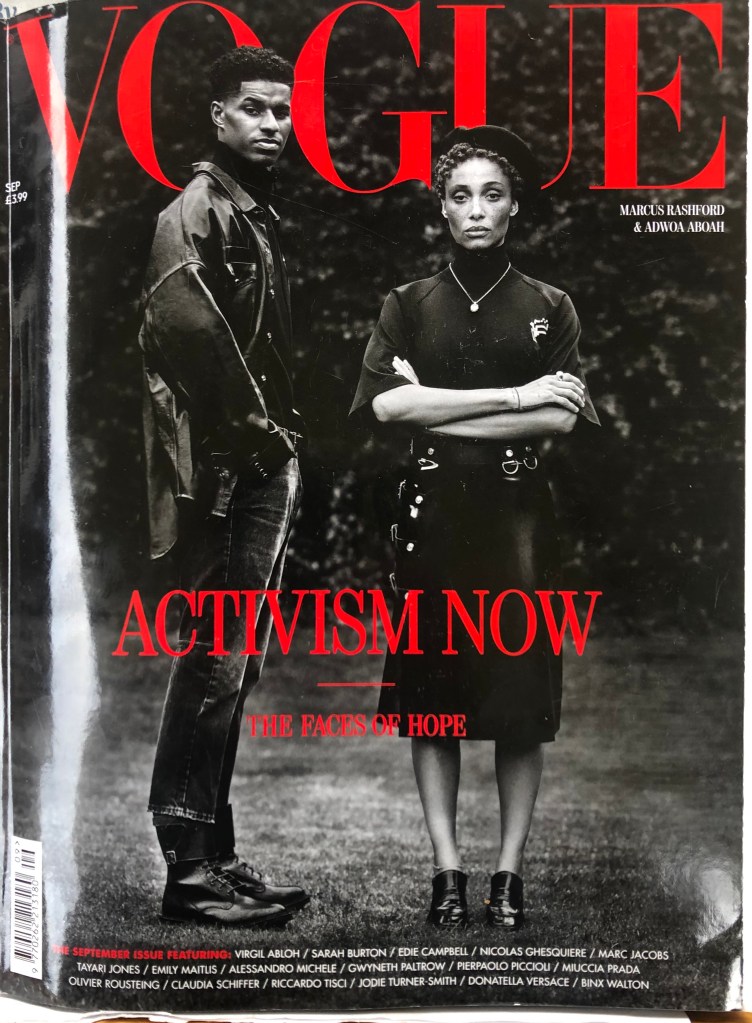
I found some the other day, in what might seem to be a rather unlikely place. They were in ‘Vogue’ magazine. Yes really, ‘Vogue’. I’m hoping we can show the cover of the latest edition on our screen. There it is.

There on the front cover with the supermodel Adwoa Aboah, is Marcus Rashford, the Manchester United footballer, who made a fuss and persuaded the government to provide school meals for poor children during the holidays; and inside there are many more people who are called the ‘faces of hope’, working in many ways as activists to bring hope where previously there was none.

I assure you that I’m not a secret employee of the publishers Condé Nast. I’m not on commission based on how many copies of Vogue you buy. But it is worth a look. There are many inspiring stories – and, reflecting the rise of Black Lives Matter, for once the stars in this glossiest magazine are all black. Beautiful black people.

Hmm. In the Song of Songs the bride sings – as you can hear in Monteverdi’s Vespers of 1610 – ‘Nigra sum, sed formosa’, ‘I am black, but beautiful’. ‘But’ beautiful. That’s the only false note in that beautiful song. Not ‘but’ beautiful, but ‘and’ beautiful is what it should be. And the editor of ‘Vogue’ has celebrated that. He is Edward Enninful, and he is an activist.

What else about these activists? A common feature of all their stories is that they all say their activism builds a sense of community, or having values and friendship in common with each other. So would the Blessed Virgin Mary count as an activist today?

I’m sure she would – maybe in a similar way to some of the beautiful people portrayed in ‘Vogue’, as icons to be followed, to be copied. Faces of hope.

Because what else does this make you think about? Surely we can loop back from our world today to the first century AD. The stories of the activists in Vogue are very reminiscent of the stories of the early Christians. They were activists; they were a community; they had everything in common. They would lift up the lowly and fill the hungry with good things. Build up your community – support your local food bank, say – isn’t that just another way of saying, ‘Love your neighbour’?

That might prompt you to think again about Mary’s song, Mary’s rant, the Magnificat, as it’s called. Because ‘magnificat’ is Latin for ‘bigged up’, ‘magnified’, ‘made more of’; as the hymn puts it: ‘Tell out, my soul, the greatness of the Lord’. And the Magnificat, sung by a cathedral choir, is one of the highlights in Evensong, that lovely service, that you can hear on Radio 3 twice a week – this afternoon at 3 and then on Wednesday at the same time – or on any day in the Cathedral at 5.30 (in normal times). It’s something you might just let flow over you in its beauty. Well, you mustn’t stop enjoying the Magnificat – but do remember that it is a call to action, to be an activist, for God.

Sermon for Mattins on Palm Sunday, 20th March 2016

Zechariah 9:9-12, 1Cor.2:1-12
We know what happens next. Or as people say nowadays, ‘Spoiler alert!’ ‘Ride on, ride on in majesty’. If you’ve just been to the family Eucharist at 10 o’clock, and seen the lovely tableau which the children presented, and maybe you have admired the Shetland pony on your way out, you will know why, when you were little, Palm Sunday was one of the best Sundays in the year to go to church. Donkeys are, alas, in rather short supply these days: there are now rather strict rules about what you have to do if you are going to carry a donkey around.

Mind you, in Stoke D’Abernon, many of the Mums do have the right vehicle for towing a horse box. Somewhere around here there is even a Range Rover with the registration number KT11 MUM! Anyway at St Mary’s we have had a lovely Shetland pony, and I am sure that Jesus would not have turned his nose up at a ride on him.

Processions are fun. Walking down the hill in a happy throng following someone riding on a Shetland pony was a very jolly thing to do. You can wave your palm leaves and your palm crosses. People do get quite carried away when they get caught up in supporting somebody who seems to take away their cares and blot out the annoyances that they have to put up with.

It’s quite noticeable, for example, that Donald Trump seems to have caught the imagination of a lot of people who feel left out by mainstream politics in the United States. They feel that big government doesn’t listen to them. Trump is their champion.

The Israelites had been in exile, and then under foreign domination, in their own country, for hundreds of years. At the time of Jesus, of course, the Romans were in charge and the Jews were second-class citizens. They were looking forward to the coming of a messiah, a deliverer, a king who was going to liberate them. They looked back to the various prophecies in Isaiah: the servant king, and in Zechariah was this strange image of a king coming on a donkey.

The basic model for the procession was what Roman generals did when they came back from foreign wars. If they had been successful, they were granted the right to have what was called a ‘triumph.’ A triumph was a magnificent procession through the centre of Rome, parading their captives and soaking up the applause of the people.

You can see that it would very much depend on your point of view how such a procession, with Jesus at its head, would be viewed. Even though Jesus was riding on a donkey, it might look rather challenging to the powers that be. In Palestine at that time, the ‘powers that be’ were both the Romans and the Jews, (the Pharisees and the scribes), because the Jews had a form of self rule, under the overall authority of the Romans. So if this big procession came over the hill from Bethany and down the Mount of Olives, it’s fairly understandable that both the Jewish authorities and the Romans might well have found it disturbing.

Even today, although we are supposed to be very liberal in our approach to free speech, you have to get permission for a demo to take place. You can’t just have a procession through the centre of the village, so that it blocks the traffic. For people in authority, processions are a sign of discontent.

There was a raw energy about to this crowd. In St John’s Gospel, we are told that the people were particularly excited because they had heard about Jesus bringing Lazarus back to life from the dead. Jesus, riding on a donkey, was a fulfilment of Zechariah’s prophecy. It all added up to a moment of great hope for the people. A man who could bring a dead man back to life could certainly be the king that they were looking for, to throw off the yoke of Roman rule so that Jerusalem would be liberated again.

But we know what comes next. ‘Ride on, ride on, in lowly pomp ride on – to die.’ A huge amount of the New Testament is devoted to the events of next week, Holy Week. A quarter of St Luke’s gospel; a third of Saint Matthew and St Mark and nearly half of St John’s Gospel. This is what Christianity is all about. And certainly, in this week, it is not about a triumph. It is not about conquest. It is more like a catalogue of suffering and failure.

When you’re little, you can only really take in nice stories about people riding on the back of donkeys. Good Friday is not something that we go into in great detail with our children. It is in a very real sense what in the cinema would attract an X rating. It is something which is too shocking. What we are talking about is the death of God, people putting to death the man who was also God. Five days earlier this man was being feted as the returning hero, as the Messiah, the king from over the water.

Nevertheless he, this same man, was going to be strung up on a cross along with common criminals.

Saint Paul says that the authorities would never have done it if they had known the full story. ‘We speak the wisdom of God in a mystery which none of the princes of this world knew; for had they known it, they would not have crucified the Lord of glory.’ [1 Cor. 2:8]

In Spiritual Cinema next week, on Tuesday, we intend to show the shortened, animated version of Ben Hur. We debated what would be an appropriate film to show during Holy Week. One film which we have shown in the past, which I felt was perhaps the very best one, was Mel Gibson’s The Passion of the Christ. A few years ago, we actually showed it in St Andrew’s Church, in the church itself.

For those who haven’t seen it, it is a very harrowing film, because it does show, in a very realistic way, exactly what happened to Jesus; how he was flogged, humiliated and ultimately crucified. Somehow it brings home to you the awfulness of what he suffered in a way that cold print on a page just can’t do. It would be a shocking film if you were watching somebody – just anybody – suffering in that way. Nobody should be treated in such a brutal and bestial way. But Jesus did suffer in that way, and he was the son of God.

The contrast with the jolly man on a donkey could not be more profound and more complete. We know what happened next. What must it feel like if you have just committed the most terrible crime, and realise what you have just done? What will the Judge say? What will your sentence be? What if that crime is to kill the son of God?

Oh, you say, but we didn’t. We weren’t there. It was the bad people, even the Jews. But in a sense, we were there. In a sense, the turnover, from his triumph to his downfall and being lifted up on the cross, was entirely predictable. It made sense in human terms to the powers that be. It wasn’t specifically because they were Jews or because they were Romans or whomever. They were just ordinary fallible human beings. They didn’t recognise his divinity. Pontius Pilate having the inscription put over the cross, naming Jesus as the King of the Jews, says it all. In one sense, he was the king of the Jews, but in that the Jews were the chosen people of God he was also king of heaven.

In Lent we have been encouraged to reflect, to deny ourselves, maybe to fast, and to pray. Now in this week, this Holy Week, we are invited to think about the full awfulness of what Jesus suffered, and why he suffered it. Maybe we should do it without a spoiler alert. Maybe we should say, we don’t know what comes next. Maybe we aren’t too comfortable. If Jesus died for all of us, for all of humankind, we should reflect that the sort of evil which pushed Jesus on to the cross is still with us.

People are still hurting each other, pursuing gain without thought for the loss to someone else that that gain entails. We are still returning an eye for an eye and a tooth for a tooth. We are still going by on the other side. We are still worshipping false gods.

‘Ride on, ride on in majesty. In lowly pomp, ride on to die.’