Archives for posts with tag: Zephaniah

Sermon for Mattins on 19th November 2023 at All Saints Church, Penarth

Bible readings: https://bible.oremus.org/?ql=567221698

When I led the team running the food bank in Cobham, Surrey, in the second richest borough in the country – I mean in the UK, not just Wales – the old saying about the political inclinations of Anglicans rang very true; you know, that the Church of England is the ‘Conservative Party at prayer’. I can see you bristling, because I’m no longer in England, and what holds good for the Church of England may well not carry sway in Wales; and also when I see our Labour MP and our Labour MS and our Labour Police and Crime Commissioner and our Labour Mayor, all happily ensconced in the congregation here at All Saints, I can’t help feeling that perhaps the political orientation of the faithful in the church in Wales might be rather different from how things are in the darkest parts of Surrey.

What, you may ask, has this got to do with the parable of the talents? ‘For to all those who have, more will be given, and they will have an abundance; but from those who have nothing, even what they have will be taken away.’ In the Authorised Version, ‘…from him that hath not, it shall be taken away, even that which he hath’. Surely this is one of the toughest things which Jesus is supposed to have said; so tough that I wonder whether he really did say it.

But then if you look at Saint Mark’s Gospel, chapter 4, you’ll find that he said almost the same words, but not referring to a parable like the parable of the talents, just rather a version of the ‘golden rule’ to do as you would be done to. ‘…the measure you give will be the measure you receive with something more besides. For those who have will be given more, and those who have not will forfeit even what they have’. That’s what is in Saint Mark’s Gospel chapter 4 [4:25].

What made me think about these socio-economic issues was when I was ‘Googling’ these lines to see if there were any brilliant insights in the University of Google, and I found in the Quora app the response to the question, what does this saying of Jesus mean, and someone had given the answer, ’It means that God is a Republican. He clearly wants the already wealthy to be given more, and for the poor to have what little they have taken away.’

Surely that can’t be right. I can dare to discuss it, because it has been neatly transposed by Quora into an American context and the parallels between the Republicans and any UK political parties are, of course, not exact; so I don’t think that I am saying anything rude about British politics, if we just keep it at this academic level. The rich get richer and the poor get poorer. Did Jesus really approve of that? 

There are even more puzzling things to tangle with if you look at the rest of the parable, because it looks like an invitation to, or at least an endorsement of, speculation. ‘You have to speculate to accumulate’, some people say, and the first two slaves did exactly that – and were successful.

It doesn’t say exactly what their trading activity was; whether they invested in making something or whether it was pure speculation, futures and options perhaps. Who knows? It does look a bit as though Jesus is attempting a Marxist analysis, that what he is talking about is capital, the uses of capital; and the third slave, the one who buried the talent in the ground, and got no credit for looking after it carefully, perhaps put into words a Marxist critique. 

‘You were a harsh man reaping where you did not sow, gathering where you did not scatter seed.’ Perhaps he was a shareholder in one of the water companies, being paid in dividends the money which should have gone to improving the quality of the water so as to put Surfers against Sewage out of business. Or somebody like the Glazers, the brothers who took over Manchester United. They borrowed all the money needed to buy Manchester United, and having bought it they used the profits of Manchester United’s activities to repay the loans. ‘Unto him who hath, it shall be added’. And the season ticket prices went through the roof – ‘… from him who hath not, …’

But are we meant to think that the absent capitalist in the parable stands for Jesus or for God, and if so, does God approve? Does He approve of speculation, more than just keeping something safe that you’ve been given to look after? The capitalist says that he should have put it in a deposit account and got interest on it. 

That’s quite a change from the usual Old Testament position in Exodus, Leviticus, and Deuteronomy. All condemn usury, which is lending at excessive rates of interest, to the detriment of the poor. It’s something that the Old Testament seems to condemn, but here Jesus seems to approve of the idea that somebody should benefit from the payment of interest on deposits. 

And the poor slave doesn’t get any credit for keeping the capitalist’s money safe. He didn’t lose it; whereas the speculators could easily have lost it. Investments can go down as well as up, as the small print always advises. Perhaps what Jesus is trying to point up is that it is better to be active, to try to work hard rather than just to sit back and go with the flow.

The reading from Zephaniah has the same sort of theme. ‘I will search Jerusalem with lamps and I will punish the people who rest complacently on their dregs’. Another translation says, ‘I shall search Jerusalem by lantern light and punish all those who are ruined by complacency, like wine left on its lees. Who say to themselves, the Lord will do nothing neither good nor bad.’ 

These people are so comfortable that they don’t care about God. But their wealth will be plundered, their houses laid in ruins. They will build houses but not live in them. Think about the new Embassy Quarter in London near where the new American embassy has been built on the south side of the River Thames, where at night there are no lights in the buildings and the restaurants are closing, because nobody lives there.

Absentee speculators have bought up the flats. They don’t live there and they don’t let anyone else live there. Just imagine the effect on the housing crisis if the councils could house some of the people on the waiting list in some of those flats. It looks as though Zephaniah was another person in the Bible with at least some views which Karl Marx would recognise.

Altogether this is challenging teaching. Perhaps Jesus was just deliberately trying to make us think. In distinct contrast with the parable of the talents, there are the stories of Dives and Lazarus, or the Good Samaritan, about generosity or the lack of it;  or turning the water into wine at the wedding in Cana in Galilee. 

I don’t see that the apparent meanness of the parable of the talents really squares with the second great Command, to love one’s neighbour as oneself, so I think it must be a discussion piece, a deliberate provocation to the disciples to think hard about economics. Granted that Jesus made five loaves and two fishes go a long way, I still don’t see him as being terribly enthusiastic about zero sums – you know, what I gain, you lose.

What would Jesus’s take on it be today? Surely he would think that the gap between the rich and the poor is far too great. And I don’t necessarily think he would recommend aggressive speculation as a way of making money. ‘Render unto Caesar’ seems to me to be a clue. Progressive taxation might be on Jesus’s agenda today, I would have thought. ‘Take care of the pennies and the pounds will take care of themselves,’ might be as far as He would go. But I don’t think that the widow, with her mite, was listening.
Sermon for Evensong on the Fifth Sunday after Easter, 26th May 2019

Zephaniah 3:14-20; Matthew 28:1-10, 16-20 (see http://bible.oremus.org/?ql=425693885) – But what about the Bigots?

‘Sing, O daughter of Zion; shout, O Israel; be glad and rejoice with all the heart, O daughter of Jerusalem.’

You can tell, even without reading the whole book, that this passage at the end of the book of the prophet Zephaniah turns things around. The first two chapters of the book are not joyful; they are more like lamentations. The kingdom of Israel, the people who made the exodus from Egypt, who had David and Solomon as kings, had split into two kingdoms, the northern kingdom called Israel, and the southern kingdom, Judah, in which was Jerusalem.

In 721 BC the northern kingdom was destroyed by the Assyrians. Zephaniah was prophesying some time after that, probably about 100 years later, in Jerusalem. The sub-heading in one of my Bibles on this passage is, ‘Doom on Judah and her neighbours’; so the first part of the book is all about how the kingdom of Israel, which has become the province of Judah, has gone to pot.

The great day of the Lord is near, …

That day is a day of wrath, a day of trouble and distress, a day of wasteness and desolation, …. And I will bring distress upon men, that they shall walk like blind men, because they have sinned against the Lord: (Zephaniah 1)

Why is the Lord cross with his people? Zephaniah says,

“Woe to her that is filthy and polluted, to the oppressing city!

She obeyed not the voice; she received not correction; she trusted not in the Lord; she drew not near to her God.’ (Zephaniah 3:1-2)

This was all nearly 3000 years ago, but there are definite resonances with things that are happening here today. I wrote this sermon originally on Friday, and I didn’t think we would know the outcome of the EU election until after 8 o’clock tonight, as we have to wait until all polling stations in all EU member states are closed – and most of the countries are having their vote today.

I suspect that it will turn out to have been a strange business, and whatever the outcome, we will all continue to have a more or less uneasy feeling that something is wrong with our society, and with our country, at the moment.

Whether it goes as far as the sort of thing that Zephaniah was prophesying about is obviously a moot point, but it seems to me that it’s not controversial to say that, wherever you are in relation to modern politics, whatever you believe in, this is a time to be concerned and worried.

The idea that comes from Zephaniah in the part which was our first lesson today, ‘Sing, O daughter of Zion’, … ‘be glad and rejoice’, is something which I think we would all respond very well to. We would love to feel that everything was right with the world, and that we could relax and be joyful.

Unfortunately, we’re not there yet. I don’t think that it’s going to help very much for me to try to spell out to what extent any of the competing parties and interest groups – ‘interest groups’, because the Brexit Party isn’t a political party, it’s actually a limited company – it isn’t going to be easy or productive at this stage to try to relate aspects of each of these people to the eternal verities which we are trying to understand and to carry out in our Christian witness.

It’s no good trying to say whether one or other party or interest group is better or worse at trying to bring the various parts of society back together, so as to finish the various arguments which have so divided people. It isn’t even worth it at this stage to try to express a view on what is going to help people materially, or perhaps more realistically, to hurt them least, in the various proposals advanced by the various parties. People are not listening to rational arguments.

What would Jesus say? I really don’t know. But I think it’s worth reminding everyone that it’s a good question. If we sit down quietly and try to work through the various propositions which have been put to us, from the time of the referendum three years ago until now, it might be a very good exercise to look at each one in the light of that question.

What would Jesus have done? What would Jesus have thought about these various things?

I went on Thursday night to our friends at St Martin’s in East Horsley for a talk which they had organised, by the long-serving former MP, Chris Mullin, who is well known for his many books, including ‘A very British Coup’, which was made into a TV series. After he had given his talk, from the audience a lady stood up and, I think, rather shocked everybody. I should tell you that the audience was about 30 people, and they could easily have been from here. Normal bods, tending towards the middle-aged if not slightly elderly; middle-class, middle-aged, respectable people. When this lady stood up, asked her question and made her point, she looked exactly the same as everyone else. But she wasn’t.

She told us that although she had grown up in this country, had lived here for many years and had worked as a solicitor for a City firm, she was not English. She was German, and her father had been head of the UK division of the great German engineering company Siemens, which has a number of factories here, and has had for many years. She is married to an Englishman. After the referendum result, her husband had said that he thought that it was not going to very nice for their family to carry on living in England – meaning, not very nice for his wife, for his German wife. So they now live in Spain. There they have recently bought a new car. One of their neighbours, she said, wondered whether it was going to be a Range Rover, and said he hoped that it wasn’t – because they didn’t want to see anyone buying anything British for the time being.

And I, as I think some of you will already have heard, had a similar experience shortly after the Brexit referendum when I went to Hamburg, and some of my German friends, several of whom have been friends for 30 or more years, all said more or less the same thing to me, the same simple sentence: they said, ‘But we thought that you were our friends’. Imagine how I felt.

No more comments on that. We all have strong views. But what would Jesus say about it? I wonder.

Let’s move on to our second Bible lesson, from St Matthew’s Gospel. It’s the resurrection story, the empty tomb, which we have read about in St John’s and St Mark’s Gospels already, during this Easter time.

For some reason the compilers of the Lectionary have missed a bit out. You’ll notice that, in St Matthew chapter 28, tonight we have heard verses 1 to 10 and then 16 to 20. The missing bit is a story, which appears only in St Matthew’s Gospel, about the chief priests bribing the Roman soldiers who had been set to guard the tomb – and again, we read about these guards only in this Gospel – bribing these soldiers to spread a story that Jesus’ disciples had come in the dead of night and taken Jesus’ body away. The passage ends, ‘This story is still told among the Jews to this day’. Perhaps that’s why it’s left out now in our lessons, as it could be taken as a a point against Judaism.

That’s one bit which is unique to St Matthew, not too crucial. But the other unique bit is far better known. It is the Great Commission, as it is called.

Go ye therefore, and teach all nations, baptising them in the name of the Father, and of the Son, and of the Holy Ghost:

Teaching them to observe all things whatsoever I have commanded you: and, lo, I am with you always, even unto the end of the world.

It is the great call to Evangelism, to spreading the Good News, the ‘Evangelia’,(Ευαγγελία) the Greek word for good news. Jesus assured us that He is still with us: he said, ‘... lo, I am with you always, even unto the end of the world.’

I began this sermon with a rather gloomy recital of the prophet Zephaniah’s words of lamentation about the godless state of the people of Israel in Jerusalem, and I invited comparisons with the state of our nation today. I invited you to think what Jesus might have to say about it. That is a really tough question.

But what about the Great Commission? How are we doing on that one? Our British reserve tends to make us rather coy about announcing our Christianity to people in public. But increasingly, people are growing up without having read the Bible or been to Sunday School. It’s important, therefore, that we have our family services at St Mary’s and that our PCC is beginning to think about having a youth worker. We invited Esther Holley, the children and young people’s minister from St Andrew’s in Cobham, to come and talk to us about her work, and we all found her account inspiring. As a result of Esther’s work, St Andrew’s has a solid group of children and some teenagers. But nothing stands still. Esther has been accepted for ordination training, so they will be looking for her successor soon. Maybe we should start making moves in this direction too.

And finally, on the question how we are carrying out Jesus’ commission to ‘teach all nations’, I think that it is vitally important that we maintain the warmest welcome, here at St Mary’s, to our services, to our church family, and to our other activities based around St Mary’s Hall, the best church hall for miles around.

I personally would like us to look at joining an organization called ‘Inclusive Church’, which encourages churches not just to be welcoming to all, but to advertise that they are. It’s the old story of the two milkmen competing for business (you can tell it’s an old story, because competition on the same milk round disappeared years ago), and one milkman put a big banner on his milk float saying, ‘We deliver milk every day’. Of course his competitor did the same thing, but they didn’t advertise it. The milkman with the banner doubled his sales!

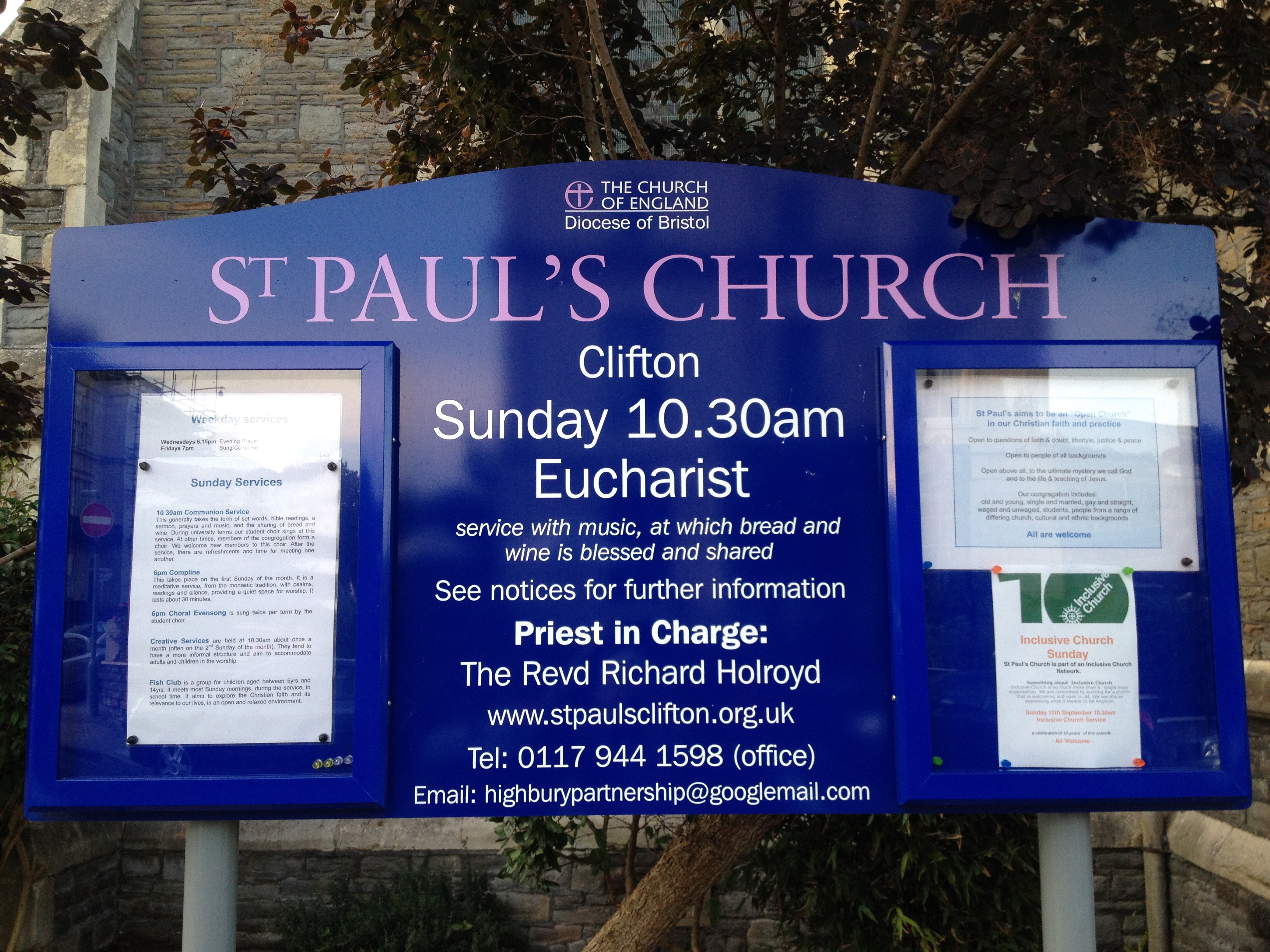
The same reasoning, I think, would work for us. If I have moved into this area and I’m looking for a church to go to: if I’m going through a tough time in my life and I’d like to find somewhere to say prayers: if I want my kids to learn what’s in the Bible: what will St Mary’s be like inside? Now if there’s a big sign outside saying that everyone is welcome – and I’ve put a picture of an Inclusive Church sign from another church with my sermon on the website [see above] – then people can feel confident, and they will dare to open our door and come in.

I know that not everyone agrees with this idea. Some people say we are already a really welcoming church. No need to join organisations or advertise – although I would gently say that it’s noticeable that we have no black people in our congregation. Somebody once even said to me, in this context, ‘But what about the bigots? We mustn’t upset the bigots!’

Well that perhaps takes me full circle, to the outcome of the European election. What about the bigots? What would Jesus say? I think he would say, ‘Look who I have lunch with already. People get shirty that I sit down with tax gatherers and sinners. But they are welcome!’