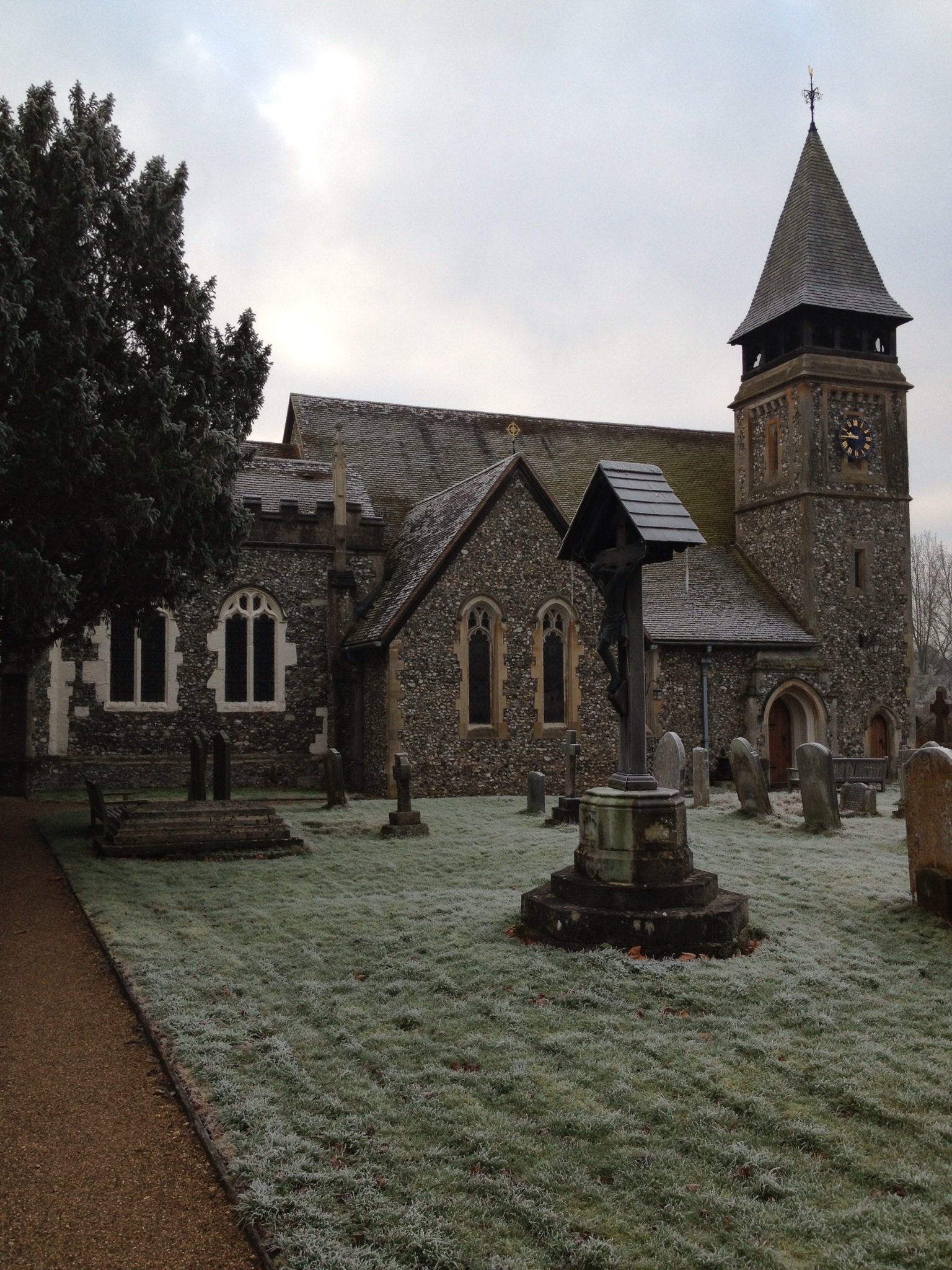
Sermon for Evensong on the Sixth Sunday after Trinity, 12th July 2015
Job 4:1; 5:6-27

Why do bad things happen? Has it got anything to do with God? Sadly, we’ve had several cases in point in the last couple of weeks. This week we remembered the ‘7/7’ bombings. Last week there was the dreadful shooting of tourists in Tunisia. Before then, more shootings of innocent people, in a church in the United States.

Poor old Job had a similar experience. He was a rich and successful livestock farmer. He had a large and happy family.

‘There was a man in the land of Uz, whose name was Job; and that man was perfect and upright, and one that feared God, and eschewed evil.
And there were born unto him seven sons and three daughters.
His substance also was seven thousand sheep, and three thousand camels, and five hundred yoke of oxen, and five hundred she asses, and a very great household; so that this man was the greatest of all the men of the east.’

Then various disasters struck, and he lost everything; even his family were killed in a hurricane which destroyed the house they were staying in. The story in the first chapter of the Book of Job puts it all down to Satan, who had challenged the Lord God: strike down Job, he tempted, and he will curse you. The Lord didn’t exactly fall for the temptation, but

‘… the LORD said unto Satan, Behold, all that he hath is in thy power; only upon himself put not forth thine hand.’

So according to the story, Job came to grief not at the hand of God, but of Satan – or perhaps more relevantly, he came to grief not as a result of anything he himself had done. Job is portrayed as a wholly good man. But nevertheless something, some external force, has brought disaster on him.

That’s quite an important step. There is an idea in parts of the Bible called technically ‘eudaimonism’, according to which, if you become ill or suffer misfortune, it is because you have done something wrong, you have sinned against God: and God has punished you. For example in St Matthew chapter 9:

And, behold, they brought to him a man sick of the palsy, lying on a bed: and Jesus seeing their faith said unto the sick of the palsy; Son, be of good cheer; thy sins be forgiven thee. ‘Thy sins be forgiven thee’, not, ‘Here’s some medicine for your palsy.’ In this theory, illness is caused by, is a punishment for, sin.

Here, in Job’s case, it’s made quite clear that Job isn’t the author of his own misfortune. But I would just pause there, and say that eudaimonism isn’t an attractive idea anyway. Would a God of love make people ill? How would it be if, when you met someone who was poorly, your first thought was not, ‘I hope you get better soon’, but, ‘What did you do wrong, in order to bring your suffering upon yourself?’

And at first Job doesn’t blame anyone. He worships God and accepts his terrible lot. Then along come his three friends, the original Job’s Comforters.

In tonight’s lesson we hear from the first one, Eliphaz. His explanation for Job’s trouble is that troubles are just part of being human. There’s no-one specific to blame. Just put your trust in God, God

‘Which doeth great things and unsearchable; marvellous things without number:
Who giveth rain upon the earth, and sendeth waters upon the fields:
To set up on high those that be low; that those which mourn may be exalted to safety.’

It reminds me of the Magnificat: ‘Who hath exalted the humble and meek, but the rich he hath sent empty away.’

That doesn’t seem to me to offer Job much real comfort. If God has the power to right wrongs, to impose justice – then why has He allowed suffering to take place at all? If God is so capable, why has He allowed Job to get into trouble? This is something which still troubles us today. Even people with the strongest faith can find that it is tested to destruction. There was a moving dramatic recreation, on the TV this week, of the story of Rev. Julie Nicholson, whose daughter was caught up in one of the bombings on 7/7, and was killed. This terrible loss effectively destroyed the mother’s faith, and her ministry in the church. She just couldn’t square the idea of a loving God with what had happened.

Eliphaz goes on with a fine piece of Job’s Comfort:

‘Behold, happy is the man whom God correcteth: therefore despise not thou the chastening of the Almighty:’

I have never understood why people receiving punishment are supposed to be grateful for it. There are all those school stories involving corporal punishment, from Tom Brown’s Schooldays onwards. It is nonsense – and in a rather sinister way, getting the victim of brutality to thank the perpetrator, must be intended somehow to amount to consent – so that ‘volenti non fit injuria’.

This is the legal principle that ‘to a willing man, it does not turn into a hurt’, it does not become the cause of legal action. This is why rugby matches do not usually end up in the High Court, even when people are seriously injured. It is surely nonsense in this context. Hurting someone by way of punishment is not something which can or should be consented to by the person being punished.

But to go back to Eliphaz. He has introduced the idea that God may punish. He may punish, may do harm – but it’s all right, because He will heal the wounds afterwards.

‘For he maketh sore, and bindeth up: he woundeth, and his hands make whole.’

I suppose this is a refinement of the earlier idea that God is good, God only does good things – which clearly seems not to be true.

But God does everything. God is the creator and sustainer of all – so He must make or do bad things as well as good. The created world needs light and shade, black and white, good and bad.

But if in a given instance, in your bit of creation, you encounter the bad side, you may still, quite naturally, want to protest, to cry out against God in pain. ‘Why me?’ you will ask.

Eliphaz accepts this, and says that although there may be pain and suffering, God will heal and comfort. That’s the first part of what he says. But then he says that God ‘reproves’, ‘correcteth’. Although Job may think himself to be blameless, perhaps he isn’t.

Eliphaz’ first scenario is where the person who suffers is innocent: the second is where they are somehow at fault. But God still puts things right –

‘He shall deliver thee in six troubles: yea, in seven there shall no evil touch thee.’

There is an echo here of the Jewish idea of the Sabbath, the seventh day, the seventh year, the jubilee, the day of the Lord’s favour. It is described in Isaiah 61, which Jesus quoted in Luke 4:18-19 –

‘The Spirit of the Lord is upon me,
because he has anointed me
to bring good news to the poor.
He has sent me to proclaim release to the captives
and recovery of sight to the blind,
to let the oppressed go free,
to proclaim the year of the Lord’s favour.’

Just in passing, I’m uneasy about the way that the restrictions on Sunday trading have been relaxed in this week’s Budget. Of course, we Christians have changed the original sabbath from Saturday to Sunday – it happened when the Romans adopted Christianity as the official religion of the Roman Empire, in the fourth century. Some people have said that one reason for changing from Saturday to Sunday was to get away from the Jewish idea of jubilee, of relief from debt and time off for recreation.

Canon Giles Fraser indeed commented this week that Sunday has become a day of worship – of shopping, not of God.[http://www.theguardian.com/commentisfree/belief/2015/jul/10/money-is-the-only-god-the-tories-want-us-to-worship-on-a-sunday] The thing which worries me is that for many people, Sunday will become just another working day.

The Jewish idea of the Sabbath, when, on the seventh day, the Lord of creation rested from his labours, is still vitally important today. Perhaps it is right that the weekly day of rest should not automatically be Sunday: perhaps it is better that the business of life (or the life of business) should not stop only on Sundays. But I do hope that the government realises that there must be a right for people to have a day off each week. I hope they – and the other European governments – remember about debt relief in the Greek context too.

Things do come right for Job. He gets his family back, and his sheep, and oxen, and camels, even more than he lost before. At the end, the Lord acknowledges that, unlike his friends, Job hasn’t tried to explain away how God works, and somehow thereby put himself above God. He hasn’t tried to be clever. He has just accepted that God is more than he can see or understand, and that God has infinite power.

There are things which we can’t understand. Awful things. But God has assured us, revealed Himself to us. In the Old Testament, He appeared through the prophets: for us, He has appeared in Jesus Christ. We have to acknowledge that this will not of itself take away our pain. But we can believe that God is there, God cares for us. He has told us what to do with pain and suffering. The answer is in Matt.25:35-40.

‘For I was an hungred, and ye gave me meat: I was thirsty, and ye gave me drink: I was a stranger, and ye took me in:
Naked, and ye clothed me: I was sick, and ye visited me: I was in prison, and ye came unto me.
Then shall the righteous answer him, saying, Lord, when saw we thee an hungred, and fed thee? or thirsty, and gave thee drink?
When saw we thee a stranger, and took thee in? or naked, and clothed thee?
Or when saw we thee sick, or in prison, and came unto thee?
And the King shall answer and say unto them, Verily I say unto you, Inasmuch as ye have done it unto one of the least of these my brethren, ye have done it unto me.’

We have the power to feed the hungry: we have the power to heal the sick: we have the power to house the homeless: we can accept the refugees. We ought to do something about it. And then, just as Job found out, the Kingdom of heaven will be ours.

‘And God shall wipe away all tears from their eyes; and there shall be no more death, neither sorrow, nor crying, neither shall there be any more pain: for the former things are passed away.
And he that sat upon the throne said, Behold, I make all things new.’ [Rev. 21:4-5]

image

Sermon at St Andrew’s, Oxshott on 5th July 2015
Mark 6:1-13

When I was little – maybe 8 or 9 – my terrifying Aunt Pegs came to stay. Peggy was my father’s sister, and she was a history lecturer at the Institute of Education in Malet Street. She was a Girton Girl, and she had never married..

She lived in one of those tall, up-and-down houses on the north side of Clapham Common, facing Holy Trinity Church, where she was one of the pillars of the congregation, and a constant source of terror to curates.

On that morning it just so happened that she and I coincided at the doors of our respective bedrooms, just about to go downstairs for our breakfast. Aunt Pegs looked into my bedroom, the door of which I had not managed to shut quickly enough, and she noticed that my bed was not made.

image

Hugh, I think you should make your bed, before you come down to breakfast’, she said.
Outrage! I felt. Who was she, to tell me that?
Only my Mum could tell me to make my bed. And anyway, the rules, as I understood them, were that the time for making one’s bed was much later: when you got round to it naturally – or possibly, when Mum had done it for you anyway.

But Aunt Pegs was challenging all that. I had to abandon the rules: think again, and take in the awful prospect of bed-making before breakfast.

It’s quite reminiscent of the story from our reading from St Mark’s Gospel. Who was this chap who was making such a splash? Wasn’t he just the carpenter’s son from Nazareth? And who were the chaps with him? Weren’t they just ordinary fishermen, that you’d seen around the place: nothing special?

How on earth could people like that be at all qualified to talk about things of cosmological significance, the beginning and end of time, questions of divine wisdom – surely not some bloke from a joinery workshop down the road, who’d never had anything special about him before. But the things he was doing: they were truly remarkable.

The thing that really stuck in their gullet was that he told them to change their outlook on life, turn over a new leaf, even to change the rules. Just as Aunt Pegs upset my convenient little routine, so Jesus was upsetting the orthodoxy of the Jewish leaders, who thought they’d worked it out and had everything down to a T.

So Jesus sent his followers away, sent them off, two by two, to spread the good news about him, to encourage all the people they met to repent, to change their ways.

As I was re-reading this Gospel passage, I came across something I must’ve read hundreds of times, but never really taken in. And that’s the sandals. Nowadays sandals are a sort of a fashion statement – certainly for people of my generation. There are the sandals that we remember our fathers wearing on holiday, usually with long socks, probably rather highly polished as well: basically the sandals were just like the shoes that they wore to work, but they had holes in, to let the summer in.

Or alternatively, of course, there were the sandals that left-wing intellectuals were supposed to wear. CND marchers in the 60s: the leaders would be striding forth – and they would be wearing sandals. Probably without socks.

Now that we’ve got a heatwave I reviewed this bit of my sermon, because I was going to say that in Cobham and Oxshott most of the people you would see wearing sandals would be wearing them on the beach in somewhere warm and sunny like Portofino or Cannes or somewhere like that. But in view of this lovely weather, I expect if I took a straw poll of everybody’s footwear today, there will even be a few sandals here in church. If so, you can take comfort in the thought that you are wearing the footwear that Jesus recommended.

But you may hastily murmur, ‘But that doesn’t make me some kind of lefty!’ Of course. Well, as some of you know, I am some kind of lefty, and so the usual disclaimers apply. You will catch yourselves saying, I bet, after I get into my stride this morning – I will catch little murmurs, one to the other, saying, ‘Who does he think he is? He’s just that old bloke that used to catch the 7.31 from Oxshott. What does he know?’

And if I start to suggest that some of our hallowed ideas might not necessarily be right, again, you will say, ‘Why on earth should I change my mind? I know how it all works.’

Well, let me try you with the Foodbank. Surely we don’t need a food bank round here, you might well say. As many of you will know, Cobham Area Foodbank was founded partly by this very church. The Foodbank is a creation of Churches Together in Cobham, Oxshott, Downside and Surrounding Areas, to give it its full title.

The representatives of the seven churches in Churches Together started discussing the creation of a food bank in this area just over two years ago, and it is now a registered charity, independent of Churches Together. I was its first manager.

In the first clear year of operation, we provided approximately 1500 food parcels. Just under half the people were hungry not because of changes in state benefits or because of unemployment. The biggest category were people who are working, who are employed, but who don’t earn enough money to pay the rent and buy food as well.

Of course the various Government changes have made life more difficult for people at the poorer end of our society. If you are unlucky enough to be made redundant, and you were working in a low-paid job, so you weren’t able to build up any savings, you will find that you don’t get any unemployment benefit for at least two weeks, and in fact, often longer.

If you receive housing benefit, to enable you to afford to pay the rent, because there are very few council houses left – for practical purposes, none in Elmbridge – you will find that the Council has to apply the so-called ‘bedroom tax’. They assess how many bedrooms you’ve got, and if your children have grown up and moved away, you will find that they will say that, according to the rules for Housing Benefit, you should be occupying a smaller house: they will only provide the benefit for a house which is ‘appropriate’ for your needs, so a one-bedroom house or flat if you’re by yourself – but even if you wanted to move, there aren’t any available.

Whereas in the old days with council houses, rents were controlled and went up very slowly, now the market dictates the rent, and landlords can raise the rent of their properties to whatever level the market will bear.

So the tenants are squeezed. They have to pay more rent, and they get less benefit to set against it. If they are in a low-paid job, perhaps on the minimum wage and perhaps on a zero-hours contract, paid by the hour worked, but without a guarantee that they will actually get any work to do, they will soon run out of money.

They have to take a hard decision about whether to pay the rent or go and buy food for themselves and their families. In the old days, again, with a council house, the council was pretty understanding about rent arrears when people were in financial difficulty. Nowadays the majority of so-called social housing is let on an ‘Assured Shorthold Tenancy’, which gives the landlord very sweeping powers to evict tenants if they miss a couple of rent payments. So people regard paying the rent as being the top priority, and then find that they haven’t got enough money left to buy any food.

A very common reaction, when I tell people that we have a food bank here in Cobham and Oxshott, is to say, ‘That’s a good thing – but surely we don’t need it here.’ There really are people who are hungry, but don’t have enough to buy food, right here in Oxshott. If that wasn’t the case, we wouldn’t have given out those 1,500 food parcels.

The Foodbank opens once a week in the Methodist Church hall, just down the road from the new library in Cobham, in Cedar Road; it opens for an hour-and-a-half at lunchtime on Fridays. People who need food go to one of a number of organisations whom we have authorised to be voucher issuers, professionals qualified to assess the genuineness of each person’s need, and they get a pink food voucher.

The food voucher tells us how many people there are to feed in the family and it identifies the reason why the people have found themselves short of food. There are a number of categories specified. The most common one around here, as I said, is simply ‘not having enough money’. There are other categories, such as the various benefit changes, unemployment, illness and disability and so on.

We belong to a network of food banks created by the Trussell Trust, a Christian charity which is based in Salisbury in Wiltshire. The Foodbank pays an annual subscription and gets the right to use Trussell’s food bank operations manuals and their computer systems.

Every ounce of food given to the Foodbank and every ounce given out, is weighed and recorded. All the vouchers are noted down and recorded so that, nationally and locally, there are robust statistics to say how many people are using the Foodbank, and why.

Trussell Trust also provides training programmes for our volunteers. We have four departments: the distribution centre, the warehouse, the van – and the management team. We have a 400sq ft warehouse in a small industrial park on the outskirts of Leatherhead. We run a van which many of you will have seen, which has so far been financed by Cargill, that very generous and successful food company.

We have eight drivers including two ladies, and ten driver’s mates. The van does a pick-up round every Monday, from all the seven churches, from Waitrose, Sainsbury’s on the High Street, Starbuck’s and from any schools who might have had a special collection. During the week there may be other collections and deliveries, and on Friday the van delivers from the warehouse to the Methodist Church hall, ready for the clients to come and collect their food.

Our Foodbank – your Foodbank – is supported by around 130 volunteers. At the distribution centre, at each session there will be five or six volunteers, who are all specially trained, two people to receive clients and take their vouchers, two people to get out bags of food and somebody to make them a cup of tea and point them in the direction of a big collection of what we call ‘signposts’ to try to help people improve their lot: for example, Christians Against Poverty, which can help people who have got into debt. It’s able to intercede for them with creditors and negotiate staged payments which they can afford, to keep them out of the hands of loan sharks.

Volunteers also deliver food to people who are housebound, or who have suddenly found themselves in urgent need for whatever reason, and can’t wait till the Friday distribution session, perhaps as a result of injury.

Those home deliveries are always done in a car rather than in the Foodbank van, in order not to embarrass people. Indeed we try very hard to recognise that for many people it’s very embarrassing to have to come and effectively beg for food. Having a voucher is a great way to take a lot of the sting out of it, because the original request is made one-to-one to one of the voucher issuers, who are professionals qualified to assess the genuineness of each person’s need. That’s a private conversation.

As soon as somebody comes to the Foodbank with their pink voucher, then they have rights. We will give them food without question. But still they need to be treated tactfully. So they get the food in a supermarket bag, so there’s nothing to show that they’ve actually got food from the Foodbank.

The exact mix of food that they get is planned by a nutritionist employed by Trussell Trust. Each food parcel is supposed to last a minimum of three days.

We are very blessed by having a lot of very generous people in this area. We are definitely not short of food. Some sorts of food are in surplus – if our clients could live just on pasta and baked beans, we could probably feed them until this time next century!

If you’re thinking, what shall I give to the Foodbank, think that poorer people who are hungry actually like to eat the same things that you like too.

The one thing that I haven’t mentioned so far is that, although we get lots and lots of food, which is great, we are struggling to get enough money to run the Foodbank.

We had a lot of generous grants to start the thing up – the Bishop of Guildford’s Foundation gave us £5,000, the churches chipped in substantial sums, Elmbridge Borough Council gave £2,000, and even the government, despite their rude remarks about food banks, gave us £2,000 through the Cinnamon Trust. Cargill very generously met the leasing cost of our van.

But – there is still rent to pay on our warehouse, there are bills for fuel, insurance and repairs to be paid for; and we do sometimes have to go out and buy food. Because we’ve got a ton of pasta and baked beans, we haven’t necessarily got enough of certain other foods which we need in order to offer a balanced diet.

In round numbers, it costs £19,000 a year to run Cobham Area Foodbank, and we have funding at the moment which will take us just about up to October. Thereafter, we will have to see if there’s a food bank for food banks!

So we would be very grateful if you would put anything you can spare into a gift aid envelope. Or you can go on our website and sign up either for a single gift or a regular donation. Gift Aid forms are on the website as well.

It couldn’t happen here, could it? It may be a bit uncomfortable for you to hear me telling you that unfortunately it can, and it does. The only thing I can say is what the disciples were told by Jesus, ‘Tell everybody to repent’.

‘Repent’ in Greek is a word which means ‘change your mind’ (μετανοιειτε). In the Foodbank context, I don’t think you need to repent in the sense of changing your evil ways, but perhaps you might need to adjust your preconceptions a bit. And of course, occasionally, don’t forget to wear your sandals.

Sermon for Mattins on the Third Sunday after Trinity, 21st June 2015

The scene is Armenia, around 257AD. ‘Armenia has been conquered by the Romans, who have outlawed Christianity, the growing new faith, and condemned all Christians to death. Paolina, who had loved the Roman proconsul Severo, married the Armenian nobleman Poliuto under pressure from her father Felice, governor of Armenia, who had told her that her lover Severo had been killed in battle.’ [Glyndebourne 2015 Programme Book]

Severo had not in fact perished. He eventually returned home safely. Paolina is dreadfully torn between her love for him and her duty to remain faithful to her new husband Poliuto.

Meanwhile Poliuto has become a Christian convert, and is baptised. Paolina warns him that he will be killed if the Romans find out. They do find out. Poliuto is condemned to death – but his sentence is suspended, to see if he is willing to renounce Christianity and go back to the old religion, the worship of the traditional Roman gods, Jupiter and Apollo and Mars and Co.

Severo, who, as the Roman proconsul, would be the man to condemn Poliuto to death, meanwhile tries to get his old girlfriend Paolina to love him again, but she says she is now committed to Poliuto – although she admits that she still has feelings for her old love too.

Poliuto refuses to recant. He says that death won’t matter, as he is confident of salvation in heaven. Paolina tries to persuade him out of it, to no avail. She is then so impressed by Poliuto’s new faith that she herself decides to convert, even if it will bring a death sentence on her as well.

Paolina is baptised, and together she and Poliuto march off to face the lions.

That was a very quick résumé of Donizetti’s opera ‘Poliuto’, which is being performed at Glyndebourne. If you haven’t been as fortunate as I was and got a ticket, then I really recommend you listen to it on BBC Radio 3 tomorrow night at 7.30. It is full of beautiful tunes and fantastic singing, and has never been performed in England before.

The opening scene involves rather a sinister back street in which people appear from round the corner rather furtively and look to right and left before they dart across the end of a passage, through which some daylight appears. We realise that they are afraid that there might be a sniper, who will shoot them as they cross the entrance. It sets the scene – this is how the early Christians felt, under constant threat.

The opera is set against the background of the early days of Christianity, when it wasn’t a mainstream religion, and indeed when Christians were persecuted. It wasn’t until the Emperor Constantine, thirty years after the action in this opera, that Romans adopted Christianity as their official religion.

The sentence of death, which awaited the Christians, involved being thrown to the lions in the arena, a particularly horrible death. 250 years after Christ, the situation which St Paul mentions in his second letter to the Corinthians was still going on, that Christ’s ministers proved themselves ‘in much patience, in afflictions, in necessities, in distresses, in stripes [which is floggings], in imprisonments, in tumults, in labours … as dying, and, behold, we live; as chastened, and not killed; as sorrowful, yet alway rejoicing.’ (2 Cor. 6:4, 10)

As these extremes of contradiction show, early Christians were very likely to be martyred for their faith, or if not actually martyred, certainly persecuted and subjected to all sorts of hardship.

Armenia, where the story of Poliuto is set, actually became the very first Christian country. Armenia adopted Christianity as its official religion only a few years after the action depicted in the opera, around 300AD. Armenia is to the north of Turkey in Asia Minor. It’s one of the oldest countries in the world, founded in 2,492BC.

Further south, in that other cradle of civilisation, between the rivers Tigris and Euphrates, in what was called Mesopotamia, ‘between the rivers’, in Greek, the same drama is unfolding, even today. Where the so-called Islamic State has become dominant, to be a Christian is to put oneself in mortal danger. Why would you risk your life in such circumstances?

Poliuto, in the opera, says that he is not afraid of death because he believes that eternal salvation will await him after death. Eventually Paolina his wife is so impressed by his example that she decides to convert and be baptised so she can join him in martyrdom.

It all feels very far away, both in time and in geographical distance. The Christians who are confronting persecution and death today are thousands of miles away, in the Middle East. It doesn’t really affect us. It’s only when we see young people from Moslem backgrounds in this country leaving to go and fight for Islamic State, or girls leaving to become jihadi brides, that the idea of self-sacrifice for religious reasons comes nearer home.

We don’t understand why they would want to do it. We are too down to earth, I think. We compartmentalise things. There is our spiritual, religious life, and our day-to-day practical life. For instance, when I said, from this pulpit last week, that the Bible is telling us to welcome and care for refugees, immigrants who are destitute and seeking a better life, I was met with the observation that this is all very well, but ‘we haven’t enough room for them.’

In other words, never mind what the Bible says – or even what we might think God is telling us – it comes down to practical considerations: but perhaps the Bible just isn’t ‘practical’ enough. Just think what that argument would look like in the context of one of the early martyrs. It wasn’t just a question whether following what the Bible said was a bit impractical. It was a matter of life and death: and the martyrs accepted death.

This is a mighty truth at the heart of Christianity. Jesus was prepared to die for what He was. He gave His life. The early Christians too were prepared to make that ultimate sacrifice, to die for what they believed, for their faith.

Poliuto, as one of the early Christian martyrs, says that he is not afraid of death because he believes that eternal salvation will await him after death. Would we risk death for that? What does it actually mean?

What is ‘eternal salvation’? St Paul describes what it means, in his Second Letter to the Corinthians. He writes, ‘Our troubles are slight and short-lived; and their outcome an eternal glory which outweighs them far. Meanwhile our eyes are fixed, not on the things that are seen, but on the things that are unseen: for what is seen passes away; what is unseen is eternal’ (2 Cor. 4:17-18, NEB).

For St Paul, God is, God works, through Jesus. The fact of Jesus’ life, death and resurrection is there: it is the way that God confronts us. God is not just an Unmoved Mover, a Blind Watchmaker, somehow setting the mechanism of evolution in motion and then standing back to see it destroy itself. For St Paul, ‘God was in Christ reconciling the world to himself, no longer holding men’s misdeeds against them.’ (2 Cor. 5:18)

By raising Christ from the dead, God showed that He was involved with us, that He cared about us. Faith in that, knowledge of that, made the early Christians brave in the face of persecution. ‘Hard-pressed on every side, we are never hemmed in; bewildered, we are never at our wits’ end; hunted, we are never abandoned to our fate; struck down, we are not left to die.’ (2 Cor. 5:8-9, NEB).

What would make us willing to give up everything, even to make the ultimate sacrifice? Whatever it is, whatever inspired the early Christians like Poliuto, it is still at work among the Christians in Iraq, Syria and Libya in the face of Islamic State. We can be very thankful that we are not there, not exposed to mortal danger for our faith.

Even so, perhaps we ought to reflect more on what ‘the Jesus event’ as some theologians call it, [For Paul, everything depends on the whole ‘Jesus event’, and what God has done in Jesus’ life, death and resurrection.’ Burridge, R.A., 2007, Imitating Jesus, Grand Rapids/Cambridge, Wm. B. Eerdmans, p. 82] the story of Jesus, really means – and what our response to it ought to be. Is it all right just to go to church once a week, and do nothing else about one’s faith? Is it all right just to carry on our lives without thinking how our way of life has an impact, an impact on God’s creation?

For example, this is what Pope Francis’ encyclical, ‘Laudato si’,’ from St Francis’ Canticle of the Creatures, “Laudato si’, mi’ Signore”, ‘Praise be to thee, My Lord’, is all about. Some things are necessary to life, and others are optional, open to choice. If the rich and powerful keep choosing more than they need for life, the life of all of us will be destroyed. The Pope is saying that, unless we give up our appetite for luxuries, the world will be destroyed.

How will the Pope’s message be received? Will it be compartmentalised, put into a dusty box called ‘climate change’? I hope not. I hope we will all be brave enough – not to face the lions, like the early Christians – but brave enough to look at our lives in the light of Christ, in the light of Christ’s sacrifice. Can we just bumble along? And is there anything more important than the actions which begin with going to church? Let’s really ponder on it. I think it will change our lives.

imageSermon for Evensong on the Second Sunday after Trinity, 14th June 2015
Jeremiah 7:1-16, Romans 9:14-26

On Wednesday night the Leatherhead Deanery Synod met in our church hall. It was a very interesting meeting, addressed by the Revd Canon Dr Hazel Whitehead, who is director for Discipleship Vocation and Ministry in our Guildford Diocese. Hazel is dynamic and somewhat formidable. Her topic was so-called ‘Faith Sharing’.

Among other things, she asked us to come up with about 20 words which would sum up the Good News, the Gospel message, which we would want to share with any heathens that we might meet in our ordinary lives. There was discussion about how one could approach people who were not Christians in a way which might open their minds to knowing more about the Gospel.

We all were nervous about possibly seeming like Jehovah’s Witnesses or those earnest people with clip-boards who tackle you at the least suitable time when you are out and about. I think that it’s probably true to say that many of us are not naturally ‘God Squad’ people, but nevertheless we are sincere in our belief, and if we could find a way of doing it, which didn’t make us look like lunatics, we would be very happy to share the Good News with people who don’t yet know about it.

How would I speak to the ‘man on the Clapham omnibus’, to use the old lawyer’s phrase, about the work of a prophet like Jeremiah, who was at work 400 years after the kingdom of David and Solomon had split into two, a northern kingdom called Israel and a southern kingdom called Judah, including Jerusalem.

Israel had been conquered by the Assyrians in 721 BC-

‘The Assyrian came down like a wolf on the fold,
And his cohorts were gleaming in purple and gold’

as you will remember, in Lord Byron’s poem: and in 587 BC the remainder of the Chosen People, the people of Judah, were deported to Babylon:

By the waters of Babylon, we sat down and wept (Psalm 137).

400 years before, there had been the time of the Exodus, and Moses had received the Ten Commandments from the Lord. Jeremiah was reminding the people of Judah that they would only be able to continue to live in the Promised Land if they kept God’s commandments: to love the Lord your God, and not to worship other gods, and to keep the other moral laws, not to steal, not to do murder, not to commit adultery, and so on.

Interestingly, when he is going through the various commandments, Jeremiah doesn’t recite the commandments about stealing, murdering and committing adultery, until he has emphasised, they would only be able to continue to live in the Promised Land, ‘If ye oppress not the stranger, the fatherless and the widow.’

We tend to think of Old Testament morality as being centred around ‘an eye for an eye, and a tooth for a tooth’. Not a bit of it – practical care for the weaker members of society was very important indeed. We perhaps don’t think of it as being part of the Law of Moses – it was not actually part of the Ten Commandments not to oppress the fatherless, the stranger and the widow. But it is part of the Jewish Law: you’ll find it in Deuteronomy (24:17) and in Exodus (22:22). There’s a real strain of socially-directed morality in the Jewish Law.

The Italians and the Maltese today, throwing their navy and their coast guard into rescuing all the refugees embarking from North Africa in unseaworthy craft, are carrying out the Law of Moses. They are saving the strangers, the refugees. Jesus affirmed that Jewish Law. He said, ‘Do not think that I have come to abolish the law and the prophets. I have come not to abolish, but to fulfil’ (Matt. 5:17).

It surprises me that, although they have committed the Royal Navy, our government so readily rejects the proposals of the European Commission, that all the nations of Europe should take a fair share of the refugees. In this our government’s attitude seems to me not only to be contrary to the Law of Moses, but also to the precepts of Christ Himself.

But if even the government is so deaf to God’s commands, how do I get through to the man on the Clapham omnibus about the ‘law and the prophets’? How can I get him to think about whether keeping to the Law and following the prophets would keep him in the Promised Land, as Jeremiah was saying to the people of Judah? Alas, I have a feeling that the chap on the bus will look at me as though I’d just stepped off a spaceship from Mars.

What about what St Paul says? In Romans 9, ‘Is there unrighteousness with God?’ Is God unfair? Is God unjust? St Paul goes back to the original giving of the Ten Commandments, God saying to Moses, ‘I will have mercy on whom I will have mercy, and I will have compassion on whom I will have compassion.’ In other words, nothing that humans can do will necessarily influence the will of God.

But does that make God good, or bad? Again, it looks quite difficult to explain to our chap on the bus. (Perhaps not on the actual number 88 from Clapham, but maybe I might be listened to on a number 9 coming along Pall Mall – a Boris Bus – what do you think?)

It was relatively simple in the time of Jeremiah. Behave decently, look after those who are weak and disadvantaged in your society – and God will look favourably on you. He will not turf you out of the Promised Land.

But St. Paul points out that things aren’t quite so simple. In the passage which comes immediately after that terrific passage which we often have at funerals – ‘I am convinced that neither death, nor life, nor angels, nor rulers, nor things present nor things to come, nor powers, nor height, nor depth, nor anything else in all creation, will be able to separate us from the love of God in Christ Jesus our Lord’,[Rom. 8:38-39], Paul agonises about whether the Israelites, the Jews, are still the chosen people.

Of course much of the Old Testament is a kind of epic love-hate story between the chosen people and God. When the chosen people obeyed God, worshipped the One True God, then they were able to escape from captivity in Egypt and go into the Promised Land.

But then when they mixed with the Canaanites, whose land they had occupied, and started to worship the Baals, the gods that the Canaanites worshipped, and no longer exclusively worshipped the One True God, then God was angry with them, and eventually they lost the Promised Land.

What St Paul points out is that God is not some kind of cosmic prizegiver. God is far greater than that. As it says at the beginning of St. John’s Gospel, ‘To all who received him, who believed in his name, he gave power to become Children of God’. St Paul says, ‘As Hosea prophesied, I will call them my people which were not my people; and it shall come to pass that in the place where it was said unto them, Ye are not my people, there shall they be called the children of the living God’.

God is omnipotent, so of course He can do this: and there’s no point answering back and complaining, railing against God if He doesn’t do what we want.

Back to my 20 words of message to my heathen friend on the top deck of the Number 9 bus. What would he make of a prophet like Jeremiah, and what would he make of a Jewish convert to Christianity like St Paul? Our heathen friend is, by definition, in this context, not an Israelite, not one of the chosen people.

So he won’t be familiar with the terms of art, with the language, of Christianity and Judaism before it. What does a prophet do? Could there be prophets today? In the Old Testament, at the crucial moment, God will speak through a prophet, to His chosen people: ‘Do this. Do that, and you will be able to enjoy the promised land.’

In today’s world, after the New Testament, it may be a bit different. Be alert to the promptings of the Holy Spirit. Try to discern what God has in mind for you, and what God is calling you to do. ‘Amend your ways and your doings. If you truly act justly one with another, if you do not oppress the alien, the orphan, and the widow’, says God through the prophet Jeremiah, ‘then I will dwell with you in this place.’

So what are we to make of all this? How would we share it with our heathen friend? How does God speak to us these days? Do we still have prophets, and if we don’t, how do we know if what we are doing is in line with the will of God?

St Paul doesn’t say straightforwardly that God only does good things. He asks, ‘Is there injustice on God’s part?’ He answers his own question, By no means – or, ‘God forbid.’ But he then goes on to say that God ‘will have mercy on whom [he] has mercy and [he] will have compassion on whom [he] has compassion.’ In other words, justice seems to depend on God’s whim, not on whether something is right or wrong.

It’s an old philosophical problem, and it’s possible that it was something that Paul knew about, from his study of Ancient Greek philosophy, and in particular, Plato. 400 years before the time of Christ, Plato wrote about the teaching of Socrates. Socrates himself didn’t write anything down, but he was reported faithfully, just as Boswell reported Dr Johnson, by Plato.

Socrates’ philosophical investigations usually took the form of dialogues, of conversations that he had with various people, which brought out the issues that he wanted to explore.

One of these dialogues is called Euthyphro. It takes the form of a conversation between Socrates and a man called Euthyphro. In the course of the dialogue, the famous Euthyphro Dilemma comes up. It is this: is something good because it is good in itself or is it good because God makes it good? St Paul seems to come down on the side of the second: something is good because God makes it good. The Ten Commandments are expressions of the will of God not because they are good in themselves but because God has laid them down by giving them to Moses.

It does seem clear, nevertheless, that most of the things that are recommended in the Jewish law are, almost self-evidently, good in themselves. But what about the refugee, and the widow and the orphan? What about the immigrants? Is God telling us to look after them? And if He is, what are we doing about it?

Sermon for Evensong on Whit Sunday 2015 at St Mary the Virgin, Stoke D’Abernon
[Ezekiel 36:22-28], Acts 2:22-38 – This man, handed over to you according to the definite plan and foreknowledge of God, you crucified ..

I find the book of the Acts of the Apostles, which is really St Luke’s Gospel Part 2, really interesting. Really interesting, because it gives us an insight into what the early church, the first Christians, did, when the story of Jesus was still pretty fresh in their minds. Today we see that they were confronted by things which have produced consequences, not necessarily good consequences, ever since.

This morning we had the story of the Holy Spirit coming to the believers gathered in Jerusalem for the Jewish Feast of the First Fruits, Harvest Festival (see Exodus 23:16). There were about 120 of them gathered together (Acts 1:15), and they were among a crowd of Jews, Jews from that splendid catalogue of places we can’t now really place: where were the Medes and the Parthians from, in today’s world? Anyway, the important thing is, that they were all Jewish.

St Peter preached the first Christian sermon to this multinational group – this group which was multinational, but not multi-ethnic. He told them the story of Jesus, saying how the great Jewish king David had foretold the Messiah’s greatness (in Psalm 16): ‘thou shalt not leave my soul in hell: neither shalt thou suffer thy Holy One to see corruption.’ (Psalm 16:11, BCP)

Peter pointed out that David was mortal; what David said about not suffering his Holy One to see corruption was not about himself, about David, but was a prophecy about the Messiah to come in future, that the Messiah would not be ‘abandoned to Hades’ (Acts 2:31, NRSV).

Jesus had died and been resurrected, had come back to life. It was he, Jesus, that fitted the description of the Messiah, the chosen one of God. Peter quoted Psalm 110, Dixit dominus domino meo, The Lord said unto my Lord: Sit thou on my right hand, until I make thine enemies thy footstool.’ You might remember ‘Dixit Dominus’ set to music by Handel.

Peter concluded, ‘Therefore let all the house of Israel know assuredly, that God hath made that same Jesus, whom ye have crucified, both Lord and Christ.’

‘That Jesus, whom ye have crucified.’ Possibly those words have been some of the most troublesome ever uttered. It said that the Jews were God-killers. That was certainly the way that the early Church fathers, such as Origen and Irenaeus, went on to see things. The original promise to Abraham and the renewal of Israel promised to Ezekiel in our first lesson, ‘[Then] you shall live in the land that I gave to your ancestors; and you shall be my people, and I will be your God’, the early Church fathers thought that promise had been replaced, replaced by the anointing of the Messiah, Jesus.

That interpretation caused untold misery for the Jews. Christianity was set against Judaism. For centuries, it wasn’t the Muslims who persecuted Jews, but Christians. I have read that even some of the defendants at the Nuremberg trials relied on the theory that Jews were God-killers, in order to justify the Holocaust. The idea had come down in German theology, it’s surprising to learn, through Martin Luther.

But it does seem very unfair. Indeed, it illustrates how careful we must be when we read the Bible, not to take things out of context. As you will remember from the lesson just now, what Peter said in full was, ‘When he [Jesus] had been given up to you, by the deliberate will and plan of God, you used heathen men to crucify and kill him’ (Acts 2:23, NEB).

I will come back, to dissect the various strands in it; but first we should recognise that, at the end of the passage in Acts, (verses 37-41), the Jews listening to Peter were ‘cut to the heart’, and asked what they should do. Peter said, ‘Repent, … repent and be baptised, every one of you, in the name of Jesus the Messiah for the forgiveness of your sins; and you will receive the gift of the Holy Spirit.’ And then note this; he went on, ‘For the promise is to you, and to your children, and to all who are far away, everyone whom the Lord our God may call.’

There’s actually no suggestion that the Jews have been replaced as the chosen people of God. And we read that three thousand were baptised that day – a huge number.

Of course, St Paul became the apostle to the non-Jews, to the Gentiles – which is us. ‘The Lord our God’, that St Peter spoke about, is the same God, whether we are Jewish or Gentile – or indeed Moslems.

If we go back to what St Peter said, ‘when he had been given up to you, by the deliberate will and plan of God’, you killed him. Could one say that the Jews were not responsible, except insofar as they carried out God’s plan? Ironically, if so, it would be the same defence that was used by the guards in Auschwitz, ‘We were only following orders.’

No. I don’t think that the Greek text works that way. Literally, it says, ‘this one, handed over [or betrayed] in accordance with God’s definite will and foreknowledge, by the hand of lawless men you killed, crucifying him.’ That he was handed over – a word which can mean ‘betrayed’ (εκδοτον) – was foreseen and willed by God. But you, using ‘the hand of lawless men (meaning outside the Jewish law, as the Romans were), killed him.’ There is no doubt that Peter did hold his fellow-Jews to blame.

But equally, the great thing about the Christian gospel is that they were not condemned eternally. Even for such a terrible crime, for having killed the Son of God, if they repented and were baptised – baptised as a symbol of washing away their sin – they would be forgiven, and the Holy Spirit would come to them.

And yet: and yet, I must confess that I thought about the ‘blood libel’, so-called, against the Jews, when I visited the Holy Land a couple of years ago, and saw the awful wall which the Israelis have put up, sometimes separating Palestinians from the fields which they farm, and when I saw the substantial Western-style suburbs which they have built illegally on Palestinian land – not so much pioneer ‘settlements’ but rather, proper towns like Milton Keynes – and when I read about and saw on the TV what the Israelis did in Gaza – for every Israeli soldier killed, they killed at least 10 Palestinian civilians, including women and children. Are the people who did these things, these dreadful people, really God’s chosen people?

It leads me to think two things. First, that we should hate the sin, and try to love the sinner. What the Israelis have done, and continue to do, is wrong, and hateful. They put forward excuses or explanations, but they are not justified. They are, I believe, guilty of brutality, racist oppression and invasion. But face to face, I have never met a nasty Jewish person. They really do conform with God’s promise to Ezekiel, ‘I will give you a new heart and put a new spirit in you; I will take the heart of stone from your body and give you a heart of flesh’ (Ezekiel 36:26). So we must follow St Peter, and recognise that even the worst sins can be forgiven. We must not oppose the Jews because they are Jews, but only oppose the harm they do in Palestine.

The second thing which occurs to me, is that we don’t really understand what it is to be ‘chosen’ by God. I have a feeling that the God of the Old Testament was rather more akin to the old Greek idea of God – essentially, a superman living above the clouds, so the ‘superman God’ could have human favourites, which is all rather different from the more spiritual, transcendent God that we think of today. What does it mean, today, to ‘sit at the right hand of God in heaven’?

That’s a question for another sermon, another day. But just think: this huge question came up for the first time in the first few weeks of the church. What a momentous time it was. And we still need to try to understand it, even 2,000 years later. Let us pray that the Holy Spirit will come to us and help us as it did those earliest Christians. ‘Repent, …. so that your sins may be forgiven.’ Think what it meant then, and what it could mean today.

Sermon for Mattins and Evensong on the Sunday after Ascension, 17th May 2015
Acts 1:15-17, 21-26; John 17:6-19 (Mattins): Isaiah 61; Luke 4:14-21 (Evensong)

What happens after the main man has gone? You know, at that special conference; the Royal visit; when the prizes have been given out and the speeches made; when the curtain has come down after the climactic finale.

Wasn’t it good? Didn’t he speak well? We all felt so inspired, uplifted, even. With this man Jesus, so many wonderful things happened while he was around. Miracles, maybe. Water into wine at a wedding, somebody said. Getting people who had been wheelchair-bound for years to jump up like spring rams. His medical ability even extended to bringing people who had died, back to life. Think of poor old Lazarus. What a wonderful time! What a wonderful man!

You can imagine how the disciples felt. It wasn’t just the Twelve by this time. There were 120 of them in the upper room – it must have been a big place. But even if it was full of the bustle which goes with a crowded room, they felt flat, empty, bereft.

Jesus had disappeared, he had been taken up into the clouds. According to Luke’s account in Acts, two men in white garments had appeared, as the disciples looked up where He seemed to have gone, and mysteriously said that He would come back the same way he had gone. (Acts 1:10-11)

That’s not very helpful. The disciples didn’t know where Jesus had gone, although from some of the things He had said to them, they could infer that He was somehow going back to His Heavenly Father, to the God who had sent him. He had said, for instance, ‘All mine are yours, and yours are mine; and I have been glorified in them. And now I am no longer in the world, but they are in the world, and I am coming to you.’ (John 17:10-11)

It’s not surprising that mankind has always been very concerned to know about life after death. There are all the myths of Hades, and people coming back from there – think of Orpheus and Eurydice – and about ghosts. For instance, this week I was fortunate enough to see John Neumeier’s famous production of the ballet ‘Giselle’ at the Staatsoper in Hamburg.

Young Duke Albert dresses up as a peasant, (as you do), and falls for a beautiful peasant girl, Giselle. Giselle is, however, rather delicate. Her Mum, who is blind (and therefore more perceptive, like the blind seer Tiresias in Greek tragedy), predicts that it will all end badly. Giselle already had another admirer, a peasant called Hilarion, before Albert burst into her life, and he just happens to find Albert’s sword, unmasks him, and poor Giselle dies of a broken heart.

In Act 2, the setting is Giselle’s grave. Ghosts, ghosts of girls whose fiancés had deserted them before they married, called the Wilis, appear, along with poor Albert and Hilarion, who are bereft at losing Giselle. The Wilis try to trap all men in a dance of death. They get the poor peasant boyfriend, but not Albert. And then the ghost of Giselle appears too. Happily, she seems to forgive Albert for cheating her, and they dance tenderly together. But the dawn breaks, and he is left alone. So sad.

We find it so difficult when we lose someone, when someone dies. Where did they go to? The Greeks believed in a very well-detailed vision of the world after death: of the underworld, and Hades, and of the gods in heaven, on Mount Olympus.

But in contrast with all that detail about ‘heaven’ in literature and mythology, in the case of Jesus there is no detail; apart from references to Jesus ‘sitting at the right hand of God on high’; it’s rather vague. There is some terrific visionary stuff in the Book of Revelation (chapter 21), but no simple factual guide.

But the disciples, whose sense of loss must have been really acute, didn’t get tied down in this eschatology, trying to capture the truth about life after death. They had work to do in the here-and-now. Jesus had given them the vital task of passing on the good news, the revelation of God among mankind. ‘How beautiful upon the mountains are the feet of him who bringeth good tidings’, as the Ascension Day lesson from Isaiah 57 says.

Father Matthew of the Anglican Church of St Thomas Becket in Hamburg, where I was on Thursday, made the congregation smile by saying that we all had beautiful feet. I hear that Godfrey also preached on Ascension Day about feet – whether they were beautiful or not I haven’t heard. According to Fr Matthew, we weren’t meant to stand around gawping, like the disciples looking up to heaven, but to get on with letting the world know the good news of Jesus. And to the extent that we did pass on the good word, our feet would be beautiful.

Father Matthew in Hamburg, and Godfrey here, weren’t offering some chiropodist’s secret treatment for bunions. The message, the message at this time in the Christian year, is that, whatever the Ascension stands for – the coming of the Kingdom of God, the ‘year of the Lord’s favour’, as Isaiah 61 puts it, which Jesus told them was a reference to Him (Luke 4:21) – whatever that really means (as it is surely a mystery), there is work to do. Next week, on Whit Sunday, we will celebrate the coming of the Holy Spirit, the ‘Holy Ghost, the comforter’. But in the meantime, in the few days after Jesus’ ascension before the Spirit came to the disciples, they still had to organise themselves.

So at the beginning of the Acts of the Apostles, they had to choose someone to replace Judas Iscariot. To replace Judas – as what? As a disciple, an apostle? A disciple, μαθητής, was a student, literally – it’s the same meaning that ‘Taliban’ has, I understand; a student of Jesus the Teacher, the rabbi. Or an ‘apostle’, a man ‘sent out’, which is what αποστολος in Greek means. It was neither of these. Matthias, the new man, was to be a witness, a witness to the life, teaching, death and resurrection of Jesus. The Greek word is μαρτυρος, ‘martyr’. It has come to mean so much more than just a witness. A Christian witness is someone who is prepared to sacrifice everything in order to witness to the Good News.

It’s interesting to see how they chose Matthias. First they prayed for God’s guidance, and then they ‘cast lots’. I’m not sure whether this was voting, as such, or something like drawing the short straw. Either way it reminds us, as I hope we were reminded at the General Election, that important choices go better if we say our prayers first.

Then, having got the team up to full strength again, they were ready. We should be the same. As Christians, there are times when we may feel a bit lost, perhaps drifting a bit in our faith. Jesus isn’t really ‘there’ for us. All we can see is busyness in our lives, ‘stuff’. The main man has gone. We need the charge of the Holy Spirit in our souls.

We should learn from what the early church did. They got on with practical things, making sure that their leadership team was up to strength. It must have been an incredibly tough time for them. Where had Jesus gone? What did it mean that He would come back the same way that He had gone? No-one knew. And yet: and yet the essentials of the Gospel story were in place. Jesus had come among them, teaching and healing the sick. He had died. He had risen again from the dead – not a ghost, but in person, flesh and blood.

It meant that God is involved with mankind, that He cares for us. Nothing, in the whole of human knowledge and experience, can be more important than that. And it isn’t just a stupendous event, something to leave you gawping in amazement, but it is also a life-changer. A lot of our concerns, a lot of the things we think of as being vital for our way of life, can never be the same in the light of this.

We may feel a bit bereft, like the disciples after Jesus had gone, after the Ascension; but we know more than they did. The Holy Spirit will come – it has come. In reality it is here, ‘open and around us’. It may help us to remember this, by our celebrating Whit Sunday and the run up to it – but the Holy Spirit is always there. He is the Advocate, the Comforter. Let us be comforted, and get on with it.

What is ‘it’, that we’re supposed to get on with?

He hath sent me to bind up the brokenhearted, to proclaim liberty to the captives, and the opening of the prison to them that are bound;
To proclaim the acceptable year of the Lord; (Isaiah 61:1)

How many of those things could we – could you – do? To ‘bind up the broken-hearted’ we can certainly do, by supporting, by being there for, people caught up in sadness of one kind or another. Tick that one.

But ‘To proclaim liberty to the captives’ and so on? Tricky one. Are we being asked to release all the people in prisons? Perhaps it implies that we should support Amnesty International, which works to free all those who have been wrongly imprisoned, in Guantanamo, for example.

But again, perhaps if we ask the Lord in prayer to guide us, He might confront us with what is happening in our prisons here in England. More and more people are being incarcerated, but government cuts have meant that there are fewer prison officers. People are being locked up in their cells for longer and longer at a time, and there are fewer opportunities to attend courses and learn skills which offer the prisoners a chance of rehabilitation in society at the end of their sentences. There is surely work for us Christians to do here as well.

So as we look forward to next Sunday, we pray, ‘Come Holy Spirit, our souls inspire’: but we have important things to do meanwhile, even now, so that we really can ‘proclaim the acceptable year of the Lord’. With God’s help, it’s up to us.

Sermon for Evensong on the Fifth Sunday after Easter, 3rd May 2015
Isaiah 60:1-14

‘Arise, shine; for thy light is come, and the glory of the LORD is risen upon thee. … The multitude of camels shall cover thee, the dromedaries of Midian and Ephah; all they from Sheba shall come: they shall bring gold and incense; and they shall shew forth the praises of the LORD.’ [Isa. 60:1 and 6]

This is a vision of the City of God, the new Jerusalem, ‘Jerusalem the golden’, that we just sang about in our second hymn. What is the City of God? Is it stretching things to think of Jerusalem, City of God, as being in England’s ‘green and pleasant land’? Is it even more risky to have that kind of vision four days before a General Election? Let’s consider it.

I’m not sure what the ‘multitude of camels’ would be, in today’s ‘new Jerusalem’ – let alone the ‘dromedaries of Midian and Ephah’. Perhaps in today’s world the camels, the ships of the desert, would be super-yachts, and the dromedaries, the ‘road-runners’, Ferraris and Porsches. But they are all signs of riches, surely. We have an echo of the entry of the Queen of Sheba in the back of our heads, of course, as soon as we hear it – perhaps accompanied in our mind’s eye by a picture of a beautiful diva, say Danielle De Niese or Joyce Di Donato, singing Handel’s oratorio Solomon, where that lovely music comes from.

What splendour could rival the entry of the Queen of Sheba today? Do you think that the opening ceremony of the Olympic Games is the sort of thing that we would put up against it? Or, now we have a royal baby, a royal christening? Maybe so. We certainly can do grand spectacles and grand ceremony here in England’s ‘green and pleasant land’.

But, you might say, surely this is the time of austerity. There’s no money, no money for showy ceremonies! I don’t suppose that you have room in your minds for any more politicians, each one claiming to be leaner and more fiscally correct than the next: everything is costed; nobody will have to pay any more tax; miraculously, important services will be preserved, even though we will spend less money on them. Our arts, our great opera houses, our concert halls, will continue to lead the world – running on air. Our National Health Service has been promised £8bn by one party – but only after £20bn of ‘efficiency savings’. That’s really £12bn of cuts.

Both the leading parties want to ‘cut the deficit’, and offer to do it at different speeds, but both do promise to make cuts in public expenditure. It’s interesting that at least one Nobel Prize-winning economist, Paul Krugman, has written recently under the title ‘The Austerity Delusion: the case for cuts was a lie. Why does Britain still believe it?’ We are, after all, the sixth-richest nation on earth. [http://www.theguardian.com/business/ng-interactive/2015/apr/29/the-austerity-delusion]

I’m sure it would be quite wrong for me to say anything political from the pulpit. But our bishops have written a pastoral letter – which is still well worth reading: you’ll find a hard copy at the back on your way out, if you want to pinch one – it’s called ‘Who is my Neighbour?’ Archbishop John Sentamu has also assembled a very interesting collection of essays, designed to inform Christian voters, called ‘On Rock or Sand?’ and every newspaper has contributed its six-penn’orth of economic and political analysis. You don’t really need me to add to the Babel chorus.

I think also that one has to be realistic in our own local context. We inhabit a ‘safe seat’; so safe that the retiring MP didn’t feel it was necessary actually to turn up at the hustings which Churches Together arranged up at St Andrew’s in Oxshott on Thursday. Which was a pity, because all the other candidates made a very good effort to explain their positions and to answer questions.

I’m going to assume that St Mary’s will follow the national statistic, as I understand it, which is that 55% of the faithful in the Church of England vote Conservative – and I might risk a guess that here, the percentage might be even higher! So I wouldn’t dare try to persuade you out of your ancient loyalties; but I do hope that all the excitement and debate which the election has caused in the last few weeks will at least have stirred up in you renewed interest in what it is to be the City of God, what the good society, the Common Good, as the Archbishops call it, should be.

St Augustine’s great work was called that, City of God, De Civitate Dei. Anyone who thinks that the church shouldn’t become involved in politics should remember that they have to contend with Archbishops John and Justin, both of whom passionately disagree with that proposition. The Archbishops passionately believe that the church should be engaged in modern society, and that that engagement necessarily involves contributing to the political debate.

That tradition goes right back to St Augustine, if not earlier. The City of God was written in the fifth century AD, right at the end of the Roman Empire, after the Goths had sacked Rome. There is of course also a lot of Biblical authority for the idea of the city of God: the hymn, Glorious things of thee are spoken, Zion City of our God, is based on Psalm 87. Citizenship was pretty important to St Paul. In Acts 22:25 he raised the matter of his being a Roman citizen – perhaps he quoted Cicero, ‘Civis Romanus sum’ – ‘I am a Roman citizen’ (Marcus Tullius Cicero, In Verrem, 2.5.162), in order to stop the authorities imprisoning him without charge. ‘Is it lawful for you to scourge a man that is a Roman and uncondemned?’ he said to the centurion.

And of course, Jesus himself said, ‘Render unto Caesar’. [Mark 12:17, or Luke 20:25] That wasn’t a command not to engage in human society, but rather positively to do one’s duty both to God and to mankind.

So whichever way you vote on Thursday – and of course I do think that you should vote rather than not vote – even if the result in Esher and Walton, our constituency, is rather a foregone conclusion, I do think that we all ought to keep alive in our minds the vision of the City of God. In our new Jerusalem, will we be covered by camels, will God smile on us in our abundance – or will we forget who our neighbours are? Let us pray that even those MPs who don’t have to make much of an effort to be elected, will still bear in mind what Jesus said about neighbours.

Think about what Jesus said about the last judgment in Matthew 25: ‘I was hungry, and you gave me food; when thirsty, you gave me drink; when I was a stranger you took me into your home, when naked, you clothed me; when I was ill you came to my help, when in prison you visited me.’ You remember the story. The righteous people asked when they had done these good deeds, and Jesus replied, ‘Verily I say unto you, Inasmuch as ye have done it unto one of the least of these my brethren, ye have done it unto me.’ (Matt. 25:40)

So following this, Jesus’ explanation of who was his neighbour, and following the bishops’ letter, does our government policy on refugees, especially those risking their lives in the Mediterranean, square up? Our MP wrote to me recently that the Mediterranean refugees should be the concern just of the states with Mediterranean coastlines, like Italy, France, Greece or Spain. I wonder whether his parents, who were Czech refugees from Nazism in 1938, would have made it to safety here if we had had such a narrow policy then.

‘I was hungry,’ said Jesus. Would He have thought that it was acceptable that over a million people turned to food banks last year? 1,300 food parcels were given out in Cobham alone between April 2014 and March 2015.

‘When I was ill,’ He said. I think that the answer today is not just to buy private health insurance, and stand idly by while the NHS is steadily and stealthily run down, but to look out for each other: everyone in their hour of need deserves help. That help, in the NHS, depends on proper funding. That massive enterprise, the National Health Service, was founded when the national debt was several times the current size.

As the bishops have said, we should be good neighbours internationally as well. Would our Lord have approved cuts in overseas aid, or threats to withdraw from the EU? He wanted us to care for those poorer than ourselves, and to look out for others who might need our skills. I think He would have praised the EU for giving 70 years of peace in Europe.

I could go on, but you know the areas where the bishops have focussed. Civil rights and freedoms should be balanced by obligations, human rights. British lawyers drafted the European Human Rights Convention on which the Human Rights Act is based. Is it really right to want to get rid of it?

Think of the multitude of camels. Whatever government we end up with, whoever is our MP, after Thursday, we must press them, we must speak up for the City of God. We must try to ensure that our leaders work to create a fairer, more neighbourly society. Or else, as Isaiah said at the end of our first lesson, ‘For the nation and kingdom that will not serve thee shall perish; yea, those nations shall be utterly wasted.’

[The House of Bishops’ Pastoral Letter, ‘Who is my Neighbour?’ is at https://www.churchofengland.org/media-centre/news/2015/02/house-of-bishops%27-pastoral-letter-on-the-2015-general-election.aspx%5D

Sermon for Mattins on the Third Sunday of Easter, 19th April 2015
Isaiah 63:7-15, 1 Corinthians 10:1-13

This week I was influenced by two stage plays. On Thursday I went to see Tom Stoppard’s latest play, ‘The Hard Problem’, as a live relay from the National Theatre to the Everyman cinema in Walton-on-Thames. I won’t spoil the play for you, if you haven’t seen it yet: but you won’t be cheated if I tell you that the ‘hard problem’ is the question, if we know how the brain works, as a kind of super-computer, so we know which bits of the brain control different functions, and we know that they do it by switching little electrical currents, the question, what is it to be conscious of something?

Another philosophical problem touched on in the play is the so-called ‘prisoner’s dilemma’. Why do we often do things which aren’t necessarily in our own interests? If Ned Kelly and I rob a bank, and we are arrested, do I give evidence against Ned? If I do, it may go easier for me. But I probably won’t, out of loyalty to Ned. ‘Honour among thieves,’ even.

In pure evolutionary terms – survival of the fittest – there is no reason for altruism. It would serve my interest best to look after myself. But I may well not do. Why are we often altruistic? This is something that Tom Stoppard looks at in his play. But because it’s a play, and not a philosophy lecture, in the ‘Hard Problem’ the altruistic part is played by a pretty girl, who believes in God and says her prayers every night. The Richard Dawkins part is played by a rather suave Irishman, her tutor, who likes to exercise a kind of droit de seigneur with his female students, and who is an atheist, a materialist.

Imagine these actors transposed into the world immediately following the death and resurrection of Jesus. Instead of a rather dry set of arguments about the way that computers, the way that the most able computer, the human brain, works, and Wittgenstein’s conclusion that ‘of which [we] may not speak, [we] must be silent’ [L.Wittgenstein, Tractatus Logico-Philosophicus, 1.21], groping towards an understanding of God by reasoning and inference – which must feel like really inadequate tools – instead of that, they would bump into people who claim to have seen a man who has risen from the dead, who is divine, God on earth.

What a contrast! In the Hard Problem, the actors are tied up with questions about how life – and its creator – works, and whether one can infer from that any information about said creator. Is it an algorithm, or God? The early Christians, by contrast, had accepted the momentous news about the presence of God in their lives, as a fact. They were concerned much more with how they should react to that fact, than whether it was a fact. Doubting Thomas had settled that.

Today our Bible themes, in our lessons, deal with the after-effects of Easter and Jesus’ resurrection. How did it affect Jesus’ followers – and how should it affect us, even though we are so long after it happened? You might be surprised that there is such an Old Testament emphasis, but this is the train of thought used by St Paul in his First Letter to the Corinthians.

St Paul, as a leader of the early church, sought to link the new life, which he called ‘being in Christ’, with the Jewish Law, the tradition of the Jews as spiritual ancestors of the Christians. He was ticking off the people in the new young church at Corinth for forgetting the story of the Israelites, and how by obeying and worshipping the one true God the Israelites of the Old Testament had been saved, led out of Egypt and through the Red Sea.

He goes through the history of the Israelites, how they ‘ate the same spiritual meat’, manna from heaven, but ‘with many of them God was not well pleased: for they were overthrown in the wilderness’. Then comes a moral lesson. ‘Now these things were our examples, to the intent that we should not lust after evil things’. In St Paul’s letter, if you do the wrong thing, if you break the Commandments, you will come to a sticky end.

Looking at things 2,000 years on, it is perhaps a little bit difficult to bring alive in our minds the excitement of the period after Jesus first appeared to the disciples risen from the dead. Even if their lives hadn’t already been changed by being with Jesus, they certainly were when they became aware of His resurrection.

In the light of that cataclysmic fact, some early Christians thought that, as they were God’s elect, saved, they need not worry about how they behaved. There was no need for them to keep the Jewish Law, to abide by the Ten Commandments, any more. They could do what they liked: they could eat, drink and be merry – because tomorrow they would not die, but have eternal life.

In the Old Testament, Moses was receiving from God His Commandments, rules for a good life in the Promised Land. 700 years later, Jesus came, the Messiah. Surely the old Law had had its day. Jesus had given a new commandment, a commandment simply ‘that ye love one another’. But Jesus said He had not come to abolish the Law and the prophets. Instead, His coming was fulfilment of those prophecies, and the Ten Commandments were still valid.

But there is a thread running through Jesus’ teaching, most evident in the Sermon on the Mount, that simply following the letter of the law is not enough: Jesus’ commandment of love involves going the extra mile, doing something extra.

Which brings me round to my second theatrical encounter this week. This one was even more of a ‘virtual’ experience than seeing the Tom Stoppard play by live relay in the local cinema. The second play was one that I read about, in the editorial of a newspaper this Thursday. This is what it said.

‘”The bodies of the drowned are more varied than you’d think,” says the character Stefano in the opening scene of a new play, Lampedusa (in London now …) The work of the young playwright Anders Lustgarten, the title refers to the island where Stefano works rescuing the bodies of those who’d fled from war and disaster in Africa and the Middle East, and found death at sea instead. “They’re overwhelmingly young, the dead,” he observes. “Twenties. Thirty at most. Kids, a lot of them. You have to be to make the journey, I suppose.” The play wants to make its audience ask what kind of society it wants. Within days of its opening last week, 400 people were missing presumed drowned after a wooden fishing boat capsized off the Libyan coast. Its human cargo had all rushed to one side in the hope of rescue. At the start of what is becoming the Mediterranean’s annual drowning season, the question of what sort of society we want to be is a challenge for all Europeans.’ [The Guardian, 16th April 2015 http://gu.com/p/47hb2%5D.

All the commentary on this topic which I’ve read so far concerns itself with how to stop the migrants coming into Europe. Do we set up systems to head them off at the point of original departure, or put up even fiercer barriers at the points of entry?

What would Jesus say? I wonder whether He might point out that it is a matter of luck where we are born. Some are fortunate, and are born in Northern Europe. The majority are born in greater or lesser poverty somewhere else. Is it wrong to try to go where there is a better life? After all, that’s what is celebrated in the Old Testament: the wanderings of the Jewish people, their search for the Promised Land. Just imagine what might be said today if 144,000 people all decided to migrate from a big country into a smaller, more fruitful one. All the talk would be of how to prevent them. Think about it. The population was much smaller then. Think of the effect on their schools and their local services. Much more of an impact than Poles or Romanians might have today.

I think that Jesus might also point out that we are all children of God, wherever we have been born. Rich people are no more deserving than poor. Indeed, ‘He hath put down the mighty from their seat, and hath exalted the humble and meek’. (Luke 1:51) or, ‘For what is a man profited, if he shall gain the whole world, and lose his own soul?’ (Matt. 16:26). It follows that we should not be concerned about nationality in future – we are all, in a real sense, citizens of the same world. There would be no more immigrants, no more strangers. Our sole concern should be to see that no-one should be hungry and in need.

Remember what the early disciples did – no doubt because they believed that this is what Jesus would have prescribed. ‘..all that believed were together, and had all things in common; And sold their possessions and goods, and parted them to all men, as every man had need.’

It’s a challenge. What do we believe Jesus would say? Tom Stoppard’s play made room for God, even in the rational worlds of a business school and a hedge fund: in his play Lampedusa, Anders Lustgarten has posed ‘the question of what sort of society we want to be’, ‘at the start of … the Mediterranean’s annual drowning season’.

What sort of society do we want to be? Will Easter make any difference to us? I pray that it will.

Email to Dominic Raab, MP

16th April 2015

Dear Mr Raab

Air-Sea Rescue of Refugees in the Mediterranean

I have written to you before about this, requesting that you encourage the government to participate actively in European activity to replace the Italian Government’s Mare Nostrum programme.

I was very disappointed that you responded by sending me a piece by a minister James Brokenshire which suggested that the availability of air-sea rescue facilities was a ‘pull factor’ which would encourage more people to risk their lives in trying to reach a better life on the other side of the Mediterranean.

Frankly, I thought, and continue the think, that such an idea is inhumane, immoral and flies in the face of our commitments under the Safety of Life at Sea Convention (SOLAS 1974, chapter V in particular).

The huge rise in numbers of refugees drowned this year, following the cessation of the Mare Nostrum programme and its replacement by the far less effective Triton, gives the lie to Brokenshire’s appalling suggestion that the availability of rescue facilities in some way encourages these desperate people.

What do you personally think about this? If I encounter you at any of the hustings due to take place locally, I intend to ask you. I hope you are a ‘caring’ Conservative, if this is not a contradiction in terms. We are all human beings, wherever we happen to be born.

I look forward to hearing from you.

Best regards

Hugh Bryant

How does Easter work? A Sermon for Evensong at St Mary the Virgin, Stoke D’Abernon, on Palm Sunday 2015
Isaiah 5:1-7; Mark 12:1-12; Romans 7

This time last week I was in St Andrew’s Cathedral in Sydney, Australia. Even allowing for the time difference, at the beginning of the sermon there, you are in for a much bigger sermon than my little efforts here. The Sub-Dean, Canon Chris Allan, preached for nearly 40 minutes – and in the pew sheet there were two blank pages for you to make notes in! He was preaching about Romans, chapter 7. What he said – or rather, some of what he said – was this. It leads rather neatly into what I want to say at the beginning of Holy Week today.

In his letter to the Romans, St Paul wrote that being married is a legal relationship. Break your marriage and you break the law. But if your spouse dies, the law no longer binds you. You can marry again without breaking the law.

Pardon? I thought. Surely, there is no law against cheating on your poor spouse. Instead it’s a classic example of the dichotomy, which all lawyers are familiar with, between something which is illegal and something which is immoral.

But of course in the context of St Paul’s letter to the Romans, the ‘law’ is the Jewish Law, the law of Moses: the Ten Commandments and the books of Deuteronomy and Leviticus in the Old Testament.

That Law was, is, a moral law rather than a civil law. It is against the Jewish Law to commit adultery. To keep to the Jewish Law, generally, is to avoid falling into sin. Paul says, rather mysteriously, that until that Law was given to Moses, there was no sin. Perhaps this is like saying that, unless we have black, we cannot understand white. Until there was a Law to be broken, there were no breaches, no crimes against the law, no sins.

The coming of Jesus has released us, as if, having been ‘married’ to sin, inseparably hitched to it, we had died, ‘died to sin’. As a result, our legal tie, our ‘marriage’ to sin, is over.

This comes about as a result of the death and resurrection of Jesus. Jesus was a man as well as being divine. As such, he was, potentially at least, ‘married’, inextricably linked, to sin. But He died, and the link died as a result. Then He rose again, no longer human, but divine.

If we somehow die with Him, our bondage, our ‘marriage ties’ to sin will be dissolved, like a widow’s former marriage. But as St Paul pointed out in Romans chapter 7, in one sense, perhaps it doesn’t work. Even after we have become Christians, our links to the former partner – dare I say to the old ‘ball and chain’? – are still there. I know what the good is, and I want to choose it, says St Paul, but I don’t do it. I still do the bad thing instead. I can’t help it.

Does that mean that we’re like the bad tenant farmers, the evil husbandmen, in Jesus’ parable of the man who let out his vineyard? God has planted a vineyard, a fruitful vineyard, and has let it out. Will the tenant farmers pay the rent? Or in Isaiah 5, God has dug and planted and done everything necessary for his vineyard, that he has planted, to bear tasty fruit – but it doesn’t.

God will be cross. He will dig up the vines that produce bad stuff, vinegar instead of wine. He will punish the tenant farmers for the way they have abused his rent-collectors.

Those favoured tenants, given leases over Chateau Lafitte (or maybe Château Musar, as we’re in a Middle Eastern context), have spurned their obligations to the landlord. Appallingly, they have even killed the landlord’s son rather than honour their contract and pay the rent to him.

Jesus is telling a parable. He’s drawing a picture, making an analogy – much in the same way as Isaiah did, generations ago. No more special relationship, no more chosen people. They, the Israelites, have produced a duff vintage, not even plonk.

Was this going to turn out badly? On one level, yes. The people in the promised land wouldn’t pay their rent. The harvest was lousy. So God would plough up the vineyard, he would forfeit the lease.

But are we like the evil husbandmen? If St Paul is right, and we never stick to what is right, even though we know what the right thing to do is, will we be cast out of the Lord’s vineyard? The Easter message is that the exact opposite will happen. Although the only Son was killed, he was raised up again. This is a sign, a sign that He was not defeated, not defeated by sin and death. In effect, even though they had murdered Him, the son will go back to those husbandmen and give them a second chance.

The other thing is who the husbandmen were. In the New Testament, when this story comes up in St Mark, or, in almost the same words, in St Matthew or St Luke, the suggested interpretation is that they were the Jews, or more particularly the Pharisees, who were on a course of deadly opposition to our Lord. But ‘the stone which the builders rejected has become the head of the corner’. There is no chosen people under the new Covenant, the Covenant summed up in John 3:16, ‘For God so loved the world, that he gave his only begotten Son, that whosoever believeth in him should not perish, but have everlasting life.’ Instead, whoever believes, wherever they come from, can be saved; everyone, not just the Jews.

The Easter message isn’t that God will miraculously fix us, fix all our faults. St Paul may have found it very frustrating, but the reality is that, in this life, we are not perfect. But in the next – as the hymn says, ‘in this world and the next’, we will have died, we will have left sin a widow, so our bonds will have been broken. And meanwhile, we have this ‘blessed assurance’ in Jesus, that God will forgive us when we fall short – and ‘falling short’ is the literal meaning of the Greek word for ‘sin’, άμαρτια.

So we may indeed, in a sense, be like the bad husbandmen in Jesus’ story. As long as we live, we can’t escape our sinful nature. But it does not mean that we’ll be cast out into the outer darkness. Provided that we repent, that we acknowledge our sins before God and try to improve, we will be forgiven, God will still care for us.

As we start Holy Week by remembering Jesus’ triumphal entry into Jerusalem on his donkey, there is some tension between our feeling joy with those crowds who strewed his path with palm leaves, and the undertow of foreboding, the dark shadow of the cross.

He looks like the one to save his people. It may only be a donkey, but it is a triumphal procession. But are we good enough? In our hands, God’s Château Lafitte has produced plonk. And we haven’t paid the rent.

What next? Come back, come back every day this week, and see. But this isn’t Sydney Cathedral, so I don’t need you to write notes.