Archives for posts with tag: galatians

Sermon for Mattins and Morning Prayer (Principal Service) at All Saints Church, Penarth, 5th October 2025

Habakkuk 1.1-4; 2.1-4

Psalm 37.1-9

2 Timothy 1.1-14

Luke 17.5-10

It’s a pity that we don’t have lantern slides at 8 o’clock, because I could show you the picture on the slide which is going to be shown at 10 o’clock when I start to preach the sermon then. It’s a sort of shovel, or it could be a large spoon, with round things in it, quite small.

I wondered whether they were my favourite special-treat breakfast cereal, Grape-Nuts – I should explain that I didn’t choose the pictures, as Susannah is leading the service at 10 as well as this one – but I suspect that at 8 o’clock we need to stay away from pictures and screens and things like that, and just keep our worship simple and our pictures in our heads, where, of course, those of you who listen to the wireless know that the best pictures are.

What is in the big spoon? I asked Susannah and she told me that they were mustard seeds, picking up a reference to the Gospel reading, the New Testament lesson today. I have to say that it rather threw me, because I thought mustard and cress was something which you grew on a face flannel on the bathroom windowsill, but apparently this is what mustard seeds really look like.

The lessons are all about how we confront a world which is going wrong, which is going against us. The Old Testament lesson, from the prophet Habakkuk, comes from a time around 600 BC when the Assyrians had overrun the northern kingdom of Israel, and all that was left of God’s chosen people were the two tribes of Judah and Benjamin, together with the survivors from the massacre when the Assyrians invaded the northern kingdom, who had fled to Jerusalem to take refuge there.

Habakkuk was preaching when the Babylonians were beginning to sweep down on Palestine; they are the Chaldeans, if you read a bit more beyond one of the bits that we have for our lesson, which is in two bits, the first four verses of chapters one and two respectively. If you read on in chapter 1, beyond where it says

Devastation and violence confront me;

strife breaks out, discord raises its head,

……

for the wicked outwit the righteous,

and so justice comes out perverted.

Habbakuk goes on in his prophecy by saying

Look, you treacherous people, look:

here is what will astonish you and stun you,

for there is work afoot in your days

which you will not believe when it is told you.

It is this: I am raising up the Chaldaeans,

that savage and impetuous nation,

who cross the wide tracts of the earth

to take possession of homes not theirs.

Terror and awe go with them;

their justice and judgement are of their own making.

Their horses are swifter than hunting-leopards

And he goes on to say how terrifying they are in all sorts of other ways. Obviously they fulfilled the American strategic objective for a successful army in the invasion of Iraq, ‘shock and awe’.

But this terrible army had its limitations.

Their whole army advances, violence in their hearts;

a sea of faces rolls on;

they bring in captives countless as the sand.

Kings they hold in derision,

rulers they despise;

they despise every fortress,

they raise siege-works and capture it.

A terrifying picture. Who could stand against them? But then –

Then they pass on like the wind and are gone;

and dismayed are all those whose strength was their god.

People who believe that ‘might is right’ turn out to be completely mistaken; and the key words in Habakuk’s prophecy come in the second chapter, in our second part of the lesson, [2:4]

Look at the proud!
 Their spirit is not right in them,
 but the righteous live by their faith.

It’s an idea that St Paul picked up on in two of his letters. In his great letter to the Romans, [1:17], he said that in the gospel of Jesus

is revealed God’s way of righting wrong, a way that starts from faith and ends in faith; he says, as Scripture says, ‘he shall gain life who is justified through faith’.

In the letter to the Galatians [3:11], where St Paul is drawing a distinction between following the provisions of the Jewish law, just carrying out the 10 Commandments, and having faith, saying that the way to salvation is through faith, he says that

It is evident that no one is ever justified before God in terms of law; because we read, ‘he shall gain life who is justified through faith’.

I’m not sure why the compilers of the Lectionary decided that we should have a lesson from the second letter to Timothy rather than one of these passages from Romans or Galatians, (which clearly reference the passage in Habbakuk), but certainly in the passage from the second letter to Timothy, St Paul celebrates that the fact that Timothy and his mother and his granny, Eunice and Lois respectively, all had strong faith.

But you might be a little bit puzzled about exactly what this faith is. It’s pretty clear that it’s not what we would call blind faith, just believing that something is true without any evidence for it. If that was true, you might never take another paracetamol ever again; or even worse, you might try to cure Covid by drinking some bleach. But we are not talking about President Trump’s belief system; this is a word which has more of a connotation of trust about it. It’s not so much about believing that something is the case, but rather, trusting in God to produce a good outcome, to right the wrongs. It’s very close to hope. Hope in the Lord. Trust in the Lord. As Isaiah puts it [14:31]:

but those who look to the Lord will win new strength,

they will grow wings like eagles;

they will run and not be weary,

they will march on and never grow faint.

They will soar, on wings like eagles: they will ‘mount up with wings like eagles’.

Just now our world looks a bit like what it must have looked like to Habakkuk; there is a lot going wrong. There are terrible wars, invasions; the rule of law looks to be under threat in places: –

devastation and violence confront me;

strife breaks out, discord raises its head,

…..

for the wicked outwit the righteous,

and so justice comes out perverted.

We can think of plenty of places and cases today, where those words would be very apt. We are going to have a vigil later on today here to pray for the people of Palestine; equally our prayers should go for the other places in the world where there is no peace and where the rule of law does not securely run: Ukraine and the south of Sudan chief among them, as well as Gaza and the West Bank; and all those places where people are held hostage or are fleeing violence and persecution and are becoming refugees.

We need to trust in the Lord, to pray with confidence and realise the power of prayer, even if our faith is only the size of one of Susannah’s mustard seeds, or a spoonful of Grape-Nuts. It doesn’t matter. You can rely on God to put things right in the end. Let us pray that he will use us in his service to that good end.

Amen.

Hugh Bryant
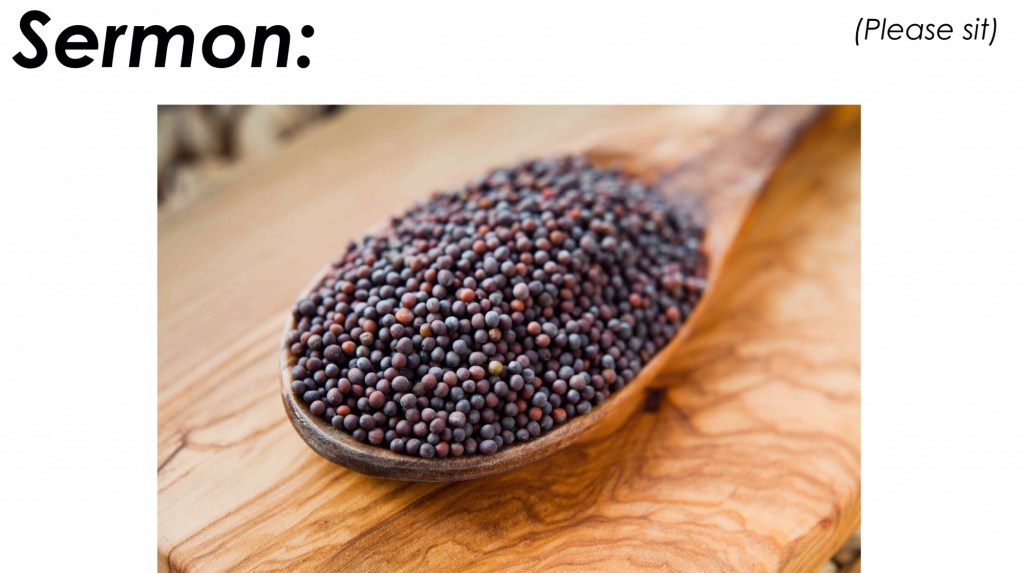
From the PowerPoint slides at the 10 o’clock service. What are those little beads?

Sermon for the second week in Lent, preached on 20th February 2024


Genesis 41.46 – 42.5
Galatians 4.8-20

Can we swap places for a minute? Would you come up here and see things as your preacher does, or maybe on your way out, let me know what you feel? We’ve got to deal with two stories today, the first one being Joseph and the amazing Technicolor Dreamcoat.

Joseph’s brothers were jealous of his natty outfit, his coat of many colours, and when they were all on a journey through the desert, they chucked him into a pit, intending to sell him into slavery to the next bunch of traders coming through with their camel train. But unfortunately for them, some other spice traders came across him, pulled him out of the pit and took him away to Egypt. where they sold him to the Egyptian government, to Pharaoh, as a slave.

But Joseph prospered. He did a good job, and eventually, with various twists and turns in the story, he ended up being effectively Pharaoh’s viceroy, running the administration of the country. His secret was that he could interpret dreams. He was a kind of diviner, a seer.

He saw the future in a dream and realised that the crops would fail, and he would need to build up a stockpile of grain, if widespread famine in Egypt was to be avoided; so when the crops duly failed, and the famine broke out, Joseph sold grain to all and sundry and became more and more influential, owning more and more land as people run out of money and had to give him their land in return for food.

Among the people who were affected by the famine was Jacob, living in Canaan. Jacob was Joseph’s father, but he had been told that Joseph had died, torn apart by wild beasts, his brothers having shown their father the coat of many colours, stained with the blood of animals, to simulate the remains of a tussle to the death.

Jacob sent the brothers over to Egypt from Canaan, where they were, to buy grain, not knowing that they were about to buy it from the brother whom they thought they had abandoned to an unknown fate in the desert.

They didn’t know it was that long lost brother that they were buying from, and as you will remember, there is a thrilling story full of suspense about Joseph toying with his awful brothers, and making them think that they were going to be wrongly accused of stealing a whole load of grain from Pharaoh so that they would meet a dreadful fate. Then, at the last minute, the tables were turned and Joseph revealed himself as their brother.

You can imagine that it must’ve been a real ‘Oh something moment’ for them, quite a shock. Imagine how they must have felt. They must have thought that the most likely thing would be would be for their younger brother, who was now in such a powerful position, to get his own back on them; that it would not turn out well for them.

The lovely thing is, in this story, that Joseph didn’t do that. In fact he forgave his brothers, and invited them to bring their father over from Canaan to where they could live in Egypt in a land of plenty. Joseph didn’t blame them because, according to the account in the book of Genesis, he reasoned that his whole story, being abandoned and sold into slavery, and then working his way up with Pharaoh so that he became the head of the government of Egypt, was God’s will, was what God had intended, and no humans, certainly not his brothers, were really responsible or to be blamed.

What a wonderful story! That’s one of the two pieces we are looking at this morning. The other one is part of Saint Paul’s great letter to the Christians in Galatia, which is part of modern day Turkey. This reads almost like one side of a telephone conversation.

We don’t really know what Paul was responding to, and what the Galatians were saying to him. We can only try to draw inferences from what he is saying.

You wouldn’t pick this passage in the letter to the Galatians. I think if somebody asked you what the letter is all about, the bits which everybody quotes are the passage where he says that you are all sons of God in union with Christ Jesus. ‘Baptised into union with him, you have all put on Christ as a garment. There is no such thing as Jew and Greek, slave and free, male and female. You are all one person in Christ Jesus’. That comes at the end of chapter 3. and then, at the end of chapter 5, he talks about the signs of being led by the Holy Spirit. ‘The harvest of the spirit is love, joy, peace, patience, kindness, goodness, fidelity, gentleness, and self-control’. These are the qualities that come when you are a good Christian.

But these two famous passages are not what we are looking at today. This bit is all about the Galatians kind-of hedging their bets about what they really believed in.

They would be Greeks living in the Roman Empire, and you would remember that every Roman house had its household gods, Lares and Penates, and of course, in the Greek world, there was the Pantheon, on Mount Olympus; Zeus, and Hera, and all the other gods, each one representing and upholding a particular sphere of influence: so Ares, or Mars, was the god of war, for example.

The big difference between the theology of the Romans and Greeks and Judeo-Christian theology, (because Christianity originated in Judaism – Jesus was a Jew) was that whereas the Greeks and Romans worshipped lots of different gods, the Christians, as well as the Jews, worshipped one God, one true God, and by and large, they did not make statues or paint pictures of the one true God. He didn’t really have a name – ‘I am who I am’, he said – and certainly in the Jewish tradition, only priests could see God and not be burned up in the experience. ‘Immortal, invisible, God only wise’ sums it up.

But the Galatians wanted to have it both ways. They wanted to go back to the old gods as well, just in case. And St Paul got very cross with them. He said it was a retrograde step and that they would no longer be able to be saved and gain eternal life, if they were enslaved by their worship of elemental spirits, as he called them. it could just have been earth, wind, fire, and water, the basic elements, but whatever it was, Saint Paul was very frustrated by the Galatians’ wanting to worship those elemental spirits as well as the one true God as revealed in Jesus Christ.

So on the one hand, we have the story of Joseph and the amazing Technicolor Dreamcoat, and all the other, a rather bad-tempered rocket written by Paul to the Galatians.

So – imagine you are up here. What do you say about those two passages? What lessons can we draw from them? I would be tempted, I have to say, to draw out how generous Joseph was. He was almost as saintly as Jesus wanted us to be in his Sermon on the Mount. Love your enemies. Turn the other cheek. Certainly not an eye for an eye and a tooth for a tooth where those awful brothers were concerned.

But I suspect that in the wider sweep of the story of the people of Israel, Joseph’s kindness rather gets blotted out. This is all part of the story of Israel being enslaved, and then freed, and then finding a place in the promised land, building the temple, having the temple knocked down, being enslaved again in Babylon, and so on, until eventually, at the time of the second temple, they are established in Palestine.

It’s very tempting to try to draw parallels with what’s happening in the same area today. Just imagine what the possibilities would be if Mr Netanyahu took a leaf out of Joseph’s book and showed compassion and forgiveness. But if you and I swapped places and you had drawn that conclusion, I’m not sure that people would give you an easy ride as they were shaking your hand on the way out at the end of the service. They might say you’d stretched things rather a lot.

And what about Saint Paul and the Galatians? Apparently, according to Paul, they were volunteering to be enslaved again by worshipping the elemental spirits, rather than the one true God. What would you say about that? It’s a different kind of slavery from the slavery which the Israelites endured in Egypt and in Babylon. This is more an intellectual slavery, abandoning their principles and hedging their bets spiritually.

And, in passing, you might want to observe that Saint Paul’s letters, particularly this sort of letter where he takes a congregation of Christians to task for something that he thinks they are doing wrong, is a sort of communication which I don’t think we would get in today’s world. Because St Paul is in effect telling the Galatians what to believe.

We go to great lengths to ensure that we don’t interfere with everyone’s freedom to believe whatever they want to. We regret the history of the missionaries. Who would say now, ‘Don’t believe in Scientology or Mormon, but stick to the real stuff?’ Alternatively, when we are thinking of Islam or Judaism, we are at great pains not to say that people mustn’t be Muslims or Jews, but that people should be only Christians.

No, instead, we emphasise that all three religions, called the religions of the book, effectively worship the same one true God. We just approach that one true God in slightly different ways. So we wouldn’t be tempted to write the sort of letter that St Paul has written if we found, for example, that somebody had converted from Christianity to Islam. Nevertheless, in certain countries the reverse move, from Islam to Christianity or Judaism, is something which is condemned, indeed, sometimes bringing the death penalty.

That happens in Pakistan or Iran, but we don’t tell people what to believe. We have to some extent therefore changed from Saint Paul’s approach. What do you think? What do we make of that?

So those are your reflection points for this second week of Lent. What lessons could we draw from the story of Joseph and the amazing Technicolor Dreamcoat, and what do you think St Paul was up to in his frankly rather tough letter to the Galatians? Would it wash today? Let’s swap places and you can tell me the answers.

Amen.

Sermon for New Year’s Day 2023 at St Dochdwys, Llandough

The Naming and Circumcision of Jesus

May God be in my mouth, and in my speaking. Amen.

Before I say anything else, let us give thanks to God for the work of Emeritus Pope Benedict, and pray for our Catholic friends, brothers and sisters in Christ, as they mourn his passing. And although the ball may be the wrong shape, we mourn the passing also of the great footballer Pelé. May both these great figures rest in peace and rise in glory.

Numbers 6.22-27

Psalm 8

Galatians 4.4-7

Luke 2.15-21

https://bible.oremus.org/?ql=538997803

It’s a bit of an upside-down sermon this morning. Indeed if you’re still waking up after last night, you might have thought that our service was back to front. Our first lesson was the blessing. It is the most beautiful blessing, which is called the Aaronic blessing. It was passed on to Aaron by Moses. But a blessing usually comes at the end of the service. It probably will still come at the end as well – Jimmy may well say it today. This is it, from the Old Testament lesson:

May the Lord bless you and keep you;

may the Lord make his face to shine upon you and be gracious unto you; may the Lord lift up his countenance upon you, and give you peace.

Don’t get up. It’s not the end of the service yet! Because the last bit of it in the lesson from Numbers, just after the blessing, says this:

‘So they shall put my name on the Israelites, and I will bless them’.

It is about the people of God being given their name, Israel, which means literally in Hebrew, people who have wrestled with God. That went back to Jacob, wrestling with the angel. So Jacob became Israel and the whole of the old Testament had a theme running through it, of the relationship between the chosen people of God, the Israelites, and God himself. It was like all the best love affairs, pretty bumpy. People who really do love each other have rows and they do fall out. That was certainly true of the Israelites and their God. They worshipped the Baals and the Golden Calf – and God punished them. (See Exodus 32 and 1 Kings 12).

This story of the Israelites getting their name is at the beginning of their story, and it’s appropriate on 1st January to think of our religious beginnings and where they might lead. Now today we are focusing on the other end of the Bible, on baby Jesus – I was going to say, on Jesus’ ‘christening’ – but that sort of thing worked differently in those days. Instead the baby would be named, and if he was a male baby, circumcised as part of the Jewish tradition. The angel had told Mary that his name would be Jesus. That name means, God saves us, God is our salvation. So we have moved from wrestling with God, Israel, to salvation through God, Jesus.

The mighty God who spoke through the burning bush to Moses, the God who was capable of tremendous wrath and destruction, has now come, with all that power, to be concentrated into a tiny baby. That is the miracle of Christmas. We are perhaps none the wiser about exactly what God looks like, apart from just being a baby. In the blessing, with God lifting up the light of his countenance upon us, we get the feeling that there is someone up there, beaming down with a beautiful smile. But we can’t actually see that God: No one could. But people could see Jesus and they did see him. He certainly lifted up the light of his countenance on everyone he met.

Although we can’t see Him, what is our relationship with God? In St Paul’s letter to the Galatians, God puts us alongside that little baby, so that we are children, children of God, calling God ‘Abba’, which is more like ‘Daddy’ rather than ‘Father’ in the Aramaic we are told. Saint Paul goes on to suggest that, as children, we are heirs; we inherit the blessings of God.

But there is a missing bit. We need to go back a bit to the Old Testament and look again at the people of Israel, the people wrestling with God. The heart of their relationship was what was known as God’s covenant with Israel. What is a covenant? As a lawyer, I can tell you that a covenant is an agreement or a contract. The two parties agree together and they agree to do things one for the other. That’s it. It’s very simple.

The covenant between God and Israel was indeed very simple. The Israelites agreed to worship God as the one true God, no other gods, and in return God promised to bless them and keep them, as the blessing says. And it’s a very useful idea, this covenant.

What can we say at this service, at the beginning of 2023? We have to cope with all these challenges and difficulties in the world ahead of us:

– the war in Ukraine,

– the cost of living crisis here at home,

– the energy crisis, where we are all worrying because we can’t afford to pay three or four times what we used to pay for our houses to be heated,

– and the pay crisis, all the strikes which the public servants, and in particular the nurses and ambulance crews, are involved in, because their pay has fallen back so much that many are now forced to go to food banks, which seems to me to be a very unfair development after all their bravery and sacrifice brought us all out clapping on our doorsteps while the Covid pandemic was on.

I hope that you will not think that this falls outside the bounds of what a preacher is supposed to cover, but it does seem to me that we were, and we are, very happy to rely on these dedicated public servants, and now we must provide them with a decent living. And, most importantly, there are theological reasons for supporting the workers’ fight for better pay and conditions of work.

Frankly our government of millionaires in London needs to think again, quickly, about this. We were all made equal in God’s image: not so rich and so poor, all in the same country – the sixth richest country in the world. Remember Jesus’ story known as Dives and Lazarus, the Rich Man and Lazarus, in Luke 16:19-31. Jesus surely didn’t approve of such a huge gap between the rich and the poor.

So as we embark on 2023, as we see our world facing all these challenges, what do we, as the people of God, the people in the church, do about it?

Quite a lot of Christians do something every New Year, which seems to me to be a great way of preparing themselves to tackle these challenges; and that is, they renew their covenant with God.

It’s an idea which started with John Wesley and the early Methodists. For Methodists the first service in a new year is still known as Covenant Sunday. The ‘people called Methodists’, as they used to call themselves, have recited the same or very similar words every year since 1780 to make their covenant, their agreement, with the Lord. I’ll give you a quick preview, and then we will say the whole of this covenant prayer together later on in this service. So this is just to introduce you to it if you haven’t heard it before. What the Methodists pray goes like this.

We are no longer our own, but thine.

Put us to what thou wilt, rank us with whom thou wilt.

Put us to doing, put us to suffering.

Let us be employed for thee or laid aside for thee,

exalted for thee or brought low for thee.

Let us be full, let us be empty.

Let us have all things, let us have nothing.

We freely and heartily yield all things to thy pleasure and disposal.

And now, O glorious and blessed God, Father, Son and Holy Spirit,

thou art ours, and we are thine.

So be it.

And the covenant which we have made on earth,

let it be ratified in heaven.

Amen.

Put us to doing, put us to suffering;

let us be employed for thee or laid side for thee ….

And now, O glorious and blessed God, Father, Son and Holy Spirit,

thou art ours, and we are thine.

So be it.

And the covenant which we have made on earth,

let it be ratified in heaven.’

Those are John Wesley’s words from 1780. They’ve been repeated every year since. That’s it. We have to do what the Lord commands us to do, just as Jesus commanded his disciples; you know, not having two cloaks, letting other people go before us, so the last shall become first: loving our enemies, not turning our backs on poor people like Dives did, on people like nurses, and instead doing things that may not necessarily be that good for us as individuals but which reflect God’s love, and which Jesus told us to do.

‘Let us be full, let us be empty.

Let us have all things, let us have nothing.’

This is the agreement which we are invited to make, and which should be our guiding principle in the year to come. We have moved from Israel, wrestling with God, to Jesus, God is our salvation.

So let’s agree on that. Let’s make that covenant. Let’s do what we have to do in order to keep our side of the bargain. It’s not just a question of words. But if we do, if we do do more than just talk: then, the blessing will come; and now, here, it will be in the right place, at the end of the service, but it will be more than that: it will be a continuing blessing. The Lord will bless you and keep you. The Lord will make his face to shine upon you, so that it will, truly, be a happy New Year.

Sermon for 1030 Holy Communion at St Mary, Oatlands on 14th October 2020

http://bible.oremus.org/?ql=469611667

Galatians 5.18-end; Luke 11.42-46

In our Gospel reading today, it leapt out at me, when I was reading it in preparation for our service today, that Jesus was saying rude things about lawyers. Although, in the Bible translation which we are using today, Jesus doesn’t actually talk about lawyers but about people who are ‘experts in the law’, in Jesus’s time there wasn’t such a thing as a ‘lawyer’ in the same sense that we understand it. Then, what you had were ‘advocates’.

You will recall that the Holy Spirit is referred to sometimes as the advocate, or even a ‘comforter’; in John 14:16, Jesus says he will send us his Holy Spirit to be an advocate and guide. If you went to the right Bible classes you may even have heard the word Paraclete, which is one of those words you only hear in church, but it means an advocate, it means somebody to be with you, to speak for you, in court.

What we have here isn’t a Paraclete, but a νομικός, that Jesus is being rude about. Νόμος, substantive, the thing, means the law; νομικός, adjective its characteristic, means ‘to do with law’; as a substantive, it means somebody who is familiar with the law, so the word is usually translated as ‘lawyer’.

As some of you will know, I used to be a lawyer, a solicitor. It’s now a dim and distant memory – I retired 15 years ago – but still I feel that I should stand up for my old profession. That is, if Jesus is really slagging off lawyers.

Actually, of course, when you see the other lesson, from Saint Paul’s letter to the Galatians, you will see that we are into the distinction that St Paul draws, picking up on what he learned of Jesus’ teaching, that on the one hand you have the Law, meaning the Jewish law, the first five books of the old Testament, the Pentateuch, and on the other hand you have the state of grace for those who have been saved and have come to faith in Christ Jesus. So maybe it is indeed right to talk about people who are ‘expert in the law’, meaning the Jewish Law, rather than simply about ‘lawyers’.

But as Jesus said in the Sermon on the Mount, he didn’t come to abolish the law, but to fulfil it [Matt. 5:17]. He said that all his teaching can be summed up in two supreme commandments, commandments taken from the Jewish Law, to love God and to love your neighbour [Matt. 22:36-40].

Galatians 5 tells you what to expect from someone who has been saved, who has had that revolution in their life and doesn’t need to have a policeman standing over them, but just does the right thing. The right thing is to love your neighbour. All those things that St Paul lists as the Fruits of the Spirit lead to various ways of loving your neighbour. So fortunately it turns out that nothing in our Gospel today is really against lawyers.

Well, I know that Folli [Revd Olokose] and Hugh [Montgomerie, Reader] have an excellent style of preaching here, which always ends with a challenge. So I thought I would try to enter into the spirit of that too; but first of all, I need to tell you a little story.

When I was starting my ministry training nearly 14 years ago, it coincided with my elder daughter Emma starting her university studies in medicine at Bristol University. Very soon in the first term I visited her to see how she was settling into her hall of residence.

When I came back, I was at church for the 10 o’clock service, and after the service I was having coffee with some of the other faithful people. Somebody asked me how I had found my trip to Bristol. Had it been an easy journey? I said that it had been a very easy journey, but that I just suddenly thought – a little cloud had crossed my brain – that it might turn out to have been rather more expensive than I had bargained for.

Why so? Because, just before I turned off on the M32 to go into the city of Bristol, I had passed under a bridge, which, too late, I’d noticed was bristling, bristling with things that looked mighty like cameras. ‘So’, my faithful friend asked, ‘surely that’s not a problem? You were doing 70 miles an hour’.

‘Hmm’, I said, ‘if only; but I did manage to get it below100!’

She took my arm and marched me off into a corner. ‘Now Hugh’, she said. ‘Now that you are in ministry training, you have to do two things. You must stop breaking the law – and the other thing is, you must stop crowing about it!’

Oh dear. She was, of course, right. The Fruits of the Spirit hadn’t quite taken root in me at that point, as you will realise. But what about you? Have you had those sort of moments? Has the Spirit taken root in you and borne fruit yet? What do you think?

And that’s my challenge to you this morning. Not just to get it below 100 – but you know what I mean.

Sermon for Evensong on the Tenth Sunday after Trinity, 25th August 2019 – Prophetic and Theological Considerations in the Brexit Debate

Isaiah 30:8-21; [2 Corinthians 9] – see http://bible.oremus.org/?ql=433650150

The first part of the Book of the Prophet Isaiah, sometimes known as ‘First Isaiah’, (because scholars think that there were three prophets whose work is collectively known as the Book of the Prophet Isaiah), ‘the first book of Isaiah’, was written in the 8th century BCE. It’s been pointed out that that century was one of the pivotal points in the history of modern civilisation.

It was the time when the Homeric legends, the Iliad and the Odyssey, were first being recited by travelling bards; in the British Isles, Celts, refugees from mainland Europe, were pouring into Cornwall; Egypt was where the most sophisticated culture was, and Assyria (Syria, roughly) was the most powerful imperial power. It was a time of religious stirrings. Zoroaster was born in Persia in about 650BCE. The Upanishads were written in India probably between c. 800 BCE and c. 500 BCE. It was the time of Confucius and Tao in China.

E. H. Robertson has written, ‘Over the whole world the spirit of God stirred the spirit of man. In Judah and Israel, four men spoke in the name of the living God, …’ [ Robertson, E. H., Introduction to J.B. Phillips, 1963, ‘Four Prophets’, London, Geoffrey Bles, p. xxv] These were the four prophets, Amos, Hosea, Isaiah and Micah. Just as in the middle of the 19th century it was a time of revolutions, and the end of the 20th century it was the beginning of the digital age, this, in the 8th century BCE, was another turning point in human history.

The spiritual narrative of this historic period was supplied, in Israel and Judah, by the four prophets.The great historical event in this period was the fall of Samaria in 732BCE, when the whole of the Northern Kingdom, Syria and Israel was depopulated and turned into Assyrian provinces. It was a great shock to the people of Israel left in the Southern Kingdom, Judah. Her prophets, particularly Isaiah, were finally listened to. ‘The general line taken by the prophets was, trust in God and keep out of foreign alliances.’ [Robertson, p.xxvi]

Our lesson tonight from chapter 30 of First Isaiah is exactly on this point. The prophet is saying that God has told him to tell the Israelites not to make an alliance with the Egyptians. But he complains that they are not taking any notice. How does God communicate with us?

I heard on the radio an absolutely fascinating programme about the fire in York Minster [http://www.bbc.co.uk/programmes/m0007pws]. This year, of course, we have had the terrible fire in Notre Dame in Paris, but in July 1984 there was a terrible fire in York Minster, which destroyed the roof of the south transept and caused extensive damage to the magnificent mediaeval Rose window.

Just before the fire, a new Bishop of Durham had been consecrated, David Jenkins. He was an academic theologian in the liberal theological tradition; in other words, he did not hold with a literal interpretation of everything in the Bible. Indeed, he went as far as saying that he didn’t think that the Virgin Birth necessarily literally took place.

When he was consecrated as Bishop of Durham, in York Minster, there was an outcry from some parts of the church; today no doubt it would have been a ‘Twitter storm’, protesting that Bishop Jenkins, Prof. Jenkins, was flying in the face of the traditional beliefs of the church over the previous 2,000 years. Some people went as far as to say that the fire in the Cathedral, in the Minster, which was attributed, by the surveyors who came to examine the wreckage, most probably to a lightning strike, that it was an ‘act of God’, literally, in that God had struck the Minster with lightning and set fire to it, as a way of showing His disapproval of the preferment of David Jenkins to the bishopric of Durham.

Isaiah was prophesying to the Israelites in the Southern Kingdom, Judah, against their making an alliance with Egypt. Judah heeded the prophecy, and did not make an alliance with Egypt. The Israelites were able to build the Temple and live in peace for nearly 100 years.

Now we are perhaps at another pivotal time in history – well, certainly in the history of this country; and perhaps if one includes as a key element in this current historical perspective the rise of populism, this pivotal time affects not only our country, but also the USA and Italy at least. We are noticing changes in our society as a result; there have been increases in nationalism and xenophobia, (with an unhealthy interest in where people have come from), leading to opposition to immigration, which also involves a ground-swell of racism.

In the British manifestation of this wave of populism, in the Brexit debate, there is also an emphasis on sovereignty – ‘take back control’, they say – as well as all the other features of populist politics. So in relation to all this, is there an Isaiah out there speaking to us? A prophetic voice, guiding us in relation to this turbulent time? And if there is, are we listening?

We look at some of the prophetic utterances in the Bible, and wonder if they might also be talking about our present age. Last week’s Gospel reading for instance, in which Jesus asks, ‘Do you think that I have come to bring peace to the earth? No, I tell you, but rather division! From now on five in one household will be divided, three against two and two against three. They will be divided father against son and son against father. ..’ [Luke 12:51f.]

Dare I say that Brexit has had very much the same effect? Friends have stopped speaking to each other. Families are divided. Literally billions have been spent on preparing for something which there is no agreement about, either within our population, our Parliament or with our European neighbours; at the same time our hospitals are desperate for resources, our schools, similarly, have often not got enough money for books, and our local authorities can’t afford to fill the potholes – and that’s not saying anything about the need for housing or the closures of our fire stations.

Is this another time when a prophet might say that God is punishing us, or that He may punish us? Revd Dr Jonathan Draper, the General Secretary of Modern Church (which used to be called the Modern Churchmen’s Union), who was the Dean of Exeter, in his conference speech in July, has tried to identify the theological aspects of the Brexit debate. I’ll put a link to his paper on the website with the text of this sermon. [Published written version: https://www.dropbox.com/s/5ees6m98pb25bh9/theology%20after%20brexit%20-%20final.docx?dl=0 – version as delivered: https://www.modernchurch.org.uk/2019/july-2019/1494-how-theology-has-failed-over-brexit]

He says, ‘Our national so-called ‘debate’ on Brexit has exposed deep, damaging, and shocking divisions: divisions that cut across families and friends, divisions that have exposed the raw experience of some of being entirely left out and ignored by the political and ecclesiastical ‘elite’, divisions that pit one part of the nation against others. Without even leaving, a deep and disturbing vein of xenophobia and racism has been exposed and even normalized in our public life.’

He goes on. ’Dr Adrian Hilton wrote ‘A Christian Case for Brexit’ on the website christiansinpolitics.org.uk. … His …. reasons for why Christians should want to be out of the EU [are], he writes, ‘about liberty, democracy, transparency, accountability, and the right to sack those who rule over me’.’ As Dr Draper points out, these are not theological reasons. There is nothing in the Bible to support these reasons.

In relation to the various things we have identified in the Brexit debate, it seems doubtful whether the ‘Christian case’ would in fact elevate ‘liberty, democracy, transparency, accountability, and the right to sack those who rule over me’ over such things as loving one’s neighbour – who, as the Good Samaritan found, might not be of the same nationality – and that anyway there is ‘no such thing as Jew and Greek’ in the Kingdom of God (Galatians 3:28) [https://biblehub.com/kjv/galatians/3.htm]- that nationality is not something which mattered to our Lord; and that political power, democratic or otherwise, wasn’t very important either, in the context of the Kingdom. More important to love (and therefore obey) the Lord your God. ‘Render unto Caesar’, indeed; but in those days democracy was practically non-existent.

Another theologian, Dr Anthony Reddie, has pointed out ‘a rising tide of white English nationalism’ and ‘the incipient sense of White entitlement’; that participants in the Brexit debate seem to have emphasised White English interests to the exclusion of other races and nationalities. Dr Reddie feels that the churches should be speaking out against this. He asks why the churches have not ‘measured Brexit against the standards of justice and equality’, loving God and loving neighbour. Dr Reddie also argues that churches ought to consider ‘not just the rights and wrongs of Brexit, but what it has done to us’. [Quoted in Dr Draper’s written text]

Dr Draper goes on to consider the theology of incarnation, of being the body of Christ, Christ incorporated in His church. It isn’t an individualistic thing. He quotes John Donne’s poem, ‘For Whom the Bell Tolls’:

Entire of itself,
Every man is a piece of the continent,
A part of the main.
If a clod be washed away by the sea,
Europe is the less.
As well as if a promontory were.
As well as if a manor of thy friend’s
Or of thine own were:
Any man’s death diminishes me,
Because I am involved in mankind,
And therefore never send to know for whom the bell tolls; 
It tolls for thee.

He also says this.

‘This is not an argument for saying that we ought to stay in the EU. It is an argument for saying that a Christian theology of the Kingdom of God, being all one in Christ, drives us away from things that divide us and towards things that bring us together. … The impulse to unity ought to be strong for Christians. Walls, barriers that divide, theologies that exclude, have no part of the Christian vision.’

Where do we as a church stand in relation to the concept of human rights, for example? Our own MP, who is now the Foreign Secretary, has recently campaigned to abolish the Human Rights Act. This is something which our country adopted by signing up to a European convention – a convention which was actually drafted by English lawyers. Although the European Court of Human Rights is not an EU institution, it is seen, mistakenly, by some Brexit supporters as interference in our country’s sovereignty by the EU. What do we as Christians have to say about this? Surely, at this pivotal point in our national life, it is too important for us to stay silent. How does Brexit square with Jesus’ great human rights challenge at the end of St Matthew’s Gospel? Dr Draper, [in the version of his paper that he delivered], quoted it in this way.

Lord, when was it that we saw you hungry and gave you food, or thirsty and gave you something to drink? And when was it that we saw a stranger and welcomed you, or naked and gave you clothing? And when was it that we saw you sick or in prison and visited you? And the king will answer them, ‘Truly I tell you, just as you did it to one of the least of these who are members of my family, you did it to me’. [Matt. 25: 37-40]”

He went on.

‘And let’s not spiritualise this either. To feed the hungry is a political act; to welcome the stranger is a political act: enacting, embodying the Christian faith is a political act. And sometimes that means not just praying for everyone but taking sides.’

That’s what Dr Draper said to the Modern Church conference. I don’t think Isaiah would have kept quiet either: but would we have heard him?

Sermon for Evensong on the Sunday after Christmas-Day, 30th December 2018

Isaiah 61; Galatians 3:27-4:7 (http://bible.oremus.org/?ql=412935020)

Do you remember when Jesus started to read in the synagogue – it’s in Luke 4, from verse 17 – and he read out from the Book of the prophet Isaiah, and then said, ‘This day is this scripture fulfilled in your ears.’ In other words, He was the Messiah, which Isaiah had prophesied about, had foretold in our lesson tonight, chapter 61, and chapter 61 was what Jesus was reading out.

That prophecy is all about the salvation of Israel, deliverance from its oppressors, from the Assyrians, the Babylonians, the Egyptians – and latterly, it would be, from the Romans – deliverance from slavery; because the Israelites were the chosen people of God, and God would keep his promise to them.

That’s as you would expect. Jesus was Jewish, he was an Israelite. He was brought up in the Jewish culture. The gospel of St Matthew, aimed at a Jewish readership, is at pains to set out his genealogy, tracing it back to King David, son of Abraham.

But truly, if the story of Jesus had just been a Jewish story, just been a story about Israelites, that story would have remained a footnote in history. But the genius of St Paul was to realise that the one true God is the god of everyone. There isn’t just a god for the Jews, or for another national group – or in those days, for the Romans. God is far bigger than any question of nationality or origin.

And so we have this great passage in the Letter to the Galatians:

There is neither Jew nor Greek, there is neither bond nor free, there is neither male nor female: for ye are all one in Christ Jesus. [Gal. 3:28f]

Just as Isaiah had prophesied,

I will make an everlasting covenant with them.
And their seed shall be known among the Gentiles, and their offspring among the people”

God’s chosen people are no longer to be regarded as being just the Israelites, but rather all those who are ‘in Christ Jesus’, who are Christians. They are God’s chosen people now. ‘Their seed shall be known among the Gentiles’, just as much as among the Jews.

Paul’s mission to the ‘nations’, (which is what the Latin-based word ‘gentile’ means), to the non-Jews, opened the door to Christianity becoming a universal religion, and there is no bar in it to anyone on the grounds of nationality, or colour, or origin: being, and becoming, Christian, and indeed that key expression in St Paul’s thought, being ‘in Christ Jesus’, is integral to the way he understands God: that God is at the heart of everything, the ultimate creator and sustainer of all our being.

But although Jesus’ coming as the Messiah meant that we should look wider than just the sons of Abraham, the Israelites, in order to find who are God’s chosen people, nevertheless, in Isaiah’s prophecy, there are some key truths which, maybe, started as distinctive Jewish or Israelite concerns, but nevertheless now have a worldwide or universal importance.

Important among these is the concept of justice.

‘.. to proclaim liberty to the captives, and the opening of the prison to them that are bound;

To proclaim the acceptable year of the Lord, and the day of vengeance of our God’

This is all about the rule of law. In the Jewish Law, the ‘acceptable year’ is the Jubilee year, is the year one-in-seven when debts were forgiven; when people were allowed a new start. Not that the law disappeared, but that its application was tempered with mercy. ‘The quality of mercy is not strained’, if you prefer Shakespeare. [The Merchant of Venice, Act IV, Scene 1]

‘For I the Lord love judgment, I hate robbery for burnt offering’. Don’t go out and pinch your neighbour’s things so as to be able to afford to put more in the collection plate. The Lord loves judgment. The Lord loves the law. Do the right thing. And the right thing is a message of renewal and, as I have observed so often, and particularly in Advent, the message of the Bible is one which is full of the counter-intuitive, it is often contrary.

See, Isaiah foretells opposites: ‘ … beauty for ashes, the oil of joy for mourning, the garment of praise for the spirit of heaviness’. This is not a message of despair: this is a message of hope. But it is hope based upon a fresh appreciation, on repentance, on throwing away the old truisms; casting off slavery; slavery, which means forcing people to work for less than they need in order to pay the rent and to buy food. And look, in this vision of justice, Isaiah sees that

strangers shall stand and feed your flocks, and the sons of the alien shall be your plowmen and your vinedressers.’

Strangers. Sons of the alien. That is what the Millennium looks like. There is nothing wrong with people coming and joining our society and doing useful jobs. But note that, both in Isaiah and in St Paul, it’s not the case that origins and nationality are obliterated. It’s more a question that there is no hierarchy of worth, based on nationality or origin.

‘There is neither Jew nor Greek, neither bond nor free, neither male nor female.’

It doesn’t literally mean that. It means that the connotations of being Jewish, or the connotations of being Greek, what it means to be in slavery, what it means to be free, what it means to be a man, what it means to be a woman, do not include connotations of worth: or to put it another way, they are all equally worth.

It doesn’t mean to say that they are all the same. But it means that you can’t say, just because somebody is from a particular country, for that reason, they are less entitled to share in the world’s riches than someone who is from Hollywood – or from the British Hollywood, Cobham.

So as we begin 2019 on Tuesday these are very timely lessons. In the good society there is no room for xenophobia or nationalism – although we can celebrate our differences and enjoy the riches of each other’s culture. We can explore new foods, new literature, new ways of looking at things, that come from different places of origin.

I was blessed, earlier in my life, in having ten years of fairly constant travel, to all sorts of other countries. I really enjoyed learning about different ways of life and making friends with people in other countries. But today, there is a worldwide movement against this, based on nationalism and xenophobia. Freedom of movement, for our young people to be able to do as I did, to travel freely throughout the world, to live and work and different places; and the other side of that coin, for people from other countries to be able to come freely here, to make their life here if they want to do so, by working hard and contributing to our society, that freedom is being overtaken, overtaken by narrow nationalism.

We should recognise that there is ‘neither Jew nor Greek’ in the Kingdom of God: that we are all sons and daughters of God, descendants of Adam and Eve: and Jesus is the second Adam, ‘a second Adam to the fight’ as the hymn puts it. He is really Everyman – He is for everyone.

Sermon for Holy Communion for SS Simon and Jude, 28th October 2018

Ephesians 2:19-end; John 15:17-end

Today along with most of the churches in the western world we are commemorating two apostles whom we know very little about, St Simon and St Jude.

There were two Judes, two Judases. We’re not quite sure who this one was, because in the four Gospels he is described as being various things. In St Matthew and St Mark he is not called Judas but Thaddeus, which might be a surname; it is only in Saint Luke and the Acts of the Apostles that he is called Jude. St Jude was not the same as Judas Iscariot, although his name in Greek is the same, Ιουδας. People historically haven’t chosen him to invoke in prayer, because they think he might get mixed up with Judas Iscariot. So he is called the patron saint of lost causes – ‘If all else fails, offer a prayer through St Jude’. The little letter of Jude in the New Testament was not written by this Jude, according to many scholars. In St Luke’s Gospel Jude is described as the son of James the brother of Jesus. ‘Jude the Obscure’, which was the title of one of Thomas Hardy’s novels, is an apt name for him.

Simon – not Simon Peter – had been a terrorist – a real terrorist. He had been a member of the Zealots, who were a Jewish extremist sect that believed that the Jews were supposed to be a free and independent nation; that God alone would be their king, and that any payment of taxes to the Romans or accepting their rule was a blasphemy against God. They were violent. They attacked both Romans and any Jews who they thought were collaborating with the Romans. Simon had been one of them.

So the Apostles were a motley assortment. Humble fishermen; a tax collector; a terrorist (although of course, depending on your point of view, one man’s terrorist is another man’s freedom fighter); James and John, the ‘Sons of Thunder’, whatever that means. It certainly doesn’t sound meek and mild. And of course, Judas Iscariot; the other Jude. Jesus wasn’t choosing people whom we would think of as saintly.

But there isn’t an awful lot that we know about Simon the Zealot and Jude – Jude-not-that-Jude. So our Bible readings today, the message from St Paul’s letter to the Ephesians, ‘You are no longer aliens in a foreign land,’ and the message from St John’s Gospel, about Christians not belonging to the world, are not about them, but rather they are a reminder of some of the teaching that Jesus – and after him, St Paul – gave to the Apostles and to the early Christians.

Paul’s letter to the Ephesians has a great theme of ‘reconciliation’: St Paul’s great mission was to bring the Gospel to the non-Jews, the Gentiles, so that Christianity wasn’t just a subdivision of Jewishness. ‘You are no longer aliens in a foreign land.’ Perhaps it’s not so topical for us nowadays.

But in Jesus’ own teaching, from St John’s Gospel (chapter 15) that we heard this morning, packed into these few lines there are some really deep meanings which still help us to understand the nature of God.

Jesus said, ’Because you do not belong to the world … For that reason the world hates you.’ In Jesus’ day and in that Roman world, being a Christian was definitely dangerous, simply because Christians didn’t worship the Roman emperor as a god. In the reign of some emperors, for example Diocletian, it meant that large numbers of Christians were fed to the lions.

It’s still to some extent true today, in parts of the Middle East and in Northern Nigeria, that Christians are persecuted. But by and large in our part of Surrey, it’s not really controversial to say that you are a Christian. But I do think that perhaps we still should reflect on what it means ‘not to belong to the world’. You don’t ‘breathe the same air’, as people sometimes say. Are we sometimes tempted to keep our religious belief out of things, for fear of offending people? But Jesus said here, don’t be afraid of being different.

What about the next proposition in this teaching passage, ‘Servants are not greater than their master’? The translation is actually wrong. The word isn’t ‘servant’, but ‘slave’, δουλος in Greek. This word also means what was called a ‘bondsman’, somebody who was indentured, bought. In the Roman empire, bondsmen, indentured slaves, could buy their freedom. Their bonds could be remitted, they could be ransomed.

It seems to me that these words surely have echoes of the idea of redemption, that by Jesus’ sacrifice he has purchased our remission from the slavery of sin. Jesus has bought us out, redeemed us. We are no longer slaves. Earlier on in chapter 15, indeed Jesus does say, ‘I call you slaves no longer’.

‘The people who hate you’, Jesus said, ‘do not know the one who sent me’. Again: ‘… the one who sent me.’ This is a reminder of the way that Christians understand God ‘in three persons’, as the Holy Trinity, father, son and Holy Spirit. (Jesus comes to the Holy Spirit later on, when he talks about sending what he calls the ‘Advocate’, the spirit of truth, after he has gone. Here, it’s just him and the One who sent him).

Here we can see what caused some of the controversy in the early church, which ended up in the Council of Nicaea in the fourth century, and in our Nicene Creed. If God ‘sent’ Jesus, the Son, was Jesus also God, or just another creature? And depending on the answer to that question, where did the Holy Spirit come from? God, or God-and-Jesus? And again, was the Spirit, is the Spirit – remember, ‘His Spirit is with us’, we say – is the Spirit made by God, or is it God itself?

If you don’t think of God as a nice old chap with a beard sitting on top of the clouds – and since the sixties, at least, since Bishop John Robinson’s wonderful little book, ‘Honest to God’ [Robinson, J. (1963), Honest to God, London, SCM Press], we mostly don’t – how can we understand the Holy Trinity? Try the logical, a priori, back to logical first principles, way that Professor Richard Swinburne, the great Oxford philosopher of religion, has set out in his book ‘Was Jesus God?’ [Swinburne, R. (2008) Was Jesus God? Oxford, OUP, p.28f]. It goes like this.

There is a ‘divine person’ who is omnipotent, omniscient, perfectly free and eternal. Let us call that person ‘God’. Because He is omnipotent, omniscient, perfectly free and eternal, God is perfectly good.

God could exist alone, but being perfectly good means he won’t be selfish; He will have to have a object for His love. Perfect love is love of an equal: a perfectly good person will seek to bring about another such person, an equal, with whom to share all that he has. That other person is the Son.

But the Son didn’t, in fact, come after the Father. As a matter of logic, because they are perfect, ’At each moment of everlasting time the Father must always cause the Son to exist, and so always keep the Son in being.’

But then, Swinburne says, ’A twosome can be selfish’. ‘The love of the Father for the Son must include a wish to cooperate with the Son in further total sharing with an equal; and hence the need for a third member of the Trinity’ And that is the Holy Spirit.

For the same logical reasons, the Spirit isn’t something ‘made’ by God. As we say in the Creed, the Spirit ‘proceeds from’ the Father, or the Father and the Son. (Saying ‘proceeds from’ is perhaps a philosophical cop-out. We can’t say exactly how the Spirit gets here). The Three-in-One are, is, there. The Trinity is in a sense caused by the One, by God. But it is one with God. The Father, the Son and the Holy Spirit. Three ways of being God.

One more nugget of theology. Jesus says, at verse 24, about the heathen, the worldly people, ’If I had not come and spoken to them, they would not be guilty of sin; but now they have both seen and hated both me and my Father’. It seems that Jesus has a different concept of guilt or criminal responsibility from the one we’re familiar with. We say that ignorance is no defence. Something is either lawful or it isn’t. You might think that sin worked the same way. Something is either sinful or it isn’t, surely, isn’t it sinful, irrespective whether you know it or not? But Jesus has this different idea – you’ll find it also in St Paul’s letter to the Romans [7:7] – that heathens, who know nothing about sin, are not sinful. What makes someone sinful, or capable of being sinful, is being ‘fixed with knowledge’, as a lawyer would put it. So it looks as though ignorance is a defence, where sin is concerned.

But that is perhaps an indication that to ‘sin’ is not the same thing as to do bad things, to do evil, even. The point about sin is that it is a separation, a turning of your back on, God. And you can’t do that, if you don’t know about God in the first place. Of course, if you are sinful, if you have turned your back on God, you may well do bad things. If you are saved by grace, you will show it by your good works. If you aren’t, if you are lost, you will show it by the bad things you do. St Paul sets it out in Galatians chapter 5.

What a concentrated lesson for his disciples it was from Jesus!

– What it means that the Father is ‘the One who sent me’;

– what it means that because of me, the Son, you are no longer servants, or really slaves; and,

– what it means that Jesus will get the Spirit to come to you. (That is the ‘Advocate’, what the Prayer Book and the Authorised Version of the Bible calls the Comforter, ό παρακλητος).

The common thread, the theme of Jesus’ teaching here, might perhaps be relationships, relationships between people, and with God. And the currency used in those relationships. Hate – ‘the world hates you’; service – Jesus has bought us out, redeemed us, so we are no longer slaves; comfort, the Holy Spirit, the Comforter; and love – love from ‘the one who sent me’. And ‘the greatest of these is love’, as you know. [1 Corinthians 13]

Sometimes it’s good to think about these lessons that Jesus taught, never mind who was listening to him. It could even be you, as well as Simon-not-Peter or Jude-not-Judas.

Sermon for Evensong on the Seventh Sunday of Easter, 1st June 2014
2 Sam 23:1-5, Eph.1:15-23

First we heard the last words of King David, and then St Paul’s prayer for the Christians at Ephesus. The context is the Ascension, which the church celebrated on Thursday. Leave-taking. The end of the party. I wonder who did the washing-up. When the disciples – and certain women, including Mary the mother of Jesus as well as his brothers, when they were all together after Jesus had left them and a cloud had taken Him out of their sight, when it was over, when the ‘farewell tour’, Jesus Christ Superstar, had come to the end of its run: what do you think they all did?

They went back to the upstairs room and said prayers. And maybe they got busy doing the washing up. Because they must have been feeling very flat. We know that when Jesus had been crucified, if we think of the story of the disciples on the way to Emmaus, they were very sad then, when they thought that Jesus had been taken away from them.

So I think we can reasonably expect that they were also feeling very flat and very sad when Jesus had been taken away from them the second time, when He had ascended into heaven. Whitsuntide, Pentecost, had not yet come, although Jesus had assured them, ‘You will receive power when the Holy Spirit has come upon you, and you will be my witnesses … to the ends of the earth’ (Acts 1:8). But that hadn’t happened yet.

It must have been very difficult, after all the momentous things that had happened. After the roller-coaster ride of following Jesus, suddenly He wasn’t there any more. In the church, we have commemorated that roller-coaster ride, through the Easter season, though the time of Jesus’ passion, and suffering, Good Friday; and then the glorious Resurrection on Easter Sunday; and then His risen appearances, the road to Emmaus, doubting Thomas: all the wonderful stories of the risen Christ.

It is a revelation to us, a sure and certain hope that we have, because of God’s presence with us, His gift of His only Son and His Resurrection from the dead. In Paul’s letter to the Ephesians, Paul prays that God will give them ‘a spirit of wisdom and revelation as they come to know Him, so that with the eyes of your heart enlightened, you may know what is the hope to which He has called you, what are the riches of His glorious inheritance among the saints.'(Eph.1:17)

If you are a Christian, if you go to church, this is a wonderful time of year: the Easter season. It is a time of hope and joy. But in the world outside, there is a sense of challenge. Not everyone is a Christian. Not everyone is aware of, let alone believes in, the wonderful story of Jesus. The Boko Haram people who have kidnapped 200 children, 200 girls, in Nigeria, are actively opposed to the Christian message. They want forcibly to convert people to Islam – forgetting perhaps that the god of Islam is very like the God of Israel and the God of the Christians – and certainly forgetting that God is a god of love.

Also in the world outside, we had an election. Some of you may have heard of my huge success in the Cobham Fairmile Ward election. It was a massive success, honestly: despite representing the Labour Party, I managed to poll in double figures! St Mary’s has much more successful politicians – congratulations to James Vickers!

After the elections, the press and the BBC are talking about the phenomenon of UKIP and what they stand for. It seems that a major part of UKIP’s message is that they are opposed to large-scale immigration and they are opposed to our membership of the EU, perhaps because they see the EU as being a major cause of the immigration which they don’t like.

And then there’s the controversy which has grown up concerning the new book by the French economist Thomas Piketty, called ‘Capital in the 21st Century’, which is all about the widening gap between the rich and the poor worldwide. Prof Piketty offers, at the end of his 573-page tome, some suggested alternatives to the economic policies which are being pursued in all the leading economies. But a Financial Times journalist, Chris Giles, has argued that Prof Piketty’s figures are wrong. If you put more than one economist in a room, they will inevitably disagree! I see that Ed Miliband confessed that he’d only just started reading Thomas Piketty. I have got to page 51.

It does all seem quite a long way away from the world of Easter, from the Resurrection and the Ascension: from the hopeful question from the disciples to Jesus just before He was taken from them, ‘Lord, is this the time when you are to establish again the sovereignty of Israel?’ (Acts 1:6 – NEB), a long way from all that, to the rather gloomy fact that only a minority of people cared enough about the way they are governed, even to cast a vote.

There does seem to be a big gap at the moment, between our church lives and the world outside. It’s all very well St Paul saying in his Letter to the Galatians that ‘the harvest of the Spirit is love, joy, peace, patience, kindness, goodness, fidelity, gentleness and self-control’. (Gal. 5:22f), but how is that relevant to UKIP and to the world of macroeconomic theory?

What we are not hearing, in all this ferment of debate, is a Christian voice. What about immigrants? A politician says he couldn’t hear any English spoken in his carriage on the Tube. An election flyer says that there is some impossible number of East Europeans just waiting to come to the UK, take our jobs and claim all our benefits. Someone else points out, against this, that the NHS would collapse without doctors and nurses from abroad. Another expert points out that immigrants contribute more in taxes than they receive in benefits, and that fees from foreign students are vital to the survival of our universities.

But – and perhaps I haven’t been reading the right paper or listening to the right station on the wireless – I don’t recall anyone bringing the Bible into it, which they could have done. In the Old Testament, it’s a fundamental point of the Jewish Law that you must look after strangers, aliens, foreigners – in Deut. 10:19, Moses says that God ‘loves the alien who lives among you, giving him food and clothing. You too must love the alien, for you once lived as aliens in Egypt.’ In Jesus’ staggering picture of the Last Judgment in Matt. 25, He says that the righteous shall ‘enter and possess the kingdom’ because ‘… when I was hungry, you gave me food; when thirsty, you gave me drink; when I was a stranger you took me into your home …’ When the righteous didn’t get it, and queried when they had done this, Jesus said, ‘I tell you this: anything you did for one of my brothers here, however humble, you did for me.’

Jesus didn’t blame people for being poor. He didn’t think there was anything wrong with being a refugee. His ancestors, the Jewish people, had all been refugees. He didn’t talk about benefit cheats and scroungers. He didn’t talk about corporate tax avoidance – although he did say, ‘Render … unto Caesar the things which are Caesar’s’. Maybe that is a good message for Starbucks, Vodafone and Google.

What about the widening gap between rich and poor, which Thomas Piketty has written about? Are the only things, which can be said, ‘It’s the market’, and ‘There is no alternative?’ If the government gives a tax cut to the highest earners, (which one commentator said was enough for them to go out and buy a Porsche with), at the same time as over 1 million people have had to go to a food bank to avoid starvation – and by the way, that includes 307 people in Cobham and Stoke D’Abernon who have used the Foodbank since we opened five months ago – if there is that seeming bias towards the rich, what is the Christian way to look at it?

Perhaps the answer is in the Magnificat, the song of Mary, the mother of God:

He hath put down the mighty from their seat:
And hath exalted the humble and meek.
He hath filled the hungry with good things:
And the rich he hath sent empty away. [Luke 1:46-55]

You might also remember what Jesus said about camels and the eye of a needle. [Matt.19:24]

But Jesus has been taken away from us. He has disappeared behind a cloud. Disappeared behind a cloud, a cloud of modern stuff. But, you might say, things were much more simple in Jesus’ day. There weren’t any benefit cheats. There weren’t any Romanians using the EU as a way to come and steal our jobs. You just can’t compare how it was then with the situation these days.

I think we should think carefully about it. I know that, in this week in the church’s year, you might argue that Jesus has ascended, and the Holy Spirit is coming – Jesus told his disciples to expect it, in Acts chapter 1 – but it doesn’t arrive till next Sunday. If it looks as though our world is rather godless, that fits with Jesus having left us, with the Ascension time.

But in this world, in our day to day lives, of course the Holy Spirit is here. The Lord is here. His Spirit is with us. So why does it look as though we are we ignoring Him? Is it OK not to want strangers? Is it OK that the rich get richer, and the poor get poorer?

As Christians, what do we think? Have I chosen my Bible references too selectively? Or is it more a question that the world today is more complicated than it was in Jesus’ time, and that some of Jesus’ sayings are out of date these days?

Or have we Christians really got something very distinctive to say, which doesn’t necessarily fit in with conventional wisdom? I’d be interested to hear what your thoughts are.