Archives for posts with tag: Galilee

A Sermon for Evensong at All Saints, Penarth, on the First Sunday of Easter, 16th April 2023

Lessons: https://bible.oremus.org/?ql=548333336 

Daniel 6:1-23; Mark 15:46 – 16:8

This is the first Sunday in the 50 days from Easter to Whitsunday, Pentecost. So where are we now, one week on from Easter Sunday? Well, leaving aside for a minute the story of Daniel in the lions’ den, in our Bible readings, in the Lectionary, we are at the very end of Saint Mark’s gospel. 

But before we start looking at that, you might wonder why our first lesson was the wonderful story of Daniel in the lions’ den, and you will, no doubt, be relying on me to pull out a suitable lion story.

Many people see lions in their mind’s eye as just bigger versions of ginger tomcats, and just as lovable. Just like the lion you can see on YouTube in a lovely little documentary which was made in the 1960s (https://youtube.com/playlist?list=PLx1gRyewAnQZhBqiNNP-u9V9sUsi36ebK), about a couple of likely lads living in swinging London; in Chelsea, who acquired a lion cub from Harrod’s pet department. In those days the ‘well-known Knightsbridge corner store’ even had a pet department, where you could buy a lion cub. 

And they christened him Christian, Christian the Lion, which was rather nice, and took him home to their flat. Once he’d settled in, they put him on a lead and took him for walks up and down the King’s Road, perhaps stopping to exchange the time of day with Mick Jagger as he stepped out of his elegant house on Cheyne Walk.

Christian the Lion stopped being a lovable cub and got rather too big to go out safely without the risk of his taking a leaf out of Hilaire Belloc’s book. 

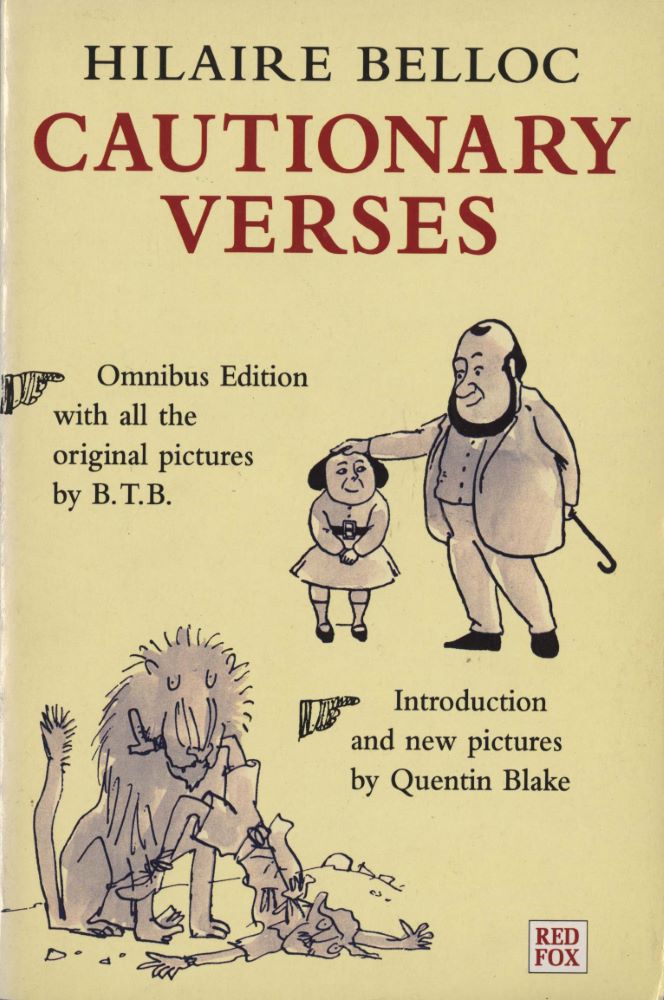
I am sure you will remember Hilaire Belloc’s ‘Cautionary Tale’ of Jim, who ran away from his nurse and was eaten by a lion. Shall I read it to you?

There was a Boy whose name was Jim; 

His Friends were very good to him. 

They gave him Tea, and Cakes, and Jam, 

And slices of delicious Ham, 

And Chocolate with pink inside, 

And little Tricycles to ride,

And read him Stories through and through, 

And even took him to the Zoo- 

But there it was the dreadful Fate 

Befell him, which I now relate.

You know – at least you ought to know, 

For I have often told you so- 

That Children never are allowed

To leave their Nurses in a Crowd;

Now this was Jim’s especial Foible, 

He ran away when he was able, 

And on this inauspicious day

He slipped his hand and ran away! 

He hadn’t gone a yard when – Bang! 

With open Jaws, a Lion sprang, 

And hungrily began to eat

The Boy: beginning at his feet.

Now just imagine how it feels 

When first your toes and then your heels, 

And then by gradual degrees, 

Your shins and ankles, calves and knees, 

Are slowly eaten, bit by bit.

No wonder Jim detested it!

No wonder that he shouted “HI!‟

The honest keeper heard his cry, 

Though very fat he almost ran

To help the little gentleman. 

“Ponto!” he ordered as he came

(For Ponto was the Lion’s name), 

“Ponto!” he cried, with angry Frown. 

“Let go, Sir! Down, Sir! Put it down!”

The Lion made a sudden Stop, 

He let the Dainty Morsel drop, 

And slunk reluctant to his cage, 

Snarling with Disappointed Rage. 

But when he bent him over Jim 

The Honest Keeper’s eyes were dim. 

The Lion having reached his head, 

The Miserable Boy was dead.

When Nurse informed his parents, they 

Were more Concerned than I can say:- 

His Mother, as she dried her eyes, 

Said, “Well- it gives me no surprise, 

He would not do as he was told!” 

His Father, who was self- controlled, 

Bade all the children round 

attend To James’ miserable end, 

And always keep a hold of Nurse 

For fear of finding something worse.

Hilaire Belloc (1907) Cautionary Tales, 

included in Cautionary Verses, Omnibus Edition, (1993) London, Jonathan Cape

Thinking of Daniel’s escape from the den of lions, the story  of Jim is a very good illustration of the fact that lions are not nice pussy cats; although in distinct contrast the story about Christian the lion does have a happy ending – perhaps I should issue a spoiler alert at this point. 

The two chaps gave Christian to Joy Adamson of ‘Born Free’ fame for her to introduce the lion to the wild in Africa. A couple of years later they went to Kenya, and perhaps showing that touching faith in leonine good nature, which they had originally exhibited when they adopted Christian, they went for a walk in the bush in the hope of seeing lions, and, incredibly, a large male lion did appear, and he came bounding towards them. I think any normal people would have turned tail and fled; but not these two. They stood there, and this mighty king of the jungle leaped up and put his paws around their necks, licking them and embracing them. He was Christian, he remembered them, and he loved them.

Well, in the middle of all these nice lion stories, we mustn’t forget where we came in, which is, after all, one of the nicest lion stories, the one about Daniel in the den of lions. King Darius is tricked by jealous courtiers into having to condemn Daniel to what was normally a bloody fate, by being locked up in a den of lions overnight. 

The great king Darius was terribly distressed. Should he uphold the law which he had made, his interdict, or should he spare Daniel who had become his most trusted administrator? And he decided he had to uphold the rule of law, the immutable law of the Medes and the Persians. 

Poor Daniel had to be condemned. It was pretty ironic that Daniel had been condemned for worshipping the one true God, but the king figured that the only way Daniel could be saved was by praying to that same God, and indeed so he was, protected by an angel from being eaten by the lions.

But why do we remember Daniel at Easter? I think because, here again, after shutting somebody up in a place of death they rolled away the stone blocking the entrance and the dead man came out alive. 

What about Jesus’ empty tomb? What happened to Daniel was nothing like as mysterious. Certainly if all you have to go on is Saint Mark’s gospel and this original so-called short ending, what happened is that the three ladies, the two Marys and Salome, found that the stone sealing the tomb had been rolled away and a young man in white was  sitting inside, who told them that Jesus had been raised and that he was not there. 

The young man was presumably an angel too; he had been promoted from lion-taming duties by this time, and he told the ladies to go and tell the disciples and Peter that Jesus was going ahead of them to Galilee where they would see him. And they fled in terror, and in fact told no one. The last words were, “…and they said nothing to anyone; for they were afraid”. 

The original Greek words have intrigued scholars ever since. Literally it does not say, “for they were afraid”. It says, “they were afraid, for…” Or “they were afraid, because…”. It looks as though something is missing; but is that something all the material that’s in the other gospels, for instance about the two men in white and Mary hearing a familiar voice, thinking it was the gardener and and then recognising her teacher, and so on? Perhaps not. Then Mark would have made a gospel which really spoke to people like us, people who haven’t experienced the miracle of resurrection with their own eyes. 

It is generally accepted that Mark is the earliest gospel, so this is the one which most closely reflects what the earliest Christians said about what happened on Easter morning. There is a lot more to come, when we do look at the other gospel accounts, in the weeks to come. 

But I expect you’re not really sitting down and reading great tomes about it just now. One week on from a really happy Easter Sunday, as we come back to church today, it has still got a gently vague, happy buzz to it. 

The Lord is risen; he is risen indeed! We’ve just sung ‘Jerusalem the Golden’, but perhaps in this Easter season we will also sing ‘Ye Choirs of new Jerusalem’, which has this splendid verse: 

How Judah’s Lion burst his chains,

and crushed the serpent’s head;

and brought with him, from death’s domains,

the long-imprisoned dead.

The lion. The Lion of Judah. We haven’t even mentioned C.S. Lewis, and Aslan, the lion who stands for Jesus in The Lion, the Witch and the Wardrobe. The Lord is risen. He is risen indeed. 
Sermon for Evensong on the 3rd Sunday after the Epiphany, 27th January 2019

Psalm 33; Numbers 9:17-24; 1 Corinthians 7:17-24 – Holocaust Memorial Day 2019

When I went to the Holy Land a few years ago, on the Clandon parish pilgrimage led by Revd Barry Preece, we had an optional visit to the Yad Vashem Holocaust memorial museum. It came as a complete change of mood from the rest of the trip. Every day we had visited sites from the Bible, in Bethlehem or in Galilee or in Jerusalem, following in the footsteps of Jesus, and every day we worshipped together in these fabled places, which before we had only imagined, perhaps helped by some pictures in books or in museums which we had been to, but now where we actually were in the places where Jesus had been.

Now we really were in the Garden of Gethsemane, or out in the Sea of Galilee, imagining St Peter and the disciples not catching any fish. Generally, it was a happy, upbeat time. We met for supper and told each other stories over nice suppers and drinkable wines. Some of the Lebanese wines were really memorable … We didn’t actually go to a party at Cana in Galilee, but we got the flavour of it.

At the same time, we could see that there was a difference between the Israeli and Palestinian districts. We could see the awfully ugly and massive wall, dividing the two. We came across the ‘settlements’, which we had read about, where Israeli ‘settlers’ had established themselves, in contravention of United Nations resolutions. But despite the rather temporary-sounding name, ‘settlements’, they weren’t some sort of temporary camp; think instead of something like Milton Keynes. Milton Keynes on the top of a hill, in one instance [Wadi Fuqeen], pouring its sewage down into the valley below, where the Palestinians, whose land had been taken, still eked out a meagre existence.

There was a ‘night tour’ by coach around Israeli Jerusalem. No more dusty Middle Eastern roads, teeming with scruffy lorries and minivans, that you get in the Palestinian part of Jerusalem. No, here it was broad highways, sprinklers, green grass verges. Almost nobody walking, but rather most people driving. A beautiful hotel, the ‘American Colony’ – that is really its name. We didn’t go in, but I could tell that it would be nice to stay there.

On the way down to Masada in the desert, to see Herod’s amazing mountain-top palace, we went through a check-point between Israel and Palestine. It took our 40-seater coach a couple of minutes to be waved through. The queue of weary-looking Palestinians waiting to cross the border – some of them to their own land, which had been arbitrarily divided by the Israeli wall – were, we were told, often delayed for more than an hour, for no reason.

And then some of us went to the Holocaust museum, Yad Vashem. I remember remarkably mundane exhibits; freight trains whose cargo was people; endless paperwork, detailing everything about that ‘cargo’; personal effects, the stuff ordinary people had with them. But truly I felt a kind of internal contradiction. The exhibits were fine, so far as they went. But the point was, that the banality of this industrialised slaughter was overwhelming. Very few of the things we saw in the museum were, in themselves, weapons or instruments of torture. But nevertheless, this was killing on an unforeseeable and awful scale. It was too much to take in properly, but it looked mundane and normal. Nothing could justify the awfulness of the Nazi persecution in the Second World War, nothing could justify that genocide.

I’ve just finished reading a really good and enlightening book by Philippe Sands, the well-known QC who specialises in the defence of human rights, called ‘East West Street’. That street is in the city called Lvov, or Lviv, or Lemburg – a city now in Ukraine, which has been in Austria and Poland also at various times, where two of the greatest academic lawyers of the modern era were born: Sir Hersch Lauterpacht, who invented the legal concept of crimes against humanity, and Professor Raphael Lemkin, who invented the word – and the concept – of ‘genocide’. Both were Jewish. Both lost many of their families in the Holocaust. Philippe Sands’ grandfather also came from there.

‘Genocide’ was defined by Prof. Lemkin as acts ‘directed against individuals, not in their individual capacity, but as members of national groups’. [See http://www.preventgenocide.org/lemkin/AxisRule1944-1.htm] The Nazis killed people not because of who they were or what they had done, but because of what they were. To be a Jew was to attract a death sentence. The term ‘genocide’ was first used, at Prof. Lemkin’s suggestion, in the charges brought in the great Nuremberg trial of the Nazi leaders in 1944. Prof. Lemkin had coined the word from the Greek root γενος, a tribe, and the Latin cido, I kill.

When I went round the Yad Vashem museum, I felt strangely detached. On the one hand, I felt the mundane, industrial horror of the concentration camps. Holocaust Memorial Day is on January 27th because that is the day when Auschwitz was liberated. On the other hand, the fact that surely no-one, now, would seriously think of doing anything as awful as the Nazis did.

Except that they have done. There have been other instances of genocide since WW2. The massacres in Cambodia, Rwanda and Bosnia, for instance. What causes it?

No clues in the lesson from the Book of Numbers. Rather recondite stuff about when the Israelites, in exile but having come out of captivity in Egypt, would move forward when the ‘tabernacle’, the tent covering the Ark of the Covenant, the very ornamental box containing the Ten Commandments on two stone tablets, was covered and uncovered by clouds. This is part of the Torah, the law, the story, of Moses, and of the people of Israel, God’s chosen people: fine; but why would anyone hate those people?

And in the other lesson from St Paul, the emphasis is on the inclusiveness of Christianity. Come as you are. You don’t have to attain any status first. You can be a slave and still be a good Christian. You can, certainly, be Jewish. Being a Christian doesn’t mean you can’t be Jewish too. We might wonder why St Paul didn’t object to the existence of slavery, but certainly there is no suggestion that some people are less deserving of salvation than others. Indeed St Paul uses the mechanisms of slavery to illustrate how Jesus can set people free, literally.

But despite these innocent Bible passages, we know that anti-Jewish feeling is a very old thing. The Jews, as a race, have been blamed for killing Jesus. They have been called ‘god-killers’. Martin Luther was very antisemitic, blaming the Jews for failing to recognise Jesus as the Messiah. He was out of line with most of the other Reformers in this. After all, the story of Paul’s conversion and acceptance by the early Christians, even though he had been persecuting them – and Jesus’ own words from the cross, ‘Forgive them, they know not what they do’, and so on, go against any blanket condemnation of the Jews.

It is still an issue. In this country the Labour Party has been condemned for being antisemitic, although I think that I would make a distinction between being opposed to some of the actions of the modern state of Israel, such as the expropriation of Palestinian land and building ‘settlements’ in contravention of United Nations resolutions, being opposed to that on the one hand, which seems to me to be legitimate, and being anti-Jewish in general. That distinction recalls Raphael Lemkin’s definition of genocide, in that people who are antisemitic are against people because of what they are, rather than because of what they do.

St Paul’s message of acceptance, of inclusion, is still very relevant. In some places when I was a boy, there were adverts which specified ‘no blacks and no Jews’ could apply. It surely couldn’t happen nowadays. But there has recently been the EMPIRE WINDRUSH scandal, where our own government, Mrs May herself, the Prime Minister in her previous post, forcibly sent elderly black people to places in the Caribbean which they had left when they were children, left at our invitation, in order to come and work here. That recent scandal again shows people judging others by what they are – in that case, black people who have come from other countries – rather than by who they are or what they do.

The banal routines, the orderliness, of the Holocaust are still a danger, I fear. Very few people would just go and shoot someone: but what if you are a soldier and you are ordered to do it? Of course that was at the heart of the Nuremberg trials. The railway employees who drove the trains, who manned the signal boxes, who repaired the main lines, wouldn’t normally be looked on as authors of genocide. But without their work, the poor Jews would not have been put in the concentration camps so efficiently and in such vast numbers. There were lots of innocent routines and ordinary jobs, which nevertheless made genocide possible.

The other great lawyer whom Philippe Sands celebrates in his book is Sir Hersch Lauterpacht, whose son was Sands’ tutor at university. Lauterpacht developed the other great concept which was first used in the Nuremberg trials, the concept of crimes against humanity. The United Nations Universal Declaration on Human Rights grew out of Lauterpacht’s work, and was, by contrast with Lemkin’s work, concerned not with crimes against whole peoples, but with crimes against individuals. What was the true nature of the evil contained in the Holocaust? When the victorious allies were preparing to try the Nazi leaders, what was the essence of their crimes? It was an assault on people as individuals, on who they were, as much as on what they were.

These are still vital ideas. Jesus’ Sermon on the Mount, his great command to us to love our neighbours as ourselves, and St Paul’s message all through his letters that it doesn’t matter what our origins are if we are to become Christians – these are so relevant today. When we hear people saying things against people because of what they are – foreigners, migrants, black people, say – and when we hear people saying that it’s just too bad (but there’s nothing which can be done about it) that many people don’t have enough to eat, or can’t afford medicines – those are the sorts of ideas which in the past have resulted in genocide.

Archbishop John Sentamu is starting to raise money for a bishop, Bishop Hannington Mutebi in Kampala, Uganda, who needs cancer treatment – which costs £155,000. What do we feel about that? We hope he gets the money, and the treatment. What if you weren’t a bishop but still had cancer in Uganda? You are still entitled to be treated, because you are human. You have human rights. Perhaps it has taken the history of the Holocaust to bring it home to us how vital those rights are.

Sermon for Mattins on the Second Sunday of Epiphany, 17th January 2016

1 Corinthians 12:1-11: John 2:1-11
Spiritual gifts, which God created in us, have given us a variety of aptitudes and skills. We are all rather different, but, St Paul’s point is, we are all bound together by being created by the same spirit. That’s appropriate to mention now, because next week is the Week of Prayer for Christian Unity.
I’m sure we could also have a nice time reflecting on the wedding at Cana in Galilee. Did you know that there has been a change in the etiquette of buying somebody a drink? This is as a result of the government’s recent health advice on safe levels of alcohol consumption. The other day, as I found myself entering the ‘Running Mare’ for some reason, as I sometimes do, one of my boon companions greeted me by saying, “Hugh, would you like a unit?” A unit. I responded, as I understand you have to do in the circumstances, “Yes please, make it three”. And accordingly, a pint of the finest Tongham Traditional English Ale, otherwise known as a pint of TEA, was duly produced.
Moderation in all things, μηδέν αγαν; ‘do nothing to excess’. It is not a Christian principle as such. It was the inscription on the temple of Apollo at Delphi in Classical antiquity. Perhaps discussion of wine, or even TEA, belongs to the jollifications of Christmas, and we really need to move on to more serious things.
Quite often at the beginning of the Week of Prayer for Christian Unity, we have discussed the relations between the various churches, have regretted our differences, and prayed for better understanding between the different parts of God’s church, and possibly the coming together of some of the different parts in unity. So for example, we have had a close encounter with the Methodists, and the relations between the Church of England and the Catholic Church have greatly improved.
What I think is more topical, more important for us today, is to discuss the idea of Christian unity not between our church and others, but within the Anglican church in the light of the meeting of Primates, that is, senior bishops (not gorillas), the leaders of the various national Anglican churches, but which has just taken place in the crypt of Canterbury Cathedral.
Over 30 senior bishops from all over the world were meeting, at Archbishop Justin’s invitation, to try to sort out their differences over various aspects of human sexuality, in particular, gay marriage and the ordination of openly gay people as ministers. Perhaps after all the wedding at Cana is relevant today – not in its wine, but simply as a wedding. Weddings are the same focus.
There are divisions between those churches which uphold a so-called ‘traditional’ view and those who believe that the spirit of Jesus’ teaching allows them to recognise that the definition of marriage may well have changed or widened to include homosexual people.
It’s probably true also to say that the dividing line is between those who rely on the letter of the Bible and those who allow the Bible to be subject to interpretation. The argument centres around the verses in the 10th chapter of St Mark’s Gospel, ‘God made them male and female’. Coupled with some gruesome prohibitions in the book of Leviticus and the less enlightened parts of Saint Paul’s letters, to the effect that homosexuality is wrong, the traditionalists argue that gay marriage cannot be allowed in church.
Against this, understanding of people’s sexuality from a scientific point of view has advanced in many countries so that there is a recognition that it may well be an oversimplification to say simply that “God made them male and female”.
We now know there are all sorts of, degrees of, maleness and femaleness, up to and including cases where people are literally hermaphroditic, that they have as many male characteristics as female. And there are also people who discover that the body in which they are born doesn’t reflect their true sexuality, so that they may have sex change operations as a result. Some very well-known people have started out as being of a different sex from the one they are now recognised to be. For example the travel writer and historian, Jan Morris, until 1972 was James Morris, who reported for the Times on the first ascent of Everest by Hillary and Tenzing.

Again, within homosexual couples, it is often quite clear that one takes a male role and the other takes a female role within the partnership, notwithstanding the fact that the partners are biologically of the same sex.
Having said all that, it is also true that people who are not gay or bisexual often find the idea of gay or bisexual behaviour physically repulsive. This is presumably a natural instinct aimed at directing us towards those who share the same orientation. Similarly, some homosexuals have a distinct aversion from the opposite sex.
But I am sure that homosexual couples feel the same love, and have the same aspirations towards lifelong commitment and fidelity, that heterosexual couples do in marriage.
The churches within the Anglican communion have adopted different attitudes. The Church of England, our church, will not marry gay people in church, have gay bishops or ordain gay clergymen. Some of the African churches take things much further. Uganda and Nigeria have both either passed or are planning to pass laws which make homosexuality a criminal offence, and their local Anglican churches support this. They are in the same position as was the case in England before the 1967 Sexual Offences Act, which decriminalised homosexuality. On the other hand, the Episcopal Church of the United States of America has consecrated an openly gay bishop, and is willing to marry gay people in church.
Archbishop Justin convened the so-called Primates’ meeting, or conference, because it was beginning to look likely that a number of the national Anglican churches would split away from the worldwide Anglican communion, because of this disagreement on sexual questions.
As you will no doubt have read in the newspaper or heard on the radio, the conference has finished and a communiqué has been issued, to say that, although the bishops regret any hurt which may have been given to homosexuals or LGBTI people, and although the church commits itself to opposing legislation against homosexuality wherever such legislation is introduced throughout the world, nevertheless they have sanctioned the Episcopal Church of United States of America by excluding them from voting rights in the various Anglican communion meetings and consultations for the next three years as punishment for that church changing their doctrine concerning marriage without first obtaining the agreement of the other churches in the Anglican communion.
Archbishop Justin has avoided a split in the church for the time being, but it is at least arguable that he is just putting a lid on a seething cauldron of disagreement which is bound to result in some kind of schism in future.
It’s not my function to tell you how to think. But I think it is legitimate simply to point out, that, from its earliest times, the church has had disagreements about how to interpret the Bible, how to strike a balance between the norms of secular society and Biblical teaching.
It has been pointed out, for example, that right up to the passing of the legislation against it in the middle of the 19th century, the Church of England had nothing against slavery. The slave traders, whose wealth went into the creation of the cities of Liverpool and Bristol, were all devout churchgoers, and the church at that time saw nothing wrong in their activity. The Clapham Sect around William Wilberforce developed their opposition to slavery at their church, Holy Trinity, Clapham Common: and in so doing they were going against the official position of the Church of England at the time.
So I think it may be a little naive to suggest that there is some such thing as “the truth”, which can be discovered simply by reading the Bible. You will, I’m sure, all know of the various ambiguities and internal contradictions in the Bible. If you read the book of Leviticus, chapters 20 and 21, where the bloodcurdling prohibitions against homosexuality are to be found, you will find that not only is homosexuality condemned, but many other things are also slammed, which we might not find particularly objectionable today. But it is only homosexuality whose prohibition is remembered.
Very early on, the church evolved a formula for the interpretation of scripture and the development of the correct doctrine, according to which the Bible was certainly the first source, but it should be understood in the light of tradition and the application of reason. If something doesn’t make sense or is contradictory, then you can use reason to correct it, and it is also relevant to see what the church in its history has believed.
But to me the bottom line seems to be that, in all these discussions, it’s difficult to see how Jesus’ great commandment of love, that ‘thou shalt love thy neighbour as thyself’ is being observed, where the churches’ attitude to the gay and lesbian, bisexual and transgender community is concerned. I find it very difficult to understand how the church can espouse anything as policy which results in such hurt.
We now know much more about how human sexuality works, as a matter of science. It seems to me that we should take advantage of that knowledge, so that in the mixture of scripture, reason and tradition we should give some weight to reason: and where scripture is concerned, we should recognise that some things are more central than others, none more so than Jesus’ new commandment that we love each other. Yes, we should acknowledge that there has been a tradition: but we should weigh this tradition appropriately against the other two factors.
We should give Archbishop Justin credit for keeping the churches in the Anglican communion together in one group and, we hope, keeping them talking to each other. The sad thing is, I can’t imagine that, if I went to a church in Nigeria or in Uganda, it would be very different, (except that it might be more jolly), from a church here or in the United States. There would indeed be ‘diversities of gifts, but the same spirit.’ And ‘differences of administrations, but the same Lord’, as St Paul says.
Let’s hope and pray that the Primates, (who are, after all, not gorillas), will recognise this in future. And then we can stop worrying about sex, and concentrate on all people who really need our compassion and love, like the refugees in Calais as they face a northern winter for the first time.