Archives for posts with tag: Hebrew

Sermon for Evensong on Palm Sunday 2025

https://bible.oremus.org/?ql=611300034

Two vineyards. Two stories about vineyards at the start of Holy Week. You might think that we are being exposed to, talking about, another temptation involving wine, but that’s not it. The two vineyard stories in Isaiah and St Luke’s gospel.

Isaiah the prophet singing for his beloved concerning his vineyard – I’m not quite sure how the genders work – the beloved having done all that is necessary to create a fruitful vineyard on a very fertile hill; he expected it to yield grapes, but it yielded, according to our translation here, ‘wild grapes’: although apparently, according to one of the commentaries which I read, the word in Hebrew literally means ‘stinkers’. Heaven knows what a grape has to be like to be described as a stinker; anyway it was not a successful planting of a vineyard. Somehow the vineyard didn’t turn out as it was intended to be.

‘What I will do to my vineyard’ – it’s quite difficult to follow who’s who in this story – it’s somebody and his beloved who builds the vineyard and then it’s me, it’s my vineyard. And because the vineyard produces stinkers I’ll dismantle it and make it a wasteland so that it’s overgrown with briars and thorns. There isn’t really some boyfriend’s Château Musar somewhere which has suddenly stopped producing decent grapes.

Similarly Jesus talks about a man turning his vineyard over to tenants – literally, farmers – in the King James Bible, husbandmen. Where have all these good words gone? I like a world with husbandmen in it. And where are the handmaidens? I ask myself. The word here is γεωργος (Georgos, which is Greek for ‘farmer’). Like a lot of names, George is derived from the Greek, so if you are called George, in Greek you are a farmer. In Jesus’ story, they were tenant farmers of some kind. And he sent members of his staff – literally, his slaves – one at a time to try to collect the rent, or a share of the produce instead, which certainly seems still to be the way that it works in the south of France even today. A friend of mine had a house there including a vineyard. He let the local cooperative manage the vineyard, in return for which they harvested the grapes and gave my friend a share in the wine produced. He took his rent in bottles.

Here, however, the parable is about wicked tenants who didn’t pay their rent and instead, eventually, when the owner sent his own son, the tenants, having kicked out his servants one by one when they called on the farmers to hand over the rent, actually killed the son. So what did the owner of the vineyard do? Obviously he evicted the wicked tenants and passed the vineyard over to other managers to manage.

Again, this is not an actual story about something that actually happened. It’s a parable and it’s very relevant to Easter. Jesus is forecasting what is going to happen, and the scribes and the chief priests, hearing him, get angry because they realise that what he is saying is directed against them, Jesus suggests that if they do behave like the wicked tenants then ‘the stone that the builders rejected has become the cornerstone’, and that stone will trip people up fatally, and it may fall on other people, with similar devastating consequences.

If they, the Pharisees and scribes, are builders, and if they reject a stone while they are building something, if they reject Jesus, then He will become a stumbling block for them, or even fall on them and obliterate them.

Ploughing up a vineyard. Fatal trips and falls. Being crushed by a massive boulder. I’m not sure whether, when we read these lessons in the Bible, even in the context of Lent and even as we look forward to the commemoration of the amazing events of the first Easter, even so, I’m not sure that these lessons really grab us in the way that some of the language used indicates that they are meant to.

Everyone who falls on that stone will be broken to pieces and it will crush anyone on whom it falls. And Isaiah’s friend’s vineyard producing ‘stinkers’ instead of the sweet juicy grapes that he might reasonably have expected and so getting dug up and bulldozed. These are two parables, two stories that are not meant to be taken literally, but which colourfully illustrate, dramatise, an idea or principle; and they have been chosen to be readings for Evensong today because they put you in mind of what we are going to commemorate at Easter.

Jesus is the son who is sent to the vineyard, the vineyard being the human race, the only son, who gets rejected and killed by the people who are looking after his father’s property, the vineyard, the world that his father has created. The Israelites, the Jews, were the bad tenants who threw out the only son and killed him; or rather, they would be, because Jesus is telling the story before he gets crucified.

But so what? Look, there are only 43 of us here – although that’s a really good turn-out: there are only a few thousand, perhaps, in Evensong services all over the UK. Most people couldn’t care less. Most people are snoozing after Sunday lunch or maybe having a nice walk in the park.

Even if they are vaguely aware of Easter having more to it than just a lot of Easter eggs, nevertheless there is nothing vital or urgent about it so far as they are concerned. Even if they’re going to turn up on Easter Sunday, if they are in the habit of coming at Christmas and Easter, say, (which, incidentally, if they were in the Roman Catholic Church would count as regular attendance), but even if they are really rather sparing attenders at church, or if they never come, they presumably don’t feel any compulsion, any need or anything really vital for their life today about this teaching of Jesus or this prophecy of Isaiah.

Nobody much today really thinks that because they might be descendants of the people who cast out the son and killed him, (in these terms), they should worry that a stone might be a stumbling block or that it might fall on them and crush them. It’s probably a metaphor too far, even if they do know a bit about Jesus, because the idea that Jesus would take some dreadful vengeance on people, crush them and grind them into dust, is not consistent with our picture of ‘gentle Jesus, meek and mild’, the suffering servant, who washed the disciples’ feet – as we will wash at least one of your feet, on Thursday at Holy Nativity.

What is our Lent reflection about this? I want to read you something which was written by Dietrich Bonhoeffer, the great German theologian who was executed by the Nazis in the dying days of the Second World War because he was a member of the Stauffenberg Plot to kill Adolf Hitler in 1944. The church remembered the 80th anniversary of his death last Wednesday. He wrote, from prison, what he called an ‘outline for a book’, in which he tackled the idea of a world in which people do not feel they need God any more. He speaks of a God in “religion” as a deus ex machina. Literally it means ‘god from the machinery’. That’s defined in the Oxford Illustrated Dictionary as a ‘power [or] event that comes in the nick of time to solve difficulty.’ The ‘machinery’ was what they had in ancient Greek theatres, to make the actors playing the part of gods fly through the air.

Bonhoeffer felt that religious people had been seeing God in a way as a magic fixer, that “[God] must be ‘there’ to provide answers and explanations beyond the point at which our understanding or our capabilities fail.” But as scientific knowledge has increased, so people have needed God less and less. They may well feel they can get along without needing God at all.

Bonhoeffer felt we ought to accept this, that this was a sign of the world ‘coming of age’. He wrote, ‘The only way to be honest is to recognise that we have to live in the world etsi deus non daretur – even if God is not ‘there’. Like children outgrowing the secure religious, moral and intellectual framework of the home, in which ‘Daddy’ is always there in the background, God is teaching us that we must live as men who can get along very well without him’.

He went on to set out a paradox at the heart of this, which I think leads very well into our reflections for Lent. Bonhoeffer wrote, ‘God allows himself to be edged out of the world, and that is the way, the only way, in which he can be with us and help us. … This is the decisive difference between Christianity and all [other] religions. Man’s religiosity makes him look in his distress to the power of God in the world; he uses God as a deus ex machina. The Bible however [has] directed him to the powerlessness and suffering of God; only a suffering God can help.’

“[Bonhoeffer wrote that he would explain in his book] the experience that a transformation of all human life is given in the fact that Jesus is ‘there only for others.’ His ‘being there for others’ is the experience of transcendence. It is only this ‘being there for others’, maintained till death, that is the ground of his omnipotence, omniscience, and omnipresence.” Those are the essential characteristics of the divine, of God, of what he calls ‘transcendence’. He goes on: “Faith is participation in this being of Jesus (incarnation, cross, and resurrection).” Those are the key things about Jesus: incarnation becoming human, the cross, and resurrection. According to Bonhoeffer,“Our relation to God is not a ‘religious’ relationship to the highest, most powerful, and best Being imaginable – that is not authentic transcendence – but our relation to God is a new life in existence for others, through participation in the being of Jesus. The transcendental is not infinite and unattainable tasks, but the neighbour who is within reach in any given situation.”

We need to think very carefully about this really big mystery. On the one hand we believe in God as a kind of omnipotent father figure, but on the other we read that the first shall be last and the last shall be first. God, Jesus, is in the needy people, the ill people, the homeless people, the naked people who have no clothes.

The sky has turned darker since the joyful procession this morning on a donkey. Donkeys are great, and Jesus was on that donkey. But what else was going on? That’s for us to ponder in this week to come.

Quotations are from ‘Outline for a Book’ in Bonhoeffer, D, (enlarged edition) 1971, ‘Letters and Papers from Prison’, London, SCM Press p.380f., and from Bonhoeffer as quoted in Robinson, J. A. T., 1963, ‘Honest to God’, p36f, ‘Must Christianity be Religious?’
Sermon for New Year’s Day 2023 at St Dochdwys, Llandough

The Naming and Circumcision of Jesus

May God be in my mouth, and in my speaking. Amen.

Before I say anything else, let us give thanks to God for the work of Emeritus Pope Benedict, and pray for our Catholic friends, brothers and sisters in Christ, as they mourn his passing. And although the ball may be the wrong shape, we mourn the passing also of the great footballer Pelé. May both these great figures rest in peace and rise in glory.

Numbers 6.22-27

Psalm 8

Galatians 4.4-7

Luke 2.15-21

https://bible.oremus.org/?ql=538997803

It’s a bit of an upside-down sermon this morning. Indeed if you’re still waking up after last night, you might have thought that our service was back to front. Our first lesson was the blessing. It is the most beautiful blessing, which is called the Aaronic blessing. It was passed on to Aaron by Moses. But a blessing usually comes at the end of the service. It probably will still come at the end as well – Jimmy may well say it today. This is it, from the Old Testament lesson:

May the Lord bless you and keep you;

may the Lord make his face to shine upon you and be gracious unto you; may the Lord lift up his countenance upon you, and give you peace.

Don’t get up. It’s not the end of the service yet! Because the last bit of it in the lesson from Numbers, just after the blessing, says this:

‘So they shall put my name on the Israelites, and I will bless them’.

It is about the people of God being given their name, Israel, which means literally in Hebrew, people who have wrestled with God. That went back to Jacob, wrestling with the angel. So Jacob became Israel and the whole of the old Testament had a theme running through it, of the relationship between the chosen people of God, the Israelites, and God himself. It was like all the best love affairs, pretty bumpy. People who really do love each other have rows and they do fall out. That was certainly true of the Israelites and their God. They worshipped the Baals and the Golden Calf – and God punished them. (See Exodus 32 and 1 Kings 12).

This story of the Israelites getting their name is at the beginning of their story, and it’s appropriate on 1st January to think of our religious beginnings and where they might lead. Now today we are focusing on the other end of the Bible, on baby Jesus – I was going to say, on Jesus’ ‘christening’ – but that sort of thing worked differently in those days. Instead the baby would be named, and if he was a male baby, circumcised as part of the Jewish tradition. The angel had told Mary that his name would be Jesus. That name means, God saves us, God is our salvation. So we have moved from wrestling with God, Israel, to salvation through God, Jesus.

The mighty God who spoke through the burning bush to Moses, the God who was capable of tremendous wrath and destruction, has now come, with all that power, to be concentrated into a tiny baby. That is the miracle of Christmas. We are perhaps none the wiser about exactly what God looks like, apart from just being a baby. In the blessing, with God lifting up the light of his countenance upon us, we get the feeling that there is someone up there, beaming down with a beautiful smile. But we can’t actually see that God: No one could. But people could see Jesus and they did see him. He certainly lifted up the light of his countenance on everyone he met.

Although we can’t see Him, what is our relationship with God? In St Paul’s letter to the Galatians, God puts us alongside that little baby, so that we are children, children of God, calling God ‘Abba’, which is more like ‘Daddy’ rather than ‘Father’ in the Aramaic we are told. Saint Paul goes on to suggest that, as children, we are heirs; we inherit the blessings of God.

But there is a missing bit. We need to go back a bit to the Old Testament and look again at the people of Israel, the people wrestling with God. The heart of their relationship was what was known as God’s covenant with Israel. What is a covenant? As a lawyer, I can tell you that a covenant is an agreement or a contract. The two parties agree together and they agree to do things one for the other. That’s it. It’s very simple.

The covenant between God and Israel was indeed very simple. The Israelites agreed to worship God as the one true God, no other gods, and in return God promised to bless them and keep them, as the blessing says. And it’s a very useful idea, this covenant.

What can we say at this service, at the beginning of 2023? We have to cope with all these challenges and difficulties in the world ahead of us:

– the war in Ukraine,

– the cost of living crisis here at home,

– the energy crisis, where we are all worrying because we can’t afford to pay three or four times what we used to pay for our houses to be heated,

– and the pay crisis, all the strikes which the public servants, and in particular the nurses and ambulance crews, are involved in, because their pay has fallen back so much that many are now forced to go to food banks, which seems to me to be a very unfair development after all their bravery and sacrifice brought us all out clapping on our doorsteps while the Covid pandemic was on.

I hope that you will not think that this falls outside the bounds of what a preacher is supposed to cover, but it does seem to me that we were, and we are, very happy to rely on these dedicated public servants, and now we must provide them with a decent living. And, most importantly, there are theological reasons for supporting the workers’ fight for better pay and conditions of work.

Frankly our government of millionaires in London needs to think again, quickly, about this. We were all made equal in God’s image: not so rich and so poor, all in the same country – the sixth richest country in the world. Remember Jesus’ story known as Dives and Lazarus, the Rich Man and Lazarus, in Luke 16:19-31. Jesus surely didn’t approve of such a huge gap between the rich and the poor.

So as we embark on 2023, as we see our world facing all these challenges, what do we, as the people of God, the people in the church, do about it?

Quite a lot of Christians do something every New Year, which seems to me to be a great way of preparing themselves to tackle these challenges; and that is, they renew their covenant with God.

It’s an idea which started with John Wesley and the early Methodists. For Methodists the first service in a new year is still known as Covenant Sunday. The ‘people called Methodists’, as they used to call themselves, have recited the same or very similar words every year since 1780 to make their covenant, their agreement, with the Lord. I’ll give you a quick preview, and then we will say the whole of this covenant prayer together later on in this service. So this is just to introduce you to it if you haven’t heard it before. What the Methodists pray goes like this.

We are no longer our own, but thine.

Put us to what thou wilt, rank us with whom thou wilt.

Put us to doing, put us to suffering.

Let us be employed for thee or laid aside for thee,

exalted for thee or brought low for thee.

Let us be full, let us be empty.

Let us have all things, let us have nothing.

We freely and heartily yield all things to thy pleasure and disposal.

And now, O glorious and blessed God, Father, Son and Holy Spirit,

thou art ours, and we are thine.

So be it.

And the covenant which we have made on earth,

let it be ratified in heaven.

Amen.

Put us to doing, put us to suffering;

let us be employed for thee or laid side for thee ….

And now, O glorious and blessed God, Father, Son and Holy Spirit,

thou art ours, and we are thine.

So be it.

And the covenant which we have made on earth,

let it be ratified in heaven.’

Those are John Wesley’s words from 1780. They’ve been repeated every year since. That’s it. We have to do what the Lord commands us to do, just as Jesus commanded his disciples; you know, not having two cloaks, letting other people go before us, so the last shall become first: loving our enemies, not turning our backs on poor people like Dives did, on people like nurses, and instead doing things that may not necessarily be that good for us as individuals but which reflect God’s love, and which Jesus told us to do.

‘Let us be full, let us be empty.

Let us have all things, let us have nothing.’

This is the agreement which we are invited to make, and which should be our guiding principle in the year to come. We have moved from Israel, wrestling with God, to Jesus, God is our salvation.

So let’s agree on that. Let’s make that covenant. Let’s do what we have to do in order to keep our side of the bargain. It’s not just a question of words. But if we do, if we do do more than just talk: then, the blessing will come; and now, here, it will be in the right place, at the end of the service, but it will be more than that: it will be a continuing blessing. The Lord will bless you and keep you. The Lord will make his face to shine upon you, so that it will, truly, be a happy New Year.

Sermon for the Second Sunday of Lent, 17th March 2019

Genesis 15:1-12, 17-18, Philippians 3:17-4:1, Luke 13:31-35

As we woke up on Friday, to hear the news about the terrible shootings in the mosques in Christchurch in New Zealand, the New Zealand Prime Minister, Mrs Ardern, made a moving statement about the fact that it seems clear that the 50 people killed were the victims of a racist, Islamophobic terrorist. Mrs Ardern said, ‘Many of those who will have been directly affected by this shooting will be migrants, they will be refugees here. They have chosen to make New Zealand their home and it is their home. They are us.’

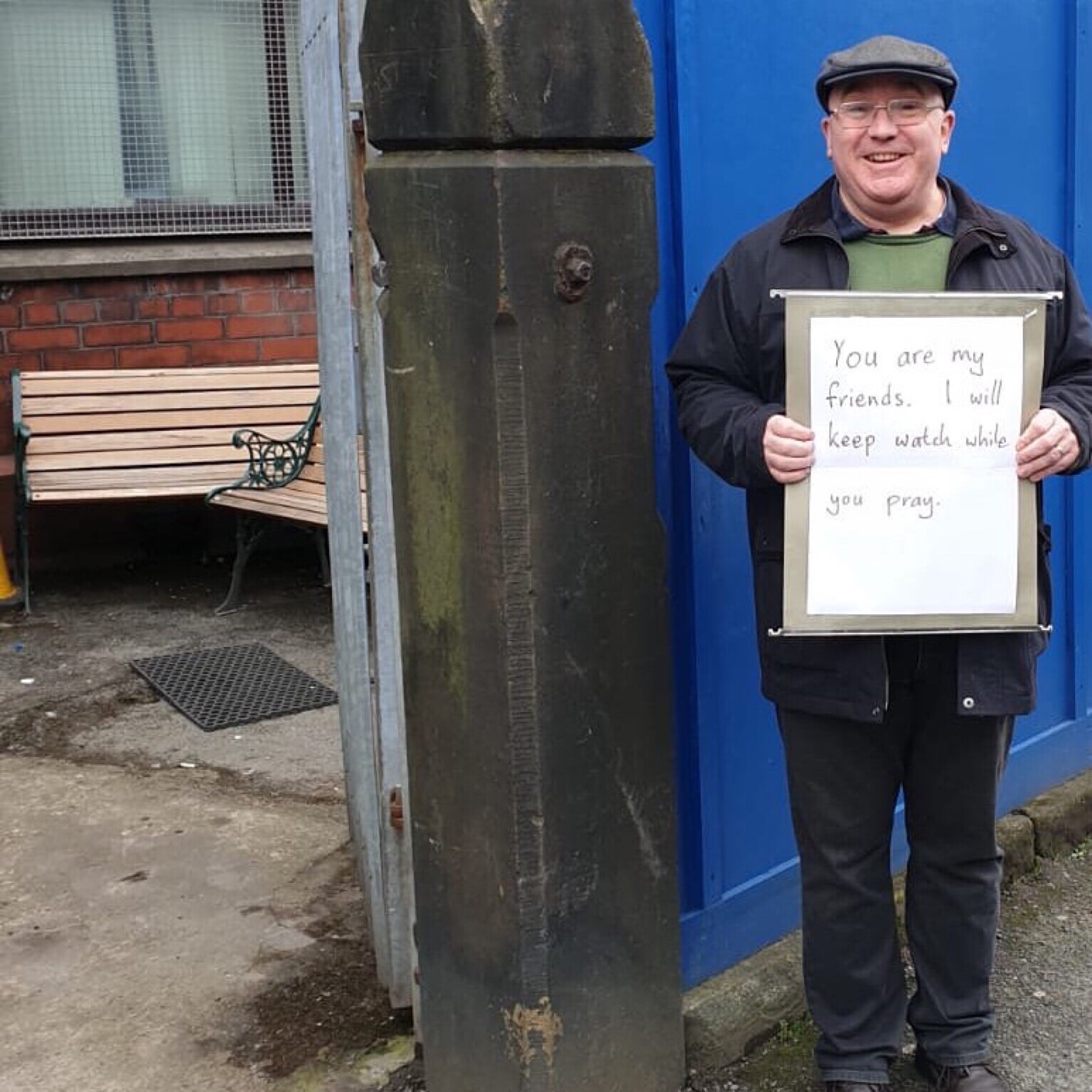
A bit later on, a picture appeared on Twitter [reproduced above] of a man who, if I can say this, did not look like a Moslem, but rather like Andy Capp in the cartoons, in a flat cap, standing smiling outside a mosque in Manchester with a placard which said, ‘You are my friends. I will keep watch while you pray.’

Terrible atrocities do sometimes seem to bring out beautiful and uplifting thoughts, like those of Mrs Ardern and of the man in the flat cap outside the mosque in Manchester.

In our Lent study groups we are going through the Beatitudes, the ‘blessed are they’ sayings which Jesus spoke at the beginning of the Sermon on the Mount in Matthew 5.

The second one, perhaps the right one at a time of tragedy, is ‘Blessed are those who mourn, for they will be comforted.’ This is one of those short sentences that contains impossibly dense and complicated ideas. On the face of things, for somebody to be mourning, to be sad, to be heartbroken, is not in any sense the same as to be fortunate, which is what the word translated as ‘blessed’ means.

How lucky for you that you are heartbroken; what a wonderful thing it is that you are in floods of tears. Clearly there’s something which doesn’t add up. Try telling the distraught people that were on the TV from New Zealand that they were in some way blessed or fortunate. But really it means, as it says, that those who mourn will be blessed, will be comforted in future: and that is a message of hope after all.

St Paul, in his letter to the Philippians, condemns those who live as enemies of the cross of Christ. Earlier in the chapter we had as our reading, he identifies the people that he condemns. He says, ‘Beware of those dogs and their malpractices. Beware of those who insist on mutilation – I will not call it ‘circumcision’’. Beware of people who tell you you have to become a Jew in order to become a true Christian.

Nevertheless, Paul was proud to tell everybody that he had been circumcised and that he was an Israelite of the tribe of Benjamin, a Hebrew born and bred, and a Pharisee [Phil. 3:5]. He’d thrown it all over, after his Road-to-Damascus experience, and in his letters, for example to the Galatians and to the Romans, he made the point that, in the kingdom of heaven, there is no difference between Greeks, (Gentiles), and Jews.

The Israelites had been the chosen people of God, and the others, the Gentiles, the ‘nations’, were the great unwashed. But St Paul’s mission was to bring the good news of Jesus precisely to those Gentiles, to those who were not circumcised. He said, ‘Our citizenship is in heaven.’ Ordinary nationality doesn’t apply in heaven.

But originally, Paul – and Jesus – were Jews, sons of Abraham, descendants of Abraham. The word of the Lord came to Abraham and said, ‘Look toward heaven and count the stars; because that’s how many your descendants will be.’ The sons of Abraham. They were Israelites, the chosen people of God.

The gunman is supposed to have said that one of his reasons for shooting Moslems was because he saw them as strangers, ‘invaders’. At the beginning of this week in morning prayers we were reading from the Book of Deuteronomy, where Moses speaks the words of the Lord, a prophecy about offering sacrifice of the first fruits of the land, the land of milk and honey, which the Israelites have been led into, the promised land. Moses tells them to say in their prayers that they are descended from ‘a wandering Aramean’, or from ‘a Syrian ready to perish’, that they have been led into Egypt and then eventually out of Egypt again, as strangers in the land. Even they, the chosen people, started out as strangers.

There are many passages in the Book of Deuteronomy, and in the Jewish Law generally, which St Paul would have been very familiar with, which impose on Jews a duty to care for a stranger that is within their gates, to care for strangers along with orphans and widows. That is the spirit that Mrs Ardern has so eloquently reminded us of. It is not a spirit of antipathy towards immigrants and refugees, not against strangers, not against people who are different from ourselves.

This is such a difficult area. There are so many apparent paradoxes. The Jews, refugees, made it to the promised land; they went to the holy city, Jerusalem, and set up the temple there. ‘Jerusalem the golden, with milk and honey blest’.

But Jesus points out that, because that is where the council, the Sanhedrin, is based, it is only in Jerusalem that he can be condemned, and that Jerusalem is a city that kills prophets, that throws stones at people who are sent to it.

Mrs Ardern was one of those world leaders, like Mrs Merkel in Germany, who has dared to extend a welcome to refugees. She still extends that welcome. But what about us? The challenge to us today is surely not to be fixated with ‘taking back control’, with restricting immigration and upholding national identity, however important some of those things might seem to be at first.

Jesus said, ‘Strive to enter in at the strait gate. Struggle to get in through the narrow door. For I tell you that many will try to enter and not be able to. You may stand outside and knock: say, ‘Sir, let us in.’ But he will only answer, ‘I do not know where you come from.’ [Luke 13:24]

Where do we come from? You could say that Jesus makes getting into the kingdom of heaven seem like a refugee trying to come ashore in Italy, or trying to get through at the Hungarian border or even being caught up in our own Government’s ‘hostile environment’ at Heathrow today. Contrast that with what Mrs Ardern said. ‘ … They will be refugees here. They have chosen to make New Zealand their home. It is their home. They are us.’

The challenge for us as Christians is to raise our sights above the earthly ghastliness which stems from narrow nationalism, and to seek what is truly heavenly. ‘Blessed are those who mourn, because they will be comforted.’ Let us pray that, with God’s help, we can become channels of peace, so that we too can say that they are our friends, and that we will keep watch while they pray.