Archives for posts with tag: Isaiah

Sermon for Mattins and Morning Prayer (Principal Service) at All Saints Church, Penarth, 5th October 2025

Habakkuk 1.1-4; 2.1-4

Psalm 37.1-9

2 Timothy 1.1-14

Luke 17.5-10

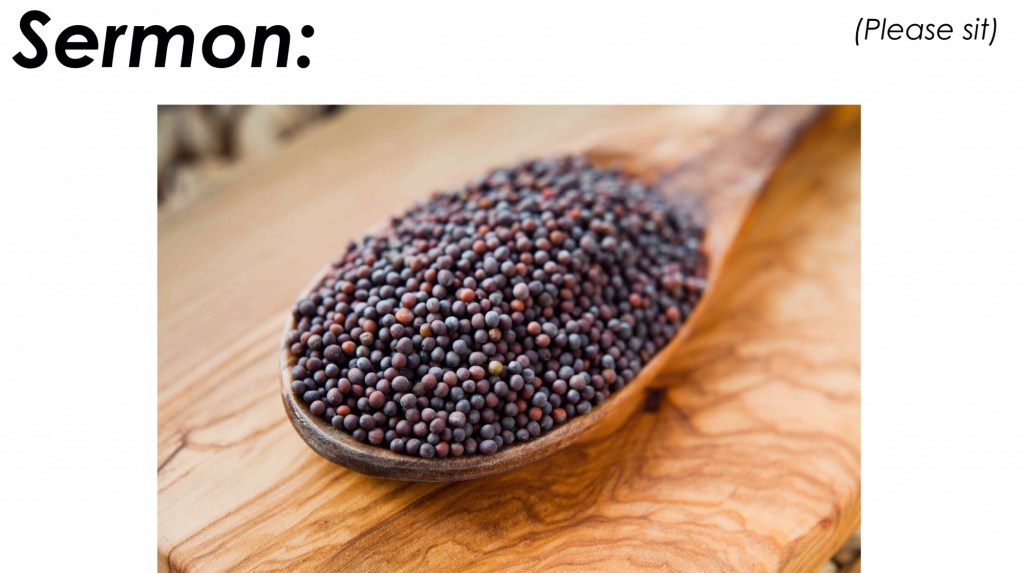
It’s a pity that we don’t have lantern slides at 8 o’clock, because I could show you the picture on the slide which is going to be shown at 10 o’clock when I start to preach the sermon then. It’s a sort of shovel, or it could be a large spoon, with round things in it, quite small.

I wondered whether they were my favourite special-treat breakfast cereal, Grape-Nuts – I should explain that I didn’t choose the pictures, as Susannah is leading the service at 10 as well as this one – but I suspect that at 8 o’clock we need to stay away from pictures and screens and things like that, and just keep our worship simple and our pictures in our heads, where, of course, those of you who listen to the wireless know that the best pictures are.

What is in the big spoon? I asked Susannah and she told me that they were mustard seeds, picking up a reference to the Gospel reading, the New Testament lesson today. I have to say that it rather threw me, because I thought mustard and cress was something which you grew on a face flannel on the bathroom windowsill, but apparently this is what mustard seeds really look like.

The lessons are all about how we confront a world which is going wrong, which is going against us. The Old Testament lesson, from the prophet Habakkuk, comes from a time around 600 BC when the Assyrians had overrun the northern kingdom of Israel, and all that was left of God’s chosen people were the two tribes of Judah and Benjamin, together with the survivors from the massacre when the Assyrians invaded the northern kingdom, who had fled to Jerusalem to take refuge there.

Habakkuk was preaching when the Babylonians were beginning to sweep down on Palestine; they are the Chaldeans, if you read a bit more beyond one of the bits that we have for our lesson, which is in two bits, the first four verses of chapters one and two respectively. If you read on in chapter 1, beyond where it says

Devastation and violence confront me;

strife breaks out, discord raises its head,

……

for the wicked outwit the righteous,

and so justice comes out perverted.

Habbakuk goes on in his prophecy by saying

Look, you treacherous people, look:

here is what will astonish you and stun you,

for there is work afoot in your days

which you will not believe when it is told you.

It is this: I am raising up the Chaldaeans,

that savage and impetuous nation,

who cross the wide tracts of the earth

to take possession of homes not theirs.

Terror and awe go with them;

their justice and judgement are of their own making.

Their horses are swifter than hunting-leopards

And he goes on to say how terrifying they are in all sorts of other ways. Obviously they fulfilled the American strategic objective for a successful army in the invasion of Iraq, ‘shock and awe’.

But this terrible army had its limitations.

Their whole army advances, violence in their hearts;

a sea of faces rolls on;

they bring in captives countless as the sand.

Kings they hold in derision,

rulers they despise;

they despise every fortress,

they raise siege-works and capture it.

A terrifying picture. Who could stand against them? But then –

Then they pass on like the wind and are gone;

and dismayed are all those whose strength was their god.

People who believe that ‘might is right’ turn out to be completely mistaken; and the key words in Habakuk’s prophecy come in the second chapter, in our second part of the lesson, [2:4]

Look at the proud!
 Their spirit is not right in them,
 but the righteous live by their faith.

It’s an idea that St Paul picked up on in two of his letters. In his great letter to the Romans, [1:17], he said that in the gospel of Jesus

is revealed God’s way of righting wrong, a way that starts from faith and ends in faith; he says, as Scripture says, ‘he shall gain life who is justified through faith’.

In the letter to the Galatians [3:11], where St Paul is drawing a distinction between following the provisions of the Jewish law, just carrying out the 10 Commandments, and having faith, saying that the way to salvation is through faith, he says that

It is evident that no one is ever justified before God in terms of law; because we read, ‘he shall gain life who is justified through faith’.

I’m not sure why the compilers of the Lectionary decided that we should have a lesson from the second letter to Timothy rather than one of these passages from Romans or Galatians, (which clearly reference the passage in Habbakuk), but certainly in the passage from the second letter to Timothy, St Paul celebrates that the fact that Timothy and his mother and his granny, Eunice and Lois respectively, all had strong faith.

But you might be a little bit puzzled about exactly what this faith is. It’s pretty clear that it’s not what we would call blind faith, just believing that something is true without any evidence for it. If that was true, you might never take another paracetamol ever again; or even worse, you might try to cure Covid by drinking some bleach. But we are not talking about President Trump’s belief system; this is a word which has more of a connotation of trust about it. It’s not so much about believing that something is the case, but rather, trusting in God to produce a good outcome, to right the wrongs. It’s very close to hope. Hope in the Lord. Trust in the Lord. As Isaiah puts it [14:31]:

but those who look to the Lord will win new strength,

they will grow wings like eagles;

they will run and not be weary,

they will march on and never grow faint.

They will soar, on wings like eagles: they will ‘mount up with wings like eagles’.

Just now our world looks a bit like what it must have looked like to Habakkuk; there is a lot going wrong. There are terrible wars, invasions; the rule of law looks to be under threat in places: –

devastation and violence confront me;

strife breaks out, discord raises its head,

…..

for the wicked outwit the righteous,

and so justice comes out perverted.

We can think of plenty of places and cases today, where those words would be very apt. We are going to have a vigil later on today here to pray for the people of Palestine; equally our prayers should go for the other places in the world where there is no peace and where the rule of law does not securely run: Ukraine and the south of Sudan chief among them, as well as Gaza and the West Bank; and all those places where people are held hostage or are fleeing violence and persecution and are becoming refugees.

We need to trust in the Lord, to pray with confidence and realise the power of prayer, even if our faith is only the size of one of Susannah’s mustard seeds, or a spoonful of Grape-Nuts. It doesn’t matter. You can rely on God to put things right in the end. Let us pray that he will use us in his service to that good end.

Amen.

Hugh Bryant

From the PowerPoint slides at the 10 o’clock service. What are those little beads?

Sermon for Evensong on Palm Sunday 2025

https://bible.oremus.org/?ql=611300034

Two vineyards. Two stories about vineyards at the start of Holy Week. You might think that we are being exposed to, talking about, another temptation involving wine, but that’s not it. The two vineyard stories in Isaiah and St Luke’s gospel.

Isaiah the prophet singing for his beloved concerning his vineyard – I’m not quite sure how the genders work – the beloved having done all that is necessary to create a fruitful vineyard on a very fertile hill; he expected it to yield grapes, but it yielded, according to our translation here, ‘wild grapes’: although apparently, according to one of the commentaries which I read, the word in Hebrew literally means ‘stinkers’. Heaven knows what a grape has to be like to be described as a stinker; anyway it was not a successful planting of a vineyard. Somehow the vineyard didn’t turn out as it was intended to be.

‘What I will do to my vineyard’ – it’s quite difficult to follow who’s who in this story – it’s somebody and his beloved who builds the vineyard and then it’s me, it’s my vineyard. And because the vineyard produces stinkers I’ll dismantle it and make it a wasteland so that it’s overgrown with briars and thorns. There isn’t really some boyfriend’s Château Musar somewhere which has suddenly stopped producing decent grapes.

Similarly Jesus talks about a man turning his vineyard over to tenants – literally, farmers – in the King James Bible, husbandmen. Where have all these good words gone? I like a world with husbandmen in it. And where are the handmaidens? I ask myself. The word here is γεωργος (Georgos, which is Greek for ‘farmer’). Like a lot of names, George is derived from the Greek, so if you are called George, in Greek you are a farmer. In Jesus’ story, they were tenant farmers of some kind. And he sent members of his staff – literally, his slaves – one at a time to try to collect the rent, or a share of the produce instead, which certainly seems still to be the way that it works in the south of France even today. A friend of mine had a house there including a vineyard. He let the local cooperative manage the vineyard, in return for which they harvested the grapes and gave my friend a share in the wine produced. He took his rent in bottles.

Here, however, the parable is about wicked tenants who didn’t pay their rent and instead, eventually, when the owner sent his own son, the tenants, having kicked out his servants one by one when they called on the farmers to hand over the rent, actually killed the son. So what did the owner of the vineyard do? Obviously he evicted the wicked tenants and passed the vineyard over to other managers to manage.

Again, this is not an actual story about something that actually happened. It’s a parable and it’s very relevant to Easter. Jesus is forecasting what is going to happen, and the scribes and the chief priests, hearing him, get angry because they realise that what he is saying is directed against them, Jesus suggests that if they do behave like the wicked tenants then ‘the stone that the builders rejected has become the cornerstone’, and that stone will trip people up fatally, and it may fall on other people, with similar devastating consequences.

If they, the Pharisees and scribes, are builders, and if they reject a stone while they are building something, if they reject Jesus, then He will become a stumbling block for them, or even fall on them and obliterate them.

Ploughing up a vineyard. Fatal trips and falls. Being crushed by a massive boulder. I’m not sure whether, when we read these lessons in the Bible, even in the context of Lent and even as we look forward to the commemoration of the amazing events of the first Easter, even so, I’m not sure that these lessons really grab us in the way that some of the language used indicates that they are meant to.

Everyone who falls on that stone will be broken to pieces and it will crush anyone on whom it falls. And Isaiah’s friend’s vineyard producing ‘stinkers’ instead of the sweet juicy grapes that he might reasonably have expected and so getting dug up and bulldozed. These are two parables, two stories that are not meant to be taken literally, but which colourfully illustrate, dramatise, an idea or principle; and they have been chosen to be readings for Evensong today because they put you in mind of what we are going to commemorate at Easter.

Jesus is the son who is sent to the vineyard, the vineyard being the human race, the only son, who gets rejected and killed by the people who are looking after his father’s property, the vineyard, the world that his father has created. The Israelites, the Jews, were the bad tenants who threw out the only son and killed him; or rather, they would be, because Jesus is telling the story before he gets crucified.

But so what? Look, there are only 43 of us here – although that’s a really good turn-out: there are only a few thousand, perhaps, in Evensong services all over the UK. Most people couldn’t care less. Most people are snoozing after Sunday lunch or maybe having a nice walk in the park.

Even if they are vaguely aware of Easter having more to it than just a lot of Easter eggs, nevertheless there is nothing vital or urgent about it so far as they are concerned. Even if they’re going to turn up on Easter Sunday, if they are in the habit of coming at Christmas and Easter, say, (which, incidentally, if they were in the Roman Catholic Church would count as regular attendance), but even if they are really rather sparing attenders at church, or if they never come, they presumably don’t feel any compulsion, any need or anything really vital for their life today about this teaching of Jesus or this prophecy of Isaiah.

Nobody much today really thinks that because they might be descendants of the people who cast out the son and killed him, (in these terms), they should worry that a stone might be a stumbling block or that it might fall on them and crush them. It’s probably a metaphor too far, even if they do know a bit about Jesus, because the idea that Jesus would take some dreadful vengeance on people, crush them and grind them into dust, is not consistent with our picture of ‘gentle Jesus, meek and mild’, the suffering servant, who washed the disciples’ feet – as we will wash at least one of your feet, on Thursday at Holy Nativity.

What is our Lent reflection about this? I want to read you something which was written by Dietrich Bonhoeffer, the great German theologian who was executed by the Nazis in the dying days of the Second World War because he was a member of the Stauffenberg Plot to kill Adolf Hitler in 1944. The church remembered the 80th anniversary of his death last Wednesday. He wrote, from prison, what he called an ‘outline for a book’, in which he tackled the idea of a world in which people do not feel they need God any more. He speaks of a God in “religion” as a deus ex machina. Literally it means ‘god from the machinery’. That’s defined in the Oxford Illustrated Dictionary as a ‘power [or] event that comes in the nick of time to solve difficulty.’ The ‘machinery’ was what they had in ancient Greek theatres, to make the actors playing the part of gods fly through the air.

Bonhoeffer felt that religious people had been seeing God in a way as a magic fixer, that “[God] must be ‘there’ to provide answers and explanations beyond the point at which our understanding or our capabilities fail.” But as scientific knowledge has increased, so people have needed God less and less. They may well feel they can get along without needing God at all.

Bonhoeffer felt we ought to accept this, that this was a sign of the world ‘coming of age’. He wrote, ‘The only way to be honest is to recognise that we have to live in the world etsi deus non daretur – even if God is not ‘there’. Like children outgrowing the secure religious, moral and intellectual framework of the home, in which ‘Daddy’ is always there in the background, God is teaching us that we must live as men who can get along very well without him’.

He went on to set out a paradox at the heart of this, which I think leads very well into our reflections for Lent. Bonhoeffer wrote, ‘God allows himself to be edged out of the world, and that is the way, the only way, in which he can be with us and help us. … This is the decisive difference between Christianity and all [other] religions. Man’s religiosity makes him look in his distress to the power of God in the world; he uses God as a deus ex machina. The Bible however [has] directed him to the powerlessness and suffering of God; only a suffering God can help.’

“[Bonhoeffer wrote that he would explain in his book] the experience that a transformation of all human life is given in the fact that Jesus is ‘there only for others.’ His ‘being there for others’ is the experience of transcendence. It is only this ‘being there for others’, maintained till death, that is the ground of his omnipotence, omniscience, and omnipresence.” Those are the essential characteristics of the divine, of God, of what he calls ‘transcendence’. He goes on: “Faith is participation in this being of Jesus (incarnation, cross, and resurrection).” Those are the key things about Jesus: incarnation becoming human, the cross, and resurrection. According to Bonhoeffer,“Our relation to God is not a ‘religious’ relationship to the highest, most powerful, and best Being imaginable – that is not authentic transcendence – but our relation to God is a new life in existence for others, through participation in the being of Jesus. The transcendental is not infinite and unattainable tasks, but the neighbour who is within reach in any given situation.”

We need to think very carefully about this really big mystery. On the one hand we believe in God as a kind of omnipotent father figure, but on the other we read that the first shall be last and the last shall be first. God, Jesus, is in the needy people, the ill people, the homeless people, the naked people who have no clothes.

The sky has turned darker since the joyful procession this morning on a donkey. Donkeys are great, and Jesus was on that donkey. But what else was going on? That’s for us to ponder in this week to come.

Quotations are from ‘Outline for a Book’ in Bonhoeffer, D, (enlarged edition) 1971, ‘Letters and Papers from Prison’, London, SCM Press p.380f., and from Bonhoeffer as quoted in Robinson, J. A. T., 1963, ‘Honest to God’, p36f, ‘Must Christianity be Religious?’

Sermon for Evensong on the First Sunday in Lent, 9th March 2025

At St Peter’s Church, Old Cogan

Jonah 3

Luke 18:9-14

https://bible.oremus.org/?ql=608348962

Last Wednesday, Ash Wednesday, I did some shopping in one of our local supermarkets. I accidentally walked down the aisle containing wine and beer, and stumbled across Beaujolais Villages from one of the finest Burgundy producers, rather curiously marked as ‘clearance’ – at less than half the normal price. 

Now on the first day of Lent this was rather a challenge. Could I resist buying it at less than half price? On Ash Wednesday it was the start of Lent, and one of the things which one is supposed to do is to give things up, to fast. What was I supposed to do about this wonderful wine bargain? 

At the same time I was starting to think about this service, and what I would say to you in my sermon. I looked at our Bible lessons prescribed for today, and came across the third chapter of the little book of Jonah.

A little like Louis Jadot’s fine Beaujolais, the passage chosen wasn’t quite what I had expected. That was nothing about the whale. If I asked you what you associate with the name of Jonah, I would be mighty impressed if the name ‘Nineveh’ was on your lips instead of something about a whale. 

Our lesson today tells you about Jonah going and uttering a prophecy to the people of Nineveh who have been misbehaving in a sinful way, telling them that God had warned that they would come to a bad end if they did not mend their ways. The ruler of Nineveh told the people to put on sackcloth and ashes, to put on visible signs of repentance, and to turn back to the true God. But you have to know that this is Jonah’s second go at this task from God. The first time around, when God was telling him to give this bad news to the people of Nineveh, he ran away, bought a passage on the ship and then, as a result of the ship being caught in a storm, he drew the short straw and was chucked overboard so as to lighten the load on the ship and to save it from being overwhelmed by the waves. And he was eaten up by a whale.

At this point when I am talking about the book of Jonah, as an ancient maritime lawyer I always use the opportunity to mention this as an early instance of the legal doctrine of general average, an “extraordinary sacrifice made to preserve the safety of the ‘maritime adventure’”, as the Marine Insurance Act1906, which is still good law, puts it; although general average doesn’t involve chucking people over the side as opposed to cargo or the ship’s tackle, of course, or making a special payment for services to prevent the ship being lost. So I won’t mention that particularly here but rather we should concentrate on Jonah’s encounter with the whale.

I’m not sufficiently up on marine biology to be able to express a view on how plausible this is as a literal account, but I think it is fine as a colourful illustration of how God might intervene to persuade somebody who was a bit reluctant. Jonah having been spat out safely, as you are, if you’re eaten by a whale, after three days, he was indeed persuaded, and he went and undertook his task. He told the people of Nineveh how awful they were, how they needed to change their ways, to repent: a bit like what we are supposed to do in Lent, I suppose. 

You can see why Jonah was reluctant. Being the bearer of bad news is never a popular thing to do, especially when you are speaking truth to power. It’s something we’ve noticed in recent days in the way in which our various leaders are not telling President Trump what time of day it is. 

Not but what Jonah, no doubt emboldened by his whaling experience, did deliver his message to the people of Nineveh, and he received a reception which was entirely different from what he had feared. God had noticed the fact that the people of Nineveh had changed their ways, and he did not punish them. 

So – what should we do? How should we change our ways in the 40 days leading up to Easter? What about fasting? Well, another thing to put into the mix is that we mustn’t crow about whatever it is that we do do; so if you are able to write a cheque for an eye-watering amount of money to the United Nations High Commissioner for Refugees, say, or even, maybe, for the Penarth Ministry Area, such that you make that gift instead of treating yourself to a holiday in Gstaad for skiing, you mustn’t talk about it. You mustn’t crow about it. Think about the Pharisee and the publican. All you should do is to ask the Lord for forgiveness because you are a sinner. Whatever sins you have committed, you just say, quietly and privately, ‘Have mercy on me, a sinner.’

I guess that bears on how you should conduct yourself at charity auctions. Maybe you will have to appoint a proxy to bid for you next time you are minded to go and support Welsh Rugby at some appropriate dinner or other, but I leave that to your discretion.

What about that Beaujolais? Well I offer this as a true story which may or may not inspire you. I know that I am very bad at giving things up, but equally I’m not sure that my giving things up really has any benefit to anybody else except possibly me. But I am enormously comforted by a verse in Isaiah about fasting. Let me quote it to you.

‘Is not this the fast that I choose: to loosen the bonds of injustice, to undo the thongs of the yoke, to let the oppressed go free, and to break every yoke? Is it not to share your bread with the hungry, and bring the homeless poor into your house; when you see the naked, to cover them, and not to hide yourself from your own kin?’ (Isaiah 58: 6,7)

Now I do think that that is more my kind of fast. So what I usually do – and I am going to do it this Lent – is, every time I eat out, (and that includes pies on the motorway), I will keep a note of what I spend; and at the end of Lent I will look at all those bills and work out what it would have cost to invite another person to join me each time: an absent guest, if you like. I will tot up the cost of the absent guests and I will give that to the United Nations High Commissioner for Refugees. Maybe that’s a sort of fast that you could undertake too. 

Oh – and, yes, about the Beaujolais. I bought three. 

Amen.

Hugh Bryant

Sermon for Ash Wednesday, 5th March 2025 at All Saints Church, Penarth

Joel 2:1-2, 12-17

2 Cor 5:20b-6:10

John 8:1-11

Psalm 51:1-17  

https://bible.oremus.org/?ql=608110117

‘Remember that you are dust, and to dust you shall return. Turn away from sin and be faithful to Christ’. That’s what Jimmy and Craig are going to be saying to you in a minute, when the ‘ash’ in Ash Wednesday is imposed on your forehead. The imposition of ashes is a symbol, a sign of the spirit of penitence, of repentance for sins; and also it is a symbol of our mortality – ‘ashes to ashes, dust to dust’. You will remember those words from funerals. These symbols lead us into the next 40 days of reflection and repentance in Lent. 

The prophet Joel writes all about the day of the Lord, the coming of the Lord, the moment of the Messiah. It’s portrayed as a pretty terrifying event. The day of the Lord is coming, it is near; a day of darkness and gloom, a day of clouds and thick darkness. In the darkness will come a great and powerful army. 

Joel is prophesying about the coming of the Lord against a backdrop where Israel, the chosen people, have not waited for salvation but they have gone their own way in many instances and worshipped other gods. In Joel’s prophecy, and in the way that Saint Paul emphasised similar ideas, it’s important that we shouldn’t separate ourselves from God. We shouldn’t pretend that we don’t need God, and we should acknowledge that we have strayed from the straight and narrow and we have been sinners in many ways. 

Although the book of Joel begins with the description of a plague of locusts, Joel believes in the end there will be a rapprochement between his chosen people and the Lord; a rapprochement, a coming-together again. ‘Return to the Lord your God, for he is gracious and merciful, slow to anger and abounding in steadfast love; who relents from punishing.’ 

St Paul picks up the idea of the day of the Lord: ’At an acceptable time I have listened to you and on a day of salvation I have helped you’ – it is a quotation from the book of the prophet Isaiah – and Saint Paul says to the Corinthians, ‘See, now is the acceptable time; see, now is the day of salvation!’ The Day of the Lord. 

Almost using the language of Joel, St Paul writes to the Corinthians, ‘We entreat you on behalf of Christ to be reconciled to God, to come back from sin’. He puts himself alongside the prophets, doing a rather similar job. ‘We are ambassadors for Christ’, he says, ‘since God is making his appeal through us’. That’s pretty well what the Old Testament prophets like Joel was doing. They were putting the voice of God into the human language. 

St Paul appeals to the Corinthians to be reconciled to God. He feels they have gone away from God. Saint Paul tells the Corinthians that he and his team have been through tremendous trials as a result of their trying to proclaim the gospel. But it is worth their suffering. Now is the crucial time: now is the moment, now is the moment about which the prophets were prophesying, so now is the time to turn away from sin and be faithful to Christ. 

If you read these passages while you are thinking about the situation in Ukraine or in Gaza, for example, you might well feel that one of those visions of the day of the Lord, the day of vengeance, the End Time, might be an apt description; especially if you reflect on the thought that nobody is really considering a wider perspective, or a higher perspective, than the relative strengths of the humans involved in any of these terrible situations. 

The Israelis can go on killing Palestinians, quite irrespective of any questions of principle, let alone the Ten Commandments. Is it right to do so? Does it break international law? They really don’t seem to be interested. As they see things, it is a question of self defence; although it seems more likely that it is retaliation, and it is extraordinary that in order to attack Hamas they don’t appear to be worried about killing thousands of Palestinians, at least half of whom are children, who haven’t ever done anything to harm them. 

Similarly in Ukraine, if you are at the court of Donald Trump, it doesn’t appear to be a question of what is right or wrong, but rather the only consideration is that might is right. President Trump and his team have said that Russia is entitled to keep the land they have seized from Ukraine, because they have ‘lost a lot of men in the process’. There is nothing about whether it was right or good to invade another country. 

President Zelenskyy is supposed to agree to a form of capitulation because, according to President Trump, he ‘doesn’t hold many cards’ – or maybe, any cards  (I’m not quite sure what was said, because everyone was shouting). Because he doesn’t hold any cards: again no question whether he is doing the right thing, whether it is legitimate to defend your country when it is attacked, but rather just a question whether his relative strength is less than the aggressor. Might is right, although they do not actually say this. If you re-read the passage in Joel about what the Israelites were doing wrong, following other gods, turning away from the true God, it could be a way of describing what is happening now in Ukraine. 

Joel suggests that, if people repent, the Lord will forgive them. But we watch and we see no signs of repentance: so we begin to fear that there is no way out of this. President Trump accuses President Zelenskyy of playing with the possibility of a third world war and it is believable that a third world war would be a form of apocalypse, that it might be the end of human life as we know it. 

In a way, therefore, no wonder that we are at least metaphorically in sackcloth and ashes over this situation. It shames the whole human race. Is it really going to be the case that we are dust, and to dust we shall shortly return? You might wonder how Jesus would deal with such an awful situation. What would Jesus do? When something has gone horribly wrong, when people have clearly behaved totally sinfully, what would Jesus do? 

This is where we have this wonderful story, (which nobody really knows where it properly belongs in the Bible, because it’s in different manuscripts in different places, and indeed is completely missing from some manuscripts), the story of the ‘woman taken in adultery.’  The very words, in their archaic ghastliness, tell you that something extraordinary is going to be played out. The context is a provision in the Jewish law which you will find in the book of Deuteronomy chapter 22 according to which adulterers were to be stoned to death. 

When you read about all the awful punishments that were used in the ancient world and indeed are still sometimes used in the Middle East today, the true horror of what was being proposed might escape us; but this was a truly awful form of killing, right up there with crucifixion in its cruelty and inhumanity. But it’s not necessary to go into all the ghastly details in the story in order to understand that it is another example where Jesus turns things on their head in a marvellous way. 

Who will guard the guards themselves? I wonder if Albert Pierrepoint, the last British executioner, was a good man who never did anything wrong. Jesus is saying that there is room for mercy and room for repentance. The only thing that he asks the woman to do is not to sin again. Don’t miss the mark again; stay close to God. However awful, whatever it is you’ve done, whatever it might be, there is room for forgiveness. 

That’s the second half of the message with the ash. Turn away from sin and be faithful to Christ. That’s good advice. It’s the best advice. But let’s just look again at the beginning. ‘Remember that you are dust and to dust you shall return’. Do you remember what comes next? In the funeral service it is the ‘sure and certain hope of the resurrection to eternal life through our Lord Jesus Christ’. So in our Lenten reflections this isn’t just a time for despair: a time for sadness and fear; a time for regret, although we may have all those things; but it is also a time for that sure and certain hope of the resurrection to eternal life. For the sure and certain hope of Easter. 

So even in the face of a world which seems to have abandoned the Lord and to be headed for that day of darkness and gloom when ‘like blackness spread upon the mountains a great and powerful army comes’, even so we can have a sure and certain hope that ultimately Jesus will be the winner, Jesus will be the conqueror, the conqueror over death and sin. So we are invited to return with all our hearts, with fasting, weeping and mourning; but not to do it just for show: to ‘rend our hearts but not our clothes’. Because ‘the Lord is gracious and merciful, slow to anger and abounding in steadfast love’. Brothers and sisters, we must not lose hope. 

Sermon for Mattins on 1st December 2024, the First Sunday of Advent

Advent Reflections

https://bible.oremus.org/?ql=605091724

Isaiah 51:4-11

Romans 13:11-14

We have lit the first Advent candle and begun the new church year with the beginning of Advent. The word ‘advent’ means coming, or ‘coming towards’ somewhere. It is from an old Latin word.

It is supposed to be a penitential season in the church’s year, although probably not quite as serious as the period of Lent. Not for the first time you get the slight feeling that in the church we are sailing against the wind so far as the rest of society is concerned. If you watch ITV and pay any attention to the adverts, essentially the thing that we are coming towards is definitely Christmas, and it’s not a thoughtful time at all except to the extent that you may have to spend a bit of time with your diary making sure that you’re in the right place at the right time for all the Christmas parties and, particularly at Christmas, that you haven’t left any of the family out. But that’s not really what the Christian tradition is all about. The ‘coming’ in Advent is the coming of Jesus, and there are really two comings, coming in the sense of his incarnation, becoming a man, being born in the manger Christmas is one coming.

But there’s also be an idea of the end time, of Jesus’s second coming, and you can see from our readings today in the lesson from Isaiah a prophecy addressed to the people of Israel looking forward to the Messiah, the great saviour who would take them out of captivity, effectively for a second time. The prophet reminds them of the escape from Egypt, the parting of the waters and the entry into the promised land. Isaiah is saying that God can do this again. 

And then in Saint Paul’s letter to the Romans he reflects the belief which was common among the early Christians that the end time, that the second coming, and the time of judgement, was just round the corner. Obviously we realise that that’s not the case, and if there is to be an end time of this type, we don’t know when it will be. 

St Paul nevertheless makes a good point in saying that we should always live our lives as though we would be hauled up before the judge eternal in the next day or so. There is a sort of tension here. For all the last 2000 years we have recognised that the Messiah has come, at Christmas time, but still we are waiting, waiting for him to come again. 

In our church in Wales there is a difference in the holy communion service compared with our brothers and sisters in England. In England the church says, ‘Christ has died, Christ is risen,’ and then, ‘Christ will come again’. The church in Wales, perhaps more realistically, says, not, Christ will come again, but, Christ will come in glory. What we can reflect on is that looking towards this second coming, whenever it may be, isn’t just a question of our hanging around aimlessly, as somebody put it that I read recently, this time of waiting is not devoid of meaning, like time spent waiting at a bus stop. 

This ‘in-between time’ is a time for the church to proclaim the gospel to every nation, to make sense of the present, while never giving up the hope that God’s Messiah, Jesus, will have the last word. We have to acknowledge that, in a very real sense, we do still need salvation. There is still an awful lot wrong with the world, particularly today when we see the terrible wars that are going on in Gaza, Ukraine and south Sudan. 

The world hasn’t faced up to the fact that as well as wars and civil strife, there is a huge gap between the haves and the have-nots, between the rich nations of the northern hemisphere and the global South, that means that there is a huge pressure of migration because people may be fleeing not only from war but also because they can’t make a living and they are moving towards the places which are richer and more likely to give them the means to sustain themselves. 

I watched Angela Merkel, the former German chancellor, being interviewed by the BBC’s Katya Adler – It’s a very interesting interview which you can catch up with on iPlayer [https://www.bbc.co.uk/iplayer/episode/m0025gqj] – and it was really interesting that Dr Merkel identified the biggest problem facing civilisation nowadays as the gap between the rich and poor. If you fix that, there will be far less need for people to migrate, quite apart from all the other benefits that will flow through having a fairer world. 

So we must be awake. We must think and do whatever is needed so that our world looks more like a place where the Messiah has already arrived and less like a place which badly needs him to come again. 

Having said that, I should just share with you that when I was doing my reading in preparation for this sermon, I managed to find one scholarly reference which might tend to suggest that people who see Advent as being just a jolly run up to Christmas might have some historical justification. 

The liturgical scholar Benjamin Gordon Taylor wrote this. ‘Although in historical terms the most recent of the seasons to emerge……, the origin of advent is not clear. It had a penitential character in the middle centuries of the first millennium which may have been linked to epiphany baptism, but neither this nor the alternative view, that it represented a Christianising of the pagan winter fast, can be certain. Contrary to its modern acceptance as the beginning of the liturgical year, Advent may in earlier times have struggled against a persistence in Rome to see Christmas in this role; certainly the emphasis on penitence in Gaul and Spain was contrasted in Rome by a focus on the joyful expectation of the coming of Christ.’ Clearly we are the spiritual successors of the Romans here. 

And he goes on to say, ‘Advent has a rich potential for reflection on powerful themes in the economy of salvation, for example the first and second comings of Christ and, traditionally, the four last things: death, judgement, heaven and hell. And earlier emphasis on penitence, although not universal, tends to be downplayed.’ 

So I think we have scholarly endorsement: it’s okay to enjoy the Waitrose ad, provided you don’t forget all those people who couldn’t afford even to go to Lidl and, more importantly, provided you do something about it. 

Sermon for Evensong on the 21st Sunday after Trinity, 20th October 2024, at All Saints Church, Penarth

Lessons: see https://bible.oremus.org/?ql=596249536

Matthew 12:1-21

As you can see, Evensong today is a team effort. The vicar, our ordinand and I all wanted to join in to praise the Lord this afternoon. You may not realise this, but the vicar has not only been leading the service but also, without knowing it, he’s written most of this sermon. 

We meet to say morning prayers at 9 o’clock most mornings during the week, and anyone can come, but most usually, it’s just the vicar, our ordinand and me. We often take the opportunity, as we say our prayers, to reflect on what we have read in the Bible and our church life; and if that sounds a bit serious, I can immediately reassure you that there’s always a lot of laughter and joy in what we discover together.

This week I shared with the vicar the thought that today we were going to be talking about sabbath day observance – when all the shops used to be shut and you used not to be able to get a drink in a pub on Sundays, and all that good stuff. I was muttering slightly that I thought that things have gone a bit too far in a secular direction and that Sunday wasn’t special any more, whereupon he brought me up short, because he said, first of all we have to be clear that Sunday is not the sabbath.

The sabbath is a Jewish idea and it was Saturday, the day when God rested, the seventh day, during the story of creation in the book of Genesis, whereas Sunday is the day on which we as Christians commemorate Jesus’s resurrection, the first Easter. And so we started to talk about that, and I made a mental note of what the vicar was saying, for this sermon; and I invite you to join in this discussion, or at least to think a little bit about it. I don’t think it matters, by the way, that most of us, when we talk about Sabbath day observance, are not talking about Saturday but are talking about Sunday.

Another thing: do we as Christians have any right to inflict on society as a whole a way of spending Sunday that perhaps only makes sense if you are a Christian? The story of Jesus clashing with the Pharisees and scribes about working on the sabbath, either through the disciples picking up heads of grain in the fields and eating them, sort-of harvesting them, or more clearly as a question of work when Jesus did some healing of the man with the withered hand, those things put him at odds with the Pharisees and the scribes, who said that on the sabbath no work of any kind should be undertaken, because it was a time of rest, picking up from what God did in the creation. He rested on the seventh day, and we should follow God, they argued, and so rest as well. But is that just a religious thing, and not really appropriate these days, when perhaps only a minority are believers?

This story comes up in three of the gospels, Matthew (the version we had as our lesson today), Mark and Luke, but crucially it only has the really memorable, famous, words in Saint Mark’s account: ‘The sabbath was made for man, and not man for the sabbath’. (Of course if you want to say it in a gender-neutral way, you say that the sabbath was made for ‘humankind’ and not ‘humankind’ for the Sabbath, but somehow it doesn’t have the same ring to it.) The sabbath was made for man, and not man for the sabbath.

I think this is a really encouraging story, and that Jesus is giving us the freedom to do what our conscience tells us to do, whatever the rules may seem to say. If you imagine the story of the healing of the man with the withered hand and put it in the context of an operation in a modern hospital, it would seem nuts to us if the surgeons had to stop operating at midnight on Saturday. The work of healing goes on every day, 24/7, and Jesus confirms, in effect, that that is what God intends.

But – perhaps it’s not quite as clear cut as that. The Jewish law, the first five books of the old Testament, contains some very enlightened ideas, two of the best of which, I think, are jubilee and the sabbath. Jubilee is not just a royal beano, but the idea that every seven years debts should be forgiven, written off. This is an idea which is still highly regarded in international affairs as there are many benefits to the world as a whole if the rich nations periodically excuse the poorer nations their debts. 

And similarly with the idea of sabbath, the day of rest. It has very clear benefits for society as a whole. If people are worked into the ground it is clearly harmful for them, and it’s ultimately harmful for the people they are working for as well, because tired people do a progressively worse and worse job, the more tired they are.

The Jews interpreted the idea of the sabbath as meaning that people were not allowed to do any work; and indeed, orthodox Jews to this day don’t drive to the synagogue on the sabbath, they don’t work and they keep exercise to the minimum. But that is quite legalistic. 

As Jesus pointed out, if people start to regard the rules as being more important than the situations which the rules are intended to cover, then things won’t turn out well. It wouldn’t be good to tell the man having open-heart surgery that the surgeon was out of time and had to stop for his statutory rest period, even though he was in the middle of the operation! 

But Jesus didn’t want to make a song and dance about it. The writer of the gospel quotes bits of the book of Isaiah, in Isaiah 42 and Isaiah 61, “Here is my servant, whom I have chosen, my beloved, with whom my soul is well pleased.” This is a reminder of the words which were heard when Jesus was baptised by John the Baptist, the voice from heaven, “This is my son, the beloved”. What Jesus said, and what he did, had divine authority.

It’s quite difficult to believe that Jesus really expected to keep all this quiet; his miracles were truly sensational. All that we can say about them is that it looks as though he did do them, but there’s absolutely no information about how he did them. They are just as startling now as they ever were before. 

So what should we say about sabbath day observance? I can’t help feeling that, just as the idea of Jubilee still has some real validity today, particularly in the context of international development and fairness between the richer and poorer nations, so the idea of a sabbath, in the sense of a day of rest, is still important; but I think it has to be interpreted consistently with what is practical, so that it may well be that some people do have their day of rest, but not actually on the seventh day (and never mind whether that is Saturday or Sunday). 

The important thing is that they should have the right to have some rest. God rested, according to the story, and so should we. Everybody should have a protected right to a day of rest. And that would be valid in a trades union meeting just as much as in Evensong – it’s not just Christians inflicting religious ideas on the heathen masses. 

It always used to amuse me that after I had taken a service, maybe Mattins, at my old church, I would see the congregation again, half an hour later, as we all did our shopping in the supermarket. But the only people that I would worry about, in that context, would be the people who worked in the supermarket. I do hope that they were not being pressed into working on Sundays, when they would rather have been taking a day of rest, or even, perhaps, coming to Evensong. It was Waitrose, after all…

Sermon for Mattins on 21st November 2023

Bible readings: see https://bible.oremus.org/?ql=567498722

‘Ah, Assyria, the rod of my anger—
   the club in their hands is my fury!’

The club, the rod of anger, are for beating up Israel, because they have done what is evil in the sight of the Lord. You could say this is where we often come in when we are studying the Old Testament. The Old Testament has this overriding theme, of the relationship between God and his chosen people: to what extent his chosen people follow him and obey his commandments, in which case he brings them prosperity, or do evil in the sight of God or perhaps worship other gods, in which case God punishes them.

It’s not an image of God which is particularly like the one which we normally have, of a God of love in the person of Jesus Christ. This is entirely different. God is saying, through his prophet Isaiah that there will be a war. The Assyrians will attack Israel. God will use the Assyrians to carry out punishment of the Israelites on God’s behalf. They will be the rod of his anger and the club in their hands represents God’s fury.

But the king of Assyria is not just a supine servant acting on behalf of God. Because he gets above himself.

‘Against a godless nation I send him,
   and against the people of my wrath I command him,
to take spoil and seize plunder..’
  
But then a couple of verses later:

‘But this is not what he intends,
   nor does he have this in mind;
but it is in his heart to destroy,
   and to cut off nations not a few.’

So the king of Assyria is not just after the Israelites under orders from God but he wants to go wider. He has already captured Carchemish and Arpad and Damascus, and now he has his sights on Calno and Hamath and Samaria.

‘Are not my commanders all kings? 
Is not Calno like Carchemish?
   Is not Hamath like Arpad?
   Is not Samaria like Damascus?’

It’s quite eerie to hear these names, some of which we would still associate with violence and suffering today, 3000 years later. Isaiah’s prophecy continues that when the Lord has finished all his work on Mount Zion and Jerusalem, sorting out the Israelites, and punishing them for their faithlessness, he will punish the arrogant boasting of the king of Assyria.

And you hear all about what the king of Assyria has to say:

‘By the strength of my hand I have done it,
   and by my wisdom, for I have understanding;
I have removed the boundaries of peoples,
   and have plundered their treasures;
   like a bull I have brought down those who sat on thrones. 
My hand has found, like a nest,
   the wealth of the peoples;
and as one gathers eggs that have been forsaken,
   so I have gathered all the earth’.

This is the boast of the king of Assyria. And then you have this striking image about the relative merits of weapons as against those who wield them.

‘Shall the axe vaunt itself over the one who wields it,
   or the saw magnify itself against the one who handles it?’

Again it makes us think of things today. When the Ukrainians were crying out for better weapons and our government agreed to send them Challenger 2 tanks and Storm Shadow missiles, somehow that seemed to be almost more of a consideration than the bravery of the soldiers who would use those weapons. One can’t go too far with that analogy, because obviously without the right weapons, a soldier is not able to fight at all.

But here in this passage from Isaiah the point that the prophet is making, that the king of Assyria is effectively God’s secret weapon, still requires that he must not get above himself. He still has to follow God’s orders. As between God and the Israelites, Assyria is the weapon, not the commander. So God will cut him down to size.

‘Therefore the Sovereign, the Lord of hosts,
   will send wasting sickness among his stout warriors,
and under his glory a burning will be kindled,
   ……
The remnant of the trees of his forest will be so few
   that a child can write them down.’

Chilling imagery. What is it for? We really don’t have, as far as I can see, any equivalent today. People just don’t talk in those terms. We tend to think of prophets, if we think of them at all, as people who foretell the future. But that’s plainly not what Isaiah is doing here. Isaiah is the mouthpiece of God.

We really are a long way away when we read this. Isaiah was writing around 700BC – BCE – so 2,700 years ago. I’m not sure that there is any prophecy of this type these days. But if not, it’s even more difficult for us to make anything of what Jesus says in our New Testament lesson. How could we tell, if somebody claims to be a prophet, whether they are genuine? If someone pops up and tells us that God wants us to do something or other, the question arises, is he or she a false prophet?

If church leaders want to do particular things, are they following the word of God, or God’s command, or not? Jesus simply said, by their fruits you shall know them. So if somebody tells you that God wants you to do something which isn’t likely to turn out well, then Jesus suggests that you can take it that it is not genuine prophecy.

Perhaps although talking about prophecy seems to come quite strangely to us, nevertheless it could be good to look at what the implications are, in spiritual terms, of what people are telling us is a good thing to do.

In the first chapter of Isaiah’s prophecy, he identifies what it looks like to be godless.

‘Your rulers obey no rules and are hand in glove with thieves. Everyone loves a bribe and is greedy for his profit. They never defend the rights of the orphan and the widow’s cause never comes up before them.’

Again it’s frighteningly contemporary. Perhaps we should think again about prophets and prophecy. If you go away and have a little read of the first few chapters of the book of Isaiah, you will immediately stumble on the passages which we often read during Advent and at Christmas about the coming of the Messiah, about Emmanuel, God with us.

‘For to us a child will be born, to us a son will be given. The government rests upon his shoulders
and his name shall be
wonderful, counsellor, mighty God,
everlasting father, prince of peace.’

But we haven’t got there yet. As we move towards Advent, this picture, of God’s anger with his chosen people, is something which we need to reflect on and pray about, because it is uncomfortably close to home.

Sermon for Evensong on the third Sunday of Lent, 12 March 2023, at Saint Peter’s, Old Cogan

https://bible.oremus.org/?ql=545542568‘

Put on the whole armour of God…; the breastplate of righteousness…; the shield of faith…; the helmet of salvation, and the sword of the Spirit.’

My favourite toy shop – yes, my favourite toy shop – isn’t Hamleys in Regent Street but it’s in Zürich and in a number of other places in Switzerland under the name Franz Carl Weber. It’s a very old shop; it’s been going since 1881. It is a truly wonderful toy shop. 

The top floor is very well stocked with model railways at one end and dolls at the other end, so there is no sexist hierarchy. Then on the floors going down, are pedal cars and bikes, dressing up clothes, board games and construction toys: there is Lego and Playmobil but, alas, no more Meccano. There’s absolutely everything for kids in there and indeed there is quite a lot for their grandpas to enjoy as well. 

But there is one small category of stuff that Franz Carl Weber does not stock. I wonder if you can imagine what it is. Well, the answer is that Franz Carl Weber, the best toy shop in the world, I think, does not stock anything to do with war or weapons. There isn’t even a spud gun to be had in there. No toy soldiers; no World of Warfare games, no Airfix kits of warplanes; nothing to do with war or weapons. 

I’ll come back to the toy shop without any toy soldiers in a minute. But I just want to look at something else we haven’t got at the moment, which is any hymns today. Sometimes that’s quite a good thing; because it’s rather like listening to the radio – you know, ‘the pictures are much better on the radio’ than on the TV – because they are in your head. That goes for other things that you can hear in your mind’s ear, if I can put it that way. So what would be our hymn?  I would suggest the one that immediately springs to mind is a great one of Charles Wesley’s, 

Soldiers of Christ arise, 

and put your armour on. 

Strong in the strength which God supplies 

through his eternal Son. 

Stand then in his great might, 

with all his strength endued, 

but take to arm you for the fight 

the panoply of God.

The panoply, the complete kit of weapons, the suit of armour; for this is a hymn based on our reading from Saint Paul’s letter to the Ephesians. And it’s a rousing hymn: that I certainly remember being very popular with us when I was at school.

And in one sense, what’s not to like? Either about our lesson, or about Charles Wesley’s poetic rendering of it? Stand up to evil; be armour-plated in your resistance, use the best weapons you have, to stand up for the good guys. It’s pretty topical, in the context of the Ukraine. There’s lots in the newspapers, on the TV and on the radio, comparing the weapons used by the Russians with those supplied to the Ukrainians by the Western nations. 

There’s something quite celebratory about the respective descriptions of the Russian and western tanks that we and some of the other European nations – and, indeed, the United States – will be sending – in fact I think that we are already sending, for the Ukrainians to use. 

There has been quite a lot of learned discussion about the relative merits of the Western weapons as against the weapons used by the Russian invaders. I am sure that most 15-year-old boys would be able to give you a detailed rundown of the respective specifications of the Russian T90 as against the Challenger 2 or the Leopard 2 tanks, or the Abrams.

You know, I used to rather like playing with toy soldiers and those Britain’s model field guns which shot out a sliver of lead as a shell. My friend John DeVille, when we were eight or nine, had the most marvellous model 18 inch ‘naval howitzer’ which reproduced all the main things that a real field gun did. You could lay the barrel at the right elevation and tracking; the shells were little masterpieces of brass with a spring inside them and the lead projectile which you put in the breach and then fired, then ejecting the casing. The whole thing was about eight or 9 inches long and it went with our toy soldiers, which were predominantly lead or die-cast, painted in enamel and colourful in their fine uniforms. 

But there was a problem. The problem was, what to do if there was a battle. Then you would actually shoot your wonderful naval howitzer or model 25-pounder at the army which you had lined up against them. But I didn’t want to break any of my soldiers and I didn’t want to damage the opposition’s half-track truck that I was very proud of. So this was a war without casualties. 

And after a bit it began to dawn on me that there is no such thing, that those beautiful soldiers would get smashed up. Some of them would lose arms and legs – and heads. Some of them would not get up again. 

And I want to suggest to you, in all humility, that St Paul may have been a bit up the pole here, in this famous passage from his letter to the Ephesians. In celebrating weapons of war, even when they are used in a good cause, he is missing what Jesus himself said. ‘Love your enemies. Turn the other cheek.’ 

Oh, but surely, you will say, Saint Paul is being a realist. The way of love is just not practical, and you do need the shield of faith, the helmet of salvation and the sword of the spirit; and indeed you may say that this is exactly in line with the Old Testament as well. 

Look at our lesson from the book of Joshua, where God says to Joshua, 

‘There shall not any man be able to stand before thee all the days of thy life: …Be strong and of a good courage: ..Only be thou strong and very courageous, … that thou mayest prosper whithersoever thou goest.’

And you will remember that this led on, once the Israelites had crossed over the Jordan, to their encounter with the Amalekites where, rather surprisingly, God took them to task for having shown mercy to the people whom they defeated. 

But the thing that perhaps St Paul didn’t really get, but which Franz Carl Weber, when he set up his toy shop in 1881, did understand, is the point about my not wanting any of my toy soldiers to be broken. Mr Weber realised that you can’t have a war without breaking soldiers; that the use of weapons does not bring about victory, but it is, rather, a sign of failure. 

Paul paints a picture which looks like a Roman centurion in his armour, and perhaps, as he was the ‘ambassador in chains’ imprisoned in Rome when he wrote the letter, he might have seen a victorious general coming back from a campaign and being granted what was called a triumph, leading the people whom he had conquered, their kings and generals, in chains through the streets of Rome. His centurions would be in their best uniform.

But war never really leads to triumph. Away from the soldiers marching in their dress uniforms there are the broken ones, maimed and dead on the battlefield. And at this time, when we are now confronting again the feeling that we have to wage war, in order to defend civilisation against the attack of the Russians, we don’t know what victory should really look like. 

And at this time of Lent we have to realise that the conflict that Jesus entered into, in trying to bring about his kingdom of love, ended on the battlefield. Jesus was one of the fallen. 

But the other message of Lent points to the triumph, the real triumph, of Easter. Be of good cheer and I will support you. Do the right thing and I will support you, is God’s message to Joshua. The prophet Isaiah, (or perhaps more correctly the first of the three prophets writing under the name), had a vision of the kingdom in which they would ‘beat their swords into ploughshares, and they would not learn war any more.’ 

Then, on God’s holy mountain, the sword of truth will have more truth than sword; the breastplate of faith, more faith than breastplate, and the helmet of salvation, more salvation than helmet. Let it be so! Let us pray for peace and love in place of war. With that peace and love, we can have the ‘sure and certain hope of the resurrection to eternal life’ which comes at Easter.

Sermon for Evensong on the Tenth Sunday after Trinity, 25th August 2019 – Prophetic and Theological Considerations in the Brexit Debate

Isaiah 30:8-21; [2 Corinthians 9] – see http://bible.oremus.org/?ql=433650150

The first part of the Book of the Prophet Isaiah, sometimes known as ‘First Isaiah’, (because scholars think that there were three prophets whose work is collectively known as the Book of the Prophet Isaiah), ‘the first book of Isaiah’, was written in the 8th century BCE. It’s been pointed out that that century was one of the pivotal points in the history of modern civilisation.

It was the time when the Homeric legends, the Iliad and the Odyssey, were first being recited by travelling bards; in the British Isles, Celts, refugees from mainland Europe, were pouring into Cornwall; Egypt was where the most sophisticated culture was, and Assyria (Syria, roughly) was the most powerful imperial power. It was a time of religious stirrings. Zoroaster was born in Persia in about 650BCE. The Upanishads were written in India probably between c. 800 BCE and c. 500 BCE. It was the time of Confucius and Tao in China.

E. H. Robertson has written, ‘Over the whole world the spirit of God stirred the spirit of man. In Judah and Israel, four men spoke in the name of the living God, …’ [ Robertson, E. H., Introduction to J.B. Phillips, 1963, ‘Four Prophets’, London, Geoffrey Bles, p. xxv] These were the four prophets, Amos, Hosea, Isaiah and Micah. Just as in the middle of the 19th century it was a time of revolutions, and the end of the 20th century it was the beginning of the digital age, this, in the 8th century BCE, was another turning point in human history.

The spiritual narrative of this historic period was supplied, in Israel and Judah, by the four prophets.The great historical event in this period was the fall of Samaria in 732BCE, when the whole of the Northern Kingdom, Syria and Israel was depopulated and turned into Assyrian provinces. It was a great shock to the people of Israel left in the Southern Kingdom, Judah. Her prophets, particularly Isaiah, were finally listened to. ‘The general line taken by the prophets was, trust in God and keep out of foreign alliances.’ [Robertson, p.xxvi]

Our lesson tonight from chapter 30 of First Isaiah is exactly on this point. The prophet is saying that God has told him to tell the Israelites not to make an alliance with the Egyptians. But he complains that they are not taking any notice. How does God communicate with us?

I heard on the radio an absolutely fascinating programme about the fire in York Minster [http://www.bbc.co.uk/programmes/m0007pws]. This year, of course, we have had the terrible fire in Notre Dame in Paris, but in July 1984 there was a terrible fire in York Minster, which destroyed the roof of the south transept and caused extensive damage to the magnificent mediaeval Rose window.

Just before the fire, a new Bishop of Durham had been consecrated, David Jenkins. He was an academic theologian in the liberal theological tradition; in other words, he did not hold with a literal interpretation of everything in the Bible. Indeed, he went as far as saying that he didn’t think that the Virgin Birth necessarily literally took place.

When he was consecrated as Bishop of Durham, in York Minster, there was an outcry from some parts of the church; today no doubt it would have been a ‘Twitter storm’, protesting that Bishop Jenkins, Prof. Jenkins, was flying in the face of the traditional beliefs of the church over the previous 2,000 years. Some people went as far as to say that the fire in the Cathedral, in the Minster, which was attributed, by the surveyors who came to examine the wreckage, most probably to a lightning strike, that it was an ‘act of God’, literally, in that God had struck the Minster with lightning and set fire to it, as a way of showing His disapproval of the preferment of David Jenkins to the bishopric of Durham.

Isaiah was prophesying to the Israelites in the Southern Kingdom, Judah, against their making an alliance with Egypt. Judah heeded the prophecy, and did not make an alliance with Egypt. The Israelites were able to build the Temple and live in peace for nearly 100 years.

Now we are perhaps at another pivotal time in history – well, certainly in the history of this country; and perhaps if one includes as a key element in this current historical perspective the rise of populism, this pivotal time affects not only our country, but also the USA and Italy at least. We are noticing changes in our society as a result; there have been increases in nationalism and xenophobia, (with an unhealthy interest in where people have come from), leading to opposition to immigration, which also involves a ground-swell of racism.

In the British manifestation of this wave of populism, in the Brexit debate, there is also an emphasis on sovereignty – ‘take back control’, they say – as well as all the other features of populist politics. So in relation to all this, is there an Isaiah out there speaking to us? A prophetic voice, guiding us in relation to this turbulent time? And if there is, are we listening?

We look at some of the prophetic utterances in the Bible, and wonder if they might also be talking about our present age. Last week’s Gospel reading for instance, in which Jesus asks, ‘Do you think that I have come to bring peace to the earth? No, I tell you, but rather division! From now on five in one household will be divided, three against two and two against three. They will be divided father against son and son against father. ..’ [Luke 12:51f.]

Dare I say that Brexit has had very much the same effect? Friends have stopped speaking to each other. Families are divided. Literally billions have been spent on preparing for something which there is no agreement about, either within our population, our Parliament or with our European neighbours; at the same time our hospitals are desperate for resources, our schools, similarly, have often not got enough money for books, and our local authorities can’t afford to fill the potholes – and that’s not saying anything about the need for housing or the closures of our fire stations.

Is this another time when a prophet might say that God is punishing us, or that He may punish us? Revd Dr Jonathan Draper, the General Secretary of Modern Church (which used to be called the Modern Churchmen’s Union), who was the Dean of Exeter, in his conference speech in July, has tried to identify the theological aspects of the Brexit debate. I’ll put a link to his paper on the website with the text of this sermon. [Published written version: https://www.dropbox.com/s/5ees6m98pb25bh9/theology%20after%20brexit%20-%20final.docx?dl=0 – version as delivered: https://www.modernchurch.org.uk/2019/july-2019/1494-how-theology-has-failed-over-brexit]

He says, ‘Our national so-called ‘debate’ on Brexit has exposed deep, damaging, and shocking divisions: divisions that cut across families and friends, divisions that have exposed the raw experience of some of being entirely left out and ignored by the political and ecclesiastical ‘elite’, divisions that pit one part of the nation against others. Without even leaving, a deep and disturbing vein of xenophobia and racism has been exposed and even normalized in our public life.’

He goes on. ’Dr Adrian Hilton wrote ‘A Christian Case for Brexit’ on the website christiansinpolitics.org.uk. … His …. reasons for why Christians should want to be out of the EU [are], he writes, ‘about liberty, democracy, transparency, accountability, and the right to sack those who rule over me’.’ As Dr Draper points out, these are not theological reasons. There is nothing in the Bible to support these reasons.

In relation to the various things we have identified in the Brexit debate, it seems doubtful whether the ‘Christian case’ would in fact elevate ‘liberty, democracy, transparency, accountability, and the right to sack those who rule over me’ over such things as loving one’s neighbour – who, as the Good Samaritan found, might not be of the same nationality – and that anyway there is ‘no such thing as Jew and Greek’ in the Kingdom of God (Galatians 3:28) [https://biblehub.com/kjv/galatians/3.htm]- that nationality is not something which mattered to our Lord; and that political power, democratic or otherwise, wasn’t very important either, in the context of the Kingdom. More important to love (and therefore obey) the Lord your God. ‘Render unto Caesar’, indeed; but in those days democracy was practically non-existent.

Another theologian, Dr Anthony Reddie, has pointed out ‘a rising tide of white English nationalism’ and ‘the incipient sense of White entitlement’; that participants in the Brexit debate seem to have emphasised White English interests to the exclusion of other races and nationalities. Dr Reddie feels that the churches should be speaking out against this. He asks why the churches have not ‘measured Brexit against the standards of justice and equality’, loving God and loving neighbour. Dr Reddie also argues that churches ought to consider ‘not just the rights and wrongs of Brexit, but what it has done to us’. [Quoted in Dr Draper’s written text]

Dr Draper goes on to consider the theology of incarnation, of being the body of Christ, Christ incorporated in His church. It isn’t an individualistic thing. He quotes John Donne’s poem, ‘For Whom the Bell Tolls’:

Entire of itself,
Every man is a piece of the continent,
A part of the main.
If a clod be washed away by the sea,
Europe is the less.
As well as if a promontory were.
As well as if a manor of thy friend’s
Or of thine own were:
Any man’s death diminishes me,
Because I am involved in mankind,
And therefore never send to know for whom the bell tolls; 
It tolls for thee.

He also says this.

‘This is not an argument for saying that we ought to stay in the EU. It is an argument for saying that a Christian theology of the Kingdom of God, being all one in Christ, drives us away from things that divide us and towards things that bring us together. … The impulse to unity ought to be strong for Christians. Walls, barriers that divide, theologies that exclude, have no part of the Christian vision.’

Where do we as a church stand in relation to the concept of human rights, for example? Our own MP, who is now the Foreign Secretary, has recently campaigned to abolish the Human Rights Act. This is something which our country adopted by signing up to a European convention – a convention which was actually drafted by English lawyers. Although the European Court of Human Rights is not an EU institution, it is seen, mistakenly, by some Brexit supporters as interference in our country’s sovereignty by the EU. What do we as Christians have to say about this? Surely, at this pivotal point in our national life, it is too important for us to stay silent. How does Brexit square with Jesus’ great human rights challenge at the end of St Matthew’s Gospel? Dr Draper, [in the version of his paper that he delivered], quoted it in this way.

Lord, when was it that we saw you hungry and gave you food, or thirsty and gave you something to drink? And when was it that we saw a stranger and welcomed you, or naked and gave you clothing? And when was it that we saw you sick or in prison and visited you? And the king will answer them, ‘Truly I tell you, just as you did it to one of the least of these who are members of my family, you did it to me’. [Matt. 25: 37-40]”

He went on.

‘And let’s not spiritualise this either. To feed the hungry is a political act; to welcome the stranger is a political act: enacting, embodying the Christian faith is a political act. And sometimes that means not just praying for everyone but taking sides.’

That’s what Dr Draper said to the Modern Church conference. I don’t think Isaiah would have kept quiet either: but would we have heard him?

Sermon for Evensong on the ninth Sunday after Trinity, 18th August 2019

Isaiah 28:9-22, 2 Corinthians 8:1-9 – see http://bible.oremus.org/?ql=433037279 – Not Just a Crown Jewel

Whom shall he teach knowledge? and whom shall he make to understand doctrine? them that are weaned from the milk, and drawn from the breasts. (Isaiah 28:9)

Sometimes I expect you are slightly puzzled by our Bible readings at Evensong. Even the language of Shakespeare might need a little bit of explanation. This is how the New English Bible renders it.

Who is it that the prophet hopes to teach,

to whom will what they hear make sense?

Are they babes newly weaned, just taken from the breast?

It could be a taunt thrown back by the drunken prophets of Judah at Isaiah. J.B. Phillips has translated it as, ‘Are we just weaned … Do we have to learn that The-law-is-the-law-is-the-law, The rule-is-the-rule-is-the-rule…?’. [Quoted by Derek Kidner in The New Bible Commentary, 4th edition 1994, reprinted 2007, Nottingham, Inter-Varsity Press, p 650.]

The background to this prophecy in Isaiah is the situation in Jerusalem between 740 and 700 BCE the two kingdoms of the Israelites, the North, Samaria, and the South, Judah, were being threatened by Assyria – ‘The Assyrian came down like a wolf on the fold’, if you remember Byron’s poem. In 734 the kings of Damascus and Samaria tried to force Jerusalem to join a coalition against Assyria. This ‘Syro-Ephraimite’ war is the background to the main prophecies of Isaiah. So our passage is prophecy addressed to the rulers in Jerusalem.

14 Listen then to the word of the LORD, you arrogant men

who rule this people in Jerusalem.

15 You say, ‘We have made a treaty with Death

and signed a pact with Sheol:

so that, when the raging flood sweeps by, it shall not touch us;

for we have taken refuge in lies

and sheltered behind falsehood.’

16 These then are the words of the Lord GOD:

Look, I am laying a stone in Zion, a block of granite,

a precious corner-stone for a firm foundation;

he who has faith shall not waver.

17 I will use justice as a plumb-line

and righteousness as a plummet;

hail shall sweep away your refuge of lies,

and flood-waters carry away your shelter.’ (Isaiah 28:14-17, NEB)

Godfrey, in some of his sermons recently, has been introducing a ‘that was then: this is now’ angle on what he is preaching about. It’s perhaps a bit tempting, to compare Isaiah’s criticism of the rulers of Judah, whom he criticised as being ‘liars’, and indeed earlier on as ‘complete drunkards’, tempting to compare them with some contemporary politicians today.

What is our prophetic duty at this time? What would Jesus say? What would Isaiah say if he were around today? One thing seems pretty clear, that God wants nothing to do with lies and deception. It’s perhaps sobering to realise that, in 721, the Assyrians did conquer Samaria, the Northern Kingdom, shortly after Isaiah had prophesied; and just over a century later, the Southern Kingdom also fell and the people were largely deported to Babylon. So these ‘scoffers’, whom Isaiah railed against, didn’t end well.

As has been said very well by Godfrey, this is a time of great anxiety, for just about all of us. Nobody knows what is going to happen with our way of life, with our country, and with our relationships with the rest of the world. We don’t like the signs of xenophobia, racism and extreme nationalism that the populist politicians in this country and abroad seem to have encouraged.

These are not just questions of taste. People are getting hurt; refugees are being abandoned on the high seas by populist politicians who seem to have completely forgotten the milk of human kindness, let alone the law of the sea. On the Mexican border with the USA, our closest allies are separating young children from their parents and putting them in cages without any sanitation.

Where should our church fit in, how should we deal with all this? Our second lesson tonight, from 2 Corinthians, is, in effect, about planned giving to the church. I’m sure everybody will be groaning away at that: but even 2,000 years ago, when St Paul was writing to the congregation in Corinth, he was telling them all about the generosity of other new Christian churches in Macedonia. There’s a wonderful piece of Greek which is really untranslatable in the second verse of our lesson, saying that the Macedonians have excelled in generosity although they are poor – the words mean ‘rich from poverty’ – εἰς τὸ πλοῦτος τῆς ἀπλότητος αὐτῶν· It’s the same idea as in Jesus’ story of the widow’s mite (Mark 12:41-44, Luke 21:1-4).

Not that they gave nothing; but that they gave much more than, as poor people, they might be expected to give. Stephen Chater is speaking to as many of us as possible, encouraging everybody to ‘Count ourselves in’. Count me in, so far as supporting our church’s financial position is concerned.

But I suspect that we ought to consider something a bit wider as well. And if we do consider something wider, it will surely lead us on to the sort of sacrificial giving which St Paul praises here.

On September 8th we will open the church at the beginning of the ‘Crown Jewels of Cobham’ scheme organised by Cobham Heritage. We will encourage people to come and look at our beautiful church, along with the other places locally which have been called ‘crown jewels’, (about which you’ll find a nice booklet on your way out if you haven’t already got one).

There’s absolutely nothing wrong with that. I’m sure it’ll be very enjoyable and everybody will have a wonderful time working out whether our brass knights in front of the altar are the real thing or some very clever reproduction. If you haven’t made up your own mind which it is, and you’d like to come and look close up, do come after the service and have a look in the sanctuary. The Sir Johns, D’Abernon, Senior and Junior, are ready to welcome you!

But the thing is that, as a parish church, we surely have a place in the community. We aren’t just a monument to be admired. We have indeed affirmed that in our PCC and at our parish ‘awayday’ a little while ago now.

What we come to church to do is not just to love God, but it is also to love our neighbour as ourself. And at present we haven’t got any settled outward-social-concern or giving projects. They might not just be questions of money – although it usually does involve some money – but there is also the question of a ‘warm embrace’ for our neighbours, as that wonderful local Christian figure Derek Williams, who has sadly just died, used to put it.

At St Mary’s we do a lot of good already in supporting the Foodbank, for example, not only with money but also by providing three of the five trustees who manage it.

There are other important local charities that do a lot of good in this area, that we might want to involve ourselves more closely with as well.

Oasis – sometimes called Oasis Children’s Charity – exists to put families back together and restore the self-confidence of family members who have suffered from break-ups, in particular involving domestic violence. That’s a terrible scourge, which unfortunately is very prevalent in Surrey. Surrey has, if not the highest level of domestic violence in the country, something very close to it, according to those who work in this field. The local authority delegates some important social work functions to Oasis – but at the same time they have cut their funding. Could we help?

We have now, in and around Cobham, Oxshott, Stoke D’Abernon and the immediate vicinity (meaning the areas that the Foodbank covers), I think there are nine of them, Syrian refugee families, who are being helped in various highly practical ways by the local refugee welcome charity called Elmbridge CAN. Maybe we could get involved there.

I was excited to hear that one of our ‘Mums’ has discovered that some local children, some no more than 11 years old, are being left at home on their own in the holidays because Mum and Dad are both out at work. What about a ‘holiday club’ in St Mary’s Hall, with some interesting things to do with friends around – maybe the odd outing, to Bockett’s Farm perhaps – and all with some responsible adults to supervise? If you’re interested, talk to Kelly McConville or Emma Tomalin. The objective is to have the holiday club ready for the Christmas holiday.

And last on my list of local charitable initiatives, there is the Safe Places scheme, which I mentioned last week. The idea is that there will be a network of places to which somebody feeling vulnerable or in a crisis, who wants to find a quiet, safe place for an hour or so, can go to, directed by an app on their phone and social media publicity. It’s an initiative started by Elmbridge Borough Council in response to a national movement; and the churches have been invited to be at the heart of it. After all, churches have been places of refuge since the beginnings of Christianity.

So far, I’m sad to say, people have reacted rather negatively to the idea of St Mary’s becoming a place of refuge, to the effect that ‘We don’t have many people passing by this church, just to drop in: so really, it isn’t worth the effort’.

The point about not being on the beaten track seems to me to be a misapprehension. The whole point is that we should make our church a beacon, a beacon of hope, to which people are attracted. We can use modern technology and social media to help with this. I hope we can think more about becoming a Safe Space.

And then there are all the things abroad that we could consider getting involved in.

In view of the refugee crisis, perhaps we should look at the work of the United Nations High Commissioner for Refugees, UNHCR, or one of the great Christian overseas charities, Christian Aid (not just for Christian Aid Week, but year-round), or World Vision or Oxfam or Save the Children, for example.

I would like to get us talking about this. These things won’t happen overnight, but, as a growing church, we should have some of them on our agenda. The wonderful thing is that, if we look outside ourselves, we will grow, and God will give us the strength. It’s like that wonderful film ‘Field of Dreams’ and the man who dreamed about bringing the legendary Babe Ruth to life again – ‘If you build it, he will come’. And in a more mundane way, in the church, many people come to faith by ‘doing stuff’ – belonging and then believing.

Remember what Isaiah said:

‘Now therefore be ye not mockers, lest your bands be made strong’

‘Lest your bands be made strong’ – lest all those things you’re worried about overwhelm you.

Instead we must love God – and not forget to love our neighbour – if our church is indeed to become a ‘cornerstone in Zion’, a precious corner-stone, a sure foundation, at this worrying time of uncertainty. I pray that with God’s grace, it will happen. And do let’s talk about it.