Archives for posts with tag: Luther

Sermon for Evensong on 6 September 2026 at St Peter’s, Old Cogan

Ezekiel 12:21-13:16; Acts 19:1-20

‘Dem bones, dem bones, dem dry bones’. I must confess that’s the passage from Ezekiel that I remember; but unfortunately today in our lesson I haven’t got a reference to that last part of the book of Ezekiel and the famous dry bones, which was a vision of the Israelites and Jerusalem rising up again after a time of exile and desolation. No, today’s lesson is from the beginning bit where Ezekiel is taking them to task in pretty direct language.

Ezekiel says that the word of the Lord has come to him condemning false prophets. ‘Your prophets have been like jackals among ruins, O Israel.’ They are like cowboy builders building a wall with whitewash instead of cement, talking about smearing whitewash on it. Ezekiel says that God says, ‘You shall perish within it. You shall know that I am the Lord’.

What do we make of this? One of the commentaries that I was reading [How to Read the Old Testament, by Etienne Charpentier] describes Ezekiel like this. ‘Ezekiel can never be like anyone else. Like his predecessors, he has visions, but his are flabbergasting:’ and then there are a few purple passages mentioned which he describes this way: ‘…he performs prophetic actions, but sometimes these go beyond the bounds of good taste -. see chapters 4 and 5. ‘Some passages in his allegories would make a guardsman blush’ – so the commentary says, ‘don’t read chapters 16 or 23!’ If you want to follow up the naughty bits, see me afterwards!

I suppose the theme isn’t just false prophets, but in a way it’s all about truth and authenticity. There are lots of prophets out there; some of them are genuinely receiving the word of God and speaking it; but others are not.

In Acts, the renegade Jewish prophets or preachers, the sons of Sceva, come along claiming to cure people or cast out devils, (whatever that means), in the name of Jesus. But they aren’t the real thing. The devils say, ‘We know about Jesus and Paul, but who are you?’ That has always struck me as being a wonderful retort – but really I would also like to say to the devils, ‘Who are you?’

I’m not sure that these days, when we talk about prophets, whether we are really talking about the same sort of thing as Ezekiel when he condemns the false prophets. Today we tend to talk about prophets just in terms of forecasting the future, and there doesn’t seem to be much reference to prophets being a mouthpiece for God.

Some people argue that in a very real sense Jesus was the last prophet, although he did say that he had not come to abolish the law and the prophets; and if you are a Muslim you see Jesus as a very great prophet, but nothing more. Ezekiel was a prophet; he had visions which he believed were visions of God. and in which God told him things intended to be passed on to God‘s chosen people, the Israelites.

As reasonably grown-up Christians in metropolitan Wales, we aren’t really alive to that kind of prophet and divinely-inspired prophecy any more; the idea that we need a prophet or a priest to be some kind of intermediary between us and the divine is pretty strange. Look, we say our prayers, either at home by ourselves or in church: and we don’t invoke anyone else as an intermediary between us and God. We’re not like the Israelites of the Old Testament: we’re not afraid of talking direct to God. We’re not like Roman Catholics of old, (not so much today), who had services said for them by the priests.

But it’s not that cut and dried. Both the Roman Catholics and many Anglicans do still pray ‘through’, or with the help of, saints and angels.

We are Anglicans – people who come to God as ‘catholic and yet reformed’. Henry VIII, the first Anglican, was a solid Catholic – until he got involved in a difficult divorce. He couldn’t persuade the Pope to allow him to divorce, and so, with the help of Thomas Cranmer, Henry declared independence from the Church of Rome. Archbishop Cranmer had met and been influenced by many of the church leaders on the Continent; the Reformers, like Luther, who had gone away from Bibles and services which were not in the ordinary people’s language and instead they led services and worshipped in everyday language rather than in Latin. So Cranmer mixed things up.

King Henry was a good Catholic – but he didn’t acknowledge the authority of the Pope. He set himself up as head of a new Church of England, and his Archbishop Cranmer drew up services in the new Book of Common Prayer which were based on English translations of the Catholic service books they used before, but which brought in ideas he had learned from the Reformers. We don’t know whether Cranmer met Martin Luther – Luther’s biographer Lyndal Roper thinks they could have met – but anyway Cranmer seems to have been influenced by him, and he definitely went to Zurich to meet Zwingli and to Geneva to meet John Calvin.

A key part of the Reform in the 16th century, that came into the mix in Anglicanism, was the idea that we, the ordinary people in the pews – not the ministers or churchwardens or bishops – are a ‘priesthood of all believers’, which means that we don’t need priests or prophets in order to make our prayers to God. And as Anglicans we have embraced this idea – we mainly pray straight to God, not to someone, some saint, to pray on our behalf for us. We are invoking God, asking him to answer our prayers, not asking someone else to approach God for us.

But we do say, ‘through Jesus Christ our Lord’. I think we invoke Jesus in this way because He is God in person. If we didn’t know about Jesus we might really struggle to know how to pray, how to talk to the divine. Who is the God whom we pray to? Some people are fortunate and think God speaks to them most days. But for other people, like me, there are some philosophical arguments to consider, for example, by Bishop John Robinson, in his famous book Honest to God.

Their argument is that God isn’t a thing, an object, something within existence, because you can’t be at the same time the creator and the created thing: and therefore when we talk about God what we are really talking about is ‘ultimate reality’ and the sense of what Paul Tillich called ‘The Ground of Being,’ or to paraphrase Leibniz, ‘God is not one of the things which exist, but is rather the reason that anything exists rather than nothing existing at all.’

God was – God is – invisible, and indeed in the Jewish tradition if you saw God face-to-face it was likely to be fatal, unless you were a priest or a prophet. That makes you wonder what the true nature of God is. We say that Jesus is the son of God, but also, in some sense, that he is God. David Jenkins, the former Bishop of Durham, said, ‘God is as he is in Jesus’. God is, as he is in Jesus. In St John’s Gospel chapter 12 Jesus said, ‘When a man believes in me, he believes in him who sent me rather than in me; seeing me, he sees him who sent me.’

But to get back to the question of authenticity, let’s consider the sons of Sceva in Acts, described as ‘itinerant Jewish exorcists’, or in the King James Bible – always more memorable – as ‘vagabonds’, using the name of Jesus to exorcise evil spirits; leaving aside the question exactly what they were doing and what an evil spirit is, the point of the story, at least when we put it alongside the passage from Ezekiel, is, what is the real deal? What makes for authenticity and what is false prophecy?

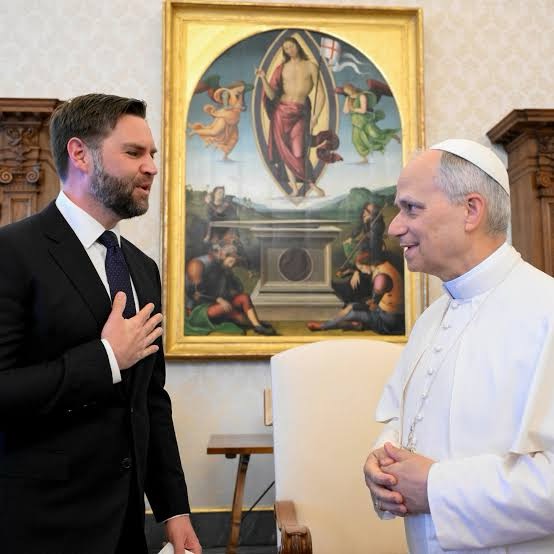
It’s a live issue in our world today. The MAGA movement in the USA professes itself to be closely aligned with Christianity – although I don’t see a lot of evidence of loving thy neighbour in what they seem to profess – and this question of authenticity, what’s the right interpretation of God‘s plan for the world, came up very spectacularly recently with one of their leaders.

That was JD Vance, the Vice President, who is a fairly recent convert to Catholicism, and who apparently took it upon himself to challenge Pope Leo, who had condemned the war in Iran, by asserting that disciples of Christ are never on the side of those who wield the sword and drop bombs. Against that JD Vance maintained that the Pope had got it wrong and ignored the ‘just war’ theory which has been used by Christians since the time of Thomas Aquinas in the 14th century to justify war in certain circumstances, and get round the commandment, in the 10 Commandments, ‘Thou shall not kill’. Who is more authentic? Who is the false prophet? Is it Vance or is it Pope Leo?

How should we tell? I would suggest that perhaps a useful principle to bear in mind at that point is that neat little phrase, ‘What would Jesus do?’ Can you imagine Jesus dropping in on Pope Leo in the Vatican – perhaps as he is enjoying his pizza one evening? (Oh no, that was Pope Francis, in ‘The Two Popes’! If you haven’t seen that film, I think you would love it.) Or what if Jesus got through the ICE guards into the White House and managed a one-to-one with JD Vance…. Would Jesus agree with him? Or would he side with the Pope?

I’ve got a feeling that just imagining those two things should give you an idea about who is more authentic. Let’s pray that we are able to tell the difference in future as well.
Sermon for the First Sunday of Christmas, 28th December 2025, at Holy Nativity Church, Penarth

Isaiah 63.7-9

Hebrews 2.10-end

Matthew 2.13-end

Lessons: https://tinyurl.com/yrwdhazj 

One of the nice things that happen here is that when we say morning prayers at 9 o’clock most mornings at All Saints, Jimmy and I often pause and talk about what we’ve just been reading in the Bible. Some of these little excursions lead us down very interesting paths. Last week we were beginning to talk about Anselm’s Ontological Argument for the existence of God.

I said that perhaps I could work our thoughts into this sermon today; but in the nicest and gentlest possible way, Jimmy steered me away from that idea, because he said that everyone will be a bit sleepy after so much fun over Christmas and really all that is needed is a simple homily to assure everyone of God’s love and care for us through his son Jesus Christ.

Well obviously I’m a bit sad not to be able to bring ontology into it, but I have to admit that Jimmy may have a point. We need something more straightforward this morning; so the message is indeed that God shows his love for us, because he sent his only son Jesus Christ to take upon himself the burden of our sin and to show us the way to eternal life. 

That’s basically what we say when we say the Creed. The joy, for Christians like us, is that we are celebrating the birth of a baby who was Emmanuel, God with us. God in human form, simultaneously human and divine.

Our lessons today from the Bible give you various angles on that basic position. The prophecy in Isaiah celebrating all the gracious deeds of the Lord, all the things that he has done for his chosen people, the people of Israel, ‘according to the abundance of his steadfast love’, because he said, ‘Surely they are my people, children who will not deal falsely’. 

That is looking forward to the coming of the Messiah, who would be the saviour of the chosen people, if in no other way because the Jews at the time of Jesus were ruled by the Romans as part of the Roman Empire. One thing that they believed the Messiah would do would be to make them independent again. 

But as the letter to the Hebrews makes plain, this Messiah would suffer alongside the people whom he came to save. Unless he suffered in the same way they did, he couldn’t really be their Messiah, their saviour: 

‘Since, therefore, the children share flesh and blood, he himself likewise shared the same things, so that through death he might destroy the one who has the power of death, that is, the devil,…’ [Hebrews 2:14-15]

And then we had the story in Matthew of Jesus’ escape from the wrath of Herod and Herod’s ‘massacre of the innocents’, as it is called, which is a story which is not found in any of the other gospels, but is in Matthew’s maybe because Matthew thought that something had happened which was very similar to what had happened to Moses in his infancy – if you remember, the story of the baby in the bulrushes, because Pharaoh wanted to kill all the firstborn sons of the Hebrews, the story in Exodus [Ex. 1] in the Old Testament. Perhaps Matthew wanted to write Jesus up in the way he did in order to show that Jesus too was very special, in that he was in the same line as Moses. 

All those bits of our Bible passages are aimed at illustrating how Jesus was at the same time human and divine; he was described as the son of God. It’s very difficult literally to understand that, and even in the earliest times some of the early Christian fathers found it difficult to reconcile the idea that Jesus was God but at the same time that he was the son of God. 

But one thing that we can say for sure is that all these passages would have made very good sense to you if you were a Jewish person living in the first century, brought up on prophecies of the coming of the Messiah. 

But let’s fast forward to today. How much of what we’ve been reading about really makes sense to us today? In one sense we can say we are on the same page as the early Christians. We can say, in the words of the Nicene creed, which dates back to the fourth century, ‘We believe in one God, the Father, the Almighty, maker of heaven and earth…’ but arguably that’s the only bit that we are reasonably sure of. If we believe in God, we do believe in the creator, the maker of heaven and earth. 

We do believe in Jesus, in the sense that it’s not controversial that he is a historical figure. But apart from that, there’s very little that we can say about him that is historical, in the sense that what we know about the Battle of Hastings is historical. 

Somebody has pointed out that although he lived for about 33 years, the gospels give us details of at most about 40 days of Jesus’ life. Nevertheless, within that very short time, Jesus said and did things which have changed the world and which continue to influence what we say and do, 2500 years later. 

We just don’t know how to explain the big miracles, the Virgin Birth, or the Resurrection, or the miracles which Jesus did in healing people and even in one case, Lazarus, bringing someone back to life after they were dead.

So is it just a very beautiful fairytale? You know, pretty much on a level with the beautiful crib services on Christmas Eve; really, stories for the children, but not something that the grown-ups take much notice of. And yet – there are still millions and millions of people throughout the world – and the numbers are growing very steadily, faster than in any other religion – who don’t think that it is just a fairy story.

I heard a really good sermon once, given by an Oxford philosophy professor (1), in which he didn’t go into abstruse detail like the Ontological Problem, but rather he just simply asked, ‘What if it’s true?’

 ‘What if it’s true?’ A really good illustration of that move from just thinking about God and Jesus in the abstract, as some kind of mythical, theoretical thing, to being able to say that the story of Jesus shows that God not only exists but that he actually takes an interest in us, cares for us, is this. 

This is what happened to John Wesley, the founder of the Methodist Church, on May 24, 1738.  This is what he wrote about it in his journal.

In the evening I went very unwillingly to a society in Aldersgate Street, where one was reading Luther’s Preface to the Epistle to the Romans. About a quarter before nine, while he was describing the change which God works in the heart through faith in Christ, I felt my heart strangely warmed. I felt I did trust in Christ, Christ alone, for salvation; and an assurance was given me that He had taken away my sins, even mine, and saved me from the law of sin and death.’(2)

His faith changed from being an intellectual exercise to an experience in his heart and soul. He knew without a doubt that he was loved by God and saved through the grace of Jesus Christ.

What if it’s true, indeed? I hope that we will all be able to experience something like what John Wesley experienced, because if the message ‘clicks’, our lives will be changed. 

So do take this thought home with you. 

Think and pray, what if? What if it is true? Then, as St Paul said,

‘Behold, I shew you a mystery: we shall not all sleep, but we shall all be changed.’ [1 Cor.15:51-52]

Notes 

(1) Prof. Brian Leftow, now William P. Alston Chair And Distinguished Professor of the Philosophy of Religion at Rutgers University, formerly Nolloth Professor of the Philosophy of the Christian Religion at Oriel College, Oxford.

(2)  John Wesley’s Journal Entry 24 May 1738, accessed at https://tinyurl.com/38fj843s on 27th Dec 2025

Sermon for Evensong for Churches Together on the Third Sunday after Easter, 11th May 2014
Ezra 3:1-13, Ephesians 2:11-22: Be Reconciled

So then you are no longer strangers …, but you are fellow-citizens with the saints and … of the household of God, built upon the foundation of the apostles and prophets, with Christ Jesus himself as the cornerstone. [Eph. 2:19-20]

Building a temple. Building a church. Being reconciled.

But now in Christ Jesus you who once were far off have been brought near, by the blood of Christ.

I want to welcome everyone to the church here at St Mary’s. We were excited when you, Godfrey, put your hand up in the Churches Together meeting and volunteered that we here would host the service to remember and celebrate the fellowship and spiritual growth which we enjoyed together in our Lent groups.

Our Lent groups, which were devoted to studying St Paul’s letter to the Ephesians, with a strap line which Jeremy Cresswell, in his erudite study notes, identified as ‘Be Reconciled’. Obviously St Paul was talking about Jews and non-Jews, at the time of Jesus Christ, whereas in applying this message today – and certainly in the context of our service tonight – we are talking about the different Christian denominations, and how we can be reconciled, brought together in fellowship, so as to become, in unity and diversity at the same time, the body of Christ.

Ezra, the author of our Old Testament lesson, was writing in the sixth century BC following the conquest of the Babylonians, who had destroyed the Temple, by the Persians – King Cyrus followed by King Darius and the three Kings Artaxerxes.

The Persians allowed the Jews to rebuild the Temple, and to have some self-government. But they were very much a minority, surrounded by people who did not necessarily sympathise with them, and who were much more powerful than they were.

Ezra tells the story of the rebuilding of the Temple. But before then, in the passage that we heard tonight, came the restoration of worship, of the One True God. It’s a theme throughout the Old Testament – certainly it comes out in Ezra, if you read Ezra and its sister book, Nehemiah – that there was one true God: that also, that one true God had made a covenant with a chosen people, and so the world was divided, divided into God’s chosen people and the rest.

It was difficult for the Israelites to maintain their faith, their belief in the one true God, when they had such terrible bad fortune. By the waters of Babylon we sat down and wept. .. How shall we sing the Lord’s song: in a strange land? (Ps. 137).

The Assyrians conquered the Israelites in 722, and when in 587 BC the southern kingdom of Judah was conquered by the Babylonians, the Temple, which had stood for so long, was razed to the ground. All the precious things in it were taken by the victorious Babylonians. You can read all about these disasters in the Books of Kings and the Books of Chronicles.

It didn’t really look as though God’s covenant with the Israelites, His covenant with Abraham, was really working. Then the Israelites started to understand that it was God, God Himself, who had caused all the misfortune, and it was because they had not followed God’s commandments. But God forgave them, and during the time of the Persians, they were treated much more kindly. Eventually they went about rebuilding the Temple.

Flash forward 600 years to the time of Jesus, and the time of St Paul immediately afterwards, and imagine what a huge step – a huge mental step – St Paul was making when he realised that God was not exclusive in the way that he had been brought up to think He was.

It wasn’t the case that there was one God, and that that one God favoured only the Israelites, the Jews. The lesson of Jesus was that God was – God is – a god for all of us. God created the whole world after all. The message of Jesus’ appearance is that there is still a covenant between God and His people: but his people are all people, not just one small nation.

That is, of course, a momentous step. Once St Paul had recognised that, it made it possible for the good news of Christ to spread throughout the world, and not just to stay as a minority cult among the Israelites.

So look at this timeline: Ezra, about 500 BC: St Paul, no more than a dozen or so years after the death of Christ, so, let’s say, just over 500 years later. And we are just over 2,000 years after that.

But back to the fact that we are tonight in St Mary’s. St Mary’s is the oldest church in Surrey – it was built originally in 680AD. Indeed, it’s a Saxon church: if you look, after the service, at the three little models that are on the shelf over there in the transept, you will see that it was originally a sort of Saxon shed – and then it grew progressively in the 17th, 18th and 19th centuries to be the shape of church which it is now.

So if we go back to the timeline – Ezra, 500 BC: St Paul, maybe 40 or 50 AD: St Mary’s, just over 500 years later, 680. And our service, written in the 1540s by Archbishop Cranmer – so, about another 5- or 600 years later.

You should know that the Book of Common Prayer, which we’re using tonight (it’s the little blue book in your pew), actually took 100 years to settle into its final form, but the key bits of it were written by Archbishop Cranmer in the middle 1500s – so, the time of Henry VIII – and we are about 700 years after that. We are joined – reconciled, sort of – with all those Christians before us.

Remember that in the 1540s Archbishop Thomas Cranmer was writing the Book of Common Prayer in the crucible of the Reformation. Martin Luther had nailed his 95 theses to the door of the church in Wittenberg: John Calvin had preached in Geneva; Zwingli in Zürich, and of course, Henry VIII; all contributed to a time of theological ferment and disagreement.

We are using words which haven’t changed for 700 years. We really are walking in the footsteps of the saints. Because Cranmer didn’t just dream up all the words in the services which went into the Book of Common Prayer. He based all the services on his translations, and on his understanding, of even older services which the church had been using before he compiled the Prayer Book in the 1540s.

The BCP was meant to be a prayer book, a service book, for use in common, meaning shared by everyone. Against the background of all the different strands of the Reformation, the BCP was a powerful tool for reconciliation.

So the fact that tonight we are using the BCP, a prayer book written 700 years ago which goes back even earlier in its origins, is, I think, very apt in the context of Churches Together: in the context of our variety, all our different ways of worshipping, in our seven churches.

Just like the time of St Paul. Faithful Christians in Ephesus, in Rome, in Corinth, in Colossae, in Galatia, were all confronting something which was far bigger than they were, and they didn’t know what the right answers were.

St Paul talked about it in 1 Corinthians 1:12.

‘ …. each of you says, ‘I belong to Paul’, or ‘I belong to Apollos’, or ‘I belong to Cephas’, or ‘I belong to Christ.’

Which one of these great preachers had it right? Terribly important; once you are confronted by the Revelation, the Good News, that God cares for us, that He sent His only Son: nothing is more important than to respond appropriately.

But, as the Roman poet Terence said, ‘Quot homines, tot sententiae’ – (for as many as there are people, there are just as many opinions). That’s why the message of Ephesians is so very important. Its message of reconciliation, coming together, of agreeing together – even in circumstances where we disagree – is vitally important.

So he came and proclaimed peace to you who were far off and peace to those who were near; for through him both of us have access in one Spirit to the Father. So then you are no longer strangers and aliens, but you are citizens with the saints and also members of the household of God.

I pray that that has been your experience in our Lent course – and that it will continue to be: that you will come and share with us here, and we will come and share with you. In our different ways, we will spread the good news of Christ and will receive the good news of Christ; and we will live like people who have seen the Kingdom.