Archives for posts with tag: Henry VIII

Sermon for Evensong on 6 September 2026 at St Peter’s, Old Cogan

Ezekiel 12:21-13:16; Acts 19:1-20

‘Dem bones, dem bones, dem dry bones’. I must confess that’s the passage from Ezekiel that I remember; but unfortunately today in our lesson I haven’t got a reference to that last part of the book of Ezekiel and the famous dry bones, which was a vision of the Israelites and Jerusalem rising up again after a time of exile and desolation. No, today’s lesson is from the beginning bit where Ezekiel is taking them to task in pretty direct language.

Ezekiel says that the word of the Lord has come to him condemning false prophets. ‘Your prophets have been like jackals among ruins, O Israel.’ They are like cowboy builders building a wall with whitewash instead of cement, talking about smearing whitewash on it. Ezekiel says that God says, ‘You shall perish within it. You shall know that I am the Lord’.

What do we make of this? One of the commentaries that I was reading [How to Read the Old Testament, by Etienne Charpentier] describes Ezekiel like this. ‘Ezekiel can never be like anyone else. Like his predecessors, he has visions, but his are flabbergasting:’ and then there are a few purple passages mentioned which he describes this way: ‘…he performs prophetic actions, but sometimes these go beyond the bounds of good taste -. see chapters 4 and 5. ‘Some passages in his allegories would make a guardsman blush’ – so the commentary says, ‘don’t read chapters 16 or 23!’ If you want to follow up the naughty bits, see me afterwards!

I suppose the theme isn’t just false prophets, but in a way it’s all about truth and authenticity. There are lots of prophets out there; some of them are genuinely receiving the word of God and speaking it; but others are not.

In Acts, the renegade Jewish prophets or preachers, the sons of Sceva, come along claiming to cure people or cast out devils, (whatever that means), in the name of Jesus. But they aren’t the real thing. The devils say, ‘We know about Jesus and Paul, but who are you?’ That has always struck me as being a wonderful retort – but really I would also like to say to the devils, ‘Who are you?’

I’m not sure that these days, when we talk about prophets, whether we are really talking about the same sort of thing as Ezekiel when he condemns the false prophets. Today we tend to talk about prophets just in terms of forecasting the future, and there doesn’t seem to be much reference to prophets being a mouthpiece for God.

Some people argue that in a very real sense Jesus was the last prophet, although he did say that he had not come to abolish the law and the prophets; and if you are a Muslim you see Jesus as a very great prophet, but nothing more. Ezekiel was a prophet; he had visions which he believed were visions of God. and in which God told him things intended to be passed on to God‘s chosen people, the Israelites.

As reasonably grown-up Christians in metropolitan Wales, we aren’t really alive to that kind of prophet and divinely-inspired prophecy any more; the idea that we need a prophet or a priest to be some kind of intermediary between us and the divine is pretty strange. Look, we say our prayers, either at home by ourselves or in church: and we don’t invoke anyone else as an intermediary between us and God. We’re not like the Israelites of the Old Testament: we’re not afraid of talking direct to God. We’re not like Roman Catholics of old, (not so much today), who had services said for them by the priests.

But it’s not that cut and dried. Both the Roman Catholics and many Anglicans do still pray ‘through’, or with the help of, saints and angels.

We are Anglicans – people who come to God as ‘catholic and yet reformed’. Henry VIII, the first Anglican, was a solid Catholic – until he got involved in a difficult divorce. He couldn’t persuade the Pope to allow him to divorce, and so, with the help of Thomas Cranmer, Henry declared independence from the Church of Rome. Archbishop Cranmer had met and been influenced by many of the church leaders on the Continent; the Reformers, like Luther, who had gone away from Bibles and services which were not in the ordinary people’s language and instead they led services and worshipped in everyday language rather than in Latin. So Cranmer mixed things up.

King Henry was a good Catholic – but he didn’t acknowledge the authority of the Pope. He set himself up as head of a new Church of England, and his Archbishop Cranmer drew up services in the new Book of Common Prayer which were based on English translations of the Catholic service books they used before, but which brought in ideas he had learned from the Reformers. We don’t know whether Cranmer met Martin Luther – Luther’s biographer Lyndal Roper thinks they could have met – but anyway Cranmer seems to have been influenced by him, and he definitely went to Zurich to meet Zwingli and to Geneva to meet John Calvin.

A key part of the Reform in the 16th century, that came into the mix in Anglicanism, was the idea that we, the ordinary people in the pews – not the ministers or churchwardens or bishops – are a ‘priesthood of all believers’, which means that we don’t need priests or prophets in order to make our prayers to God. And as Anglicans we have embraced this idea – we mainly pray straight to God, not to someone, some saint, to pray on our behalf for us. We are invoking God, asking him to answer our prayers, not asking someone else to approach God for us.

But we do say, ‘through Jesus Christ our Lord’. I think we invoke Jesus in this way because He is God in person. If we didn’t know about Jesus we might really struggle to know how to pray, how to talk to the divine. Who is the God whom we pray to? Some people are fortunate and think God speaks to them most days. But for other people, like me, there are some philosophical arguments to consider, for example, by Bishop John Robinson, in his famous book Honest to God.

Their argument is that God isn’t a thing, an object, something within existence, because you can’t be at the same time the creator and the created thing: and therefore when we talk about God what we are really talking about is ‘ultimate reality’ and the sense of what Paul Tillich called ‘The Ground of Being,’ or to paraphrase Leibniz, ‘God is not one of the things which exist, but is rather the reason that anything exists rather than nothing existing at all.’

God was – God is – invisible, and indeed in the Jewish tradition if you saw God face-to-face it was likely to be fatal, unless you were a priest or a prophet. That makes you wonder what the true nature of God is. We say that Jesus is the son of God, but also, in some sense, that he is God. David Jenkins, the former Bishop of Durham, said, ‘God is as he is in Jesus’. God is, as he is in Jesus. In St John’s Gospel chapter 12 Jesus said, ‘When a man believes in me, he believes in him who sent me rather than in me; seeing me, he sees him who sent me.’

But to get back to the question of authenticity, let’s consider the sons of Sceva in Acts, described as ‘itinerant Jewish exorcists’, or in the King James Bible – always more memorable – as ‘vagabonds’, using the name of Jesus to exorcise evil spirits; leaving aside the question exactly what they were doing and what an evil spirit is, the point of the story, at least when we put it alongside the passage from Ezekiel, is, what is the real deal? What makes for authenticity and what is false prophecy?

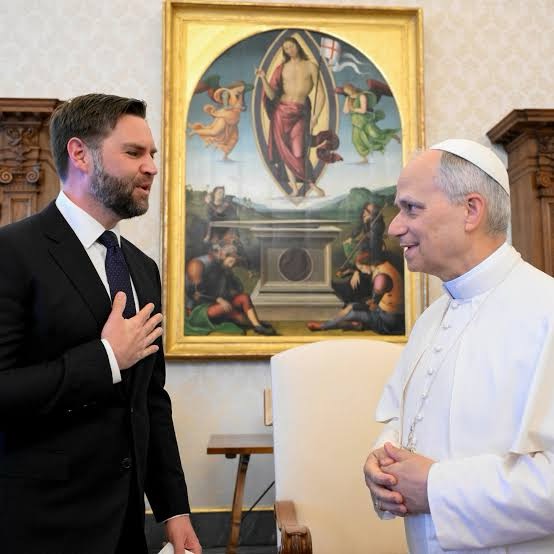
It’s a live issue in our world today. The MAGA movement in the USA professes itself to be closely aligned with Christianity – although I don’t see a lot of evidence of loving thy neighbour in what they seem to profess – and this question of authenticity, what’s the right interpretation of God‘s plan for the world, came up very spectacularly recently with one of their leaders.

That was JD Vance, the Vice President, who is a fairly recent convert to Catholicism, and who apparently took it upon himself to challenge Pope Leo, who had condemned the war in Iran, by asserting that disciples of Christ are never on the side of those who wield the sword and drop bombs. Against that JD Vance maintained that the Pope had got it wrong and ignored the ‘just war’ theory which has been used by Christians since the time of Thomas Aquinas in the 14th century to justify war in certain circumstances, and get round the commandment, in the 10 Commandments, ‘Thou shall not kill’. Who is more authentic? Who is the false prophet? Is it Vance or is it Pope Leo?

How should we tell? I would suggest that perhaps a useful principle to bear in mind at that point is that neat little phrase, ‘What would Jesus do?’ Can you imagine Jesus dropping in on Pope Leo in the Vatican – perhaps as he is enjoying his pizza one evening? (Oh no, that was Pope Francis, in ‘The Two Popes’! If you haven’t seen that film, I think you would love it.) Or what if Jesus got through the ICE guards into the White House and managed a one-to-one with JD Vance…. Would Jesus agree with him? Or would he side with the Pope?

I’ve got a feeling that just imagining those two things should give you an idea about who is more authentic. Let’s pray that we are able to tell the difference in future as well.
Sermon for Evening Prayer on Saturday 7th March 2020 for the Prayer Book Society Guildford Branch, at the Founder’s Chapel, Charterhouse

Jeremiah 7:1-20; John 6:27-40 (see http://bible.oremus.org/?ql=450504242)

And Jesus said unto them, I am the bread of life: he that cometh to me shall never hunger; and he that believeth on me shall never thirst.

I want to speak to you not just about the bread of life, but also about baked beans and sausages. At the same time we can’t ignore that it is the end of the first week in Lent.

The baked beans and sausage, you might be a bit surprised to hear, bring into consideration two theologians, one ancient and one modern, and the bread and the Lent give us a topical Christian context for that food, which is, fasting.

And I suppose that the other ingredient which I need to work in is some reference to our beloved Book of Common Prayer, and the theological developments which Cranmer was influenced by in writing it.

The first thing to reassure you about is that there is no command to fast in the Gospels – except that Jesus said that he did not come to abolish the Law of Moses, but to fulfil it. So the days laid down for fasting in Leviticus, for example on the Day of Atonement, mean that it’s not strictly true that there’s no Biblical justification for fasting.

As you will know, the Reformation, which greatly influenced Cranmer, was led certainly by Martin Luther in Germany but also by Zwingli and Calvin in Switzerland.

Diarmaid MacCulloch has written, ‘It was a sausage that proved to be the rallying-cry for the Swiss Reformation.’ A Zurich printer, Christoph Froschauer, with Zwingli and 12 of his followers in Zurich sat down on the first Sunday in Lent in 1522 and ate two large sausages. Zwingli followed up by preaching a sermon in which he argued that it was unnecessary to follow the church’s traditional teaching about not eating meat during Lent. It was a human command introduced by the Church, which might or might not be observed, but which ‘obscured the real laws of God in the Gospel if it was made compulsory’. [MacCulloch, D., 2003, Reformation, London, Allen Lane, p139]. Cranmer and Zwingli are supposed to have met, and the Swiss reformer is thought to have influenced the English archbishop.

So that’s the sausage. In the Reformation context, according to Zwingli, fasting is not divinely ordained. It’s up to you.

Not but what by the time of the Second Book of Homilies, published in the Church of England in Queen Elizabeth’s time, in 1563, whose author was Bishop Jewel, there was a published sermon – a Homily – called ‘Of Fasting’, Homily number 16. The Homilies were intended for the use of vicars who were not good at preaching, so they didn’t make any theological mistakes. We tend to think of a ‘homily’ as a short sermon – the sort that the vicar doesn’t get into the pulpit to deliver, but perhaps hovers invisibly on the chancel steps for; something like Thought for the Day in size and weight. Not so in 1563! ‘An Homily of Good Works and of Fasting’ is in two parts, the first being about fasting, and in the modern edition which I have, it occupies 8 ½ pages of very dense small type!

Some of the early Christian Fathers such as Irenaeus or Chrysostom or Tertullian or Gregory the Great all debated how long a fast should go on for. The possibilities included one day, as on the Jewish Day of Atonement, or 40 hours, mirroring Jesus’ 40 days in the wilderness, or indeed 40 days of fasting.

The ‘Annotated Book of Common Prayer’, edited by the Revd John Henry Blunt, published in 1872, which I’m very fortunate to have a copy of, says this.

The general mode of fasting seems to have been to abstain from food until after 6 o’clock in the afternoon and even then not to partake of animal food or wine. Yet it may be doubted whether such a mode of life could have been continued day after day for six weeks by those whose duties called upon them for much physical exertion… and although it may seem at first that men ought to be able to fast in the 19th century as strictly as they did in the 16th, the 12th, or the third, yet it should be remembered that the continuous labour of life was unknown to the great majority of persons in ancient days, as it is at the present time in the eastern church and in southern Europe; and that the quantity and quality of the food which now forms a full meal is only equivalent to what would have been an extremely spare one until comparatively modern days.’

The Victorians were too busy safely to fast, and their meals were cuisine minceur by comparison with the groaning boards enjoyed in olden times. Think of what we know of Henry VIII’s diet, or Sir John Falstaff’s. Having a rest from eating was probably very good for them, and there was no risk of starving. Come the industrial revolution, however, and meat and two veg in the works canteen was all you might have. If you gave that up, ‘night starvation’, as the Horlicks advert used to warn, was a real possibility unless you had some nourishment at least.

But it’s at least arguable that Jesus, in our lesson from St John’s Gospel, wasn’t talking about the ins and outs of fasting. [6:27] ‘Labour not for the meat which perisheth, but for that meat which endureth unto everlasting life, which the Son of man shall give unto you..’ This leads up to one of the great ‘I am’ sayings in St John’s Gospel, ‘I am the bread of life’. Just as the name of God as He spoke to Moses in the Old Testament was ‘I am’, so in these sayings, Jesus is using the same form of words, giving a sign of his divine nature. And we are no longer thinking about whether or not to eat a sausage. This is spiritual, divine food, ‘meat which endureth unto everlasting life’.

And that, you’ll be amazed to know, brings us to baked beans, and to our second theologian. He is Jürgen Moltmann, the great German theologian, some time Professor of Systematic Theology at the University of Tübingen. (That is the same university at which Pope Benedict taught, once upon a time.) Moltmann is in his 90s now, and so it was a great honour for me to attend his lecture this week at Westminster Abbey, called ‘Theology of Hope’. This was the title of one of his famous books.

Prof. Moltmann comes originally from Hamburg. His excellent English still has the same accent that I know so well from my friends there in the shipping world. He was a boy when Hamburg was bombed, bombed by us, when there was the terrible ‘fire storm’ about which Kurt Vonnegut and others have written so eloquently. Moltmann was conscripted into the German army, and on Monday night he told us he had carefully learned two words of English, which he used when his platoon encountered the British Army for the first time. They were, ‘I surrender’. He told his audience that the abiding memory of his time as a prisoner of war was baked beans – which like all boys, he liked, and I think he still likes, very much.

So if the sausage in our baked beans and sausage is redolent of the Reformation, and the creation of the Book of Common Prayer, so the baked beans lead us to Jürgen Moltmann, and his Theology of Hope. What is this hope?

Moltmann saw, and still sees in the world today, great challenges in our life. They represent death, or even separation from God, which is another way of describing sin. Climate change, the destruction of God’s creation; nuclear war, where the use of nuclear weapons would end the world as we know it, because no-one could survive the nuclear winter. Division and separation among peoples instead of unity and co-operation; the erection or rebuilding of borders in contravention of God’s creation of all peoples as equals. The end time – what will happen when we die?

Maybe it’s not fanciful to say that this, this climate of despair, is somewhat reminiscent of Jesus being tempted in the wilderness. Lent is the right time for this kind of reflection.

Moltmann has argued that we should not despair or become nihilistic in the face of these challenges. Whereas we are often encouraged to have ‘faith’ when we have to confront these existential threats, Moltmann has suggested that what we really need, and what really reflects the presence of God in our lives, is hope. Hope, rather than faith.

For example, in the committal prayer at a funeral, the body is buried ‘in sure and certain hope of the resurrection to eternal life’. You might think that what you need at that end time, at the end of life, is faith, a strong faith. But Moltmann says no, not faith, but hope is what we need. The fact, the great revelation, of Jesus’ life on earth gives us the grounds for hope. It is more than a bare belief, more than blind faith. If I hope for something, I reasonably expect that it will be possible. It’s more than an intellectual construct.

So there we are. Baked Beans and Sausages. Should we abstain from bread, or meat, or drink? Certainly not from the Bread of Life. But if even our spiritual bread is disappearing, overwhelmed in the apocalypse, in what looks like the end time, then what? 500 years ago Zwingli said, don’t stop enjoying your sausage – give thanks to God for his bounty. In the smoking ruins of that great city of Hamburg at the end of WW2, Moltmann discovered Baked Beans, and with them, divine hope. I hope that that will give you some food for thought this Lent.

Sermon for Evensong at All Saints’ Day, 4th November 2018

Isaiah 65:17-25; Hebrews 11:32-12:2

As you can see, you’ve got some neighbours in church today. 17 silhouettes, each one representing a soldier from Stoke D’Abernon who died fighting in the First World War. There are little plaques in front of each one of the silhouettes which tell you the name of each of the soldiers and the regiment that he belonged to. There are two pairs of brothers, you will find. All over the country there are churches with these silhouettes in. They have been created by a new charity called ‘Remembered’ and our Vanessa Richards is a trustee of the charity. A number of us have subscribed to buy the silhouettes which are in the pews.

These soldiers are ‘there are but not there’, which is the name of the campaign, launched by this charity called Remembered, to remind people, and especially people like me who have never been in a war, to remind us of the great sacrifice and bravery of our soldiers – in what they had hoped would be the ‘war to end all wars’; and also to raise money for the relief of mental conditions caused by war such as PTSD, combat stress, which used to be called ‘shell shock’.

Our silhouettes were first installed in the pews on Friday, for the All Souls service, when we remembered the dead, our dear departed, and today is All Saints, when we remember and celebrate that ‘cloud of witnesses’ that was mentioned in our second lesson from Hebrews.

We will of course come back and make our main act of remembrance next Sunday. Today we are celebrating All Saints’ Day, which follows very closely after our celebration of All Souls. Using the word ‘souls’ reflects the idea that we are made up of a body and a soul and that in some sense our souls are immortal and eternal, carrying on after our bodies have died. So All Souls is the great commemoration of the dead.

Today we focus on the idea of saints and sainthood. Through both these festivals we may get a glimpse of heaven; this is a chance for us to reflect on what we can understand of heaven, at All Souls on life after death and today on the saints, the great ‘cloud of witnesses,’ in history – and perhaps nearer to home as well.

We can think of ‘saints’ in two ways. On one hand we can understand the expression ‘saint’ to cover all Christian people. St Paul’s letters refer to the ‘saints’ at Ephesus and in Rome and in Jerusalem, meaning the normal members of the congregation in each church. So in that sense we are all saints. We are the saints at Stoke d’Abernon.

The other sense, which is perhaps the one which we would normally think of when we use the word ‘saint’, is to identify people who lead exemplary and virtuous lives, who are witnesses to the gospel of Jesus through the self-denying love which they show.

We should notice that there is a difference between the beliefs of the Protestant churches and the Roman Catholic Church where saints are concerned. Roman Catholics see the saints as being so close to God and to Jesus that they can intercede for us. In other words, Catholics address prayers to one or other of the saints and ask them to pass on their prayers to God. As Protestants we use the same language and perhaps adopt the same thought when we end our prayers with the words ‘through Jesus Christ our Lord’, but this is as far as we go.

Praying through a saint, through a person who speaks for us to God, is a very old idea, a mediaeval idea, but it was one of the things which was attacked by Martin Luther and the Reformation theologians. If you look at the 39 Articles of Religion at the back of your little blue Prayer Book, if you look at article 22 on page 620 and article 31 on page 624, you will see what the reformers were objecting to.

Article 31 was against people saying masses for the dead – at first sight, against what we were doing on Thursday. Before the Reformation, people left money in their wills to pay for masses to be said for them after they had died, to help them to get to heaven and not be stuck in ‘Purgatory’, a kind of half-way house for those whose virtues were not clear enough for them to pass straight through the Pearly Gates. People built ‘chantries’, chapels where they could be remembered and prayed for.

Our Norbury Chapel is an example of a chantry. It was built for Sir John Norbury after the Battle of Bosworth which ended the Wars of the Roses in 1485. Sir John died in 1521, before the Reformation, or more particularly before Henry VIII. His original statue must have been destroyed in the Elizabethan purge on ‘monuments of superstition’, and now his monument is the little figure of a kneeling knight, whose armour is in the style of Charles I’s time, 100 years later.

I think that we can agree with Article 31 that Christ’s sacrifice on the cross is the only thing we need, in order to be reconciled with God and forgiven our sins. We don’t need to make a ritual sacrifice as well, in order to buy forgiveness for someone’s sins. But remembering our dear ones by reading out their names doesn’t go against this, I believe.

Martin Luther, who started the objections to ‘masses for the dead’, was aiming at what he thought was a racket run by the Roman church, getting money for saying masses and building chantries, although there was no theological justification for it. We should remember that Jesus’ salvation is for all, not just for the ones whose names we read out in church – but that’s not a reason for us not to remember our dear departed ones.

Article 22 is even more specific about the worship, or ‘veneration’, as it was called, of saints, their statues and pictures. It reads:

‘The Romish Doctrine concerning Purgatory, Pardons, Worshipping, and Adoration, as well of Images as of Reliques, and also invocation of Saints, is a fond thing vainly invented, and grounded upon no warranty of Scripture, but rather repugnant to the Word of God’.

The reformers thought that there was an element of idolatry, that people were worshipping the saints rather than God, and that there was really no need to use an agent in order to be able to say your prayers to God. There is a reflection of John Calvin’s idea of the ‘priesthood of all believers’ here. Again, in the Jewish faith, only the High Priest could enter the the Holy of Holies, in the Temple, to come close to God, once a year only, without being consumed (cf Moses in Exodus 33:20). This is one place where the idea, that God needs to be approached through somebody, comes from. In our first lesson from Isaiah there is also the example of prophecy, where God speaks through the mouth of a human, a prophet.

Because St Mary’s is so old – its origins are 7th century Saxon – if you look around, it shows you signs of all this historical theology. You will see some images of saints in some of the windows, but the only statue of a saint is the statue of Mary, the Madonna and Child, at the front. Actually pretty well all the images of saints, the windows and the statue, although they are often of mediaeval origin, were imported during Revd John Waterson’s time (1949-1983), because whatever was here before the Reformation was removed or smashed up. In the Baptistry some of the windows contain bits of the remains of pre-Reformation windows, but I think that is all.

The Church of England is often called ‘catholic and reformed’. Henry VIII was a faithful Roman Catholic, except for his little difficulty with the Pope! The question of how we look at saints today is a good example of how our church’s theology and history are combined in a rich mixture. The greatest of the saints is Mary, the mother of Jesus, who was always closest to him, even at the end; his mother stood grieving at the foot of the cross. Who better, who closer, to intercede, if you feel you need someone to do it? The words of the ‘Hail Mary’, which Roman Catholics use almost as much as the Lord’s Prayer, end with

‘Holy Mary, Mother of God,

Pray for us sinners now,

And at the hour of death’.

Indeed Mary is the saint preferred by more people than any other to pray through, in the Roman Catholic Church, where veneration of the saints and praying through them still thrives – they still create saints, for instance recently Archbishop Romero, the Bishop of San Salvador, who was martyred on the steps of his cathedral in 1980, and who was renowned as a liberation theologian, concerned to minister to the poor.

So I have taken you through the story of what it could mean to be a saint. We can be one of the saints at Stoke d’Abernon, one of the people who turn up faithfully in the pews, contribute to good causes and are happy to let people know that this is what we do on a Sunday and indeed, perhaps, what we do on other days. Church saints are involved, involved in church activities.

Or you could be a witness. You could stand up and say to other people what it means to be a Christian in today’s society. You could do things, things which actually take a little bit longer than signing a cheque or turning up to a meeting. You would have to show commitment. The touchstone for being this kind of saint is selfless giving.

Or you might even be a martyr. ‘Martyr’, after all, is just the Greek word for a ‘witness’. Your being a witness may have a price. People may not approve of what you have to say. You may be put to the test as a result. Being a saint, being a witness to the gospel of Christ, may be tough.

There have been occasions when some of you have said to me that my interpretation of what it is to be a practical Christian, to be a practical witness, shades over into politics. Well, on this occasion, I leave it to you. You work out what it would be for you to be a saint. All I would say to you is that I think we all have it in us to be some kind of a saint. Which one are you?

Sermon for the third Sunday of Epiphany at St Mary’s 22nd January 2017 

1 Corinthians 1:10-18; Matthew 4:12-23 

When President Trump took the oath of allegiance on Friday, according to the report on the radio, he had his tiny hand on two Bibles, one of which was the one which Abraham Lincoln used, and the other was one which his mother had given him. It makes you think that the Bible must mean something to the new president. 

Using two Bibles in this way reminds me of a story which I heard about a rich old man who had two Rolls Royces. Somebody once asked him why he needed two. He wasn’t a car collector. However, he said, he felt better having two, just in case one broke down. So perhaps Donald Trump needs two Bibles, just in case one breaks down. 

‘Wait a minute’, you will say. One of the things about the Bible is that it is utterly reliable. It’s even better than a Rolls-Royce. It doesn’t break down. All you need in life is holy scripture, ‘sola scriptura’, only scripture, in Latin. But different churches say different things here. There are, perhaps, some differences of emphasis.

Today is the Sunday in the middle of the Week of Prayer for Christian Unity. I must confess that my heart does sink a little bit when I realise that I have to try to say something useful and enlightening about the Week of Prayer for Christian Unity, especially when we have a lesson like the one which we had today from St Paul’s first letter to the Corinthians. St Paul ticks them off. ‘… each of you says, ‘I belong to Paul’, or ‘I belong to Apollos’, or ‘I belong to Cephas’, or ‘I belong to Christ.’ St Paul says, Has Christ been divided? Was Paul crucified for you? Or were you baptised in the name of Paul?’

Poor old Corinthians. They are always getting ticked off by St Paul. It’s one of those points where I have to say – and I think some of you will agree with me – that I feel rather sympathetic to those Corinthians. Why am I an Anglican? Why is somebody else a Methodist? Or for a Wee Free? A Baptist? Or a member of the United Reformed Church, or indeed Roman Catholic? And is this a good thing? 

When you read a lesson like the one we’ve read from 1 Corinthians, It’s an ‘oh dear’ moment. It looks as though, although for hundreds of years, the church has been divided into lots of different denominations, everybody seems to turn a blind eye to these Bible passages which suggest that we should be all one church. 

We can trace back the various splits and disagreements which have given rise to the different denominations. For instance the original split between the church in Byzantium and the church in Rome, the orthodox and the Roman Catholics respectively; and then in the time of the Reformation – 500 years ago this year – Martin Luther posting his 95 theses on the door of the church in Wittenberg, and starting a movement which split the Western Church into Roman Catholics and Protestants. The Protestants themselves were divided, mainly between those who were Lutherans and those who followed Calvin and Zwingli, the reformed Christians. And there were – there are – Baptists as well!

This isn’t going to be a sermon where I try to teach you all about the various differences in theology and the philosophy of religion as it has evolved down the ages; why, for example, the Anglicans and the Roman Catholics have not moved together – after all, Henry VIII was a jolly good Catholic, the only problem being that he had some local difficulty with the Pope. 

Apart from that, Henry had no difficulty with the Catholic doctrines, of transubstantiation, according to which the bread and wine in holy communion actually become the body and blood of Christ; and the blueprint or route map of heaven, what happens to people after they die: that their souls go to a place called purgatory, where all the sins are laundered from the souls. Possibly laundry is too nice an image; it is more like the refiner’s fire. 

Not a nice process, but after that you were ready for your encounter with St Peter at the Pearly Gates. Henry had no difficulty with all of that; but of course Martin Luther did. He was particularly opposed to the Catholic Church’s system of indulgences, according to which you could pay in order to shorten your time in purgatory. It was very lucrative for the church but it didn’t have any basis in holy scripture. 

Martin Luther wanted to strip out all these things that were not in the Bible but which had grown up in the church’s tradition. ‘Sola scriptura’, only scripture, was his motto, his byword. Calvin and Zwingli, on the other hand, as well as relying on scripture, like Luther, did not like the traditional idea of a priest, as someone standing between the believer and God, somehow mediating worship. That Catholic idea was based on the Jewish concept of the priesthood, according to which an ordinary mortal who came into contact with God would die.

The trouble with having a priesthood is that you start to have a hierarchy, ‘princes of the church’ among the bishops, living in splendour in complete contrast with the simple life enjoined on his disciples by Jesus. In reaction against that, Calvin introduced the idea of the ‘priesthood of all believers’. God would meet anyone, directly, face to face in prayer or worship.
Why would you follow one form of theology rather than another? Surely what the Bible says, if you follow what St Paul has written to the Corinthians, is that splitting up into all these different churches is an aberration. Somehow we have all got lost on the way. True believers will all just belong to one church, whatever that is.

At that point, of course, all of you in the pews mentally shift from one foot to another, with your eyes cast down, thinking privately that it’s hopeless, after 2,000 years of history and because of the way that all of us have been brought up in different traditions round the world. There is no chance of abolishing all the various denominations in favour of a single unified church, and the idea of having to go to a single church may well fill us with some trepidation. 

‘Our beliefs are not one-size-fits-all’, you will say. You might even say, ‘My God is not like your God.’ I have always found it rather difficult when people talk about ‘my God’, because it seems to me that God does not belong to us, but rather that we belong to Him. So saying that something or someone is my God, mine, is nonsense. 

In your mind’s eye, even if not out loud, you are probably thinking, ‘I don’t want the churches to be all just like so-and-so down the road. Just think, they might make me wave my arms around or clap in time to a guitar, or have to smell incense!’ – or, indeed, whatever it is that you get sniffy about in other churches. 

But I think the thing that you need to take into account is the idea that is behind what St Paul is saying to the Corinthians in our lesson today. In effect, it is not what the Corinthians want that matters, it isn’t that they must have that great thing, that we celebrate so much in our society today, namely, choice, it isn’t that: It isn’t up to them, it isn’t up to the Corinthians: it’s up to Jesus himself. 

What would Jesus say about, ‘I belong to Apollos’ or ‘I follow Paul’? Or, I’m a Methodist, I’m a United Reformed? I’m a Roman Catholic, or an Anglican? I’m a high Anglican. I’m a low Anglican. I’m a middle of the road Anglican. I’m an Evangelical (Godfrey will tell you more about that, of course); or I’m an Anglo-Catholic. Every shade and nuance is catered for. What do you think Jesus would think about that?

What St Paul says is, ‘Christ did not send me to baptise, but to proclaim the gospel, and not with eloquent wisdom, so that the cross of Christ might not be emptied of its power.’ In other words, the key thing is for people to hear the gospel, and in particular to hear about Christ’s passion and death and resurrection: to hear about the role of the cross which is at the heart of it. 

Provided we get the Gospel, nothing else really matters. I don’t think that Jesus would particularly care whether we like a particular church or a particular style of worship or not. The more important thing is that Jesus gets to be believed in by more people. So my feeling is that is that, although there might be moves to get closer to each other in the various denominations, moves such, for example, as ARCIC, the Anglican Roman Catholic International Commission, or more recently the conversations between the Pope and the Archbishop of Canterbury, or the covenant discussions between the Anglicans and Methodists, still, you can give yourself a break; you can smile sweetly at your friends in the other churches, particularly in this Week of Prayer for Christian Unity: you can take the opportunity to go and visit each other’s churches and worship with them. But you don’t have to give up being based at the church you’ve always gone to, where your friends are. 

You definitely can be confident that we all, all of us in Churches Together in Cobham, Oxshott, Stoke D’Abernon and Downside, are united, united in that we believe in the gospel of our Lord Jesus Christ; so I think we wouldn’t get ticked off like the Corinthians were. 

Mind you, going back to Donald Trump and his two bibles, as Canon Giles Fraser has written recently in his ‘Loose Canon’ column in the Guardian [https://www.theguardian.com/commentisfree/belief/2017/jan/19/for-donald-trump-faith-has-become-the-perfect-alibi-for-greed], President Trump does go to a different sort of church, different from any of the ones round here, a church called Marble Collegiate Church on Fifth Avenue in New York, where the minister is, or has been, the Rev Norman Vincent Peale. Mr Peale has published a book called ‘The power of positive thinking’ and has developed a theology, if you can believe this, of how to be a winner, how to be successful in business. It seems to be a sort of ‘prosperity gospel’.To be blessed, in that congregation, means to be rich.

Giles Fraser wrote, ‘When Trump was asked what God is to him … he came up with this: “Well, I say God is the ultimate. You know you look at this … here we are on the Pacific Ocean. How did I ever own this? I bought it 15 years ago. I made one of the great deals, they say, ever. I have no more mortgage on it as I will certify and represent to you. And I was able to buy this and make a great deal. That’s what I want to do for the country. Make great deals.” 

Awful, isn’t it. And it came from something at least pretending to be a church. Now what that means is something which we ought to be thinking about, especially in this Week of Prayer for Christian Unity.

Sermon for Evensong for Churches Together on the Third Sunday after Easter, 11th May 2014
Ezra 3:1-13, Ephesians 2:11-22: Be Reconciled

So then you are no longer strangers …, but you are fellow-citizens with the saints and … of the household of God, built upon the foundation of the apostles and prophets, with Christ Jesus himself as the cornerstone. [Eph. 2:19-20]

Building a temple. Building a church. Being reconciled.

But now in Christ Jesus you who once were far off have been brought near, by the blood of Christ.

I want to welcome everyone to the church here at St Mary’s. We were excited when you, Godfrey, put your hand up in the Churches Together meeting and volunteered that we here would host the service to remember and celebrate the fellowship and spiritual growth which we enjoyed together in our Lent groups.

Our Lent groups, which were devoted to studying St Paul’s letter to the Ephesians, with a strap line which Jeremy Cresswell, in his erudite study notes, identified as ‘Be Reconciled’. Obviously St Paul was talking about Jews and non-Jews, at the time of Jesus Christ, whereas in applying this message today – and certainly in the context of our service tonight – we are talking about the different Christian denominations, and how we can be reconciled, brought together in fellowship, so as to become, in unity and diversity at the same time, the body of Christ.

Ezra, the author of our Old Testament lesson, was writing in the sixth century BC following the conquest of the Babylonians, who had destroyed the Temple, by the Persians – King Cyrus followed by King Darius and the three Kings Artaxerxes.

The Persians allowed the Jews to rebuild the Temple, and to have some self-government. But they were very much a minority, surrounded by people who did not necessarily sympathise with them, and who were much more powerful than they were.

Ezra tells the story of the rebuilding of the Temple. But before then, in the passage that we heard tonight, came the restoration of worship, of the One True God. It’s a theme throughout the Old Testament – certainly it comes out in Ezra, if you read Ezra and its sister book, Nehemiah – that there was one true God: that also, that one true God had made a covenant with a chosen people, and so the world was divided, divided into God’s chosen people and the rest.

It was difficult for the Israelites to maintain their faith, their belief in the one true God, when they had such terrible bad fortune. By the waters of Babylon we sat down and wept. .. How shall we sing the Lord’s song: in a strange land? (Ps. 137).

The Assyrians conquered the Israelites in 722, and when in 587 BC the southern kingdom of Judah was conquered by the Babylonians, the Temple, which had stood for so long, was razed to the ground. All the precious things in it were taken by the victorious Babylonians. You can read all about these disasters in the Books of Kings and the Books of Chronicles.

It didn’t really look as though God’s covenant with the Israelites, His covenant with Abraham, was really working. Then the Israelites started to understand that it was God, God Himself, who had caused all the misfortune, and it was because they had not followed God’s commandments. But God forgave them, and during the time of the Persians, they were treated much more kindly. Eventually they went about rebuilding the Temple.

Flash forward 600 years to the time of Jesus, and the time of St Paul immediately afterwards, and imagine what a huge step – a huge mental step – St Paul was making when he realised that God was not exclusive in the way that he had been brought up to think He was.

It wasn’t the case that there was one God, and that that one God favoured only the Israelites, the Jews. The lesson of Jesus was that God was – God is – a god for all of us. God created the whole world after all. The message of Jesus’ appearance is that there is still a covenant between God and His people: but his people are all people, not just one small nation.

That is, of course, a momentous step. Once St Paul had recognised that, it made it possible for the good news of Christ to spread throughout the world, and not just to stay as a minority cult among the Israelites.

So look at this timeline: Ezra, about 500 BC: St Paul, no more than a dozen or so years after the death of Christ, so, let’s say, just over 500 years later. And we are just over 2,000 years after that.

But back to the fact that we are tonight in St Mary’s. St Mary’s is the oldest church in Surrey – it was built originally in 680AD. Indeed, it’s a Saxon church: if you look, after the service, at the three little models that are on the shelf over there in the transept, you will see that it was originally a sort of Saxon shed – and then it grew progressively in the 17th, 18th and 19th centuries to be the shape of church which it is now.

So if we go back to the timeline – Ezra, 500 BC: St Paul, maybe 40 or 50 AD: St Mary’s, just over 500 years later, 680. And our service, written in the 1540s by Archbishop Cranmer – so, about another 5- or 600 years later.

You should know that the Book of Common Prayer, which we’re using tonight (it’s the little blue book in your pew), actually took 100 years to settle into its final form, but the key bits of it were written by Archbishop Cranmer in the middle 1500s – so, the time of Henry VIII – and we are about 700 years after that. We are joined – reconciled, sort of – with all those Christians before us.

Remember that in the 1540s Archbishop Thomas Cranmer was writing the Book of Common Prayer in the crucible of the Reformation. Martin Luther had nailed his 95 theses to the door of the church in Wittenberg: John Calvin had preached in Geneva; Zwingli in Zürich, and of course, Henry VIII; all contributed to a time of theological ferment and disagreement.

We are using words which haven’t changed for 700 years. We really are walking in the footsteps of the saints. Because Cranmer didn’t just dream up all the words in the services which went into the Book of Common Prayer. He based all the services on his translations, and on his understanding, of even older services which the church had been using before he compiled the Prayer Book in the 1540s.

The BCP was meant to be a prayer book, a service book, for use in common, meaning shared by everyone. Against the background of all the different strands of the Reformation, the BCP was a powerful tool for reconciliation.

So the fact that tonight we are using the BCP, a prayer book written 700 years ago which goes back even earlier in its origins, is, I think, very apt in the context of Churches Together: in the context of our variety, all our different ways of worshipping, in our seven churches.

Just like the time of St Paul. Faithful Christians in Ephesus, in Rome, in Corinth, in Colossae, in Galatia, were all confronting something which was far bigger than they were, and they didn’t know what the right answers were.

St Paul talked about it in 1 Corinthians 1:12.

‘ …. each of you says, ‘I belong to Paul’, or ‘I belong to Apollos’, or ‘I belong to Cephas’, or ‘I belong to Christ.’

Which one of these great preachers had it right? Terribly important; once you are confronted by the Revelation, the Good News, that God cares for us, that He sent His only Son: nothing is more important than to respond appropriately.

But, as the Roman poet Terence said, ‘Quot homines, tot sententiae’ – (for as many as there are people, there are just as many opinions). That’s why the message of Ephesians is so very important. Its message of reconciliation, coming together, of agreeing together – even in circumstances where we disagree – is vitally important.

So he came and proclaimed peace to you who were far off and peace to those who were near; for through him both of us have access in one Spirit to the Father. So then you are no longer strangers and aliens, but you are citizens with the saints and also members of the household of God.

I pray that that has been your experience in our Lent course – and that it will continue to be: that you will come and share with us here, and we will come and share with you. In our different ways, we will spread the good news of Christ and will receive the good news of Christ; and we will live like people who have seen the Kingdom.