Archives for posts with tag: Thomas Cranmer

Sermon for Evensong on 6 September 2026 at St Peter’s, Old Cogan

Ezekiel 12:21-13:16; Acts 19:1-20

‘Dem bones, dem bones, dem dry bones’. I must confess that’s the passage from Ezekiel that I remember; but unfortunately today in our lesson I haven’t got a reference to that last part of the book of Ezekiel and the famous dry bones, which was a vision of the Israelites and Jerusalem rising up again after a time of exile and desolation. No, today’s lesson is from the beginning bit where Ezekiel is taking them to task in pretty direct language.

Ezekiel says that the word of the Lord has come to him condemning false prophets. ‘Your prophets have been like jackals among ruins, O Israel.’ They are like cowboy builders building a wall with whitewash instead of cement, talking about smearing whitewash on it. Ezekiel says that God says, ‘You shall perish within it. You shall know that I am the Lord’.

What do we make of this? One of the commentaries that I was reading [How to Read the Old Testament, by Etienne Charpentier] describes Ezekiel like this. ‘Ezekiel can never be like anyone else. Like his predecessors, he has visions, but his are flabbergasting:’ and then there are a few purple passages mentioned which he describes this way: ‘…he performs prophetic actions, but sometimes these go beyond the bounds of good taste -. see chapters 4 and 5. ‘Some passages in his allegories would make a guardsman blush’ – so the commentary says, ‘don’t read chapters 16 or 23!’ If you want to follow up the naughty bits, see me afterwards!

I suppose the theme isn’t just false prophets, but in a way it’s all about truth and authenticity. There are lots of prophets out there; some of them are genuinely receiving the word of God and speaking it; but others are not.

In Acts, the renegade Jewish prophets or preachers, the sons of Sceva, come along claiming to cure people or cast out devils, (whatever that means), in the name of Jesus. But they aren’t the real thing. The devils say, ‘We know about Jesus and Paul, but who are you?’ That has always struck me as being a wonderful retort – but really I would also like to say to the devils, ‘Who are you?’

I’m not sure that these days, when we talk about prophets, whether we are really talking about the same sort of thing as Ezekiel when he condemns the false prophets. Today we tend to talk about prophets just in terms of forecasting the future, and there doesn’t seem to be much reference to prophets being a mouthpiece for God.

Some people argue that in a very real sense Jesus was the last prophet, although he did say that he had not come to abolish the law and the prophets; and if you are a Muslim you see Jesus as a very great prophet, but nothing more. Ezekiel was a prophet; he had visions which he believed were visions of God. and in which God told him things intended to be passed on to God‘s chosen people, the Israelites.

As reasonably grown-up Christians in metropolitan Wales, we aren’t really alive to that kind of prophet and divinely-inspired prophecy any more; the idea that we need a prophet or a priest to be some kind of intermediary between us and the divine is pretty strange. Look, we say our prayers, either at home by ourselves or in church: and we don’t invoke anyone else as an intermediary between us and God. We’re not like the Israelites of the Old Testament: we’re not afraid of talking direct to God. We’re not like Roman Catholics of old, (not so much today), who had services said for them by the priests.

But it’s not that cut and dried. Both the Roman Catholics and many Anglicans do still pray ‘through’, or with the help of, saints and angels.

We are Anglicans – people who come to God as ‘catholic and yet reformed’. Henry VIII, the first Anglican, was a solid Catholic – until he got involved in a difficult divorce. He couldn’t persuade the Pope to allow him to divorce, and so, with the help of Thomas Cranmer, Henry declared independence from the Church of Rome. Archbishop Cranmer had met and been influenced by many of the church leaders on the Continent; the Reformers, like Luther, who had gone away from Bibles and services which were not in the ordinary people’s language and instead they led services and worshipped in everyday language rather than in Latin. So Cranmer mixed things up.

King Henry was a good Catholic – but he didn’t acknowledge the authority of the Pope. He set himself up as head of a new Church of England, and his Archbishop Cranmer drew up services in the new Book of Common Prayer which were based on English translations of the Catholic service books they used before, but which brought in ideas he had learned from the Reformers. We don’t know whether Cranmer met Martin Luther – Luther’s biographer Lyndal Roper thinks they could have met – but anyway Cranmer seems to have been influenced by him, and he definitely went to Zurich to meet Zwingli and to Geneva to meet John Calvin.

A key part of the Reform in the 16th century, that came into the mix in Anglicanism, was the idea that we, the ordinary people in the pews – not the ministers or churchwardens or bishops – are a ‘priesthood of all believers’, which means that we don’t need priests or prophets in order to make our prayers to God. And as Anglicans we have embraced this idea – we mainly pray straight to God, not to someone, some saint, to pray on our behalf for us. We are invoking God, asking him to answer our prayers, not asking someone else to approach God for us.

But we do say, ‘through Jesus Christ our Lord’. I think we invoke Jesus in this way because He is God in person. If we didn’t know about Jesus we might really struggle to know how to pray, how to talk to the divine. Who is the God whom we pray to? Some people are fortunate and think God speaks to them most days. But for other people, like me, there are some philosophical arguments to consider, for example, by Bishop John Robinson, in his famous book Honest to God.

Their argument is that God isn’t a thing, an object, something within existence, because you can’t be at the same time the creator and the created thing: and therefore when we talk about God what we are really talking about is ‘ultimate reality’ and the sense of what Paul Tillich called ‘The Ground of Being,’ or to paraphrase Leibniz, ‘God is not one of the things which exist, but is rather the reason that anything exists rather than nothing existing at all.’

God was – God is – invisible, and indeed in the Jewish tradition if you saw God face-to-face it was likely to be fatal, unless you were a priest or a prophet. That makes you wonder what the true nature of God is. We say that Jesus is the son of God, but also, in some sense, that he is God. David Jenkins, the former Bishop of Durham, said, ‘God is as he is in Jesus’. God is, as he is in Jesus. In St John’s Gospel chapter 12 Jesus said, ‘When a man believes in me, he believes in him who sent me rather than in me; seeing me, he sees him who sent me.’

But to get back to the question of authenticity, let’s consider the sons of Sceva in Acts, described as ‘itinerant Jewish exorcists’, or in the King James Bible – always more memorable – as ‘vagabonds’, using the name of Jesus to exorcise evil spirits; leaving aside the question exactly what they were doing and what an evil spirit is, the point of the story, at least when we put it alongside the passage from Ezekiel, is, what is the real deal? What makes for authenticity and what is false prophecy?

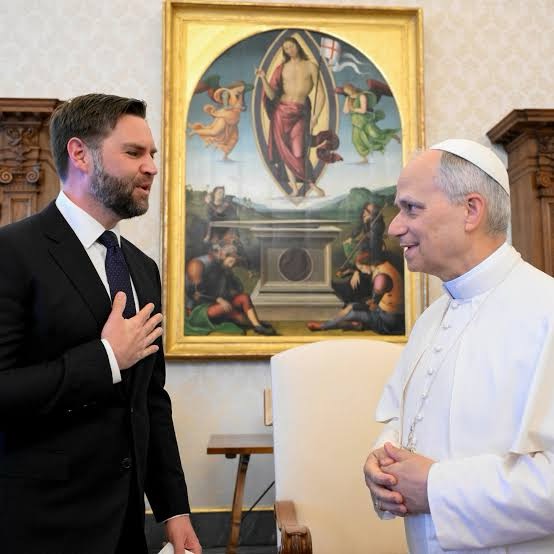
It’s a live issue in our world today. The MAGA movement in the USA professes itself to be closely aligned with Christianity – although I don’t see a lot of evidence of loving thy neighbour in what they seem to profess – and this question of authenticity, what’s the right interpretation of God‘s plan for the world, came up very spectacularly recently with one of their leaders.

That was JD Vance, the Vice President, who is a fairly recent convert to Catholicism, and who apparently took it upon himself to challenge Pope Leo, who had condemned the war in Iran, by asserting that disciples of Christ are never on the side of those who wield the sword and drop bombs. Against that JD Vance maintained that the Pope had got it wrong and ignored the ‘just war’ theory which has been used by Christians since the time of Thomas Aquinas in the 14th century to justify war in certain circumstances, and get round the commandment, in the 10 Commandments, ‘Thou shall not kill’. Who is more authentic? Who is the false prophet? Is it Vance or is it Pope Leo?

How should we tell? I would suggest that perhaps a useful principle to bear in mind at that point is that neat little phrase, ‘What would Jesus do?’ Can you imagine Jesus dropping in on Pope Leo in the Vatican – perhaps as he is enjoying his pizza one evening? (Oh no, that was Pope Francis, in ‘The Two Popes’! If you haven’t seen that film, I think you would love it.) Or what if Jesus got through the ICE guards into the White House and managed a one-to-one with JD Vance…. Would Jesus agree with him? Or would he side with the Pope?

I’ve got a feeling that just imagining those two things should give you an idea about who is more authentic. Let’s pray that we are able to tell the difference in future as well.
Sermon for Holy Communion on the Feast of Christ the King, 26th November 2017, at St John’s, West Hartford, Conn.

[Ezekiel 34.11-16,20-24, Ephesians 1.15-23], Matthew 25.31-46

See http://bible.oremus.org/?ql=378268013 for the readings, and https://sjparish.net/wp-content/uploads/2017/11/Nov-26-Pentecost-25-1030am.pdf for the full service booklet.

It’s really kind of you to welcome me back to St John’s to preach again. Susan, you have been amazingly gracious. Just when you were getting nicely settled in as Rector, Bill and Hope Eakins dropped in the suggestion that you might want to risk having me, this old Brit, to preach at the church – and just after Thanksgiving as well, when you are all celebrating having got rid of us colonial throw-backs. You’re truly kind.

Obviously I have been well briefed. I must stay away from anything too controversial or political. And I can’t really do the ancient Greek orator’s trick of doing a Philippic: you know, saying loudly, ‘I’m not going to say anything about Philip’, and then going on to say what an awful person he is. So no Brexit and Trump, then. Sorry.

Instead I want to get to grips with the sheep and the goats. Are you a sheep, or a goat? It’s a rigid division. On the right side, the Elysian Fields await you; but if you’re Billy Goat Gruff, nothing so nice.

That’s the thing I want to explore, with the sheep and the goats: divisions. People divided: divided, because they disagree. They disagree about what is best to do. And then, perhaps, do they have those divisions confirmed, ratified, by the Judge eternal?

At Thanksgiving you are celebrating independence from the colonial power that we were, the young nation standing on its own feet. It was a journey started by the Pilgrim Fathers, Puritans, who found themselves different from, at odds with, divided from, the society they were leaving in England. So I want to look at that division. It stemmed at least in part from the religious ferment and turmoil of the Reformation.

Apart from those things I’m not talking about, the other thing this year that has been of special note, not in our political, but in our spiritual life, has indeed been the Martin Luther 500th anniversary, 500 years since he is said to have posted up 95 points where he was at odds with the Roman Catholic Church, on the church door at Wittenberg in Saxony, which is the event which started the Reformation.

The Reformation led to civil war and persecution: the particularly ghastly thing about it was that the favourite way of getting rid of opponents was to burn them alive at the stake. We often spend time on Good Friday, during the Three Hours, reflecting on the dreadful mechanics of death by crucifixion. Death by burning seems to me to have been equally dreadful. And the penalty was so arbitrary and undeserved.

Think of Thomas Cranmer, the great scholar and Archbishop who created the first Book of Common Prayer in 1549, and gave the new Church of England liturgy, forms of worship, which were for the first time in a language that could be ‘understanded of the people’, as they said, in English instead of Latin, although they were in fact based on, and continued the tradition of, services which in some cases could be traced back to the earliest Church Fathers. But even Cranmer was eventually burned to death, at the hands of the original ‘Bloody Mary’, Queen Mary, who brought back the Catholic faith for the duration of her reign.

This happened because Cranmer was a Protestant, at a time when it was no longer the right thing to be. We don’t know whether he met Martin Luther – some scholars, such as Diarmaid McCulloch, think he might well have done – but he certainly spent time in Zürich with Zwingli and Bucer.

It is fascinating to see how Cranmer reflected the new Reformation ideas, in the way in which he dealt, (in the Book of Common Prayer that he largely authored), with what was happening in the Holy Communion, at the point when the bread and the wine are shared.

The Roman church, the Catholics, believe in what they call ‘Transubstantiation’, the ‘Real Presence’ of Jesus’ body and blood in the bread and wine of the Holy Communion. Many of the Reformers did not believe in Transubstantiation. For them the bread and the wine were just that, bread and wine; just symbols of a greater thing.

The words in Cranmer’s Prayer Book changed, from the 1549 original, where the bread and wine are treated in the Catholic way, as actually being Christ’s body and blood, to his revision in 1552, perhaps after he met the other reformers: ‘Take and eate this, in remembraunce that Christ dyed for thee, and feede on him in thy hearte by faythe, with thankesgeving’ , which means they remain just that, bread and wine, just symbols, until, long after Cranmer’s awful death in 1556, in 1662 the final version of the Prayer Book (until the twentieth century revisions, here and in England), the 1662 Book has it all ways: ‘The body of our Lord Jesus Christ, broken for thee: Eat this, in remembrance that Christ died for thee, and feed on him in thy heart by faith with thanksgiving.’ In the first bit, the body, the actual body: but then a ‘remembrance’, a symbol: feeding, but by faith, not literally. Now, you can be anywhere on the Catholic – Protestant spectrum, and find spiritual resonance somewhere in those words, which we will still use, albeit in a slightly different order, in our service today.

But, the point is that, then, people were dying for those differences. Or feeling so alienated by them, that they opted to make a perilous voyage to a largely unknown land, and make a new life – as the Pilgrim Fathers did. It’s frankly strange – repugnant, even – to us today to think that the State could mete out the ultimate punishment, death, to a learned theologian such as Cranmer. But it did.

Belief, opinion, learned opinion, was a life-or-death affair. Now we can look back 500 years and shake our heads sagely, regretting how brutal life was then: we’re far too rational to let ourselves get into that kind of overreaction.

But I wonder. I promised not to talk about Brexit and Trump. But I will just say that it seems to be true both back home in England, over Brexit, and, dare I say, here, where Pres. Trump is concerned, that a climate has built up recently where people on each side not only feel strongly, very strongly: but they have stopped talking to each other. Certainly at home in the UK, the referendum on Brexit has divided people, divided people in a serious way. Old friends are avoiding each other; families are divided. There’s no sense of the old way of managing differences: so that we would say ‘Old so-and-so thinks such-and-such: I know he’s wrong, but it doesn’t matter. We’re still the best of friends.’ That really doesn’t seem to be working any more.

Time was, even recently, when we could disagree about quite serious things, and still be friends; it really was a case of hating the sin and loving the sinner. So what did Jesus the King do? The sheep and the goats are to be separated out, they are to be divided: but not by what they have thought, but what they have done. Jesus wasn’t requiring the elect, the people who were saved, the sheep, to subscribe to any particular world view. He was looking for acts of kindness, not manifestos.

‘I was hungry and you gave me food, I was thirsty and you gave me something to drink, I was a stranger and you welcomed me, I was naked and you gave me clothing, I was sick and you took care of me, I was in prison and you visited me.’ (Matt.25:35-36).

Hungry; thirsty; a stranger; no clothes; ill; in prison. You can construct all sorts of scenarios, which may well broadly reflect your political outlook, to explain how a person can be in any of those situations – and we might disagree.

Hungry and thirsty because they’ve made bad ‘life choices’, perhaps; a stranger, because they live somewhere that I don’t go to – and perhaps they don’t live the way we do; no clothes, probably not literally, but scruffy, down-at-heel, when – ‘if they cared about their appearance… ‘ You know.

Or they might be refugees, from a poor country. Are they ‘genuine refugees’, or just ‘economic migrants’? That’s a question which I suspect you would answer much more sympathetically than many of us Englishmen have been doing. The USA’s prosperity is built on the labour of economic migrants – but we are now trying to keep them out.

Or what if you are sick, if you are ill? You know one of the differences between us in England and you is that, I think, we have more restrictive rules about when you can fire people. Basically, our law says that an employer has to show that he has a fair reason for terminating someone’s employment, and it is presumed that it was not fair. But a fair reason, in English law, is if you are ill, ill for too long.

That’s one where I expect there might be disagreements. You know, on the one hand, you can’t run a business if you have to pay a salary for someone who’s not there: and on the other, think what it will do to your powers of recovery if, when you are in the depths of illness, you lose your livelihood. What’s your point of view? Which side are you on?

Jesus says, when I was in hospital, you came and visited me. Dare we say, you visited me, and didn’t bring me any bad news? I hope so. Here in the home of the US insurance industry, of The Hartford and the Aetna, let me dare say it – surely long-term sickness might be covered by an employer’s insurance. Or maybe that’s too much. I was ill, and you visited me. That’s what Jesus said.

I was in prison. You came to me. I was a criminal. I didn’t deserve anything. I had done something terrible. But surely there are limits? Some criminals are just beyond the pale. At home, the man called the Moors Murderer, Ian Brady, has died, and there was controversy where his remains should be buried. He killed a number of children, in appalling circumstances. Here, Charles Manson has died. Both of them I have heard called ‘evil personified’. But Jesus isn’t judging them. Jesus’ judgement, separating the sheep and the goats, is not about whether someone has been bad, been a sinner. Jesus would have visited them. He sat down and ate with sinners.

That’s the clue. That’s how it is with Jesus. Not what you’d think; perhaps not particularly reasonable. But good.

So I suspect that if we acknowledge Christ as King, and as judge eternal, as we are invited to do today, on this festival of Christ the King at the end of Thanksgiving, we may find a way to deal with our differences: even, dare I say, those real, deep differences over Brexit and Trump. Ultimately those differences may not really be that important. Instead we need to think sheep and goats. Acts of kindness, not manifestos.

Sermon for All Saints, Sunday 1st November 2015
Rev. 21:1-6, John 11:32-44

Why do you come to church? I’m sorry; I’ll put it a bit less abruptly. Why does one come? I used to know a lovely old lady, Mrs Ryder, who said, ‘I go to church to think about dead people.’ To some extent, I think that’s how I came in, too. What does happen when we die? What is heaven like? ‘Behold, I make all things new. … A new heaven – and a new earth’. Is that where Mrs Ryder’s people have gone?

And then there’s Lazarus. Too much detail: his corpse was beginning to go off, to get smelly. He hadn’t gone anywhere, apparently. Then out he came, blinking, into the light. Not smelly.

In a way, those two pieces encapsulate where I came in; where I started to think about things outside the realm of what I could see and feel and touch. How I started the the process in which I eventually came into being a Christian.

‘Am I going to die?’ I asked my mother one day when I was a boy. ‘No’, she said. Well, not imminently, anyway, she might have added. But even so, I had started to think about it.

Actually, it’s tomorrow that we really think about dead people – All Souls, the Commemoration of the Faithful Departed, will be our service at 10.30 tomorrow morning. Today we are doing what Christians have done at least from the third century, and that is to celebrate the special people who have been, from the earliest time, witnesses to Jesus’ mission, the saints. I Sancti, the holy ones, set apart from ordinary people. St Paul mentions ‘saints’ thirty times in his letters. We may think of them as being somehow almost superhuman, but St Paul simply used that name for the ordinary members of the church.

But clearly in many instances the term ‘saint’ does describe someone very special. In the Roman Catholic Church saints are priests, in the sense that they pray for us, they intercede for us with God. ‘Sancta Maria – ora pro nobis’: holy Mary, saintly Mary – pray for us. So in Catholicism the idea grew up that you pray to God through a saint, you ‘invoked’ that saint.

This was all part of the system of purgatory and indulgences which Martin Luther opposed. Thomas Cranmer, following Luther, wrote in our 39 Articles of Religion, Article XXII, ‘The Romish Doctrine concerning Purgatory, Pardons, Worshipping, and Adoration, as well of Images as of Reliques, and also invocation of Saints, is it fond thing vainly invented, and grounded upon no warranty of Scripture, but rather repugnant to the Word of God.’According to the Reformers, invocation of saints, praying through the saints, has no scriptural basis – you can come to God direct: you don’t need a priest to intercede for you. There is a ‘priesthood of all believers.’

Just like a lot of the controversies from the Reformation, the antithesis between the Catholic idea of the saints as being people whom we can call upon to intercede for us with God, and the Reformation idea of the Priesthood of all Believers, is a question which we don’t now look at in such a black-and-white way. We do say prayers by ourselves; we do dare to speak directly to God, wherever we might be: but we also come to church and have the minister say prayers for us.

In the Apostles’ Creed in the Prayer Book (the one we say at Mattins or Evensong), we say,
‘I believe in the Holy Ghost, the holy Catholic Church, the Communion of Saints, the Forgiveness of sins, the Resurrection of the body, and the life everlasting.’ The Communion of Saints is right up there with all the other really important parts of our faith.

Today we pray in the Collect, “O Almighty God, who hast knit together thine elect in one communion and fellowship, in the mystical body of thy son Christ our Lord…” Being in ‘Communion with the Saints’ means being in the same body with them, in the church down the ages. There is something very powerful about that. All those wonderful men and women, beginning with the apostles and the earliest Christians – Peter and James and John, the Twelve, then Paul, then Dorcas and Phoebe; then the early martyrs, St Stephen and all those who were eaten by lions in the arena: and then all the great figures in the church down the ages.

Martin Luther, certainly: Thomas Cranmer: but also St Francis Xavier, and Pope John XXIII. John Wesley and John Henry Newman. Dietrich Bonhöffer. This is the ‘great cloud of witnesses’ that we read about in the Letter to the Hebrews.

These saints were willing to sacrifice everything for their faith. Read the list of faith heroes in Hebrews 11. It might be rather daunting. How could we match up to some of the things they did? But at least we don’t have to face being thrown to the lions.

Whom would you think of as a saint today? This is where we can recognise the force of St Paul’s idea that everyone in the churches was, is, a saint. I’m sure it’s still true. Just look around you, and think how nice we are – think how we have cared for each other and for those in need. In a real sense everyone in the congregation is a saint.

It doesn’t mean that we have to be perfect in order to qualify to be saints. St Paul, when he wrote to the ‘saints’ at Corinth, or in Ephesus, or in Colossae, or even in Rome, wasn’t writing to eulogise their virtues: instead the purpose of his letters was often to correct their errors and put them back on the track of the true faith. Saints are normal people with normal faults and weaknesses. People like us can be saints.

So what is it that calls us, still calls us, to be people apart, holy people – (because that is what Άγιος , Sanctus, sacred, saintly, means)? This is where poor old Lazarus comes in. We are ‘members of one another in Christ, members of a company of saints, whose mutual belonging transcends death’. Jesus conquered death. He raised Lazarus from the dead, and He himself rose resurrected in glory. This is our faith.

This faith is the mark of a saint. A saint – a saint like us – has the sure and certain hope of the resurrection to eternal life.

‘Behold, I make all things new’. That includes us. Us saints.