Sermon for Evensong on 6 September 2026 at St Peter’s, Old Cogan
Ezekiel 12:21-13:16; Acts 19:1-20
‘Dem bones, dem bones, dem dry bones’. I must confess that’s the passage from Ezekiel that I remember; but unfortunately today in our lesson I haven’t got a reference to that last part of the book of Ezekiel and the famous dry bones, which was a vision of the Israelites and Jerusalem rising up again after a time of exile and desolation. No, today’s lesson is from the beginning bit where Ezekiel is taking them to task in pretty direct language.
Ezekiel says that the word of the Lord has come to him condemning false prophets. ‘Your prophets have been like jackals among ruins, O Israel.’ They are like cowboy builders building a wall with whitewash instead of cement, talking about smearing whitewash on it. Ezekiel says that God says, ‘You shall perish within it. You shall know that I am the Lord’.
What do we make of this? One of the commentaries that I was reading [How to Read the Old Testament, by Etienne Charpentier] describes Ezekiel like this. ‘Ezekiel can never be like anyone else. Like his predecessors, he has visions, but his are flabbergasting:’ and then there are a few purple passages mentioned which he describes this way: ‘…he performs prophetic actions, but sometimes these go beyond the bounds of good taste -. see chapters 4 and 5. ‘Some passages in his allegories would make a guardsman blush’ – so the commentary says, ‘don’t read chapters 16 or 23!’ If you want to follow up the naughty bits, see me afterwards!
I suppose the theme isn’t just false prophets, but in a way it’s all about truth and authenticity. There are lots of prophets out there; some of them are genuinely receiving the word of God and speaking it; but others are not.
In Acts, the renegade Jewish prophets or preachers, the sons of Sceva, come along claiming to cure people or cast out devils, (whatever that means), in the name of Jesus. But they aren’t the real thing. The devils say, ‘We know about Jesus and Paul, but who are you?’ That has always struck me as being a wonderful retort – but really I would also like to say to the devils, ‘Who are you?’
I’m not sure that these days, when we talk about prophets, whether we are really talking about the same sort of thing as Ezekiel when he condemns the false prophets. Today we tend to talk about prophets just in terms of forecasting the future, and there doesn’t seem to be much reference to prophets being a mouthpiece for God.
Some people argue that in a very real sense Jesus was the last prophet, although he did say that he had not come to abolish the law and the prophets; and if you are a Muslim you see Jesus as a very great prophet, but nothing more. Ezekiel was a prophet; he had visions which he believed were visions of God. and in which God told him things intended to be passed on to God‘s chosen people, the Israelites.
As reasonably grown-up Christians in metropolitan Wales, we aren’t really alive to that kind of prophet and divinely-inspired prophecy any more; the idea that we need a prophet or a priest to be some kind of intermediary between us and the divine is pretty strange. Look, we say our prayers, either at home by ourselves or in church: and we don’t invoke anyone else as an intermediary between us and God. We’re not like the Israelites of the Old Testament: we’re not afraid of talking direct to God. We’re not like Roman Catholics of old, (not so much today), who had services said for them by the priests.
But it’s not that cut and dried. Both the Roman Catholics and many Anglicans do still pray ‘through’, or with the help of, saints and angels.
We are Anglicans – people who come to God as ‘catholic and yet reformed’. Henry VIII, the first Anglican, was a solid Catholic – until he got involved in a difficult divorce. He couldn’t persuade the Pope to allow him to divorce, and so, with the help of Thomas Cranmer, Henry declared independence from the Church of Rome. Archbishop Cranmer had met and been influenced by many of the church leaders on the Continent; the Reformers, like Luther, who had gone away from Bibles and services which were not in the ordinary people’s language and instead they led services and worshipped in everyday language rather than in Latin. So Cranmer mixed things up.
King Henry was a good Catholic – but he didn’t acknowledge the authority of the Pope. He set himself up as head of a new Church of England, and his Archbishop Cranmer drew up services in the new Book of Common Prayer which were based on English translations of the Catholic service books they used before, but which brought in ideas he had learned from the Reformers. We don’t know whether Cranmer met Martin Luther – Luther’s biographer Lyndal Roper thinks they could have met – but anyway Cranmer seems to have been influenced by him, and he definitely went to Zurich to meet Zwingli and to Geneva to meet John Calvin.
A key part of the Reform in the 16th century, that came into the mix in Anglicanism, was the idea that we, the ordinary people in the pews – not the ministers or churchwardens or bishops – are a ‘priesthood of all believers’, which means that we don’t need priests or prophets in order to make our prayers to God. And as Anglicans we have embraced this idea – we mainly pray straight to God, not to someone, some saint, to pray on our behalf for us. We are invoking God, asking him to answer our prayers, not asking someone else to approach God for us.
But we do say, ‘through Jesus Christ our Lord’. I think we invoke Jesus in this way because He is God in person. If we didn’t know about Jesus we might really struggle to know how to pray, how to talk to the divine. Who is the God whom we pray to? Some people are fortunate and think God speaks to them most days. But for other people, like me, there are some philosophical arguments to consider, for example, by Bishop John Robinson, in his famous book Honest to God.
Their argument is that God isn’t a thing, an object, something within existence, because you can’t be at the same time the creator and the created thing: and therefore when we talk about God what we are really talking about is ‘ultimate reality’ and the sense of what Paul Tillich called ‘The Ground of Being,’ or to paraphrase Leibniz, ‘God is not one of the things which exist, but is rather the reason that anything exists rather than nothing existing at all.’
God was – God is – invisible, and indeed in the Jewish tradition if you saw God face-to-face it was likely to be fatal, unless you were a priest or a prophet. That makes you wonder what the true nature of God is. We say that Jesus is the son of God, but also, in some sense, that he is God. David Jenkins, the former Bishop of Durham, said, ‘God is as he is in Jesus’. God is, as he is in Jesus. In St John’s Gospel chapter 12 Jesus said, ‘When a man believes in me, he believes in him who sent me rather than in me; seeing me, he sees him who sent me.’
But to get back to the question of authenticity, let’s consider the sons of Sceva in Acts, described as ‘itinerant Jewish exorcists’, or in the King James Bible – always more memorable – as ‘vagabonds’, using the name of Jesus to exorcise evil spirits; leaving aside the question exactly what they were doing and what an evil spirit is, the point of the story, at least when we put it alongside the passage from Ezekiel, is, what is the real deal? What makes for authenticity and what is false prophecy?
It’s a live issue in our world today. The MAGA movement in the USA professes itself to be closely aligned with Christianity – although I don’t see a lot of evidence of loving thy neighbour in what they seem to profess – and this question of authenticity, what’s the right interpretation of God‘s plan for the world, came up very spectacularly recently with one of their leaders.
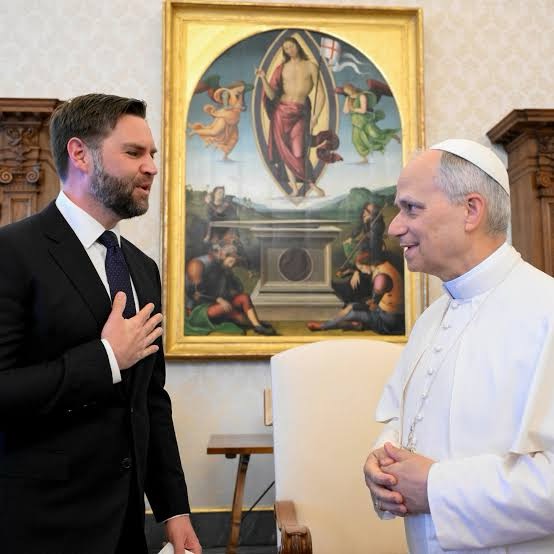
That was JD Vance, the Vice President, who is a fairly recent convert to Catholicism, and who apparently took it upon himself to challenge Pope Leo, who had condemned the war in Iran, by asserting that disciples of Christ are never on the side of those who wield the sword and drop bombs. Against that JD Vance maintained that the Pope had got it wrong and ignored the ‘just war’ theory which has been used by Christians since the time of Thomas Aquinas in the 14th century to justify war in certain circumstances, and get round the commandment, in the 10 Commandments, ‘Thou shall not kill’. Who is more authentic? Who is the false prophet? Is it Vance or is it Pope Leo?
How should we tell? I would suggest that perhaps a useful principle to bear in mind at that point is that neat little phrase, ‘What would Jesus do?’ Can you imagine Jesus dropping in on Pope Leo in the Vatican – perhaps as he is enjoying his pizza one evening? (Oh no, that was Pope Francis, in ‘The Two Popes’! If you haven’t seen that film, I think you would love it.) Or what if Jesus got through the ICE guards into the White House and managed a one-to-one with JD Vance…. Would Jesus agree with him? Or would he side with the Pope?
I’ve got a feeling that just imagining those two things should give you an idea about who is more authentic. Let’s pray that we are able to tell the difference in future as well.