Archives for posts with tag: Jesus

Sermon for Mattins and Morning Prayer (Principal Service) at All Saints Church, Penarth, 5th October 2025

Habakkuk 1.1-4; 2.1-4

Psalm 37.1-9

2 Timothy 1.1-14

Luke 17.5-10

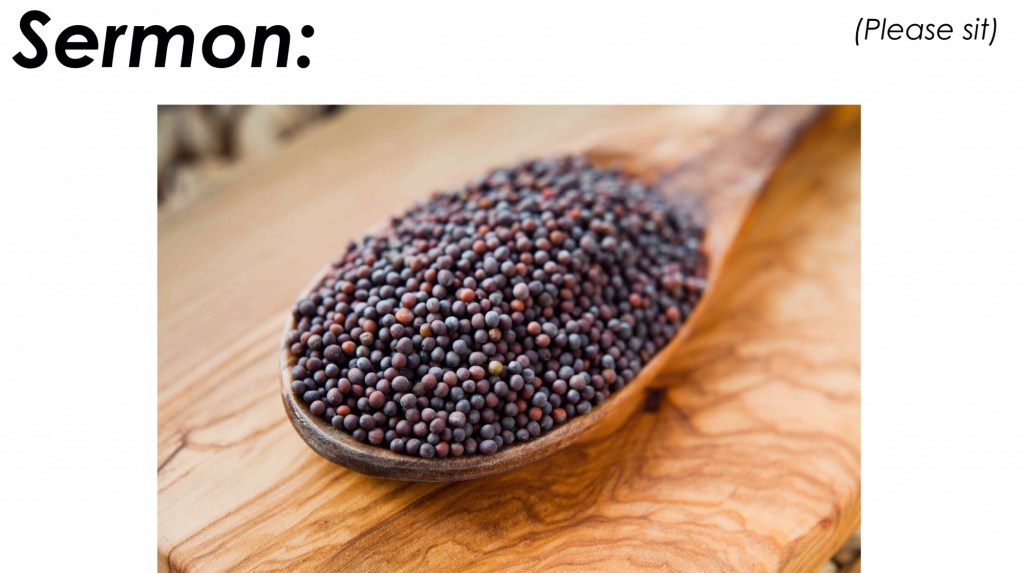
It’s a pity that we don’t have lantern slides at 8 o’clock, because I could show you the picture on the slide which is going to be shown at 10 o’clock when I start to preach the sermon then. It’s a sort of shovel, or it could be a large spoon, with round things in it, quite small.

I wondered whether they were my favourite special-treat breakfast cereal, Grape-Nuts – I should explain that I didn’t choose the pictures, as Susannah is leading the service at 10 as well as this one – but I suspect that at 8 o’clock we need to stay away from pictures and screens and things like that, and just keep our worship simple and our pictures in our heads, where, of course, those of you who listen to the wireless know that the best pictures are.

What is in the big spoon? I asked Susannah and she told me that they were mustard seeds, picking up a reference to the Gospel reading, the New Testament lesson today. I have to say that it rather threw me, because I thought mustard and cress was something which you grew on a face flannel on the bathroom windowsill, but apparently this is what mustard seeds really look like.

The lessons are all about how we confront a world which is going wrong, which is going against us. The Old Testament lesson, from the prophet Habakkuk, comes from a time around 600 BC when the Assyrians had overrun the northern kingdom of Israel, and all that was left of God’s chosen people were the two tribes of Judah and Benjamin, together with the survivors from the massacre when the Assyrians invaded the northern kingdom, who had fled to Jerusalem to take refuge there.

Habakkuk was preaching when the Babylonians were beginning to sweep down on Palestine; they are the Chaldeans, if you read a bit more beyond one of the bits that we have for our lesson, which is in two bits, the first four verses of chapters one and two respectively. If you read on in chapter 1, beyond where it says

Devastation and violence confront me;

strife breaks out, discord raises its head,

……

for the wicked outwit the righteous,

and so justice comes out perverted.

Habbakuk goes on in his prophecy by saying

Look, you treacherous people, look:

here is what will astonish you and stun you,

for there is work afoot in your days

which you will not believe when it is told you.

It is this: I am raising up the Chaldaeans,

that savage and impetuous nation,

who cross the wide tracts of the earth

to take possession of homes not theirs.

Terror and awe go with them;

their justice and judgement are of their own making.

Their horses are swifter than hunting-leopards

And he goes on to say how terrifying they are in all sorts of other ways. Obviously they fulfilled the American strategic objective for a successful army in the invasion of Iraq, ‘shock and awe’.

But this terrible army had its limitations.

Their whole army advances, violence in their hearts;

a sea of faces rolls on;

they bring in captives countless as the sand.

Kings they hold in derision,

rulers they despise;

they despise every fortress,

they raise siege-works and capture it.

A terrifying picture. Who could stand against them? But then –

Then they pass on like the wind and are gone;

and dismayed are all those whose strength was their god.

People who believe that ‘might is right’ turn out to be completely mistaken; and the key words in Habakuk’s prophecy come in the second chapter, in our second part of the lesson, [2:4]

Look at the proud!
 Their spirit is not right in them,
 but the righteous live by their faith.

It’s an idea that St Paul picked up on in two of his letters. In his great letter to the Romans, [1:17], he said that in the gospel of Jesus

is revealed God’s way of righting wrong, a way that starts from faith and ends in faith; he says, as Scripture says, ‘he shall gain life who is justified through faith’.

In the letter to the Galatians [3:11], where St Paul is drawing a distinction between following the provisions of the Jewish law, just carrying out the 10 Commandments, and having faith, saying that the way to salvation is through faith, he says that

It is evident that no one is ever justified before God in terms of law; because we read, ‘he shall gain life who is justified through faith’.

I’m not sure why the compilers of the Lectionary decided that we should have a lesson from the second letter to Timothy rather than one of these passages from Romans or Galatians, (which clearly reference the passage in Habbakuk), but certainly in the passage from the second letter to Timothy, St Paul celebrates that the fact that Timothy and his mother and his granny, Eunice and Lois respectively, all had strong faith.

But you might be a little bit puzzled about exactly what this faith is. It’s pretty clear that it’s not what we would call blind faith, just believing that something is true without any evidence for it. If that was true, you might never take another paracetamol ever again; or even worse, you might try to cure Covid by drinking some bleach. But we are not talking about President Trump’s belief system; this is a word which has more of a connotation of trust about it. It’s not so much about believing that something is the case, but rather, trusting in God to produce a good outcome, to right the wrongs. It’s very close to hope. Hope in the Lord. Trust in the Lord. As Isaiah puts it [14:31]:

but those who look to the Lord will win new strength,

they will grow wings like eagles;

they will run and not be weary,

they will march on and never grow faint.

They will soar, on wings like eagles: they will ‘mount up with wings like eagles’.

Just now our world looks a bit like what it must have looked like to Habakkuk; there is a lot going wrong. There are terrible wars, invasions; the rule of law looks to be under threat in places: –

devastation and violence confront me;

strife breaks out, discord raises its head,

…..

for the wicked outwit the righteous,

and so justice comes out perverted.

We can think of plenty of places and cases today, where those words would be very apt. We are going to have a vigil later on today here to pray for the people of Palestine; equally our prayers should go for the other places in the world where there is no peace and where the rule of law does not securely run: Ukraine and the south of Sudan chief among them, as well as Gaza and the West Bank; and all those places where people are held hostage or are fleeing violence and persecution and are becoming refugees.

We need to trust in the Lord, to pray with confidence and realise the power of prayer, even if our faith is only the size of one of Susannah’s mustard seeds, or a spoonful of Grape-Nuts. It doesn’t matter. You can rely on God to put things right in the end. Let us pray that he will use us in his service to that good end.

Amen.

Hugh Bryant

From the PowerPoint slides at the 10 o’clock service. What are those little beads?

Sermon for Morning Prayer on the Feast of Matthew, Apostle and Evangelist, 21st September 2025, at St Dochdwy’s Church, Llandough, and St Augustine’s Church, Penarth

2 Corinthians 4.1-6

1 Therefore, since it is by God’s mercy that we are engaged in this ministry, we do not lose heart. 2 We have renounced the shameful things that one hides; we refuse to practise cunning or to falsify God’s word; but by the open statement of the truth we commend ourselves to the conscience of everyone in the sight of God. 3 And even if our gospel is veiled, it is veiled to those who are perishing. 4 In their case the god of this world has blinded the minds of the unbelievers, to keep them from seeing the light of the gospel of the glory of Christ, who is the image of God. 5 For we do not proclaim ourselves; we proclaim Jesus Christ as Lord and ourselves as your slaves for Jesus’ sake. 6 For it is the God who said, ‘Let light shine out of darkness’, who has shone in our hearts to give the light of the knowledge of the glory of God in the face of Jesus Christ.

Matthew 9.9-13

9 As Jesus was walking along, he saw a man called Matthew sitting at the tax booth; and he said to him, ‘Follow me.’ And he got up and followed him.

10 And as he sat at dinner in the house, many tax-collectors and sinners came and were sitting with him and his disciples. 11 When the Pharisees saw this, they said to his disciples, ‘Why does your teacher eat with tax-collectors and sinners?’ 12 But when he heard this, he said, ‘Those who are well have no need of a physician, but those who are sick. 13 Go and learn what this means, “I desire mercy, not sacrifice.” For I have come to call not the righteous but sinners.’

Last Saturday I was in London at Southwark Cathedral. Actually it wasn’t just because I wanted to make friends with their relatively new but already fairly famous cathedral cat, Hodge – named after Samuel Johnson’s cat. Hodge arrived after their definitely famous Doorkins Magnificat died in September 2020. Doorkins got a beautiful funeral at the Cathedral, which you can still see on YouTube [https://youtu.be/sdCtdqmdgtI?si=o6h6htHMFt6xoTn5], led by the previous Dean, Andrew Nunn. 

Incidentally I am on another catty mission, which perhaps some of you could help me with, maybe even come with me, to our own cathedral in Llandaff, where I would like to meet the new cathedral cat there, called Frank. Frank is a black cat and so is Hodge. Anyway, I was delighted to meet Hodge during the day I was in the Cathedral. 

But really, the reason why I was there – with your support, because very generously our Ministry Area paid the registration fee – was to attend the ‘Festival of Preaching’ which was held that day, organised by the Church Times, with the help of the current Dean of Southwark, Mark Oakley, and the vicar of St Martin in the Fields, Sam Wells, both of whom I’m sure you will have come across on ‘Thought for the Day’ on Radio 4 if nowhere else. 

The theme of the day was ‘preaching truth to power’. The keynote speaker, who also led Holy Communion and preached, was the Bishop of Washington DC, Mariann Edgar Budde. 

You will remember, I am sure, that she is the bishop whom President Trump criticised for being ‘nasty’ when she used her sermon at the National Cathedral, in a service for the presidential inauguration, to implore Donald Trump to “have mercy upon” immigrants and LGBTQ+ individuals. 

I’ll read you what was in the Guardian, 22 Jan 2025, under the splendid headline,‘Trump criticises ‘nasty’ bishop ….’. The Guardian’s Anna Betts wrote:

‘[S]he made headlines for urging Trump during her sermon to show mercy to “gay, lesbian and transgender children” from all political backgrounds, some of whom, she said, “fear for their lives”.

‘She also used her sermon to ask that Trump grant mercy to families fearing deportation and to help those fleeing war and persecution.

‘She emphasised the contributions of immigrants, telling the president: “The vast majority of immigrants are not criminals,” adding that they were “good neighbours” and “faithful members of our churches, mosques and synagogues, gurdwara and temples”.

“Our God teaches us that we are to be merciful to the stranger, for we were once strangers in this land,” she said. [Exodus 22:21, et al.]

This is not the first time that [Bishop Mariann] has called out and clashed with Trump.

During Trump’s first term, [Bishop Mariann] published an opinion piece in the New York Times. In the June 2020 article, she expressed outrage over Trump’s appearance in front of St John’s Episcopal church in Washington DC, when he held up a Bible for a photo after federal officers used force to clear a crowd of peaceful protesters demonstrating against the death of George Floyd.

[Bishop Mariann] wrote that Trump had “used sacred symbols to cloak himself in the mantle of spiritual authority, while espousing positions antithetical to the Bible that he held in his hands”.’

Nasty bishop indeed! I remember watching on TV as Bishop Mariann preached at the inauguration service and being very stirred by how she had indeed spoken truth to power. It’s a challenge that has faced Christians ever since the earliest days when Jesus was with his disciples. Today we celebrate his calling one of them, Matthew, but the story comes with an important challenge to Jesus, about the people he associated with.

‘Sitting down at meat with publicans and sinners’, if you’re old enough to remember how the old Bible used to put it. Because I was brought up a Methodist, I assumed that this was theological authority for taking the pledge, that anything to do with pubs and their landlords – publicans – was reprehensible, and Jesus was being challenged for associating with pub landlords, I thought. Disappointingly, our modern translation says they’re not pub landlords but tax gatherers; still bad guys but possibly less reprehensible. After all, you might be able to avoid going to the pub, but not the taxman. Death and taxes, you know.

Jesus emphasised the need to engage with these unsavoury citizens and not just people who were on his side. He was there for people who had not seen the light. That’s what Paul is on about as well. In a hostile environment ‘we do not lose heart’, he says. ‘…by the open statement of the truth we commend ourselves to the conscience of everyone in the sight of God. … even if … the god of this world has blinded the minds of the unbelievers, to keep them from seeing the light of the gospel of the glory of Christ’. 

Nasty people doing nasty things and wrongly accusing good Christians of being nasty. How do we manage this conflict? How do we speak truth in the face of powerful opposition?

Coincidentally, while I was in Southwark Cathedral, not far away a huge demonstration was going on, led by the man who calls himself Tommy Robinson, addressed by Elon Musk by video link on giant screens telling people to be ready to fight; wrapping themselves in Union Jacks and blaming anybody who did not look like them – they were all white – for anything that wasn’t going well in their lives, and shouting that the country was going to rack and ruin. 

They didn’t want immigrants, they didn’t want black people, and it would seem they weren’t very keen on the law, because unfortunately there was considerable violence against the police. I came across numbers of them at London Bridge station on my way home. They were scary. They were nasty too. I could see black people on the platform looking nervous. Fortunately there were policemen around and no trouble actually ensued, but the whole atmosphere was menacing. Theirs was another kind of power. How would you speak to people like this, to them, to the power of the mob? 

Really it was a world away from the civilised discourse at the front of the nave of Southwark Cathedral which I had just come from. Hanging from the ceiling of the Cathedral was a huge installation of paper doves, each one inscribed with a prayer for peace. The only noise, when it came, was the music of the hymns that we sang and the anthems sung by the choir. 

Elon Musk’s participation in the fascist demonstration, by video link, demonstrated how that malign power of the extreme Right had crossed the Atlantic. It was somehow fitting that we had another American to show us how she had, with God’s help, stood up against it. No prizes for knowing which was the nasty American last Saturday.

I have no easy solutions to lay in front of you, but one message which came loud and clear was that it is very important that we should not just shut ourselves in our churches with our heads in our bibles, however faithfully, and not realise the need to engage, the need to preach truth to power.

There is such a lot going on in the world today which would not have gladdened the heart of Jesus. Our voices in the churches, speaking truth to power, need to be heard. We are specially praying today for the situation in the Middle East, for the release of hostages, for the cessation of violence, for the provision of enough food and water and the reconstruction of houses. 

There is going to be a vigil of witness led by ++Cherry at the Senedd on Wednesday at 12.30. If anyone else would like to go, I will be going along with Jimmy and Susannah, and would be very happy to give lifts if anyone needs one. We are planning a vigil for peace in this Ministry Area also, on 5th October in the evening, at  All Saints.

Jesus first, then his disciples, and then his ‘meta-disciple’, Saint Paul, his second-order disciple, the great theologian, all knew the importance of preaching truth to power. Let us pray that we are given the Lord’s help and encouragement in continuing that important work.  Amen.

Hugh Bryant

Sermon for Evensong on 11th May 2025, Easter 4

Psalms 113, 114

Isaiah 63:7-14

Luke 24:36-49

Peace be with You

You are very welcome, on this sunny afternoon, to the fastest-growing service in the Anglican church. Certainly in numbers attending, Evensong is where it’s at. That might seem a bit counterintuitive, when you think of the success of some of the great big evangelical churches such as Citizen Church here in Cardiff, which offer an entirely different way of worship, but apparently there are statistics to back it up.

I have from time to time tactfully enquired of members of the congregation what they particularly like about Evensong, and one of the more surprising answers which I have received was from a rather formidable lady of a certain age, who said that she particularly liked Evensong because there was ‘none of that shaking hands or kissing nonsense’.

Indeed I read once upon a time that our brothers and sisters in the Methodist Church had a bit of difficulty over exchanging the Peace as it became very popular among the teenage members of the congregation, who certainly weren’t shaking hands.

They could have relied on a theological justification, because all the biblical references which are relied on as the background to this part of the liturgy refer to the exchange of a ‘holy kiss’ – see Romans 16 verse 16, 1 Corinthians 16 verse 20, 2 Corinthians 13 verse 12 and other references in 1 Thessalonians and 1 Peter.

Be that as it may, we will not be exchanging the Peace in this service, although I am sure we are at peace with one another in this happy band of pilgrims here in Saint Peter’s.

But ‘Peace be with you’ – who said that? “Jesus himself stood among them and said to them, ‘Peace be with you.’” That’s in our New Testament lesson this evening. But also those were the first words that the new Pope, Leo XIV, spoke to the crowd at Saint Peter’s in Rome after he had been chosen by the conclave.

What a week to be thinking about peace! We have been celebrating V-E Day, peace in Europe at the end of the Second World War; and we have been hoping and praying for peace in Ukraine and in Gaza, in Sudan, in Syria, and in the Yemen; and most recently, between India and Pakistan.

Peace be with you! This is a message that an awful lot of people around the world need to hear. Peace is the result of expressions of brotherly love, of the kind of love, love for one’s neighbour, that Jesus made such a central part of his teaching.

So it’s entirely logical that the new pope should make this his first message; the new Pope, the new man in the line of apostolic succession, as it’s called, from Saint Peter. I think we’ve all spent a fair bit of time recently boning up on how the apostolic succession works, meaning how the Conclave works, so that excellent film, ‘Conclave’, has been very timely, and some of us have also enjoyed watching again the splendid imagined dialogue between the two previous popes in the film ‘The Two Popes’ with Anthony Hopkins and Jonathan Pryce in the starring roles.

Their real-life successor, Pope Leo, has begun his papacy with a message of peace, just like Jesus. I hope that the context of Pope Leo’s message will be looked back on in almost as wonderful a way as the context to the first time that these wonderful words, peace be with you, were uttered, by Jesus himself; because Jesus went on to demonstrate that he had risen from the dead: he wasn’t a ghost. You could touch him and feel him.

Last week we were reading about Doubting Thomas: Thomas said, ‘Unless I can touch him and feel him and put my hands where he was wounded, I will not believe that he has risen from the dead.’ And then Jesus appeared and gave Thomas the chance to do all those things; so Thomas realised who Jesus really was, that he was the Messiah, he was God on Earth.

This passage that was read to us tonight from Luke’s gospel is Luke’s version of the same story. He doesn’t mention Thomas, so this could be a slightly different way of looking at the miraculous events of the resurrection.

In a way, if you think of the story of doubting Thomas, what he says, and does, is really a way of reassuring you that the story is true. Thomas stands for all of us. We would need proof, especially of something so earth-shattering as raising somebody from the dead.

Luke has it a different way round, and it is possible that Luke’s proof is even more convincing than the live evidence of Thomas, because what Jesus does, to show to the disciples that he isn’t a ghost, that he’s real and that he really has risen from the dead, is to ask them for something to eat, and then to eat it in front of them. Obviously somebody who eats something has a physical presence; he is not a ghost.

I find the story of Jesus eating the fish very interesting, not just as a way of making this earth-shattering event more believable, (as ghosts don’t just eat their food and leave their plates clean in front of people), not just for that reason, but because the nuts and bolts of what Jesus did are very interesting in themselves, I think.

Our reading says, ‘They gave him a piece of broiled fish.’ ‘Broiled’ fish. What sort of fish do you think that is? Have you ever ordered ‘broiled’ fish in a restaurant? If you ordered it in any of our fine Penarth chippies, what would you expect to get?

At first, when I thought about this, I thought it was because we are using a version of the Bible called the New Revised Standard Version, ‘Anglicised edition’; and it’s called ‘anglicised’ because it is in fact an American Bible. Translated originally by an American team of scholars, it has been, or at least it claims to have been, revised in accordance with English English, as opposed to American English, by British scholars led by Professor John Barton.

But although I have a lot of respect for Professor Barton, I’m not sure that he has spotted all the Americanisms. The only broiled thing that I can think of is a type of steak called a New York broil. These days broiling is something you come across only in the USA.

But the funny thing is, if you actually look at the King James version of the Bible (1611), even as early as that, the fish is described as ‘broiled’. I think the explanation is that American English has actually kept some old usages – you know, they use some words which we would think of as archaic; for instance the word ‘gotten’, as in ‘he’s gotten himself into trouble’. ‘Broiled’ is one of those. It’s an old word for ‘roast’ or just generally ‘cooked’, so a better modern translation simply says ‘They offered him a piece of fish they had cooked which he took and ate before their eyes’ [NEB].

When you go back to the King James Bible and look at it, Jesus appears to have eaten an utterly disgusting combination, because in the King James it says that not only did he eat the broiled fish, but he also ate a honeycomb, he ate ‘a piece of broiled fish and a honeycomb’. When you get to the Revised Version (1881), where they have had access to better copies of the original manuscripts, the honeycomb is not mentioned in the main text, but is relegated to a side note, which says: “Some authorities have ‘and a honeycomb’”.

My instinct is that, say, a piece of cod and a honeycomb is a truly disgusting combination – although I have to tell you that Kenny says, from an African point of view, that they are both individually nice-tasting foods; and Africans tend not to mind combining different tastes, so she wouldn’t have any particular difficulty with having a piece of fish and honeycomb at the same time.

But I think the more likely explanation is that an early manuscript contained a mistake. In the original Greek a ‘piece’ of fish and ‘honey’ are both very similar words: μέρος, a piece, μέλι, honey; mer-/mel-… I think it could be that one got mixed up for the other in the text, and so that might be how this mythical honeycomb crept in.

And the thought that what I consider to be a revolting combination, for someone else, is not, but is delicious, is indeed worth considering. We are what we eat. I am a beefeater; you might be a ‘cheese-eating surrender monkey’ and my friend in Hamburg is a Kraut (which is the name for a cabbage in German). So what was Jesus? He ate the fish – so he was alive. And he was a man, ‘a man in full’, as Tom Wolfe would have described him. Not a ghost. What he was offering was peace, brotherly love. And to remember that, we are encouraged to greet one another with a holy kiss.

But before you get too excited, the ‘kiss’ is translated from a Greek word φίλημα which doesn’t have sex overtones but does mean brotherly love and affection, so I think you can maintain proper British reserve next time the Peace comes around. But just think what the brotherhood of man brings, what variety of approaches, of tastes. True peace. So with Pope Leo, with Jesus himself, I say, Peace be with you!

Sermon preached at All Saints Church, Penarth, 29th April 2025

Acts of the Apostles 4:32-37; John 3:7-15 – see https://acrobat.adobe.com/id/urn:aaid:sc:EU:ab09bab9-b3d3-40fb-94f8-e2783f0f51ba

This morning I want to look at two or three words in our lessons which I think in one way or another, by a happy accident, because the lessons were chosen long before this came about, have reminded me about various things to do with the late Pope Francis. I am sure you have read and watched and listened to many reminiscences and obituaries which have given us a very colourful picture of this great man, this great man of God, this vicar of Christ, the man who takes the place of, represents, Christ – which is what the word ‘vicar’ means.

Someone who takes the place of somebody else. Vice, in Latin, as in vice versa; vice, vicar. I was very tempted just to read out to you a really good article in this week’s Church Times by Prof. Paul Vallely, biographer of Pope Francis, about the late pope. At the end I will read out a bit of the article because it is so memorable and, I think, gives a really authentic reminiscence of this good man.

But first let’s look at our lessons today in the light of what we know and remember of Pope Francis. ‘The Lord is king and has put on glorious apparel’; the opening line of our psalm appointed today; as the vicar of Christ, the pope is often dressed in amazingly rich and ornate robes, and I think that on occasions, Pope Francis was no exception: but very often we saw him just simply wearing a simple alb, a monk’s garment, not weighed down by a beautiful gilded and embroidered chasuble; and that was the key to so much about Pope Francis, that he was a man who believed in not being a ‘prince of the church,’ as it’s sometimes called.

I treated myself last night to watching again on Netflix that wonderful film that came out a few years ago called The Two Popes, with Sir Jonathan Pryce as Pope Francis and Sir Anthony Hopkins as Pope Benedict. 

The film is full of lovely contrasts. The grand style of the former Cardinal Ratzinger, Pope Benedict, a great theologian but quite happy to go along with the tradition of the Catholic Church as it had grown up, and to enjoy the trappings: travelling by helicopter to the summer residence outside Rome and coming in to the Vatican, again by helicopter: and then where Pope Francis rings for a takeaway pizza, which is a very sweet moment; and so on. 

I’m sure we have all read about the only time that Pope Francis drove in a Mercedes was when he was in his Popemobile, whereas normally he used a Ford Fiesta. How he didn’t live in the grand rooms are usually allocated to the pope in the Vatican but rather in a modest guesthouse. How he rang up to settle his newspaper bill in Buenos Aires when he had been elected Pope and suddenly had to stay in Rome permanently.

For Pope Francis the image of the Lord was not so much that of a king who had put on glorious apparel but the servant king, the one who washed the feet of the disciples and healed the sick. One of the stories in the Church Times is of the Pope meeting a man who was horribly disfigured and his face was really repulsive – and hugging him, when nobody else would go near him. You feel that Jesus would have been exactly the same. When Jesus healed a leper it had the same connotation of touching the untouchable.

Then we look at the passage from the Acts of the Apostles with its picture of how the early church conducted itself, that ‘they were of one heart and soul, and no one had private ownership of any possessions, but everything that they had was owned in common’. I’m not going to get into a discussion whether the early Christians were communists – although you will remember what Jesus said about the rich man and the eye of the needle – but certainly there is this passage and the approving reference to Joseph of Cyprus, who became Barnabas and then travelled a lot with Paul subsequently, who, after selling some land, brought the proceeds to add to the early church funds.

This passage, the story, is very much in line with the humble approach of Pope Francis, although he wasn’t actually one of the ‘liberation theologians’ from South America who were also Marxists. He had a really big heart for the poor, and he wanted the church to be a ‘poor church for poor people’. The passage in Acts 4 is, though, certainly reminiscent of Marx’s ‘from each according to his ability: to each according to his need’. 

The other thing that it reminded me of, by pointing out that Joseph came from Cyprus, was what happened at the funeral of Pope Francis on Saturday, that after the main funeral service in several languages, which you can read on the Internet on the Vatican website, there was a second mass in Greek celebrated by the Greek Catholics, the eastern Catholics; not quite the eastern Orthodox church, but certainly a nod towards them and the fact that Christians come in all shapes and sizes. 

At the time of Jesus Latin, which only became the international language of the Church from the time of Constantine, 300 years later, wasn’t used everywhere, but Greek was; so also the mention of Barnabas coming from Cyprus reminds us of the Greek heritage of the early church.

Just moving away from Pope Francis for a minute, our second lesson is this rather mysterious passage from St John’s gospel which tells of Jesus’ discussion with Nicodemus, a rabbi, a senior rabbi, a member of the Council who had come to see Jesus secretly by night. It’s worth reading the bit of the chapter which comes before our second lesson so you can see the context more clearly. 

‘‘Rabbi,’ he said, ‘we know that you are a teacher sent by God; no one could perform these signs of yours unless God were with him.’  Jesus answered, ‘In truth, in very truth I tell you, unless a man has been born over again he cannot see the kingdom of God.’ ‘But how is it possible’, said Nicodemus, ‘for a man to be born when he is old? Can he enter his mother’s womb a second time and be born?’ Jesus answered, ‘In truth I tell you, no one can enter the kingdom of God without being born from water and spirit. Flesh can give birth only to flesh; it is spirit that gives birth to spirit. [John 3:2–6, NEB, https://ref.ly/Jn3.2-6;neb]

You ought not to be astonished, then, when I tell you that you must be born over again. [John 3:7, NEB, https://ref.ly/Jn3.7;neb] In the lesson that was read out from a different translation, this line reads, Do not be astonished that I said to you, “You must be born from above.” [NRSV]

Born over again or born from above: which is it? The word in the Greek original – άνωθεν – could mean either of these things, so the different translators have gone in different directions and neither of them is necessarily wrong. But it does seem to me that more logically it must mean born over again, and this passage is all about that division between body and soul, body and spirit, which you come across here and also in Saint Paul’s letters, notably his first letter to the Corinthians chapter 15. 

Paul picked up on Jesus’s teaching here, and said that the mechanism of resurrection, being born again, involves the spirit rather than the body. The other thing to say at this stage is that as well as the word for ‘over again’ or ‘from above’ being capable of two different meanings, one single Greek word can mean spirit, wind, or soul. 

We will all probably remember the King James Version of this passage, ‘The wind blows where it listeth’, which is somehow much more memorable than ‘the wind blows where it chooses’ [NRSV]. The bathos of the modern translation loses the poetry entirely. 

But the point is that it’s not just the wind. The same word can also mean spirit, the Holy Spirit, and thus, the life force. There is clearly a reference here to condemnation and punishment in the reference to Moses lifting up the serpent in the wilderness and the son of a man being lifted up, lifted up on the cross. The idea is that, as Moses made the golden serpent and lifted it up on the pole, and anyone who had been bitten by the snakes which were plaguing the Israelites had only to touch the serpent in order to be healed, so Jesus is suffering and death on the cross has the potential to heal as well. 

The exact mechanism, how this healing works, is really difficult to understand; I think we should have some sympathy with Nicodemus. I think in a way he is a bit like doubting Thomas in the sense that there’s nothing wrong with his intellect but the things that he is expected to believe, the things that he is confronted with, in his encounters with Jesus, are just beyond human understanding. 

But maybe even that passage has a reflection in the life of Pope Francis. Let me close by reading you a story about him from the Church Times, which shows how he answered another, similarly tricky, question about the mystery of God.

A FEW years ago, on a visit to a poor parish on the outskirts of Rome, Pope Francis offered to answer questions from the youngest parishioners. But, when one young boy, aged about six, was invited to step up to the microphone to ask his question, he became suddenly overwhelmed.

“I can’t do it,” whispered the boy to a papal aide. “Go on, go on,” Pope Francis said, sitting on a little stage in front of the children and their parents. Children clapped to encourage the boy, who was called Emanuele. He started to cry. “Come up, Emanuele, and whisper your question in my ear,” the Pope said.

The aide led the boy, still crying, up the few steps to Francis. The boy buried his face in the Pope’s neck and hugged him. Francis patted the boy’s back and placed his hand upon his head. The child began to speak. No one could hear. The crowd sat in silence. The Pope was listening. The boy was speaking. On the Pope’s finger we could see the silver ring that he had worn since he first became a bishop in Buenos Aires. On his wrist we could see his cheap black plastic watch.

Then it was over. The boy was led back to his seat to applause. The Pope spoke to the crowd: “OK. I asked Emanuele’s permission to tell you the question he asked me. And he said Yes. So I will tell you. He said: ‘A little while ago I lost my father. He did not believe in God, but he had all four of his children baptised. He was a good man. Is my papà in heaven?’”

The Pope continued: “God is the only one who says who goes to heaven. But what is God’s heart like, with a dad like that?” he asked the rows of parents. They were silent. The Pope smiled. “This dad, who was not a believer, but who baptised his children and gave them that advantage, what do you think? God has a dad’s heart. Would God be able to leave such a father far away from himself?”

“No,” said a few people in the crowd.

“Louder,” said Francis. “Be brave, speak up. Does God abandon his children, when they are good?” “No,” chorused the crowd. “There, Emanuele, that is the answer. God surely was proud of your father. Because it is easier as a believer to baptise your children than to baptise them when you are not a believer. Surely this pleased God very much.” Smiling at the child, he added: “Talk to your dad. Pray to your dad.” [From Paul Vallely: ‘Pope Francis was pastor to the world’, Church Times, 25th April 2025]

I hope that this Easter will be remembered, and you will remember it, as the Easter when Pope Francis, the humble pope, went home to the Lord. He was a Holy Father indeed.

Sermon for Evensong on Palm Sunday 2025

https://bible.oremus.org/?ql=611300034

Two vineyards. Two stories about vineyards at the start of Holy Week. You might think that we are being exposed to, talking about, another temptation involving wine, but that’s not it. The two vineyard stories in Isaiah and St Luke’s gospel.

Isaiah the prophet singing for his beloved concerning his vineyard – I’m not quite sure how the genders work – the beloved having done all that is necessary to create a fruitful vineyard on a very fertile hill; he expected it to yield grapes, but it yielded, according to our translation here, ‘wild grapes’: although apparently, according to one of the commentaries which I read, the word in Hebrew literally means ‘stinkers’. Heaven knows what a grape has to be like to be described as a stinker; anyway it was not a successful planting of a vineyard. Somehow the vineyard didn’t turn out as it was intended to be.

‘What I will do to my vineyard’ – it’s quite difficult to follow who’s who in this story – it’s somebody and his beloved who builds the vineyard and then it’s me, it’s my vineyard. And because the vineyard produces stinkers I’ll dismantle it and make it a wasteland so that it’s overgrown with briars and thorns. There isn’t really some boyfriend’s Château Musar somewhere which has suddenly stopped producing decent grapes.

Similarly Jesus talks about a man turning his vineyard over to tenants – literally, farmers – in the King James Bible, husbandmen. Where have all these good words gone? I like a world with husbandmen in it. And where are the handmaidens? I ask myself. The word here is γεωργος (Georgos, which is Greek for ‘farmer’). Like a lot of names, George is derived from the Greek, so if you are called George, in Greek you are a farmer. In Jesus’ story, they were tenant farmers of some kind. And he sent members of his staff – literally, his slaves – one at a time to try to collect the rent, or a share of the produce instead, which certainly seems still to be the way that it works in the south of France even today. A friend of mine had a house there including a vineyard. He let the local cooperative manage the vineyard, in return for which they harvested the grapes and gave my friend a share in the wine produced. He took his rent in bottles.

Here, however, the parable is about wicked tenants who didn’t pay their rent and instead, eventually, when the owner sent his own son, the tenants, having kicked out his servants one by one when they called on the farmers to hand over the rent, actually killed the son. So what did the owner of the vineyard do? Obviously he evicted the wicked tenants and passed the vineyard over to other managers to manage.

Again, this is not an actual story about something that actually happened. It’s a parable and it’s very relevant to Easter. Jesus is forecasting what is going to happen, and the scribes and the chief priests, hearing him, get angry because they realise that what he is saying is directed against them, Jesus suggests that if they do behave like the wicked tenants then ‘the stone that the builders rejected has become the cornerstone’, and that stone will trip people up fatally, and it may fall on other people, with similar devastating consequences.

If they, the Pharisees and scribes, are builders, and if they reject a stone while they are building something, if they reject Jesus, then He will become a stumbling block for them, or even fall on them and obliterate them.

Ploughing up a vineyard. Fatal trips and falls. Being crushed by a massive boulder. I’m not sure whether, when we read these lessons in the Bible, even in the context of Lent and even as we look forward to the commemoration of the amazing events of the first Easter, even so, I’m not sure that these lessons really grab us in the way that some of the language used indicates that they are meant to.

Everyone who falls on that stone will be broken to pieces and it will crush anyone on whom it falls. And Isaiah’s friend’s vineyard producing ‘stinkers’ instead of the sweet juicy grapes that he might reasonably have expected and so getting dug up and bulldozed. These are two parables, two stories that are not meant to be taken literally, but which colourfully illustrate, dramatise, an idea or principle; and they have been chosen to be readings for Evensong today because they put you in mind of what we are going to commemorate at Easter.

Jesus is the son who is sent to the vineyard, the vineyard being the human race, the only son, who gets rejected and killed by the people who are looking after his father’s property, the vineyard, the world that his father has created. The Israelites, the Jews, were the bad tenants who threw out the only son and killed him; or rather, they would be, because Jesus is telling the story before he gets crucified.

But so what? Look, there are only 43 of us here – although that’s a really good turn-out: there are only a few thousand, perhaps, in Evensong services all over the UK. Most people couldn’t care less. Most people are snoozing after Sunday lunch or maybe having a nice walk in the park.

Even if they are vaguely aware of Easter having more to it than just a lot of Easter eggs, nevertheless there is nothing vital or urgent about it so far as they are concerned. Even if they’re going to turn up on Easter Sunday, if they are in the habit of coming at Christmas and Easter, say, (which, incidentally, if they were in the Roman Catholic Church would count as regular attendance), but even if they are really rather sparing attenders at church, or if they never come, they presumably don’t feel any compulsion, any need or anything really vital for their life today about this teaching of Jesus or this prophecy of Isaiah.

Nobody much today really thinks that because they might be descendants of the people who cast out the son and killed him, (in these terms), they should worry that a stone might be a stumbling block or that it might fall on them and crush them. It’s probably a metaphor too far, even if they do know a bit about Jesus, because the idea that Jesus would take some dreadful vengeance on people, crush them and grind them into dust, is not consistent with our picture of ‘gentle Jesus, meek and mild’, the suffering servant, who washed the disciples’ feet – as we will wash at least one of your feet, on Thursday at Holy Nativity.

What is our Lent reflection about this? I want to read you something which was written by Dietrich Bonhoeffer, the great German theologian who was executed by the Nazis in the dying days of the Second World War because he was a member of the Stauffenberg Plot to kill Adolf Hitler in 1944. The church remembered the 80th anniversary of his death last Wednesday. He wrote, from prison, what he called an ‘outline for a book’, in which he tackled the idea of a world in which people do not feel they need God any more. He speaks of a God in “religion” as a deus ex machina. Literally it means ‘god from the machinery’. That’s defined in the Oxford Illustrated Dictionary as a ‘power [or] event that comes in the nick of time to solve difficulty.’ The ‘machinery’ was what they had in ancient Greek theatres, to make the actors playing the part of gods fly through the air.

Bonhoeffer felt that religious people had been seeing God in a way as a magic fixer, that “[God] must be ‘there’ to provide answers and explanations beyond the point at which our understanding or our capabilities fail.” But as scientific knowledge has increased, so people have needed God less and less. They may well feel they can get along without needing God at all.

Bonhoeffer felt we ought to accept this, that this was a sign of the world ‘coming of age’. He wrote, ‘The only way to be honest is to recognise that we have to live in the world etsi deus non daretur – even if God is not ‘there’. Like children outgrowing the secure religious, moral and intellectual framework of the home, in which ‘Daddy’ is always there in the background, God is teaching us that we must live as men who can get along very well without him’.

He went on to set out a paradox at the heart of this, which I think leads very well into our reflections for Lent. Bonhoeffer wrote, ‘God allows himself to be edged out of the world, and that is the way, the only way, in which he can be with us and help us. … This is the decisive difference between Christianity and all [other] religions. Man’s religiosity makes him look in his distress to the power of God in the world; he uses God as a deus ex machina. The Bible however [has] directed him to the powerlessness and suffering of God; only a suffering God can help.’

“[Bonhoeffer wrote that he would explain in his book] the experience that a transformation of all human life is given in the fact that Jesus is ‘there only for others.’ His ‘being there for others’ is the experience of transcendence. It is only this ‘being there for others’, maintained till death, that is the ground of his omnipotence, omniscience, and omnipresence.” Those are the essential characteristics of the divine, of God, of what he calls ‘transcendence’. He goes on: “Faith is participation in this being of Jesus (incarnation, cross, and resurrection).” Those are the key things about Jesus: incarnation becoming human, the cross, and resurrection. According to Bonhoeffer,“Our relation to God is not a ‘religious’ relationship to the highest, most powerful, and best Being imaginable – that is not authentic transcendence – but our relation to God is a new life in existence for others, through participation in the being of Jesus. The transcendental is not infinite and unattainable tasks, but the neighbour who is within reach in any given situation.”

We need to think very carefully about this really big mystery. On the one hand we believe in God as a kind of omnipotent father figure, but on the other we read that the first shall be last and the last shall be first. God, Jesus, is in the needy people, the ill people, the homeless people, the naked people who have no clothes.

The sky has turned darker since the joyful procession this morning on a donkey. Donkeys are great, and Jesus was on that donkey. But what else was going on? That’s for us to ponder in this week to come.

Quotations are from ‘Outline for a Book’ in Bonhoeffer, D, (enlarged edition) 1971, ‘Letters and Papers from Prison’, London, SCM Press p.380f., and from Bonhoeffer as quoted in Robinson, J. A. T., 1963, ‘Honest to God’, p36f, ‘Must Christianity be Religious?’

Sermon for Ash Wednesday, 5th March 2025 at All Saints Church, Penarth

Joel 2:1-2, 12-17

2 Cor 5:20b-6:10

John 8:1-11

Psalm 51:1-17  

https://bible.oremus.org/?ql=608110117

‘Remember that you are dust, and to dust you shall return. Turn away from sin and be faithful to Christ’. That’s what Jimmy and Craig are going to be saying to you in a minute, when the ‘ash’ in Ash Wednesday is imposed on your forehead. The imposition of ashes is a symbol, a sign of the spirit of penitence, of repentance for sins; and also it is a symbol of our mortality – ‘ashes to ashes, dust to dust’. You will remember those words from funerals. These symbols lead us into the next 40 days of reflection and repentance in Lent. 

The prophet Joel writes all about the day of the Lord, the coming of the Lord, the moment of the Messiah. It’s portrayed as a pretty terrifying event. The day of the Lord is coming, it is near; a day of darkness and gloom, a day of clouds and thick darkness. In the darkness will come a great and powerful army. 

Joel is prophesying about the coming of the Lord against a backdrop where Israel, the chosen people, have not waited for salvation but they have gone their own way in many instances and worshipped other gods. In Joel’s prophecy, and in the way that Saint Paul emphasised similar ideas, it’s important that we shouldn’t separate ourselves from God. We shouldn’t pretend that we don’t need God, and we should acknowledge that we have strayed from the straight and narrow and we have been sinners in many ways. 

Although the book of Joel begins with the description of a plague of locusts, Joel believes in the end there will be a rapprochement between his chosen people and the Lord; a rapprochement, a coming-together again. ‘Return to the Lord your God, for he is gracious and merciful, slow to anger and abounding in steadfast love; who relents from punishing.’ 

St Paul picks up the idea of the day of the Lord: ’At an acceptable time I have listened to you and on a day of salvation I have helped you’ – it is a quotation from the book of the prophet Isaiah – and Saint Paul says to the Corinthians, ‘See, now is the acceptable time; see, now is the day of salvation!’ The Day of the Lord. 

Almost using the language of Joel, St Paul writes to the Corinthians, ‘We entreat you on behalf of Christ to be reconciled to God, to come back from sin’. He puts himself alongside the prophets, doing a rather similar job. ‘We are ambassadors for Christ’, he says, ‘since God is making his appeal through us’. That’s pretty well what the Old Testament prophets like Joel was doing. They were putting the voice of God into the human language. 

St Paul appeals to the Corinthians to be reconciled to God. He feels they have gone away from God. Saint Paul tells the Corinthians that he and his team have been through tremendous trials as a result of their trying to proclaim the gospel. But it is worth their suffering. Now is the crucial time: now is the moment, now is the moment about which the prophets were prophesying, so now is the time to turn away from sin and be faithful to Christ. 

If you read these passages while you are thinking about the situation in Ukraine or in Gaza, for example, you might well feel that one of those visions of the day of the Lord, the day of vengeance, the End Time, might be an apt description; especially if you reflect on the thought that nobody is really considering a wider perspective, or a higher perspective, than the relative strengths of the humans involved in any of these terrible situations. 

The Israelis can go on killing Palestinians, quite irrespective of any questions of principle, let alone the Ten Commandments. Is it right to do so? Does it break international law? They really don’t seem to be interested. As they see things, it is a question of self defence; although it seems more likely that it is retaliation, and it is extraordinary that in order to attack Hamas they don’t appear to be worried about killing thousands of Palestinians, at least half of whom are children, who haven’t ever done anything to harm them. 

Similarly in Ukraine, if you are at the court of Donald Trump, it doesn’t appear to be a question of what is right or wrong, but rather the only consideration is that might is right. President Trump and his team have said that Russia is entitled to keep the land they have seized from Ukraine, because they have ‘lost a lot of men in the process’. There is nothing about whether it was right or good to invade another country. 

President Zelenskyy is supposed to agree to a form of capitulation because, according to President Trump, he ‘doesn’t hold many cards’ – or maybe, any cards  (I’m not quite sure what was said, because everyone was shouting). Because he doesn’t hold any cards: again no question whether he is doing the right thing, whether it is legitimate to defend your country when it is attacked, but rather just a question whether his relative strength is less than the aggressor. Might is right, although they do not actually say this. If you re-read the passage in Joel about what the Israelites were doing wrong, following other gods, turning away from the true God, it could be a way of describing what is happening now in Ukraine. 

Joel suggests that, if people repent, the Lord will forgive them. But we watch and we see no signs of repentance: so we begin to fear that there is no way out of this. President Trump accuses President Zelenskyy of playing with the possibility of a third world war and it is believable that a third world war would be a form of apocalypse, that it might be the end of human life as we know it. 

In a way, therefore, no wonder that we are at least metaphorically in sackcloth and ashes over this situation. It shames the whole human race. Is it really going to be the case that we are dust, and to dust we shall shortly return? You might wonder how Jesus would deal with such an awful situation. What would Jesus do? When something has gone horribly wrong, when people have clearly behaved totally sinfully, what would Jesus do? 

This is where we have this wonderful story, (which nobody really knows where it properly belongs in the Bible, because it’s in different manuscripts in different places, and indeed is completely missing from some manuscripts), the story of the ‘woman taken in adultery.’  The very words, in their archaic ghastliness, tell you that something extraordinary is going to be played out. The context is a provision in the Jewish law which you will find in the book of Deuteronomy chapter 22 according to which adulterers were to be stoned to death. 

When you read about all the awful punishments that were used in the ancient world and indeed are still sometimes used in the Middle East today, the true horror of what was being proposed might escape us; but this was a truly awful form of killing, right up there with crucifixion in its cruelty and inhumanity. But it’s not necessary to go into all the ghastly details in the story in order to understand that it is another example where Jesus turns things on their head in a marvellous way. 

Who will guard the guards themselves? I wonder if Albert Pierrepoint, the last British executioner, was a good man who never did anything wrong. Jesus is saying that there is room for mercy and room for repentance. The only thing that he asks the woman to do is not to sin again. Don’t miss the mark again; stay close to God. However awful, whatever it is you’ve done, whatever it might be, there is room for forgiveness. 

That’s the second half of the message with the ash. Turn away from sin and be faithful to Christ. That’s good advice. It’s the best advice. But let’s just look again at the beginning. ‘Remember that you are dust and to dust you shall return’. Do you remember what comes next? In the funeral service it is the ‘sure and certain hope of the resurrection to eternal life through our Lord Jesus Christ’. So in our Lenten reflections this isn’t just a time for despair: a time for sadness and fear; a time for regret, although we may have all those things; but it is also a time for that sure and certain hope of the resurrection to eternal life. For the sure and certain hope of Easter. 

So even in the face of a world which seems to have abandoned the Lord and to be headed for that day of darkness and gloom when ‘like blackness spread upon the mountains a great and powerful army comes’, even so we can have a sure and certain hope that ultimately Jesus will be the winner, Jesus will be the conqueror, the conqueror over death and sin. So we are invited to return with all our hearts, with fasting, weeping and mourning; but not to do it just for show: to ‘rend our hearts but not our clothes’. Because ‘the Lord is gracious and merciful, slow to anger and abounding in steadfast love’. Brothers and sisters, we must not lose hope. 

Sermon for Mattins on 1st December 2024, the First Sunday of Advent

Advent Reflections

https://bible.oremus.org/?ql=605091724

Isaiah 51:4-11

Romans 13:11-14

We have lit the first Advent candle and begun the new church year with the beginning of Advent. The word ‘advent’ means coming, or ‘coming towards’ somewhere. It is from an old Latin word.

It is supposed to be a penitential season in the church’s year, although probably not quite as serious as the period of Lent. Not for the first time you get the slight feeling that in the church we are sailing against the wind so far as the rest of society is concerned. If you watch ITV and pay any attention to the adverts, essentially the thing that we are coming towards is definitely Christmas, and it’s not a thoughtful time at all except to the extent that you may have to spend a bit of time with your diary making sure that you’re in the right place at the right time for all the Christmas parties and, particularly at Christmas, that you haven’t left any of the family out. But that’s not really what the Christian tradition is all about. The ‘coming’ in Advent is the coming of Jesus, and there are really two comings, coming in the sense of his incarnation, becoming a man, being born in the manger Christmas is one coming.

But there’s also be an idea of the end time, of Jesus’s second coming, and you can see from our readings today in the lesson from Isaiah a prophecy addressed to the people of Israel looking forward to the Messiah, the great saviour who would take them out of captivity, effectively for a second time. The prophet reminds them of the escape from Egypt, the parting of the waters and the entry into the promised land. Isaiah is saying that God can do this again. 

And then in Saint Paul’s letter to the Romans he reflects the belief which was common among the early Christians that the end time, that the second coming, and the time of judgement, was just round the corner. Obviously we realise that that’s not the case, and if there is to be an end time of this type, we don’t know when it will be. 

St Paul nevertheless makes a good point in saying that we should always live our lives as though we would be hauled up before the judge eternal in the next day or so. There is a sort of tension here. For all the last 2000 years we have recognised that the Messiah has come, at Christmas time, but still we are waiting, waiting for him to come again. 

In our church in Wales there is a difference in the holy communion service compared with our brothers and sisters in England. In England the church says, ‘Christ has died, Christ is risen,’ and then, ‘Christ will come again’. The church in Wales, perhaps more realistically, says, not, Christ will come again, but, Christ will come in glory. What we can reflect on is that looking towards this second coming, whenever it may be, isn’t just a question of our hanging around aimlessly, as somebody put it that I read recently, this time of waiting is not devoid of meaning, like time spent waiting at a bus stop. 

This ‘in-between time’ is a time for the church to proclaim the gospel to every nation, to make sense of the present, while never giving up the hope that God’s Messiah, Jesus, will have the last word. We have to acknowledge that, in a very real sense, we do still need salvation. There is still an awful lot wrong with the world, particularly today when we see the terrible wars that are going on in Gaza, Ukraine and south Sudan. 

The world hasn’t faced up to the fact that as well as wars and civil strife, there is a huge gap between the haves and the have-nots, between the rich nations of the northern hemisphere and the global South, that means that there is a huge pressure of migration because people may be fleeing not only from war but also because they can’t make a living and they are moving towards the places which are richer and more likely to give them the means to sustain themselves. 

I watched Angela Merkel, the former German chancellor, being interviewed by the BBC’s Katya Adler – It’s a very interesting interview which you can catch up with on iPlayer [https://www.bbc.co.uk/iplayer/episode/m0025gqj] – and it was really interesting that Dr Merkel identified the biggest problem facing civilisation nowadays as the gap between the rich and poor. If you fix that, there will be far less need for people to migrate, quite apart from all the other benefits that will flow through having a fairer world. 

So we must be awake. We must think and do whatever is needed so that our world looks more like a place where the Messiah has already arrived and less like a place which badly needs him to come again. 

Having said that, I should just share with you that when I was doing my reading in preparation for this sermon, I managed to find one scholarly reference which might tend to suggest that people who see Advent as being just a jolly run up to Christmas might have some historical justification. 

The liturgical scholar Benjamin Gordon Taylor wrote this. ‘Although in historical terms the most recent of the seasons to emerge……, the origin of advent is not clear. It had a penitential character in the middle centuries of the first millennium which may have been linked to epiphany baptism, but neither this nor the alternative view, that it represented a Christianising of the pagan winter fast, can be certain. Contrary to its modern acceptance as the beginning of the liturgical year, Advent may in earlier times have struggled against a persistence in Rome to see Christmas in this role; certainly the emphasis on penitence in Gaul and Spain was contrasted in Rome by a focus on the joyful expectation of the coming of Christ.’ Clearly we are the spiritual successors of the Romans here. 

And he goes on to say, ‘Advent has a rich potential for reflection on powerful themes in the economy of salvation, for example the first and second comings of Christ and, traditionally, the four last things: death, judgement, heaven and hell. And earlier emphasis on penitence, although not universal, tends to be downplayed.’ 

So I think we have scholarly endorsement: it’s okay to enjoy the Waitrose ad, provided you don’t forget all those people who couldn’t afford even to go to Lidl and, more importantly, provided you do something about it. 

Sermon for Evensong on the 21st Sunday after Trinity, 20th October 2024, at All Saints Church, Penarth

Lessons: see https://bible.oremus.org/?ql=596249536

Matthew 12:1-21

As you can see, Evensong today is a team effort. The vicar, our ordinand and I all wanted to join in to praise the Lord this afternoon. You may not realise this, but the vicar has not only been leading the service but also, without knowing it, he’s written most of this sermon. 

We meet to say morning prayers at 9 o’clock most mornings during the week, and anyone can come, but most usually, it’s just the vicar, our ordinand and me. We often take the opportunity, as we say our prayers, to reflect on what we have read in the Bible and our church life; and if that sounds a bit serious, I can immediately reassure you that there’s always a lot of laughter and joy in what we discover together.

This week I shared with the vicar the thought that today we were going to be talking about sabbath day observance – when all the shops used to be shut and you used not to be able to get a drink in a pub on Sundays, and all that good stuff. I was muttering slightly that I thought that things have gone a bit too far in a secular direction and that Sunday wasn’t special any more, whereupon he brought me up short, because he said, first of all we have to be clear that Sunday is not the sabbath.

The sabbath is a Jewish idea and it was Saturday, the day when God rested, the seventh day, during the story of creation in the book of Genesis, whereas Sunday is the day on which we as Christians commemorate Jesus’s resurrection, the first Easter. And so we started to talk about that, and I made a mental note of what the vicar was saying, for this sermon; and I invite you to join in this discussion, or at least to think a little bit about it. I don’t think it matters, by the way, that most of us, when we talk about Sabbath day observance, are not talking about Saturday but are talking about Sunday.

Another thing: do we as Christians have any right to inflict on society as a whole a way of spending Sunday that perhaps only makes sense if you are a Christian? The story of Jesus clashing with the Pharisees and scribes about working on the sabbath, either through the disciples picking up heads of grain in the fields and eating them, sort-of harvesting them, or more clearly as a question of work when Jesus did some healing of the man with the withered hand, those things put him at odds with the Pharisees and the scribes, who said that on the sabbath no work of any kind should be undertaken, because it was a time of rest, picking up from what God did in the creation. He rested on the seventh day, and we should follow God, they argued, and so rest as well. But is that just a religious thing, and not really appropriate these days, when perhaps only a minority are believers?

This story comes up in three of the gospels, Matthew (the version we had as our lesson today), Mark and Luke, but crucially it only has the really memorable, famous, words in Saint Mark’s account: ‘The sabbath was made for man, and not man for the sabbath’. (Of course if you want to say it in a gender-neutral way, you say that the sabbath was made for ‘humankind’ and not ‘humankind’ for the Sabbath, but somehow it doesn’t have the same ring to it.) The sabbath was made for man, and not man for the sabbath.

I think this is a really encouraging story, and that Jesus is giving us the freedom to do what our conscience tells us to do, whatever the rules may seem to say. If you imagine the story of the healing of the man with the withered hand and put it in the context of an operation in a modern hospital, it would seem nuts to us if the surgeons had to stop operating at midnight on Saturday. The work of healing goes on every day, 24/7, and Jesus confirms, in effect, that that is what God intends.

But – perhaps it’s not quite as clear cut as that. The Jewish law, the first five books of the old Testament, contains some very enlightened ideas, two of the best of which, I think, are jubilee and the sabbath. Jubilee is not just a royal beano, but the idea that every seven years debts should be forgiven, written off. This is an idea which is still highly regarded in international affairs as there are many benefits to the world as a whole if the rich nations periodically excuse the poorer nations their debts. 

And similarly with the idea of sabbath, the day of rest. It has very clear benefits for society as a whole. If people are worked into the ground it is clearly harmful for them, and it’s ultimately harmful for the people they are working for as well, because tired people do a progressively worse and worse job, the more tired they are.

The Jews interpreted the idea of the sabbath as meaning that people were not allowed to do any work; and indeed, orthodox Jews to this day don’t drive to the synagogue on the sabbath, they don’t work and they keep exercise to the minimum. But that is quite legalistic. 

As Jesus pointed out, if people start to regard the rules as being more important than the situations which the rules are intended to cover, then things won’t turn out well. It wouldn’t be good to tell the man having open-heart surgery that the surgeon was out of time and had to stop for his statutory rest period, even though he was in the middle of the operation! 

But Jesus didn’t want to make a song and dance about it. The writer of the gospel quotes bits of the book of Isaiah, in Isaiah 42 and Isaiah 61, “Here is my servant, whom I have chosen, my beloved, with whom my soul is well pleased.” This is a reminder of the words which were heard when Jesus was baptised by John the Baptist, the voice from heaven, “This is my son, the beloved”. What Jesus said, and what he did, had divine authority.

It’s quite difficult to believe that Jesus really expected to keep all this quiet; his miracles were truly sensational. All that we can say about them is that it looks as though he did do them, but there’s absolutely no information about how he did them. They are just as startling now as they ever were before. 

So what should we say about sabbath day observance? I can’t help feeling that, just as the idea of Jubilee still has some real validity today, particularly in the context of international development and fairness between the richer and poorer nations, so the idea of a sabbath, in the sense of a day of rest, is still important; but I think it has to be interpreted consistently with what is practical, so that it may well be that some people do have their day of rest, but not actually on the seventh day (and never mind whether that is Saturday or Sunday). 

The important thing is that they should have the right to have some rest. God rested, according to the story, and so should we. Everybody should have a protected right to a day of rest. And that would be valid in a trades union meeting just as much as in Evensong – it’s not just Christians inflicting religious ideas on the heathen masses. 

It always used to amuse me that after I had taken a service, maybe Mattins, at my old church, I would see the congregation again, half an hour later, as we all did our shopping in the supermarket. But the only people that I would worry about, in that context, would be the people who worked in the supermarket. I do hope that they were not being pressed into working on Sundays, when they would rather have been taking a day of rest, or even, perhaps, coming to Evensong. It was Waitrose, after all…

By Hugh Bryant – 13th March 2022

I attended a most interesting discussion where a currently serving bishop said, in the context of nuclear deterrence, that he has ‘lost faith in violence’.

The question I am interested in is whether a particular type of violence, the threat of nuclear retaliation for deterrence, still works, and whether Christians can support it.

The terrible effects of weapons of mass destruction, not only nuclear weapons but also non-nuclear violence such as carpet bombing of cities, for example at Dresden, Hamburg and Coventry, where war extends to include indiscriminate attacks both on combatants and non-combatants alike, surely raise serious questions whether such destruction is ever justified.

In relation to nuclear weapons, the doctrine of mutually assured destruction (MAD) is supposed to have kept the peace and avoided world wars since the end of World War II.

The Christian attitude to war seems to me to be in two parts, what Jesus said and what Christians have interpreted that to mean in succeeding years. What Jesus said is easily stated. In the Sermon on the Mount (Matthew 5), ‘Love your enemies – turn the other cheek – do good to those who hate you.’ And, of course, ‘Thou shalt not kill.’ Later on, in C4 CE, in his ‘City of God’ Book XIX, St Augustine put forward the so-called ‘just war’ theory, which was a Christian concept relating his perception of what he believed Jesus would have said with classical Greek and Roman philosophy (in Aristotle’s Politics and Cicero’s De Officiis).

Anti-nuclear campaigners argue that it is wrong to spend money on nuclear weapons, as the state will be depriving citizens of benefits which they would otherwise be able to enjoy if the money were not being spent on nukes. The reason for this is that these weapons will never be used. If they were used, this would be the end of the world as we know it and calculations of public utility would become completely pointless as there would be nobody left alive to receive whatever benefits there might be.

It is said, just as with the other sayings of Jesus in the Sermon on the Mount, here again what he is advocating is just not practicable in real life. It’s all very well for us to give up our nuclear weapons but, if so, how do we answer an aggressor such as Vladimir Putin? It is also clear that MAD is at work in relation to the current crisis, the war between Russia and Ukraine.

On the face of things there are a lot of parallels with the situation in 1939. An aggressive dictator has invaded a neighbouring country and there is a risk that, if steps are not taken to resist, in this case by operating a so-called no-fly zone, the neighbouring country will likely be overwhelmed and there is a risk that further aggression will take place against other neighbouring countries. In 1939, following the invasion of Czechoslovakia and when Poland was invaded, we declared war on Germany and the second world war began.

Now we and the other NATO countries are refusing Ukraine’s request that we join their fight against Russia. The reason for our refusal is said to be that, if NATO aircraft come into conflict with Russian aircraft this would probably trigger a third world war with a risk of nuclear conflict. This last element seems to be the factor which is making a difference when the situation is compared with what happened in 1939.

Putin has expressly threatened to use nuclear weapons if he is attacked by NATO and, apparently, his threat is being believed. But would the officer tasked with launching the apocalyptic weapon follow orders? Two Russian officers, Capt. Arkhipov during the Cuban Missile Crisis in 1962, and Lt Col Petrov in 1983, both in effect refused orders to launch nuclear weapons, and are said to have saved the world each time.

Clearly, the logic of MAD (if one can put it that way) is that the opponent cannot risk calling the other’s bluff. And I am not suggesting that only Russian officers would prefer to save the world rather than press the nuclear annihilation button. For instance, I understand that Royal Navy nuclear submarine commanders study moral philosophy. Whether that might make them less willing to press the nuclear launch button, one cannot know – but it might help.

If one forgets the nuclear weapons for a moment, what we are talking about is dispute resolution. You and I disagree about something. We can’t persuade each other who is right, whose view is to prevail. But it’s something very important to us. We can’t just let it go. It’s not something we can go to court about. So – do I beat you up? Shall I fight you, and by defeating you, force you to do what I want? Or, more realistically, perhaps, if you start to attack me, do I fight back?

In that context, of course whether one of us will win depends upon our fighting ability and the calibre of weapons each of us is using. That is where armed forces, nukes, and MAD, come into the picture. But surely this is rather like some kinds of bee sting. If the bee stings you, it may kill you – but it will itself die.

St Augustine said that even war is waged in order to bring about peace (City of God, Bk XIX, ch 12). But MAD doesn’t fit with this. If war is waged – if the nuke is launched – it cannot bring about peace, unless a fiery descent into nothingness is to be counted as peace.

So are we, in nuclear deterrence, relying on a strategy which is irrational, which in fact does not even aim at achieving an objective which we would want?

In that, in waging war, we are forcing someone to do what they do not want to do, we are perhaps acting in a similar way to a parent chastising a child, or perhaps, in a grown-up context, we are paralleling the operation of criminal legal sanctions.

What is punishment, in the context of the criminal law? It is a mark of victory. The criminal has been defeated. Then, instead of being beaten over the head, they are punished. What is the purpose of the punishment? Among other things, to protect society, to stop the criminal from doing their crime. And deterrence, to deter others from committing the crime.

That looks like a rationale for waging war against an invader. But ‘What would Jesus do?’ On the face of it, he was not against the invading Romans – although one of his disciples was Simon ‘the Zealot’, a resistance fighter. Turning the other cheek doesn’t chime with fighting to the death against someone. On the other hand, Jesus respected the Jewish Law; ‘I have not come to abolish the Law, but to fulfil it’ (Matt. 5:17). By extension that might imply that he supported the Rule of Law.

This could mean that, in dealing with an invader, the defending state has to abide by international law. That would allow the defenders to use violence (force) in self-defence, provided that they obeyed the rules of the Geneva Conventions (roughly equivalent to the rules of the Just War ‘jus in bello’ – rules governing conduct in a war, as opposed to principles to justify whether to wage war at all – so-called ‘jus ad bellum’).

But – none of this bears on the question whether MAD really works. Just as criminologists argue that it is the likelihood of getting caught which deters criminals, rather than the length of prison sentences, so are unjustified aggressors like Putin actually deterred by our having nukes?

MAD, as understood by Russia, involves the ‘no first use’ principle, (although NATO has not accepted this). So it could be argued that Putin’s threat to retaliate, against NATO use of non-nuclear force in support of Ukraine, does not fit the paradigm of MAD. It could be argued that Putin is expressly threatening first use: and therefore, by the operation of MAD, inviting nuclear destruction.

Either way, surely NATO could in fact respond to Putin and intervene, and at the same time robustly state that his threat of nuclear ‘retaliation’ would amount to a first use. Both sides would shy away from ‘going nuclear’. But a no-fly zone would be feasible, and that would be likely to bring about a ceasefire.

Surely that is an argument in favour of nuclear deterrence? I don’t think so. Even in this Ukrainian case, nuclear weapons are ultimately pointless. If the pilots of Russian warplanes see that NATO targeting radar has locked on to them, they will not fly over their erstwhile targets any more. That will have had nothing to do with the availability of nukes.

Hugh Bryant is a Reader in the Church in Wales.

An edited version of this article was first published on the CRCOnline website, https://www.crconline.org.uk/.

If you come across a terrible situation, what does it feel like to the people involved? And if it is a truly terrible situation, what does God feel about it?

We hear about Joshua leading the people of Israel into the promised land, and taking over the city of Jericho, in a very theatrical way, at the blast of a trumpet. It did occur to me that the priests who blew the trumpets, and blew the trumpets continually, must have been supremely fit, because they were walking round the city and blowing their trumpets at the same time, for seven circuits of the city. I have no idea how that compares with the effort required to undertake the half marathon, but I suspect that it is in the same league. To do that, while blowing the trumpet flat out is pretty impressive.

I’m very edgy about reading Bible stories about the Israelites entering the promised land at the moment, because I can’t get away from thinking about what is happening in the Holy Land today. In a sense we are looking at the consequences of the Israelites entering the promised land all over again, in 1948, or possibly you could trace it back to the Balfour Declaration, in 1917. If you want to know more about the history, there is a very good film which we saw the other night, courtesy of Christian Aid, called The Tinderbox.

Either way, they were displacing the indigenous Palestinians and now, in the conflict in Gaza, the International Court of Justice has ruled that Israel is to take steps to avoid genocide. I was listening to the BBC Today programme yesterday morning, and I would like to read to you what I made notes of from the programme and from Jeremy Bowen’s report.

Introducing the topic, the presenter Justin Webb said,“Israel’s operation in Gaza is intended to destroy Hamas. Now the medical charity MSF says the bombardment is turning neighbourhoods into uninhabitable ruins. There are still 400,000 Palestinian civilians in northern Gaza, the UN says.” He introduced a report from Jeremy Bowen.

“JB: ‘Israel has upped the military pressure on northern Gaza once again…. Just a few miles away on the other side of the wall is Jabalia Camp, where Palestinian families were fleeing on the orders of the Israeli army. Some of them were hit by bullets.’

“A Palestinian, a woman called Manar al-Bayar, who was rushing down the street carrying a toddler, says: ‘They told us we have five minutes to leave the Fallujah school. Where do we go? In southern Gaza there are assassinations. In western Gaza they’re shelling people. Where do we go? O God! God is our only chance.’

“JB said: ’The Israelis don’t allow journalists in [to Gaza] except with the army in very restrictive circumstances.… the Israelis are doing a major military operation. They are working in virtual privacy there, secrecy. They are moving, they say, after elements of Hamas, but of course there are terrible things happening to the civilian population who have already lived under massive pressure for a year.’

“He introduced Liz Allcock, of Medical Aid for Palestinians, who said: ‘It’s been apparent for some time that this has been a deliberate systematic attempt to present an existential threat to the Palestinians, particularly in the north of Gaza, by making life unliveable but at the same time issuing these forced displacement orders, and then when people try to flee, direct targeting of those people while they are under the impression that they will be provided safe passage.”

JB asked how she could prove they were being aimed at deliberately. “After all, it’s a war zone”. She said, “When we are receiving patients in hospitals, [there are a] large number of those women and children and people of, if you like, noncombatant age, receiving direct shots to the head, to the spine, to the limbs -[which is] very indicative of direct, targeted, attack.’

JB: “At the Kamal Adwan hospital in northern Gaza, the director is posting daily updates from his intensive care unit. It is filled with wounded children on ventilators.

He says Israel is blocking fuel deliveries for his generator and bringing the hospital and its patients close to catastrophe.

JB: “On Israeli TV, … a retired general has launched an idea that he believed can finally deliver victory to Israel in Gaza. The IDF is gradually adopting some or all of this new tactic, to clear northern Gaza, known as the “Generals’ Plan”. It was proposed by a group of retired senior officers led by General Giora Eiland, who is a former national security adviser. His idea is to tell civilians to leave, and if they don’t, to impose a siege. No food or water, and treat everyone left as a legitimate target.”

What does it feel like to be a Palestinian in Gaza right now? Could it be a bit like being an inhabitant of Jericho when Joshua and the Israelites were walking round blowing their trumpets? There’s no hope. Destruction is all around you. What did you do wrong? Isn’t it striking that the voice of the woman from the heart of northern Gaza appeals to God. Only God can help.

I can’t help feeling that somehow we should not be just leaving this to God. We should be doing something to stop this killing and this desolation. We should certainly bring this to the Lord in our prayers, but also what Jesus said about the unrepentant cities should resonate with us, surely.

That’s what Jesus felt. He was looking for repentance, for the minds of the people where he had done the deeds of power, his miracles, to be changed, and for them to follow his commandment of love.

We must repent, change our minds, and change the minds of the people in those terrible places. At the very least we should be writing to our MP to join the calls to our government to stop supplying weapons to Israel.

Because, after all, how hard is it? How hard is it to follow Jesus’s commandments? The answer is what we have traditionally called one of the ‘Comfortable Words’. ‘Come unto me all that travail and are heavy laden, and I will refresh you’. ‘For my yoke is easy, and my burden is light’.

If people really believed that, and if they did something about it, then a lot of the suffering in the world, if not all of it, would go away. Because they don’t, really they are like the cities in Galilee that Jesus condemned in frustration. Is what we do better than the genocide? What would Jesus say?