Archives for posts with tag: Jews

Sermon for the First Sunday of Christmas, 28th December 2025, at Holy Nativity Church, Penarth

Isaiah 63.7-9

Hebrews 2.10-end

Matthew 2.13-end

Lessons: https://tinyurl.com/yrwdhazj 

One of the nice things that happen here is that when we say morning prayers at 9 o’clock most mornings at All Saints, Jimmy and I often pause and talk about what we’ve just been reading in the Bible. Some of these little excursions lead us down very interesting paths. Last week we were beginning to talk about Anselm’s Ontological Argument for the existence of God.

I said that perhaps I could work our thoughts into this sermon today; but in the nicest and gentlest possible way, Jimmy steered me away from that idea, because he said that everyone will be a bit sleepy after so much fun over Christmas and really all that is needed is a simple homily to assure everyone of God’s love and care for us through his son Jesus Christ.

Well obviously I’m a bit sad not to be able to bring ontology into it, but I have to admit that Jimmy may have a point. We need something more straightforward this morning; so the message is indeed that God shows his love for us, because he sent his only son Jesus Christ to take upon himself the burden of our sin and to show us the way to eternal life. 

That’s basically what we say when we say the Creed. The joy, for Christians like us, is that we are celebrating the birth of a baby who was Emmanuel, God with us. God in human form, simultaneously human and divine.

Our lessons today from the Bible give you various angles on that basic position. The prophecy in Isaiah celebrating all the gracious deeds of the Lord, all the things that he has done for his chosen people, the people of Israel, ‘according to the abundance of his steadfast love’, because he said, ‘Surely they are my people, children who will not deal falsely’. 

That is looking forward to the coming of the Messiah, who would be the saviour of the chosen people, if in no other way because the Jews at the time of Jesus were ruled by the Romans as part of the Roman Empire. One thing that they believed the Messiah would do would be to make them independent again. 

But as the letter to the Hebrews makes plain, this Messiah would suffer alongside the people whom he came to save. Unless he suffered in the same way they did, he couldn’t really be their Messiah, their saviour: 

‘Since, therefore, the children share flesh and blood, he himself likewise shared the same things, so that through death he might destroy the one who has the power of death, that is, the devil,…’ [Hebrews 2:14-15]

And then we had the story in Matthew of Jesus’ escape from the wrath of Herod and Herod’s ‘massacre of the innocents’, as it is called, which is a story which is not found in any of the other gospels, but is in Matthew’s maybe because Matthew thought that something had happened which was very similar to what had happened to Moses in his infancy – if you remember, the story of the baby in the bulrushes, because Pharaoh wanted to kill all the firstborn sons of the Hebrews, the story in Exodus [Ex. 1] in the Old Testament. Perhaps Matthew wanted to write Jesus up in the way he did in order to show that Jesus too was very special, in that he was in the same line as Moses. 

All those bits of our Bible passages are aimed at illustrating how Jesus was at the same time human and divine; he was described as the son of God. It’s very difficult literally to understand that, and even in the earliest times some of the early Christian fathers found it difficult to reconcile the idea that Jesus was God but at the same time that he was the son of God. 

But one thing that we can say for sure is that all these passages would have made very good sense to you if you were a Jewish person living in the first century, brought up on prophecies of the coming of the Messiah. 

But let’s fast forward to today. How much of what we’ve been reading about really makes sense to us today? In one sense we can say we are on the same page as the early Christians. We can say, in the words of the Nicene creed, which dates back to the fourth century, ‘We believe in one God, the Father, the Almighty, maker of heaven and earth…’ but arguably that’s the only bit that we are reasonably sure of. If we believe in God, we do believe in the creator, the maker of heaven and earth. 

We do believe in Jesus, in the sense that it’s not controversial that he is a historical figure. But apart from that, there’s very little that we can say about him that is historical, in the sense that what we know about the Battle of Hastings is historical. 

Somebody has pointed out that although he lived for about 33 years, the gospels give us details of at most about 40 days of Jesus’ life. Nevertheless, within that very short time, Jesus said and did things which have changed the world and which continue to influence what we say and do, 2500 years later. 

We just don’t know how to explain the big miracles, the Virgin Birth, or the Resurrection, or the miracles which Jesus did in healing people and even in one case, Lazarus, bringing someone back to life after they were dead.

So is it just a very beautiful fairytale? You know, pretty much on a level with the beautiful crib services on Christmas Eve; really, stories for the children, but not something that the grown-ups take much notice of. And yet – there are still millions and millions of people throughout the world – and the numbers are growing very steadily, faster than in any other religion – who don’t think that it is just a fairy story.

I heard a really good sermon once, given by an Oxford philosophy professor (1), in which he didn’t go into abstruse detail like the Ontological Problem, but rather he just simply asked, ‘What if it’s true?’

 ‘What if it’s true?’ A really good illustration of that move from just thinking about God and Jesus in the abstract, as some kind of mythical, theoretical thing, to being able to say that the story of Jesus shows that God not only exists but that he actually takes an interest in us, cares for us, is this. 

This is what happened to John Wesley, the founder of the Methodist Church, on May 24, 1738.  This is what he wrote about it in his journal.

In the evening I went very unwillingly to a society in Aldersgate Street, where one was reading Luther’s Preface to the Epistle to the Romans. About a quarter before nine, while he was describing the change which God works in the heart through faith in Christ, I felt my heart strangely warmed. I felt I did trust in Christ, Christ alone, for salvation; and an assurance was given me that He had taken away my sins, even mine, and saved me from the law of sin and death.’(2)

His faith changed from being an intellectual exercise to an experience in his heart and soul. He knew without a doubt that he was loved by God and saved through the grace of Jesus Christ.

What if it’s true, indeed? I hope that we will all be able to experience something like what John Wesley experienced, because if the message ‘clicks’, our lives will be changed. 

So do take this thought home with you. 

Think and pray, what if? What if it is true? Then, as St Paul said,

‘Behold, I shew you a mystery: we shall not all sleep, but we shall all be changed.’ [1 Cor.15:51-52]

Notes 

(1) Prof. Brian Leftow, now William P. Alston Chair And Distinguished Professor of the Philosophy of Religion at Rutgers University, formerly Nolloth Professor of the Philosophy of the Christian Religion at Oriel College, Oxford.

(2)  John Wesley’s Journal Entry 24 May 1738, accessed at https://tinyurl.com/38fj843s on 27th Dec 2025
Sermon for Evensong on the 21st Sunday after Trinity, 20th October 2024, at All Saints Church, Penarth

Lessons: see https://bible.oremus.org/?ql=596249536

Matthew 12:1-21

As you can see, Evensong today is a team effort. The vicar, our ordinand and I all wanted to join in to praise the Lord this afternoon. You may not realise this, but the vicar has not only been leading the service but also, without knowing it, he’s written most of this sermon. 

We meet to say morning prayers at 9 o’clock most mornings during the week, and anyone can come, but most usually, it’s just the vicar, our ordinand and me. We often take the opportunity, as we say our prayers, to reflect on what we have read in the Bible and our church life; and if that sounds a bit serious, I can immediately reassure you that there’s always a lot of laughter and joy in what we discover together.

This week I shared with the vicar the thought that today we were going to be talking about sabbath day observance – when all the shops used to be shut and you used not to be able to get a drink in a pub on Sundays, and all that good stuff. I was muttering slightly that I thought that things have gone a bit too far in a secular direction and that Sunday wasn’t special any more, whereupon he brought me up short, because he said, first of all we have to be clear that Sunday is not the sabbath.

The sabbath is a Jewish idea and it was Saturday, the day when God rested, the seventh day, during the story of creation in the book of Genesis, whereas Sunday is the day on which we as Christians commemorate Jesus’s resurrection, the first Easter. And so we started to talk about that, and I made a mental note of what the vicar was saying, for this sermon; and I invite you to join in this discussion, or at least to think a little bit about it. I don’t think it matters, by the way, that most of us, when we talk about Sabbath day observance, are not talking about Saturday but are talking about Sunday.

Another thing: do we as Christians have any right to inflict on society as a whole a way of spending Sunday that perhaps only makes sense if you are a Christian? The story of Jesus clashing with the Pharisees and scribes about working on the sabbath, either through the disciples picking up heads of grain in the fields and eating them, sort-of harvesting them, or more clearly as a question of work when Jesus did some healing of the man with the withered hand, those things put him at odds with the Pharisees and the scribes, who said that on the sabbath no work of any kind should be undertaken, because it was a time of rest, picking up from what God did in the creation. He rested on the seventh day, and we should follow God, they argued, and so rest as well. But is that just a religious thing, and not really appropriate these days, when perhaps only a minority are believers?

This story comes up in three of the gospels, Matthew (the version we had as our lesson today), Mark and Luke, but crucially it only has the really memorable, famous, words in Saint Mark’s account: ‘The sabbath was made for man, and not man for the sabbath’. (Of course if you want to say it in a gender-neutral way, you say that the sabbath was made for ‘humankind’ and not ‘humankind’ for the Sabbath, but somehow it doesn’t have the same ring to it.) The sabbath was made for man, and not man for the sabbath.

I think this is a really encouraging story, and that Jesus is giving us the freedom to do what our conscience tells us to do, whatever the rules may seem to say. If you imagine the story of the healing of the man with the withered hand and put it in the context of an operation in a modern hospital, it would seem nuts to us if the surgeons had to stop operating at midnight on Saturday. The work of healing goes on every day, 24/7, and Jesus confirms, in effect, that that is what God intends.

But – perhaps it’s not quite as clear cut as that. The Jewish law, the first five books of the old Testament, contains some very enlightened ideas, two of the best of which, I think, are jubilee and the sabbath. Jubilee is not just a royal beano, but the idea that every seven years debts should be forgiven, written off. This is an idea which is still highly regarded in international affairs as there are many benefits to the world as a whole if the rich nations periodically excuse the poorer nations their debts. 

And similarly with the idea of sabbath, the day of rest. It has very clear benefits for society as a whole. If people are worked into the ground it is clearly harmful for them, and it’s ultimately harmful for the people they are working for as well, because tired people do a progressively worse and worse job, the more tired they are.

The Jews interpreted the idea of the sabbath as meaning that people were not allowed to do any work; and indeed, orthodox Jews to this day don’t drive to the synagogue on the sabbath, they don’t work and they keep exercise to the minimum. But that is quite legalistic. 

As Jesus pointed out, if people start to regard the rules as being more important than the situations which the rules are intended to cover, then things won’t turn out well. It wouldn’t be good to tell the man having open-heart surgery that the surgeon was out of time and had to stop for his statutory rest period, even though he was in the middle of the operation! 

But Jesus didn’t want to make a song and dance about it. The writer of the gospel quotes bits of the book of Isaiah, in Isaiah 42 and Isaiah 61, “Here is my servant, whom I have chosen, my beloved, with whom my soul is well pleased.” This is a reminder of the words which were heard when Jesus was baptised by John the Baptist, the voice from heaven, “This is my son, the beloved”. What Jesus said, and what he did, had divine authority.

It’s quite difficult to believe that Jesus really expected to keep all this quiet; his miracles were truly sensational. All that we can say about them is that it looks as though he did do them, but there’s absolutely no information about how he did them. They are just as startling now as they ever were before. 

So what should we say about sabbath day observance? I can’t help feeling that, just as the idea of Jubilee still has some real validity today, particularly in the context of international development and fairness between the richer and poorer nations, so the idea of a sabbath, in the sense of a day of rest, is still important; but I think it has to be interpreted consistently with what is practical, so that it may well be that some people do have their day of rest, but not actually on the seventh day (and never mind whether that is Saturday or Sunday). 

The important thing is that they should have the right to have some rest. God rested, according to the story, and so should we. Everybody should have a protected right to a day of rest. And that would be valid in a trades union meeting just as much as in Evensong – it’s not just Christians inflicting religious ideas on the heathen masses. 

It always used to amuse me that after I had taken a service, maybe Mattins, at my old church, I would see the congregation again, half an hour later, as we all did our shopping in the supermarket. But the only people that I would worry about, in that context, would be the people who worked in the supermarket. I do hope that they were not being pressed into working on Sundays, when they would rather have been taking a day of rest, or even, perhaps, coming to Evensong. It was Waitrose, after all…

https://bible.oremus.org/?ql=575175148

Genesis 2:15-17, 3:1-7; Romans 5:12-19

The first Sunday in Lent,  in preparation for the great Easter climax: a time of spiritual reflection, renewal, fasting. We are preparing for the events which revealed God’s love for humanity. God’s love, indeed, for fallen humanity, we often say. and that’s what our Bible readings this afternoon are about. The lesson from Genesis is sometimes described as the story of the Fall, and Christ’s passion and death, followed by his glorious resurrection, described in terms of sacrifice and redemption, salvation. Salvation for fallen humanity.

We know these stories. We know the story of Adam and Eve, and we know Paul’s famous passage contrasting Adam, who brought sin into the world, with the free gift, the grace of God, in giving us Jesus Christ. and I’m sure that as you’ve heard the lessons, as they were beautifully read just now, even if you aren’t word perfect in your memory, they were pretty familiar. 

But in the spirit of Lenten reflection, perhaps not in a full-on 40 days in the wilderness sense, but nevertheless, in the hope that it makes you quietly go away and think about this, let’s have a closer look at the Fall and the ‘free gift’.

Let’s look at the Fall. What did Adam and Eve do wrong? I remember when I first heard this bit of Genesis, where God tells Adam that he can eat the fruit of all the other trees, but not this funny tree called the tree of the knowledge of good and evil; I wondered what its fruit looked like. It’s one clue that this is not meant to be a scientific explanation of anything, that one of the key elements is that there is this mysterious tree. It’s not just a plum tree or an apple tree. 

But then again, what is wrong? What is wrong with getting to know the difference between right and wrong? The idea seems to be that, before the Fall, before the act of disobedience, humans, or at least the first humans, Adam and Eve, didn’t know the difference between right and wrong. They were in some kind of primordial innocence – but they were immortal, or at least that seems to be the implication, because the threat that God makes is that if they disobey him and eat the fruit of the tree of good and evil, “you shall die”. Later on in Genesis, it says, “you shall get your bread by the sweat of your brow until you return to the ground, for from it, you were taken. Dust you are, and to dust you shall return.” You will remember that phrase from the Ash Wednesday service.

But why should it be a bad thing to know the difference between good and evil? And is there any obvious link between acquiring an innate moral sense and becoming mortal? Without wanting to sound flippant, I do think that this is a fairytale. Or perhaps, to put it more positively, it’s a myth, a story told to illustrate a point. So I suppose the attractiveness of it, why it is such a compelling story, is that indeed, we are very drawn to sympathise with Eve. As the serpent says, “when you eat of the  fruit of the tree, your eyes will be opened, and you will be like God, knowing good and evil.“

 The woman saw that “the tree was good for food, and that it was a delight to the eyes, and that the tree was to be desired to make one wise”. 

What on earth is wrong with any of that? The only thing you can find in the text is that God told them not to do it. You might say that there was more to it. There was a suggestion that, as a consequence of them doing it, they would become mortal. 

Alternatively, (and I think this comes out from Saint Paul’s discussion that we will go on to look at in a minute), it’s not that they will become mortal, so much as that God will kill them. There will be a death penalty for their disobedience. They were always mortal, because that’s the nature of being human: but if they disobey God, God will punish them, he will inflict death upon them. Perhaps that is closer to the true meaning.

It’s all painfully like stuff we remember from childhood. ‘Why do I have to stop throwing bread rolls at my brother when we are having our breakfast?’

 Answer, ‘Because I told you not to.’

‘ Why not?’

 ‘Because if you carry on doing that, you will get a thick ear.’

The way that this is written, makes us realise that it isn’t the ability to tell wrong from right that is the problem – that ability is always a good thing – but it’s how Adam and Eve acquired this ability that got them into trouble. 

The important thing is that they disobeyed God. They went off in another direction away from where God had directed them. The problem is not that they knew the difference between good and evil, but that they had become estranged from God. They had ploughed their own furrow; they thought they knew better than God what to do. That is why it is described as sin. What Adam and Eve did was sinful. Sinfulness isn’t necessarily doing something which is morally wrong, so much as becoming cut off from God. 

That’s what Paul picks up on in his letter to the Romans. ‘Just as sin came into the world through one man, and death came through sin’, is what he says, not ‘bad things or doing bad things’ came into the world – and incidentally, St Paul seems to be a bit shaky on gender equality, because he only seems to blame Adam, whereas it looks as though the Fall was proximately caused by Eve: anyway, we’ll leave that for another day. 

St Paul sees the Fall as alienation from God, as sin, not just doing bad things. He repeats what Genesis says about the consequence of sin being death. I can’t help feeling that perhaps Paul reasons backwards from Jesus’s rising from the dead, from Jesus‘s resurrection, from his conquering death, as it is sometimes called, to infer that mortality was the consequence of sin, that alienation from God, disobedience to God, made one mortal.

That seems to be the logic, although I have to say, it’s one part of these passages that you either believe or not, because there’s nothing you can do to prove or disprove whether God made previously immortal people into mortals. 

Be that as it may, Paul contrasts the idea that Adam brought sin into the world – and as Paul says he is not treating Adam as a particular person, but, as the lesson says, “Adam, who was a type of the one who was to come“, or, as another translation [NEB] puts it, “Adam foreshadows the Man who was to come”– either way, it was not particularly Adam – or Eve – who was responsible, but mankind in general going away from the commandments of God.

The Greek word for sin is άμαρτια, which means missing the mark, shooting, and missing the target; Paul then goes on to talk about the effect of what he calls “the law“, that sin existed before the law, but until the law came along, you couldn’t measure how much sin there was. He means law in the sense not of statutes passed by government, but the Jewish law, which is intended to give direction, how to comply with God’s commandments. 

So, if you disobey the Jewish law, which is in the first five books of the Old Testament, and summed up in the 10 Commandments, then you have broken the law, not in the sense of being a burglar or a murderer, (although if you were one of those, you would be contravening some of the 10 Commandments) – but more importantly, you are committing sins, things which drive you apart from God. 

So Paul contrasts the beginning of sin, the Fall, the fall from grace, by Adam, the prototype man, he contrasts that with God’s gift, his grace, his free gift, to fallen mankind, in giving us his son, Jesus Christ.

Paul contrasts judgement following one trespass, which brought condemnation, and the free gift following many trespasses, which brings justification. 

‘Justification’ is a technical term in the Bible. It means being on good terms with God. Sometimes theologians translate it as being right with God, so as to pick up the connotation of justice; but it is more like what an engineer or a carpenter, or a toolmaker, might understand as justification: bringing a work piece into alignment with another work piece, justifying that piece with its intended place. 

You adjust something so that it fits. 

It’s that kind of relationship that St Paul is talking about here: not a question of being acquitted in a court of law. This all comes in the context where Paul has introduced the idea of “justification through faith“. The idea that you’re not put right with God by doing good deeds necessarily, although good deeds are a good thing to do anyway, but that you depend on God’s generosity. 

He is not so much rewarding us as being gracious to us, giving us what is translated as a “free gift” It’s a Greek word, which is translated as a free gift, but it also really means a ‘gifty thing’, a δωρημα as opposed to a δωρον. It’s the essence of generosity, the essence of giving, rather than just a particular present. And that squares again with the idea that we are being put right with God, being brought into adjustment, into a good fit.

Just one more puzzle, before I leave you to carry on musing on these really rich passages with so many things to ponder over. That is the consequence of the free gift. Saint Paul says that those who receive the free gift of righteousness are saved. They “exercise dominion in life” it said in our lesson, through that one man, Jesus Christ. It’s the conquest of life over death. We have the gift of eternal life. That’s what salvation is. 

You need to go on and do some homework and read the 15th chapter of Saint Paul’s first letter to the Corinthians to give you more detail about what eternal life is and how it works. Jesus showed that it is possible, by himself rising from the dead. St Paul gives you some very believable analogies to explain in more detail how we can expect eternal life to come about.

So those are some ideas which you might want to reflect on as you begin your journey into Lent this year. All the Fs, the Fall and the Freebie, the Free Gift.

And just one more thing, for those of you who have been tackling me about this.  What am I going to do by way of giving things up for Lent? I like to follow an idea which a former Lord Mayor of London had a good few years ago, called the absent guest scheme. 

Whenever I go out for a meal or some other refreshment, I keep a note of the bill and then, at the end of Lent, I calculate what it would’ve cost to have had another person present at each of these occasions, an ‘absent guest’. I tot up what the total cost of the absent guests would have been and give it to my chosen charity for that Easter.

This year I will be giving it, I hope, to the United Nations Relief and Works Agency, UNRWA, for their work in Gaza.

Sermon at Evensong on 15th October 2023 at All Saints Church, Penarth

Bible readings referred to:

https://bible.oremus.org/?ql=564029064

Writing a sermon this week has been a challenge. In the face of the terrible events in Israel and Palestine, it doesn’t seem right for me just to give you a more or less academic, measured exposition of two Bible lessons, coupled with some observations on the words of the psalm, unless that analysis and exposition in some way bears on how we as Christians should respond to the crisis in the Middle East.

I am not going to add much to the huge number of more or less wise words which have been written or said by commentators, journalists and scholars, who all know far more than I do. 

But starting with our Bible readings; how can a sentence such as the beginning of our new Testament lesson, “See what love the father has given us, that we should be called children of God”, say anything about the bestial violence perpetrated by Hamas and the disproportionate retribution meted out by Israel? I honestly think that the only thing we can say is that two wrongs do not make a right. But that doesn’t take away the wrongness of either of the wrongs.

I suggest that there will be no chance of restoring peace unless the parties understand where the actions being taken are supposed to lead. What is the ultimate objective? Granted, of course, that Israel has the right to defend itself, what should that mean, precisely? Does the objective justify breaking international law? Cutting off fresh water, food and power, and forcing the civilian population of an area to leave, are said, by representatives of the United Nations, of the World Health Organisation and of the EU, to be breaches of that law.

Everybody can trade historical references. Moses leading the Jews into the ‘promised land’. The Balfour Declaration in 1917, according to which there would be created a national home for the Jews in Palestine, on the express understanding that no harm would be done to the indigenous inhabitants, to the Palestinians, by the arrival of the Jews; the creation of the state of Israel, following a revolt against British rule, carried out by what we would regard as a terrorist organisation, the Stern Gang, in which Yitzhak Shamir, who became the prime minister of Israel, figured prominently, in the end of the 1940s; The Six-Day War; the Yom Kippur War; the Camp David agreement; the two state solution; they are all earnestly rehearsed by somebody or other in relation to this crisis.

Not all – not many – Palestinians are terrorists; they don’t all belong to Hamas. Not all Jews are Zionists, supporting the occupation of settlements on the West Bank in contravention of United Nations resolutions. 

But the world stands by. 

What does it mean for a government to say they ‘stand with’ Israel? Does it mean that they turn a blind eye if the international law against making war on civilians is ignored? They are happy to condemn Hamas for exactly the same crime, for that is the nature of Hamas’ terrorism, that they made war on civilians.

So what does St John say in his first letter? He says that ‘everyone who commits sin is guilty of lawlessness’, and that ‘sin is lawlessness’. It’s not specified in the Greek text which law is being referred to, just ‘law’. The New English Bible dares to say that it is the law of God. Thou shalt love the Lord thy God with all thy heart, and with all thy soul, and with all thy strength. And thou shalt love thy neighbour as thyself. 

That is the essence of the law of God. But it doesn’t actually say that here. It just says that committing sin is to be lawless, is to break the law. So that could also be the law of man, including international law. So you could say that, according to St John’s first letter, a lot of what is going on in the Middle East, on both sides, is sinful.

But, as the editor of the Church Times, Paul Handley, says in his editorial this week, ‘The conventions of war are fictions. They apply a veneer of civilisation to violence, but they lure people into the confused business of judging relative guilt and innocence. There is, of course, no difference between an infant in Kibbutz Kfar Aza, stabbed to death by a Hamas militant, or an infant in a flat in Gaza City, killed by a retaliatory Israeli missile strike.’

Our psalm today is that wonderful vision of God knowing every bit about us, even before we were made, and saying that we are “fearfully and wonderfully made”. But looking at what’s going on in Gaza, and just outside, that isn’t really the psalm that we would choose.“My God, my God, why have you forsaken me?” – Psalm 22, seems much more apt. But, maybe, there is still ground for hope. 

Recent history has at least two wonderful examples, where people who were mired in conflict, bitterly hating one another, and committing atrocities, found ways to bring about peace; in apartheid South Africa, and in Northern Ireland during the time of the troubles. In Northern Ireland they made the Good Friday agreement, and in South Africa, Nelson Mandela got Archbishop Tutu to run the Truth and Reconciliation Commission.

Just as Saint John says, “What we will be has not yet been revealed“, rather in the way that St Paul said, in his first letter to the Corinthians, that, although today we see ‘as through a glass, darkly’, then we shall see him face-to-face: so John also says, “We must not be like Cain who was from the evil one and murdered his brother…. We know that we have passed from death to life because we love one another”. Can we bring love back to the Middle East?

The former Israeli ambassador in London, Mark Regev, was interviewed on Newsnight by Mark Urban. When asked how he would justify invading Gaza and killing civilians as well as Hamas fighters, he said, ‘What else would you do? If the world sees that Hamas can attack Israel and Israel does nothing, Israel will no longer be safe’.

But what if there was truth and reconciliation? What if Israel made Gaza something other than a giant prison camp; what if the Palestinians were able to travel freely and engage in economic activity without restraint? Then surely Israel need no longer feel threatened by what the editor of the Church Times describes as ‘a young Gazan man, brutalised from childhood by the deprivations inflicted by Israel and infected by the murderous ideology of the Hamas organisation’.

Then I believe we could have sure and certain hope, that we will see the present things as sinful as they are; hope that we will see ourselves as the Lord sees us, and that peace will come again through the lawfulness of love. 

Let it be so: Lord, hear our prayer.

Sermon for Evensong on 20th November 2022 at All Saints, Penarth: Christ the King

1 Samuel 8:4-20: John 18:33-37: Psalm 72. See https://tinyurl.com/ydmp6t26

This Sunday the church celebrates ‘Christ the King’.

Kings. God save the King! King’s Counsel: King Charles III – and now today, in the church, we are celebrating Christ the King. Actually, the church has only had a feast of Christ the King since 1925, when Pope Pius XI first made it a festival in the Roman Catholic Church; and in 1969, Pope Paul VI determined that the right time for the festival would be the last Sunday before Advent, at the end of the church year.

Now, never mind whether you are a Catholic or an Anglican or a Methodist or a Baptist, you will probably be using the same readings from the Bible this weekend for the various services in your church, and thinking about Christ the King. We Anglicans have something else, earlier than the feast of Christ the King, to celebrate at the same time. I’ll come back to it.

You might think that I was going to pick up on what Samuel has said in our Old Testament lesson about the the disadvantages of kings, of absolute monarchy. If you were reading it in the King James version, you would see that Samuel warns the Israelites that if they make somebody a king, among other bad things, he will “take your daughters to be confectionaries”. In the rather more down-to-earth version which we have been using, the confectionaries have become “perfumers”, but either way you wouldn’t want your daughter to become perfumers or confectionaries to the King. That sort of king has a distinct whiff of slavery about him.

Now today, I think if you read some of the newspapers, the ones that have a rather bigger section about the royal family than my beloved Guardian, there are quite often articles which speculate on what in the old days the Queen, and now the King, might be thinking about the various things that the government is getting up to. And perhaps people might start to think that a wise king would be preferable to yet another Prime Minister. But then we remember that we have a constitutional monarchy. For us the King is just a figurehead, even if he is an inspiring one.

But it’s interesting to look back at the argument about the pros and cons of being a king that was going on between Samuel and the elders of Israel. They said, ‘Give us a king to govern us’. And then there is this fascinating sentence, “Samuel prayed to the Lord, and the Lord said to Samuel, ‘Listen to the voice of the people and all that they say to you. For they have not rejected you, but they have rejected me from being king over them.’’’ It’s God speaking – and He says that the people have rejected the idea that He, God, should be their ruler, their king.

The way that they thought about God in those days was that He was much more like a kind of Marvel comic superhero than what we think God is. Having the Lord on your side in those days was a huge advantage, for instance in a battle, and they didn’t seem to be worried about the thought that He might be much bigger than just a superhuman supporting one side against the other. So a king could even be God. God could be a king. It gives a historical background to the idea of the ‘divine right of kings’ – that the first King Charles claimed, for instance.

So it wouldn’t have seemed strange to the Israelites to hear that God had said that they had rejected him, God, from being their king over them. But it’s strange to us. We would think of God as being bigger than any king.

Now when Jesus is being questioned by Pontius Pilate, it’s perhaps a rather different kind of strangeness which we notice. Surely it is pretty strange to ask somebody whether they are a king. I think it’d be pretty hard to miss, certainly in normal circumstances. I mean, I am not assuming that people who were kings went around with crowns on their heads so you’d be able to recognise them as royals, but even so you would have thought that it would have been pretty obvious to Pontius Pilate whether Jesus was a king or not.

Indeed, Jesus does query this. ‘Was that a question that occurred to you or has somebody else suggested it?’ And Pilate, who always seems to me to be a pretty common-sense sort of person, says that he doesn’t really get it. He says, ‘Your own nation, the Jews and chief priests, have handed you over to me. It looks a bit of an unlikely thing to do to a king. So what have you done?’

Jesus replies that he’s not a temporal ruler, a ruler in this world, a political figure, in which case he says he would certainly have been able to call upon his followers to fight off the Jews, and keep him from being handed over to them. In the normal course of things if he was at risk of being seized by the Jews in some ignominious way, it wouldn’t sit very easily with the idea that he was, or might have been, the king of the Jews.

So you’ve got two angles on being a king. One in the Old Testament, and the other one from the time of Christ; but in neither case does the idea of what it was to be a king at that time really square with what we understand about kings.

In the Old Testament, a king could also be a God, or even God himself. Bear in mind that the Jews were unique in worshipping just one God, whereas most of the others, like the Egyptians or the Babylonians, worshipped lots of different gods. The Jews worshipped Yahweh as their God, just the one God.

We have learned that when a new king was consecrated in Egypt or Babylon, the priest would declare an oracle from one of the national gods over the new king, and what he would say was, ‘You are my son, I am your father.’ That’s the god speaking through the priest. So in Babylon and Egypt, they believed that being a king was even being the son of a god.

That is the same formula that the prophet Nathan used when he consecrated David as the king of the Jews. If you look at 2 Samuel 7:14, through the prophet Nathan, God says about King David, ‘I will be a father to him and he shall be a son to me’. So King David is expressed to be a son of God.

So that’s the background to what on the face of things is rather an odd conversation between Pontius Pilate and Jesus. Pontius Pilate, who is just a normal bloke in this, doesn’t understand that in the Jewish tradition, to be the king means much more than just being an earthly ruler.

In a sense, Pontius Pilate stands for all of us. He saw this remarkable man, who had no crown, no entourage, no motorcade, no trappings of majesty about him – rather the reverse – but nevertheless, he was being accused of holding himself out as being the king of the Jews.

What made it so serious was that to the Jews it would have meant Jesus was holding himself out as being the son of God. Since they didn’t recognise him, they thought that it was blasphemy. Everybody got it wrong. It’s another illustration of the way that Jesus was a king, but a king in an entirely different sense.

Think of the idea of the Servant King in Isaiah 52:13 – 53:12, picked up in St Mark’s gospel 10:45 where Jesus says that ‘the Son of Man did not come to be served, but to serve’, for example, and what Jesus said about the first becoming the last and the last becoming first (Matt. 20:16).

The more I think about this, the more I realise this is like so many other things that we learn about Jesus. In a sense, he was a king, but in other senses he was much more modest. I think we can learn from him on all sorts of levels as a result. God isn’t like superman. He doesn’t necessarily weigh in on one side or another. But equally he is not a normal king. He doesn’t have the trappings of office and he doesn’t rule in the sense that King Charles rules, or even like an actual absolute monarch – as King Zog of Yugoslavia did, perhaps.

Instead Jesus defined his kingship in relation to something he called the truth. ‘Everyone who belongs to the truth listens to my voice’. And Pontius Pilate came up with the sort of thing that you might hear from Piers Morgan: ‘What is truth?’ It’s a good challenge.

That’s all very interesting, you might say. All that stuff about being a king. But at the beginning you did say that the Feast of Christ the King is a celebration. How are we supposed to go about celebrating? You get the answer in the first collect, the first prayer of the day, which Beth will say. It goes, “Stir up, we beseech thee, Lord, the wills of thy faithful people”. So today is not just Christ the King Sunday. It is sometimes called “Stir-up Sunday”. This is the day when you are supposed to start mixing the Christmas pudding. That is something to celebrate. I wonder, if you are stirring up a Christmas pudding, if it makes you what Samuel called a ‘confectionary’. Why not be a confectionary? A confectionary for King Jesus, indeed. Keep stirring!

Sermon for 1030 Eucharist at St Mary, Oatlands on 21st October 2020

Acts 16:6-12; 2 Timothy 4:5-17; Luke 10:1-9 (http://bible.oremus.org/?ql=470148758)

On Sunday we were remembering Saint Luke, the ‘beloved physician’, as Saint Paul describes him in his second letter to Timothy, the one who wrote not only the Gospel according to Saint Luke but also the Acts of the Apostles, I want to carry on remembering St Luke this morning, looking at the same Bible passages as we used on Sunday.

Folli [Revd Folo Olokose] treated us to a theological masterclass in his sermon on Sunday. I don’t want to go over exactly the same ground again, but he did make some points which I will just briefly mention, particularly for anyone who was not there on Sunday.

Folli took, as the heart of his sermon, the name of the person to whom Saint Luke dedicates his two books, Theophilus. Who was Theophilus? Folli argued that it is a name for a type of person, not someone in particular – not who, but what. It literally means, ‘a friend of God’. It could mean any of us.

All the other things which might seem to make us different from each other, such as our education, our physical characteristics, or the ability to run a four-minute mile, are all things which can come and go, and might depend on where you have been born, who your parents were. However, being God’s friend is something which lasts forever, and which any of us can be.

So Folli argued that, in dedicating his books to Theophilus, Luke was in fact dedicating them to all of us, to all who love God. And we see from today’s lessons that Luke was a companion of Saint Paul on his travels. ‘We did this..’, rather than ‘they did it’, in the passage from Acts 16 which was one of the lessons prescribed for Sunday.

During the night Paul had a vision: there stood a man of Macedonia pleading with him and saying, ‘Come over to Macedonia and help us.’ When he had seen the vision, we immediately tried to cross over to Macedonia, being convinced that God had called us to proclaim the good news to them.

We set sail from Troas and took a straight course to Samothrace, the following day to Neapolis, and from there to Philippi, which is a leading city of the district of Macedonia and a Roman colony. We remained in this city for some days.’

Luke says, ‘We’. He was there, travelling with St Paul. In a wider sense, who are ‘we’ in this context? From Paul’s letter to the Romans, ‘… there is no distinction between Jew and Greek, because the same Lord is Lord of all…’ (Romans 10:12).

So in our lesson today, Luke reports on Jesus sending his disciples out ahead of him, to prepare people for him coming and preaching among them. Roughly the same report comes in St Matthew’s Gospel too.

You might note that Jesus instructs the apostles, ‘Do not move around from house to house’. I had a bit of an unholy thought – do you think our Lord might have had tier 2 or tier 3 in mind?

Of course they didn’t have a plague then. Sending them out they were a bit like Billy Graham’s people, arranging one of his crusades, securing the venues and booking the hotels – although Jesus stipulated that it should all be done on a shoestring – but what was the message that Jesus was going to preach?

The message wasn’t going to be about life after death. Jesus hadn’t died at this stage. Let’s look at the Gospels where Jesus sends out his disciples to do the Billy Graham thing, that is, our Gospel passage today from St Luke, chapter 10, where Jesus sends out 70 or 72 apostles, and St Matthew chapter 10, where he only sends out 12 apostles.

By the way, the word ‘apostle’ comes from the Greek verb αποστέλλω, which means ‘I send out’, so an αποστολος, the noun from it, means someone sent out, in the same sense that an ambassador is sent out.

The other difference is that in St Matthew’s account, Jesus wanted the apostles just to go to the ‘lost sheep of the house of Israel’, and not to go to the non-Jews, the Gentiles and Samaritans, whereas in St Luke’s gospel the only thing that mattered was whether they were welcomed or not.

Given that Luke and Paul were together for some time, and that actually Paul wrote his letters, like the letter to the Romans, before any of the Gospels were written, I’m inclined to say that Luke’s account is more likely. Paul’s idea that there was no difference between Jew and Greek, between Jews and non-Jews, Gentiles, seems to me to be more in line with what Jesus was teaching.

In St Luke’s Gospel, immediately after the 70 are sent out, we read the story of the Good Samaritan. The point is, it doesn’t matter what nationality he was. He cared for his neighbour, for the person he found hurt on the road. Surely Jesus wouldn’t have warned the apostles off having to do with Samaritans, if he was going to praise the Good Samaritan in his next breath, as He did.

Bear in mind that St Matthew’s Gospel is generally reckoned to have been aimed at a Jewish readership, whereas St Luke probably wasn’t a Jew and was writing for everyone – for ‘Theophilus’. And St Paul definitely had the same idea. No such thing as Jew and Greek.

One thing that these two accounts, in Matthew and Luke, do have in common is that the apostles were sent out just after Jesus preached his great Sermon on the Mount. You know, all those great challenges: love your enemies, turn the other cheek. Think of the lilies of the field: they neither spin nor weave: yet Solomon in all his glory was not arrayed like one of these. Don’t worry about material comforts. The Lord will provide.

Surely, you might say, the sermon on the Mount is great in theory, but not really doable. Impractical instructions. How literally can we take what Jesus said? Why would we have armies, if we really always turned the other cheek?

And according to St Luke, it was all for Theophilus. For anyone who loves God. No one has any special qualification to receive God’s blessing.

So if we are thinking about Jesus’ teaching as he sent out the apostles, and the idea that in God’s sight we are all equal, neither Jew not Greek, can I pose a question for you to think about?

My question is about refugees, about ‘migrants’. If we believe that it is true that all people, from any nationality, are equal in the sight of God, why should we be entitled to live in bounteous Surrey in England whereas a person from another country – Syria or Afghanistan or South Sudan, say – has to pass rigorous checks before they are let in? Why are they not equally entitled?

Is it because they will overwhelm our public facilities, schools, hospitals and so on? Is that true? They will be a drain on our economy, some people say. The statistics say that immigrants contribute 15% more in tax than people who were born here. Or, should we sift out the applications so that we only let in people with a certain minimum level of qualifications?

But just a minute. I wasn’t born in the UK only because I’d won an Oxford scholarship. What does ‘Theophilus’ mean? Are British people more entitled to salvation than, say, Ethiopians? In St Luke’s terms, both could be ‘Theophilus’.

What do you think? It might be a good idea to imagine that we could be like the people on the road to Emmaus, that we might suddenly meet Jesus. What would we say to Him? Would we justify to Jesus what we do, keeping poor immigrants out of ‘our’ country? Even if our country is supposed to be ‘full’, how would we, who have so much, justify drawing up the drawbridge against people who have so little?

I’m not telling you what to think. We have quite a few refugees who’ve come to this area, and we have a local charity to help refugees, Elmbridge CAN. Through them I’ve had refugees and, yes, ‘economic migrants’ staying for a few months in my own spare room. I felt that I was being called to help them. They are all now settled – productively. Should we be doing more of that sort of thing for refugees?

Well, I hope that is food for thought. Please do keep on thinking about St Luke and Theophilus. Theophilus. Everyone.

When I first started to train as a Reader (the Diocese likes to call us ‘licensed lay ministers’), the vicar of St Andrew’s Cobham, where I was worshipping, said to me, when he asked me to do my first sermon, that it should be eight minutes long. Eight minutes is still the target, even now. Keep an eye on your watches, but I have to warn you, there may be more. Eight minutes, right?

Jesus said to the first 12 disciples, as he sent them out,

‘Go nowhere among the Gentiles and enter no town of the Samaritans, but go rather to the lost sheep of the house of Israel. As you go, proclaim the good news, the kingdom of heaven has come near’. …

‘Cure the sick, raise the dead, cleanse the lepers, cast out demons. You received without payment; give without payment.’ (Matt. 10:5-8)

It’s practical stuff. The kingdom of heaven has come near. It isn’t a message about heaven in the sense of it being at the last judgement, after we die; this is the here and now. The kingdom of heaven is here, and what it implies is not particularly spiritual either. Cure the sick, raise the dead, cleanse the lepers.

Most of that today would equate to being an instruction to become a doctor or a nurse. ‘Curing the sick’ is just that – become a doctor or a nurse; ‘raising the dead’ looks totally miraculous, but today there are cases where people who have been given up for dead are actually revived and brought back to life through the exercise of expert medical knowledge. ‘Cleansing the lepers’. ‘Cleansing’ meant that by curing the leprosy you removed the disfigurement from the faces of people who had been sufferers. Their faces were clean, unblemished, again. And ‘casting out demons’ is what we would understand today as psychiatry.

The Holy Land then was a land under foreign occupation. I think that suggests a way we might understand this rather odd instruction that Jesus gives, about where the disciples should concentrate on going, going to the lost sheep of the house of Israel rather than to the Gentiles or the Samaritans.

That doesn’t sit very well with our understanding of Christianity. Christ was – is – Lord of all. He was God in human form, true God, the Almighty, the creator of all there is, seen and unseen, not just of the Jews.

I think the way to understand what Jesus said, seeming to favour the Jews, is simply that the Jews were the lost sheep because of the fact that they were under the oppressive rule of the Romans. ‘Gentiles’, which means ‘nations’, is a shorthand expression for the Romans, because lots of nations became Roman citizens. So Jesus wanted his disciples at least initially to concentrate on people who needed help, on the oppressed, not on their oppressors.

Oppressed people. I think it’s time to come clean, to let you into the secret, what that’s got to do with my trying to preach for eight minutes. Time’s nearly up. Eight minutes. Not yet for this sermon, actually.

It’s how long it took for that policeman to kill George Floyd. ‘I can’t breathe’, he said. And amazingly, other policemen, who were standing around, and even bystanders, who were filming the scene on their phones, just watched and did nothing: they let him die. They let him be killed. Nobody really thought of him as a human being. He was a black man, and as such, he wasn’t counted as being, really, human.

A great movement has sprung up in reaction to this terrible crime, to point out that it is the tip of an iceberg and that black lives matter. It is because Mr Floyd was black that he was treated as subhuman. What would Jesus do? His lost sheep of Israel, I’m pretty sure, would today include plenty of black people.

This part of Surrey isn’t a very racially mixed area. Our congregation today doesn’t seem to have any black faces in it. It ought to have. I can assure you that there are black people around, and the important thing is that they are just like us. They are human beings.

Down the road from Whiteley Village and Saint James’s in Weybridge is St Mary Oatlands, where there is a very wonderful vicar called Folli Olokose. He is a French national, born and brought up in Nigeria. He is a black man. At St Andrew’s in Cobham there is a deacon, shortly to become a curate, Dr Moni Babatunde; born in Nigeria and brought up in Wimbledon, living in Cobham for the last 20 years or so. A black lady. And it’s not just black vicars. There are many other black families living around us.

In a way, it’s not right to go into the question ‘where they came from’. It ought not to make any difference. The only reason I mention African or Indian or Caribbean heritage is simply to emphasise the fact that they are black people. They are not being treated equally. Dr Babatunde told me that when her son passed his driving test, she took him on one side and quietly gave him some advice on what to do if – when – he is stopped by the police. For eight minutes.

He is a talented young man who has just achieved first class honours in philosophy at Nottingham University and is now doing the law conversion course in order to become a solicitor. But even so his mother has had to warn him how to conduct himself so as not to get arrested. Because he is black.

So there it is. Eight minutes. Time to die. Time to live. Time for the kingdom of heaven to come near. But let’s do something about it.

Sermon for Evensong with the Prayer Book Society on Saturday 16th November 2019

Daniel 7:15-28; Revelation 9:13-21 – see http://bible.oremus.org/?ql=440816069

Earlier this week, some of us were here in this Founder’s Chapel at Charterhouse, also under the auspices of the PBS, for the competition to select candidates to go forward to the finals of the Cranmer Awards in February next year at the Bishop’s Palace in Worcester. Thanks to Revd Chris Hancock’s excellent organising efforts and Fr Tom Pote of Holy Trinity, Guildford encouraging four good students to enter, we had a very good selection of six candidates, four juniors and two seniors, who had to read passages from the Prayer Book and from the Authorised Version of the Bible, which in the final they have to memorise and deliver by heart.

Everybody did really well and we are putting forward from the Guildford Branch two very strong candidates. Competitors in the competition can choose the passages which they use, and because the competition aims to look for people who can bring out the richness of the language in the Prayer Book and the excitement of it, it’s a good idea to find passages which are in themselves dramatic and colourful. So, for example, the conversion of St Paul (Acts 9:1-19) was one passage used and another was the reluctant wedding guests, where one who turned up improperly dressed was cast out into the outer darkness where there is ‘weeping and gnashing of teeth’. (Matt. 22:1-14)

We all love the Prayer Book and the Authorised Version of the Bible for many things but especially for the spiky and memorable words. I don’t know how young I was when I first registered the idea of weeping and gnashing of teeth – possibly at the time when my milk teeth were falling out, the whole idea of gnashing them was even more exciting.

Today’s lessons are cases in point. They are fanciful, metaphorical, colourful evocations of things which no one could literally experience. Prof. John Barton, in his splendid book ‘A History of the Bible’, [J. Barton, 2019, A History of the Bible, London, Allen Lane, at p 369], has pointed out that the mythical animals which you meet in Daniel chapter 7 (just before the passage which was our lesson this afternoon), a lion with eagle’s wings, and a leopard with ‘wings of a fowl’ and four heads, are not animals which anyone could meet in a zoo.

Fr Etienne Charpentier, in his commentary on Daniel ch 7, [E. Charpentier, translated by John Bowden, 1982, How to Read the Old Testament, London, SCM Press, at pp 90-91] has observed that the second half of the Book of Daniel, from chapter 6 onwards, and the whole of the Revelation of Saint John the Divine at the end of the New Testament are what is known as apocalypses; uncoverings, literally, from the Greek ὰποκαλυπτειν, ‘taking the cover off’, literally; the Latin translation of that Greek word being ‘revelare,’ taking the veil off, revealing, so, Revelation. 

We have come to use the word apocalypse to connote a catastrophic end, possibly the end of the world. But this is not the whole story. Certainly in the Bible, in Daniel and in the Book of Revelation, the intention is to give a glimpse into heaven, a glimpse of the Divine at work. But this glimpse is not in the sense of a learned work of history or a Panorama documentary, but rather a metaphor, a myth, a picture of something which we cannot see. Charpentier writes, ‘History is thought to unfold in a straight line, the end of which is hidden in God’s secret.’

Saint Paul, in 1 Corinthians 13, speaks of seeing through a glass, darkly [v12], and contrasts that with the clear vision which will come with the coming of the Kingdom. We are not intended to take these things literally. We shouldn’t have nightmares about lions with wings or a beast with iron teeth. Remember that Daniel is supposed to be having his dreams and encountering the powers of evil at the time of the Persian Kings Nebuchadnezzar, Cyrus and Darius, who cast him into the den of the lions, at the time of the exile in Babylon in the sixth century BC, whereas in fact he was writing about 165BC, at the time of the Maccabees, the great Jewish revolt against king Antiochus IV’s attempt to impose Greek religion on the Jews by force. 

The historical context when these books were written is very interesting. It gives us a clue why we should still consider them as relevant to our life today. They were written at times of danger, strife, when people were worried about the future, threatened by external forces, not sure what the right thing to do should be, and in particular how to deal with earthly powers opposed to the ways of God. 

Who are these four kings in Daniel, and who are the forces, a third of whom are wiped out in the vision in Revelation? They are mythical forces; but perhaps we can identify them down the ages with particular cases where faithful people have turned to the Bible for guidance and inspiration in their own times of trouble. As one scholar has written, ‘To uphold his people’s hope in dramatic times, God lifts the veil which hides the end, revealing the happy outcome to history as a result of God’s victory.’ This is the theology of apocalypse.

If we are looking for signs of the apocalypse today, you will not need me to add to the chorus of voices shouting the odds about our contemporary situation, with our general election, all the problems of the NHS, the need for food banks and the continuing consequences of the Brexit referendum. If we are looking for signs of an apocalypse, we might class the signs of climate change as ‘apocalyptic’ more than anything else.

What to do in the face of all this? The spiky words of the Prayer Book are very helpful. We pray the Collects; and as we use some of the wonderful prayers, ‘for all sorts and conditions of men’, the Book helps us to bring all those men – and women – before the Lord in humility. Let us reflect on how those apocalypses that we have read about, those revelations, visions of heaven, can tell us the true way to that place where true joys may be found. 

In the words of the psalmist, in today’s psalms,

‘Defend the poor and fatherless: see that such as are in need and necessity have right.

Deliver the outcast and poor; save them from the hand of the ungodly.’  [Psalm 82] or 

‘Blessed is the man whose strength is in thee: in whose heart are thy ways. 

Who going through the vale of misery use it for a well: and the pools are filled with water.

They will go from strength to strength …’ [Psalm 84]

I wish you all a blessed Advent time, not too much Election or Brexit stuff, and a very happy Christmas. ‘O how amiable are thy dwellings: thou Lord of hosts!’

Sermon for the Second Sunday of Lent, 17th March 2019

Genesis 15:1-12, 17-18, Philippians 3:17-4:1, Luke 13:31-35

As we woke up on Friday, to hear the news about the terrible shootings in the mosques in Christchurch in New Zealand, the New Zealand Prime Minister, Mrs Ardern, made a moving statement about the fact that it seems clear that the 50 people killed were the victims of a racist, Islamophobic terrorist. Mrs Ardern said, ‘Many of those who will have been directly affected by this shooting will be migrants, they will be refugees here. They have chosen to make New Zealand their home and it is their home. They are us.’

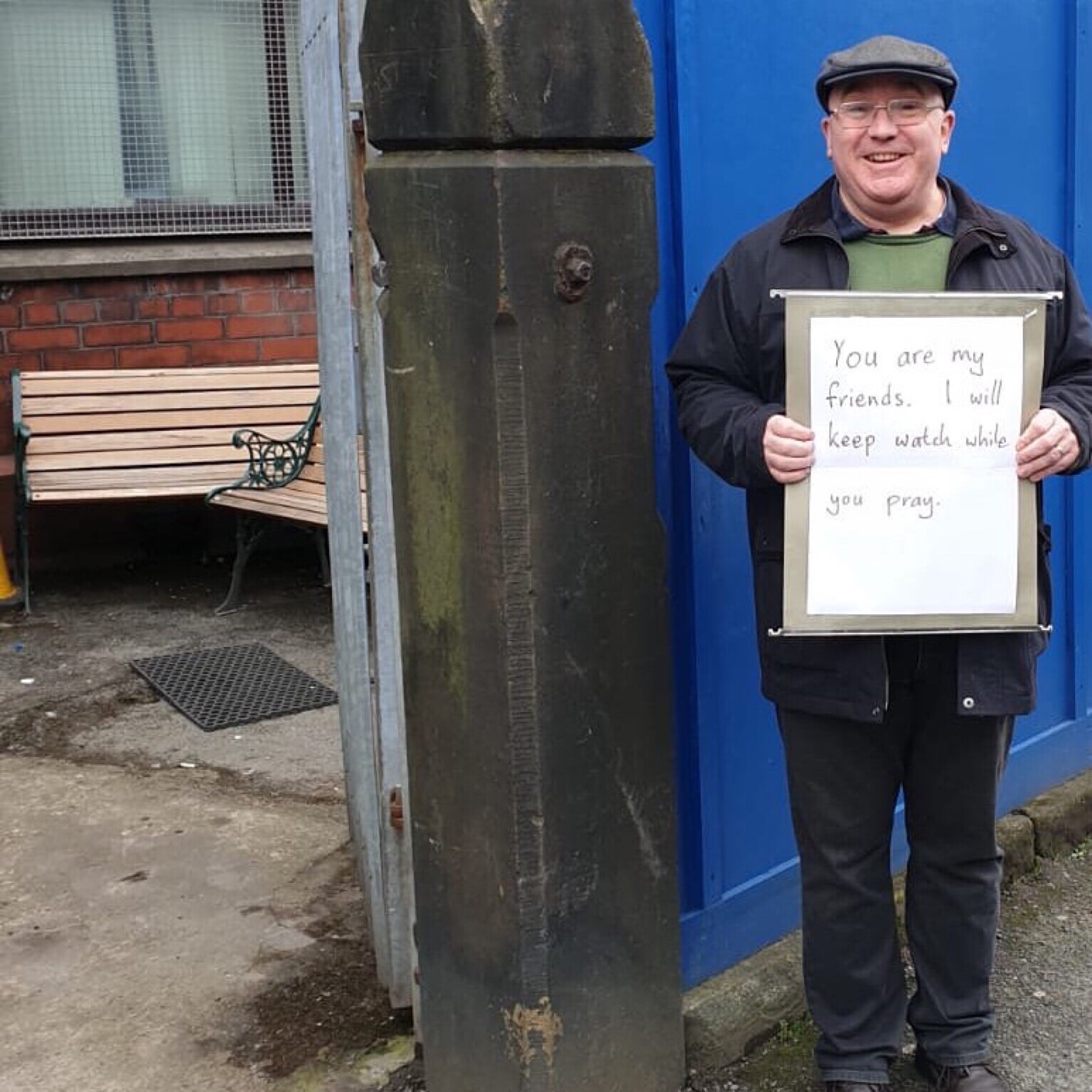
A bit later on, a picture appeared on Twitter [reproduced above] of a man who, if I can say this, did not look like a Moslem, but rather like Andy Capp in the cartoons, in a flat cap, standing smiling outside a mosque in Manchester with a placard which said, ‘You are my friends. I will keep watch while you pray.’

Terrible atrocities do sometimes seem to bring out beautiful and uplifting thoughts, like those of Mrs Ardern and of the man in the flat cap outside the mosque in Manchester.

In our Lent study groups we are going through the Beatitudes, the ‘blessed are they’ sayings which Jesus spoke at the beginning of the Sermon on the Mount in Matthew 5.

The second one, perhaps the right one at a time of tragedy, is ‘Blessed are those who mourn, for they will be comforted.’ This is one of those short sentences that contains impossibly dense and complicated ideas. On the face of things, for somebody to be mourning, to be sad, to be heartbroken, is not in any sense the same as to be fortunate, which is what the word translated as ‘blessed’ means.

How lucky for you that you are heartbroken; what a wonderful thing it is that you are in floods of tears. Clearly there’s something which doesn’t add up. Try telling the distraught people that were on the TV from New Zealand that they were in some way blessed or fortunate. But really it means, as it says, that those who mourn will be blessed, will be comforted in future: and that is a message of hope after all.

St Paul, in his letter to the Philippians, condemns those who live as enemies of the cross of Christ. Earlier in the chapter we had as our reading, he identifies the people that he condemns. He says, ‘Beware of those dogs and their malpractices. Beware of those who insist on mutilation – I will not call it ‘circumcision’’. Beware of people who tell you you have to become a Jew in order to become a true Christian.

Nevertheless, Paul was proud to tell everybody that he had been circumcised and that he was an Israelite of the tribe of Benjamin, a Hebrew born and bred, and a Pharisee [Phil. 3:5]. He’d thrown it all over, after his Road-to-Damascus experience, and in his letters, for example to the Galatians and to the Romans, he made the point that, in the kingdom of heaven, there is no difference between Greeks, (Gentiles), and Jews.

The Israelites had been the chosen people of God, and the others, the Gentiles, the ‘nations’, were the great unwashed. But St Paul’s mission was to bring the good news of Jesus precisely to those Gentiles, to those who were not circumcised. He said, ‘Our citizenship is in heaven.’ Ordinary nationality doesn’t apply in heaven.

But originally, Paul – and Jesus – were Jews, sons of Abraham, descendants of Abraham. The word of the Lord came to Abraham and said, ‘Look toward heaven and count the stars; because that’s how many your descendants will be.’ The sons of Abraham. They were Israelites, the chosen people of God.

The gunman is supposed to have said that one of his reasons for shooting Moslems was because he saw them as strangers, ‘invaders’. At the beginning of this week in morning prayers we were reading from the Book of Deuteronomy, where Moses speaks the words of the Lord, a prophecy about offering sacrifice of the first fruits of the land, the land of milk and honey, which the Israelites have been led into, the promised land. Moses tells them to say in their prayers that they are descended from ‘a wandering Aramean’, or from ‘a Syrian ready to perish’, that they have been led into Egypt and then eventually out of Egypt again, as strangers in the land. Even they, the chosen people, started out as strangers.

There are many passages in the Book of Deuteronomy, and in the Jewish Law generally, which St Paul would have been very familiar with, which impose on Jews a duty to care for a stranger that is within their gates, to care for strangers along with orphans and widows. That is the spirit that Mrs Ardern has so eloquently reminded us of. It is not a spirit of antipathy towards immigrants and refugees, not against strangers, not against people who are different from ourselves.

This is such a difficult area. There are so many apparent paradoxes. The Jews, refugees, made it to the promised land; they went to the holy city, Jerusalem, and set up the temple there. ‘Jerusalem the golden, with milk and honey blest’.

But Jesus points out that, because that is where the council, the Sanhedrin, is based, it is only in Jerusalem that he can be condemned, and that Jerusalem is a city that kills prophets, that throws stones at people who are sent to it.

Mrs Ardern was one of those world leaders, like Mrs Merkel in Germany, who has dared to extend a welcome to refugees. She still extends that welcome. But what about us? The challenge to us today is surely not to be fixated with ‘taking back control’, with restricting immigration and upholding national identity, however important some of those things might seem to be at first.

Jesus said, ‘Strive to enter in at the strait gate. Struggle to get in through the narrow door. For I tell you that many will try to enter and not be able to. You may stand outside and knock: say, ‘Sir, let us in.’ But he will only answer, ‘I do not know where you come from.’ [Luke 13:24]

Where do we come from? You could say that Jesus makes getting into the kingdom of heaven seem like a refugee trying to come ashore in Italy, or trying to get through at the Hungarian border or even being caught up in our own Government’s ‘hostile environment’ at Heathrow today. Contrast that with what Mrs Ardern said. ‘ … They will be refugees here. They have chosen to make New Zealand their home. It is their home. They are us.’

The challenge for us as Christians is to raise our sights above the earthly ghastliness which stems from narrow nationalism, and to seek what is truly heavenly. ‘Blessed are those who mourn, because they will be comforted.’ Let us pray that, with God’s help, we can become channels of peace, so that we too can say that they are our friends, and that we will keep watch while they pray.

Sermon for Evensong on the Fourth Sunday of Advent, 23rd December 2018

Isaiah 10:33-11:10, Matthew 1:18-25

‘In the bleak midwinter’; ‘Snow had fallen, snow on snow’; ‘Good King Wenceslas looked out … deep and crisp and even’. But Bethlehem is a hot place, dusty rather than snowy. I suppose carols and hymns can be rather an unreliable source of proper geographical information. ‘And did those feet .. walk upon England’s green and pleasant land?’

I don’t suppose they sing ‘Jerusalem’ in Italy, or in France or in Germany. Or if they do, presumably those feet were walking in the Black Forest or on the Palatine Hill, or maybe, in the Bois de Boulogne. There is, if we are literal about it, quite a lot of nonsense which we happily tolerate at this time of year. Things that appear to go completely contrary to common sense; like snow in Bethlehem. It probably was quite cold at night in the stable, once the sun had gone down. But there certainly wasn’t any snow.

One of the things that these carols are doing is assimilating the story of the birth of Jesus into our homes, or rather into an idealised version of our homes, because even here in England a white Christmas is, of course, very rare. I think it’s a fairly safe assumption that we won’t have one this year either.

And as well as the carols, the Bible readings that we traditionally use at this time also contain things which look contrary. Isaiah’s wonderful vision of the peaceful life on ‘God’s holy mountain’, after the Rod of Jesse, the Saviour, has beaten the Assyrians, and saved God’s chosen people, isn’t just a pastoral idyll.

It deliberately puts almost impossible companions together. The wolf and the sheep; the leopard, the kid; the calf, the young lion, the cow and the bear – the little child, leading them, like a party of schoolchildren following their teacher around the Tower of London, say.

Or perhaps it’s a classroom, full of these unlikely neighbours, who are not busily eating each other, but they are sitting attentively in class, being kept in good order by a little boy, like my two-year old grandson Jim. In your dreams, Sunshine!

Well, yes; in Isaiah, in Isaiah’s dreams. In the words of the prophet, telling his hearers what God has spoken to him and said, that the Rod of Jesse would come and slay the Assyrians, and then that they ‘would not hurt or destroy on God’s holy mountain.’

Interesting that it is on a mountain, on a high place. The Greek gods were on a mountain too; on Mount Olympus. And in the Old Testament, the heathen gods, the Baals and the Astartes of the Chaldeans, were worshipped with sacred poles, which were ‘in the high places’. ‘High places’ was almost a synonym for where God lived. We ourselves look up, look up to heaven, because conventionally, God lives in Heaven, and Jesus sits at God’s right hand ‘on high’, we say. Think of our Psalm this evening.

Unto thee I lift up mine eyes:

O thou that dwellest in the heavens. [Ps. 123]

But again, it’s not literally true. Yuri Gagarin, the first astronaut, was said by Nikita Krushchev to have gone into space ‘but not to have seen God there’. The early astronauts didn’t find a man with a white beard sitting on a golden throne and floating above the clouds. John Gillespie Magee’s wonderful poem, which is often read at the funeral of a pilot, ‘High Flight’, comes to mind. ‘Oh, I have slipped the surly bonds of earth … put out my hand and touched the face of God’. And so, on God’s holy mountain, children can safely play with cockatrices, vipers, and with asps, cobras. ‘Sheep may safely graze’.

It’s a much better outlook for the Israelites. The Messiah would come along and free them from slavery. The Rod of Jesse would mete out retribution to all their foes. That’s something that we can certainly relate to. ‘If only ..’, we say. If only: what would you call in the Rod of Jesse to do in your life? But maybe we are too comfortable, too well settled to really empathise with how the Israelites must have felt.

But there are people who are in exile, who are not free, who may even be subjected to slavery, even today, not far away. On Friday I did my first Father Christmas duty of this Christmas, up at Brooklands College, where there is a project for children who are asylum seekers and refugees. I gave out splendid big stockings full of goodies donated by the supporters of the project and by Elmbridge CAN, our local refugee support group, to 26 young people, teenagers and in their early 20s, who had come from Eritrea, from Syria, Ukraine, from Kurdistan, Iraq, from Afghanistan. Some were black Africans, some were Arabs, a couple were Chinese, and a couple were white Europeans. Many do not know whether they will be allowed to stay.

Some were learning to read and write for the first time; although typically, the ones who hadn’t been able to read and write were amazingly good at mental arithmetic. They were learning English, of course, and learning how to fit in with English society. The first words that they are taught are ‘please’, ‘thank you’, and ‘sorry’, because none of those are necessarily expressions that you come across in some of the countries that they have come from. Part of Father Christmas’ visit was a huge lunch, of Middle Eastern and African delicacies, that one of the volunteers from Elmbridge CAN had made. For about half the children, this would be their only meal that day. One meal, if you’re lucky. This is in Weybridge!

So pictures of the Israelites, in exile and under the oppressor’s boot, could still in certain circumstances be a picture of contemporary life, for refugees and asylum seekers today. Think what life in the refugee camps must be like, in Jordan, for example. No snow there, either!

As well as the mythical snow on this fourth Sunday of Advent, just on the eve of Christmas itself, St Matthew tells us the story of the other half of the Annunciation. This isn’t about Mary but about Joseph her betrothed. Again, the Christmas story is so familiar that we perhaps gloss over the bits that seem rather unlikely. Joseph’s original reaction when he finds out that his wife-to-be is pregnant, although he has had nothing to do with it, is what you might expect. His first thought is that the wedding is not going to happen.

Who is the Angel Gabriel? Have you met any angels recently? Or at all? It seems to depend a bit on where you come from and what you’re used to. In Africa and in Southern Europe, people are much more ready to believe in the existence of angels than perhaps we are. I don’t think that we can explain the Virgin Birth in the same way that we could explain how to bake a perfect soufflé – or whatever it is they do on the Great British Bake-Off.

But look at it functionally. Jesus definitely lived. He was a human being, although during his life and afterwards, things happened which have led us to believe that he was more than human, that he was divine as well as human. So somehow he must have been born, been conceived. All the things that show that he was really born, that he really was human, just like the other miracles, turning water into wine, miraculously healing sick people, raising Lazarus from the dead – none of those can be explained: so Jesus’ conception is equally mysterious and impossible to understand.

But notice how Jesus’ earthly parents, wonderfully, accepted the situation; and of course Mary said the Magnificat, which we’ve just sung together. God has chosen me; God has magnified me; God has made a big thing out of me.

Is it just a pretty story, then? Is it just a convenient excuse to have a nice time at Christmas? Think about what Mary said. Think about the message of the Magnificat, and the message of Isaiah, about the animals on ‘God’s holy mountain’. ‘He has put down the mighty from his seat, and exalted the humble and meek.’ Are we the mighty? Or are we the ‘humble and meek’?

We need to think about it, and to do something. Perhaps the other thing about God’s holy mountain is that a little child shall lead them. Shall we say that that is the Christ Child? You know, in snowy Bethlehem? And another thing. ‘No crying he makes’. This is some baby!

High Flight

Oh! I have slipped the surly bonds of Earth

And danced the skies on laughter-silvered wings;

Sunward I’ve climbed, and joined the tumbling mirth

of sun-split clouds, — and done a hundred things

You have not dreamed of — wheeled and soared and swung

High in the sunlit silence. Hov’ring there,

I’ve chased the shouting wind along, and flung

My eager craft through footless halls of air….

Up, up the long, delirious, burning blue

I’ve topped the wind-swept heights with easy grace.

Where never lark, or even eagle flew —

And, while with silent, lifting mind I’ve trod

The high untrespassed sanctity of space,

– Put out my hand, and touched the face of God.

John Gillespie Magee (1922-1941)