Archives for posts with tag: king david

Bible readings: https://bible.oremus.org/?ql=567221767

This morning we thought about the parable of the talents and Zephaniah’s prophecy of doom directed at people whose wealth had made them contemptuous of God, who built houses and did not live in them. We were thinking about economics, and wondering whether Jesus and the prophets had to some extent foreseen some of the insights of Karl Marx.

So this morning was economics and this afternoon is politics, or to be more precise, government. We have a description of the change of government, 3,000 years ago in the time of King David. We may look forward to a general election from time to time, but King David could do it simply by having his successor, his son Solomon, anointed, as a result of a promise which he had made to his mother Bathsheba.

You will remember the pretty dreadful story in the second book of Samuel, chapters 11 and 12, telling how King David had taken a fancy to Uriah’s wife Bathsheba when he accidentally saw her in the bath; he engineered for Uriah her husband, who was a soldier, to be put in harm’s way and killed in battle so that he could marry Bathsheba, and how the prophet Nathan had told this story.

‘In a certain town there lived two men, one rich and one poor.  The rich man had large flocks and herds; the poor man had nothing of his own except one little ewe lamb he had bought. He reared it and it grew up in his home together with his children. It shared his food, drank from his cup and nestled in his arms. It was like a daughter to him. 

‘One day a traveller came to the rich man’s house and he, too mean to take anything from his own flock or herd to serve to his guest, took the poor man’s lamb and served that up.’ David was very angry and burst out, ’As the Lord lives, that man deserves to die! He shall pay for the lamb four times over because he has done this and shown no pity.’ Nathan said to David, you are the man.’ [2 Samuel 12:1-7]

And David repented, although the Lord still punished him by saying that the child which he had fathered adulterously with Bathsheba would die, and he did: but then they had another son, Solomon, and David promised to Bathsheba that Solomon would inherit the kingdom after him.

Our lesson today was about how that promise was carried out. David, although he was a bad man in many respects, was a great king, and he kept his promises. I’m not sure that there is more than historical interest in the story so far as we are concerned, because we do depend on democracy in being ruled, rather than the divine right of kings.

Jesus was known as the son of David; he was in a line of descent from King David as the enormous and slightly different genealogies, that you find in Matthew 1 and Luke 3, demonstrate. It was important in that world to be able to prove your ancestry. Perhaps there is a small lesson about how people can change their ways, reform and repent, because there is an interesting little sideline at the very beginning of the lesson from the first book of Kings which we had. The king was very old and Abishag the Shunnamite was attending the King. She was another beautiful young woman, much in the way that Bathsheba had been. But we are told, a little bit earlier, that she had been brought in essentially to keep the old King David warm in bed. But the account takes care to tell us that he did not misbehave. There was no hanky-panky.

In our second lesson we go from divine succession 3,000 years ago to the end times, God the Alpha and the Omega, the beginning and the end. This is something which is far beyond our understanding. If you think of our expanding knowledge of the cosmos, of the billions of years and billions of miles in time and space, it seems odd that one can simply say that God is the Alpha and Omega, the beginning and the end. 

I think that mathematicians and philosophers will struggle today to tell you really what a beginning or an end of everything could possibly be. There will be some who will say that indeed they are logically impossible, because whatever you suggest to be the beginning, you can always imagine something that came before it; and the same is true of numbers, that whatever number you end up with, you can always add another one. 

So St John’s vision, when he was ‘in the spirit on the Lord’s day’, is as good as anything, as a vision of something which is completely beyond man’s understanding. This figure, of the ‘Son of Man’ clothed with a long robe with a sash of gold across his chest, says, ‘Do not be afraid. I am the first and the last, and the living one.’ It’s a vision of the kingdom. ‘Look, he is coming with the clouds. Every eye will see him, even those who pierced him’.

Well, I don’t think we are ready for him. Our world is full of terrible war, and our government, which I guess, at least so far as the ministers are concerned, you could say has not really been democratically elected but rather anointed, seems more concerned to be inhospitable to poor desperate refugees, than to do any of the other things that a good government should surely do. 

This is the time in the Christian year called the kingdom season, when we look forward to the coming of Jesus into the kingdom of God. But are we ready, and would we recognise Jesus? What if he came on one of those boats, or what if he was one of the brave surgeons still operating in the hospitals in Gaza? 

What would Jesus say? Dare one say it, he might well say it was time for a general ceasefire – everywhere.  All hostilities. This is the beginning. This is the ‘alpha’ of the kingdom. Let us pray that, until things get better, until ‘they shall not hurt or destroy on God’s holy mountain’, until then, there may be an alpha – but no omega.
Sermon for Mattins on 3rd Sept 2023 at All Saints Church, Penarth

Romans 12:9-21

Matthew 16:21-28

https://bible.oremus.org/?ql=560606098

What does it mean to be a Christian? Is it one of those organisations that have a rule book or a constitution which you have to keep to if you are going to be a member? Some people say that they think that what’s really valuable about Christianity is that it provides a moral compass that people can live by, especially today, when even in public life people do things and say things that perhaps in the past we wouldn’t have thought possible.

I won’t try to trace that pattern through recent history, in case I say something wrong about one of your heroes; but I think one could mention in passing things like former President Trump continuing to repeat a patently untrue story about having won the last election, for example: and I think it would be fair enough to have in mind some of the things that former prime ministers of recent years have said as well, as being ‘economical with the actualité’, as somebody once described it. You hear people say, ‘Things are going to the dogs’: ‘The policeman are getting smaller’: ‘Nobody knows the difference between right and wrong any more’.

So it’s interesting to come across what almost looks like a rule book for being a Christian, in what St Paul wrote to the Christians in Rome. ‘Let love be genuine; hate what is evil, hold fast to what is good’. ‘Rejoice in hope, be patient in suffering, persevere in prayer. Contribute to the needs of the saints; extend hospitality to strangers.’ It reminds us of Jesus’s own Sermon on the Mount (Matthew 5). St Paul says do not repay anyone evil for evil, for example. Live in harmony with one another – and in the Sermon on the Mount, Jesus says don’t just go tit for tat, an eye for an eye, a tooth for a tooth, but turn the other cheek; if someone wants your shirt, give him your coat as well. If a ‘man in authority’ makes you go one mile, go with him two. Give when you are asked to give and don’t turn your back on someone who asks for a loan. Jesus and Paul are pretty similar. This is the moral philosophy of Jesus Christ. Saint Paul, writing to the Romans, was probably writing before any of the gospels were written down, so it’s pretty clear that what he was saying reflected what all the early Christians held to by way of their moral beliefs.

I was thinking about that when I started listening to one of those radio programmes where the Archbishop of Canterbury interviews various people. I don’t know whether you’ve come across them, on BBC Radio 4, but I heartily recommend them. They are absolutely fascinating. The interviews are with a very wide variety of people. I think it’s true to say that most of them are top people, leaders, in one way or another, but they’re not necessarily people who would immediately spring to mind as wanting to have a public chat with the Archbishop of Canterbury.

A person like that was a lady called Dr Susan Blackmore, whom I’m sure some of you will know far better than I do: she was certainly a new one on me. It turns out that she is a ‘psychologist who is interested in the paranormal and matters spiritual’, according to the BBC, and who is keen on ‘Zen meditation’.

A lot of the people that Archbishop Justin interviews are not actually believers but are atheists, and Dr Blackmore is one like that. What struck me was that she and Justin Welby both seemed largely to believe in the same moral principles: they would both, I think, have recognised the same things as being good and bad; and if you took the labels off I think that Dr Blackmore would have been quite happy with most of the moral ideas outlined by Saint Paul – and indeed, by Jesus himself. She certainly believes that mankind is capable of altruism, going the extra mile and so on, being generous to strangers, and also, to some extent, in being ultimately generous: ‘greater love hath no man’ and all that, sacrificing oneself for your friend.

Then a very interesting moment in the conversation happened. These two people, who appeared to be identikit decent middle-class English people, with plenty of goodwill towards their fellow men and women, suddenly came to something which clearly stopped both of them in their tracks.

That was this: Dr Blackmore asked the Archbishop, “Hey, look: what would happen if it turned out that you discovered that there was good scientific evidence that the resurrection of Jesus Christ never happened, and that Jesus had died just like any one of us – and stayed dead?” Clearly Dr Blackmore expected him to say that it wouldn’t matter too much; that he had a ‘belief in the round’ and that he would still be a Christian even if it turned out that Jesus was just another bloke, perhaps a prophet, as Muslims believe.

But Archbishop Justin didn’t say that. He said, “Well, if Jesus wasn’t resurrected from the dead, it would be over. All my Christianity would be washed up instantly.” He said that it might be possible, perhaps, that he would revert to a kind of agnostic position about whether there was a God, in the sense of an ultimate creator, but he was quite clear that, just like St Paul, he believes that the whole thing depends on the resurrection of Jesus. In his first letter to the Corinthians Paul says, “If Christ was not raised, then our gospel is null and void” (1 Cor. 15:14).

It isn’t the case that Christians believe in a sort of generalised creator, a creative force, some kind of ill-defined spiritual positive force, what William Paley in the 17th century referred to as the divine watchmaker: a creator, who, sure enough, created the world and everything in it, and just like a watchmaker he had made the mechanism and set it off, and away it went without any further interference from him. That’s not Christianity.

Christianity is about Christ; and that crunch moment is what we see in the story from Saint Matthew’s Gospel, with Saint Peter trying to talk Jesus out of going to suffer and die in Jerusalem. Jesus knew what was waiting for him, and he told the disciples about it. Peter reacted as I think any of us might have reacted if we’d been there. He didn’t want to see this good man, who’d taught him so much and had shown him so many wonderful things, hurt in any way.

But he didn’t get it. Peter acknowledged Jesus as his Messiah, as his heavenly king come on Earth. But he didn’t really know how that worked. He probably had a picture in mind of something more like an earthly king, a King David or a Roman emperor in triumph; and of course, Jesus turned everything upside down, as he always did. The triumph was a triumph over suffering. He had to suffer first, before his triumph, because he wasn’t a king who was above all suffering, but was rather a king who was at the heart of everything, suffering what his people suffered – and worse.

It might be interesting at that point just to look back to the differences between how St Paul saw morality as it affects Christians – and how Jesus himself did ; and to compare it with somebody like Dr Blackmore the psychologist, who denied that there was any such thing as free will, but seemed to be able to recognise good and evil nevertheless. She certainly didn’t acknowledge that there was a God, or that Jesus was in any way divine. I think that, although she didn’t actually say so, she didn’t believe in the resurrection.

But if you say that you don’t believe that people can choose what they do freely, because you’re determined, pre-programmed, so you are fixed by your evolution, your genes and your experience, then is there any real meaning to good and evil? Dr Blackmore is left looking down an empty hole. On the other hand Saint Paul can say, “Hold fast to what is good”, because he can point to what Jesus has said, and through Jesus, in Jesus, Saint Paul recognised ultimate reality, a justification for everything.

Justin Welby said that when he was 19, in his second year at university, a friend had taken him to church and then on to supper, during which the friend had been telling him about the cross and the resurrection of Jesus, and the Archbishop said there was suddenly a ‘sense of presence’ in the room. “I’m not sure how to explain that,” he said, and his friend had apparently said, “What do you want to do now?” The Archbishop had said, “Whatever it is, it is good – and I need to cooperate with it”.

It’s perhaps a bit like John Wesley, walking down Aldersgate Street to a Bible study meeting, to study one of St Paul’s letters, and he said he was feeling a little bit reluctant, perhaps because he had done too much Bible study that day, and then all of a sudden he ‘felt his heart strangely warmed’. He had a strong feeling that Jesus, God, was there and that He did care, personally, for him.

Dr Blackmore by contrast, when she was 19, had one of those out of body experiences – although she did say she was smoking cannabis at the time – but apparently she experienced a very real feeling of going down a tunnel with a light at the end, which is an experience which quite a number of other people have testified to, but which doesn’t necessarily lead you to believe in God.

So what is it that makes you a Christian as opposed to someone who does Zen meditation? The difference is Jesus. The difference is the unique history of Jesus. After this we will say the creed – we’ll say, “I believe”- and there is nothing like it. Maybe there are some bits that you find difficult to understand or even to believe. But taken as a whole it is like the constitutional document for being a Christian.

I believe. I believe in God the father Almighty. I believe in Jesus Christ, who was crucified, died and was buried. On the third day he rose again. There is nothing like it. Frankly we wouldn’t be here, and there wouldn’t be people in church all round the world, if that was some kind of illusion, if it hadn’t happened.

As the Archbishop himself said, there are today about 85 million Anglicans, let alone the other denominations, Roman Catholics, Baptists, Methodists, Lutherans, Pentecostals, Orthodox, and although in Western Europe and in the northern hemisphere generally, fewer people are coming to Christ, in the world as a whole Christianity it’s still far and away the biggest and fastest-growing religion.

Christ is coming to more and more people. More and more people are being confronted by this amazing story and realising that they can’t make sense of their lives without in some meaningful way coming to terms with it. And they realise that coming to terms with it isn’t necessarily a picnic.

As Jesus himself said, ‘If any want to become my followers, let them deny themselves and take up their cross and follow me’. It’s not a prosperity gospel. It can be tough, but once you’ve confronted it – once it’s confronted you – then your life is changed forever. If you do the things that St Paul recommends, your love will be genuine, you will rejoice in hope, you will be patient in your suffering; and, so far as it depends on you, if it is possible, (because Paul is a realist), you will live ‘peaceably’ with all.

That’s a perfect context for this service. What we are doing is celebrating, praising, the God who came to us in the form of a man, went through terrible suffering, died, in the most horrible and undeniable way, and then, on the third day, he rose again. So today we must give him our praise; and we must show our love, love for God and love for each other.

Sermon for Evensong at All Saints, Penarth, on the 6th Sunday after Trinity, 16th July 2023

2 Samuel 7:18-29

Luke 19:41 – 20:8

See https://bible.oremus.org/?ql=556283310 

When I was little, my folks, especially my Dad, were very fond of a TV show which I think went out on Sunday nights, called the Dave Allen Show. It featured an Irish comedian called Dave Allen. I remember the way the shows always ended. Dave Allen would be sitting on top of a high stool, nursing a glass of Irish whiskey and, somewhat improbably, smoking a cigarette. He would say some warm words of farewell to his audience, and as the applause died down, he would sign off with the same greeting every week: – “May your God go with you”. 

I’ve always found that rather intriguing. It seemed to me that Dave Allen had this picture of everyone having their own private God in their pocket, almost like some kind of super talisman or a piece of ‘Kryptonite’, if you prefer a Superman analogy. Maybe he just wanted to acknowledge the fact that, in his audience of millions, there would be people who had many different beliefs, followed different religions – which is perhaps another way of saying that they followed different gods.

And certainly, when we look at the story of King David making his prayer to God, after he had asked the prophet Nathan to consult God about whether he should make a house for God, now that he himself as a king had a nice house made of cedar wood, in that context, in those days, it looks as though when David was thanking him, for all that he had done for him and the people of Israel, that he was their God, and not a god for anyone else. Indeed it did look as though your religious belief then was all about finding a god who was stronger than your enemy’s god or even your neighbour’s god.

The people of Israel had come in to the promised land out of Egypt; and they had quite a lot of fighting to do against the indigenous people whom they displaced. I don’t want to get involved in discussing Zionism on this occasion, but I did want to point out that people have seemed to have understood what it is to be a God, or to be God, in a fairly local, parochial, sort of way. So they worshipped the one true God partly, we could say, in a Dave Allen sort of way. He was their God, and it was the foundation of their success, or at least of the survival of Israel.

The prophet Nathan told King David that he had consulted God and God did not want David to make a house for him, but David did bring the Ark, the Ark of the Covenant, to Jerusalem, to his capital city, so there was a sense in which God was local; the Israelites’ God, supporting them against the other people and their gods. But God told Nathan that up to that time he had never lived in a house, but rather had lived in a tent or a tabernacle. 

There was a sense in which God and the king were tied up with each other. God wasn’t based anywhere, but He was with the king. It’s a very persistent idea, the idea of the divine right of kings, even in our history. So by having the Ark of the Covenant in his capital, David, in one sense, had God behind him, or possibly, in the Dave Allen sense, somewhere even closer.

But we might feel that’s not quite right, I think. Because surely God is much bigger than that. If he is all powerful, all knowing, the creator – and he may not be ‘he’ or just ‘he’ alone; for instance he could be he, she, they – or all of them. And indeed when David makes his prayer – which was our Old Testament lesson – you can see that he understands how much bigger God is than anything else. 

‘Therefore you are great, O Lord God; for there is no one like you, and there is no God besides you, according to all that we have heard with our ears’. 

But at the same time David also thinks that God is in his pocket too:

‘Who is like your people, like Israel? Is there another nation on earth whose God went to redeem it as a people, and to make a name for himself, doing great and awesome things for them, by driving out before his people nations and their gods?’

My God is mightier than you other people’s gods.

Then along came Solomon and built the first temple. So although God had told Nathan that he didn’t need a house, nevertheless eventually he got one. That temple lasted 400-odd years from 957BC till 587 when the Israelites were captured by the Babylonians and taken into exile. ‘By the waters of Babylon we sat down and wept.’ And the temple was destroyed. Fortunately, 70-odd years later, Cyrus, the Persian king, liberated them from the Babylonians and let them go back and rebuild the temple. It was finished in 515BC. It was God’s house, the place where the Ark of the Covenant was kept; where worship took place and sacrifices were made.

We come back to it 500 years later, when we read in our New Testament lesson from Saint Luke’s gospel, which is a passage taken just after the Palm Sunday story, and Jesus prophesies the overthrow and destruction of Jerusalem. He went on to throw out the moneychangers and people doing business of one kind or another within the bounds of the temple. “My house shall be a house of prayer; but you have made it a den of robbers”. It was an accurate prophecy because the Romans destroyed the temple in 70AD.

The beginning and end of the story of the Temple, the House of God, and the two different ways of thinking of God, living in a house or being over all houses, not confined, were mentioned in one of the first great Christian sermons, when St Stephen went through the history of the people of Israel and their God in the Book of Acts chapter 7. He said, 

‘Yet the Most High does not dwell in houses made by human hands; as the prophet says,
 “Heaven is my throne,
   and the earth is my footstool.
What kind of house will you build for me, says the Lord,
   or what is the place of my rest? 

Did not my hand make all these things?”’ 

He’s quoting Nathan, from our Old Testament lesson.

So where does God live? Is he defined by time and place? Today I don’t think we worry much about asking that question. It seems pretty obvious to us, I think, that the divine can’t be limited in time and space. By definition, someone who is all powerful, all knowing, eternal. But still, I don’t know whether we spend enough time – or any time really – thinking about who it is that we are praying to. Is it God who lives in a house, or is it that God who is characterised by those ‘omni’ words; omnipresent, omniscient, omnipotent?

I don’t think people will necessarily fight you, these days, about whether God is a partisan God – whether our God is stronger than your God – as opposed to tackling you about whether he exists at all. If that happens, if you encounter Richard Dawkins, or one of his acolytes in the new atheists, then it might be tempting to say that your belief is divinely sanctioned; you, as a Christian, sense His real presence. 

But how do you know? How do you know it’s God? It’s the question Jesus was asked. ‘Tell us by what authority you are doing these things. Who is it who gave you this authority?’ Jesus gave quite a tricky answer.  

But we wouldn’t hesitate, surely, knowing what we do. We would say he got his authority from heaven. Then the question is the question Jesus asked. If you think that I get all this stuff from heaven, why don’t you take any notice? 

Fortunately that’s not where we came in. Instead we are back with Dave Allen. Where is our God? Does our God go with us? I pray – I believe – that He does. The Lord is here. His Spirit is with us. Everywhere.

Sermon for Evensong on 20th November 2022 at All Saints, Penarth: Christ the King

1 Samuel 8:4-20: John 18:33-37: Psalm 72. See https://tinyurl.com/ydmp6t26

This Sunday the church celebrates ‘Christ the King’.

Kings. God save the King! King’s Counsel: King Charles III – and now today, in the church, we are celebrating Christ the King. Actually, the church has only had a feast of Christ the King since 1925, when Pope Pius XI first made it a festival in the Roman Catholic Church; and in 1969, Pope Paul VI determined that the right time for the festival would be the last Sunday before Advent, at the end of the church year.

Now, never mind whether you are a Catholic or an Anglican or a Methodist or a Baptist, you will probably be using the same readings from the Bible this weekend for the various services in your church, and thinking about Christ the King. We Anglicans have something else, earlier than the feast of Christ the King, to celebrate at the same time. I’ll come back to it.

You might think that I was going to pick up on what Samuel has said in our Old Testament lesson about the the disadvantages of kings, of absolute monarchy. If you were reading it in the King James version, you would see that Samuel warns the Israelites that if they make somebody a king, among other bad things, he will “take your daughters to be confectionaries”. In the rather more down-to-earth version which we have been using, the confectionaries have become “perfumers”, but either way you wouldn’t want your daughter to become perfumers or confectionaries to the King. That sort of king has a distinct whiff of slavery about him.

Now today, I think if you read some of the newspapers, the ones that have a rather bigger section about the royal family than my beloved Guardian, there are quite often articles which speculate on what in the old days the Queen, and now the King, might be thinking about the various things that the government is getting up to. And perhaps people might start to think that a wise king would be preferable to yet another Prime Minister. But then we remember that we have a constitutional monarchy. For us the King is just a figurehead, even if he is an inspiring one.

But it’s interesting to look back at the argument about the pros and cons of being a king that was going on between Samuel and the elders of Israel. They said, ‘Give us a king to govern us’. And then there is this fascinating sentence, “Samuel prayed to the Lord, and the Lord said to Samuel, ‘Listen to the voice of the people and all that they say to you. For they have not rejected you, but they have rejected me from being king over them.’’’ It’s God speaking – and He says that the people have rejected the idea that He, God, should be their ruler, their king.

The way that they thought about God in those days was that He was much more like a kind of Marvel comic superhero than what we think God is. Having the Lord on your side in those days was a huge advantage, for instance in a battle, and they didn’t seem to be worried about the thought that He might be much bigger than just a superhuman supporting one side against the other. So a king could even be God. God could be a king. It gives a historical background to the idea of the ‘divine right of kings’ – that the first King Charles claimed, for instance.

So it wouldn’t have seemed strange to the Israelites to hear that God had said that they had rejected him, God, from being their king over them. But it’s strange to us. We would think of God as being bigger than any king.

Now when Jesus is being questioned by Pontius Pilate, it’s perhaps a rather different kind of strangeness which we notice. Surely it is pretty strange to ask somebody whether they are a king. I think it’d be pretty hard to miss, certainly in normal circumstances. I mean, I am not assuming that people who were kings went around with crowns on their heads so you’d be able to recognise them as royals, but even so you would have thought that it would have been pretty obvious to Pontius Pilate whether Jesus was a king or not.

Indeed, Jesus does query this. ‘Was that a question that occurred to you or has somebody else suggested it?’ And Pilate, who always seems to me to be a pretty common-sense sort of person, says that he doesn’t really get it. He says, ‘Your own nation, the Jews and chief priests, have handed you over to me. It looks a bit of an unlikely thing to do to a king. So what have you done?’

Jesus replies that he’s not a temporal ruler, a ruler in this world, a political figure, in which case he says he would certainly have been able to call upon his followers to fight off the Jews, and keep him from being handed over to them. In the normal course of things if he was at risk of being seized by the Jews in some ignominious way, it wouldn’t sit very easily with the idea that he was, or might have been, the king of the Jews.

So you’ve got two angles on being a king. One in the Old Testament, and the other one from the time of Christ; but in neither case does the idea of what it was to be a king at that time really square with what we understand about kings.

In the Old Testament, a king could also be a God, or even God himself. Bear in mind that the Jews were unique in worshipping just one God, whereas most of the others, like the Egyptians or the Babylonians, worshipped lots of different gods. The Jews worshipped Yahweh as their God, just the one God.

We have learned that when a new king was consecrated in Egypt or Babylon, the priest would declare an oracle from one of the national gods over the new king, and what he would say was, ‘You are my son, I am your father.’ That’s the god speaking through the priest. So in Babylon and Egypt, they believed that being a king was even being the son of a god.

That is the same formula that the prophet Nathan used when he consecrated David as the king of the Jews. If you look at 2 Samuel 7:14, through the prophet Nathan, God says about King David, ‘I will be a father to him and he shall be a son to me’. So King David is expressed to be a son of God.

So that’s the background to what on the face of things is rather an odd conversation between Pontius Pilate and Jesus. Pontius Pilate, who is just a normal bloke in this, doesn’t understand that in the Jewish tradition, to be the king means much more than just being an earthly ruler.

In a sense, Pontius Pilate stands for all of us. He saw this remarkable man, who had no crown, no entourage, no motorcade, no trappings of majesty about him – rather the reverse – but nevertheless, he was being accused of holding himself out as being the king of the Jews.

What made it so serious was that to the Jews it would have meant Jesus was holding himself out as being the son of God. Since they didn’t recognise him, they thought that it was blasphemy. Everybody got it wrong. It’s another illustration of the way that Jesus was a king, but a king in an entirely different sense.

Think of the idea of the Servant King in Isaiah 52:13 – 53:12, picked up in St Mark’s gospel 10:45 where Jesus says that ‘the Son of Man did not come to be served, but to serve’, for example, and what Jesus said about the first becoming the last and the last becoming first (Matt. 20:16).

The more I think about this, the more I realise this is like so many other things that we learn about Jesus. In a sense, he was a king, but in other senses he was much more modest. I think we can learn from him on all sorts of levels as a result. God isn’t like superman. He doesn’t necessarily weigh in on one side or another. But equally he is not a normal king. He doesn’t have the trappings of office and he doesn’t rule in the sense that King Charles rules, or even like an actual absolute monarch – as King Zog of Yugoslavia did, perhaps.

Instead Jesus defined his kingship in relation to something he called the truth. ‘Everyone who belongs to the truth listens to my voice’. And Pontius Pilate came up with the sort of thing that you might hear from Piers Morgan: ‘What is truth?’ It’s a good challenge.

That’s all very interesting, you might say. All that stuff about being a king. But at the beginning you did say that the Feast of Christ the King is a celebration. How are we supposed to go about celebrating? You get the answer in the first collect, the first prayer of the day, which Beth will say. It goes, “Stir up, we beseech thee, Lord, the wills of thy faithful people”. So today is not just Christ the King Sunday. It is sometimes called “Stir-up Sunday”. This is the day when you are supposed to start mixing the Christmas pudding. That is something to celebrate. I wonder, if you are stirring up a Christmas pudding, if it makes you what Samuel called a ‘confectionary’. Why not be a confectionary? A confectionary for King Jesus, indeed. Keep stirring!

Sermon for Evensong on the Fifth Sunday after Easter, 26th May 2019

Zephaniah 3:14-20; Matthew 28:1-10, 16-20 (see http://bible.oremus.org/?ql=425693885) – But what about the Bigots?

‘Sing, O daughter of Zion; shout, O Israel; be glad and rejoice with all the heart, O daughter of Jerusalem.’

You can tell, even without reading the whole book, that this passage at the end of the book of the prophet Zephaniah turns things around. The first two chapters of the book are not joyful; they are more like lamentations. The kingdom of Israel, the people who made the exodus from Egypt, who had David and Solomon as kings, had split into two kingdoms, the northern kingdom called Israel, and the southern kingdom, Judah, in which was Jerusalem.

In 721 BC the northern kingdom was destroyed by the Assyrians. Zephaniah was prophesying some time after that, probably about 100 years later, in Jerusalem. The sub-heading in one of my Bibles on this passage is, ‘Doom on Judah and her neighbours’; so the first part of the book is all about how the kingdom of Israel, which has become the province of Judah, has gone to pot.

The great day of the Lord is near, …

That day is a day of wrath, a day of trouble and distress, a day of wasteness and desolation, …. And I will bring distress upon men, that they shall walk like blind men, because they have sinned against the Lord: (Zephaniah 1)

Why is the Lord cross with his people? Zephaniah says,

“Woe to her that is filthy and polluted, to the oppressing city!

She obeyed not the voice; she received not correction; she trusted not in the Lord; she drew not near to her God.’ (Zephaniah 3:1-2)

This was all nearly 3000 years ago, but there are definite resonances with things that are happening here today. I wrote this sermon originally on Friday, and I didn’t think we would know the outcome of the EU election until after 8 o’clock tonight, as we have to wait until all polling stations in all EU member states are closed – and most of the countries are having their vote today.

I suspect that it will turn out to have been a strange business, and whatever the outcome, we will all continue to have a more or less uneasy feeling that something is wrong with our society, and with our country, at the moment.

Whether it goes as far as the sort of thing that Zephaniah was prophesying about is obviously a moot point, but it seems to me that it’s not controversial to say that, wherever you are in relation to modern politics, whatever you believe in, this is a time to be concerned and worried.

The idea that comes from Zephaniah in the part which was our first lesson today, ‘Sing, O daughter of Zion’, … ‘be glad and rejoice’, is something which I think we would all respond very well to. We would love to feel that everything was right with the world, and that we could relax and be joyful.

Unfortunately, we’re not there yet. I don’t think that it’s going to help very much for me to try to spell out to what extent any of the competing parties and interest groups – ‘interest groups’, because the Brexit Party isn’t a political party, it’s actually a limited company – it isn’t going to be easy or productive at this stage to try to relate aspects of each of these people to the eternal verities which we are trying to understand and to carry out in our Christian witness.

It’s no good trying to say whether one or other party or interest group is better or worse at trying to bring the various parts of society back together, so as to finish the various arguments which have so divided people. It isn’t even worth it at this stage to try to express a view on what is going to help people materially, or perhaps more realistically, to hurt them least, in the various proposals advanced by the various parties. People are not listening to rational arguments.

What would Jesus say? I really don’t know. But I think it’s worth reminding everyone that it’s a good question. If we sit down quietly and try to work through the various propositions which have been put to us, from the time of the referendum three years ago until now, it might be a very good exercise to look at each one in the light of that question.

What would Jesus have done? What would Jesus have thought about these various things?

I went on Thursday night to our friends at St Martin’s in East Horsley for a talk which they had organised, by the long-serving former MP, Chris Mullin, who is well known for his many books, including ‘A very British Coup’, which was made into a TV series. After he had given his talk, from the audience a lady stood up and, I think, rather shocked everybody. I should tell you that the audience was about 30 people, and they could easily have been from here. Normal bods, tending towards the middle-aged if not slightly elderly; middle-class, middle-aged, respectable people. When this lady stood up, asked her question and made her point, she looked exactly the same as everyone else. But she wasn’t.

She told us that although she had grown up in this country, had lived here for many years and had worked as a solicitor for a City firm, she was not English. She was German, and her father had been head of the UK division of the great German engineering company Siemens, which has a number of factories here, and has had for many years. She is married to an Englishman. After the referendum result, her husband had said that he thought that it was not going to very nice for their family to carry on living in England – meaning, not very nice for his wife, for his German wife. So they now live in Spain. There they have recently bought a new car. One of their neighbours, she said, wondered whether it was going to be a Range Rover, and said he hoped that it wasn’t – because they didn’t want to see anyone buying anything British for the time being.

And I, as I think some of you will already have heard, had a similar experience shortly after the Brexit referendum when I went to Hamburg, and some of my German friends, several of whom have been friends for 30 or more years, all said more or less the same thing to me, the same simple sentence: they said, ‘But we thought that you were our friends’. Imagine how I felt.

No more comments on that. We all have strong views. But what would Jesus say about it? I wonder.

Let’s move on to our second Bible lesson, from St Matthew’s Gospel. It’s the resurrection story, the empty tomb, which we have read about in St John’s and St Mark’s Gospels already, during this Easter time.

For some reason the compilers of the Lectionary have missed a bit out. You’ll notice that, in St Matthew chapter 28, tonight we have heard verses 1 to 10 and then 16 to 20. The missing bit is a story, which appears only in St Matthew’s Gospel, about the chief priests bribing the Roman soldiers who had been set to guard the tomb – and again, we read about these guards only in this Gospel – bribing these soldiers to spread a story that Jesus’ disciples had come in the dead of night and taken Jesus’ body away. The passage ends, ‘This story is still told among the Jews to this day’. Perhaps that’s why it’s left out now in our lessons, as it could be taken as a a point against Judaism.

That’s one bit which is unique to St Matthew, not too crucial. But the other unique bit is far better known. It is the Great Commission, as it is called.

Go ye therefore, and teach all nations, baptising them in the name of the Father, and of the Son, and of the Holy Ghost:

Teaching them to observe all things whatsoever I have commanded you: and, lo, I am with you always, even unto the end of the world.

It is the great call to Evangelism, to spreading the Good News, the ‘Evangelia’,(Ευαγγελία) the Greek word for good news. Jesus assured us that He is still with us: he said, ‘... lo, I am with you always, even unto the end of the world.’

I began this sermon with a rather gloomy recital of the prophet Zephaniah’s words of lamentation about the godless state of the people of Israel in Jerusalem, and I invited comparisons with the state of our nation today. I invited you to think what Jesus might have to say about it. That is a really tough question.

But what about the Great Commission? How are we doing on that one? Our British reserve tends to make us rather coy about announcing our Christianity to people in public. But increasingly, people are growing up without having read the Bible or been to Sunday School. It’s important, therefore, that we have our family services at St Mary’s and that our PCC is beginning to think about having a youth worker. We invited Esther Holley, the children and young people’s minister from St Andrew’s in Cobham, to come and talk to us about her work, and we all found her account inspiring. As a result of Esther’s work, St Andrew’s has a solid group of children and some teenagers. But nothing stands still. Esther has been accepted for ordination training, so they will be looking for her successor soon. Maybe we should start making moves in this direction too.

And finally, on the question how we are carrying out Jesus’ commission to ‘teach all nations’, I think that it is vitally important that we maintain the warmest welcome, here at St Mary’s, to our services, to our church family, and to our other activities based around St Mary’s Hall, the best church hall for miles around.

I personally would like us to look at joining an organization called ‘Inclusive Church’, which encourages churches not just to be welcoming to all, but to advertise that they are. It’s the old story of the two milkmen competing for business (you can tell it’s an old story, because competition on the same milk round disappeared years ago), and one milkman put a big banner on his milk float saying, ‘We deliver milk every day’. Of course his competitor did the same thing, but they didn’t advertise it. The milkman with the banner doubled his sales!

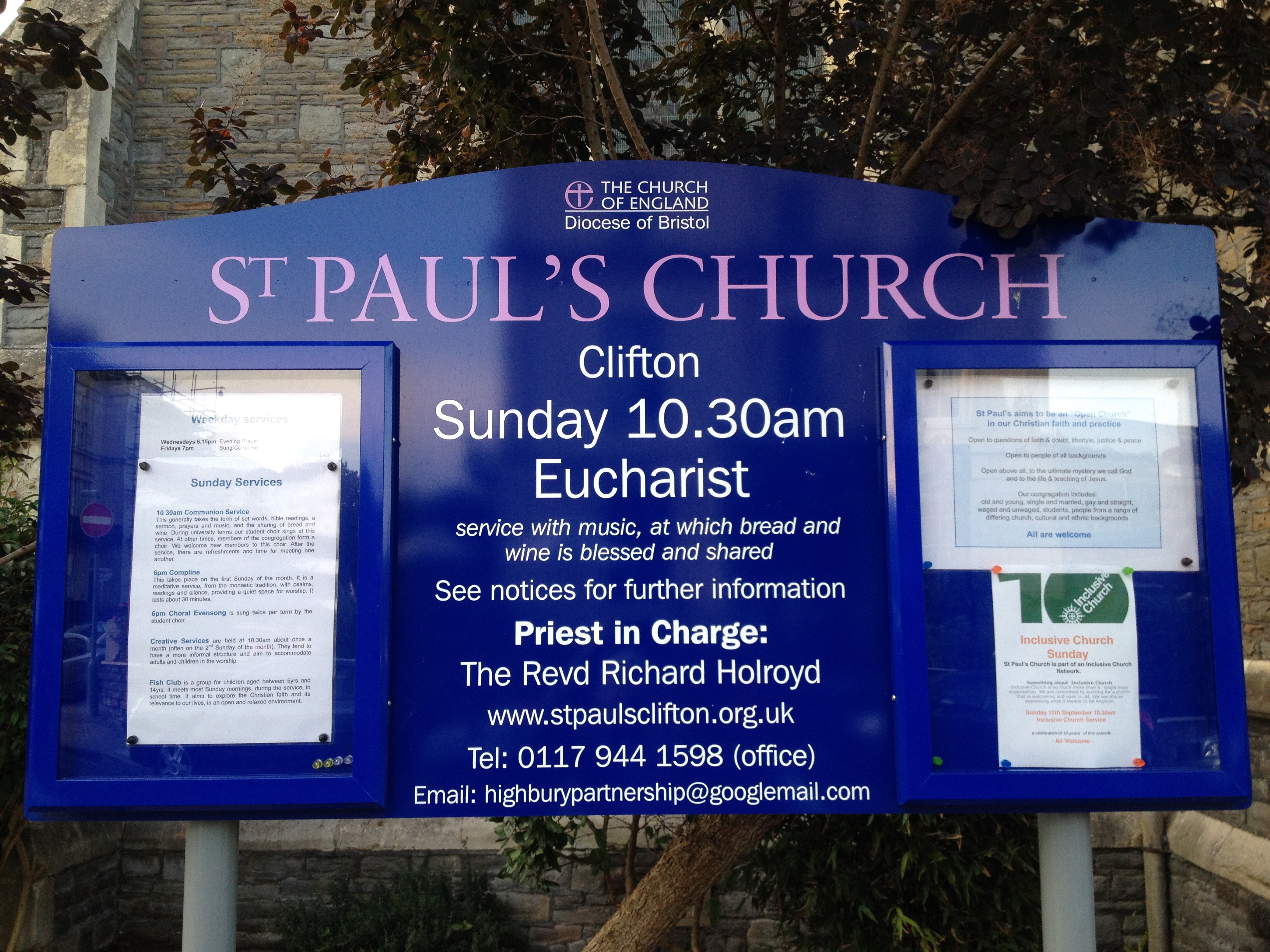
The same reasoning, I think, would work for us. If I have moved into this area and I’m looking for a church to go to: if I’m going through a tough time in my life and I’d like to find somewhere to say prayers: if I want my kids to learn what’s in the Bible: what will St Mary’s be like inside? Now if there’s a big sign outside saying that everyone is welcome – and I’ve put a picture of an Inclusive Church sign from another church with my sermon on the website [see above] – then people can feel confident, and they will dare to open our door and come in.

I know that not everyone agrees with this idea. Some people say we are already a really welcoming church. No need to join organisations or advertise – although I would gently say that it’s noticeable that we have no black people in our congregation. Somebody once even said to me, in this context, ‘But what about the bigots? We mustn’t upset the bigots!’

Well that perhaps takes me full circle, to the outcome of the European election. What about the bigots? What would Jesus say? I think he would say, ‘Look who I have lunch with already. People get shirty that I sit down with tax gatherers and sinners. But they are welcome!’

Sermon for Evensong on the Sunday after Christmas-Day, 30th December 2018

Isaiah 61; Galatians 3:27-4:7 (http://bible.oremus.org/?ql=412935020)

Do you remember when Jesus started to read in the synagogue – it’s in Luke 4, from verse 17 – and he read out from the Book of the prophet Isaiah, and then said, ‘This day is this scripture fulfilled in your ears.’ In other words, He was the Messiah, which Isaiah had prophesied about, had foretold in our lesson tonight, chapter 61, and chapter 61 was what Jesus was reading out.

That prophecy is all about the salvation of Israel, deliverance from its oppressors, from the Assyrians, the Babylonians, the Egyptians – and latterly, it would be, from the Romans – deliverance from slavery; because the Israelites were the chosen people of God, and God would keep his promise to them.

That’s as you would expect. Jesus was Jewish, he was an Israelite. He was brought up in the Jewish culture. The gospel of St Matthew, aimed at a Jewish readership, is at pains to set out his genealogy, tracing it back to King David, son of Abraham.

But truly, if the story of Jesus had just been a Jewish story, just been a story about Israelites, that story would have remained a footnote in history. But the genius of St Paul was to realise that the one true God is the god of everyone. There isn’t just a god for the Jews, or for another national group – or in those days, for the Romans. God is far bigger than any question of nationality or origin.

And so we have this great passage in the Letter to the Galatians:

There is neither Jew nor Greek, there is neither bond nor free, there is neither male nor female: for ye are all one in Christ Jesus. [Gal. 3:28f]

Just as Isaiah had prophesied,

I will make an everlasting covenant with them.
And their seed shall be known among the Gentiles, and their offspring among the people”

God’s chosen people are no longer to be regarded as being just the Israelites, but rather all those who are ‘in Christ Jesus’, who are Christians. They are God’s chosen people now. ‘Their seed shall be known among the Gentiles’, just as much as among the Jews.

Paul’s mission to the ‘nations’, (which is what the Latin-based word ‘gentile’ means), to the non-Jews, opened the door to Christianity becoming a universal religion, and there is no bar in it to anyone on the grounds of nationality, or colour, or origin: being, and becoming, Christian, and indeed that key expression in St Paul’s thought, being ‘in Christ Jesus’, is integral to the way he understands God: that God is at the heart of everything, the ultimate creator and sustainer of all our being.

But although Jesus’ coming as the Messiah meant that we should look wider than just the sons of Abraham, the Israelites, in order to find who are God’s chosen people, nevertheless, in Isaiah’s prophecy, there are some key truths which, maybe, started as distinctive Jewish or Israelite concerns, but nevertheless now have a worldwide or universal importance.

Important among these is the concept of justice.

‘.. to proclaim liberty to the captives, and the opening of the prison to them that are bound;

To proclaim the acceptable year of the Lord, and the day of vengeance of our God’

This is all about the rule of law. In the Jewish Law, the ‘acceptable year’ is the Jubilee year, is the year one-in-seven when debts were forgiven; when people were allowed a new start. Not that the law disappeared, but that its application was tempered with mercy. ‘The quality of mercy is not strained’, if you prefer Shakespeare. [The Merchant of Venice, Act IV, Scene 1]

‘For I the Lord love judgment, I hate robbery for burnt offering’. Don’t go out and pinch your neighbour’s things so as to be able to afford to put more in the collection plate. The Lord loves judgment. The Lord loves the law. Do the right thing. And the right thing is a message of renewal and, as I have observed so often, and particularly in Advent, the message of the Bible is one which is full of the counter-intuitive, it is often contrary.

See, Isaiah foretells opposites: ‘ … beauty for ashes, the oil of joy for mourning, the garment of praise for the spirit of heaviness’. This is not a message of despair: this is a message of hope. But it is hope based upon a fresh appreciation, on repentance, on throwing away the old truisms; casting off slavery; slavery, which means forcing people to work for less than they need in order to pay the rent and to buy food. And look, in this vision of justice, Isaiah sees that

strangers shall stand and feed your flocks, and the sons of the alien shall be your plowmen and your vinedressers.’

Strangers. Sons of the alien. That is what the Millennium looks like. There is nothing wrong with people coming and joining our society and doing useful jobs. But note that, both in Isaiah and in St Paul, it’s not the case that origins and nationality are obliterated. It’s more a question that there is no hierarchy of worth, based on nationality or origin.

‘There is neither Jew nor Greek, neither bond nor free, neither male nor female.’

It doesn’t literally mean that. It means that the connotations of being Jewish, or the connotations of being Greek, what it means to be in slavery, what it means to be free, what it means to be a man, what it means to be a woman, do not include connotations of worth: or to put it another way, they are all equally worth.

It doesn’t mean to say that they are all the same. But it means that you can’t say, just because somebody is from a particular country, for that reason, they are less entitled to share in the world’s riches than someone who is from Hollywood – or from the British Hollywood, Cobham.

So as we begin 2019 on Tuesday these are very timely lessons. In the good society there is no room for xenophobia or nationalism – although we can celebrate our differences and enjoy the riches of each other’s culture. We can explore new foods, new literature, new ways of looking at things, that come from different places of origin.

I was blessed, earlier in my life, in having ten years of fairly constant travel, to all sorts of other countries. I really enjoyed learning about different ways of life and making friends with people in other countries. But today, there is a worldwide movement against this, based on nationalism and xenophobia. Freedom of movement, for our young people to be able to do as I did, to travel freely throughout the world, to live and work and different places; and the other side of that coin, for people from other countries to be able to come freely here, to make their life here if they want to do so, by working hard and contributing to our society, that freedom is being overtaken, overtaken by narrow nationalism.

We should recognise that there is ‘neither Jew nor Greek’ in the Kingdom of God: that we are all sons and daughters of God, descendants of Adam and Eve: and Jesus is the second Adam, ‘a second Adam to the fight’ as the hymn puts it. He is really Everyman – He is for everyone.

Sermon for Evensong on the 21st Sunday after Trinity, 21st October 2018

Psalm 141: Matthew 12:1-21 – ‘Smite me Friendly’

Set a watch, O Lord, before my mouth 

 and keep the door of my lips.

  O let not mine heart be inclined to any evil thing 

 let me not be occupied in ungodly works with the men that work wickedness, lest I eat of such things as please them.

  Let the righteous rather smite me friendly 

 and reprove me.

That’s from Psalm 141, which is the one set in the Lectionary for tonight.

‘Set a watch, O Lord, before my mouth

and keep the door of my lips.’ Make sure that I only say the right things. But if I should inadvertently stray off-piste,

‘Let the righteous rather smite me friendly

and reprove me.’

I rather like the idea that the righteous should ‘smite me friendly’! Anyway, I have been warned.

As quite a lot of you know, I haven’t been very well. I’ll spare you the details, but I spent a week in Epsom Hospital three weeks ago, and then had a quiet week at my daughter Alice’s outside Exeter, before spending last week getting back up to speed at home in Cobham. It was very nice to hear from so many friends from St Mary’s, and to have some lovely visits too. Thank you for all your kindness!

I don’t know what it is that makes this happen, but my irregular stays in hospital have coincided with momentous events in the world outside. The last time I was in Epsom Hospital, in 1997, coincided with the death of poor Princess Di. I became quite an expert on all the various theories and odd facts surrounding that sad story. Now, just recently, and again in Epsom Hospital, I’ve been trying to keep on top of all the twists and turns in the Brexit negotiations, and particularly the ideas which our government and the European Commission have each come up with in order to avoid creating a ‘hard border’ around Northern Ireland.

Now you will realise why I adopted the ‘smite me friendly’ words from Psalm 141. I may find that you’re smiting me, but not friendly, if I’m not careful when I talk about Brexit!

Well, here’s the thing. There’s a nightmarishness about all the twists and turns of the Brexit process. If you go one way, you bump into an obstacle, perhaps something we’ve agreed beforehand or that Parliament has decided on, which rules out what you now think might be a good idea. So you turn down another entrance, and head off in another direction. You come up with something that you think will square with what the EU will accept – but your own MPs don’t like it. Nightmare. And of course, all the time there are plenty of people reminding you that they feel that nothing can compare with what we already have, as members of the European Union.

People are very passionate about it. Friendships have been broken. Families aren’t speaking to each other. And the worrying thing is, that no-one seems to agree how to decide who is right. People cling to the principle of democracy. More people voted to leave than to remain: 52% to 48%. But other people point out that 67% didn’t vote to leave. So people even disagree about what the democratic outcome was.

A factor in all this, this inability to decide who is right, is that there has been a lot of cheating and lying. There was the infamous red bus which had a banner down each side saying that, if we left the EU, there would be £350m a week more for the NHS – whereas even before Brexit day, as soon as the vote to leave was passed, the NHS has taken huge hits, from the devaluation of the £, making many drugs 20% more expensive, from doctors and nurses from the EU leaving, because they feel that the Brexit vote shows that people don’t like them – and from the 98% drop in numbers of nurses from the other EU countries applying to work here. The message on the bus was a wicked lie.

How do people know whom to believe? What is true in all this? Is it just a question of shouting louder?

Sitting in my hospital bed, and on Dr Alice, my daughter’s, couch, I started to wonder. Does it make a difference if you are a Christian? What would Jesus have done?

Today’s lesson from St Matthew shows him facing a rather similar set of conundrums to the ones that Mrs May and Dominic Raab, our MP, who’s now the Brexit minister, have to wrestle with. The question of eating on the Sabbath. Maybe what was held to be wrong extended to the act of gleaning, picking up the ears of wheat left at the edge of the field. Healing sick people, again on the Sabbath Day. Conflicting realities. Being hungry; worse, being ill: and you have the means to solve the problem. You can see where there is food freely available. Just pick it up. You have the power of healing. Just get him to stretch out his withered hand, and you can restore it to full strength. Does it matter if the Sabbath rules make it wrong to do these things?

Jesus gives a scholarly answer. He quotes the Hebrew scriptures to show that there are exceptions. King David and his men ate the bread offered on the altar in the Temple when they were hungry, which was something only the priests were allowed to do. Jesus pointed out that they had moved on from the limits of the old Temple worship. He was here. He was something else, something more. In Hosea [6:6] is a prophecy which includes these words, ‘I will have mercy and not sacrifice’. In Hosea those words follow a prophecy about rising again from the grave on the third day. This is all about Jesus, Jesus as much more than just a teacher, a rabbi. More than ‘a priest of the order of Melchizedek’ as the letter to the Hebrews describes him. (Hebrews 5:5, 5:10)

And he goes on to give the lovely example of a shepherd rescuing one of his sheep which has fallen into a pit on the sabbath day. We always want to help if an animal is trapped or hurt. That is why I was angry the other day when our local Painshill animal rescue team were not able to be on duty because the austerity cuts had reduced their numbers, so that a cow which had fallen into a ditch locally, and was in distress, had to wait for a crew from Sussex to come. Never mind what Jesus would say about austerity – the point is that He said that the animal, the sheep, must be saved, whatever day it is.

And finally Jesus quoted from Isaiah chapter 42, a prophecy again about the Messiah. Gentle, quiet – and trusted, even by the Gentiles, the non-Jews. ‘A bruised reed he shall not break’.

What can we bring from this, from how Jesus squared the circle with the Pharisees about what you can and can’t do on the Sabbath? He, Jesus, rises above any day-to-day considerations. The Temple rules don’t apply to him. But almost more important, Jesus is the servant, the gentle spirit of kindness. He expects mercy, not ritual sacrifice. It’s not about Him, but about the ones in need. The man with the withered hand, maybe a Thalidomide victim, in today’s world; the sheep which has fallen down into a hole.

So what could we learn from Jesus about the Brexit ‘conundrum’, as Godfrey [Revd Godfrey Hilliard, Rector of Stoke D’Abernon] calls it? What principles can we use as followers of Jesus, as Christians? Obviously no-one can say for sure what Jesus would have said or done. But surely it would be good if we at least thought about it.

Would Jesus have wanted the Jews, his people, to get their independence from the Romans? Was it a bad thing to belong to the great Roman empire? After all, St Paul did very well out of being able to say, ‘Civis Romanus sum’ (‘I am a Roman citizen’, Acts 22, after Cicero, In Verrem, 2.5.162) – and indeed he was very proud of being able to say that. Jesus himself seems to have felt the same way: ‘render unto Caesar that which is Caesar’s’, is what he said. (Matt.22:21)

What about immigration? The Jewish law protected the widow, the orphan – and ‘the stranger that is within thy gate’ (Deut. 10:19, Leviticus 19:34). That stranger is in the same position as the injured man in the story of the Good Samaritan. He was saved by a Samaritan, who was a foreigner, not someone Jewish people would ordinarily have wanted to have living next door. But this foreigner showed compassion and kindness. He showed that human dignity, human rights, the right to life, the right to medical treatment if you are hurt, are far more important than nationalistic considerations. Being a neighbour, a good neighbour, is far more important than what flag you fly.

But as I sat on Alice’s couch I realised that I wasn’t hearing those sort of arguments very much. There are some of our bishops who have said things along the same lines. [See, e.g., https://www.churchtimes.co.uk/articles/2016/1-july/news/uk/church-leaders-seek-to-unite-divided-country] But it occurred to me that we ought to try to work through it, through the Brexit conundrum, with Jesus on our shoulder. What would He think of as important? Would He ‘smite anyone friendly’ for things they said? What about that red bus? What else do the politicians know about that they aren’t telling the ordinary people? Aren’t all the doctors and nurses from other countries who work in our NHS ‘Good Samaritans’, just as Jesus would have wanted?

And we, when we argue passionately for one side or the other, do we give any thought to what our Christian faith might bring to the argument? And if not, why not? I have a feeling that things might work out rather better if we did – and if our leaders remembered Psalm 141.

Set a watch, O Lord, before my mouth 

 and keep the door of my lips.

  O let not mine heart be inclined to any evil thing 

 let me not be occupied in ungodly works ….

  Let the righteous rather smite me friendly 

 and reprove me.

Sermon for Evensong on the 10th Sunday after Trinity, 20th August 2017
2 Kings 4:1-37; Psalm 90; Acts 16:1-15

‘Thou turnest man to destruction: again thou sayest, Come again, ye children of men’. That’s what we’ve just sung, in Psalm 90. It means, return to the dust, out of which you were made. Psalm 90 is sometimes used at funerals, and describes the insignificance and fleeting existence of human life when compared with the creative – and destructive – power of God.


There’s a powerful novel by P. D. James called ‘Children of Men’. It’s a dystopian vision of the future – just as 1984 suddenly wasn’t in the distant future, in this case, the future is 2021 – not long now.


Gradually, no more children are being born. The human race is dying out. Then, years after the last person was born, a woman becomes pregnant. Now read on! I won’t spoil it for you. There’s a film of it too, which is also good, but rather different.


One little switch. No more babies. And that’s it for the human race. It’s perhaps more frightening, as being rather more mundane, more feasible, in a way, than a nuclear holocaust.


There has been a school of thought – perhaps as a result of too much reading of the Old Testament – that if God does take steps against mankind, it must be to punish them for something they’ve done wrong.


So now, for people who think in that way, it will be likely to be rather a worrying time. We have the President of the USA completely failing to condemn white supremacists and Nazis – saying there are ‘some very good people’ among them; in this country, all of sudden, it’s not beyond the pale for people openly to want to shut out from this country anyone who isn’t a white, English-speaking person with useful skills and plenty of money.


Nearer to home, did anyone even think for a minute whether it was right to chase away the travellers, the gypsies, who came and camped out on the Leg O’Mutton field in Cobham? Remember, Hitler exterminated Gypsies as well as Jews. How should we treat them? What would Jesus have said?


Now again, instead of seeking closer union with our neighbours in Europe, we have set our faces against them with the vote for so-called ‘Brexit’. ‘Sovereignty’, whatever that means, is supposed to be more important than the brotherhood of man.


I think that Emily Thornberry was right, although she got into hot water for saying it, about the house with a white van parked in the drive, festooned with English flags. That flag is not benign: it is meant to say, ‘England alone!’ Go away, everyone else. Black, brown, foreign people: go away from our ‘crowded’ island. The crowds are, I would suggest, a myth. There is plenty of room in the UK. The hidden, evil message is that there are too many of the ‘wrong sort of person’ – people who are not like us.


I still remember the first time I went to Bombay – the first time I went to India – and walked down the street. I was the only white man. The only white man among thousands of brown and black faces. I began to imagine what it must feel like to be a black person in England sometimes. No wonder that black people may congregate in places where there are already significant numbers of black people. We have a certain innate small-c conservatism, all of us, I think, which makes us easier with people whom we know.


Obviously in a country of nearly 70 million people, we can’t know everyone, so I suspect that we fall back on what people look like. If they look like us, fine. If not, there might be a reservation, a hesitation, a query in our minds.


This isn’t good. Xenophobia, racism, white supremacy. No thought for the idea that we are all equally God’s creatures, God’s children. God, if He cares about us in the way the Old Testament describes, might well send some plagues down on us for being so awful.


Yet so far as I know, God hasn’t worked that way recently. Taken as a whole in the Bible, in contrast with the various chastisements in the Old Testament – and Psalm 90 is said to be a Psalm of Moses, inspired by the complaining of the Israelites in the desert – there are many stories of healing and salvation.


Elisha’s two miracles described in our first lesson are cases in point. The first one is a sort of self-help example with a miraculous element, a bit like feeding the 5,000, in that the oil never ran out, and the resurrection of the Shunammite woman’s daughter is like the raising of Lazarus or the resurrection of Jairus’ daughter – ‘damsel, arise’ – in the New Testament.


We don’t know how these miracles worked – or else they wouldn’t be miraculous. Maybe these stories are just mythical. It’s striking how similar the miracles done by Elisha are, in these two cases at least, to Jesus’ miracles.


The ‘rose of Sharon’, the beautiful girl, in the Song of Solomon, ‘nigra sum sed pulchra,’ in the Latin words of the beautiful canticle in Monteverdi’s Vespers, is said to be a ‘Shulamite’, or a Shunammite. Perhaps there’s a link with the ‘great woman’ in our lesson from 2 Kings. She was kind to the man of God, Elisha, and ‘constrained him’ to eat bread. It’s a bit reminiscent of Mrs Doyle, Father Ted’s housekeeper, pressing ever more cake and sandwiches on her hapless priestly charges: ‘Oh, go on, go on, go on …!’ Maybe she was Abishag, the most beautiful woman in Israel, who went to comfort King David in his old age – she too came from Shunem.


But even in the beauty of Monteverdi there’s a wrong note. ‘Nigra sum sed pulchra’ sings the girl – although often, for mysterious musical reasons, it’s actually a male counter-tenor singing – meaning, ‘I am black but beautiful’. To sing ‘but’ beautiful is awful – but in 1610, when the Vespers was written, that kind of casual racism was unfortunately there. I feel that if we can change the words of the Lord’s Prayer so that we ‘forgive those who’ trespass against us, instead of ‘them that’ do it, we could change ‘nigra sum, sed’ (black, but …) to ‘nigra sum et pulchra’. ‘And’ beautiful. Perhaps you, Robert [Prof. Robert Woolley, Director of Music at St Mary’s], could speak to Harry Christophers or Sir John Eliot Gardner about it.


The disciples with St Paul – (including St Luke, who most likely was the author of the Acts of the Apostles as well, and who was an eyewitness with the Apostles, at least for some of the time, which we think partly because of the passage which was our lesson tonight, in their journey, where it says, ‘We’: ‘We came with a straight course to Samothracia’, and so on) – well, he and the disciples went to pray, not just in the synagogues, but in Philippi they went to a part of the river bank, where people went to pray; actually, not just any ‘people’ went there, but a group of women. And there they met and got to know Lydia, who, like the Shunammite woman with the man of God, Elisha, invited them to stay with her. She ‘constrained them’ too; she was another Mrs Doyle!


Shunammite women, blacks, and the women worshipping with Lydia on the river bank: all a bit different, according to the lights of the time then; but all variously blessed. To be with Elisha, and with the apostles – and of course, with Jesus – we should be celebrating diversity and welcoming the people who are shut out – shut out by polite society, but also because they are black or strangers or refugees. Let us not shelter behind false distinctions between ‘genuine’ refugees and ‘economic migrants’. Whatever they are, they are here; they are human beings like us; they’re just as good as us; and if they are refugees, they need our welcome, our love, and our help. ‘Come again, ye children of men.’

Sermon for Evensong on the 25th Sunday after Trinity, the Feast of
Christ the King
2 Samuel 23:1-7, Matt. 28:16-end

The other day in the Guardian there was an extended article, in a section which they now call ‘the long read’, about Prince Charles, and what sort of a king he would be when eventually he accedes to the throne. Apparently it’s not something he likes to talk about, because to do so would necessarily mean that he would have to be thinking about the death of his beloved mother, the Queen.

I think that’s rather endearing. I read the article with extra interest, knowing that I was going to be preaching tonight, on the Sunday when we celebrate Christ the King. It’s a relatively new festival in Christianity – it began in the Roman Catholic Church in 1925. Pope Pius XI instituted the Feast of Christ the King as a reaction against what he perceived as a rising tide of secularism. People had forgotten the importance of God.

Actually I preached only last week about the text from the Gospel according to St Matthew which was our New Testament lesson tonight, Jesus’ Great Commission, to go and make disciples of all the world.

It isn’t the Gospel reading which one most readily associates with the idea of Jesus as King. This morning the lesson was Matthew 25, ‘Then shall the King say unto them on his right hand, Come, ye blessed of my Father, inherit the kingdom prepared for you for the foundation of the world: For I was an hungred, and ye gave me meat, …’ You remember, when they asked when they had done this, Jesus replied, ‘inasmuch as ye have done it unto one of the least of these my brethren, ye have done it unto me’ – one of the most powerful social justice and charitable love messages that Jesus ever gave.

Jesus the King was King in heaven, and He was dividing the sheep and the goats in the Last Judgment. The Gospel writer expected Jesus to be an absolute monarch, splendid in majesty and power.

We are not used to absolute monarchs now, today in England. After Magna Carta our kings are ‘constitutional monarchs’ with powers constrained and restricted. The will of the people, expressed in Parliament, is sovereign.

King David, the greatest king of the Jews, in his last words, in the first lesson, from 2 Samuel, affirmed that God had told him that ‘One who rules over people justly, ruling in the fear of God, is like the light of the morning, like the sun rising on a cloudless morning, gleaming from the rain on the grassy land.’ That’s the poetry of the man who wrote the Psalms, describing kingship in a similar vein to Magna Carta. The king is subject to higher authority, and, respecting that higher authority, he must rule justly: not capriciously or cruelly.

Reading the article about Prince Charles,[http://gu.com/p/43dtt, ] I found that the author was concerned that perhaps Charles, who has a habit of writing to people in public life and expressing very forthright views, would be much more assertive in public than the Queen has been, and is. The thrust of the article was to ask whether Charles would throw his weight around in an anti-democratic way.

I confess that I was somewhat uneasy about the Monarchy when I was a young man. What was it that made the Queen and her family better than you or me, so that we owed her respect – reverence, almost. What was her strength? Why would we go through elaborate rigmaroles when she was about?

That feeling in me changed completely, when my Father got the OBE. My mother, my brother and I went with him to the investiture in Buckingham Palace. We sat no more than a few feet away from where Her Majesty was standing. She had someone standing next to her to pass her the medals, but no notes or prompts.

She bestowed medals on about 75 people. What was amazing was that she seemed to know about every single one that she was giving a medal to. She spoke to my Father for a couple of minutes – which felt much longer, of course – and clearly she had carefully researched all that Dad had been doing.

She had done this thorough preparation for every single person that she decorated that day. It must have been a big task of preparation – and just think, she must have to do a similar job several times a year. It speaks volumes that, after so many years, the Queen still takes it upon herself to prepare and get to know exactly what her loyal subjects have been doing, the reason why they have been awarded the medals.

The Queen is reported to say that this hard work is just part of the job. She has a very strong ethic of service. The Queen is modest enough to do masses of homework, so that she can serve her people in a professional way. My Dad was really impressed. Although he was dying, the whole thing really bucked him up. He really did walk taller after getting his OBE from the Queen.

And I ceased to have republican leanings. In a minute we will pray for our Queen; I will lead the prayers; and I’ll really mean it.

I do hope that Prince Charles will be similarly imbued with an ethic of service. He has had to lead a rather odd life so far. In the article which I read, for example. It describes Prince Charles visiting Chester Cathedral.

‘Inside the cathedral, the strangeness of Prince Charles’s life came into focus. … Some modernist choir stalls, installed 15 years ago, caught his disapproving eye. “Doesn’t quite go,” the prince announced, locking eyes with the senior churchman. “It may be time for a review.” …. Finally, in the cloister, Charles was invited to hold Grace the golden eagle, a magnificent bird who, moments earlier, had evacuated her bowels explosively on to this reporter’s notebook.’ A close shave for the Prince.

Apart from the eagle, Charles seemed to act as though he was in charge. Telling the Dean of a cathedral that his seating ‘didn’t quite go’ and that it was ‘time for a review’ doesn’t sound like someone whose prime object is to serve.

But that is it. The Servant King. That is a modern hymn which we can like. Think of the passage in St Mark chapter 10: ‘You know that among the Gentiles [in the context, it must mean, among the Romans], those whom they recognise as their rulers [their kings] lord it over them, and their great ones are tyrants over them. But …. whoever wishes to become great among you must be your servant, …’

Jesus’ kingship was not like a Roman emperor’s. Not even like Herod, the puppet king, king of the Jews, who would soon condemn Him. These men had considerable power in the secular sphere, we say, ‘on earth’. They had the power of life and death. Jesus, Jesus the man, didn’t have that kind of power.

‘Pilate said to Jesus, “Are you the King of the Jews?”… Jesus answered, “My kingdom is not from this world. If my kingdom were from this world, my followers would be fighting to keep me from being handed over to the Jews. But as it is, my kingdom is not from here.” So Pilate said to him, “Then you are a king?” Jesus answered, “You say I am a king. For this I was born and for this I came into the world,to testify to the truth.”‘ (John 18:33b, 36-37).

So we come back to this question, what makes a real king. King David said that he must fear God and deal justly; our Queen is giving her service, committed and faithful to her people. Prince Charles already does a great deal of charitable work – but he must not stray into autocracy. He needs to be a Servant King, just as his mother is a Servant Queen.

And the Servant King, the original Servant King, will be with us till the end of the age. As Bob Dylan sang, ‘You’re gonna have to serve somebody.’ Christ the King. Let us indeed serve Him.

Sermon for Evensong on the Seventh Sunday of Easter, 1st June 2014
2 Sam 23:1-5, Eph.1:15-23

First we heard the last words of King David, and then St Paul’s prayer for the Christians at Ephesus. The context is the Ascension, which the church celebrated on Thursday. Leave-taking. The end of the party. I wonder who did the washing-up. When the disciples – and certain women, including Mary the mother of Jesus as well as his brothers, when they were all together after Jesus had left them and a cloud had taken Him out of their sight, when it was over, when the ‘farewell tour’, Jesus Christ Superstar, had come to the end of its run: what do you think they all did?

They went back to the upstairs room and said prayers. And maybe they got busy doing the washing up. Because they must have been feeling very flat. We know that when Jesus had been crucified, if we think of the story of the disciples on the way to Emmaus, they were very sad then, when they thought that Jesus had been taken away from them.

So I think we can reasonably expect that they were also feeling very flat and very sad when Jesus had been taken away from them the second time, when He had ascended into heaven. Whitsuntide, Pentecost, had not yet come, although Jesus had assured them, ‘You will receive power when the Holy Spirit has come upon you, and you will be my witnesses … to the ends of the earth’ (Acts 1:8). But that hadn’t happened yet.

It must have been very difficult, after all the momentous things that had happened. After the roller-coaster ride of following Jesus, suddenly He wasn’t there any more. In the church, we have commemorated that roller-coaster ride, through the Easter season, though the time of Jesus’ passion, and suffering, Good Friday; and then the glorious Resurrection on Easter Sunday; and then His risen appearances, the road to Emmaus, doubting Thomas: all the wonderful stories of the risen Christ.

It is a revelation to us, a sure and certain hope that we have, because of God’s presence with us, His gift of His only Son and His Resurrection from the dead. In Paul’s letter to the Ephesians, Paul prays that God will give them ‘a spirit of wisdom and revelation as they come to know Him, so that with the eyes of your heart enlightened, you may know what is the hope to which He has called you, what are the riches of His glorious inheritance among the saints.'(Eph.1:17)

If you are a Christian, if you go to church, this is a wonderful time of year: the Easter season. It is a time of hope and joy. But in the world outside, there is a sense of challenge. Not everyone is a Christian. Not everyone is aware of, let alone believes in, the wonderful story of Jesus. The Boko Haram people who have kidnapped 200 children, 200 girls, in Nigeria, are actively opposed to the Christian message. They want forcibly to convert people to Islam – forgetting perhaps that the god of Islam is very like the God of Israel and the God of the Christians – and certainly forgetting that God is a god of love.

Also in the world outside, we had an election. Some of you may have heard of my huge success in the Cobham Fairmile Ward election. It was a massive success, honestly: despite representing the Labour Party, I managed to poll in double figures! St Mary’s has much more successful politicians – congratulations to James Vickers!

After the elections, the press and the BBC are talking about the phenomenon of UKIP and what they stand for. It seems that a major part of UKIP’s message is that they are opposed to large-scale immigration and they are opposed to our membership of the EU, perhaps because they see the EU as being a major cause of the immigration which they don’t like.

And then there’s the controversy which has grown up concerning the new book by the French economist Thomas Piketty, called ‘Capital in the 21st Century’, which is all about the widening gap between the rich and the poor worldwide. Prof Piketty offers, at the end of his 573-page tome, some suggested alternatives to the economic policies which are being pursued in all the leading economies. But a Financial Times journalist, Chris Giles, has argued that Prof Piketty’s figures are wrong. If you put more than one economist in a room, they will inevitably disagree! I see that Ed Miliband confessed that he’d only just started reading Thomas Piketty. I have got to page 51.

It does all seem quite a long way away from the world of Easter, from the Resurrection and the Ascension: from the hopeful question from the disciples to Jesus just before He was taken from them, ‘Lord, is this the time when you are to establish again the sovereignty of Israel?’ (Acts 1:6 – NEB), a long way from all that, to the rather gloomy fact that only a minority of people cared enough about the way they are governed, even to cast a vote.

There does seem to be a big gap at the moment, between our church lives and the world outside. It’s all very well St Paul saying in his Letter to the Galatians that ‘the harvest of the Spirit is love, joy, peace, patience, kindness, goodness, fidelity, gentleness and self-control’. (Gal. 5:22f), but how is that relevant to UKIP and to the world of macroeconomic theory?

What we are not hearing, in all this ferment of debate, is a Christian voice. What about immigrants? A politician says he couldn’t hear any English spoken in his carriage on the Tube. An election flyer says that there is some impossible number of East Europeans just waiting to come to the UK, take our jobs and claim all our benefits. Someone else points out, against this, that the NHS would collapse without doctors and nurses from abroad. Another expert points out that immigrants contribute more in taxes than they receive in benefits, and that fees from foreign students are vital to the survival of our universities.

But – and perhaps I haven’t been reading the right paper or listening to the right station on the wireless – I don’t recall anyone bringing the Bible into it, which they could have done. In the Old Testament, it’s a fundamental point of the Jewish Law that you must look after strangers, aliens, foreigners – in Deut. 10:19, Moses says that God ‘loves the alien who lives among you, giving him food and clothing. You too must love the alien, for you once lived as aliens in Egypt.’ In Jesus’ staggering picture of the Last Judgment in Matt. 25, He says that the righteous shall ‘enter and possess the kingdom’ because ‘… when I was hungry, you gave me food; when thirsty, you gave me drink; when I was a stranger you took me into your home …’ When the righteous didn’t get it, and queried when they had done this, Jesus said, ‘I tell you this: anything you did for one of my brothers here, however humble, you did for me.’

Jesus didn’t blame people for being poor. He didn’t think there was anything wrong with being a refugee. His ancestors, the Jewish people, had all been refugees. He didn’t talk about benefit cheats and scroungers. He didn’t talk about corporate tax avoidance – although he did say, ‘Render … unto Caesar the things which are Caesar’s’. Maybe that is a good message for Starbucks, Vodafone and Google.

What about the widening gap between rich and poor, which Thomas Piketty has written about? Are the only things, which can be said, ‘It’s the market’, and ‘There is no alternative?’ If the government gives a tax cut to the highest earners, (which one commentator said was enough for them to go out and buy a Porsche with), at the same time as over 1 million people have had to go to a food bank to avoid starvation – and by the way, that includes 307 people in Cobham and Stoke D’Abernon who have used the Foodbank since we opened five months ago – if there is that seeming bias towards the rich, what is the Christian way to look at it?

Perhaps the answer is in the Magnificat, the song of Mary, the mother of God:

He hath put down the mighty from their seat:
And hath exalted the humble and meek.
He hath filled the hungry with good things:
And the rich he hath sent empty away. [Luke 1:46-55]

You might also remember what Jesus said about camels and the eye of a needle. [Matt.19:24]

But Jesus has been taken away from us. He has disappeared behind a cloud. Disappeared behind a cloud, a cloud of modern stuff. But, you might say, things were much more simple in Jesus’ day. There weren’t any benefit cheats. There weren’t any Romanians using the EU as a way to come and steal our jobs. You just can’t compare how it was then with the situation these days.

I think we should think carefully about it. I know that, in this week in the church’s year, you might argue that Jesus has ascended, and the Holy Spirit is coming – Jesus told his disciples to expect it, in Acts chapter 1 – but it doesn’t arrive till next Sunday. If it looks as though our world is rather godless, that fits with Jesus having left us, with the Ascension time.

But in this world, in our day to day lives, of course the Holy Spirit is here. The Lord is here. His Spirit is with us. So why does it look as though we are we ignoring Him? Is it OK not to want strangers? Is it OK that the rich get richer, and the poor get poorer?

As Christians, what do we think? Have I chosen my Bible references too selectively? Or is it more a question that the world today is more complicated than it was in Jesus’ time, and that some of Jesus’ sayings are out of date these days?

Or have we Christians really got something very distinctive to say, which doesn’t necessarily fit in with conventional wisdom? I’d be interested to hear what your thoughts are.