Archives for posts with tag: Resurrection

Sermon for Evensong on the 21st Sunday after Trinity, 20th October 2024, at All Saints Church, Penarth

Lessons: see https://bible.oremus.org/?ql=596249536

Matthew 12:1-21

As you can see, Evensong today is a team effort. The vicar, our ordinand and I all wanted to join in to praise the Lord this afternoon. You may not realise this, but the vicar has not only been leading the service but also, without knowing it, he’s written most of this sermon. 

We meet to say morning prayers at 9 o’clock most mornings during the week, and anyone can come, but most usually, it’s just the vicar, our ordinand and me. We often take the opportunity, as we say our prayers, to reflect on what we have read in the Bible and our church life; and if that sounds a bit serious, I can immediately reassure you that there’s always a lot of laughter and joy in what we discover together.

This week I shared with the vicar the thought that today we were going to be talking about sabbath day observance – when all the shops used to be shut and you used not to be able to get a drink in a pub on Sundays, and all that good stuff. I was muttering slightly that I thought that things have gone a bit too far in a secular direction and that Sunday wasn’t special any more, whereupon he brought me up short, because he said, first of all we have to be clear that Sunday is not the sabbath.

The sabbath is a Jewish idea and it was Saturday, the day when God rested, the seventh day, during the story of creation in the book of Genesis, whereas Sunday is the day on which we as Christians commemorate Jesus’s resurrection, the first Easter. And so we started to talk about that, and I made a mental note of what the vicar was saying, for this sermon; and I invite you to join in this discussion, or at least to think a little bit about it. I don’t think it matters, by the way, that most of us, when we talk about Sabbath day observance, are not talking about Saturday but are talking about Sunday.

Another thing: do we as Christians have any right to inflict on society as a whole a way of spending Sunday that perhaps only makes sense if you are a Christian? The story of Jesus clashing with the Pharisees and scribes about working on the sabbath, either through the disciples picking up heads of grain in the fields and eating them, sort-of harvesting them, or more clearly as a question of work when Jesus did some healing of the man with the withered hand, those things put him at odds with the Pharisees and the scribes, who said that on the sabbath no work of any kind should be undertaken, because it was a time of rest, picking up from what God did in the creation. He rested on the seventh day, and we should follow God, they argued, and so rest as well. But is that just a religious thing, and not really appropriate these days, when perhaps only a minority are believers?

This story comes up in three of the gospels, Matthew (the version we had as our lesson today), Mark and Luke, but crucially it only has the really memorable, famous, words in Saint Mark’s account: ‘The sabbath was made for man, and not man for the sabbath’. (Of course if you want to say it in a gender-neutral way, you say that the sabbath was made for ‘humankind’ and not ‘humankind’ for the Sabbath, but somehow it doesn’t have the same ring to it.) The sabbath was made for man, and not man for the sabbath.

I think this is a really encouraging story, and that Jesus is giving us the freedom to do what our conscience tells us to do, whatever the rules may seem to say. If you imagine the story of the healing of the man with the withered hand and put it in the context of an operation in a modern hospital, it would seem nuts to us if the surgeons had to stop operating at midnight on Saturday. The work of healing goes on every day, 24/7, and Jesus confirms, in effect, that that is what God intends.

But – perhaps it’s not quite as clear cut as that. The Jewish law, the first five books of the old Testament, contains some very enlightened ideas, two of the best of which, I think, are jubilee and the sabbath. Jubilee is not just a royal beano, but the idea that every seven years debts should be forgiven, written off. This is an idea which is still highly regarded in international affairs as there are many benefits to the world as a whole if the rich nations periodically excuse the poorer nations their debts. 

And similarly with the idea of sabbath, the day of rest. It has very clear benefits for society as a whole. If people are worked into the ground it is clearly harmful for them, and it’s ultimately harmful for the people they are working for as well, because tired people do a progressively worse and worse job, the more tired they are.

The Jews interpreted the idea of the sabbath as meaning that people were not allowed to do any work; and indeed, orthodox Jews to this day don’t drive to the synagogue on the sabbath, they don’t work and they keep exercise to the minimum. But that is quite legalistic. 

As Jesus pointed out, if people start to regard the rules as being more important than the situations which the rules are intended to cover, then things won’t turn out well. It wouldn’t be good to tell the man having open-heart surgery that the surgeon was out of time and had to stop for his statutory rest period, even though he was in the middle of the operation! 

But Jesus didn’t want to make a song and dance about it. The writer of the gospel quotes bits of the book of Isaiah, in Isaiah 42 and Isaiah 61, “Here is my servant, whom I have chosen, my beloved, with whom my soul is well pleased.” This is a reminder of the words which were heard when Jesus was baptised by John the Baptist, the voice from heaven, “This is my son, the beloved”. What Jesus said, and what he did, had divine authority.

It’s quite difficult to believe that Jesus really expected to keep all this quiet; his miracles were truly sensational. All that we can say about them is that it looks as though he did do them, but there’s absolutely no information about how he did them. They are just as startling now as they ever were before. 

So what should we say about sabbath day observance? I can’t help feeling that, just as the idea of Jubilee still has some real validity today, particularly in the context of international development and fairness between the richer and poorer nations, so the idea of a sabbath, in the sense of a day of rest, is still important; but I think it has to be interpreted consistently with what is practical, so that it may well be that some people do have their day of rest, but not actually on the seventh day (and never mind whether that is Saturday or Sunday). 

The important thing is that they should have the right to have some rest. God rested, according to the story, and so should we. Everybody should have a protected right to a day of rest. And that would be valid in a trades union meeting just as much as in Evensong – it’s not just Christians inflicting religious ideas on the heathen masses. 

It always used to amuse me that after I had taken a service, maybe Mattins, at my old church, I would see the congregation again, half an hour later, as we all did our shopping in the supermarket. But the only people that I would worry about, in that context, would be the people who worked in the supermarket. I do hope that they were not being pressed into working on Sundays, when they would rather have been taking a day of rest, or even, perhaps, coming to Evensong. It was Waitrose, after all…

Acts 1.1-11

Luke 24.44-53

https://bible.oremus.org/?ql=582458634

Today is Ascension Day. Having heard the lessons that you have heard, and having recited the Apostles’ Creed, you are in no doubt that we are celebrating Jesus’s Ascension, his going up into heaven.

Perhaps the nicest and most picturesque words in this connection unfortunately are not ones that we in Wales use, but they are in Psalm 47, verse 5, where the Church in Wales sees fit to translate the verse as, “God is gone up with a shout of triumph, and the Lord with the sound of trumpets”, whereas in the 1662 English Book of Common Prayer (which is also authorised for use in Wales), Bishop Miles Coverdale translated the Psalms, and what he said was, “God is gone up with a merry noise”. Gone up with a merry noise: and I am delighted to say that that expression, ‘gone up with a merry noise’, actually survives into Common Worship, the Church of England’s latest prayer book.

It reminds me of someone releasing a balloon, so that it shoots up to the ceiling, with a noise like a loud raspberry. I hope it’s not sacrilegious or blasphemous to have an innocent smile at the thought of Jesus disappearing into a cloud like a balloon – and Coverdale left no doubt what sort of noise it was, by what he said in the second half of the verse, (God is gone up with a merry noise,) and the Lord with the sound of the trump. The sound of the trump.

Am I seriously saying that the best we can do in the face of the Ascension is to make schoolboy jokes? Perhaps we are a bit embarrassed about the story, because honestly I don’t think any of us really believes that Jesus somehow levitated into the clouds, with or without sound effects, and disappeared from sight. I suppose you could say that, if we believe in the Resurrection, that’s so difficult to believe that adding an Ascension doesn’t really make any difference in terms of credibility. In for a penny, in for a pound.

It does bother some people, even faithful people in our churches here in Penarth. I took a service the other day and we recited the Creed; on the way out as I was shaking hands with everybody, one of the faithful said to me, “By the way, he descended into hell: where is hell? Where exactly is that?” And as far as I can tell, they were not trying to pull my leg.

What do these apocalyptic miracles really mean? Are they in any sense true or factual? Those of you who have heard me preach before, will know that at this point I like to bring out the story of the first spaceman Yuri Gagarin, who apparently was asked by President Khrushchev whether he had seen anybody up there – and he was able to confirm that he hadn’t. There weren’t any people with white beards sitting on top of the clouds. But it didn’t actually put Yuri Gagarin off going to church. So far as I know he was a regular churchgoer and he remained one after going up above the clouds.

But equally, if someone who doesn’t normally darken the doors of church came in and listened to what we were saying and what we were professing to believe, they might react with a certain amount of ridicule. So I would say that we ought to be able to cope with the idea that the Ascension is a story. It is the sort of story that you would have to have made up in order to explain why Jesus was no longer there, after a substantial period – it says 40 days – of resurrection appearances. If there hadn’t been an Ascension you would have had to invent one.

Well, maybe that sounds insufficiently respectful, and if so, I hope the Lord will forgive me. But I think it’s important to wrestle away at the true meaning of the Ascension story. As I was in my study writing this, I looked up and there, high up on the windowsill, was Tikka Masala, my beloved Bengal cat. Bengals love to climb up things. My other Bengal, the late lamented Poppadum, who lived to cat 100, 21 years old, was an inveterate tree climber. She scared the pants off us by getting stuck at the top of really tall trees. But she never actually fell, fortunately. She was queen, queen of all she surveyed. Top Cat indeed.

People like going up. If you are ‘high up’ in society, it means you are superior – and indeed ‘superior’ is a Latin word which means above, on top of, something. All the ‘high’ words, or at least most of them, have very positive connotations. To be ‘on high’ is to be at the top, to be superior indeed, to be in charge.

There is a slight exception which is that, certainly at the time of Jesus, it did slightly depend in what context you got up to your high place, whether this was a good thing or not; because if you were strung up, as Jesus was in the crucifixion, then ascension was not divine or praiseworthy but was a sign of disgrace. But that does seem to be an exception that proves the rule.

The idea of the divine being ‘high up’ predates Christianity, of course. The Greeks believed that the gods lived above the clouds on Mount Olympus, and in the Old Testament the Canaanites worshipped the Baals ‘on the high places’. They erected sacred poles and altars in high places. They were obviously meant to be the sort of place where God would be found. The Roman Catholic Church doesn’t just believe in one Ascension, Jesus’s Ascension, but also they believe that his mother Mary ascended into heaven too.

If you are a logical positivist, as I was when I was an undergraduate, studying philosophy – and I was fortunate enough to attend some of the last lectures given by Sir Alfred Ayer in Oxford – you learned that for something to have meaning you had to know what would contradict it: and I wonder whether there is that kind of connotation to the very mysterious thing that the two men in white say to the disciples. ‘This Jesus who has been taken up from you into heaven will come in the same way as you saw him go into heaven.’ Jesus is going to come back, which is a reversal of the Ascension, a contradiction of it. And perhaps as such that flags up for us the possibility that this may look far-fetched, but it’s not. We may not understand how something works, but all we need to know is that it does work. So I think we are allowed to let our imaginations run riot on Ascension Day. God is indeed gone up, with a merry noise.

Sermon for Morning Prayer on 21st April 2024, Fourth Sunday of Easter

Acts 4:5-12, 1 John 3:16-24

I want you to think about the morning after the morning after the morning after the night before. Or possibly, the morning after that.

Think of something that has happened, something that you’ve been involved in, that was really a big deal. Something that really made a difference.

Maybe it was the day you got married, if you did. Or the day when you won an Olympic gold medal. Or the day when something really momentous happened in the world outside. Perhaps you can even remember Armistice Day, or perhaps more likely, the day after the Brexit referendum. In all those cases, things changed; things changed really radically for ever. Nothing would be the same again. In our Bible lessons today the context is another of those enormous events as we enter into the world of the very first Christians, in the first, the earliest, churches.

The momentous event was of course Easter, Jesus’ resurrection. They had either experienced meeting the risen Christ themselves or they had met people who had. That’s one reason why I always find it very exciting to read the Acts of the Apostles, written by St Luke, as book 2 of his gospel, in effect; and St Luke was certainly around at the earliest time even if he didn’t actually meet Jesus. St Paul describes him as the ‘beloved physician’ and there are certainly moments in the Acts of the Apostles, describing St Paul’s journeys, where the third-party narrative, ‘they’ did this, ‘they’ did that, turns to ‘we’ did it, so we can infer that Luke was there.

So it is a very immediate, personal account of what it was like to be an early Christian. And so we are seeing the Easter people, the first Easter people, picking up their lives and carrying on after the amazing events of Easter. And we hear that they ‘met constantly to hear the apostles teach, and to share the common life, to break bread and to pray. A sense of awe was everywhere and many marvels and signs were brought about through the apostles’. They held everything in common, as we heard in one of the lessons a couple of weeks ago.

And then the part which we heard read today: Peter and John had healed a man who had been crippled from birth, who was begging at the gate of the temple. Peter said, ‘I have no silver or gold; but what I have I give you; in the name of Jesus Christ of Nazareth, walk!’ And the man who had been crippled from birth sprang up, stood on his feet and started to walk.

Needless to say it attracted a lot of attention, and Peter said this to the crowd: ‘Why stare at us as though we had made this man walk by some power or godliness of our own? The God of Abraham, Isaac and Jacob, the God of our fathers, has given the highest honour to his servant Jesus… And the name of Jesus, by awakening faith, has strengthened this man, whom you see and know, and his faith has made him completely well.’

The chief priests and the Sadducees, just as they had done with Jesus himself, took exception to this and considered it to be blasphemy. They arrested Peter and John and put them in prison. And the passage describes what happened when they were asked to explain themselves.

It’s very reminiscent of a similar episode when Jesus himself was tackled about healing somebody on the sabbath day. Again, to use a contemporary expression, the disciples pushed back against the criticism. What was wrong with healing somebody who was sick? You might be tempted to say, what does it matter who the doctor was? Just be grateful that the cure worked. But the high priests were concerned that Peter and John were giving credit to Jesus in a blasphemous way. But they insisted that it was Jesus who was the divine agent and it was the sick man’s faith in Jesus which had brought on his healing.

Let’s go back a minute to the question of the morning after the morning after the morning after the night before. Nothing was the same after Easter. Whom could you trust? There were so many people claiming that they were the true believers, that they had an inside track to understanding the story of Jesus.

So let’s look at the first letter of John, the first ‘Epistle General of John’ as the King James Bible puts the heading. It’s possible that the John who wrote the letter was the apostle, or certainly was the same person who wrote Saint John’s Gospel. Although he would have had to be pretty old, it’s not impossible. Some scholars do think that all three of them are the same individual.

Again we are in the world of the very early church, and it’s clear that in that world it was commonly expected that the end of the world was round the corner, and all the references to salvation and eternal life referred to a last judgement at the bar of heaven which was just about to happen. All the more reason, the early Christians felt, to be sure that you were a true believer, that you were one of the people who were truly saved, the elect.

And this is what the letter, John’s first letter, is all about. In one of my Bibles there’s a sub-heading describing the letter as a ‘recall to fundamentals’. It begins with these words: ‘It was there from the beginning; we have heard it; we have seen it with our own eyes; we looked upon it, and felt it with our own hands; and it is of this we tell. Our theme is the word of life. This life was made visible; we have heard it and bear our testimony; we here declare to you the eternal life which dwelt with the Father and was made visible to us.’ Do you remember the beginning of St John’s Gospel? ‘In the beginning was the word’. And it is all about love. The ‘word’ is Jesus, and Jesus is love; and the key to being saved is whether you are ‘in Christ’, which is a rather mysterious expression which is generally reckoned to mean whether Christ is in you.

In John’s First Letter there are a series of illustrations of what it means to be in Christ and to be in the light of Christ. ‘A man may say I am in the light; but if he hates his brother, he is still in the dark.’ Only the man who loves his brother dwells in the light. And then this great passage that we had read to us as the second lesson, contrasting two examples, one, the greatest example, that greater love hath no man…, And we ought to lay down our lives for one another, the supreme sacrifice; and the other, because we can’t be in a position to offer a supreme sacrifice every day, the everyday salvation, the everyday expression of love, which you will remember from the sentences before the traditional Holy Communion service, ‘Whoso hath this world’s good, and seeth his brother have need, and shutteth up his compassion from him, how dwelleth the love of God in him?’ If a man has enough to live on, and yet, when he sees his brother in need, shuts up his heart against him, how can it be said that the divine love dwells in him? That’s how it works. God is love.

God is love; God: Father, Son and Holy Spirit. If we are in Jesus, in the Son, we are in love, love is in us; and the test of that is how we show that love. Let us love our brothers and sisters, let us love our neighbours. If we are Easter people, if we are like those early Christians on the day after the day after the day of the great event, what difference does it make to us? Is it still buzzing in our minds? Does it still draw us irresistibly to do things that we didn’t do before? Let us pray that it does.

Amen.

Sermon for the Morning Service at All Saints Church, Penarth

On 7th April 2024

Acts 4:32-35; John 20:19-31 https://bible.oremus.org/?ql=579426284

You hear that people who go to church describe themselves as Easter people. We are Easter people. I presume that means that, as Christians, our lives have been touched by the momentous events of Easter all those years ago. It has been made a huge difference to our lives and to the way that we carry on. The biggest thing about Easter – not really an elephant in the room, but something altogether bigger – is Jesus’ resurrection from the dead.

Jesus definitely died, and he died in a way which really doesn’t leave it open to anyone to say that he wasn’t really dead. If you die by crucifixion you are most definitely absolutely dead. He was then put in a tomb which was sealed with an enormous rock and put under guard by the chief priests and the Pharisees, who had been given permission to do so by Pilate because they said they were afraid that the Christians would steal his body. So I think we can be sure that he was definitely buried in a grave which would not be easy to get at.

And then on the third day, as we celebrated last Sunday, the stone had been rolled away, the grave was empty, and Jesus had somehow risen from the dead. He saw Mary Magdalene and Mary the mother of James and Joanna, and perhaps other women who had gone to the tomb to dress the body, who all went to tell the disciples. They were not believed initially. ‘The story appeared to them to be nonsense.’

Some versions of the gospel add that Peter took it on himself to rush back to the tomb, and he found it empty and realised what had happened. But the other disciples were sceptical until Jesus appeared to two people on the way to Emmaus and they brought the news back to the disciples. And then Jesus appeared to all of them in the way that we had described to us in Saint John’s Gospel just now. On the first day of the week; when the doors of the house were locked; somehow Jesus got in and stood among them, giving them a chance to touch him and realise that he wasn’t a ghost.

And Jesus stood among them and said, ‘Peace be with you.’ That’s one thing that you will miss this morning. We only share the peace when we’re having holy communion. I’m afraid we’re not doing that today. But this is where sharing the peace comes from. It’s a way of reminding ourselves of that appearance among the disciples, appearance by the risen Lord, Jesus resurrected from the dead.

They saw and they believed. They didn’t know how he had been resurrected, but they had no doubt that he had been. And then along came Thomas, officially known as ‘Thomas the Twin’ but known almost universally afterwards as ‘Doubting Thomas’. Because Thomas just couldn’t believe that Jesus had risen from the dead. Then we have this really powerful story, which I think really appeals to lots of us – it certainly appeals to me – showing how Thomas came to believe, because he saw and touched Jesus, in a way which I think we can all understand. He almost stood for Everyman at that moment. He could be any of us.

And then Jesus said this marvellous thing. ‘Blessed are those who have not seen and yet have come to believe.’ That means all of us. We haven’t seen Jesus. We haven’t touched him. But to a greater or lesser extent, we Christians all believe. We believe that he rose from the dead. That makes a huge difference.

If you accept that this is possible, that that happened, that there is a life after death, that is going to make a big difference to you. But it probably isn’t going to make as much difference as it did to the disciples who actually saw him and touched him. They didn’t have any doubt. They believed.

So what effect did it have on them? One effect, one major effect, was what we have heard described in our reading from the Acts of the Apostles, that ‘those who believed were of one heart and soul’ and ‘no one claimed private ownership of any possessions. There was not a needy person among them,’ for ‘as many as owned lands or houses sold them’ and brought the proceeds of what they sold to be put into the common fund.

It looks like an early form of communism: at which point some of you may start to fidget and mutter about not mixing politics and religion – but perhaps another way of looking at it is to compare this passage with some of the Sermon on the Mount: that Jesus seems to have been talking in a utopian way, not a practical way. Turning the other cheek; not going for an eye for an eye but loving your enemies: just not practical, you might say. Just as you might well say that although a form of communism looks to be ideal, our experience in the last 2000 years has told us that it’s just not practical.

Perhaps meeting Jesus risen from the dead had made the disciples feel that they could do anything, that they could ignore practicalities and just go for whatever was the best and most ideal thing. What do we, 2000 years later, we who have not seen and yet have come to believe, are we able to do idealistic things? Maybe looking again at Thomas we might have to admit that although we do believe, perhaps our belief is not as strong as Thomas’ became – once he had touched the Lord.

Maybe we do still have a few doubts, and therefore to some extent in our lives we still play safe. So although living in a commune and sharing everything sounds great in some ways, we are cautious about throwing caution to the winds and selling up. But there is something there. There is definitely something which we could say. In the context of the extreme difference between rich and poor that the neoliberalism of the last 40 years or so, has produced, the emphasis on individualism, that everyone has the seeds of their own success in them, all you have to do is to get on your bike, as one of the politicians said at the time, all that is beginning to ring rather hollow, because just like the commune which the apostles operated, it doesn’t really work. It doesn’t make us love our neighbours or, increasingly, love God.

So now in this Easter season, when we are Easter people, let’s think hard about what that really means and whether we can say, ‘Lord I believe; help thou mine unbelief’[Mark 9:24]. That still means we believe, and it still means we can do something to show that we believe. Tomorrow it will be the Festival of the Annunciation, the angel announcing to Mary that she will be the mother of the son of God. The Bible lesson will be the Magnificat, which is arguably one of the greatest revolutionary texts in all of literature.

’He hath put down the mighty from their seat:

and hath exalted the humble and meek.

He hath filled the hungry with good things:

and the rich he hath sent empty away.’ [Luke 1]

Maybe Thomas was on to something. No doubt about it.

https://bible.oremus.org/?ql=575175148

Genesis 2:15-17, 3:1-7; Romans 5:12-19

The first Sunday in Lent,  in preparation for the great Easter climax: a time of spiritual reflection, renewal, fasting. We are preparing for the events which revealed God’s love for humanity. God’s love, indeed, for fallen humanity, we often say. and that’s what our Bible readings this afternoon are about. The lesson from Genesis is sometimes described as the story of the Fall, and Christ’s passion and death, followed by his glorious resurrection, described in terms of sacrifice and redemption, salvation. Salvation for fallen humanity.

We know these stories. We know the story of Adam and Eve, and we know Paul’s famous passage contrasting Adam, who brought sin into the world, with the free gift, the grace of God, in giving us Jesus Christ. and I’m sure that as you’ve heard the lessons, as they were beautifully read just now, even if you aren’t word perfect in your memory, they were pretty familiar. 

But in the spirit of Lenten reflection, perhaps not in a full-on 40 days in the wilderness sense, but nevertheless, in the hope that it makes you quietly go away and think about this, let’s have a closer look at the Fall and the ‘free gift’.

Let’s look at the Fall. What did Adam and Eve do wrong? I remember when I first heard this bit of Genesis, where God tells Adam that he can eat the fruit of all the other trees, but not this funny tree called the tree of the knowledge of good and evil; I wondered what its fruit looked like. It’s one clue that this is not meant to be a scientific explanation of anything, that one of the key elements is that there is this mysterious tree. It’s not just a plum tree or an apple tree. 

But then again, what is wrong? What is wrong with getting to know the difference between right and wrong? The idea seems to be that, before the Fall, before the act of disobedience, humans, or at least the first humans, Adam and Eve, didn’t know the difference between right and wrong. They were in some kind of primordial innocence – but they were immortal, or at least that seems to be the implication, because the threat that God makes is that if they disobey him and eat the fruit of the tree of good and evil, “you shall die”. Later on in Genesis, it says, “you shall get your bread by the sweat of your brow until you return to the ground, for from it, you were taken. Dust you are, and to dust you shall return.” You will remember that phrase from the Ash Wednesday service.

But why should it be a bad thing to know the difference between good and evil? And is there any obvious link between acquiring an innate moral sense and becoming mortal? Without wanting to sound flippant, I do think that this is a fairytale. Or perhaps, to put it more positively, it’s a myth, a story told to illustrate a point. So I suppose the attractiveness of it, why it is such a compelling story, is that indeed, we are very drawn to sympathise with Eve. As the serpent says, “when you eat of the  fruit of the tree, your eyes will be opened, and you will be like God, knowing good and evil.“

 The woman saw that “the tree was good for food, and that it was a delight to the eyes, and that the tree was to be desired to make one wise”. 

What on earth is wrong with any of that? The only thing you can find in the text is that God told them not to do it. You might say that there was more to it. There was a suggestion that, as a consequence of them doing it, they would become mortal. 

Alternatively, (and I think this comes out from Saint Paul’s discussion that we will go on to look at in a minute), it’s not that they will become mortal, so much as that God will kill them. There will be a death penalty for their disobedience. They were always mortal, because that’s the nature of being human: but if they disobey God, God will punish them, he will inflict death upon them. Perhaps that is closer to the true meaning.

It’s all painfully like stuff we remember from childhood. ‘Why do I have to stop throwing bread rolls at my brother when we are having our breakfast?’

 Answer, ‘Because I told you not to.’

‘ Why not?’

 ‘Because if you carry on doing that, you will get a thick ear.’

The way that this is written, makes us realise that it isn’t the ability to tell wrong from right that is the problem – that ability is always a good thing – but it’s how Adam and Eve acquired this ability that got them into trouble. 

The important thing is that they disobeyed God. They went off in another direction away from where God had directed them. The problem is not that they knew the difference between good and evil, but that they had become estranged from God. They had ploughed their own furrow; they thought they knew better than God what to do. That is why it is described as sin. What Adam and Eve did was sinful. Sinfulness isn’t necessarily doing something which is morally wrong, so much as becoming cut off from God. 

That’s what Paul picks up on in his letter to the Romans. ‘Just as sin came into the world through one man, and death came through sin’, is what he says, not ‘bad things or doing bad things’ came into the world – and incidentally, St Paul seems to be a bit shaky on gender equality, because he only seems to blame Adam, whereas it looks as though the Fall was proximately caused by Eve: anyway, we’ll leave that for another day. 

St Paul sees the Fall as alienation from God, as sin, not just doing bad things. He repeats what Genesis says about the consequence of sin being death. I can’t help feeling that perhaps Paul reasons backwards from Jesus’s rising from the dead, from Jesus‘s resurrection, from his conquering death, as it is sometimes called, to infer that mortality was the consequence of sin, that alienation from God, disobedience to God, made one mortal.

That seems to be the logic, although I have to say, it’s one part of these passages that you either believe or not, because there’s nothing you can do to prove or disprove whether God made previously immortal people into mortals. 

Be that as it may, Paul contrasts the idea that Adam brought sin into the world – and as Paul says he is not treating Adam as a particular person, but, as the lesson says, “Adam, who was a type of the one who was to come“, or, as another translation [NEB] puts it, “Adam foreshadows the Man who was to come”– either way, it was not particularly Adam – or Eve – who was responsible, but mankind in general going away from the commandments of God.

The Greek word for sin is άμαρτια, which means missing the mark, shooting, and missing the target; Paul then goes on to talk about the effect of what he calls “the law“, that sin existed before the law, but until the law came along, you couldn’t measure how much sin there was. He means law in the sense not of statutes passed by government, but the Jewish law, which is intended to give direction, how to comply with God’s commandments. 

So, if you disobey the Jewish law, which is in the first five books of the Old Testament, and summed up in the 10 Commandments, then you have broken the law, not in the sense of being a burglar or a murderer, (although if you were one of those, you would be contravening some of the 10 Commandments) – but more importantly, you are committing sins, things which drive you apart from God. 

So Paul contrasts the beginning of sin, the Fall, the fall from grace, by Adam, the prototype man, he contrasts that with God’s gift, his grace, his free gift, to fallen mankind, in giving us his son, Jesus Christ.

Paul contrasts judgement following one trespass, which brought condemnation, and the free gift following many trespasses, which brings justification. 

‘Justification’ is a technical term in the Bible. It means being on good terms with God. Sometimes theologians translate it as being right with God, so as to pick up the connotation of justice; but it is more like what an engineer or a carpenter, or a toolmaker, might understand as justification: bringing a work piece into alignment with another work piece, justifying that piece with its intended place. 

You adjust something so that it fits. 

It’s that kind of relationship that St Paul is talking about here: not a question of being acquitted in a court of law. This all comes in the context where Paul has introduced the idea of “justification through faith“. The idea that you’re not put right with God by doing good deeds necessarily, although good deeds are a good thing to do anyway, but that you depend on God’s generosity. 

He is not so much rewarding us as being gracious to us, giving us what is translated as a “free gift” It’s a Greek word, which is translated as a free gift, but it also really means a ‘gifty thing’, a δωρημα as opposed to a δωρον. It’s the essence of generosity, the essence of giving, rather than just a particular present. And that squares again with the idea that we are being put right with God, being brought into adjustment, into a good fit.

Just one more puzzle, before I leave you to carry on musing on these really rich passages with so many things to ponder over. That is the consequence of the free gift. Saint Paul says that those who receive the free gift of righteousness are saved. They “exercise dominion in life” it said in our lesson, through that one man, Jesus Christ. It’s the conquest of life over death. We have the gift of eternal life. That’s what salvation is. 

You need to go on and do some homework and read the 15th chapter of Saint Paul’s first letter to the Corinthians to give you more detail about what eternal life is and how it works. Jesus showed that it is possible, by himself rising from the dead. St Paul gives you some very believable analogies to explain in more detail how we can expect eternal life to come about.

So those are some ideas which you might want to reflect on as you begin your journey into Lent this year. All the Fs, the Fall and the Freebie, the Free Gift.

And just one more thing, for those of you who have been tackling me about this.  What am I going to do by way of giving things up for Lent? I like to follow an idea which a former Lord Mayor of London had a good few years ago, called the absent guest scheme. 

Whenever I go out for a meal or some other refreshment, I keep a note of the bill and then, at the end of Lent, I calculate what it would’ve cost to have had another person present at each of these occasions, an ‘absent guest’. I tot up what the total cost of the absent guests would have been and give it to my chosen charity for that Easter.

This year I will be giving it, I hope, to the United Nations Relief and Works Agency, UNRWA, for their work in Gaza.

Sermon for Mattins on 3rd Sept 2023 at All Saints Church, Penarth

Romans 12:9-21

Matthew 16:21-28

https://bible.oremus.org/?ql=560606098

What does it mean to be a Christian? Is it one of those organisations that have a rule book or a constitution which you have to keep to if you are going to be a member? Some people say that they think that what’s really valuable about Christianity is that it provides a moral compass that people can live by, especially today, when even in public life people do things and say things that perhaps in the past we wouldn’t have thought possible.

I won’t try to trace that pattern through recent history, in case I say something wrong about one of your heroes; but I think one could mention in passing things like former President Trump continuing to repeat a patently untrue story about having won the last election, for example: and I think it would be fair enough to have in mind some of the things that former prime ministers of recent years have said as well, as being ‘economical with the actualité’, as somebody once described it. You hear people say, ‘Things are going to the dogs’: ‘The policeman are getting smaller’: ‘Nobody knows the difference between right and wrong any more’.

So it’s interesting to come across what almost looks like a rule book for being a Christian, in what St Paul wrote to the Christians in Rome. ‘Let love be genuine; hate what is evil, hold fast to what is good’. ‘Rejoice in hope, be patient in suffering, persevere in prayer. Contribute to the needs of the saints; extend hospitality to strangers.’ It reminds us of Jesus’s own Sermon on the Mount (Matthew 5). St Paul says do not repay anyone evil for evil, for example. Live in harmony with one another – and in the Sermon on the Mount, Jesus says don’t just go tit for tat, an eye for an eye, a tooth for a tooth, but turn the other cheek; if someone wants your shirt, give him your coat as well. If a ‘man in authority’ makes you go one mile, go with him two. Give when you are asked to give and don’t turn your back on someone who asks for a loan. Jesus and Paul are pretty similar. This is the moral philosophy of Jesus Christ. Saint Paul, writing to the Romans, was probably writing before any of the gospels were written down, so it’s pretty clear that what he was saying reflected what all the early Christians held to by way of their moral beliefs.

I was thinking about that when I started listening to one of those radio programmes where the Archbishop of Canterbury interviews various people. I don’t know whether you’ve come across them, on BBC Radio 4, but I heartily recommend them. They are absolutely fascinating. The interviews are with a very wide variety of people. I think it’s true to say that most of them are top people, leaders, in one way or another, but they’re not necessarily people who would immediately spring to mind as wanting to have a public chat with the Archbishop of Canterbury.

A person like that was a lady called Dr Susan Blackmore, whom I’m sure some of you will know far better than I do: she was certainly a new one on me. It turns out that she is a ‘psychologist who is interested in the paranormal and matters spiritual’, according to the BBC, and who is keen on ‘Zen meditation’.

A lot of the people that Archbishop Justin interviews are not actually believers but are atheists, and Dr Blackmore is one like that. What struck me was that she and Justin Welby both seemed largely to believe in the same moral principles: they would both, I think, have recognised the same things as being good and bad; and if you took the labels off I think that Dr Blackmore would have been quite happy with most of the moral ideas outlined by Saint Paul – and indeed, by Jesus himself. She certainly believes that mankind is capable of altruism, going the extra mile and so on, being generous to strangers, and also, to some extent, in being ultimately generous: ‘greater love hath no man’ and all that, sacrificing oneself for your friend.

Then a very interesting moment in the conversation happened. These two people, who appeared to be identikit decent middle-class English people, with plenty of goodwill towards their fellow men and women, suddenly came to something which clearly stopped both of them in their tracks.

That was this: Dr Blackmore asked the Archbishop, “Hey, look: what would happen if it turned out that you discovered that there was good scientific evidence that the resurrection of Jesus Christ never happened, and that Jesus had died just like any one of us – and stayed dead?” Clearly Dr Blackmore expected him to say that it wouldn’t matter too much; that he had a ‘belief in the round’ and that he would still be a Christian even if it turned out that Jesus was just another bloke, perhaps a prophet, as Muslims believe.

But Archbishop Justin didn’t say that. He said, “Well, if Jesus wasn’t resurrected from the dead, it would be over. All my Christianity would be washed up instantly.” He said that it might be possible, perhaps, that he would revert to a kind of agnostic position about whether there was a God, in the sense of an ultimate creator, but he was quite clear that, just like St Paul, he believes that the whole thing depends on the resurrection of Jesus. In his first letter to the Corinthians Paul says, “If Christ was not raised, then our gospel is null and void” (1 Cor. 15:14).

It isn’t the case that Christians believe in a sort of generalised creator, a creative force, some kind of ill-defined spiritual positive force, what William Paley in the 17th century referred to as the divine watchmaker: a creator, who, sure enough, created the world and everything in it, and just like a watchmaker he had made the mechanism and set it off, and away it went without any further interference from him. That’s not Christianity.

Christianity is about Christ; and that crunch moment is what we see in the story from Saint Matthew’s Gospel, with Saint Peter trying to talk Jesus out of going to suffer and die in Jerusalem. Jesus knew what was waiting for him, and he told the disciples about it. Peter reacted as I think any of us might have reacted if we’d been there. He didn’t want to see this good man, who’d taught him so much and had shown him so many wonderful things, hurt in any way.

But he didn’t get it. Peter acknowledged Jesus as his Messiah, as his heavenly king come on Earth. But he didn’t really know how that worked. He probably had a picture in mind of something more like an earthly king, a King David or a Roman emperor in triumph; and of course, Jesus turned everything upside down, as he always did. The triumph was a triumph over suffering. He had to suffer first, before his triumph, because he wasn’t a king who was above all suffering, but was rather a king who was at the heart of everything, suffering what his people suffered – and worse.

It might be interesting at that point just to look back to the differences between how St Paul saw morality as it affects Christians – and how Jesus himself did ; and to compare it with somebody like Dr Blackmore the psychologist, who denied that there was any such thing as free will, but seemed to be able to recognise good and evil nevertheless. She certainly didn’t acknowledge that there was a God, or that Jesus was in any way divine. I think that, although she didn’t actually say so, she didn’t believe in the resurrection.

But if you say that you don’t believe that people can choose what they do freely, because you’re determined, pre-programmed, so you are fixed by your evolution, your genes and your experience, then is there any real meaning to good and evil? Dr Blackmore is left looking down an empty hole. On the other hand Saint Paul can say, “Hold fast to what is good”, because he can point to what Jesus has said, and through Jesus, in Jesus, Saint Paul recognised ultimate reality, a justification for everything.

Justin Welby said that when he was 19, in his second year at university, a friend had taken him to church and then on to supper, during which the friend had been telling him about the cross and the resurrection of Jesus, and the Archbishop said there was suddenly a ‘sense of presence’ in the room. “I’m not sure how to explain that,” he said, and his friend had apparently said, “What do you want to do now?” The Archbishop had said, “Whatever it is, it is good – and I need to cooperate with it”.

It’s perhaps a bit like John Wesley, walking down Aldersgate Street to a Bible study meeting, to study one of St Paul’s letters, and he said he was feeling a little bit reluctant, perhaps because he had done too much Bible study that day, and then all of a sudden he ‘felt his heart strangely warmed’. He had a strong feeling that Jesus, God, was there and that He did care, personally, for him.

Dr Blackmore by contrast, when she was 19, had one of those out of body experiences – although she did say she was smoking cannabis at the time – but apparently she experienced a very real feeling of going down a tunnel with a light at the end, which is an experience which quite a number of other people have testified to, but which doesn’t necessarily lead you to believe in God.

So what is it that makes you a Christian as opposed to someone who does Zen meditation? The difference is Jesus. The difference is the unique history of Jesus. After this we will say the creed – we’ll say, “I believe”- and there is nothing like it. Maybe there are some bits that you find difficult to understand or even to believe. But taken as a whole it is like the constitutional document for being a Christian.

I believe. I believe in God the father Almighty. I believe in Jesus Christ, who was crucified, died and was buried. On the third day he rose again. There is nothing like it. Frankly we wouldn’t be here, and there wouldn’t be people in church all round the world, if that was some kind of illusion, if it hadn’t happened.

As the Archbishop himself said, there are today about 85 million Anglicans, let alone the other denominations, Roman Catholics, Baptists, Methodists, Lutherans, Pentecostals, Orthodox, and although in Western Europe and in the northern hemisphere generally, fewer people are coming to Christ, in the world as a whole Christianity it’s still far and away the biggest and fastest-growing religion.

Christ is coming to more and more people. More and more people are being confronted by this amazing story and realising that they can’t make sense of their lives without in some meaningful way coming to terms with it. And they realise that coming to terms with it isn’t necessarily a picnic.

As Jesus himself said, ‘If any want to become my followers, let them deny themselves and take up their cross and follow me’. It’s not a prosperity gospel. It can be tough, but once you’ve confronted it – once it’s confronted you – then your life is changed forever. If you do the things that St Paul recommends, your love will be genuine, you will rejoice in hope, you will be patient in your suffering; and, so far as it depends on you, if it is possible, (because Paul is a realist), you will live ‘peaceably’ with all.

That’s a perfect context for this service. What we are doing is celebrating, praising, the God who came to us in the form of a man, went through terrible suffering, died, in the most horrible and undeniable way, and then, on the third day, he rose again. So today we must give him our praise; and we must show our love, love for God and love for each other.

Sermon for Evensong on the third Sunday of Lent, 12 March 2023, at Saint Peter’s, Old Cogan

https://bible.oremus.org/?ql=545542568‘

Put on the whole armour of God…; the breastplate of righteousness…; the shield of faith…; the helmet of salvation, and the sword of the Spirit.’

My favourite toy shop – yes, my favourite toy shop – isn’t Hamleys in Regent Street but it’s in Zürich and in a number of other places in Switzerland under the name Franz Carl Weber. It’s a very old shop; it’s been going since 1881. It is a truly wonderful toy shop. 

The top floor is very well stocked with model railways at one end and dolls at the other end, so there is no sexist hierarchy. Then on the floors going down, are pedal cars and bikes, dressing up clothes, board games and construction toys: there is Lego and Playmobil but, alas, no more Meccano. There’s absolutely everything for kids in there and indeed there is quite a lot for their grandpas to enjoy as well. 

But there is one small category of stuff that Franz Carl Weber does not stock. I wonder if you can imagine what it is. Well, the answer is that Franz Carl Weber, the best toy shop in the world, I think, does not stock anything to do with war or weapons. There isn’t even a spud gun to be had in there. No toy soldiers; no World of Warfare games, no Airfix kits of warplanes; nothing to do with war or weapons. 

I’ll come back to the toy shop without any toy soldiers in a minute. But I just want to look at something else we haven’t got at the moment, which is any hymns today. Sometimes that’s quite a good thing; because it’s rather like listening to the radio – you know, ‘the pictures are much better on the radio’ than on the TV – because they are in your head. That goes for other things that you can hear in your mind’s ear, if I can put it that way. So what would be our hymn?  I would suggest the one that immediately springs to mind is a great one of Charles Wesley’s, 

Soldiers of Christ arise, 

and put your armour on. 

Strong in the strength which God supplies 

through his eternal Son. 

Stand then in his great might, 

with all his strength endued, 

but take to arm you for the fight 

the panoply of God.

The panoply, the complete kit of weapons, the suit of armour; for this is a hymn based on our reading from Saint Paul’s letter to the Ephesians. And it’s a rousing hymn: that I certainly remember being very popular with us when I was at school.

And in one sense, what’s not to like? Either about our lesson, or about Charles Wesley’s poetic rendering of it? Stand up to evil; be armour-plated in your resistance, use the best weapons you have, to stand up for the good guys. It’s pretty topical, in the context of the Ukraine. There’s lots in the newspapers, on the TV and on the radio, comparing the weapons used by the Russians with those supplied to the Ukrainians by the Western nations. 

There’s something quite celebratory about the respective descriptions of the Russian and western tanks that we and some of the other European nations – and, indeed, the United States – will be sending – in fact I think that we are already sending, for the Ukrainians to use. 

There has been quite a lot of learned discussion about the relative merits of the Western weapons as against the weapons used by the Russian invaders. I am sure that most 15-year-old boys would be able to give you a detailed rundown of the respective specifications of the Russian T90 as against the Challenger 2 or the Leopard 2 tanks, or the Abrams.

You know, I used to rather like playing with toy soldiers and those Britain’s model field guns which shot out a sliver of lead as a shell. My friend John DeVille, when we were eight or nine, had the most marvellous model 18 inch ‘naval howitzer’ which reproduced all the main things that a real field gun did. You could lay the barrel at the right elevation and tracking; the shells were little masterpieces of brass with a spring inside them and the lead projectile which you put in the breach and then fired, then ejecting the casing. The whole thing was about eight or 9 inches long and it went with our toy soldiers, which were predominantly lead or die-cast, painted in enamel and colourful in their fine uniforms. 

But there was a problem. The problem was, what to do if there was a battle. Then you would actually shoot your wonderful naval howitzer or model 25-pounder at the army which you had lined up against them. But I didn’t want to break any of my soldiers and I didn’t want to damage the opposition’s half-track truck that I was very proud of. So this was a war without casualties. 

And after a bit it began to dawn on me that there is no such thing, that those beautiful soldiers would get smashed up. Some of them would lose arms and legs – and heads. Some of them would not get up again. 

And I want to suggest to you, in all humility, that St Paul may have been a bit up the pole here, in this famous passage from his letter to the Ephesians. In celebrating weapons of war, even when they are used in a good cause, he is missing what Jesus himself said. ‘Love your enemies. Turn the other cheek.’ 

Oh, but surely, you will say, Saint Paul is being a realist. The way of love is just not practical, and you do need the shield of faith, the helmet of salvation and the sword of the spirit; and indeed you may say that this is exactly in line with the Old Testament as well. 

Look at our lesson from the book of Joshua, where God says to Joshua, 

‘There shall not any man be able to stand before thee all the days of thy life: …Be strong and of a good courage: ..Only be thou strong and very courageous, … that thou mayest prosper whithersoever thou goest.’

And you will remember that this led on, once the Israelites had crossed over the Jordan, to their encounter with the Amalekites where, rather surprisingly, God took them to task for having shown mercy to the people whom they defeated. 

But the thing that perhaps St Paul didn’t really get, but which Franz Carl Weber, when he set up his toy shop in 1881, did understand, is the point about my not wanting any of my toy soldiers to be broken. Mr Weber realised that you can’t have a war without breaking soldiers; that the use of weapons does not bring about victory, but it is, rather, a sign of failure. 

Paul paints a picture which looks like a Roman centurion in his armour, and perhaps, as he was the ‘ambassador in chains’ imprisoned in Rome when he wrote the letter, he might have seen a victorious general coming back from a campaign and being granted what was called a triumph, leading the people whom he had conquered, their kings and generals, in chains through the streets of Rome. His centurions would be in their best uniform.

But war never really leads to triumph. Away from the soldiers marching in their dress uniforms there are the broken ones, maimed and dead on the battlefield. And at this time, when we are now confronting again the feeling that we have to wage war, in order to defend civilisation against the attack of the Russians, we don’t know what victory should really look like. 

And at this time of Lent we have to realise that the conflict that Jesus entered into, in trying to bring about his kingdom of love, ended on the battlefield. Jesus was one of the fallen. 

But the other message of Lent points to the triumph, the real triumph, of Easter. Be of good cheer and I will support you. Do the right thing and I will support you, is God’s message to Joshua. The prophet Isaiah, (or perhaps more correctly the first of the three prophets writing under the name), had a vision of the kingdom in which they would ‘beat their swords into ploughshares, and they would not learn war any more.’ 

Then, on God’s holy mountain, the sword of truth will have more truth than sword; the breastplate of faith, more faith than breastplate, and the helmet of salvation, more salvation than helmet. Let it be so! Let us pray for peace and love in place of war. With that peace and love, we can have the ‘sure and certain hope of the resurrection to eternal life’ which comes at Easter.

Sermon for the Third Sunday of Lent, 7th March 2021

John 2:13-22

‘My house is the house of prayer – but you have made it a den of thieves.’ The story about Jesus turning out the moneychangers and people selling animals and birds for sacrifice in the temple is one that we are all very familiar with, probably particularly the ‘den of thieves’. But you’ll realise that the version of the story which was our gospel today doesn’t actually contain those words, ‘den of thieves’. The ‘den of thieves’ version appears in all in all the other gospels, in Matthew, Mark and Luke [Matt. 21:12-17, Mark 11:15-17, Luke 19:45-48], but not in St John’s Gospel, which we read from today.

Here in St John’s account, Jesus ejected from the Temple all the various people selling things there, saying, ‘…you must not turn my father’s house into a market’ [NEB]. In St John’s Gospel, the people that Jesus kicked out of the temple were not thieves, but were simply people running a market, a shop – the word in Greek, το εμπορίον, is the same as our ‘emporium’ – running a shop in a place where they should not have done. Maybe that can give us an idea what Jesus thought about commerce and places of worship. So how should the church interact with the market?

I went once to a very interesting seminar on charity fundraising, and one of the speakers was the Revd Dr Sam Wells, whom I’m sure a lot of you will have heard on ‘Thought for the Day’ in the morning. He is the vicar of St Martin in the Fields in Trafalgar Square.

Sam Wells’ contribution to the seminar was all about the commercial activities of Saint Martin in the Fields. For example the church runs, and charges for, concerts, and they have a big restaurant in the crypt in the basement. Dr Wells was robustly in favour of his church’s commercial activities because, he said, it made it possible for them to do more charitable things than if they just had to rely on what people put in the collection plate. And I’m sure no-one thinks that St Martin’s is a den of thieves!

Perhaps we get a better idea what Jesus was driving at from the context of the story in the Bible. In St John’s Gospel this story of the cleaning out of the temple comes at the beginning of the gospel, immediately after the story of the turning of water into wine at the wedding in Cana in Galilee. In the other gospels the story comes right at the end just before Jesus’ trial and crucifixion.

Whereas, in the other three gospels, the ‘cleansing’ of the temple was taken as a provocation by the Jewish authorities, leading on to Jesus’ trial, in John’s account the emphasis is much more on the bit about rebuilding of the temple in three days, looking forward to Jesus’ resurrection after three days, with a sort of pun on the word ‘temple’, so that it’s not only the building, but also the physical body of Jesus, and his resurrection – the quintessential sign of his divine nature – that they are talking about.

The way that the first three gospels look at it, they emphasise the den of thieves, the corruption, the cheating; but in St John’s Gospel Jesus simply says you mustn’t be running a shop, any shop, in the temple. There is no suggestion in John’s account that the shopkeepers were ripping people off. It was just that commercial activity wasn’t appropriate in the temple.

If Jesus’ saying about pulling down and rebuilding the temple in three days was a metaphor, a metaphor for his own death and resurrection, was the chucking out of all the paraphernalia of animal sacrifice perhaps not also a metaphor, a metaphorical way of showing that God no longer needed to be appeased, bought off, by being given the carcasses of poor innocent dead animals and birds?

If we see God in that light, instead of a God to be feared, who has to be bought off by sacrifices, Jesus’ message is that after him, divine retaliation and retribution will not be the way forward, but that forgiveness and hope are the ways of the kingdom.

I don’t think we should picture the Temple with any old shops in it – surely these were special shops, just selling what you needed for the worship in the temple. It wasn’t a question of opening a branch of Marks & Spencer in a side chapel of the temple.

But even so, Jesus was passionately opposed to having those shops in the Temple. For him I think it was the whole question of values, and possibly false values, implicit in the idea of markets. Are markets really the only way which we have to reach a fair assessment of the value of something? Do you value things only because they have a certain value in the marketplace?

Take footballers, for instance. Footballers are exceptional in all sorts of ways, but one of them is that leading footballers have a very visible price tag. They are bought and sold almost like a commodity. We are not quite back in the world of the slave trade but, you know, people refer to each of the stars by reference to the cost of their last transfer. We say that a player ‘cost £20 million’. One of you, I’m sure, will be able to tell me immediately what David Beckham’s last transfer cost or what some of the current stars have cost their clubs. The other side of this, of course, is that when a footballer gets near the end of his career, he will get a free transfer. But – does that mean he’s not worth anything at all any more?

Is it right to value something or somebody highly only because they have a big price tag? Surely we’re not really talking about those kind of deals. Granted there are silly prices for exceptional things like football transfers, but still, surely it is all right to buy and sell ordinary things honestly for fair value. Or all right, provided you don’t have your shop in a place of worship.

Jesus doesn’t appear to have anything against people earning money, after all. There’s the story about the labourers in the vineyard (Matt. 20:1-17), getting the daily rate for the job irrespective of whether they have worked all day or just in the last hour. The argument was about how much they should be paid, not whether being paid at all was the right thing.

Because Jesus said that, if the one who works just for the last hour gets paid the same as the one who worked all the day, it shows that in his Kingdom the first shall be last and the last first – and so market values don’t work in heaven.

So what about the here and now? How should we value someone? Do I hear 1 per cent, for a nurse or a doctor? Or 40 per cent, for Dominic Cummings? What would our Lord say? What price would he put on those NHS angels?

But even though we might well say that doctors and nurses are worth more than any footballer, we need to remember the eternal truths about this. In this week’s Church Times, Dr Cally Hammond, the chaplain of Gonville and Caius, says, ‘Our relationship with God is not a financial transaction.’

She is surely right. You can’t buy your way to heaven in the Temple gift shop. Perhaps heaven is, like Kronenbourg – you know, ‘reassuringly expensive’. Or maybe not.

Hugh Bryant

Sermon for Evensong on the Eighteenth Sunday after Trinity, 20th October 2019

Nehemiah 8:9-18, John 16:1-11 – http://bible.oremus.org/?ql=438415019

‘What is truth?’ You’ll remember Pontius Pilate’s famous question when Jesus was on trial in front of him, in John 18:38. In the context of our Christian faith, what is ‘truth’?

When Nehemiah had gathered all the exiles, who had returned from Babylon, together, and Ezra the scribe had started to read out all the Law of Moses to them, he made the occasion a great holiday. Nothing was more important than knowing what God had commanded – that was the ultimate truth.

It’s interesting that, as well as decreeing that everyone should take the day off and celebrate – or possibly take longer than the day off, so as to go off on a kind of summer camp and live in tents – or booths, or tabernacles – temporary houses – for a week – that also, as well as feasting themselves, they had to make sure that they sent a share of the food to anyone who couldn’t manage to provide for themselves. The two most important commandments in the Law of Moses were to love God, and also, to love your neighbour as yourself.

So there was a social truth as well as a theological one in the law of the Old Testament. Later on, when Jesus is telling his disciples what to expect when he has finally left them – and indeed, telling them that he has got finally to leave them, which they might not necessarily have expected after the huge miracle of his resurrection, (you could understand them not wanting to let him go) – he says that it is to their advantage, for their good, that he is leaving, because then what he describes as the Comforter, the Advocate, the spirit of truth, will come in his place: truth personified, not just a matter of law. Living truth, the Holy Spirit, the Comforter.

What Jesus is saying here, as reported in St John’s Gospel, is one of the first mentions in the Bible of the Holy Trinity. Jesus talks about his father, about his being the son, and then about this third party, the Comforter, the Advocate; somebody who, literally in Greek, shores them up, supports them, perhaps in a forensic context, in court; the Greek word, παρακλητος, sometimes actually said as the ‘Paraclete’, the Comforter, the Advocate, means a sort of barrister: that is how the third member of the Holy Trinity is described.

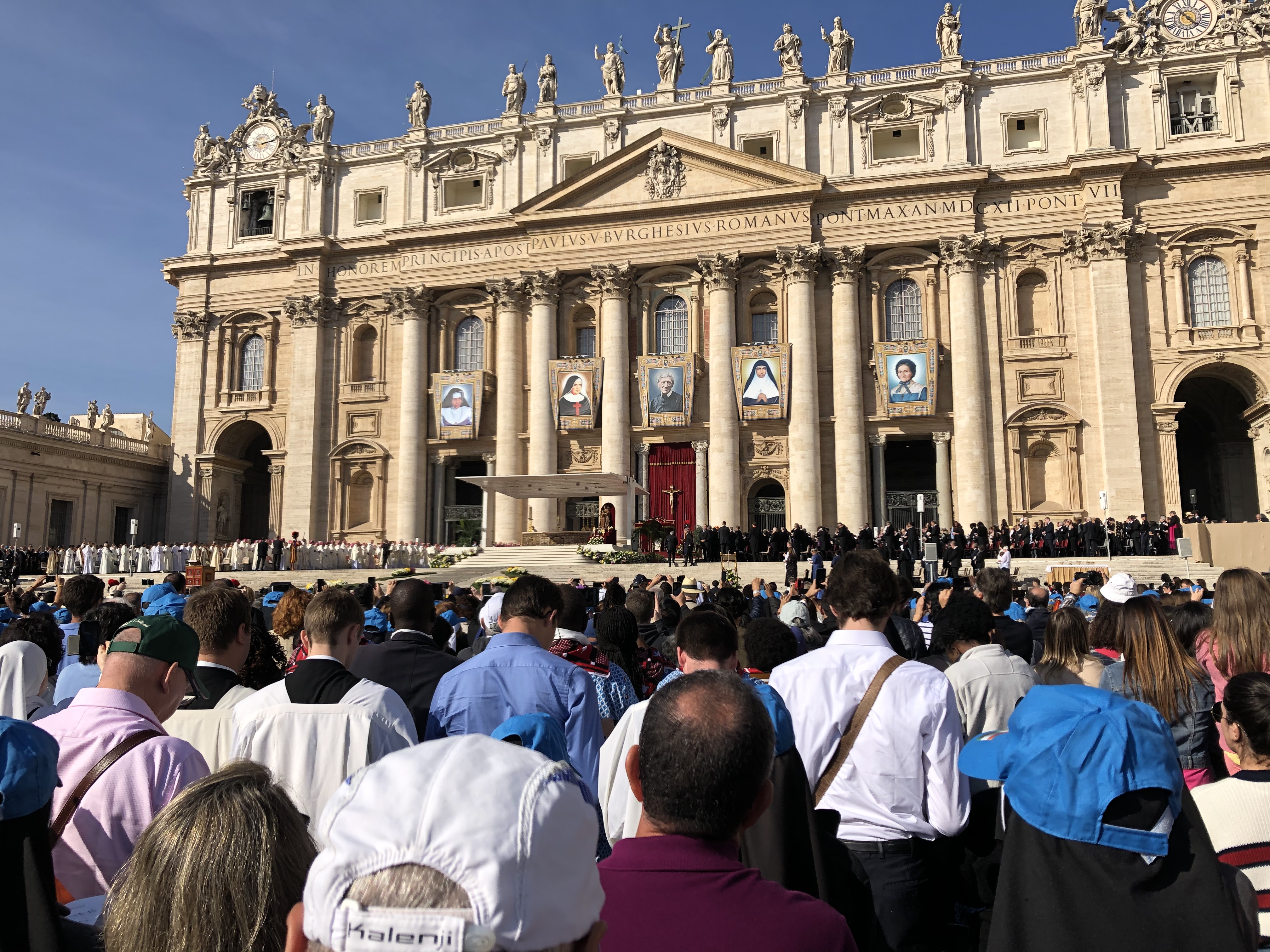
When I was thinking about that, and about what Jesus says about the Comforter, the Advocate, it reminded me of what I had experienced last Sunday when I went to Rome to attend the mass at St Peter’s for the ‘canonisation’ of five new saints in the Roman Catholic Church, John Henry Newman and four other saintly figures, three nuns and a Swiss seamstress, who all had various claims to ‘sainthood’, as the Roman Catholics understand it.

One of the things that comes out, that the Roman Catholics do that we don’t, is that they use saints as intermediaries between themselves and God. They pray to God through the saints, starting with the Blessed Virgin Mary, Mary, the Mother of God, but also then through one of more of the various saints of the church. So a form of prayer in the Catholic Mass is that you name a particular saint, and you ask that saint to pray for you.

The idea is that the saint is almost like what Jesus is describing the Holy Spirit as, if the Holy Spirit is the Advocate. It involves the idea of somebody who speaks for you. You pray through the saint, you invoke the assistance of the saint. The process of becoming a saint in the Roman Catholic Church involves miracles, to show how close the saint is to God. The person to be canonised as a saint, recognised as a saint, therefore needs to have brought about miracles, miracles which have been investigated and found to be genuine by theologians of the church.

I was in Rome particularly to witness the canonisation of one of the new saints, John Henry Newman, Cardinal Newman, who wrote the hymns ‘Praise to the Holiest in the Height’, and ‘Lead, kindly Light’, for example. He started out in the Church of England and was for 20 years a fellow of my old college at Oxford, Oriel. Eventually he changed to Roman Catholicism and became a Cardinal.

Newman was a leader – perhaps the leader – of the spiritual revival in the Church of England called the Tractarians, or the Oxford Movement, in the 1830s. Newman’s great theological message – and he was a prolific author and preacher – he was the vicar of St Mary’s in the High Street in Oxford, the University Church – the heart of his message was a call to the church to abandon what we might call today ‘relativism’, in favour of what we might describe as revealed truth.

He didn’t want the church to base its beliefs and its teaching on whatever was popularly thought to be ‘a good thing’ at the time, but rather on the truth as shown in God’s word in the Bible and in the teaching of the early Christian Fathers. You can see that sort of argument still alive in the church today, in the context, for example, of things like same-sex marriage.

The story of the Tractarians is a story of exciting spiritual revival in parts of the church. It’s not an exaggeration to say that, in the period between 1820 and 1840, the Senior Common Room of Oriel College contained some of the most influential theologians in England: not only Newman, but also Pusey, Keble and Hurrell Froude, who all supported this powerful revival movement in the Church of England, based on going back to what was perceived to be the message of the early fathers, stripped of any of the superstructure built up over the years by attempts to modernise the church in various ways.

Tractarianism (the name came from their series of pamphlets, called Tracts for the Times) came after the earlier Methodist revival, and in both those revivals there was a strong social message. The Tractarians were great believers in the Christian obligation to care for others, and particularly to care for those less fortunate than themselves.

This was a time when the Tractarians founded new congregations, new churches, in, for example, the East End of London and in some of the downtown slum areas of the big industrial cities. Just as Methodism had attacked the gin houses and encouraged people not to become prey to the demon drink, but rather to be able to keep and save their earnings and become more secure financially, so the Tractarians went out into places and founded churches where posh country parsons would never have dreamed of going.

Two healing miracles are attributed to John Henry Newman, one of Deacon Jack Sullivan in 2001, who was healed in a way that defied a normal medical explanation, and involved prayer invoking John Henry Newman, or rather his memory; and the second miracle involved the healing of an unstoppable haemorrhage in a pregnant American woman in 2013, where the woman, Melissa Villalobos, living near Chicago, had offered a prayer for healing, again invoking John Henry Newman to pray for her, and her bleeding suddenly stopped. These two miracles were considered, by the Roman Catholic Church, to be sufficient evidence of Newman’s sainthood.

We in the Church of England don’t reckon much to the idea of saints: Article XXII of the 39 Articles – on p.620 of your Prayer Books – says that the ‘Romish Doctrine concerning … invocation of Saints, is a fond thing vainly invented’, not Biblical and indeed contrary to the word of God.

This reflects the Reformation idea of our not needing to have priests stand between us and God, to pray for us and celebrate the mass on our behalf. By the same token we don’t need to have saints to pray for us. The idea is of a ‘priesthood of all believers’, which came from John Calvin.

But the Church of England is not a wholly Protestant church, although neither is it wholly a Catholic one. Henry VIII wanted to have the best of both worlds. He wanted to uphold all the doctrines of Roman Catholicism, except for the fact that he had some slight local difficulty with the Pope; so instead of the Pope being the head of the church on earth, he arrogated that function to the English monarch. So as it says on our coins, or on some of them, the name of the king or queen is on them and then ‘FD’, or ‘fidei defensor’, defender of the faith, signifying that the monarch is the head of the church on earth. That title started out as a compliment from the Pope for Henry VIII’s support for him against Martin Luther. But after they differed over Henry’s wives, the king kept the title nevertheless.

I have to say that, despite that background, I didn’t think any less of the wonderful service in Rome – there were reckoned to be 50,000 people attending, and we all got the bread of communion. It’s available on YouTube to watch [at https://www.youtube.com/watch?v=uzFObwA79xo], with a gentle but helpful commentary from an American priest. The beautiful illustrated multilingual service book had 125 pages – and everyone, from the Pope and his cardinals downwards, was given one.

In a sense there was a slight flavour of a sporting event – groups of the congregation were cheering on ‘their’ saint as they were canonised – but at bottom it was just a very beautiful Holy Communion service, whose words, and the hymns and their tunes, were familiar to everyone. The music from the choir and organ was beautiful.

Of course the idea of saints performing miracles is very far-fetched to us. But when you saw all those people not going to a football match, but going to church, it was a very happy occasion, when we all felt inspired, caught up in something beyond our own little domestic concerns, something good and wholesome which made us willing to exchange the peace and try to talk to people sitting next to us – all sorts of nationalities, speaking all sorts of languages.

Smiles went a long way – and the fact that the service was in Latin actually helped, because everyone had a little knowledge of some of the words. I was going to use the ‘Kyrie’ as a for-instance – but of course, that’s Greek. But I hope you can see what I mean.

In its basic structure, the wonderful Canonisation Mass was just like our communion service every week here at St Mary’s. It had all the same bits, and only a couple of extras – the ‘Angelus’, Angelus Domini, the Angel of the Lord, the prayer commemorating the angel Gabriel’s coming to Mary, was the most obvious extra bit – but most was word-for-word the same as our service. It made you feel very special, part of a huge family, a huge, warm family. John Henry Newman was truly a saint: and I felt the presence, in that huge crowd, of great comfort; maybe it was even the Holy Spirit, the Comforter. I think it could well have been.

Sermon for Holy Communion on the Second Sunday of Easter, 28th April 2019

Revelation 1:4-8, Acts 5:27-32, John 20:19-32

http://bible.oremus.org/?ql=423140630

_____________________________________________________

This Sunday our Bible readings take us back vividly to the life of the apostles just after the Crucifixion and Resurrection. Each passage illustrates a different angle. First in the Book of Revelation.

What is your favourite hymn? A little while ago there was a series in the parish magazine – well, actually in the old parish mag, before the beautiful St Mary’s Quarterly came out, of course – anyway, the series was on ‘favourite hymns’. People were invited to pick their favourite hymn and to explain what it was they liked about it. What would my favourite hymn be? One strong contender in my heart would be ‘Lo! He comes with clouds descending’, one of Charles Wesley’s greatest hymns. It’s number 31 in our hymn book, if you want to look it up.

Like many hymns, it contains several sermons and profound theological insights. It’s based on our first lesson, from the Book of Revelation, which says:

Look! He is coming with the clouds;

   every eye will see him,

even those who pierced him;

   and on his account all the tribes of the earth will wail.

So it is to be. Amen.

The hymn covers the same ground – in rather better poetry, I think.

The Book of Revelation is a book about the End Time, a vision of heaven, a vision of the divine. It’s a vision of God, and of Jesus sitting at his right hand, ‘up there’. Since Bishop John Robinson’s great little book ‘Honest to God’, or Don Cupitt’s BBC series called ‘The Sea of Faith’ in the early 1980s, we haven’t tended to see God as a man with a white beard sitting on top of the clouds. Even if we weren’t influenced by Bishop John Robinson or by Don Cupitt, you might remember that according to President Krushchev, when Yuri Gagarin, the first man in space, returned to earth, he is supposed to have mentioned that he hadn’t seen God ‘up there’. The great vision in Revelation is a metaphorical one; its truth is not literal. Our reading from it says

Every eye will see him,

even those who pierced him.

‘Those who pierced him.’ We have to be careful not to take early accounts of the passion and resurrection of Jesus as being very anti-Jewish. The Pharisees and the Sadducees, the Sanhedrin, the ‘the whole body of the elders of Israel’, did, as a matter of bare facts, cause Jesus to be crucified: but as Jesus himself said, they did not know what they were doing. They were not consciously killing the Son of God. In the early encounter between the Jewish authorities and the disciples which we heard about in the words of Acts chapter 5, if you read a bit more of the chapter after this, you’ll see that it isn’t simply a question of a brush between the Jewish leaders and the apostles, not simply – or at all, actually – a kind of repeat of the persecution which had resulted in Jesus’ death. The full story tells that the High Priest and the Sadducees, motivated by jealousy, arrested the apostles and put them in prison. But ‘an angel of the Lord’ opened the doors of the prison and let them out during the night, so that when they went to get them in the morning, the police reported that they’d found the prison locked, but no apostles inside. They’d gone back to teaching in the Temple. They sent the police and fetched them to appear before the Council – but without using any force, ‘for fear of being stoned by the people’.

Then comes the passage which was our second reading, the exchange between the High Priest’s group, the Sadducees, and Peter. They asked, ‘Why did you ignore our injunction to prevent you from preaching?’ …. And the answer was, ‘We must obey God rather than men.’ Then Peter went on to rehearse the crucifixion story. ‘The God of our fathers raised up Jesus whom you had done to death’, and most important, ‘We are witnesses’. The Sadducees, extraordinarily, wanted to kill them. They couldn’t cope with how popular the gospel message had already become. To the apostles, it must have felt horribly reminiscent of the time immediately before the crucifixion.

But then another Jewish leader, a Pharisee called Gamaliel, a ‘teacher of the law held in high esteem by all the people’, stood up in the Sanhedrin council and said, ‘Keep clear of these men, I tell you; leave them alone. For if this idea of theirs or its execution is of human origin, it will collapse; but if it is from God, you will never be able to put them down, and you risk finding yourselves at war with God.’ These were wise words – and they came as much from a Jewish source as any of the cruel Sadducees’ threats. Both sentiments came from Jewish sources, enlightened, Gamaliel, or cruel, the Sadducees. You can’t really blame the Jews. They really had no idea what the big picture was.

A quick look back, before we move on to consider Doubting Thomas. An ‘angel of the Lord’ organised the apostles’ gaol break. What was this angel? Given that the name ‘angel’ means ‘messenger’ in the original Greek, rather than thinking about angels as being superheroes like Superman, let’s think instead that they could just have been ordinary Christians, doing the will of the Lord. You can understand quite a few of these apparently supernatural terms in natural, normal terms. Most likely it was just ordinary humans who got them out of jail – but in so doing, they were doing the work of God. But of course, if you want to believe in angels as something magical, between gods and mere men, fair enough. I’ve got no proof either way.

Then we do go on to think about Doubting Thomas. The story of Doubting Thomas has strengthened so many people’s faith. It certainly did mine. ‘Blessed are those who have not seen and yet have come to believe’. That’s us. We haven’t been able to do what Thomas did and verify empirically that they were encountering the risen Jesus. Our understanding, our trust in the whole Gospel, has to have been based on things we ourselves haven’t seen.

The essence of that faith is that Jesus rose from the dead. That’s not just an extraordinary miracle, something to amaze and delight you, which is really what the word ‘miracle’ meant originally, (something to amaze and delight), but also most crucially it means that God, however we understand him to be, the unmoved mover (according to Aristotle), the creator and sustainer, the Almighty, all-powerful, all knowing, He, has a relationship with the human race, with us.

God is bigger and infinitely more detailed than I, certainly, can comprehend. The Bible says, in St John’s Gospel, Jesus is quoted as saying, that whoever has seen him has seen the father (John 14:9). I suppose if you take literally the passages which have Jesus sitting at the right hand of God the Father in heaven, then those glorious images of a heavenly palace above the clouds will resonate with you.

But I think that I am too much a prosaic, matter-of-fact person to believe literally that that is how things are. I’m with Yuri Gagarin. I don’t actually think that God lives above the clouds, or indeed that he can be tied down to a particular time or place. Except of course he can. He can be tied down in a sense to the time and place of Jesus. If we didn’t know about Jesus we wouldn’t know anything at all about God except in purely functional terms, making stuff, creation, and knowing stuff, omniscience, and so on. And the story of Thomas is the most powerful expression of this.

But hang on a minute: if God isn’t somewhere, if there isn’t a sort of Mount Olympus somewhere, with God and his angels and Jesus together on top of the clouds on their thrones in some glorious palace which looks just as we would imagine 20th Century Fox and perhaps one of those great directors like David Lean would portray it, larger-than-life for sure; if that’s not the way it is, and if Jesus was not saying something completely fanciful, when he said that if we have seen him we have seen the father, then can we actually know God a bit more after all?

I wonder whether the angels are a clue. As I said earlier on, when the angel of the Lord came to let St Peter and the apostles out of the gaol, I did just wonder who the angel was. It occurred to me that, just as we say that the Holy Spirit – which is God in one form – just as we say that the Holy Spirit is in our church, is in all of us, and that we are called ‘the body of Christ’, here today as well, so it means that angels, messengers of God, could be ordinary people, just as Jesus was an ordinary human being in one sense.

So we could be angels. Surely we are angels, when the Spirit is at work in us and when we do God’s work. I’ve preached before about saints. I’ve made the point that the saints are all of us Christians. Another hymn:

For all the saints who from their labours rest,

Who thee by faith before the world confessed.

That’s us. We are in that wonderful ‘apostolic succession’, as it’s sometimes called, from the earliest Christians; and thousands and thousands of new Christians are coming forward every minute, who haven’t seen, but yet believe.

Well that’s great. It’s a very major thing – and we could stop it there and go away from this service feeling perhaps that we’d come a little closer to God. But the other major thing that we must consider is that, if we are to be saints and angels, real saints and angels, we must behave like them.

So today in a society where there is a terrible xenophobia, where people say things against immigrants, ignoring the fact that they are human beings like us, where people blame those who go to food banks, for being in some sense feckless or undeserving, where we turn our backs as a country on our relationships and treaties with other countries, where we fail to take our fair share of refugees, where we allow a government ministry to uproot people who have being here working and making their lives among us for decades, and send them to countries which they have not seen for those decades, on the grounds that they are in some way here illegally, where there are so many instances of our society’s meanness and failure properly to provide for those who are less fortunate than ourselves, where we justify it by shrugging our shoulders and saying that it is all very sad but there isn’t enough money to go round; but then, miraculously, the government finds billions for Brexit.

Yes, what I’m saying is political; but it is not intended to be party political. It’s true whether you’re Labour or LibDem or Conservative. The important thing is that we’re Christians. I’m saying that, as Christians, we should have a view on these things. We should call them out; we should stand against them, because we are Christians. We should, if we have a spare room, consider welcoming some refugees to stay with us when they first arrive. We should tell our politicians that it’s not acceptable not to put sprinklers in high rise council blocks like Grenfell Tower, (even though government ministers have promised to do it); tell our politicians it’s not acceptable not to pay proper compensation to the people whose lives have been ruined by the Windrush scandal; it’s not acceptable that thousands of people – last year, over 4,000 – are denied benefits on the grounds that they are fit to work, and then are so ill that they die within three months of that decision. It’s not acceptable that the newspapers should be full of pictures of a poor man, Stephen Smith, so emaciated that his bones are sticking out, so obviously desperately ill, denied benefits, on the ground that he is ‘fit to work’: he died. But not until he had won an appeal in court, as 70% of the appeals are won. [See https://www.theguardian.com/commentisfree/2019/apr/22/stephen-smith-benefits-system-dying]

This institutional meanness doesn’t just come out of the air. Just as we are saints and angels with the Holy Spirit in us, we have God’s power in us. We are not impotent. We have God’s power to do something about it. We need to speak to our MP, to write letters, to demonstrate on the streets if necessary, to rise up.

So today the message, the Easter message, is that we have seen the Lord. We have seen him at work in our fellow saints and angels. Let us join them, let us take that divine power and use it.

Stephen Smith