Archives for posts with tag: Romans

Sermon for Mattins and Morning Prayer (Principal Service) at All Saints Church, Penarth, 5th October 2025

Habakkuk 1.1-4; 2.1-4

Psalm 37.1-9

2 Timothy 1.1-14

Luke 17.5-10

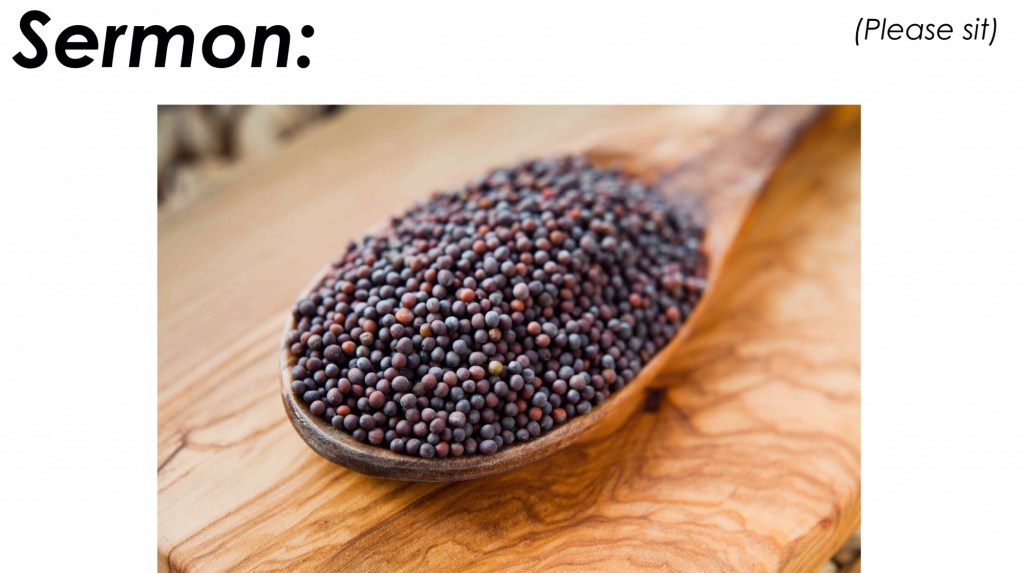
It’s a pity that we don’t have lantern slides at 8 o’clock, because I could show you the picture on the slide which is going to be shown at 10 o’clock when I start to preach the sermon then. It’s a sort of shovel, or it could be a large spoon, with round things in it, quite small.

I wondered whether they were my favourite special-treat breakfast cereal, Grape-Nuts – I should explain that I didn’t choose the pictures, as Susannah is leading the service at 10 as well as this one – but I suspect that at 8 o’clock we need to stay away from pictures and screens and things like that, and just keep our worship simple and our pictures in our heads, where, of course, those of you who listen to the wireless know that the best pictures are.

What is in the big spoon? I asked Susannah and she told me that they were mustard seeds, picking up a reference to the Gospel reading, the New Testament lesson today. I have to say that it rather threw me, because I thought mustard and cress was something which you grew on a face flannel on the bathroom windowsill, but apparently this is what mustard seeds really look like.

The lessons are all about how we confront a world which is going wrong, which is going against us. The Old Testament lesson, from the prophet Habakkuk, comes from a time around 600 BC when the Assyrians had overrun the northern kingdom of Israel, and all that was left of God’s chosen people were the two tribes of Judah and Benjamin, together with the survivors from the massacre when the Assyrians invaded the northern kingdom, who had fled to Jerusalem to take refuge there.

Habakkuk was preaching when the Babylonians were beginning to sweep down on Palestine; they are the Chaldeans, if you read a bit more beyond one of the bits that we have for our lesson, which is in two bits, the first four verses of chapters one and two respectively. If you read on in chapter 1, beyond where it says

Devastation and violence confront me;

strife breaks out, discord raises its head,

……

for the wicked outwit the righteous,

and so justice comes out perverted.

Habbakuk goes on in his prophecy by saying

Look, you treacherous people, look:

here is what will astonish you and stun you,

for there is work afoot in your days

which you will not believe when it is told you.

It is this: I am raising up the Chaldaeans,

that savage and impetuous nation,

who cross the wide tracts of the earth

to take possession of homes not theirs.

Terror and awe go with them;

their justice and judgement are of their own making.

Their horses are swifter than hunting-leopards

And he goes on to say how terrifying they are in all sorts of other ways. Obviously they fulfilled the American strategic objective for a successful army in the invasion of Iraq, ‘shock and awe’.

But this terrible army had its limitations.

Their whole army advances, violence in their hearts;

a sea of faces rolls on;

they bring in captives countless as the sand.

Kings they hold in derision,

rulers they despise;

they despise every fortress,

they raise siege-works and capture it.

A terrifying picture. Who could stand against them? But then –

Then they pass on like the wind and are gone;

and dismayed are all those whose strength was their god.

People who believe that ‘might is right’ turn out to be completely mistaken; and the key words in Habakuk’s prophecy come in the second chapter, in our second part of the lesson, [2:4]

Look at the proud!
 Their spirit is not right in them,
 but the righteous live by their faith.

It’s an idea that St Paul picked up on in two of his letters. In his great letter to the Romans, [1:17], he said that in the gospel of Jesus

is revealed God’s way of righting wrong, a way that starts from faith and ends in faith; he says, as Scripture says, ‘he shall gain life who is justified through faith’.

In the letter to the Galatians [3:11], where St Paul is drawing a distinction between following the provisions of the Jewish law, just carrying out the 10 Commandments, and having faith, saying that the way to salvation is through faith, he says that

It is evident that no one is ever justified before God in terms of law; because we read, ‘he shall gain life who is justified through faith’.

I’m not sure why the compilers of the Lectionary decided that we should have a lesson from the second letter to Timothy rather than one of these passages from Romans or Galatians, (which clearly reference the passage in Habbakuk), but certainly in the passage from the second letter to Timothy, St Paul celebrates that the fact that Timothy and his mother and his granny, Eunice and Lois respectively, all had strong faith.

But you might be a little bit puzzled about exactly what this faith is. It’s pretty clear that it’s not what we would call blind faith, just believing that something is true without any evidence for it. If that was true, you might never take another paracetamol ever again; or even worse, you might try to cure Covid by drinking some bleach. But we are not talking about President Trump’s belief system; this is a word which has more of a connotation of trust about it. It’s not so much about believing that something is the case, but rather, trusting in God to produce a good outcome, to right the wrongs. It’s very close to hope. Hope in the Lord. Trust in the Lord. As Isaiah puts it [14:31]:

but those who look to the Lord will win new strength,

they will grow wings like eagles;

they will run and not be weary,

they will march on and never grow faint.

They will soar, on wings like eagles: they will ‘mount up with wings like eagles’.

Just now our world looks a bit like what it must have looked like to Habakkuk; there is a lot going wrong. There are terrible wars, invasions; the rule of law looks to be under threat in places: –

devastation and violence confront me;

strife breaks out, discord raises its head,

…..

for the wicked outwit the righteous,

and so justice comes out perverted.

We can think of plenty of places and cases today, where those words would be very apt. We are going to have a vigil later on today here to pray for the people of Palestine; equally our prayers should go for the other places in the world where there is no peace and where the rule of law does not securely run: Ukraine and the south of Sudan chief among them, as well as Gaza and the West Bank; and all those places where people are held hostage or are fleeing violence and persecution and are becoming refugees.

We need to trust in the Lord, to pray with confidence and realise the power of prayer, even if our faith is only the size of one of Susannah’s mustard seeds, or a spoonful of Grape-Nuts. It doesn’t matter. You can rely on God to put things right in the end. Let us pray that he will use us in his service to that good end.

Amen.

Hugh Bryant

From the PowerPoint slides at the 10 o’clock service. What are those little beads?

Sermon for Mattins on 1st December 2024, the First Sunday of Advent

Advent Reflections

https://bible.oremus.org/?ql=605091724

Isaiah 51:4-11

Romans 13:11-14

We have lit the first Advent candle and begun the new church year with the beginning of Advent. The word ‘advent’ means coming, or ‘coming towards’ somewhere. It is from an old Latin word.

It is supposed to be a penitential season in the church’s year, although probably not quite as serious as the period of Lent. Not for the first time you get the slight feeling that in the church we are sailing against the wind so far as the rest of society is concerned. If you watch ITV and pay any attention to the adverts, essentially the thing that we are coming towards is definitely Christmas, and it’s not a thoughtful time at all except to the extent that you may have to spend a bit of time with your diary making sure that you’re in the right place at the right time for all the Christmas parties and, particularly at Christmas, that you haven’t left any of the family out. But that’s not really what the Christian tradition is all about. The ‘coming’ in Advent is the coming of Jesus, and there are really two comings, coming in the sense of his incarnation, becoming a man, being born in the manger Christmas is one coming.

But there’s also be an idea of the end time, of Jesus’s second coming, and you can see from our readings today in the lesson from Isaiah a prophecy addressed to the people of Israel looking forward to the Messiah, the great saviour who would take them out of captivity, effectively for a second time. The prophet reminds them of the escape from Egypt, the parting of the waters and the entry into the promised land. Isaiah is saying that God can do this again. 

And then in Saint Paul’s letter to the Romans he reflects the belief which was common among the early Christians that the end time, that the second coming, and the time of judgement, was just round the corner. Obviously we realise that that’s not the case, and if there is to be an end time of this type, we don’t know when it will be. 

St Paul nevertheless makes a good point in saying that we should always live our lives as though we would be hauled up before the judge eternal in the next day or so. There is a sort of tension here. For all the last 2000 years we have recognised that the Messiah has come, at Christmas time, but still we are waiting, waiting for him to come again. 

In our church in Wales there is a difference in the holy communion service compared with our brothers and sisters in England. In England the church says, ‘Christ has died, Christ is risen,’ and then, ‘Christ will come again’. The church in Wales, perhaps more realistically, says, not, Christ will come again, but, Christ will come in glory. What we can reflect on is that looking towards this second coming, whenever it may be, isn’t just a question of our hanging around aimlessly, as somebody put it that I read recently, this time of waiting is not devoid of meaning, like time spent waiting at a bus stop. 

This ‘in-between time’ is a time for the church to proclaim the gospel to every nation, to make sense of the present, while never giving up the hope that God’s Messiah, Jesus, will have the last word. We have to acknowledge that, in a very real sense, we do still need salvation. There is still an awful lot wrong with the world, particularly today when we see the terrible wars that are going on in Gaza, Ukraine and south Sudan. 

The world hasn’t faced up to the fact that as well as wars and civil strife, there is a huge gap between the haves and the have-nots, between the rich nations of the northern hemisphere and the global South, that means that there is a huge pressure of migration because people may be fleeing not only from war but also because they can’t make a living and they are moving towards the places which are richer and more likely to give them the means to sustain themselves. 

I watched Angela Merkel, the former German chancellor, being interviewed by the BBC’s Katya Adler – It’s a very interesting interview which you can catch up with on iPlayer [https://www.bbc.co.uk/iplayer/episode/m0025gqj] – and it was really interesting that Dr Merkel identified the biggest problem facing civilisation nowadays as the gap between the rich and poor. If you fix that, there will be far less need for people to migrate, quite apart from all the other benefits that will flow through having a fairer world. 

So we must be awake. We must think and do whatever is needed so that our world looks more like a place where the Messiah has already arrived and less like a place which badly needs him to come again. 

Having said that, I should just share with you that when I was doing my reading in preparation for this sermon, I managed to find one scholarly reference which might tend to suggest that people who see Advent as being just a jolly run up to Christmas might have some historical justification. 

The liturgical scholar Benjamin Gordon Taylor wrote this. ‘Although in historical terms the most recent of the seasons to emerge……, the origin of advent is not clear. It had a penitential character in the middle centuries of the first millennium which may have been linked to epiphany baptism, but neither this nor the alternative view, that it represented a Christianising of the pagan winter fast, can be certain. Contrary to its modern acceptance as the beginning of the liturgical year, Advent may in earlier times have struggled against a persistence in Rome to see Christmas in this role; certainly the emphasis on penitence in Gaul and Spain was contrasted in Rome by a focus on the joyful expectation of the coming of Christ.’ Clearly we are the spiritual successors of the Romans here. 

And he goes on to say, ‘Advent has a rich potential for reflection on powerful themes in the economy of salvation, for example the first and second comings of Christ and, traditionally, the four last things: death, judgement, heaven and hell. And earlier emphasis on penitence, although not universal, tends to be downplayed.’ 

So I think we have scholarly endorsement: it’s okay to enjoy the Waitrose ad, provided you don’t forget all those people who couldn’t afford even to go to Lidl and, more importantly, provided you do something about it. 

https://bible.oremus.org/?ql=575175148

Genesis 2:15-17, 3:1-7; Romans 5:12-19

The first Sunday in Lent,  in preparation for the great Easter climax: a time of spiritual reflection, renewal, fasting. We are preparing for the events which revealed God’s love for humanity. God’s love, indeed, for fallen humanity, we often say. and that’s what our Bible readings this afternoon are about. The lesson from Genesis is sometimes described as the story of the Fall, and Christ’s passion and death, followed by his glorious resurrection, described in terms of sacrifice and redemption, salvation. Salvation for fallen humanity.

We know these stories. We know the story of Adam and Eve, and we know Paul’s famous passage contrasting Adam, who brought sin into the world, with the free gift, the grace of God, in giving us Jesus Christ. and I’m sure that as you’ve heard the lessons, as they were beautifully read just now, even if you aren’t word perfect in your memory, they were pretty familiar. 

But in the spirit of Lenten reflection, perhaps not in a full-on 40 days in the wilderness sense, but nevertheless, in the hope that it makes you quietly go away and think about this, let’s have a closer look at the Fall and the ‘free gift’.

Let’s look at the Fall. What did Adam and Eve do wrong? I remember when I first heard this bit of Genesis, where God tells Adam that he can eat the fruit of all the other trees, but not this funny tree called the tree of the knowledge of good and evil; I wondered what its fruit looked like. It’s one clue that this is not meant to be a scientific explanation of anything, that one of the key elements is that there is this mysterious tree. It’s not just a plum tree or an apple tree. 

But then again, what is wrong? What is wrong with getting to know the difference between right and wrong? The idea seems to be that, before the Fall, before the act of disobedience, humans, or at least the first humans, Adam and Eve, didn’t know the difference between right and wrong. They were in some kind of primordial innocence – but they were immortal, or at least that seems to be the implication, because the threat that God makes is that if they disobey him and eat the fruit of the tree of good and evil, “you shall die”. Later on in Genesis, it says, “you shall get your bread by the sweat of your brow until you return to the ground, for from it, you were taken. Dust you are, and to dust you shall return.” You will remember that phrase from the Ash Wednesday service.

But why should it be a bad thing to know the difference between good and evil? And is there any obvious link between acquiring an innate moral sense and becoming mortal? Without wanting to sound flippant, I do think that this is a fairytale. Or perhaps, to put it more positively, it’s a myth, a story told to illustrate a point. So I suppose the attractiveness of it, why it is such a compelling story, is that indeed, we are very drawn to sympathise with Eve. As the serpent says, “when you eat of the  fruit of the tree, your eyes will be opened, and you will be like God, knowing good and evil.“

 The woman saw that “the tree was good for food, and that it was a delight to the eyes, and that the tree was to be desired to make one wise”. 

What on earth is wrong with any of that? The only thing you can find in the text is that God told them not to do it. You might say that there was more to it. There was a suggestion that, as a consequence of them doing it, they would become mortal. 

Alternatively, (and I think this comes out from Saint Paul’s discussion that we will go on to look at in a minute), it’s not that they will become mortal, so much as that God will kill them. There will be a death penalty for their disobedience. They were always mortal, because that’s the nature of being human: but if they disobey God, God will punish them, he will inflict death upon them. Perhaps that is closer to the true meaning.

It’s all painfully like stuff we remember from childhood. ‘Why do I have to stop throwing bread rolls at my brother when we are having our breakfast?’

 Answer, ‘Because I told you not to.’

‘ Why not?’

 ‘Because if you carry on doing that, you will get a thick ear.’

The way that this is written, makes us realise that it isn’t the ability to tell wrong from right that is the problem – that ability is always a good thing – but it’s how Adam and Eve acquired this ability that got them into trouble. 

The important thing is that they disobeyed God. They went off in another direction away from where God had directed them. The problem is not that they knew the difference between good and evil, but that they had become estranged from God. They had ploughed their own furrow; they thought they knew better than God what to do. That is why it is described as sin. What Adam and Eve did was sinful. Sinfulness isn’t necessarily doing something which is morally wrong, so much as becoming cut off from God. 

That’s what Paul picks up on in his letter to the Romans. ‘Just as sin came into the world through one man, and death came through sin’, is what he says, not ‘bad things or doing bad things’ came into the world – and incidentally, St Paul seems to be a bit shaky on gender equality, because he only seems to blame Adam, whereas it looks as though the Fall was proximately caused by Eve: anyway, we’ll leave that for another day. 

St Paul sees the Fall as alienation from God, as sin, not just doing bad things. He repeats what Genesis says about the consequence of sin being death. I can’t help feeling that perhaps Paul reasons backwards from Jesus’s rising from the dead, from Jesus‘s resurrection, from his conquering death, as it is sometimes called, to infer that mortality was the consequence of sin, that alienation from God, disobedience to God, made one mortal.

That seems to be the logic, although I have to say, it’s one part of these passages that you either believe or not, because there’s nothing you can do to prove or disprove whether God made previously immortal people into mortals. 

Be that as it may, Paul contrasts the idea that Adam brought sin into the world – and as Paul says he is not treating Adam as a particular person, but, as the lesson says, “Adam, who was a type of the one who was to come“, or, as another translation [NEB] puts it, “Adam foreshadows the Man who was to come”– either way, it was not particularly Adam – or Eve – who was responsible, but mankind in general going away from the commandments of God.

The Greek word for sin is άμαρτια, which means missing the mark, shooting, and missing the target; Paul then goes on to talk about the effect of what he calls “the law“, that sin existed before the law, but until the law came along, you couldn’t measure how much sin there was. He means law in the sense not of statutes passed by government, but the Jewish law, which is intended to give direction, how to comply with God’s commandments. 

So, if you disobey the Jewish law, which is in the first five books of the Old Testament, and summed up in the 10 Commandments, then you have broken the law, not in the sense of being a burglar or a murderer, (although if you were one of those, you would be contravening some of the 10 Commandments) – but more importantly, you are committing sins, things which drive you apart from God. 

So Paul contrasts the beginning of sin, the Fall, the fall from grace, by Adam, the prototype man, he contrasts that with God’s gift, his grace, his free gift, to fallen mankind, in giving us his son, Jesus Christ.

Paul contrasts judgement following one trespass, which brought condemnation, and the free gift following many trespasses, which brings justification. 

‘Justification’ is a technical term in the Bible. It means being on good terms with God. Sometimes theologians translate it as being right with God, so as to pick up the connotation of justice; but it is more like what an engineer or a carpenter, or a toolmaker, might understand as justification: bringing a work piece into alignment with another work piece, justifying that piece with its intended place. 

You adjust something so that it fits. 

It’s that kind of relationship that St Paul is talking about here: not a question of being acquitted in a court of law. This all comes in the context where Paul has introduced the idea of “justification through faith“. The idea that you’re not put right with God by doing good deeds necessarily, although good deeds are a good thing to do anyway, but that you depend on God’s generosity. 

He is not so much rewarding us as being gracious to us, giving us what is translated as a “free gift” It’s a Greek word, which is translated as a free gift, but it also really means a ‘gifty thing’, a δωρημα as opposed to a δωρον. It’s the essence of generosity, the essence of giving, rather than just a particular present. And that squares again with the idea that we are being put right with God, being brought into adjustment, into a good fit.

Just one more puzzle, before I leave you to carry on musing on these really rich passages with so many things to ponder over. That is the consequence of the free gift. Saint Paul says that those who receive the free gift of righteousness are saved. They “exercise dominion in life” it said in our lesson, through that one man, Jesus Christ. It’s the conquest of life over death. We have the gift of eternal life. That’s what salvation is. 

You need to go on and do some homework and read the 15th chapter of Saint Paul’s first letter to the Corinthians to give you more detail about what eternal life is and how it works. Jesus showed that it is possible, by himself rising from the dead. St Paul gives you some very believable analogies to explain in more detail how we can expect eternal life to come about.

So those are some ideas which you might want to reflect on as you begin your journey into Lent this year. All the Fs, the Fall and the Freebie, the Free Gift.

And just one more thing, for those of you who have been tackling me about this.  What am I going to do by way of giving things up for Lent? I like to follow an idea which a former Lord Mayor of London had a good few years ago, called the absent guest scheme. 

Whenever I go out for a meal or some other refreshment, I keep a note of the bill and then, at the end of Lent, I calculate what it would’ve cost to have had another person present at each of these occasions, an ‘absent guest’. I tot up what the total cost of the absent guests would have been and give it to my chosen charity for that Easter.

This year I will be giving it, I hope, to the United Nations Relief and Works Agency, UNRWA, for their work in Gaza.

Sermon for Evensong on the third Sunday of Lent, 12 March 2023, at Saint Peter’s, Old Cogan

https://bible.oremus.org/?ql=545542568‘

Put on the whole armour of God…; the breastplate of righteousness…; the shield of faith…; the helmet of salvation, and the sword of the Spirit.’

My favourite toy shop – yes, my favourite toy shop – isn’t Hamleys in Regent Street but it’s in Zürich and in a number of other places in Switzerland under the name Franz Carl Weber. It’s a very old shop; it’s been going since 1881. It is a truly wonderful toy shop. 

The top floor is very well stocked with model railways at one end and dolls at the other end, so there is no sexist hierarchy. Then on the floors going down, are pedal cars and bikes, dressing up clothes, board games and construction toys: there is Lego and Playmobil but, alas, no more Meccano. There’s absolutely everything for kids in there and indeed there is quite a lot for their grandpas to enjoy as well. 

But there is one small category of stuff that Franz Carl Weber does not stock. I wonder if you can imagine what it is. Well, the answer is that Franz Carl Weber, the best toy shop in the world, I think, does not stock anything to do with war or weapons. There isn’t even a spud gun to be had in there. No toy soldiers; no World of Warfare games, no Airfix kits of warplanes; nothing to do with war or weapons. 

I’ll come back to the toy shop without any toy soldiers in a minute. But I just want to look at something else we haven’t got at the moment, which is any hymns today. Sometimes that’s quite a good thing; because it’s rather like listening to the radio – you know, ‘the pictures are much better on the radio’ than on the TV – because they are in your head. That goes for other things that you can hear in your mind’s ear, if I can put it that way. So what would be our hymn?  I would suggest the one that immediately springs to mind is a great one of Charles Wesley’s, 

Soldiers of Christ arise, 

and put your armour on. 

Strong in the strength which God supplies 

through his eternal Son. 

Stand then in his great might, 

with all his strength endued, 

but take to arm you for the fight 

the panoply of God.

The panoply, the complete kit of weapons, the suit of armour; for this is a hymn based on our reading from Saint Paul’s letter to the Ephesians. And it’s a rousing hymn: that I certainly remember being very popular with us when I was at school.

And in one sense, what’s not to like? Either about our lesson, or about Charles Wesley’s poetic rendering of it? Stand up to evil; be armour-plated in your resistance, use the best weapons you have, to stand up for the good guys. It’s pretty topical, in the context of the Ukraine. There’s lots in the newspapers, on the TV and on the radio, comparing the weapons used by the Russians with those supplied to the Ukrainians by the Western nations. 

There’s something quite celebratory about the respective descriptions of the Russian and western tanks that we and some of the other European nations – and, indeed, the United States – will be sending – in fact I think that we are already sending, for the Ukrainians to use. 

There has been quite a lot of learned discussion about the relative merits of the Western weapons as against the weapons used by the Russian invaders. I am sure that most 15-year-old boys would be able to give you a detailed rundown of the respective specifications of the Russian T90 as against the Challenger 2 or the Leopard 2 tanks, or the Abrams.

You know, I used to rather like playing with toy soldiers and those Britain’s model field guns which shot out a sliver of lead as a shell. My friend John DeVille, when we were eight or nine, had the most marvellous model 18 inch ‘naval howitzer’ which reproduced all the main things that a real field gun did. You could lay the barrel at the right elevation and tracking; the shells were little masterpieces of brass with a spring inside them and the lead projectile which you put in the breach and then fired, then ejecting the casing. The whole thing was about eight or 9 inches long and it went with our toy soldiers, which were predominantly lead or die-cast, painted in enamel and colourful in their fine uniforms. 

But there was a problem. The problem was, what to do if there was a battle. Then you would actually shoot your wonderful naval howitzer or model 25-pounder at the army which you had lined up against them. But I didn’t want to break any of my soldiers and I didn’t want to damage the opposition’s half-track truck that I was very proud of. So this was a war without casualties. 

And after a bit it began to dawn on me that there is no such thing, that those beautiful soldiers would get smashed up. Some of them would lose arms and legs – and heads. Some of them would not get up again. 

And I want to suggest to you, in all humility, that St Paul may have been a bit up the pole here, in this famous passage from his letter to the Ephesians. In celebrating weapons of war, even when they are used in a good cause, he is missing what Jesus himself said. ‘Love your enemies. Turn the other cheek.’ 

Oh, but surely, you will say, Saint Paul is being a realist. The way of love is just not practical, and you do need the shield of faith, the helmet of salvation and the sword of the spirit; and indeed you may say that this is exactly in line with the Old Testament as well. 

Look at our lesson from the book of Joshua, where God says to Joshua, 

‘There shall not any man be able to stand before thee all the days of thy life: …Be strong and of a good courage: ..Only be thou strong and very courageous, … that thou mayest prosper whithersoever thou goest.’

And you will remember that this led on, once the Israelites had crossed over the Jordan, to their encounter with the Amalekites where, rather surprisingly, God took them to task for having shown mercy to the people whom they defeated. 

But the thing that perhaps St Paul didn’t really get, but which Franz Carl Weber, when he set up his toy shop in 1881, did understand, is the point about my not wanting any of my toy soldiers to be broken. Mr Weber realised that you can’t have a war without breaking soldiers; that the use of weapons does not bring about victory, but it is, rather, a sign of failure. 

Paul paints a picture which looks like a Roman centurion in his armour, and perhaps, as he was the ‘ambassador in chains’ imprisoned in Rome when he wrote the letter, he might have seen a victorious general coming back from a campaign and being granted what was called a triumph, leading the people whom he had conquered, their kings and generals, in chains through the streets of Rome. His centurions would be in their best uniform.

But war never really leads to triumph. Away from the soldiers marching in their dress uniforms there are the broken ones, maimed and dead on the battlefield. And at this time, when we are now confronting again the feeling that we have to wage war, in order to defend civilisation against the attack of the Russians, we don’t know what victory should really look like. 

And at this time of Lent we have to realise that the conflict that Jesus entered into, in trying to bring about his kingdom of love, ended on the battlefield. Jesus was one of the fallen. 

But the other message of Lent points to the triumph, the real triumph, of Easter. Be of good cheer and I will support you. Do the right thing and I will support you, is God’s message to Joshua. The prophet Isaiah, (or perhaps more correctly the first of the three prophets writing under the name), had a vision of the kingdom in which they would ‘beat their swords into ploughshares, and they would not learn war any more.’ 

Then, on God’s holy mountain, the sword of truth will have more truth than sword; the breastplate of faith, more faith than breastplate, and the helmet of salvation, more salvation than helmet. Let it be so! Let us pray for peace and love in place of war. With that peace and love, we can have the ‘sure and certain hope of the resurrection to eternal life’ which comes at Easter.

Sermon for 1030 Eucharist at St Mary, Oatlands on 21st October 2020

Acts 16:6-12; 2 Timothy 4:5-17; Luke 10:1-9 (http://bible.oremus.org/?ql=470148758)

On Sunday we were remembering Saint Luke, the ‘beloved physician’, as Saint Paul describes him in his second letter to Timothy, the one who wrote not only the Gospel according to Saint Luke but also the Acts of the Apostles, I want to carry on remembering St Luke this morning, looking at the same Bible passages as we used on Sunday.

Folli [Revd Folo Olokose] treated us to a theological masterclass in his sermon on Sunday. I don’t want to go over exactly the same ground again, but he did make some points which I will just briefly mention, particularly for anyone who was not there on Sunday.

Folli took, as the heart of his sermon, the name of the person to whom Saint Luke dedicates his two books, Theophilus. Who was Theophilus? Folli argued that it is a name for a type of person, not someone in particular – not who, but what. It literally means, ‘a friend of God’. It could mean any of us.

All the other things which might seem to make us different from each other, such as our education, our physical characteristics, or the ability to run a four-minute mile, are all things which can come and go, and might depend on where you have been born, who your parents were. However, being God’s friend is something which lasts forever, and which any of us can be.

So Folli argued that, in dedicating his books to Theophilus, Luke was in fact dedicating them to all of us, to all who love God. And we see from today’s lessons that Luke was a companion of Saint Paul on his travels. ‘We did this..’, rather than ‘they did it’, in the passage from Acts 16 which was one of the lessons prescribed for Sunday.

During the night Paul had a vision: there stood a man of Macedonia pleading with him and saying, ‘Come over to Macedonia and help us.’ When he had seen the vision, we immediately tried to cross over to Macedonia, being convinced that God had called us to proclaim the good news to them.

We set sail from Troas and took a straight course to Samothrace, the following day to Neapolis, and from there to Philippi, which is a leading city of the district of Macedonia and a Roman colony. We remained in this city for some days.’

Luke says, ‘We’. He was there, travelling with St Paul. In a wider sense, who are ‘we’ in this context? From Paul’s letter to the Romans, ‘… there is no distinction between Jew and Greek, because the same Lord is Lord of all…’ (Romans 10:12).

So in our lesson today, Luke reports on Jesus sending his disciples out ahead of him, to prepare people for him coming and preaching among them. Roughly the same report comes in St Matthew’s Gospel too.

You might note that Jesus instructs the apostles, ‘Do not move around from house to house’. I had a bit of an unholy thought – do you think our Lord might have had tier 2 or tier 3 in mind?

Of course they didn’t have a plague then. Sending them out they were a bit like Billy Graham’s people, arranging one of his crusades, securing the venues and booking the hotels – although Jesus stipulated that it should all be done on a shoestring – but what was the message that Jesus was going to preach?

The message wasn’t going to be about life after death. Jesus hadn’t died at this stage. Let’s look at the Gospels where Jesus sends out his disciples to do the Billy Graham thing, that is, our Gospel passage today from St Luke, chapter 10, where Jesus sends out 70 or 72 apostles, and St Matthew chapter 10, where he only sends out 12 apostles.

By the way, the word ‘apostle’ comes from the Greek verb αποστέλλω, which means ‘I send out’, so an αποστολος, the noun from it, means someone sent out, in the same sense that an ambassador is sent out.

The other difference is that in St Matthew’s account, Jesus wanted the apostles just to go to the ‘lost sheep of the house of Israel’, and not to go to the non-Jews, the Gentiles and Samaritans, whereas in St Luke’s gospel the only thing that mattered was whether they were welcomed or not.

Given that Luke and Paul were together for some time, and that actually Paul wrote his letters, like the letter to the Romans, before any of the Gospels were written, I’m inclined to say that Luke’s account is more likely. Paul’s idea that there was no difference between Jew and Greek, between Jews and non-Jews, Gentiles, seems to me to be more in line with what Jesus was teaching.

In St Luke’s Gospel, immediately after the 70 are sent out, we read the story of the Good Samaritan. The point is, it doesn’t matter what nationality he was. He cared for his neighbour, for the person he found hurt on the road. Surely Jesus wouldn’t have warned the apostles off having to do with Samaritans, if he was going to praise the Good Samaritan in his next breath, as He did.

Bear in mind that St Matthew’s Gospel is generally reckoned to have been aimed at a Jewish readership, whereas St Luke probably wasn’t a Jew and was writing for everyone – for ‘Theophilus’. And St Paul definitely had the same idea. No such thing as Jew and Greek.

One thing that these two accounts, in Matthew and Luke, do have in common is that the apostles were sent out just after Jesus preached his great Sermon on the Mount. You know, all those great challenges: love your enemies, turn the other cheek. Think of the lilies of the field: they neither spin nor weave: yet Solomon in all his glory was not arrayed like one of these. Don’t worry about material comforts. The Lord will provide.

Surely, you might say, the sermon on the Mount is great in theory, but not really doable. Impractical instructions. How literally can we take what Jesus said? Why would we have armies, if we really always turned the other cheek?

And according to St Luke, it was all for Theophilus. For anyone who loves God. No one has any special qualification to receive God’s blessing.

So if we are thinking about Jesus’ teaching as he sent out the apostles, and the idea that in God’s sight we are all equal, neither Jew not Greek, can I pose a question for you to think about?

My question is about refugees, about ‘migrants’. If we believe that it is true that all people, from any nationality, are equal in the sight of God, why should we be entitled to live in bounteous Surrey in England whereas a person from another country – Syria or Afghanistan or South Sudan, say – has to pass rigorous checks before they are let in? Why are they not equally entitled?

Is it because they will overwhelm our public facilities, schools, hospitals and so on? Is that true? They will be a drain on our economy, some people say. The statistics say that immigrants contribute 15% more in tax than people who were born here. Or, should we sift out the applications so that we only let in people with a certain minimum level of qualifications?

But just a minute. I wasn’t born in the UK only because I’d won an Oxford scholarship. What does ‘Theophilus’ mean? Are British people more entitled to salvation than, say, Ethiopians? In St Luke’s terms, both could be ‘Theophilus’.

What do you think? It might be a good idea to imagine that we could be like the people on the road to Emmaus, that we might suddenly meet Jesus. What would we say to Him? Would we justify to Jesus what we do, keeping poor immigrants out of ‘our’ country? Even if our country is supposed to be ‘full’, how would we, who have so much, justify drawing up the drawbridge against people who have so little?

I’m not telling you what to think. We have quite a few refugees who’ve come to this area, and we have a local charity to help refugees, Elmbridge CAN. Through them I’ve had refugees and, yes, ‘economic migrants’ staying for a few months in my own spare room. I felt that I was being called to help them. They are all now settled – productively. Should we be doing more of that sort of thing for refugees?

Well, I hope that is food for thought. Please do keep on thinking about St Luke and Theophilus. Theophilus. Everyone.

Luke 1:46-55 – The Magnificat – see http://bible.oremus.org/?ql=464171095

‘And Mary said, ‘My soul doth magnify the Lord’. Really? Is that really what Mary, the mother of Jesus, said? Now what Mary is reported by Luke as saying, saying to the other rather unlikely mother, Elisabeth, the wife of Zechariah, was, of course, not transcribed from a dictaphone recording. Dr Luke was writing it up, 40 or 50 years later. These are the words that Luke felt that Mary would most likely have said, after the angel Gabriel had visited her and told her that she would have a baby who would be the Son of God. Picture the scene. ‘Hello Mary! I’m an angel. Call me Gabriel. You’re going to have a baby. He is going to be the Son of God.’ Y’know. As you do.

As you do? No – you don’t. It’s not a normal thing. What would you have said, if you were in Mary’s place? Some of Mary’s words are, indeed, what you’d expect her to have said: but other bits are more hypothetical, more speculative; they come more from St Luke, from Luke reflecting on the true meaning of the earth-shattering event which Mary was about to undergo. On the one hand, there is nothing too far-fetched about having Mary say, ‘My spirit rejoices’ because ‘.. he has looked with favour on the lowliness of his servant’. She’s saying, God has chosen me, an ordinary girl, to do the second most important thing for the world after its original creation. That is the sort of thing you’d have expected Mary to have said.

But what about this other bit: ‘… he has scattered the proud in the imagination of their hearts’, or ‘He has brought down the powerful from their thrones, and lifted up the lowly;

he has filled the hungry with good things, and sent the rich away empty’? Is that really something that Mary would have said? Because those are really quite revolutionary ideas. Let’s think a bit about them.

When Mary was visited by the angel Gabriel, so far as we know, the rich were still comfortably situated; the Emperor, the Roman emperor, still had his clothes – and his mighty armies. The lowly were still poor and lowly. The hungry were still hungry. God hadn’t actually done any of the things which Mary was supposed to be celebrating.

St Luke was putting words into Mary’s mouth, thinking what Gabriel’s visit to Mary really meant. It meant that God wanted to upset the established order. Luke knew what Jesus was going to do, what the true values would be, in the Kingdom of God. No more inequality; no more rich people getting more in one day than whole countries’ worth of what ordinary people could earn in their lifetimes.

You know that Jeff Bezos, the boss of Amazon, is said to have ‘earned’ – well, earned; perhaps a better word would be ‘come by’, or ‘trousered’, or ‘blagged’ – $14billion in one day, recently. And, incidentally, he tried to reduce the salaries of his employees on the same day. What a hero. Now God, according to Mary in the Magnificat, would definitely ‘send the rich away empty’. That means Mr Bezos. Amazon Prime to Amazon Zero. God will send the rich away empty.

Mary’s words, Mary’s rant, even, is a vision of the Kingdom of God. What do we think about that? Do we just hope, and pray, that things will eventually, miraculously, become fairer, and no-one will want for anything? Because if so, after 2,000 years, we’re still waiting. Or do we believe that God needs people, people to be His hands and feet, to be his eyes and ears?

If that’s how it’s supposed to work, then what the the Kingdom needs is activists. It needs people who are prepared to work really hard to change things for the better. Maybe their activism will even verge on being revolutionary. Activists. So who are these activists? Are there any activists about today?

I found some the other day, in what might seem to be a rather unlikely place. They were in ‘Vogue’ magazine. Yes really, ‘Vogue’. I’m hoping we can show the cover of the latest edition on our screen. There it is.

There on the front cover with the supermodel Adwoa Aboah, is Marcus Rashford, the Manchester United footballer, who made a fuss and persuaded the government to provide school meals for poor children during the holidays; and inside there are many more people who are called the ‘faces of hope’, working in many ways as activists to bring hope where previously there was none.

I assure you that I’m not a secret employee of the publishers Condé Nast. I’m not on commission based on how many copies of Vogue you buy. But it is worth a look. There are many inspiring stories – and, reflecting the rise of Black Lives Matter, for once the stars in this glossiest magazine are all black. Beautiful black people.

Hmm. In the Song of Songs the bride sings – as you can hear in Monteverdi’s Vespers of 1610 – ‘Nigra sum, sed formosa’, ‘I am black, but beautiful’. ‘But’ beautiful. That’s the only false note in that beautiful song. Not ‘but’ beautiful, but ‘and’ beautiful is what it should be. And the editor of ‘Vogue’ has celebrated that. He is Edward Enninful, and he is an activist.

What else about these activists? A common feature of all their stories is that they all say their activism builds a sense of community, or having values and friendship in common with each other. So would the Blessed Virgin Mary count as an activist today?

I’m sure she would – maybe in a similar way to some of the beautiful people portrayed in ‘Vogue’, as icons to be followed, to be copied. Faces of hope.

Because what else does this make you think about? Surely we can loop back from our world today to the first century AD. The stories of the activists in Vogue are very reminiscent of the stories of the early Christians. They were activists; they were a community; they had everything in common. They would lift up the lowly and fill the hungry with good things. Build up your community – support your local food bank, say – isn’t that just another way of saying, ‘Love your neighbour’?

That might prompt you to think again about Mary’s song, Mary’s rant, the Magnificat, as it’s called. Because ‘magnificat’ is Latin for ‘bigged up’, ‘magnified’, ‘made more of’; as the hymn puts it: ‘Tell out, my soul, the greatness of the Lord’. And the Magnificat, sung by a cathedral choir, is one of the highlights in Evensong, that lovely service, that you can hear on Radio 3 twice a week – this afternoon at 3 and then on Wednesday at the same time – or on any day in the Cathedral at 5.30 (in normal times). It’s something you might just let flow over you in its beauty. Well, you mustn’t stop enjoying the Magnificat – but do remember that it is a call to action, to be an activist, for God.

When I first started to train as a Reader (the Diocese likes to call us ‘licensed lay ministers’), the vicar of St Andrew’s Cobham, where I was worshipping, said to me, when he asked me to do my first sermon, that it should be eight minutes long. Eight minutes is still the target, even now. Keep an eye on your watches, but I have to warn you, there may be more. Eight minutes, right?

Jesus said to the first 12 disciples, as he sent them out,

‘Go nowhere among the Gentiles and enter no town of the Samaritans, but go rather to the lost sheep of the house of Israel. As you go, proclaim the good news, the kingdom of heaven has come near’. …

‘Cure the sick, raise the dead, cleanse the lepers, cast out demons. You received without payment; give without payment.’ (Matt. 10:5-8)

It’s practical stuff. The kingdom of heaven has come near. It isn’t a message about heaven in the sense of it being at the last judgement, after we die; this is the here and now. The kingdom of heaven is here, and what it implies is not particularly spiritual either. Cure the sick, raise the dead, cleanse the lepers.

Most of that today would equate to being an instruction to become a doctor or a nurse. ‘Curing the sick’ is just that – become a doctor or a nurse; ‘raising the dead’ looks totally miraculous, but today there are cases where people who have been given up for dead are actually revived and brought back to life through the exercise of expert medical knowledge. ‘Cleansing the lepers’. ‘Cleansing’ meant that by curing the leprosy you removed the disfigurement from the faces of people who had been sufferers. Their faces were clean, unblemished, again. And ‘casting out demons’ is what we would understand today as psychiatry.

The Holy Land then was a land under foreign occupation. I think that suggests a way we might understand this rather odd instruction that Jesus gives, about where the disciples should concentrate on going, going to the lost sheep of the house of Israel rather than to the Gentiles or the Samaritans.

That doesn’t sit very well with our understanding of Christianity. Christ was – is – Lord of all. He was God in human form, true God, the Almighty, the creator of all there is, seen and unseen, not just of the Jews.

I think the way to understand what Jesus said, seeming to favour the Jews, is simply that the Jews were the lost sheep because of the fact that they were under the oppressive rule of the Romans. ‘Gentiles’, which means ‘nations’, is a shorthand expression for the Romans, because lots of nations became Roman citizens. So Jesus wanted his disciples at least initially to concentrate on people who needed help, on the oppressed, not on their oppressors.

Oppressed people. I think it’s time to come clean, to let you into the secret, what that’s got to do with my trying to preach for eight minutes. Time’s nearly up. Eight minutes. Not yet for this sermon, actually.

It’s how long it took for that policeman to kill George Floyd. ‘I can’t breathe’, he said. And amazingly, other policemen, who were standing around, and even bystanders, who were filming the scene on their phones, just watched and did nothing: they let him die. They let him be killed. Nobody really thought of him as a human being. He was a black man, and as such, he wasn’t counted as being, really, human.

A great movement has sprung up in reaction to this terrible crime, to point out that it is the tip of an iceberg and that black lives matter. It is because Mr Floyd was black that he was treated as subhuman. What would Jesus do? His lost sheep of Israel, I’m pretty sure, would today include plenty of black people.

This part of Surrey isn’t a very racially mixed area. Our congregation today doesn’t seem to have any black faces in it. It ought to have. I can assure you that there are black people around, and the important thing is that they are just like us. They are human beings.

Down the road from Whiteley Village and Saint James’s in Weybridge is St Mary Oatlands, where there is a very wonderful vicar called Folli Olokose. He is a French national, born and brought up in Nigeria. He is a black man. At St Andrew’s in Cobham there is a deacon, shortly to become a curate, Dr Moni Babatunde; born in Nigeria and brought up in Wimbledon, living in Cobham for the last 20 years or so. A black lady. And it’s not just black vicars. There are many other black families living around us.

In a way, it’s not right to go into the question ‘where they came from’. It ought not to make any difference. The only reason I mention African or Indian or Caribbean heritage is simply to emphasise the fact that they are black people. They are not being treated equally. Dr Babatunde told me that when her son passed his driving test, she took him on one side and quietly gave him some advice on what to do if – when – he is stopped by the police. For eight minutes.

He is a talented young man who has just achieved first class honours in philosophy at Nottingham University and is now doing the law conversion course in order to become a solicitor. But even so his mother has had to warn him how to conduct himself so as not to get arrested. Because he is black.

So there it is. Eight minutes. Time to die. Time to live. Time for the kingdom of heaven to come near. But let’s do something about it.

Sermon for Evensong on the Fifth Sunday after Easter, 26th May 2019

Zephaniah 3:14-20; Matthew 28:1-10, 16-20 (see http://bible.oremus.org/?ql=425693885) – But what about the Bigots?

‘Sing, O daughter of Zion; shout, O Israel; be glad and rejoice with all the heart, O daughter of Jerusalem.’

You can tell, even without reading the whole book, that this passage at the end of the book of the prophet Zephaniah turns things around. The first two chapters of the book are not joyful; they are more like lamentations. The kingdom of Israel, the people who made the exodus from Egypt, who had David and Solomon as kings, had split into two kingdoms, the northern kingdom called Israel, and the southern kingdom, Judah, in which was Jerusalem.

In 721 BC the northern kingdom was destroyed by the Assyrians. Zephaniah was prophesying some time after that, probably about 100 years later, in Jerusalem. The sub-heading in one of my Bibles on this passage is, ‘Doom on Judah and her neighbours’; so the first part of the book is all about how the kingdom of Israel, which has become the province of Judah, has gone to pot.

The great day of the Lord is near, …

That day is a day of wrath, a day of trouble and distress, a day of wasteness and desolation, …. And I will bring distress upon men, that they shall walk like blind men, because they have sinned against the Lord: (Zephaniah 1)

Why is the Lord cross with his people? Zephaniah says,

“Woe to her that is filthy and polluted, to the oppressing city!

She obeyed not the voice; she received not correction; she trusted not in the Lord; she drew not near to her God.’ (Zephaniah 3:1-2)

This was all nearly 3000 years ago, but there are definite resonances with things that are happening here today. I wrote this sermon originally on Friday, and I didn’t think we would know the outcome of the EU election until after 8 o’clock tonight, as we have to wait until all polling stations in all EU member states are closed – and most of the countries are having their vote today.

I suspect that it will turn out to have been a strange business, and whatever the outcome, we will all continue to have a more or less uneasy feeling that something is wrong with our society, and with our country, at the moment.

Whether it goes as far as the sort of thing that Zephaniah was prophesying about is obviously a moot point, but it seems to me that it’s not controversial to say that, wherever you are in relation to modern politics, whatever you believe in, this is a time to be concerned and worried.

The idea that comes from Zephaniah in the part which was our first lesson today, ‘Sing, O daughter of Zion’, … ‘be glad and rejoice’, is something which I think we would all respond very well to. We would love to feel that everything was right with the world, and that we could relax and be joyful.

Unfortunately, we’re not there yet. I don’t think that it’s going to help very much for me to try to spell out to what extent any of the competing parties and interest groups – ‘interest groups’, because the Brexit Party isn’t a political party, it’s actually a limited company – it isn’t going to be easy or productive at this stage to try to relate aspects of each of these people to the eternal verities which we are trying to understand and to carry out in our Christian witness.

It’s no good trying to say whether one or other party or interest group is better or worse at trying to bring the various parts of society back together, so as to finish the various arguments which have so divided people. It isn’t even worth it at this stage to try to express a view on what is going to help people materially, or perhaps more realistically, to hurt them least, in the various proposals advanced by the various parties. People are not listening to rational arguments.

What would Jesus say? I really don’t know. But I think it’s worth reminding everyone that it’s a good question. If we sit down quietly and try to work through the various propositions which have been put to us, from the time of the referendum three years ago until now, it might be a very good exercise to look at each one in the light of that question.

What would Jesus have done? What would Jesus have thought about these various things?

I went on Thursday night to our friends at St Martin’s in East Horsley for a talk which they had organised, by the long-serving former MP, Chris Mullin, who is well known for his many books, including ‘A very British Coup’, which was made into a TV series. After he had given his talk, from the audience a lady stood up and, I think, rather shocked everybody. I should tell you that the audience was about 30 people, and they could easily have been from here. Normal bods, tending towards the middle-aged if not slightly elderly; middle-class, middle-aged, respectable people. When this lady stood up, asked her question and made her point, she looked exactly the same as everyone else. But she wasn’t.

She told us that although she had grown up in this country, had lived here for many years and had worked as a solicitor for a City firm, she was not English. She was German, and her father had been head of the UK division of the great German engineering company Siemens, which has a number of factories here, and has had for many years. She is married to an Englishman. After the referendum result, her husband had said that he thought that it was not going to very nice for their family to carry on living in England – meaning, not very nice for his wife, for his German wife. So they now live in Spain. There they have recently bought a new car. One of their neighbours, she said, wondered whether it was going to be a Range Rover, and said he hoped that it wasn’t – because they didn’t want to see anyone buying anything British for the time being.

And I, as I think some of you will already have heard, had a similar experience shortly after the Brexit referendum when I went to Hamburg, and some of my German friends, several of whom have been friends for 30 or more years, all said more or less the same thing to me, the same simple sentence: they said, ‘But we thought that you were our friends’. Imagine how I felt.

No more comments on that. We all have strong views. But what would Jesus say about it? I wonder.

Let’s move on to our second Bible lesson, from St Matthew’s Gospel. It’s the resurrection story, the empty tomb, which we have read about in St John’s and St Mark’s Gospels already, during this Easter time.

For some reason the compilers of the Lectionary have missed a bit out. You’ll notice that, in St Matthew chapter 28, tonight we have heard verses 1 to 10 and then 16 to 20. The missing bit is a story, which appears only in St Matthew’s Gospel, about the chief priests bribing the Roman soldiers who had been set to guard the tomb – and again, we read about these guards only in this Gospel – bribing these soldiers to spread a story that Jesus’ disciples had come in the dead of night and taken Jesus’ body away. The passage ends, ‘This story is still told among the Jews to this day’. Perhaps that’s why it’s left out now in our lessons, as it could be taken as a a point against Judaism.

That’s one bit which is unique to St Matthew, not too crucial. But the other unique bit is far better known. It is the Great Commission, as it is called.

Go ye therefore, and teach all nations, baptising them in the name of the Father, and of the Son, and of the Holy Ghost:

Teaching them to observe all things whatsoever I have commanded you: and, lo, I am with you always, even unto the end of the world.

It is the great call to Evangelism, to spreading the Good News, the ‘Evangelia’,(Ευαγγελία) the Greek word for good news. Jesus assured us that He is still with us: he said, ‘... lo, I am with you always, even unto the end of the world.’

I began this sermon with a rather gloomy recital of the prophet Zephaniah’s words of lamentation about the godless state of the people of Israel in Jerusalem, and I invited comparisons with the state of our nation today. I invited you to think what Jesus might have to say about it. That is a really tough question.

But what about the Great Commission? How are we doing on that one? Our British reserve tends to make us rather coy about announcing our Christianity to people in public. But increasingly, people are growing up without having read the Bible or been to Sunday School. It’s important, therefore, that we have our family services at St Mary’s and that our PCC is beginning to think about having a youth worker. We invited Esther Holley, the children and young people’s minister from St Andrew’s in Cobham, to come and talk to us about her work, and we all found her account inspiring. As a result of Esther’s work, St Andrew’s has a solid group of children and some teenagers. But nothing stands still. Esther has been accepted for ordination training, so they will be looking for her successor soon. Maybe we should start making moves in this direction too.

And finally, on the question how we are carrying out Jesus’ commission to ‘teach all nations’, I think that it is vitally important that we maintain the warmest welcome, here at St Mary’s, to our services, to our church family, and to our other activities based around St Mary’s Hall, the best church hall for miles around.

I personally would like us to look at joining an organization called ‘Inclusive Church’, which encourages churches not just to be welcoming to all, but to advertise that they are. It’s the old story of the two milkmen competing for business (you can tell it’s an old story, because competition on the same milk round disappeared years ago), and one milkman put a big banner on his milk float saying, ‘We deliver milk every day’. Of course his competitor did the same thing, but they didn’t advertise it. The milkman with the banner doubled his sales!

The same reasoning, I think, would work for us. If I have moved into this area and I’m looking for a church to go to: if I’m going through a tough time in my life and I’d like to find somewhere to say prayers: if I want my kids to learn what’s in the Bible: what will St Mary’s be like inside? Now if there’s a big sign outside saying that everyone is welcome – and I’ve put a picture of an Inclusive Church sign from another church with my sermon on the website [see above] – then people can feel confident, and they will dare to open our door and come in.

I know that not everyone agrees with this idea. Some people say we are already a really welcoming church. No need to join organisations or advertise – although I would gently say that it’s noticeable that we have no black people in our congregation. Somebody once even said to me, in this context, ‘But what about the bigots? We mustn’t upset the bigots!’

Well that perhaps takes me full circle, to the outcome of the European election. What about the bigots? What would Jesus say? I think he would say, ‘Look who I have lunch with already. People get shirty that I sit down with tax gatherers and sinners. But they are welcome!’

‘To be a Christian is to be attentive to signs of God’s action in the world, and this is especially true in Holy Week and at Easter when – the faithful believe – Jesus by his death and resurrection revealed the nature of God’s relationship with humanity.’ Sometimes one finds profound theological statements in unlikely places. That sentence was from the first editorial in the Guardian on Wednesday 17th April. It is perhaps a slightly different way of putting the profound words ‘God so loved the world that He gave His only son …’

The three hours’ devotion service on Good Friday is concerned with sacrifice, about Jesus’ sacrifice, his terrible suffering and death. The service is unlike any other one in our Christian year. What makes it special is that we try to get really close to Jesus in his last hours, to understand what happened to him and what he did; as we often say in a theological context, to walk alongside him, or maybe rather to have him walk alongside us, in his time of trial.

To say the service is unlike any other one is not quite right, because every time we celebrate Holy Communion we remember Jesus’ sacrifice – ‘in the same night that he was betrayed, he took bread, and when he had given thanks to thee, he broke it and gave it to his disciples… and likewise after supper he took the cup; and when he had given thanks to thee, he gave it to them, saying, Drink ye all of this, for this is my blood of the new covenant’. The heart of the Eucharist service is a memorial of the Last Supper, before Jesus’s crucifixion and death. I’m not in any way trying to take away the significance of the holy Eucharist, but I am saying that the Good Friday service takes you further and takes you deeper in understanding, or rather, shall we say, in appreciating, what Jesus went through.

What I am going to try to do now is to address that question of understanding. I hope that you will more fully appreciate what Jesus suffered, what he went through; and to some extent you will understand why, at least in the historical sense of who did what to whom.

I’m not going to touch on the mechanics of the crucifixion or the literal historical data; what I want to concentrate on is trying to explain it. Why did Jesus have to die?

Perhaps today it’s more a question ‘Why did He die?’, not necessarily why he had to die. You could say, following the words of the Creed, that Jesus’ death was for us – ‘who for us men and for our salvation came down from heaven and was incarnate by the Holy Ghost and the Virgin Mary and was made man, and was crucified also for us under Pontius Pilate’. Jesus himself said that ‘greater love hath no man than that he should lay down his life for his friend’. (I am quoting from the Book of Common Prayer, 1662, and the Authorised Version of the Bible, 1611, so it is necessary to point out that ‘man’ means ‘human being’). Or again, we hear that Jesus is the ‘propitiation for our sins’, making up for what we have done that is sinful.

There is a powerful romantic theme that occasionally people do heroic things where they suffer in somebody else’s place. St Paul, in his letter to the Romans [5:7-8], contrasts what you might call ordinary heroism, risking your life or even losing your life, to save someone else whom you might not know particularly well, but have nothing against, and what Jesus appears to have done, which is to give his life not for just anybody but for people who definitely don’t deserve it, who are sinners.

We don’t really talk about ritual sacrifice much these days. The idea of going to a temple and slaughtering some animal to give it ritually to God is completely alien to us in our modern world. But I think we know how it was supposed to work: that nobody could measure up to God’s perfect standard, and to the extent that you fell short – an example of falling short would be Adam and Eve in the garden of Eden – to the extent that you fell short you had to ask God for forgiveness, to make it up to him, to turn away God’s wrath.

This is allied with the idea of the Last Judgement, either at the end of the world, (if we can imagine that), or at the end of a person’s life. And again, although we couldn’t really describe with any certainty what to expect at that End Time, as it is called, there is a very common idea that there will be some kind of last judgement; and indeed in the Bible at the end of St Matthew’s Gospel there is a picture of the last judgement, the division of the sheep from the goats. ‘The Son of Man shall come in his glory and all the holy angels with him. Then shall he sit upon the throne of his glory and before him shall be gathered all nations. And he shall separate them one from another as a shepherd divideth the sheep from the goats’ (Matthew 25:31-32). In that context, Jesus is taking the punishment that sinful man would otherwise deserve.

But there is a little question mark. It is easy to miss this, but particularly in the context of this very solemn, contemplative service, when we are trying to get as close as we can to follow in Jesus’s footsteps on the way to the place of the Skull, Golgotha, where he was crucified, the little niggle, if you like, is quite a major issue in fact. It is this. God gave his only son. What does the word ‘gave’ mean, here? God is, after all, the creator and sustainer of everything and

everyone. Did He give his only son over to be hurt, to be whipped, to be insulted, to be humiliated, to be tortured and ultimately killed in the most bestial way? Because if he did that, how can we say that God is a loving God, that God wants the best for all of us, and if there is evil in the world, it has come in against God?

As you know, sin isn’t just, isn’t really at all, a question of doing bad things. It has a very particular meaning. It is about being separated, divided off from God, cut off from God. And the ‘salvation’ that we talk about, that we believe in, the eternal life – ‘so that everyone who believes in him may not perish but have eternal life’ – that salvation is coming together with God, being united eternally. So in that context how could God give his nearest and dearest over to be horribly hurt and then killed? Something doesn’t add up.

At the very least it looks as though there is a paradox. How could the good God hurt anyone, least of all his own son? And if you were concerned about that, put yourself in Jesus’ position. You would feel uniquely deserted. We will say, towards the end of this service, the terrible words of Psalm 22: ‘My God, my God, why have you forsaken me?’ It’s what Jesus said as he suffered. There is no more terrible protest in the whole of literature. ‘My God, my God, why have you forsaken me?’

But at the end of the Stations of the Cross, these days the last station is usually the station of the Resurrection. These days, particularly since the Roman Catholics dusted off the old idea in their second Vatican Council in the sixties, the most important message to the world from Easter is the message of what they call the Paschal Mystery, the ‘unity of the death and resurrection of Jesus’. The Paschal mystery; the mystery is that unity, that putting together, of opposites; that everything to do with Jesus is the opposite of what you would expect.

Think of the Sermon on the Mount. Love your enemies. Turn the other cheek. Don’t retaliate. The exact opposite of the normal thing to do. In the Beatitudes, everything is back to front. ‘Blessed are the poor in spirit.’ You would have thought in the context of being close to God himself – the most theological situation you could possibly be in – that the last thing you would possibly want, in heaven with God, is to have weedy people round you who have no particular spiritual gifts. But they are blessed. ‘Theirs is the kingdom of heaven’. That’s crazy.

It’s more straightforward to understand ‘Blessed are they that mourn’. For ‘They shall be comforted’. That is a contrast, but it is an understandable one. You might hope for comfort. Jesus assures it.

But ‘Blessed are ye when men shall revile you and persecute you, and shall say all manner of evil against you falsely for my sake. Rejoice and be exceeding glad, for great is your reward in heaven.’ Doesn’t sound happy – but happiness is assured.

Think of the Magnificat, the most revolutionary text this side of Karl Marx. ‘He hath put down the mighty from their seat, and exalted the humble and meek. He hath filled the hungry with good things, and the rich he hath sent empty away.’ ‘The rich man in his castle, the poor man at his gate.’ Why don’t we sing that verse of ‘All things bright and beautiful’ any more? Mrs Alexander wasn’t saying it was right when she wrote that verse. We shouldn’t just shut it away. It’s shocking, and it’s meant to be.

There’s a sort of tension on Good Friday, there’s another sort of paradox; in a very sacramental way, for Jesus to be uniquely alive, alive in a new way that no-one had ever seen before, the opposite had to be true. He had to be very, very dead. But except in the very minimal sense that God, the creator and sustainer of all things, must be behind everything, everything that happens, I think we can explain Jesus’ suffering, not in terms of cruelty by his father, but in terms of the waywardness of sinful man.

When you look at the details of the trial before Pontius Pilate, there isn’t an inevitability about what happens. It is the active badness, the active sinfulness of the chief priests and scribes which catches Jesus. Pilate gave them a good way out if they had got carried away by the mob, by offering Jesus as the prisoner to be released in the traditional way at Passover time. But they positively chose – it was deliberate – to release the bad man and to kill off the good one. It was another paradox, and another counterintuitive.

But as you go through the Good Friday service, metaphorically walking behind the cross with Jesus, I do suggest that you can hold your head high and recognise him truly as your king, because that tomb will definitely be empty. This is Jesus working out the way to salvation: salvation, a relationship with God, a close relationship with God. That tomb will definitely be empty.

One implication of that is that there’s no need for a priest to stand between us and God. Jesus is the great high priest, who has opened the sanctuary to us. In the letter to the Hebrews [chapter 10], we will hear that the Lord says ‘I will remember their sins and their lawless deeds no more,’ and the letter goes on to say, ‘where there is forgiveness there is no longer any offering for sin. Therefore my friends since we have confidence to enter the sanctuary by the blood of Jesus, by the new and living way, that he opened for us through the curtain, let us approach with a true heart in full assurance of faith, with our hearts sprinkled clean from an evil conscience’.

It’s not a question of buying off God’s wrath. It’s the other way round. God will raise Jesus from the dead, in the Easter morning miracle that we will joyfully celebrate. There it is. There is forgiveness and there is no longer any offering for sin. There will no longer be any blood sacrifice.

But first we must follow Jesus. To come out into his blessed light, we must follow him into the darkness.

This is an edited version of a reflection originally given by Hugh Bryant at the Three Hours’ Devotion service at St Mary’s Church, Stoke D’Abernon, on 19th April 2019.

Sermon for Evensong on the Sunday after Christmas-Day, 30th December 2018

Isaiah 61; Galatians 3:27-4:7 (http://bible.oremus.org/?ql=412935020)

Do you remember when Jesus started to read in the synagogue – it’s in Luke 4, from verse 17 – and he read out from the Book of the prophet Isaiah, and then said, ‘This day is this scripture fulfilled in your ears.’ In other words, He was the Messiah, which Isaiah had prophesied about, had foretold in our lesson tonight, chapter 61, and chapter 61 was what Jesus was reading out.

That prophecy is all about the salvation of Israel, deliverance from its oppressors, from the Assyrians, the Babylonians, the Egyptians – and latterly, it would be, from the Romans – deliverance from slavery; because the Israelites were the chosen people of God, and God would keep his promise to them.

That’s as you would expect. Jesus was Jewish, he was an Israelite. He was brought up in the Jewish culture. The gospel of St Matthew, aimed at a Jewish readership, is at pains to set out his genealogy, tracing it back to King David, son of Abraham.

But truly, if the story of Jesus had just been a Jewish story, just been a story about Israelites, that story would have remained a footnote in history. But the genius of St Paul was to realise that the one true God is the god of everyone. There isn’t just a god for the Jews, or for another national group – or in those days, for the Romans. God is far bigger than any question of nationality or origin.

And so we have this great passage in the Letter to the Galatians:

There is neither Jew nor Greek, there is neither bond nor free, there is neither male nor female: for ye are all one in Christ Jesus. [Gal. 3:28f]

Just as Isaiah had prophesied,

I will make an everlasting covenant with them.
And their seed shall be known among the Gentiles, and their offspring among the people”

God’s chosen people are no longer to be regarded as being just the Israelites, but rather all those who are ‘in Christ Jesus’, who are Christians. They are God’s chosen people now. ‘Their seed shall be known among the Gentiles’, just as much as among the Jews.

Paul’s mission to the ‘nations’, (which is what the Latin-based word ‘gentile’ means), to the non-Jews, opened the door to Christianity becoming a universal religion, and there is no bar in it to anyone on the grounds of nationality, or colour, or origin: being, and becoming, Christian, and indeed that key expression in St Paul’s thought, being ‘in Christ Jesus’, is integral to the way he understands God: that God is at the heart of everything, the ultimate creator and sustainer of all our being.

But although Jesus’ coming as the Messiah meant that we should look wider than just the sons of Abraham, the Israelites, in order to find who are God’s chosen people, nevertheless, in Isaiah’s prophecy, there are some key truths which, maybe, started as distinctive Jewish or Israelite concerns, but nevertheless now have a worldwide or universal importance.

Important among these is the concept of justice.

‘.. to proclaim liberty to the captives, and the opening of the prison to them that are bound;

To proclaim the acceptable year of the Lord, and the day of vengeance of our God’

This is all about the rule of law. In the Jewish Law, the ‘acceptable year’ is the Jubilee year, is the year one-in-seven when debts were forgiven; when people were allowed a new start. Not that the law disappeared, but that its application was tempered with mercy. ‘The quality of mercy is not strained’, if you prefer Shakespeare. [The Merchant of Venice, Act IV, Scene 1]

‘For I the Lord love judgment, I hate robbery for burnt offering’. Don’t go out and pinch your neighbour’s things so as to be able to afford to put more in the collection plate. The Lord loves judgment. The Lord loves the law. Do the right thing. And the right thing is a message of renewal and, as I have observed so often, and particularly in Advent, the message of the Bible is one which is full of the counter-intuitive, it is often contrary.

See, Isaiah foretells opposites: ‘ … beauty for ashes, the oil of joy for mourning, the garment of praise for the spirit of heaviness’. This is not a message of despair: this is a message of hope. But it is hope based upon a fresh appreciation, on repentance, on throwing away the old truisms; casting off slavery; slavery, which means forcing people to work for less than they need in order to pay the rent and to buy food. And look, in this vision of justice, Isaiah sees that

strangers shall stand and feed your flocks, and the sons of the alien shall be your plowmen and your vinedressers.’

Strangers. Sons of the alien. That is what the Millennium looks like. There is nothing wrong with people coming and joining our society and doing useful jobs. But note that, both in Isaiah and in St Paul, it’s not the case that origins and nationality are obliterated. It’s more a question that there is no hierarchy of worth, based on nationality or origin.

‘There is neither Jew nor Greek, neither bond nor free, neither male nor female.’

It doesn’t literally mean that. It means that the connotations of being Jewish, or the connotations of being Greek, what it means to be in slavery, what it means to be free, what it means to be a man, what it means to be a woman, do not include connotations of worth: or to put it another way, they are all equally worth.

It doesn’t mean to say that they are all the same. But it means that you can’t say, just because somebody is from a particular country, for that reason, they are less entitled to share in the world’s riches than someone who is from Hollywood – or from the British Hollywood, Cobham.

So as we begin 2019 on Tuesday these are very timely lessons. In the good society there is no room for xenophobia or nationalism – although we can celebrate our differences and enjoy the riches of each other’s culture. We can explore new foods, new literature, new ways of looking at things, that come from different places of origin.

I was blessed, earlier in my life, in having ten years of fairly constant travel, to all sorts of other countries. I really enjoyed learning about different ways of life and making friends with people in other countries. But today, there is a worldwide movement against this, based on nationalism and xenophobia. Freedom of movement, for our young people to be able to do as I did, to travel freely throughout the world, to live and work and different places; and the other side of that coin, for people from other countries to be able to come freely here, to make their life here if they want to do so, by working hard and contributing to our society, that freedom is being overtaken, overtaken by narrow nationalism.

We should recognise that there is ‘neither Jew nor Greek’ in the Kingdom of God: that we are all sons and daughters of God, descendants of Adam and Eve: and Jesus is the second Adam, ‘a second Adam to the fight’ as the hymn puts it. He is really Everyman – He is for everyone.