Archives for posts with tag: Rome

Sermon preached at All Saints Church, Penarth, 29th April 2025

Acts of the Apostles 4:32-37; John 3:7-15 – see https://acrobat.adobe.com/id/urn:aaid:sc:EU:ab09bab9-b3d3-40fb-94f8-e2783f0f51ba

This morning I want to look at two or three words in our lessons which I think in one way or another, by a happy accident, because the lessons were chosen long before this came about, have reminded me about various things to do with the late Pope Francis. I am sure you have read and watched and listened to many reminiscences and obituaries which have given us a very colourful picture of this great man, this great man of God, this vicar of Christ, the man who takes the place of, represents, Christ – which is what the word ‘vicar’ means.

Someone who takes the place of somebody else. Vice, in Latin, as in vice versa; vice, vicar. I was very tempted just to read out to you a really good article in this week’s Church Times by Prof. Paul Vallely, biographer of Pope Francis, about the late pope. At the end I will read out a bit of the article because it is so memorable and, I think, gives a really authentic reminiscence of this good man.

But first let’s look at our lessons today in the light of what we know and remember of Pope Francis. ‘The Lord is king and has put on glorious apparel’; the opening line of our psalm appointed today; as the vicar of Christ, the pope is often dressed in amazingly rich and ornate robes, and I think that on occasions, Pope Francis was no exception: but very often we saw him just simply wearing a simple alb, a monk’s garment, not weighed down by a beautiful gilded and embroidered chasuble; and that was the key to so much about Pope Francis, that he was a man who believed in not being a ‘prince of the church,’ as it’s sometimes called.

I treated myself last night to watching again on Netflix that wonderful film that came out a few years ago called The Two Popes, with Sir Jonathan Pryce as Pope Francis and Sir Anthony Hopkins as Pope Benedict. 

The film is full of lovely contrasts. The grand style of the former Cardinal Ratzinger, Pope Benedict, a great theologian but quite happy to go along with the tradition of the Catholic Church as it had grown up, and to enjoy the trappings: travelling by helicopter to the summer residence outside Rome and coming in to the Vatican, again by helicopter: and then where Pope Francis rings for a takeaway pizza, which is a very sweet moment; and so on. 

I’m sure we have all read about the only time that Pope Francis drove in a Mercedes was when he was in his Popemobile, whereas normally he used a Ford Fiesta. How he didn’t live in the grand rooms are usually allocated to the pope in the Vatican but rather in a modest guesthouse. How he rang up to settle his newspaper bill in Buenos Aires when he had been elected Pope and suddenly had to stay in Rome permanently.

For Pope Francis the image of the Lord was not so much that of a king who had put on glorious apparel but the servant king, the one who washed the feet of the disciples and healed the sick. One of the stories in the Church Times is of the Pope meeting a man who was horribly disfigured and his face was really repulsive – and hugging him, when nobody else would go near him. You feel that Jesus would have been exactly the same. When Jesus healed a leper it had the same connotation of touching the untouchable.

Then we look at the passage from the Acts of the Apostles with its picture of how the early church conducted itself, that ‘they were of one heart and soul, and no one had private ownership of any possessions, but everything that they had was owned in common’. I’m not going to get into a discussion whether the early Christians were communists – although you will remember what Jesus said about the rich man and the eye of the needle – but certainly there is this passage and the approving reference to Joseph of Cyprus, who became Barnabas and then travelled a lot with Paul subsequently, who, after selling some land, brought the proceeds to add to the early church funds.

This passage, the story, is very much in line with the humble approach of Pope Francis, although he wasn’t actually one of the ‘liberation theologians’ from South America who were also Marxists. He had a really big heart for the poor, and he wanted the church to be a ‘poor church for poor people’. The passage in Acts 4 is, though, certainly reminiscent of Marx’s ‘from each according to his ability: to each according to his need’. 

The other thing that it reminded me of, by pointing out that Joseph came from Cyprus, was what happened at the funeral of Pope Francis on Saturday, that after the main funeral service in several languages, which you can read on the Internet on the Vatican website, there was a second mass in Greek celebrated by the Greek Catholics, the eastern Catholics; not quite the eastern Orthodox church, but certainly a nod towards them and the fact that Christians come in all shapes and sizes. 

At the time of Jesus Latin, which only became the international language of the Church from the time of Constantine, 300 years later, wasn’t used everywhere, but Greek was; so also the mention of Barnabas coming from Cyprus reminds us of the Greek heritage of the early church.

Just moving away from Pope Francis for a minute, our second lesson is this rather mysterious passage from St John’s gospel which tells of Jesus’ discussion with Nicodemus, a rabbi, a senior rabbi, a member of the Council who had come to see Jesus secretly by night. It’s worth reading the bit of the chapter which comes before our second lesson so you can see the context more clearly. 

‘‘Rabbi,’ he said, ‘we know that you are a teacher sent by God; no one could perform these signs of yours unless God were with him.’  Jesus answered, ‘In truth, in very truth I tell you, unless a man has been born over again he cannot see the kingdom of God.’ ‘But how is it possible’, said Nicodemus, ‘for a man to be born when he is old? Can he enter his mother’s womb a second time and be born?’ Jesus answered, ‘In truth I tell you, no one can enter the kingdom of God without being born from water and spirit. Flesh can give birth only to flesh; it is spirit that gives birth to spirit. [John 3:2–6, NEB, https://ref.ly/Jn3.2-6;neb]

You ought not to be astonished, then, when I tell you that you must be born over again. [John 3:7, NEB, https://ref.ly/Jn3.7;neb] In the lesson that was read out from a different translation, this line reads, Do not be astonished that I said to you, “You must be born from above.” [NRSV]

Born over again or born from above: which is it? The word in the Greek original – άνωθεν – could mean either of these things, so the different translators have gone in different directions and neither of them is necessarily wrong. But it does seem to me that more logically it must mean born over again, and this passage is all about that division between body and soul, body and spirit, which you come across here and also in Saint Paul’s letters, notably his first letter to the Corinthians chapter 15. 

Paul picked up on Jesus’s teaching here, and said that the mechanism of resurrection, being born again, involves the spirit rather than the body. The other thing to say at this stage is that as well as the word for ‘over again’ or ‘from above’ being capable of two different meanings, one single Greek word can mean spirit, wind, or soul. 

We will all probably remember the King James Version of this passage, ‘The wind blows where it listeth’, which is somehow much more memorable than ‘the wind blows where it chooses’ [NRSV]. The bathos of the modern translation loses the poetry entirely. 

But the point is that it’s not just the wind. The same word can also mean spirit, the Holy Spirit, and thus, the life force. There is clearly a reference here to condemnation and punishment in the reference to Moses lifting up the serpent in the wilderness and the son of a man being lifted up, lifted up on the cross. The idea is that, as Moses made the golden serpent and lifted it up on the pole, and anyone who had been bitten by the snakes which were plaguing the Israelites had only to touch the serpent in order to be healed, so Jesus is suffering and death on the cross has the potential to heal as well. 

The exact mechanism, how this healing works, is really difficult to understand; I think we should have some sympathy with Nicodemus. I think in a way he is a bit like doubting Thomas in the sense that there’s nothing wrong with his intellect but the things that he is expected to believe, the things that he is confronted with, in his encounters with Jesus, are just beyond human understanding. 

But maybe even that passage has a reflection in the life of Pope Francis. Let me close by reading you a story about him from the Church Times, which shows how he answered another, similarly tricky, question about the mystery of God.

A FEW years ago, on a visit to a poor parish on the outskirts of Rome, Pope Francis offered to answer questions from the youngest parishioners. But, when one young boy, aged about six, was invited to step up to the microphone to ask his question, he became suddenly overwhelmed.

“I can’t do it,” whispered the boy to a papal aide. “Go on, go on,” Pope Francis said, sitting on a little stage in front of the children and their parents. Children clapped to encourage the boy, who was called Emanuele. He started to cry. “Come up, Emanuele, and whisper your question in my ear,” the Pope said.

The aide led the boy, still crying, up the few steps to Francis. The boy buried his face in the Pope’s neck and hugged him. Francis patted the boy’s back and placed his hand upon his head. The child began to speak. No one could hear. The crowd sat in silence. The Pope was listening. The boy was speaking. On the Pope’s finger we could see the silver ring that he had worn since he first became a bishop in Buenos Aires. On his wrist we could see his cheap black plastic watch.

Then it was over. The boy was led back to his seat to applause. The Pope spoke to the crowd: “OK. I asked Emanuele’s permission to tell you the question he asked me. And he said Yes. So I will tell you. He said: ‘A little while ago I lost my father. He did not believe in God, but he had all four of his children baptised. He was a good man. Is my papà in heaven?’”

The Pope continued: “God is the only one who says who goes to heaven. But what is God’s heart like, with a dad like that?” he asked the rows of parents. They were silent. The Pope smiled. “This dad, who was not a believer, but who baptised his children and gave them that advantage, what do you think? God has a dad’s heart. Would God be able to leave such a father far away from himself?”

“No,” said a few people in the crowd.

“Louder,” said Francis. “Be brave, speak up. Does God abandon his children, when they are good?” “No,” chorused the crowd. “There, Emanuele, that is the answer. God surely was proud of your father. Because it is easier as a believer to baptise your children than to baptise them when you are not a believer. Surely this pleased God very much.” Smiling at the child, he added: “Talk to your dad. Pray to your dad.” [From Paul Vallely: ‘Pope Francis was pastor to the world’, Church Times, 25th April 2025]

I hope that this Easter will be remembered, and you will remember it, as the Easter when Pope Francis, the humble pope, went home to the Lord. He was a Holy Father indeed.
Sermon for Mattins on 3rd Sept 2023 at All Saints Church, Penarth

Romans 12:9-21

Matthew 16:21-28

https://bible.oremus.org/?ql=560606098

What does it mean to be a Christian? Is it one of those organisations that have a rule book or a constitution which you have to keep to if you are going to be a member? Some people say that they think that what’s really valuable about Christianity is that it provides a moral compass that people can live by, especially today, when even in public life people do things and say things that perhaps in the past we wouldn’t have thought possible.

I won’t try to trace that pattern through recent history, in case I say something wrong about one of your heroes; but I think one could mention in passing things like former President Trump continuing to repeat a patently untrue story about having won the last election, for example: and I think it would be fair enough to have in mind some of the things that former prime ministers of recent years have said as well, as being ‘economical with the actualité’, as somebody once described it. You hear people say, ‘Things are going to the dogs’: ‘The policeman are getting smaller’: ‘Nobody knows the difference between right and wrong any more’.

So it’s interesting to come across what almost looks like a rule book for being a Christian, in what St Paul wrote to the Christians in Rome. ‘Let love be genuine; hate what is evil, hold fast to what is good’. ‘Rejoice in hope, be patient in suffering, persevere in prayer. Contribute to the needs of the saints; extend hospitality to strangers.’ It reminds us of Jesus’s own Sermon on the Mount (Matthew 5). St Paul says do not repay anyone evil for evil, for example. Live in harmony with one another – and in the Sermon on the Mount, Jesus says don’t just go tit for tat, an eye for an eye, a tooth for a tooth, but turn the other cheek; if someone wants your shirt, give him your coat as well. If a ‘man in authority’ makes you go one mile, go with him two. Give when you are asked to give and don’t turn your back on someone who asks for a loan. Jesus and Paul are pretty similar. This is the moral philosophy of Jesus Christ. Saint Paul, writing to the Romans, was probably writing before any of the gospels were written down, so it’s pretty clear that what he was saying reflected what all the early Christians held to by way of their moral beliefs.

I was thinking about that when I started listening to one of those radio programmes where the Archbishop of Canterbury interviews various people. I don’t know whether you’ve come across them, on BBC Radio 4, but I heartily recommend them. They are absolutely fascinating. The interviews are with a very wide variety of people. I think it’s true to say that most of them are top people, leaders, in one way or another, but they’re not necessarily people who would immediately spring to mind as wanting to have a public chat with the Archbishop of Canterbury.

A person like that was a lady called Dr Susan Blackmore, whom I’m sure some of you will know far better than I do: she was certainly a new one on me. It turns out that she is a ‘psychologist who is interested in the paranormal and matters spiritual’, according to the BBC, and who is keen on ‘Zen meditation’.

A lot of the people that Archbishop Justin interviews are not actually believers but are atheists, and Dr Blackmore is one like that. What struck me was that she and Justin Welby both seemed largely to believe in the same moral principles: they would both, I think, have recognised the same things as being good and bad; and if you took the labels off I think that Dr Blackmore would have been quite happy with most of the moral ideas outlined by Saint Paul – and indeed, by Jesus himself. She certainly believes that mankind is capable of altruism, going the extra mile and so on, being generous to strangers, and also, to some extent, in being ultimately generous: ‘greater love hath no man’ and all that, sacrificing oneself for your friend.

Then a very interesting moment in the conversation happened. These two people, who appeared to be identikit decent middle-class English people, with plenty of goodwill towards their fellow men and women, suddenly came to something which clearly stopped both of them in their tracks.

That was this: Dr Blackmore asked the Archbishop, “Hey, look: what would happen if it turned out that you discovered that there was good scientific evidence that the resurrection of Jesus Christ never happened, and that Jesus had died just like any one of us – and stayed dead?” Clearly Dr Blackmore expected him to say that it wouldn’t matter too much; that he had a ‘belief in the round’ and that he would still be a Christian even if it turned out that Jesus was just another bloke, perhaps a prophet, as Muslims believe.

But Archbishop Justin didn’t say that. He said, “Well, if Jesus wasn’t resurrected from the dead, it would be over. All my Christianity would be washed up instantly.” He said that it might be possible, perhaps, that he would revert to a kind of agnostic position about whether there was a God, in the sense of an ultimate creator, but he was quite clear that, just like St Paul, he believes that the whole thing depends on the resurrection of Jesus. In his first letter to the Corinthians Paul says, “If Christ was not raised, then our gospel is null and void” (1 Cor. 15:14).

It isn’t the case that Christians believe in a sort of generalised creator, a creative force, some kind of ill-defined spiritual positive force, what William Paley in the 17th century referred to as the divine watchmaker: a creator, who, sure enough, created the world and everything in it, and just like a watchmaker he had made the mechanism and set it off, and away it went without any further interference from him. That’s not Christianity.

Christianity is about Christ; and that crunch moment is what we see in the story from Saint Matthew’s Gospel, with Saint Peter trying to talk Jesus out of going to suffer and die in Jerusalem. Jesus knew what was waiting for him, and he told the disciples about it. Peter reacted as I think any of us might have reacted if we’d been there. He didn’t want to see this good man, who’d taught him so much and had shown him so many wonderful things, hurt in any way.

But he didn’t get it. Peter acknowledged Jesus as his Messiah, as his heavenly king come on Earth. But he didn’t really know how that worked. He probably had a picture in mind of something more like an earthly king, a King David or a Roman emperor in triumph; and of course, Jesus turned everything upside down, as he always did. The triumph was a triumph over suffering. He had to suffer first, before his triumph, because he wasn’t a king who was above all suffering, but was rather a king who was at the heart of everything, suffering what his people suffered – and worse.

It might be interesting at that point just to look back to the differences between how St Paul saw morality as it affects Christians – and how Jesus himself did ; and to compare it with somebody like Dr Blackmore the psychologist, who denied that there was any such thing as free will, but seemed to be able to recognise good and evil nevertheless. She certainly didn’t acknowledge that there was a God, or that Jesus was in any way divine. I think that, although she didn’t actually say so, she didn’t believe in the resurrection.

But if you say that you don’t believe that people can choose what they do freely, because you’re determined, pre-programmed, so you are fixed by your evolution, your genes and your experience, then is there any real meaning to good and evil? Dr Blackmore is left looking down an empty hole. On the other hand Saint Paul can say, “Hold fast to what is good”, because he can point to what Jesus has said, and through Jesus, in Jesus, Saint Paul recognised ultimate reality, a justification for everything.

Justin Welby said that when he was 19, in his second year at university, a friend had taken him to church and then on to supper, during which the friend had been telling him about the cross and the resurrection of Jesus, and the Archbishop said there was suddenly a ‘sense of presence’ in the room. “I’m not sure how to explain that,” he said, and his friend had apparently said, “What do you want to do now?” The Archbishop had said, “Whatever it is, it is good – and I need to cooperate with it”.

It’s perhaps a bit like John Wesley, walking down Aldersgate Street to a Bible study meeting, to study one of St Paul’s letters, and he said he was feeling a little bit reluctant, perhaps because he had done too much Bible study that day, and then all of a sudden he ‘felt his heart strangely warmed’. He had a strong feeling that Jesus, God, was there and that He did care, personally, for him.

Dr Blackmore by contrast, when she was 19, had one of those out of body experiences – although she did say she was smoking cannabis at the time – but apparently she experienced a very real feeling of going down a tunnel with a light at the end, which is an experience which quite a number of other people have testified to, but which doesn’t necessarily lead you to believe in God.

So what is it that makes you a Christian as opposed to someone who does Zen meditation? The difference is Jesus. The difference is the unique history of Jesus. After this we will say the creed – we’ll say, “I believe”- and there is nothing like it. Maybe there are some bits that you find difficult to understand or even to believe. But taken as a whole it is like the constitutional document for being a Christian.

I believe. I believe in God the father Almighty. I believe in Jesus Christ, who was crucified, died and was buried. On the third day he rose again. There is nothing like it. Frankly we wouldn’t be here, and there wouldn’t be people in church all round the world, if that was some kind of illusion, if it hadn’t happened.

As the Archbishop himself said, there are today about 85 million Anglicans, let alone the other denominations, Roman Catholics, Baptists, Methodists, Lutherans, Pentecostals, Orthodox, and although in Western Europe and in the northern hemisphere generally, fewer people are coming to Christ, in the world as a whole Christianity it’s still far and away the biggest and fastest-growing religion.

Christ is coming to more and more people. More and more people are being confronted by this amazing story and realising that they can’t make sense of their lives without in some meaningful way coming to terms with it. And they realise that coming to terms with it isn’t necessarily a picnic.

As Jesus himself said, ‘If any want to become my followers, let them deny themselves and take up their cross and follow me’. It’s not a prosperity gospel. It can be tough, but once you’ve confronted it – once it’s confronted you – then your life is changed forever. If you do the things that St Paul recommends, your love will be genuine, you will rejoice in hope, you will be patient in your suffering; and, so far as it depends on you, if it is possible, (because Paul is a realist), you will live ‘peaceably’ with all.

That’s a perfect context for this service. What we are doing is celebrating, praising, the God who came to us in the form of a man, went through terrible suffering, died, in the most horrible and undeniable way, and then, on the third day, he rose again. So today we must give him our praise; and we must show our love, love for God and love for each other.

Sermon for Evensong on the Eighteenth Sunday after Trinity, 20th October 2019

Nehemiah 8:9-18, John 16:1-11 – http://bible.oremus.org/?ql=438415019

‘What is truth?’ You’ll remember Pontius Pilate’s famous question when Jesus was on trial in front of him, in John 18:38. In the context of our Christian faith, what is ‘truth’?

When Nehemiah had gathered all the exiles, who had returned from Babylon, together, and Ezra the scribe had started to read out all the Law of Moses to them, he made the occasion a great holiday. Nothing was more important than knowing what God had commanded – that was the ultimate truth.

It’s interesting that, as well as decreeing that everyone should take the day off and celebrate – or possibly take longer than the day off, so as to go off on a kind of summer camp and live in tents – or booths, or tabernacles – temporary houses – for a week – that also, as well as feasting themselves, they had to make sure that they sent a share of the food to anyone who couldn’t manage to provide for themselves. The two most important commandments in the Law of Moses were to love God, and also, to love your neighbour as yourself.

So there was a social truth as well as a theological one in the law of the Old Testament. Later on, when Jesus is telling his disciples what to expect when he has finally left them – and indeed, telling them that he has got finally to leave them, which they might not necessarily have expected after the huge miracle of his resurrection, (you could understand them not wanting to let him go) – he says that it is to their advantage, for their good, that he is leaving, because then what he describes as the Comforter, the Advocate, the spirit of truth, will come in his place: truth personified, not just a matter of law. Living truth, the Holy Spirit, the Comforter.

What Jesus is saying here, as reported in St John’s Gospel, is one of the first mentions in the Bible of the Holy Trinity. Jesus talks about his father, about his being the son, and then about this third party, the Comforter, the Advocate; somebody who, literally in Greek, shores them up, supports them, perhaps in a forensic context, in court; the Greek word, παρακλητος, sometimes actually said as the ‘Paraclete’, the Comforter, the Advocate, means a sort of barrister: that is how the third member of the Holy Trinity is described.

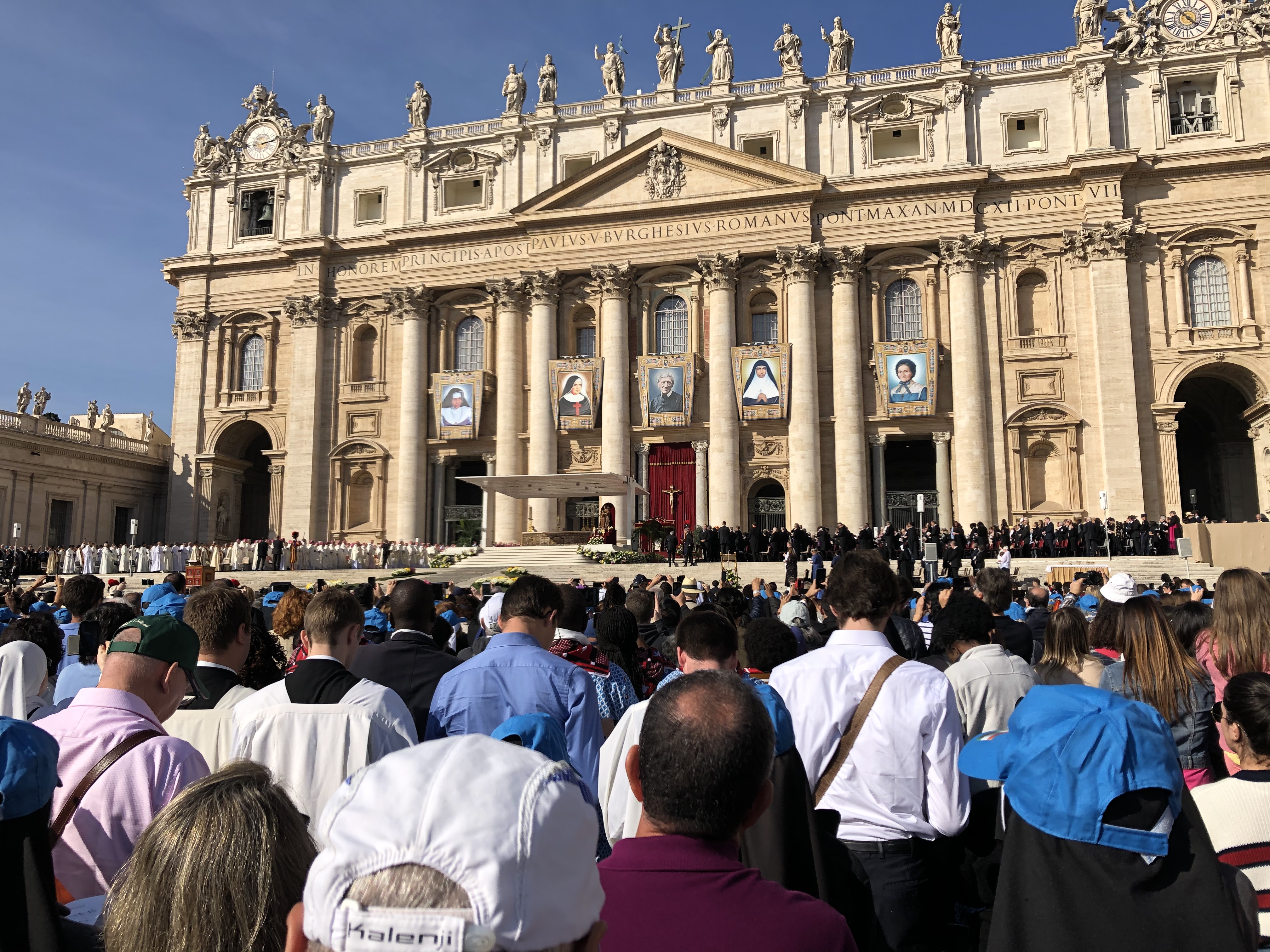
When I was thinking about that, and about what Jesus says about the Comforter, the Advocate, it reminded me of what I had experienced last Sunday when I went to Rome to attend the mass at St Peter’s for the ‘canonisation’ of five new saints in the Roman Catholic Church, John Henry Newman and four other saintly figures, three nuns and a Swiss seamstress, who all had various claims to ‘sainthood’, as the Roman Catholics understand it.

One of the things that comes out, that the Roman Catholics do that we don’t, is that they use saints as intermediaries between themselves and God. They pray to God through the saints, starting with the Blessed Virgin Mary, Mary, the Mother of God, but also then through one of more of the various saints of the church. So a form of prayer in the Catholic Mass is that you name a particular saint, and you ask that saint to pray for you.

The idea is that the saint is almost like what Jesus is describing the Holy Spirit as, if the Holy Spirit is the Advocate. It involves the idea of somebody who speaks for you. You pray through the saint, you invoke the assistance of the saint. The process of becoming a saint in the Roman Catholic Church involves miracles, to show how close the saint is to God. The person to be canonised as a saint, recognised as a saint, therefore needs to have brought about miracles, miracles which have been investigated and found to be genuine by theologians of the church.

I was in Rome particularly to witness the canonisation of one of the new saints, John Henry Newman, Cardinal Newman, who wrote the hymns ‘Praise to the Holiest in the Height’, and ‘Lead, kindly Light’, for example. He started out in the Church of England and was for 20 years a fellow of my old college at Oxford, Oriel. Eventually he changed to Roman Catholicism and became a Cardinal.

Newman was a leader – perhaps the leader – of the spiritual revival in the Church of England called the Tractarians, or the Oxford Movement, in the 1830s. Newman’s great theological message – and he was a prolific author and preacher – he was the vicar of St Mary’s in the High Street in Oxford, the University Church – the heart of his message was a call to the church to abandon what we might call today ‘relativism’, in favour of what we might describe as revealed truth.

He didn’t want the church to base its beliefs and its teaching on whatever was popularly thought to be ‘a good thing’ at the time, but rather on the truth as shown in God’s word in the Bible and in the teaching of the early Christian Fathers. You can see that sort of argument still alive in the church today, in the context, for example, of things like same-sex marriage.

The story of the Tractarians is a story of exciting spiritual revival in parts of the church. It’s not an exaggeration to say that, in the period between 1820 and 1840, the Senior Common Room of Oriel College contained some of the most influential theologians in England: not only Newman, but also Pusey, Keble and Hurrell Froude, who all supported this powerful revival movement in the Church of England, based on going back to what was perceived to be the message of the early fathers, stripped of any of the superstructure built up over the years by attempts to modernise the church in various ways.

Tractarianism (the name came from their series of pamphlets, called Tracts for the Times) came after the earlier Methodist revival, and in both those revivals there was a strong social message. The Tractarians were great believers in the Christian obligation to care for others, and particularly to care for those less fortunate than themselves.

This was a time when the Tractarians founded new congregations, new churches, in, for example, the East End of London and in some of the downtown slum areas of the big industrial cities. Just as Methodism had attacked the gin houses and encouraged people not to become prey to the demon drink, but rather to be able to keep and save their earnings and become more secure financially, so the Tractarians went out into places and founded churches where posh country parsons would never have dreamed of going.

Two healing miracles are attributed to John Henry Newman, one of Deacon Jack Sullivan in 2001, who was healed in a way that defied a normal medical explanation, and involved prayer invoking John Henry Newman, or rather his memory; and the second miracle involved the healing of an unstoppable haemorrhage in a pregnant American woman in 2013, where the woman, Melissa Villalobos, living near Chicago, had offered a prayer for healing, again invoking John Henry Newman to pray for her, and her bleeding suddenly stopped. These two miracles were considered, by the Roman Catholic Church, to be sufficient evidence of Newman’s sainthood.

We in the Church of England don’t reckon much to the idea of saints: Article XXII of the 39 Articles – on p.620 of your Prayer Books – says that the ‘Romish Doctrine concerning … invocation of Saints, is a fond thing vainly invented’, not Biblical and indeed contrary to the word of God.

This reflects the Reformation idea of our not needing to have priests stand between us and God, to pray for us and celebrate the mass on our behalf. By the same token we don’t need to have saints to pray for us. The idea is of a ‘priesthood of all believers’, which came from John Calvin.

But the Church of England is not a wholly Protestant church, although neither is it wholly a Catholic one. Henry VIII wanted to have the best of both worlds. He wanted to uphold all the doctrines of Roman Catholicism, except for the fact that he had some slight local difficulty with the Pope; so instead of the Pope being the head of the church on earth, he arrogated that function to the English monarch. So as it says on our coins, or on some of them, the name of the king or queen is on them and then ‘FD’, or ‘fidei defensor’, defender of the faith, signifying that the monarch is the head of the church on earth. That title started out as a compliment from the Pope for Henry VIII’s support for him against Martin Luther. But after they differed over Henry’s wives, the king kept the title nevertheless.

I have to say that, despite that background, I didn’t think any less of the wonderful service in Rome – there were reckoned to be 50,000 people attending, and we all got the bread of communion. It’s available on YouTube to watch [at https://www.youtube.com/watch?v=uzFObwA79xo], with a gentle but helpful commentary from an American priest. The beautiful illustrated multilingual service book had 125 pages – and everyone, from the Pope and his cardinals downwards, was given one.

In a sense there was a slight flavour of a sporting event – groups of the congregation were cheering on ‘their’ saint as they were canonised – but at bottom it was just a very beautiful Holy Communion service, whose words, and the hymns and their tunes, were familiar to everyone. The music from the choir and organ was beautiful.

Of course the idea of saints performing miracles is very far-fetched to us. But when you saw all those people not going to a football match, but going to church, it was a very happy occasion, when we all felt inspired, caught up in something beyond our own little domestic concerns, something good and wholesome which made us willing to exchange the peace and try to talk to people sitting next to us – all sorts of nationalities, speaking all sorts of languages.

Smiles went a long way – and the fact that the service was in Latin actually helped, because everyone had a little knowledge of some of the words. I was going to use the ‘Kyrie’ as a for-instance – but of course, that’s Greek. But I hope you can see what I mean.

In its basic structure, the wonderful Canonisation Mass was just like our communion service every week here at St Mary’s. It had all the same bits, and only a couple of extras – the ‘Angelus’, Angelus Domini, the Angel of the Lord, the prayer commemorating the angel Gabriel’s coming to Mary, was the most obvious extra bit – but most was word-for-word the same as our service. It made you feel very special, part of a huge family, a huge, warm family. John Henry Newman was truly a saint: and I felt the presence, in that huge crowd, of great comfort; maybe it was even the Holy Spirit, the Comforter. I think it could well have been.

Sermon for Evensong at All Saints’ Day, 4th November 2018

Isaiah 65:17-25; Hebrews 11:32-12:2

As you can see, you’ve got some neighbours in church today. 17 silhouettes, each one representing a soldier from Stoke D’Abernon who died fighting in the First World War. There are little plaques in front of each one of the silhouettes which tell you the name of each of the soldiers and the regiment that he belonged to. There are two pairs of brothers, you will find. All over the country there are churches with these silhouettes in. They have been created by a new charity called ‘Remembered’ and our Vanessa Richards is a trustee of the charity. A number of us have subscribed to buy the silhouettes which are in the pews.

These soldiers are ‘there are but not there’, which is the name of the campaign, launched by this charity called Remembered, to remind people, and especially people like me who have never been in a war, to remind us of the great sacrifice and bravery of our soldiers – in what they had hoped would be the ‘war to end all wars’; and also to raise money for the relief of mental conditions caused by war such as PTSD, combat stress, which used to be called ‘shell shock’.

Our silhouettes were first installed in the pews on Friday, for the All Souls service, when we remembered the dead, our dear departed, and today is All Saints, when we remember and celebrate that ‘cloud of witnesses’ that was mentioned in our second lesson from Hebrews.

We will of course come back and make our main act of remembrance next Sunday. Today we are celebrating All Saints’ Day, which follows very closely after our celebration of All Souls. Using the word ‘souls’ reflects the idea that we are made up of a body and a soul and that in some sense our souls are immortal and eternal, carrying on after our bodies have died. So All Souls is the great commemoration of the dead.

Today we focus on the idea of saints and sainthood. Through both these festivals we may get a glimpse of heaven; this is a chance for us to reflect on what we can understand of heaven, at All Souls on life after death and today on the saints, the great ‘cloud of witnesses,’ in history – and perhaps nearer to home as well.

We can think of ‘saints’ in two ways. On one hand we can understand the expression ‘saint’ to cover all Christian people. St Paul’s letters refer to the ‘saints’ at Ephesus and in Rome and in Jerusalem, meaning the normal members of the congregation in each church. So in that sense we are all saints. We are the saints at Stoke d’Abernon.

The other sense, which is perhaps the one which we would normally think of when we use the word ‘saint’, is to identify people who lead exemplary and virtuous lives, who are witnesses to the gospel of Jesus through the self-denying love which they show.

We should notice that there is a difference between the beliefs of the Protestant churches and the Roman Catholic Church where saints are concerned. Roman Catholics see the saints as being so close to God and to Jesus that they can intercede for us. In other words, Catholics address prayers to one or other of the saints and ask them to pass on their prayers to God. As Protestants we use the same language and perhaps adopt the same thought when we end our prayers with the words ‘through Jesus Christ our Lord’, but this is as far as we go.

Praying through a saint, through a person who speaks for us to God, is a very old idea, a mediaeval idea, but it was one of the things which was attacked by Martin Luther and the Reformation theologians. If you look at the 39 Articles of Religion at the back of your little blue Prayer Book, if you look at article 22 on page 620 and article 31 on page 624, you will see what the reformers were objecting to.

Article 31 was against people saying masses for the dead – at first sight, against what we were doing on Thursday. Before the Reformation, people left money in their wills to pay for masses to be said for them after they had died, to help them to get to heaven and not be stuck in ‘Purgatory’, a kind of half-way house for those whose virtues were not clear enough for them to pass straight through the Pearly Gates. People built ‘chantries’, chapels where they could be remembered and prayed for.

Our Norbury Chapel is an example of a chantry. It was built for Sir John Norbury after the Battle of Bosworth which ended the Wars of the Roses in 1485. Sir John died in 1521, before the Reformation, or more particularly before Henry VIII. His original statue must have been destroyed in the Elizabethan purge on ‘monuments of superstition’, and now his monument is the little figure of a kneeling knight, whose armour is in the style of Charles I’s time, 100 years later.

I think that we can agree with Article 31 that Christ’s sacrifice on the cross is the only thing we need, in order to be reconciled with God and forgiven our sins. We don’t need to make a ritual sacrifice as well, in order to buy forgiveness for someone’s sins. But remembering our dear ones by reading out their names doesn’t go against this, I believe.

Martin Luther, who started the objections to ‘masses for the dead’, was aiming at what he thought was a racket run by the Roman church, getting money for saying masses and building chantries, although there was no theological justification for it. We should remember that Jesus’ salvation is for all, not just for the ones whose names we read out in church – but that’s not a reason for us not to remember our dear departed ones.

Article 22 is even more specific about the worship, or ‘veneration’, as it was called, of saints, their statues and pictures. It reads:

‘The Romish Doctrine concerning Purgatory, Pardons, Worshipping, and Adoration, as well of Images as of Reliques, and also invocation of Saints, is a fond thing vainly invented, and grounded upon no warranty of Scripture, but rather repugnant to the Word of God’.

The reformers thought that there was an element of idolatry, that people were worshipping the saints rather than God, and that there was really no need to use an agent in order to be able to say your prayers to God. There is a reflection of John Calvin’s idea of the ‘priesthood of all believers’ here. Again, in the Jewish faith, only the High Priest could enter the the Holy of Holies, in the Temple, to come close to God, once a year only, without being consumed (cf Moses in Exodus 33:20). This is one place where the idea, that God needs to be approached through somebody, comes from. In our first lesson from Isaiah there is also the example of prophecy, where God speaks through the mouth of a human, a prophet.

Because St Mary’s is so old – its origins are 7th century Saxon – if you look around, it shows you signs of all this historical theology. You will see some images of saints in some of the windows, but the only statue of a saint is the statue of Mary, the Madonna and Child, at the front. Actually pretty well all the images of saints, the windows and the statue, although they are often of mediaeval origin, were imported during Revd John Waterson’s time (1949-1983), because whatever was here before the Reformation was removed or smashed up. In the Baptistry some of the windows contain bits of the remains of pre-Reformation windows, but I think that is all.

The Church of England is often called ‘catholic and reformed’. Henry VIII was a faithful Roman Catholic, except for his little difficulty with the Pope! The question of how we look at saints today is a good example of how our church’s theology and history are combined in a rich mixture. The greatest of the saints is Mary, the mother of Jesus, who was always closest to him, even at the end; his mother stood grieving at the foot of the cross. Who better, who closer, to intercede, if you feel you need someone to do it? The words of the ‘Hail Mary’, which Roman Catholics use almost as much as the Lord’s Prayer, end with

‘Holy Mary, Mother of God,

Pray for us sinners now,

And at the hour of death’.

Indeed Mary is the saint preferred by more people than any other to pray through, in the Roman Catholic Church, where veneration of the saints and praying through them still thrives – they still create saints, for instance recently Archbishop Romero, the Bishop of San Salvador, who was martyred on the steps of his cathedral in 1980, and who was renowned as a liberation theologian, concerned to minister to the poor.

So I have taken you through the story of what it could mean to be a saint. We can be one of the saints at Stoke d’Abernon, one of the people who turn up faithfully in the pews, contribute to good causes and are happy to let people know that this is what we do on a Sunday and indeed, perhaps, what we do on other days. Church saints are involved, involved in church activities.

Or you could be a witness. You could stand up and say to other people what it means to be a Christian in today’s society. You could do things, things which actually take a little bit longer than signing a cheque or turning up to a meeting. You would have to show commitment. The touchstone for being this kind of saint is selfless giving.

Or you might even be a martyr. ‘Martyr’, after all, is just the Greek word for a ‘witness’. Your being a witness may have a price. People may not approve of what you have to say. You may be put to the test as a result. Being a saint, being a witness to the gospel of Christ, may be tough.

There have been occasions when some of you have said to me that my interpretation of what it is to be a practical Christian, to be a practical witness, shades over into politics. Well, on this occasion, I leave it to you. You work out what it would be for you to be a saint. All I would say to you is that I think we all have it in us to be some kind of a saint. Which one are you?

Sermon for Evensong on the Fifth Sunday after Easter, 3rd May 2015
Isaiah 60:1-14

‘Arise, shine; for thy light is come, and the glory of the LORD is risen upon thee. … The multitude of camels shall cover thee, the dromedaries of Midian and Ephah; all they from Sheba shall come: they shall bring gold and incense; and they shall shew forth the praises of the LORD.’ [Isa. 60:1 and 6]

This is a vision of the City of God, the new Jerusalem, ‘Jerusalem the golden’, that we just sang about in our second hymn. What is the City of God? Is it stretching things to think of Jerusalem, City of God, as being in England’s ‘green and pleasant land’? Is it even more risky to have that kind of vision four days before a General Election? Let’s consider it.

I’m not sure what the ‘multitude of camels’ would be, in today’s ‘new Jerusalem’ – let alone the ‘dromedaries of Midian and Ephah’. Perhaps in today’s world the camels, the ships of the desert, would be super-yachts, and the dromedaries, the ‘road-runners’, Ferraris and Porsches. But they are all signs of riches, surely. We have an echo of the entry of the Queen of Sheba in the back of our heads, of course, as soon as we hear it – perhaps accompanied in our mind’s eye by a picture of a beautiful diva, say Danielle De Niese or Joyce Di Donato, singing Handel’s oratorio Solomon, where that lovely music comes from.

What splendour could rival the entry of the Queen of Sheba today? Do you think that the opening ceremony of the Olympic Games is the sort of thing that we would put up against it? Or, now we have a royal baby, a royal christening? Maybe so. We certainly can do grand spectacles and grand ceremony here in England’s ‘green and pleasant land’.

But, you might say, surely this is the time of austerity. There’s no money, no money for showy ceremonies! I don’t suppose that you have room in your minds for any more politicians, each one claiming to be leaner and more fiscally correct than the next: everything is costed; nobody will have to pay any more tax; miraculously, important services will be preserved, even though we will spend less money on them. Our arts, our great opera houses, our concert halls, will continue to lead the world – running on air. Our National Health Service has been promised £8bn by one party – but only after £20bn of ‘efficiency savings’. That’s really £12bn of cuts.

Both the leading parties want to ‘cut the deficit’, and offer to do it at different speeds, but both do promise to make cuts in public expenditure. It’s interesting that at least one Nobel Prize-winning economist, Paul Krugman, has written recently under the title ‘The Austerity Delusion: the case for cuts was a lie. Why does Britain still believe it?’ We are, after all, the sixth-richest nation on earth. [http://www.theguardian.com/business/ng-interactive/2015/apr/29/the-austerity-delusion]

I’m sure it would be quite wrong for me to say anything political from the pulpit. But our bishops have written a pastoral letter – which is still well worth reading: you’ll find a hard copy at the back on your way out, if you want to pinch one – it’s called ‘Who is my Neighbour?’ Archbishop John Sentamu has also assembled a very interesting collection of essays, designed to inform Christian voters, called ‘On Rock or Sand?’ and every newspaper has contributed its six-penn’orth of economic and political analysis. You don’t really need me to add to the Babel chorus.

I think also that one has to be realistic in our own local context. We inhabit a ‘safe seat’; so safe that the retiring MP didn’t feel it was necessary actually to turn up at the hustings which Churches Together arranged up at St Andrew’s in Oxshott on Thursday. Which was a pity, because all the other candidates made a very good effort to explain their positions and to answer questions.

I’m going to assume that St Mary’s will follow the national statistic, as I understand it, which is that 55% of the faithful in the Church of England vote Conservative – and I might risk a guess that here, the percentage might be even higher! So I wouldn’t dare try to persuade you out of your ancient loyalties; but I do hope that all the excitement and debate which the election has caused in the last few weeks will at least have stirred up in you renewed interest in what it is to be the City of God, what the good society, the Common Good, as the Archbishops call it, should be.

St Augustine’s great work was called that, City of God, De Civitate Dei. Anyone who thinks that the church shouldn’t become involved in politics should remember that they have to contend with Archbishops John and Justin, both of whom passionately disagree with that proposition. The Archbishops passionately believe that the church should be engaged in modern society, and that that engagement necessarily involves contributing to the political debate.

That tradition goes right back to St Augustine, if not earlier. The City of God was written in the fifth century AD, right at the end of the Roman Empire, after the Goths had sacked Rome. There is of course also a lot of Biblical authority for the idea of the city of God: the hymn, Glorious things of thee are spoken, Zion City of our God, is based on Psalm 87. Citizenship was pretty important to St Paul. In Acts 22:25 he raised the matter of his being a Roman citizen – perhaps he quoted Cicero, ‘Civis Romanus sum’ – ‘I am a Roman citizen’ (Marcus Tullius Cicero, In Verrem, 2.5.162), in order to stop the authorities imprisoning him without charge. ‘Is it lawful for you to scourge a man that is a Roman and uncondemned?’ he said to the centurion.

And of course, Jesus himself said, ‘Render unto Caesar’. [Mark 12:17, or Luke 20:25] That wasn’t a command not to engage in human society, but rather positively to do one’s duty both to God and to mankind.

So whichever way you vote on Thursday – and of course I do think that you should vote rather than not vote – even if the result in Esher and Walton, our constituency, is rather a foregone conclusion, I do think that we all ought to keep alive in our minds the vision of the City of God. In our new Jerusalem, will we be covered by camels, will God smile on us in our abundance – or will we forget who our neighbours are? Let us pray that even those MPs who don’t have to make much of an effort to be elected, will still bear in mind what Jesus said about neighbours.

Think about what Jesus said about the last judgment in Matthew 25: ‘I was hungry, and you gave me food; when thirsty, you gave me drink; when I was a stranger you took me into your home, when naked, you clothed me; when I was ill you came to my help, when in prison you visited me.’ You remember the story. The righteous people asked when they had done these good deeds, and Jesus replied, ‘Verily I say unto you, Inasmuch as ye have done it unto one of the least of these my brethren, ye have done it unto me.’ (Matt. 25:40)

So following this, Jesus’ explanation of who was his neighbour, and following the bishops’ letter, does our government policy on refugees, especially those risking their lives in the Mediterranean, square up? Our MP wrote to me recently that the Mediterranean refugees should be the concern just of the states with Mediterranean coastlines, like Italy, France, Greece or Spain. I wonder whether his parents, who were Czech refugees from Nazism in 1938, would have made it to safety here if we had had such a narrow policy then.

‘I was hungry,’ said Jesus. Would He have thought that it was acceptable that over a million people turned to food banks last year? 1,300 food parcels were given out in Cobham alone between April 2014 and March 2015.

‘When I was ill,’ He said. I think that the answer today is not just to buy private health insurance, and stand idly by while the NHS is steadily and stealthily run down, but to look out for each other: everyone in their hour of need deserves help. That help, in the NHS, depends on proper funding. That massive enterprise, the National Health Service, was founded when the national debt was several times the current size.

As the bishops have said, we should be good neighbours internationally as well. Would our Lord have approved cuts in overseas aid, or threats to withdraw from the EU? He wanted us to care for those poorer than ourselves, and to look out for others who might need our skills. I think He would have praised the EU for giving 70 years of peace in Europe.

I could go on, but you know the areas where the bishops have focussed. Civil rights and freedoms should be balanced by obligations, human rights. British lawyers drafted the European Human Rights Convention on which the Human Rights Act is based. Is it really right to want to get rid of it?

Think of the multitude of camels. Whatever government we end up with, whoever is our MP, after Thursday, we must press them, we must speak up for the City of God. We must try to ensure that our leaders work to create a fairer, more neighbourly society. Or else, as Isaiah said at the end of our first lesson, ‘For the nation and kingdom that will not serve thee shall perish; yea, those nations shall be utterly wasted.’

[The House of Bishops’ Pastoral Letter, ‘Who is my Neighbour?’ is at https://www.churchofengland.org/media-centre/news/2015/02/house-of-bishops%27-pastoral-letter-on-the-2015-general-election.aspx%5D