Archives for posts with tag: Ukraine

Sermon for Mattins and Morning Prayer (Principal Service) at All Saints Church, Penarth, 5th October 2025

Habakkuk 1.1-4; 2.1-4

Psalm 37.1-9

2 Timothy 1.1-14

Luke 17.5-10

It’s a pity that we don’t have lantern slides at 8 o’clock, because I could show you the picture on the slide which is going to be shown at 10 o’clock when I start to preach the sermon then. It’s a sort of shovel, or it could be a large spoon, with round things in it, quite small.

I wondered whether they were my favourite special-treat breakfast cereal, Grape-Nuts – I should explain that I didn’t choose the pictures, as Susannah is leading the service at 10 as well as this one – but I suspect that at 8 o’clock we need to stay away from pictures and screens and things like that, and just keep our worship simple and our pictures in our heads, where, of course, those of you who listen to the wireless know that the best pictures are.

What is in the big spoon? I asked Susannah and she told me that they were mustard seeds, picking up a reference to the Gospel reading, the New Testament lesson today. I have to say that it rather threw me, because I thought mustard and cress was something which you grew on a face flannel on the bathroom windowsill, but apparently this is what mustard seeds really look like.

The lessons are all about how we confront a world which is going wrong, which is going against us. The Old Testament lesson, from the prophet Habakkuk, comes from a time around 600 BC when the Assyrians had overrun the northern kingdom of Israel, and all that was left of God’s chosen people were the two tribes of Judah and Benjamin, together with the survivors from the massacre when the Assyrians invaded the northern kingdom, who had fled to Jerusalem to take refuge there.

Habakkuk was preaching when the Babylonians were beginning to sweep down on Palestine; they are the Chaldeans, if you read a bit more beyond one of the bits that we have for our lesson, which is in two bits, the first four verses of chapters one and two respectively. If you read on in chapter 1, beyond where it says

Devastation and violence confront me;

strife breaks out, discord raises its head,

……

for the wicked outwit the righteous,

and so justice comes out perverted.

Habbakuk goes on in his prophecy by saying

Look, you treacherous people, look:

here is what will astonish you and stun you,

for there is work afoot in your days

which you will not believe when it is told you.

It is this: I am raising up the Chaldaeans,

that savage and impetuous nation,

who cross the wide tracts of the earth

to take possession of homes not theirs.

Terror and awe go with them;

their justice and judgement are of their own making.

Their horses are swifter than hunting-leopards

And he goes on to say how terrifying they are in all sorts of other ways. Obviously they fulfilled the American strategic objective for a successful army in the invasion of Iraq, ‘shock and awe’.

But this terrible army had its limitations.

Their whole army advances, violence in their hearts;

a sea of faces rolls on;

they bring in captives countless as the sand.

Kings they hold in derision,

rulers they despise;

they despise every fortress,

they raise siege-works and capture it.

A terrifying picture. Who could stand against them? But then –

Then they pass on like the wind and are gone;

and dismayed are all those whose strength was their god.

People who believe that ‘might is right’ turn out to be completely mistaken; and the key words in Habakuk’s prophecy come in the second chapter, in our second part of the lesson, [2:4]

Look at the proud!
 Their spirit is not right in them,
 but the righteous live by their faith.

It’s an idea that St Paul picked up on in two of his letters. In his great letter to the Romans, [1:17], he said that in the gospel of Jesus

is revealed God’s way of righting wrong, a way that starts from faith and ends in faith; he says, as Scripture says, ‘he shall gain life who is justified through faith’.

In the letter to the Galatians [3:11], where St Paul is drawing a distinction between following the provisions of the Jewish law, just carrying out the 10 Commandments, and having faith, saying that the way to salvation is through faith, he says that

It is evident that no one is ever justified before God in terms of law; because we read, ‘he shall gain life who is justified through faith’.

I’m not sure why the compilers of the Lectionary decided that we should have a lesson from the second letter to Timothy rather than one of these passages from Romans or Galatians, (which clearly reference the passage in Habbakuk), but certainly in the passage from the second letter to Timothy, St Paul celebrates that the fact that Timothy and his mother and his granny, Eunice and Lois respectively, all had strong faith.

But you might be a little bit puzzled about exactly what this faith is. It’s pretty clear that it’s not what we would call blind faith, just believing that something is true without any evidence for it. If that was true, you might never take another paracetamol ever again; or even worse, you might try to cure Covid by drinking some bleach. But we are not talking about President Trump’s belief system; this is a word which has more of a connotation of trust about it. It’s not so much about believing that something is the case, but rather, trusting in God to produce a good outcome, to right the wrongs. It’s very close to hope. Hope in the Lord. Trust in the Lord. As Isaiah puts it [14:31]:

but those who look to the Lord will win new strength,

they will grow wings like eagles;

they will run and not be weary,

they will march on and never grow faint.

They will soar, on wings like eagles: they will ‘mount up with wings like eagles’.

Just now our world looks a bit like what it must have looked like to Habakkuk; there is a lot going wrong. There are terrible wars, invasions; the rule of law looks to be under threat in places: –

devastation and violence confront me;

strife breaks out, discord raises its head,

…..

for the wicked outwit the righteous,

and so justice comes out perverted.

We can think of plenty of places and cases today, where those words would be very apt. We are going to have a vigil later on today here to pray for the people of Palestine; equally our prayers should go for the other places in the world where there is no peace and where the rule of law does not securely run: Ukraine and the south of Sudan chief among them, as well as Gaza and the West Bank; and all those places where people are held hostage or are fleeing violence and persecution and are becoming refugees.

We need to trust in the Lord, to pray with confidence and realise the power of prayer, even if our faith is only the size of one of Susannah’s mustard seeds, or a spoonful of Grape-Nuts. It doesn’t matter. You can rely on God to put things right in the end. Let us pray that he will use us in his service to that good end.

Amen.

Hugh Bryant
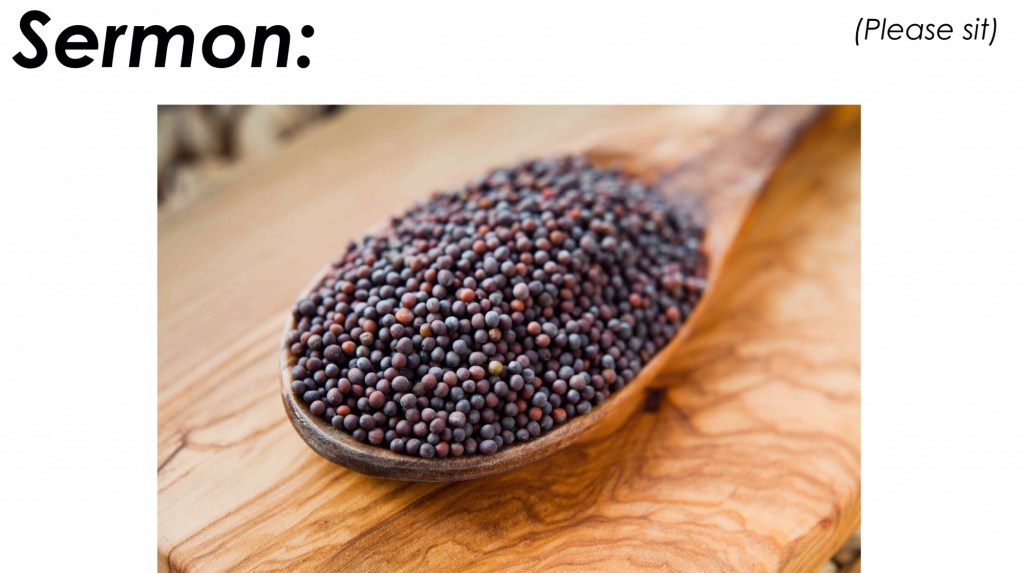
From the PowerPoint slides at the 10 o’clock service. What are those little beads?

Sermon for Ash Wednesday, 5th March 2025 at All Saints Church, Penarth

Joel 2:1-2, 12-17

2 Cor 5:20b-6:10

John 8:1-11

Psalm 51:1-17  

https://bible.oremus.org/?ql=608110117

‘Remember that you are dust, and to dust you shall return. Turn away from sin and be faithful to Christ’. That’s what Jimmy and Craig are going to be saying to you in a minute, when the ‘ash’ in Ash Wednesday is imposed on your forehead. The imposition of ashes is a symbol, a sign of the spirit of penitence, of repentance for sins; and also it is a symbol of our mortality – ‘ashes to ashes, dust to dust’. You will remember those words from funerals. These symbols lead us into the next 40 days of reflection and repentance in Lent. 

The prophet Joel writes all about the day of the Lord, the coming of the Lord, the moment of the Messiah. It’s portrayed as a pretty terrifying event. The day of the Lord is coming, it is near; a day of darkness and gloom, a day of clouds and thick darkness. In the darkness will come a great and powerful army. 

Joel is prophesying about the coming of the Lord against a backdrop where Israel, the chosen people, have not waited for salvation but they have gone their own way in many instances and worshipped other gods. In Joel’s prophecy, and in the way that Saint Paul emphasised similar ideas, it’s important that we shouldn’t separate ourselves from God. We shouldn’t pretend that we don’t need God, and we should acknowledge that we have strayed from the straight and narrow and we have been sinners in many ways. 

Although the book of Joel begins with the description of a plague of locusts, Joel believes in the end there will be a rapprochement between his chosen people and the Lord; a rapprochement, a coming-together again. ‘Return to the Lord your God, for he is gracious and merciful, slow to anger and abounding in steadfast love; who relents from punishing.’ 

St Paul picks up the idea of the day of the Lord: ’At an acceptable time I have listened to you and on a day of salvation I have helped you’ – it is a quotation from the book of the prophet Isaiah – and Saint Paul says to the Corinthians, ‘See, now is the acceptable time; see, now is the day of salvation!’ The Day of the Lord. 

Almost using the language of Joel, St Paul writes to the Corinthians, ‘We entreat you on behalf of Christ to be reconciled to God, to come back from sin’. He puts himself alongside the prophets, doing a rather similar job. ‘We are ambassadors for Christ’, he says, ‘since God is making his appeal through us’. That’s pretty well what the Old Testament prophets like Joel was doing. They were putting the voice of God into the human language. 

St Paul appeals to the Corinthians to be reconciled to God. He feels they have gone away from God. Saint Paul tells the Corinthians that he and his team have been through tremendous trials as a result of their trying to proclaim the gospel. But it is worth their suffering. Now is the crucial time: now is the moment, now is the moment about which the prophets were prophesying, so now is the time to turn away from sin and be faithful to Christ. 

If you read these passages while you are thinking about the situation in Ukraine or in Gaza, for example, you might well feel that one of those visions of the day of the Lord, the day of vengeance, the End Time, might be an apt description; especially if you reflect on the thought that nobody is really considering a wider perspective, or a higher perspective, than the relative strengths of the humans involved in any of these terrible situations. 

The Israelis can go on killing Palestinians, quite irrespective of any questions of principle, let alone the Ten Commandments. Is it right to do so? Does it break international law? They really don’t seem to be interested. As they see things, it is a question of self defence; although it seems more likely that it is retaliation, and it is extraordinary that in order to attack Hamas they don’t appear to be worried about killing thousands of Palestinians, at least half of whom are children, who haven’t ever done anything to harm them. 

Similarly in Ukraine, if you are at the court of Donald Trump, it doesn’t appear to be a question of what is right or wrong, but rather the only consideration is that might is right. President Trump and his team have said that Russia is entitled to keep the land they have seized from Ukraine, because they have ‘lost a lot of men in the process’. There is nothing about whether it was right or good to invade another country. 

President Zelenskyy is supposed to agree to a form of capitulation because, according to President Trump, he ‘doesn’t hold many cards’ – or maybe, any cards  (I’m not quite sure what was said, because everyone was shouting). Because he doesn’t hold any cards: again no question whether he is doing the right thing, whether it is legitimate to defend your country when it is attacked, but rather just a question whether his relative strength is less than the aggressor. Might is right, although they do not actually say this. If you re-read the passage in Joel about what the Israelites were doing wrong, following other gods, turning away from the true God, it could be a way of describing what is happening now in Ukraine. 

Joel suggests that, if people repent, the Lord will forgive them. But we watch and we see no signs of repentance: so we begin to fear that there is no way out of this. President Trump accuses President Zelenskyy of playing with the possibility of a third world war and it is believable that a third world war would be a form of apocalypse, that it might be the end of human life as we know it. 

In a way, therefore, no wonder that we are at least metaphorically in sackcloth and ashes over this situation. It shames the whole human race. Is it really going to be the case that we are dust, and to dust we shall shortly return? You might wonder how Jesus would deal with such an awful situation. What would Jesus do? When something has gone horribly wrong, when people have clearly behaved totally sinfully, what would Jesus do? 

This is where we have this wonderful story, (which nobody really knows where it properly belongs in the Bible, because it’s in different manuscripts in different places, and indeed is completely missing from some manuscripts), the story of the ‘woman taken in adultery.’  The very words, in their archaic ghastliness, tell you that something extraordinary is going to be played out. The context is a provision in the Jewish law which you will find in the book of Deuteronomy chapter 22 according to which adulterers were to be stoned to death. 

When you read about all the awful punishments that were used in the ancient world and indeed are still sometimes used in the Middle East today, the true horror of what was being proposed might escape us; but this was a truly awful form of killing, right up there with crucifixion in its cruelty and inhumanity. But it’s not necessary to go into all the ghastly details in the story in order to understand that it is another example where Jesus turns things on their head in a marvellous way. 

Who will guard the guards themselves? I wonder if Albert Pierrepoint, the last British executioner, was a good man who never did anything wrong. Jesus is saying that there is room for mercy and room for repentance. The only thing that he asks the woman to do is not to sin again. Don’t miss the mark again; stay close to God. However awful, whatever it is you’ve done, whatever it might be, there is room for forgiveness. 

That’s the second half of the message with the ash. Turn away from sin and be faithful to Christ. That’s good advice. It’s the best advice. But let’s just look again at the beginning. ‘Remember that you are dust and to dust you shall return’. Do you remember what comes next? In the funeral service it is the ‘sure and certain hope of the resurrection to eternal life through our Lord Jesus Christ’. So in our Lenten reflections this isn’t just a time for despair: a time for sadness and fear; a time for regret, although we may have all those things; but it is also a time for that sure and certain hope of the resurrection to eternal life. For the sure and certain hope of Easter. 

So even in the face of a world which seems to have abandoned the Lord and to be headed for that day of darkness and gloom when ‘like blackness spread upon the mountains a great and powerful army comes’, even so we can have a sure and certain hope that ultimately Jesus will be the winner, Jesus will be the conqueror, the conqueror over death and sin. So we are invited to return with all our hearts, with fasting, weeping and mourning; but not to do it just for show: to ‘rend our hearts but not our clothes’. Because ‘the Lord is gracious and merciful, slow to anger and abounding in steadfast love’. Brothers and sisters, we must not lose hope. 

Sermon for Mattins on 1st December 2024, the First Sunday of Advent

Advent Reflections

https://bible.oremus.org/?ql=605091724

Isaiah 51:4-11

Romans 13:11-14

We have lit the first Advent candle and begun the new church year with the beginning of Advent. The word ‘advent’ means coming, or ‘coming towards’ somewhere. It is from an old Latin word.

It is supposed to be a penitential season in the church’s year, although probably not quite as serious as the period of Lent. Not for the first time you get the slight feeling that in the church we are sailing against the wind so far as the rest of society is concerned. If you watch ITV and pay any attention to the adverts, essentially the thing that we are coming towards is definitely Christmas, and it’s not a thoughtful time at all except to the extent that you may have to spend a bit of time with your diary making sure that you’re in the right place at the right time for all the Christmas parties and, particularly at Christmas, that you haven’t left any of the family out. But that’s not really what the Christian tradition is all about. The ‘coming’ in Advent is the coming of Jesus, and there are really two comings, coming in the sense of his incarnation, becoming a man, being born in the manger Christmas is one coming.

But there’s also be an idea of the end time, of Jesus’s second coming, and you can see from our readings today in the lesson from Isaiah a prophecy addressed to the people of Israel looking forward to the Messiah, the great saviour who would take them out of captivity, effectively for a second time. The prophet reminds them of the escape from Egypt, the parting of the waters and the entry into the promised land. Isaiah is saying that God can do this again. 

And then in Saint Paul’s letter to the Romans he reflects the belief which was common among the early Christians that the end time, that the second coming, and the time of judgement, was just round the corner. Obviously we realise that that’s not the case, and if there is to be an end time of this type, we don’t know when it will be. 

St Paul nevertheless makes a good point in saying that we should always live our lives as though we would be hauled up before the judge eternal in the next day or so. There is a sort of tension here. For all the last 2000 years we have recognised that the Messiah has come, at Christmas time, but still we are waiting, waiting for him to come again. 

In our church in Wales there is a difference in the holy communion service compared with our brothers and sisters in England. In England the church says, ‘Christ has died, Christ is risen,’ and then, ‘Christ will come again’. The church in Wales, perhaps more realistically, says, not, Christ will come again, but, Christ will come in glory. What we can reflect on is that looking towards this second coming, whenever it may be, isn’t just a question of our hanging around aimlessly, as somebody put it that I read recently, this time of waiting is not devoid of meaning, like time spent waiting at a bus stop. 

This ‘in-between time’ is a time for the church to proclaim the gospel to every nation, to make sense of the present, while never giving up the hope that God’s Messiah, Jesus, will have the last word. We have to acknowledge that, in a very real sense, we do still need salvation. There is still an awful lot wrong with the world, particularly today when we see the terrible wars that are going on in Gaza, Ukraine and south Sudan. 

The world hasn’t faced up to the fact that as well as wars and civil strife, there is a huge gap between the haves and the have-nots, between the rich nations of the northern hemisphere and the global South, that means that there is a huge pressure of migration because people may be fleeing not only from war but also because they can’t make a living and they are moving towards the places which are richer and more likely to give them the means to sustain themselves. 

I watched Angela Merkel, the former German chancellor, being interviewed by the BBC’s Katya Adler – It’s a very interesting interview which you can catch up with on iPlayer [https://www.bbc.co.uk/iplayer/episode/m0025gqj] – and it was really interesting that Dr Merkel identified the biggest problem facing civilisation nowadays as the gap between the rich and poor. If you fix that, there will be far less need for people to migrate, quite apart from all the other benefits that will flow through having a fairer world. 

So we must be awake. We must think and do whatever is needed so that our world looks more like a place where the Messiah has already arrived and less like a place which badly needs him to come again. 

Having said that, I should just share with you that when I was doing my reading in preparation for this sermon, I managed to find one scholarly reference which might tend to suggest that people who see Advent as being just a jolly run up to Christmas might have some historical justification. 

The liturgical scholar Benjamin Gordon Taylor wrote this. ‘Although in historical terms the most recent of the seasons to emerge……, the origin of advent is not clear. It had a penitential character in the middle centuries of the first millennium which may have been linked to epiphany baptism, but neither this nor the alternative view, that it represented a Christianising of the pagan winter fast, can be certain. Contrary to its modern acceptance as the beginning of the liturgical year, Advent may in earlier times have struggled against a persistence in Rome to see Christmas in this role; certainly the emphasis on penitence in Gaul and Spain was contrasted in Rome by a focus on the joyful expectation of the coming of Christ.’ Clearly we are the spiritual successors of the Romans here. 

And he goes on to say, ‘Advent has a rich potential for reflection on powerful themes in the economy of salvation, for example the first and second comings of Christ and, traditionally, the four last things: death, judgement, heaven and hell. And earlier emphasis on penitence, although not universal, tends to be downplayed.’ 

So I think we have scholarly endorsement: it’s okay to enjoy the Waitrose ad, provided you don’t forget all those people who couldn’t afford even to go to Lidl and, more importantly, provided you do something about it. 

By Hugh Bryant – 13th March 2022

I attended a most interesting discussion where a currently serving bishop said, in the context of nuclear deterrence, that he has ‘lost faith in violence’.

The question I am interested in is whether a particular type of violence, the threat of nuclear retaliation for deterrence, still works, and whether Christians can support it.

The terrible effects of weapons of mass destruction, not only nuclear weapons but also non-nuclear violence such as carpet bombing of cities, for example at Dresden, Hamburg and Coventry, where war extends to include indiscriminate attacks both on combatants and non-combatants alike, surely raise serious questions whether such destruction is ever justified.

In relation to nuclear weapons, the doctrine of mutually assured destruction (MAD) is supposed to have kept the peace and avoided world wars since the end of World War II.

The Christian attitude to war seems to me to be in two parts, what Jesus said and what Christians have interpreted that to mean in succeeding years. What Jesus said is easily stated. In the Sermon on the Mount (Matthew 5), ‘Love your enemies – turn the other cheek – do good to those who hate you.’ And, of course, ‘Thou shalt not kill.’ Later on, in C4 CE, in his ‘City of God’ Book XIX, St Augustine put forward the so-called ‘just war’ theory, which was a Christian concept relating his perception of what he believed Jesus would have said with classical Greek and Roman philosophy (in Aristotle’s Politics and Cicero’s De Officiis).

Anti-nuclear campaigners argue that it is wrong to spend money on nuclear weapons, as the state will be depriving citizens of benefits which they would otherwise be able to enjoy if the money were not being spent on nukes. The reason for this is that these weapons will never be used. If they were used, this would be the end of the world as we know it and calculations of public utility would become completely pointless as there would be nobody left alive to receive whatever benefits there might be.

It is said, just as with the other sayings of Jesus in the Sermon on the Mount, here again what he is advocating is just not practicable in real life. It’s all very well for us to give up our nuclear weapons but, if so, how do we answer an aggressor such as Vladimir Putin? It is also clear that MAD is at work in relation to the current crisis, the war between Russia and Ukraine.

On the face of things there are a lot of parallels with the situation in 1939. An aggressive dictator has invaded a neighbouring country and there is a risk that, if steps are not taken to resist, in this case by operating a so-called no-fly zone, the neighbouring country will likely be overwhelmed and there is a risk that further aggression will take place against other neighbouring countries. In 1939, following the invasion of Czechoslovakia and when Poland was invaded, we declared war on Germany and the second world war began.

Now we and the other NATO countries are refusing Ukraine’s request that we join their fight against Russia. The reason for our refusal is said to be that, if NATO aircraft come into conflict with Russian aircraft this would probably trigger a third world war with a risk of nuclear conflict. This last element seems to be the factor which is making a difference when the situation is compared with what happened in 1939.

Putin has expressly threatened to use nuclear weapons if he is attacked by NATO and, apparently, his threat is being believed. But would the officer tasked with launching the apocalyptic weapon follow orders? Two Russian officers, Capt. Arkhipov during the Cuban Missile Crisis in 1962, and Lt Col Petrov in 1983, both in effect refused orders to launch nuclear weapons, and are said to have saved the world each time.

Clearly, the logic of MAD (if one can put it that way) is that the opponent cannot risk calling the other’s bluff. And I am not suggesting that only Russian officers would prefer to save the world rather than press the nuclear annihilation button. For instance, I understand that Royal Navy nuclear submarine commanders study moral philosophy. Whether that might make them less willing to press the nuclear launch button, one cannot know – but it might help.

If one forgets the nuclear weapons for a moment, what we are talking about is dispute resolution. You and I disagree about something. We can’t persuade each other who is right, whose view is to prevail. But it’s something very important to us. We can’t just let it go. It’s not something we can go to court about. So – do I beat you up? Shall I fight you, and by defeating you, force you to do what I want? Or, more realistically, perhaps, if you start to attack me, do I fight back?

In that context, of course whether one of us will win depends upon our fighting ability and the calibre of weapons each of us is using. That is where armed forces, nukes, and MAD, come into the picture. But surely this is rather like some kinds of bee sting. If the bee stings you, it may kill you – but it will itself die.

St Augustine said that even war is waged in order to bring about peace (City of God, Bk XIX, ch 12). But MAD doesn’t fit with this. If war is waged – if the nuke is launched – it cannot bring about peace, unless a fiery descent into nothingness is to be counted as peace.

So are we, in nuclear deterrence, relying on a strategy which is irrational, which in fact does not even aim at achieving an objective which we would want?

In that, in waging war, we are forcing someone to do what they do not want to do, we are perhaps acting in a similar way to a parent chastising a child, or perhaps, in a grown-up context, we are paralleling the operation of criminal legal sanctions.

What is punishment, in the context of the criminal law? It is a mark of victory. The criminal has been defeated. Then, instead of being beaten over the head, they are punished. What is the purpose of the punishment? Among other things, to protect society, to stop the criminal from doing their crime. And deterrence, to deter others from committing the crime.

That looks like a rationale for waging war against an invader. But ‘What would Jesus do?’ On the face of it, he was not against the invading Romans – although one of his disciples was Simon ‘the Zealot’, a resistance fighter. Turning the other cheek doesn’t chime with fighting to the death against someone. On the other hand, Jesus respected the Jewish Law; ‘I have not come to abolish the Law, but to fulfil it’ (Matt. 5:17). By extension that might imply that he supported the Rule of Law.

This could mean that, in dealing with an invader, the defending state has to abide by international law. That would allow the defenders to use violence (force) in self-defence, provided that they obeyed the rules of the Geneva Conventions (roughly equivalent to the rules of the Just War ‘jus in bello’ – rules governing conduct in a war, as opposed to principles to justify whether to wage war at all – so-called ‘jus ad bellum’).

But – none of this bears on the question whether MAD really works. Just as criminologists argue that it is the likelihood of getting caught which deters criminals, rather than the length of prison sentences, so are unjustified aggressors like Putin actually deterred by our having nukes?

MAD, as understood by Russia, involves the ‘no first use’ principle, (although NATO has not accepted this). So it could be argued that Putin’s threat to retaliate, against NATO use of non-nuclear force in support of Ukraine, does not fit the paradigm of MAD. It could be argued that Putin is expressly threatening first use: and therefore, by the operation of MAD, inviting nuclear destruction.

Either way, surely NATO could in fact respond to Putin and intervene, and at the same time robustly state that his threat of nuclear ‘retaliation’ would amount to a first use. Both sides would shy away from ‘going nuclear’. But a no-fly zone would be feasible, and that would be likely to bring about a ceasefire.

Surely that is an argument in favour of nuclear deterrence? I don’t think so. Even in this Ukrainian case, nuclear weapons are ultimately pointless. If the pilots of Russian warplanes see that NATO targeting radar has locked on to them, they will not fly over their erstwhile targets any more. That will have had nothing to do with the availability of nukes.

Hugh Bryant is a Reader in the Church in Wales.

An edited version of this article was first published on the CRCOnline website, https://www.crconline.org.uk/.

Sermon for Mattins on 21st November 2023

Bible readings: see https://bible.oremus.org/?ql=567498722

‘Ah, Assyria, the rod of my anger—
   the club in their hands is my fury!’

The club, the rod of anger, are for beating up Israel, because they have done what is evil in the sight of the Lord. You could say this is where we often come in when we are studying the Old Testament. The Old Testament has this overriding theme, of the relationship between God and his chosen people: to what extent his chosen people follow him and obey his commandments, in which case he brings them prosperity, or do evil in the sight of God or perhaps worship other gods, in which case God punishes them.

It’s not an image of God which is particularly like the one which we normally have, of a God of love in the person of Jesus Christ. This is entirely different. God is saying, through his prophet Isaiah that there will be a war. The Assyrians will attack Israel. God will use the Assyrians to carry out punishment of the Israelites on God’s behalf. They will be the rod of his anger and the club in their hands represents God’s fury.

But the king of Assyria is not just a supine servant acting on behalf of God. Because he gets above himself.

‘Against a godless nation I send him,
   and against the people of my wrath I command him,
to take spoil and seize plunder..’
  
But then a couple of verses later:

‘But this is not what he intends,
   nor does he have this in mind;
but it is in his heart to destroy,
   and to cut off nations not a few.’

So the king of Assyria is not just after the Israelites under orders from God but he wants to go wider. He has already captured Carchemish and Arpad and Damascus, and now he has his sights on Calno and Hamath and Samaria.

‘Are not my commanders all kings? 
Is not Calno like Carchemish?
   Is not Hamath like Arpad?
   Is not Samaria like Damascus?’

It’s quite eerie to hear these names, some of which we would still associate with violence and suffering today, 3000 years later. Isaiah’s prophecy continues that when the Lord has finished all his work on Mount Zion and Jerusalem, sorting out the Israelites, and punishing them for their faithlessness, he will punish the arrogant boasting of the king of Assyria.

And you hear all about what the king of Assyria has to say:

‘By the strength of my hand I have done it,
   and by my wisdom, for I have understanding;
I have removed the boundaries of peoples,
   and have plundered their treasures;
   like a bull I have brought down those who sat on thrones. 
My hand has found, like a nest,
   the wealth of the peoples;
and as one gathers eggs that have been forsaken,
   so I have gathered all the earth’.

This is the boast of the king of Assyria. And then you have this striking image about the relative merits of weapons as against those who wield them.

‘Shall the axe vaunt itself over the one who wields it,
   or the saw magnify itself against the one who handles it?’

Again it makes us think of things today. When the Ukrainians were crying out for better weapons and our government agreed to send them Challenger 2 tanks and Storm Shadow missiles, somehow that seemed to be almost more of a consideration than the bravery of the soldiers who would use those weapons. One can’t go too far with that analogy, because obviously without the right weapons, a soldier is not able to fight at all.

But here in this passage from Isaiah the point that the prophet is making, that the king of Assyria is effectively God’s secret weapon, still requires that he must not get above himself. He still has to follow God’s orders. As between God and the Israelites, Assyria is the weapon, not the commander. So God will cut him down to size.

‘Therefore the Sovereign, the Lord of hosts,
   will send wasting sickness among his stout warriors,
and under his glory a burning will be kindled,
   ……
The remnant of the trees of his forest will be so few
   that a child can write them down.’

Chilling imagery. What is it for? We really don’t have, as far as I can see, any equivalent today. People just don’t talk in those terms. We tend to think of prophets, if we think of them at all, as people who foretell the future. But that’s plainly not what Isaiah is doing here. Isaiah is the mouthpiece of God.

We really are a long way away when we read this. Isaiah was writing around 700BC – BCE – so 2,700 years ago. I’m not sure that there is any prophecy of this type these days. But if not, it’s even more difficult for us to make anything of what Jesus says in our New Testament lesson. How could we tell, if somebody claims to be a prophet, whether they are genuine? If someone pops up and tells us that God wants us to do something or other, the question arises, is he or she a false prophet?

If church leaders want to do particular things, are they following the word of God, or God’s command, or not? Jesus simply said, by their fruits you shall know them. So if somebody tells you that God wants you to do something which isn’t likely to turn out well, then Jesus suggests that you can take it that it is not genuine prophecy.

Perhaps although talking about prophecy seems to come quite strangely to us, nevertheless it could be good to look at what the implications are, in spiritual terms, of what people are telling us is a good thing to do.

In the first chapter of Isaiah’s prophecy, he identifies what it looks like to be godless.

‘Your rulers obey no rules and are hand in glove with thieves. Everyone loves a bribe and is greedy for his profit. They never defend the rights of the orphan and the widow’s cause never comes up before them.’

Again it’s frighteningly contemporary. Perhaps we should think again about prophets and prophecy. If you go away and have a little read of the first few chapters of the book of Isaiah, you will immediately stumble on the passages which we often read during Advent and at Christmas about the coming of the Messiah, about Emmanuel, God with us.

‘For to us a child will be born, to us a son will be given. The government rests upon his shoulders
and his name shall be
wonderful, counsellor, mighty God,
everlasting father, prince of peace.’

But we haven’t got there yet. As we move towards Advent, this picture, of God’s anger with his chosen people, is something which we need to reflect on and pray about, because it is uncomfortably close to home.

Sermon preached at St Peter’s, Old Cogan, on 14th May 2023: the Sixth Sunday after Easter

Zechariah 8.1-13
Revelation 21.22 – 22.5

See https://bible.oremus.org/?ql=556703225

‘The third day he rose again from the dead;

He ascended into heaven’…

This bit of the Creed neatly marks where the church is after Easter and before Ascension Day, which is this coming Thursday.

At first, when I was thinking what I was going to say to you at this point, I had a real feeling of cognitive dissonance, if I can call it that, between our Bible readings, with their visions of heaven or the Heavenly City, and what seems to be going on in the world around us today. 

Archbishop Justin made an impassioned speech in the House of Lords the other day, pointing out how a Bill intended to stop people crossing the Channel in little boats contradicts morality and international law as well as being profoundly inhumane; and then I read in the paper that we are going to supply to the Ukrainians cruise missiles called Storm Shadow which cost

 £2 million each. 

So many thoughts were swirling around in my brain. On the one hand there is no price which one can put on preserving freedom and defeating invaders: on the other, it is interesting to know that apparently we in the UK have about 1000 of these missiles, £2,000m, £2 billion-worth, and yet we are told we can’t afford to pay our doctors and nurses and all the other public servants properly. 

They say that, if you met all the public service pay demands at present being put forward, in full, it would cost about the same amount, £2 billion. How to judge which is the right course to take? Missiles to defend Ukraine, or paying our public servants? 

In the face of these terrible dilemmas maybe the thing to do is to clear one’s head by drawing close to the Lord in prayer and coming to the Lord’s house at 3 o’clock on Sunday, as we have, and bringing our worship and prayers.

But isn’t this just escapism? Maybe not. Our Bible readings today have, I think, a heavenly flavour. 

‘On the holy mount stands the city he founded. 

Glorious things are spoken of you, city of God.’ 

‘Glorious things of thee are spoken, Zion city of our God’, as the hymn says.

And we have Zechariah’s prophetic vision of the city of God. 

‘I will return to Jerusalem, and will dwell in the midst of Jerusalem; Jerusalem shall be called the faithful city and the mountain of the Lord of hosts shall be called the holy mountain.’

Or you could stay in heaven itself and follow the vision of John in the Book of Revelation. 

‘I saw no temple in the city, for its temple is the Lord God the Almighty and the Lamb. And the city has no need of sun or moon to shine on it, for the glory of God is its light, and its lamp is the Lamb’.

I think these days we tend to rather shy away from talking much about heaven, because we feel that it is very much beyond our comprehension. What would you say, if somebody tackled you as you were coming out of the church today, and said, “It looks like you are a churchgoer, a Christian, can you tell me anything about heaven?” Well certainly if that was me being tackled in that way, I think I’d find it quite challenging. 

One might start to say things like, ‘That it is where God lives’ – and then immediately you’d worry that God lives everywhere, by definition. There isn’t a particular place where he lives. Or perhaps, ‘It’s where people go after they die’.  Again, it’s quite difficult to work out the geography of that. Or just, a place above the skies, out of our sight. Again, mundane considerations might intrude.

When Yuri Gagarin, the first astronaut, returned to earth (and he was a Christian), President Khrushchev asked him whether he had seen anything above the clouds in the realms of space. Did he encounter God? Gagarin said, no, unfortunately he hadn’t seen anything divine up there.

Well maybe you can do better than I can, but I think that in principle it’s quite a tricky question. If we stay with the idea that heaven is where God is at home, say, if that’s not too vague, here in these Bible readings we have two versions; it seems that Zion, where not only God, but God’s chosen people, the Israelites, live, on the one hand is heavenly and on the other hand, earthly.

On the one hand we have the city and temple of Zion; that seems to be an earthly place; and on the other hand we have the vision of heaven in Revelation, where the heavenly city has no temple in it. It’s not a place for God to visit like the temple on Earth, because God is the temple. 

God’s presence gives it its light and makes it glorious. It has the river of the water of life flowing from the throne of God and of the Lamb through the middle of the street and on either side of the river is the tree of life with its 12 kinds of fruit, reflecting the 12 tribes of Israel, and the leaves of the tree of life for the healing of the nations. Naturally-occurring medicine, like aspirin.

You could miss that word ‘nations’ – it means not just the chosen people, in fact, not the chosen people at all, but all the other people who are cut off from from the Jews, the Israelites: people like us. Both the new Zion on earth and the sort of heaven that we perhaps naturally think of beyond the skies are open to the ‘nations’ as well as to the Israelites. 

Maybe neither of them is literally true, in the sense that you could go there and take pictures, but nevertheless I think there are real things we can see which are very relevant in our lives today.

In Psalm 87:  ‘Very excellent things are spoken of thee, O Zion, the city of God. I, the Lord will record Egypt and Babylon as among them that are my friends. Behold the sons of Philistia, Tyre and Ethiopia.’

These are not just Israel or Judah, and in some instances they even look like enemies of the Israelites. Philistia, Philistines, Egypt – where they were enslaved. Babylon – where they were enslaved, again. Enemies have become friends in the new Zion, in heaven on earth. Strangers in our midst. Refugees. ‘Behold the sons of Philistia, Tyre and Ethiopia.’

Look again at Zechariah’s vision. ‘Old men and old women shall again sit in the streets of Jerusalem.’ It’s been pedestrianised. ‘And the streets of the city shall be full of boys and girls playing in its streets.’ An idyllic scene; but here’s the thing. Even though it actually seemed impossible to the ‘remnant of this people’ in those days, ‘Should it also seem impossible to me?’ says the Lord of hosts. 

Think of all the politicians, not just on one side, who tell you that something or other which would otherwise improve the lot of the people, isn’t possible, isn’t practical.

For instance, ‘I would love to abolish student fees,’ says Keir Starmer,  ‘but I can’t make a commitment because it may be that practical considerations get in the way’. It seems impossible. 

But the Lord of hosts points out that he is God, and nothing is impossible for him. ‘For before those days there were no wages for people or for animals, nor was there any safety from the foe for those who went out or came in’. It sounds like today. Cost of living crisis. War. Crisis in our public services: not enough money. But look:

‘ There shall be a sowing of peace. The vine shall yield its fruit, the ground shall give its produce and the skies shall give their dew; and I will cause the remnant of this people to possess all these things.’

The chosen people had been taken off to Babylon. ‘By the waters of Babylon we sat down and wept.’  The Temple had been destroyed and quite a lot of them had drifted away and married local girls. The ones that were left were called the ‘remnant’ of the chosen people. 

Remember what happened in 1945. Our country was completely broke. But somehow the National Health Service was founded, millions of council houses were built and the welfare state started. 

Zechariah could have been forecasting, prophesying, about that as well as, instead of, what he actually was forecasting about, which was what would happen to the Israelites as they returned after their exile. He was writing in about 530 BC; but what he was saying, that there should be a ‘sowing of peace’, could apply today. 

‘Should it seem impossible to me?’ asks the Lord of hosts. Surely not: God can do anything, and with his help, so can we.

Sermon for New Year’s Day 2023 at St Dochdwys, Llandough

The Naming and Circumcision of Jesus

May God be in my mouth, and in my speaking. Amen.

Before I say anything else, let us give thanks to God for the work of Emeritus Pope Benedict, and pray for our Catholic friends, brothers and sisters in Christ, as they mourn his passing. And although the ball may be the wrong shape, we mourn the passing also of the great footballer Pelé. May both these great figures rest in peace and rise in glory.

Numbers 6.22-27

Psalm 8

Galatians 4.4-7

Luke 2.15-21

https://bible.oremus.org/?ql=538997803

It’s a bit of an upside-down sermon this morning. Indeed if you’re still waking up after last night, you might have thought that our service was back to front. Our first lesson was the blessing. It is the most beautiful blessing, which is called the Aaronic blessing. It was passed on to Aaron by Moses. But a blessing usually comes at the end of the service. It probably will still come at the end as well – Jimmy may well say it today. This is it, from the Old Testament lesson:

May the Lord bless you and keep you;

may the Lord make his face to shine upon you and be gracious unto you; may the Lord lift up his countenance upon you, and give you peace.

Don’t get up. It’s not the end of the service yet! Because the last bit of it in the lesson from Numbers, just after the blessing, says this:

‘So they shall put my name on the Israelites, and I will bless them’.

It is about the people of God being given their name, Israel, which means literally in Hebrew, people who have wrestled with God. That went back to Jacob, wrestling with the angel. So Jacob became Israel and the whole of the old Testament had a theme running through it, of the relationship between the chosen people of God, the Israelites, and God himself. It was like all the best love affairs, pretty bumpy. People who really do love each other have rows and they do fall out. That was certainly true of the Israelites and their God. They worshipped the Baals and the Golden Calf – and God punished them. (See Exodus 32 and 1 Kings 12).

This story of the Israelites getting their name is at the beginning of their story, and it’s appropriate on 1st January to think of our religious beginnings and where they might lead. Now today we are focusing on the other end of the Bible, on baby Jesus – I was going to say, on Jesus’ ‘christening’ – but that sort of thing worked differently in those days. Instead the baby would be named, and if he was a male baby, circumcised as part of the Jewish tradition. The angel had told Mary that his name would be Jesus. That name means, God saves us, God is our salvation. So we have moved from wrestling with God, Israel, to salvation through God, Jesus.

The mighty God who spoke through the burning bush to Moses, the God who was capable of tremendous wrath and destruction, has now come, with all that power, to be concentrated into a tiny baby. That is the miracle of Christmas. We are perhaps none the wiser about exactly what God looks like, apart from just being a baby. In the blessing, with God lifting up the light of his countenance upon us, we get the feeling that there is someone up there, beaming down with a beautiful smile. But we can’t actually see that God: No one could. But people could see Jesus and they did see him. He certainly lifted up the light of his countenance on everyone he met.

Although we can’t see Him, what is our relationship with God? In St Paul’s letter to the Galatians, God puts us alongside that little baby, so that we are children, children of God, calling God ‘Abba’, which is more like ‘Daddy’ rather than ‘Father’ in the Aramaic we are told. Saint Paul goes on to suggest that, as children, we are heirs; we inherit the blessings of God.

But there is a missing bit. We need to go back a bit to the Old Testament and look again at the people of Israel, the people wrestling with God. The heart of their relationship was what was known as God’s covenant with Israel. What is a covenant? As a lawyer, I can tell you that a covenant is an agreement or a contract. The two parties agree together and they agree to do things one for the other. That’s it. It’s very simple.

The covenant between God and Israel was indeed very simple. The Israelites agreed to worship God as the one true God, no other gods, and in return God promised to bless them and keep them, as the blessing says. And it’s a very useful idea, this covenant.

What can we say at this service, at the beginning of 2023? We have to cope with all these challenges and difficulties in the world ahead of us:

– the war in Ukraine,

– the cost of living crisis here at home,

– the energy crisis, where we are all worrying because we can’t afford to pay three or four times what we used to pay for our houses to be heated,

– and the pay crisis, all the strikes which the public servants, and in particular the nurses and ambulance crews, are involved in, because their pay has fallen back so much that many are now forced to go to food banks, which seems to me to be a very unfair development after all their bravery and sacrifice brought us all out clapping on our doorsteps while the Covid pandemic was on.

I hope that you will not think that this falls outside the bounds of what a preacher is supposed to cover, but it does seem to me that we were, and we are, very happy to rely on these dedicated public servants, and now we must provide them with a decent living. And, most importantly, there are theological reasons for supporting the workers’ fight for better pay and conditions of work.

Frankly our government of millionaires in London needs to think again, quickly, about this. We were all made equal in God’s image: not so rich and so poor, all in the same country – the sixth richest country in the world. Remember Jesus’ story known as Dives and Lazarus, the Rich Man and Lazarus, in Luke 16:19-31. Jesus surely didn’t approve of such a huge gap between the rich and the poor.

So as we embark on 2023, as we see our world facing all these challenges, what do we, as the people of God, the people in the church, do about it?

Quite a lot of Christians do something every New Year, which seems to me to be a great way of preparing themselves to tackle these challenges; and that is, they renew their covenant with God.

It’s an idea which started with John Wesley and the early Methodists. For Methodists the first service in a new year is still known as Covenant Sunday. The ‘people called Methodists’, as they used to call themselves, have recited the same or very similar words every year since 1780 to make their covenant, their agreement, with the Lord. I’ll give you a quick preview, and then we will say the whole of this covenant prayer together later on in this service. So this is just to introduce you to it if you haven’t heard it before. What the Methodists pray goes like this.

We are no longer our own, but thine.

Put us to what thou wilt, rank us with whom thou wilt.

Put us to doing, put us to suffering.

Let us be employed for thee or laid aside for thee,

exalted for thee or brought low for thee.

Let us be full, let us be empty.

Let us have all things, let us have nothing.

We freely and heartily yield all things to thy pleasure and disposal.

And now, O glorious and blessed God, Father, Son and Holy Spirit,

thou art ours, and we are thine.

So be it.

And the covenant which we have made on earth,

let it be ratified in heaven.

Amen.

Put us to doing, put us to suffering;

let us be employed for thee or laid side for thee ….

And now, O glorious and blessed God, Father, Son and Holy Spirit,

thou art ours, and we are thine.

So be it.

And the covenant which we have made on earth,

let it be ratified in heaven.’

Those are John Wesley’s words from 1780. They’ve been repeated every year since. That’s it. We have to do what the Lord commands us to do, just as Jesus commanded his disciples; you know, not having two cloaks, letting other people go before us, so the last shall become first: loving our enemies, not turning our backs on poor people like Dives did, on people like nurses, and instead doing things that may not necessarily be that good for us as individuals but which reflect God’s love, and which Jesus told us to do.

‘Let us be full, let us be empty.

Let us have all things, let us have nothing.’

This is the agreement which we are invited to make, and which should be our guiding principle in the year to come. We have moved from Israel, wrestling with God, to Jesus, God is our salvation.

So let’s agree on that. Let’s make that covenant. Let’s do what we have to do in order to keep our side of the bargain. It’s not just a question of words. But if we do, if we do do more than just talk: then, the blessing will come; and now, here, it will be in the right place, at the end of the service, but it will be more than that: it will be a continuing blessing. The Lord will bless you and keep you. The Lord will make his face to shine upon you, so that it will, truly, be a happy New Year.

Sermon for Evensong on the 3rd Sunday after the Epiphany, 27th January 2019

Psalm 33; Numbers 9:17-24; 1 Corinthians 7:17-24 – Holocaust Memorial Day 2019

When I went to the Holy Land a few years ago, on the Clandon parish pilgrimage led by Revd Barry Preece, we had an optional visit to the Yad Vashem Holocaust memorial museum. It came as a complete change of mood from the rest of the trip. Every day we had visited sites from the Bible, in Bethlehem or in Galilee or in Jerusalem, following in the footsteps of Jesus, and every day we worshipped together in these fabled places, which before we had only imagined, perhaps helped by some pictures in books or in museums which we had been to, but now where we actually were in the places where Jesus had been.

Now we really were in the Garden of Gethsemane, or out in the Sea of Galilee, imagining St Peter and the disciples not catching any fish. Generally, it was a happy, upbeat time. We met for supper and told each other stories over nice suppers and drinkable wines. Some of the Lebanese wines were really memorable … We didn’t actually go to a party at Cana in Galilee, but we got the flavour of it.

At the same time, we could see that there was a difference between the Israeli and Palestinian districts. We could see the awfully ugly and massive wall, dividing the two. We came across the ‘settlements’, which we had read about, where Israeli ‘settlers’ had established themselves, in contravention of United Nations resolutions. But despite the rather temporary-sounding name, ‘settlements’, they weren’t some sort of temporary camp; think instead of something like Milton Keynes. Milton Keynes on the top of a hill, in one instance [Wadi Fuqeen], pouring its sewage down into the valley below, where the Palestinians, whose land had been taken, still eked out a meagre existence.

There was a ‘night tour’ by coach around Israeli Jerusalem. No more dusty Middle Eastern roads, teeming with scruffy lorries and minivans, that you get in the Palestinian part of Jerusalem. No, here it was broad highways, sprinklers, green grass verges. Almost nobody walking, but rather most people driving. A beautiful hotel, the ‘American Colony’ – that is really its name. We didn’t go in, but I could tell that it would be nice to stay there.

On the way down to Masada in the desert, to see Herod’s amazing mountain-top palace, we went through a check-point between Israel and Palestine. It took our 40-seater coach a couple of minutes to be waved through. The queue of weary-looking Palestinians waiting to cross the border – some of them to their own land, which had been arbitrarily divided by the Israeli wall – were, we were told, often delayed for more than an hour, for no reason.

And then some of us went to the Holocaust museum, Yad Vashem. I remember remarkably mundane exhibits; freight trains whose cargo was people; endless paperwork, detailing everything about that ‘cargo’; personal effects, the stuff ordinary people had with them. But truly I felt a kind of internal contradiction. The exhibits were fine, so far as they went. But the point was, that the banality of this industrialised slaughter was overwhelming. Very few of the things we saw in the museum were, in themselves, weapons or instruments of torture. But nevertheless, this was killing on an unforeseeable and awful scale. It was too much to take in properly, but it looked mundane and normal. Nothing could justify the awfulness of the Nazi persecution in the Second World War, nothing could justify that genocide.

I’ve just finished reading a really good and enlightening book by Philippe Sands, the well-known QC who specialises in the defence of human rights, called ‘East West Street’. That street is in the city called Lvov, or Lviv, or Lemburg – a city now in Ukraine, which has been in Austria and Poland also at various times, where two of the greatest academic lawyers of the modern era were born: Sir Hersch Lauterpacht, who invented the legal concept of crimes against humanity, and Professor Raphael Lemkin, who invented the word – and the concept – of ‘genocide’. Both were Jewish. Both lost many of their families in the Holocaust. Philippe Sands’ grandfather also came from there.

‘Genocide’ was defined by Prof. Lemkin as acts ‘directed against individuals, not in their individual capacity, but as members of national groups’. [See http://www.preventgenocide.org/lemkin/AxisRule1944-1.htm] The Nazis killed people not because of who they were or what they had done, but because of what they were. To be a Jew was to attract a death sentence. The term ‘genocide’ was first used, at Prof. Lemkin’s suggestion, in the charges brought in the great Nuremberg trial of the Nazi leaders in 1944. Prof. Lemkin had coined the word from the Greek root γενος, a tribe, and the Latin cido, I kill.

When I went round the Yad Vashem museum, I felt strangely detached. On the one hand, I felt the mundane, industrial horror of the concentration camps. Holocaust Memorial Day is on January 27th because that is the day when Auschwitz was liberated. On the other hand, the fact that surely no-one, now, would seriously think of doing anything as awful as the Nazis did.

Except that they have done. There have been other instances of genocide since WW2. The massacres in Cambodia, Rwanda and Bosnia, for instance. What causes it?

No clues in the lesson from the Book of Numbers. Rather recondite stuff about when the Israelites, in exile but having come out of captivity in Egypt, would move forward when the ‘tabernacle’, the tent covering the Ark of the Covenant, the very ornamental box containing the Ten Commandments on two stone tablets, was covered and uncovered by clouds. This is part of the Torah, the law, the story, of Moses, and of the people of Israel, God’s chosen people: fine; but why would anyone hate those people?

And in the other lesson from St Paul, the emphasis is on the inclusiveness of Christianity. Come as you are. You don’t have to attain any status first. You can be a slave and still be a good Christian. You can, certainly, be Jewish. Being a Christian doesn’t mean you can’t be Jewish too. We might wonder why St Paul didn’t object to the existence of slavery, but certainly there is no suggestion that some people are less deserving of salvation than others. Indeed St Paul uses the mechanisms of slavery to illustrate how Jesus can set people free, literally.

But despite these innocent Bible passages, we know that anti-Jewish feeling is a very old thing. The Jews, as a race, have been blamed for killing Jesus. They have been called ‘god-killers’. Martin Luther was very antisemitic, blaming the Jews for failing to recognise Jesus as the Messiah. He was out of line with most of the other Reformers in this. After all, the story of Paul’s conversion and acceptance by the early Christians, even though he had been persecuting them – and Jesus’ own words from the cross, ‘Forgive them, they know not what they do’, and so on, go against any blanket condemnation of the Jews.

It is still an issue. In this country the Labour Party has been condemned for being antisemitic, although I think that I would make a distinction between being opposed to some of the actions of the modern state of Israel, such as the expropriation of Palestinian land and building ‘settlements’ in contravention of United Nations resolutions, being opposed to that on the one hand, which seems to me to be legitimate, and being anti-Jewish in general. That distinction recalls Raphael Lemkin’s definition of genocide, in that people who are antisemitic are against people because of what they are, rather than because of what they do.

St Paul’s message of acceptance, of inclusion, is still very relevant. In some places when I was a boy, there were adverts which specified ‘no blacks and no Jews’ could apply. It surely couldn’t happen nowadays. But there has recently been the EMPIRE WINDRUSH scandal, where our own government, Mrs May herself, the Prime Minister in her previous post, forcibly sent elderly black people to places in the Caribbean which they had left when they were children, left at our invitation, in order to come and work here. That recent scandal again shows people judging others by what they are – in that case, black people who have come from other countries – rather than by who they are or what they do.

The banal routines, the orderliness, of the Holocaust are still a danger, I fear. Very few people would just go and shoot someone: but what if you are a soldier and you are ordered to do it? Of course that was at the heart of the Nuremberg trials. The railway employees who drove the trains, who manned the signal boxes, who repaired the main lines, wouldn’t normally be looked on as authors of genocide. But without their work, the poor Jews would not have been put in the concentration camps so efficiently and in such vast numbers. There were lots of innocent routines and ordinary jobs, which nevertheless made genocide possible.

The other great lawyer whom Philippe Sands celebrates in his book is Sir Hersch Lauterpacht, whose son was Sands’ tutor at university. Lauterpacht developed the other great concept which was first used in the Nuremberg trials, the concept of crimes against humanity. The United Nations Universal Declaration on Human Rights grew out of Lauterpacht’s work, and was, by contrast with Lemkin’s work, concerned not with crimes against whole peoples, but with crimes against individuals. What was the true nature of the evil contained in the Holocaust? When the victorious allies were preparing to try the Nazi leaders, what was the essence of their crimes? It was an assault on people as individuals, on who they were, as much as on what they were.

These are still vital ideas. Jesus’ Sermon on the Mount, his great command to us to love our neighbours as ourselves, and St Paul’s message all through his letters that it doesn’t matter what our origins are if we are to become Christians – these are so relevant today. When we hear people saying things against people because of what they are – foreigners, migrants, black people, say – and when we hear people saying that it’s just too bad (but there’s nothing which can be done about it) that many people don’t have enough to eat, or can’t afford medicines – those are the sorts of ideas which in the past have resulted in genocide.

Archbishop John Sentamu is starting to raise money for a bishop, Bishop Hannington Mutebi in Kampala, Uganda, who needs cancer treatment – which costs £155,000. What do we feel about that? We hope he gets the money, and the treatment. What if you weren’t a bishop but still had cancer in Uganda? You are still entitled to be treated, because you are human. You have human rights. Perhaps it has taken the history of the Holocaust to bring it home to us how vital those rights are.

Sermon for Evensong on the Sunday before Lent, 2nd March 2014
2 Kings 2:1-12; Matt. 17:9-23 – Elijah and Jesus

I’m not quite sure whether you still find some of the stuff in the Bible surprising or not: just in case it did just flow over you, I will just highlight a couple of surprising things which we have heard in this evening’s lessons.

In the second Book of Kings, we heard about the prophet Elijah being taken up into heaven – but first of all, parting the waters of the River Jordan, so that he and his successor Elisha could pass through to the other side: ‘They went over on dry ground’ (2 Kings 2:8). And then ‘a chariot of fire appeared, and horses of fire, and took Elijah up in a whirlwind to heaven’ (2:11).

Then if we turn to St Matthew’s gospel, we have picked up the story, as Jesus, Peter, James and John the brother of James were coming down the high mountain on which they had seen Jesus ‘transfigured’ with Moses and Elijah. A bright cloud had suddenly overshadowed them and a voice came out of the cloud, ‘This is my beloved Son, in whom I am well pleased; hear ye him’ (Matt. 17:5).

And then as they came down the mountain, Jesus cured a man’s son who had epilepsy, by ‘casting out a devil’ which had made the boy have fits. Jesus challenged his disciples by saying that they did not have enough faith: ‘If you have faith no bigger than a mustard seed, you will say to this mountain, move from here to there: and it will move. Nothing will prove impossible for you.’

What do you think? Is there any way these days that we could understand Elijah suddenly appearing with Moses and Jesus, in some way ‘transfigured’? I’m not sure what ‘transfigured’ really means. There is that wonderful piece of music by Arnold Schoenberg, ‘Verklärte Nacht’, Transfigured Night, a night of strange light, a supernatural aspect. What do we feel? Are we in the camp which feels, along with C. S. Lewis, that anything is possible for God, and therefore there is no reason why God could not make miracles like the Transfiguration, or Elijah being taken up into heaven?

Elijah being taken up into heaven, of course, is somewhat like the Ascension of our Lord Himself. So are we comfortable saying, ‘Because of the omnipotence of God, there is no reason why, given that Jesus was God, he shouldn’t be able to have transfigurations and ascensions: and no reason that Elijah, as the prophet of God – as the other great prophet with Moses – couldn’t be taken up into heaven in the way described?’

On the other hand, we could be sensitive to the charge of humanists and rationalists, who object that everything that we believe in ought to be subject to the same rules of logic and science, and that you could not make sense of stories such as Elijah being taken up to heaven in a whirlwind or the Transfiguration in the normal way: just contrast the way in which you would describe the arrival of a number 38 bus with the way in which these stories about Elijah and Jesus are told. Quite different.

We can generally agree that if I tell you about seeing a number 38 bus, you will know what I am talking about, even though perhaps what you and I actually see when we look at a number 38 bus might in fact be different. We can’t get into each other’s heads to prove what it is exactly that we are looking at: whether it is the same thing. Nevertheless it’s sufficiently similar for us to be able to communicate about it successfully. What it is for something to be a number 38 bus is sufficiently similar in my understanding to what it is in yours for us to be able to talk about it.

But on the other hand, if we talk about something like Elijah going up to heaven in a whirlwind, or Jesus being transfigured with Moses and Elijah, we can’t necessarily be confident that we will be understood by everyone in the same way.

Jesus adds a twist, by asking whether or not the disciples have enough faith; if they do have enough faith, even the tiniest quantity, it will be sufficient to move mountains.

But – are you going to beat yourself up over the fact that you aren’t able to go out there and transpose K2 for Everest using pure will-power and faith? Nobody else has done it. So what did Jesus mean? Clearly we are in a different area, different from simple mundane questions like whether the 38 bus has arrived or not.

Of course some of the Oxford philosophers of the 50s and 60s, like the late, great, A. J. Ayer, would have said that, unless a statement is verifiable, in the same way that something about the number 38 bus would be verifiable, then it is meaningless. So everything about Moses and Elijah, transfiguration, being caught up to heaven in a whirlwind and so on, is, according to Prof. Ayer and others, meaningless.

So on the one hand you have C.S. Lewis accepting miracles and saying, ‘This is just the sort of thing that an omnipotent god would do’, and on the other, you’ve got a sort of common sense view, either that they’re not true, or that there’s no way in which we could make sense of these stories in any literal way.

Does it matter? We are just about to start Lent. Ash Wednesday is this Wednesday, and in fact our Lent courses are going to start on Monday morning, so that we can get six sessions in before Holy Week. We’re going to be studying St Paul’s Letter to the Ephesians, under the heading, ‘Be Reconciled’.

St Paul wrote, ‘He has made known to us His hidden purpose – such was His will and pleasure, determined beforehand in Christ – to be put into effect when the time was ripe: namely that the universe, all in heaven and on earth, might be brought into a unity in Christ.’ We will be studying all the various aspects of this ‘unity in Christ’, this reconciliation, over the next six weeks.

But for the purpose of this sermon, I simply want to draw attention to the process, to the way that our faith can work. There must be a very strong suspicion that unless something very remarkable did in fact happen, it’s tempting to feel that no-one would have said that Elijah was a prophet, someone through whom God spoke.

Without the miracles, the revelations, perhaps no-one would have said that Jesus was not only a prophet – as the Moslems and Jews acknowledge – but was in fact God on earth, the Son of God. But it’s not so much a question how God manifested Himself through Elijah, or became incarnate in Jesus Christ, not a question of how, but that He did. The exact mechanism is beyond our powers of understanding.

One can say that these big miracles, like the Transfiguration, or Elijah being taken up into heaven in a whirlwind, are indeed beyond our power fully to describe or explain. But that doesn’t mean to say that they did not happen in some sense. Because if they did happen, we can recognise through them that God cares for us, that God is involved with us.

And in the light of that wonderful fact, we ought to be reconciled, to be reconciled with God and with each other. Sin is being separated from God: salvation is being brought back together, reconciled.

So much for this rather philosophical excursion. You might be rather scornful that I could stay in this rather rarified vein in the face of all the momentous events which have been happening this week. As Christians preparing to rehearse, to act out, the drama of Jesus’ Passion, prepared to accept the reality of God on earth, how do we look at the conflicts in the world, in Syria or in the Ukraine?

Nearer to home, what do we think about the two criminals who murdered the soldier, Lee Rigby? ‘ROT IN JAIL,’ in bold capitals, read the headline on the front page of the Daily Mirror. What is the Christian perspective? How would we see it if we ourselves had just come down from the mountain with Jesus?

Who are the good people and the bad people in these stories? What happens when the dust has settled? When the Syrians have finally stopped killing each other, and the Ukrainians have decided whether they want to go with the Russians or with the Europeans, where are we going to stand as Christians?

Are the killers of Lee Rigby really condemned to rot? Is there no redemption for them? Clearly now the killers don’t appreciate that what they did was wrong. They have a crooked justification for it. But let’s suppose after years in gaol, they appreciate the wrongness of what they have done, and they repent. What shall we say then? Jesus’ message was a message of forgiveness, not ‘rot in jail’. How would it feel to us if we had just come down from that high mountain?

The same with the civil war in Syria and the terrible divisions in the Ukraine. Will people be reconciled? In these situations the church can speak. The church can remind the world of Jesus’ message of forgiveness and reconciliation: we Christians should be fired up by the thought of that mountain-top experience.

We can be prophets; we can let the Holy Spirit speak through us. Let us pray that, at the end of the conflicts in Syria and the Ukraine – and in all other places where there is a breakdown of law and order, where there is civil war or civil unrest – that there will be a resolution, not based on victors’ justice, but rather on true reconciliation. Truth and reconciliation, in Nelson Mandela and Desmond Tutu’s words: truth and reconciliation. Come down from the mountain. Be reconciled.