Archives for posts with tag: Assyrians

Sermon for Mattins and Morning Prayer (Principal Service) at All Saints Church, Penarth, 5th October 2025

Habakkuk 1.1-4; 2.1-4

Psalm 37.1-9

2 Timothy 1.1-14

Luke 17.5-10

It’s a pity that we don’t have lantern slides at 8 o’clock, because I could show you the picture on the slide which is going to be shown at 10 o’clock when I start to preach the sermon then. It’s a sort of shovel, or it could be a large spoon, with round things in it, quite small.

I wondered whether they were my favourite special-treat breakfast cereal, Grape-Nuts – I should explain that I didn’t choose the pictures, as Susannah is leading the service at 10 as well as this one – but I suspect that at 8 o’clock we need to stay away from pictures and screens and things like that, and just keep our worship simple and our pictures in our heads, where, of course, those of you who listen to the wireless know that the best pictures are.

What is in the big spoon? I asked Susannah and she told me that they were mustard seeds, picking up a reference to the Gospel reading, the New Testament lesson today. I have to say that it rather threw me, because I thought mustard and cress was something which you grew on a face flannel on the bathroom windowsill, but apparently this is what mustard seeds really look like.

The lessons are all about how we confront a world which is going wrong, which is going against us. The Old Testament lesson, from the prophet Habakkuk, comes from a time around 600 BC when the Assyrians had overrun the northern kingdom of Israel, and all that was left of God’s chosen people were the two tribes of Judah and Benjamin, together with the survivors from the massacre when the Assyrians invaded the northern kingdom, who had fled to Jerusalem to take refuge there.

Habakkuk was preaching when the Babylonians were beginning to sweep down on Palestine; they are the Chaldeans, if you read a bit more beyond one of the bits that we have for our lesson, which is in two bits, the first four verses of chapters one and two respectively. If you read on in chapter 1, beyond where it says

Devastation and violence confront me;

strife breaks out, discord raises its head,

……

for the wicked outwit the righteous,

and so justice comes out perverted.

Habbakuk goes on in his prophecy by saying

Look, you treacherous people, look:

here is what will astonish you and stun you,

for there is work afoot in your days

which you will not believe when it is told you.

It is this: I am raising up the Chaldaeans,

that savage and impetuous nation,

who cross the wide tracts of the earth

to take possession of homes not theirs.

Terror and awe go with them;

their justice and judgement are of their own making.

Their horses are swifter than hunting-leopards

And he goes on to say how terrifying they are in all sorts of other ways. Obviously they fulfilled the American strategic objective for a successful army in the invasion of Iraq, ‘shock and awe’.

But this terrible army had its limitations.

Their whole army advances, violence in their hearts;

a sea of faces rolls on;

they bring in captives countless as the sand.

Kings they hold in derision,

rulers they despise;

they despise every fortress,

they raise siege-works and capture it.

A terrifying picture. Who could stand against them? But then –

Then they pass on like the wind and are gone;

and dismayed are all those whose strength was their god.

People who believe that ‘might is right’ turn out to be completely mistaken; and the key words in Habakuk’s prophecy come in the second chapter, in our second part of the lesson, [2:4]

Look at the proud!
 Their spirit is not right in them,
 but the righteous live by their faith.

It’s an idea that St Paul picked up on in two of his letters. In his great letter to the Romans, [1:17], he said that in the gospel of Jesus

is revealed God’s way of righting wrong, a way that starts from faith and ends in faith; he says, as Scripture says, ‘he shall gain life who is justified through faith’.

In the letter to the Galatians [3:11], where St Paul is drawing a distinction between following the provisions of the Jewish law, just carrying out the 10 Commandments, and having faith, saying that the way to salvation is through faith, he says that

It is evident that no one is ever justified before God in terms of law; because we read, ‘he shall gain life who is justified through faith’.

I’m not sure why the compilers of the Lectionary decided that we should have a lesson from the second letter to Timothy rather than one of these passages from Romans or Galatians, (which clearly reference the passage in Habbakuk), but certainly in the passage from the second letter to Timothy, St Paul celebrates that the fact that Timothy and his mother and his granny, Eunice and Lois respectively, all had strong faith.

But you might be a little bit puzzled about exactly what this faith is. It’s pretty clear that it’s not what we would call blind faith, just believing that something is true without any evidence for it. If that was true, you might never take another paracetamol ever again; or even worse, you might try to cure Covid by drinking some bleach. But we are not talking about President Trump’s belief system; this is a word which has more of a connotation of trust about it. It’s not so much about believing that something is the case, but rather, trusting in God to produce a good outcome, to right the wrongs. It’s very close to hope. Hope in the Lord. Trust in the Lord. As Isaiah puts it [14:31]:

but those who look to the Lord will win new strength,

they will grow wings like eagles;

they will run and not be weary,

they will march on and never grow faint.

They will soar, on wings like eagles: they will ‘mount up with wings like eagles’.

Just now our world looks a bit like what it must have looked like to Habakkuk; there is a lot going wrong. There are terrible wars, invasions; the rule of law looks to be under threat in places: –

devastation and violence confront me;

strife breaks out, discord raises its head,

…..

for the wicked outwit the righteous,

and so justice comes out perverted.

We can think of plenty of places and cases today, where those words would be very apt. We are going to have a vigil later on today here to pray for the people of Palestine; equally our prayers should go for the other places in the world where there is no peace and where the rule of law does not securely run: Ukraine and the south of Sudan chief among them, as well as Gaza and the West Bank; and all those places where people are held hostage or are fleeing violence and persecution and are becoming refugees.

We need to trust in the Lord, to pray with confidence and realise the power of prayer, even if our faith is only the size of one of Susannah’s mustard seeds, or a spoonful of Grape-Nuts. It doesn’t matter. You can rely on God to put things right in the end. Let us pray that he will use us in his service to that good end.

Amen.

Hugh Bryant
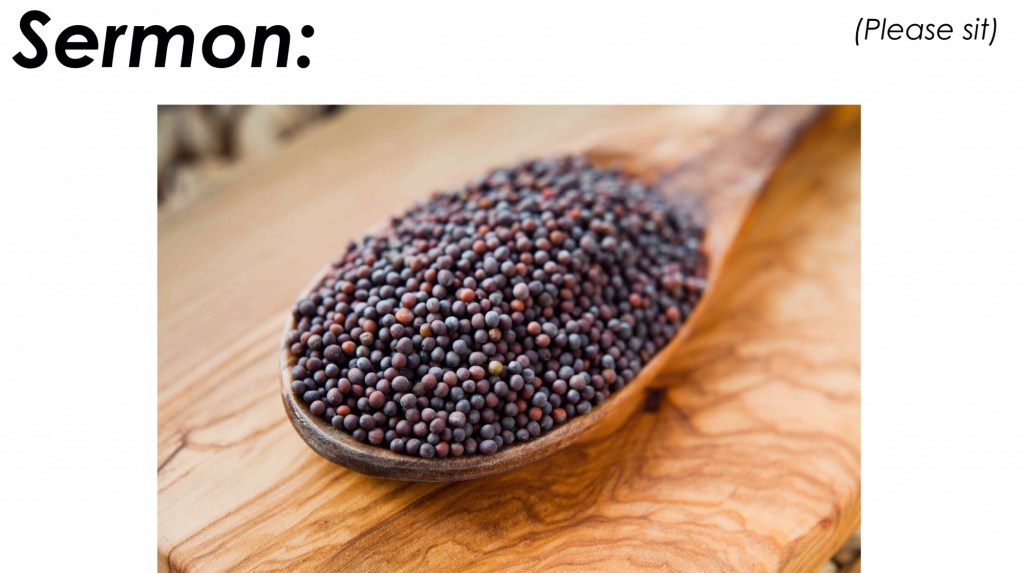
From the PowerPoint slides at the 10 o’clock service. What are those little beads?

Sermon for Mattins on 21st November 2023

Bible readings: see https://bible.oremus.org/?ql=567498722

‘Ah, Assyria, the rod of my anger—
   the club in their hands is my fury!’

The club, the rod of anger, are for beating up Israel, because they have done what is evil in the sight of the Lord. You could say this is where we often come in when we are studying the Old Testament. The Old Testament has this overriding theme, of the relationship between God and his chosen people: to what extent his chosen people follow him and obey his commandments, in which case he brings them prosperity, or do evil in the sight of God or perhaps worship other gods, in which case God punishes them.

It’s not an image of God which is particularly like the one which we normally have, of a God of love in the person of Jesus Christ. This is entirely different. God is saying, through his prophet Isaiah that there will be a war. The Assyrians will attack Israel. God will use the Assyrians to carry out punishment of the Israelites on God’s behalf. They will be the rod of his anger and the club in their hands represents God’s fury.

But the king of Assyria is not just a supine servant acting on behalf of God. Because he gets above himself.

‘Against a godless nation I send him,
   and against the people of my wrath I command him,
to take spoil and seize plunder..’
  
But then a couple of verses later:

‘But this is not what he intends,
   nor does he have this in mind;
but it is in his heart to destroy,
   and to cut off nations not a few.’

So the king of Assyria is not just after the Israelites under orders from God but he wants to go wider. He has already captured Carchemish and Arpad and Damascus, and now he has his sights on Calno and Hamath and Samaria.

‘Are not my commanders all kings? 
Is not Calno like Carchemish?
   Is not Hamath like Arpad?
   Is not Samaria like Damascus?’

It’s quite eerie to hear these names, some of which we would still associate with violence and suffering today, 3000 years later. Isaiah’s prophecy continues that when the Lord has finished all his work on Mount Zion and Jerusalem, sorting out the Israelites, and punishing them for their faithlessness, he will punish the arrogant boasting of the king of Assyria.

And you hear all about what the king of Assyria has to say:

‘By the strength of my hand I have done it,
   and by my wisdom, for I have understanding;
I have removed the boundaries of peoples,
   and have plundered their treasures;
   like a bull I have brought down those who sat on thrones. 
My hand has found, like a nest,
   the wealth of the peoples;
and as one gathers eggs that have been forsaken,
   so I have gathered all the earth’.

This is the boast of the king of Assyria. And then you have this striking image about the relative merits of weapons as against those who wield them.

‘Shall the axe vaunt itself over the one who wields it,
   or the saw magnify itself against the one who handles it?’

Again it makes us think of things today. When the Ukrainians were crying out for better weapons and our government agreed to send them Challenger 2 tanks and Storm Shadow missiles, somehow that seemed to be almost more of a consideration than the bravery of the soldiers who would use those weapons. One can’t go too far with that analogy, because obviously without the right weapons, a soldier is not able to fight at all.

But here in this passage from Isaiah the point that the prophet is making, that the king of Assyria is effectively God’s secret weapon, still requires that he must not get above himself. He still has to follow God’s orders. As between God and the Israelites, Assyria is the weapon, not the commander. So God will cut him down to size.

‘Therefore the Sovereign, the Lord of hosts,
   will send wasting sickness among his stout warriors,
and under his glory a burning will be kindled,
   ……
The remnant of the trees of his forest will be so few
   that a child can write them down.’

Chilling imagery. What is it for? We really don’t have, as far as I can see, any equivalent today. People just don’t talk in those terms. We tend to think of prophets, if we think of them at all, as people who foretell the future. But that’s plainly not what Isaiah is doing here. Isaiah is the mouthpiece of God.

We really are a long way away when we read this. Isaiah was writing around 700BC – BCE – so 2,700 years ago. I’m not sure that there is any prophecy of this type these days. But if not, it’s even more difficult for us to make anything of what Jesus says in our New Testament lesson. How could we tell, if somebody claims to be a prophet, whether they are genuine? If someone pops up and tells us that God wants us to do something or other, the question arises, is he or she a false prophet?

If church leaders want to do particular things, are they following the word of God, or God’s command, or not? Jesus simply said, by their fruits you shall know them. So if somebody tells you that God wants you to do something which isn’t likely to turn out well, then Jesus suggests that you can take it that it is not genuine prophecy.

Perhaps although talking about prophecy seems to come quite strangely to us, nevertheless it could be good to look at what the implications are, in spiritual terms, of what people are telling us is a good thing to do.

In the first chapter of Isaiah’s prophecy, he identifies what it looks like to be godless.

‘Your rulers obey no rules and are hand in glove with thieves. Everyone loves a bribe and is greedy for his profit. They never defend the rights of the orphan and the widow’s cause never comes up before them.’

Again it’s frighteningly contemporary. Perhaps we should think again about prophets and prophecy. If you go away and have a little read of the first few chapters of the book of Isaiah, you will immediately stumble on the passages which we often read during Advent and at Christmas about the coming of the Messiah, about Emmanuel, God with us.

‘For to us a child will be born, to us a son will be given. The government rests upon his shoulders
and his name shall be
wonderful, counsellor, mighty God,
everlasting father, prince of peace.’

But we haven’t got there yet. As we move towards Advent, this picture, of God’s anger with his chosen people, is something which we need to reflect on and pray about, because it is uncomfortably close to home.

Sermon for Evensong on the Fifth Sunday after Easter, 26th May 2019

Zephaniah 3:14-20; Matthew 28:1-10, 16-20 (see http://bible.oremus.org/?ql=425693885) – But what about the Bigots?

‘Sing, O daughter of Zion; shout, O Israel; be glad and rejoice with all the heart, O daughter of Jerusalem.’

You can tell, even without reading the whole book, that this passage at the end of the book of the prophet Zephaniah turns things around. The first two chapters of the book are not joyful; they are more like lamentations. The kingdom of Israel, the people who made the exodus from Egypt, who had David and Solomon as kings, had split into two kingdoms, the northern kingdom called Israel, and the southern kingdom, Judah, in which was Jerusalem.

In 721 BC the northern kingdom was destroyed by the Assyrians. Zephaniah was prophesying some time after that, probably about 100 years later, in Jerusalem. The sub-heading in one of my Bibles on this passage is, ‘Doom on Judah and her neighbours’; so the first part of the book is all about how the kingdom of Israel, which has become the province of Judah, has gone to pot.

The great day of the Lord is near, …

That day is a day of wrath, a day of trouble and distress, a day of wasteness and desolation, …. And I will bring distress upon men, that they shall walk like blind men, because they have sinned against the Lord: (Zephaniah 1)

Why is the Lord cross with his people? Zephaniah says,

“Woe to her that is filthy and polluted, to the oppressing city!

She obeyed not the voice; she received not correction; she trusted not in the Lord; she drew not near to her God.’ (Zephaniah 3:1-2)

This was all nearly 3000 years ago, but there are definite resonances with things that are happening here today. I wrote this sermon originally on Friday, and I didn’t think we would know the outcome of the EU election until after 8 o’clock tonight, as we have to wait until all polling stations in all EU member states are closed – and most of the countries are having their vote today.

I suspect that it will turn out to have been a strange business, and whatever the outcome, we will all continue to have a more or less uneasy feeling that something is wrong with our society, and with our country, at the moment.

Whether it goes as far as the sort of thing that Zephaniah was prophesying about is obviously a moot point, but it seems to me that it’s not controversial to say that, wherever you are in relation to modern politics, whatever you believe in, this is a time to be concerned and worried.

The idea that comes from Zephaniah in the part which was our first lesson today, ‘Sing, O daughter of Zion’, … ‘be glad and rejoice’, is something which I think we would all respond very well to. We would love to feel that everything was right with the world, and that we could relax and be joyful.

Unfortunately, we’re not there yet. I don’t think that it’s going to help very much for me to try to spell out to what extent any of the competing parties and interest groups – ‘interest groups’, because the Brexit Party isn’t a political party, it’s actually a limited company – it isn’t going to be easy or productive at this stage to try to relate aspects of each of these people to the eternal verities which we are trying to understand and to carry out in our Christian witness.

It’s no good trying to say whether one or other party or interest group is better or worse at trying to bring the various parts of society back together, so as to finish the various arguments which have so divided people. It isn’t even worth it at this stage to try to express a view on what is going to help people materially, or perhaps more realistically, to hurt them least, in the various proposals advanced by the various parties. People are not listening to rational arguments.

What would Jesus say? I really don’t know. But I think it’s worth reminding everyone that it’s a good question. If we sit down quietly and try to work through the various propositions which have been put to us, from the time of the referendum three years ago until now, it might be a very good exercise to look at each one in the light of that question.

What would Jesus have done? What would Jesus have thought about these various things?

I went on Thursday night to our friends at St Martin’s in East Horsley for a talk which they had organised, by the long-serving former MP, Chris Mullin, who is well known for his many books, including ‘A very British Coup’, which was made into a TV series. After he had given his talk, from the audience a lady stood up and, I think, rather shocked everybody. I should tell you that the audience was about 30 people, and they could easily have been from here. Normal bods, tending towards the middle-aged if not slightly elderly; middle-class, middle-aged, respectable people. When this lady stood up, asked her question and made her point, she looked exactly the same as everyone else. But she wasn’t.

She told us that although she had grown up in this country, had lived here for many years and had worked as a solicitor for a City firm, she was not English. She was German, and her father had been head of the UK division of the great German engineering company Siemens, which has a number of factories here, and has had for many years. She is married to an Englishman. After the referendum result, her husband had said that he thought that it was not going to very nice for their family to carry on living in England – meaning, not very nice for his wife, for his German wife. So they now live in Spain. There they have recently bought a new car. One of their neighbours, she said, wondered whether it was going to be a Range Rover, and said he hoped that it wasn’t – because they didn’t want to see anyone buying anything British for the time being.

And I, as I think some of you will already have heard, had a similar experience shortly after the Brexit referendum when I went to Hamburg, and some of my German friends, several of whom have been friends for 30 or more years, all said more or less the same thing to me, the same simple sentence: they said, ‘But we thought that you were our friends’. Imagine how I felt.

No more comments on that. We all have strong views. But what would Jesus say about it? I wonder.

Let’s move on to our second Bible lesson, from St Matthew’s Gospel. It’s the resurrection story, the empty tomb, which we have read about in St John’s and St Mark’s Gospels already, during this Easter time.

For some reason the compilers of the Lectionary have missed a bit out. You’ll notice that, in St Matthew chapter 28, tonight we have heard verses 1 to 10 and then 16 to 20. The missing bit is a story, which appears only in St Matthew’s Gospel, about the chief priests bribing the Roman soldiers who had been set to guard the tomb – and again, we read about these guards only in this Gospel – bribing these soldiers to spread a story that Jesus’ disciples had come in the dead of night and taken Jesus’ body away. The passage ends, ‘This story is still told among the Jews to this day’. Perhaps that’s why it’s left out now in our lessons, as it could be taken as a a point against Judaism.

That’s one bit which is unique to St Matthew, not too crucial. But the other unique bit is far better known. It is the Great Commission, as it is called.

Go ye therefore, and teach all nations, baptising them in the name of the Father, and of the Son, and of the Holy Ghost:

Teaching them to observe all things whatsoever I have commanded you: and, lo, I am with you always, even unto the end of the world.

It is the great call to Evangelism, to spreading the Good News, the ‘Evangelia’,(Ευαγγελία) the Greek word for good news. Jesus assured us that He is still with us: he said, ‘... lo, I am with you always, even unto the end of the world.’

I began this sermon with a rather gloomy recital of the prophet Zephaniah’s words of lamentation about the godless state of the people of Israel in Jerusalem, and I invited comparisons with the state of our nation today. I invited you to think what Jesus might have to say about it. That is a really tough question.

But what about the Great Commission? How are we doing on that one? Our British reserve tends to make us rather coy about announcing our Christianity to people in public. But increasingly, people are growing up without having read the Bible or been to Sunday School. It’s important, therefore, that we have our family services at St Mary’s and that our PCC is beginning to think about having a youth worker. We invited Esther Holley, the children and young people’s minister from St Andrew’s in Cobham, to come and talk to us about her work, and we all found her account inspiring. As a result of Esther’s work, St Andrew’s has a solid group of children and some teenagers. But nothing stands still. Esther has been accepted for ordination training, so they will be looking for her successor soon. Maybe we should start making moves in this direction too.

And finally, on the question how we are carrying out Jesus’ commission to ‘teach all nations’, I think that it is vitally important that we maintain the warmest welcome, here at St Mary’s, to our services, to our church family, and to our other activities based around St Mary’s Hall, the best church hall for miles around.

I personally would like us to look at joining an organization called ‘Inclusive Church’, which encourages churches not just to be welcoming to all, but to advertise that they are. It’s the old story of the two milkmen competing for business (you can tell it’s an old story, because competition on the same milk round disappeared years ago), and one milkman put a big banner on his milk float saying, ‘We deliver milk every day’. Of course his competitor did the same thing, but they didn’t advertise it. The milkman with the banner doubled his sales!

The same reasoning, I think, would work for us. If I have moved into this area and I’m looking for a church to go to: if I’m going through a tough time in my life and I’d like to find somewhere to say prayers: if I want my kids to learn what’s in the Bible: what will St Mary’s be like inside? Now if there’s a big sign outside saying that everyone is welcome – and I’ve put a picture of an Inclusive Church sign from another church with my sermon on the website [see above] – then people can feel confident, and they will dare to open our door and come in.

I know that not everyone agrees with this idea. Some people say we are already a really welcoming church. No need to join organisations or advertise – although I would gently say that it’s noticeable that we have no black people in our congregation. Somebody once even said to me, in this context, ‘But what about the bigots? We mustn’t upset the bigots!’

Well that perhaps takes me full circle, to the outcome of the European election. What about the bigots? What would Jesus say? I think he would say, ‘Look who I have lunch with already. People get shirty that I sit down with tax gatherers and sinners. But they are welcome!’

Sermon for Evensong on the Sunday after Christmas-Day, 30th December 2018

Isaiah 61; Galatians 3:27-4:7 (http://bible.oremus.org/?ql=412935020)

Do you remember when Jesus started to read in the synagogue – it’s in Luke 4, from verse 17 – and he read out from the Book of the prophet Isaiah, and then said, ‘This day is this scripture fulfilled in your ears.’ In other words, He was the Messiah, which Isaiah had prophesied about, had foretold in our lesson tonight, chapter 61, and chapter 61 was what Jesus was reading out.

That prophecy is all about the salvation of Israel, deliverance from its oppressors, from the Assyrians, the Babylonians, the Egyptians – and latterly, it would be, from the Romans – deliverance from slavery; because the Israelites were the chosen people of God, and God would keep his promise to them.

That’s as you would expect. Jesus was Jewish, he was an Israelite. He was brought up in the Jewish culture. The gospel of St Matthew, aimed at a Jewish readership, is at pains to set out his genealogy, tracing it back to King David, son of Abraham.

But truly, if the story of Jesus had just been a Jewish story, just been a story about Israelites, that story would have remained a footnote in history. But the genius of St Paul was to realise that the one true God is the god of everyone. There isn’t just a god for the Jews, or for another national group – or in those days, for the Romans. God is far bigger than any question of nationality or origin.

And so we have this great passage in the Letter to the Galatians:

There is neither Jew nor Greek, there is neither bond nor free, there is neither male nor female: for ye are all one in Christ Jesus. [Gal. 3:28f]

Just as Isaiah had prophesied,

I will make an everlasting covenant with them.
And their seed shall be known among the Gentiles, and their offspring among the people”

God’s chosen people are no longer to be regarded as being just the Israelites, but rather all those who are ‘in Christ Jesus’, who are Christians. They are God’s chosen people now. ‘Their seed shall be known among the Gentiles’, just as much as among the Jews.

Paul’s mission to the ‘nations’, (which is what the Latin-based word ‘gentile’ means), to the non-Jews, opened the door to Christianity becoming a universal religion, and there is no bar in it to anyone on the grounds of nationality, or colour, or origin: being, and becoming, Christian, and indeed that key expression in St Paul’s thought, being ‘in Christ Jesus’, is integral to the way he understands God: that God is at the heart of everything, the ultimate creator and sustainer of all our being.

But although Jesus’ coming as the Messiah meant that we should look wider than just the sons of Abraham, the Israelites, in order to find who are God’s chosen people, nevertheless, in Isaiah’s prophecy, there are some key truths which, maybe, started as distinctive Jewish or Israelite concerns, but nevertheless now have a worldwide or universal importance.

Important among these is the concept of justice.

‘.. to proclaim liberty to the captives, and the opening of the prison to them that are bound;

To proclaim the acceptable year of the Lord, and the day of vengeance of our God’

This is all about the rule of law. In the Jewish Law, the ‘acceptable year’ is the Jubilee year, is the year one-in-seven when debts were forgiven; when people were allowed a new start. Not that the law disappeared, but that its application was tempered with mercy. ‘The quality of mercy is not strained’, if you prefer Shakespeare. [The Merchant of Venice, Act IV, Scene 1]

‘For I the Lord love judgment, I hate robbery for burnt offering’. Don’t go out and pinch your neighbour’s things so as to be able to afford to put more in the collection plate. The Lord loves judgment. The Lord loves the law. Do the right thing. And the right thing is a message of renewal and, as I have observed so often, and particularly in Advent, the message of the Bible is one which is full of the counter-intuitive, it is often contrary.

See, Isaiah foretells opposites: ‘ … beauty for ashes, the oil of joy for mourning, the garment of praise for the spirit of heaviness’. This is not a message of despair: this is a message of hope. But it is hope based upon a fresh appreciation, on repentance, on throwing away the old truisms; casting off slavery; slavery, which means forcing people to work for less than they need in order to pay the rent and to buy food. And look, in this vision of justice, Isaiah sees that

strangers shall stand and feed your flocks, and the sons of the alien shall be your plowmen and your vinedressers.’

Strangers. Sons of the alien. That is what the Millennium looks like. There is nothing wrong with people coming and joining our society and doing useful jobs. But note that, both in Isaiah and in St Paul, it’s not the case that origins and nationality are obliterated. It’s more a question that there is no hierarchy of worth, based on nationality or origin.

‘There is neither Jew nor Greek, neither bond nor free, neither male nor female.’

It doesn’t literally mean that. It means that the connotations of being Jewish, or the connotations of being Greek, what it means to be in slavery, what it means to be free, what it means to be a man, what it means to be a woman, do not include connotations of worth: or to put it another way, they are all equally worth.

It doesn’t mean to say that they are all the same. But it means that you can’t say, just because somebody is from a particular country, for that reason, they are less entitled to share in the world’s riches than someone who is from Hollywood – or from the British Hollywood, Cobham.

So as we begin 2019 on Tuesday these are very timely lessons. In the good society there is no room for xenophobia or nationalism – although we can celebrate our differences and enjoy the riches of each other’s culture. We can explore new foods, new literature, new ways of looking at things, that come from different places of origin.

I was blessed, earlier in my life, in having ten years of fairly constant travel, to all sorts of other countries. I really enjoyed learning about different ways of life and making friends with people in other countries. But today, there is a worldwide movement against this, based on nationalism and xenophobia. Freedom of movement, for our young people to be able to do as I did, to travel freely throughout the world, to live and work and different places; and the other side of that coin, for people from other countries to be able to come freely here, to make their life here if they want to do so, by working hard and contributing to our society, that freedom is being overtaken, overtaken by narrow nationalism.

We should recognise that there is ‘neither Jew nor Greek’ in the Kingdom of God: that we are all sons and daughters of God, descendants of Adam and Eve: and Jesus is the second Adam, ‘a second Adam to the fight’ as the hymn puts it. He is really Everyman – He is for everyone.

Sermon for Evensong for Churches Together on the Third Sunday after Easter, 11th May 2014
Ezra 3:1-13, Ephesians 2:11-22: Be Reconciled

So then you are no longer strangers …, but you are fellow-citizens with the saints and … of the household of God, built upon the foundation of the apostles and prophets, with Christ Jesus himself as the cornerstone. [Eph. 2:19-20]

Building a temple. Building a church. Being reconciled.

But now in Christ Jesus you who once were far off have been brought near, by the blood of Christ.

I want to welcome everyone to the church here at St Mary’s. We were excited when you, Godfrey, put your hand up in the Churches Together meeting and volunteered that we here would host the service to remember and celebrate the fellowship and spiritual growth which we enjoyed together in our Lent groups.

Our Lent groups, which were devoted to studying St Paul’s letter to the Ephesians, with a strap line which Jeremy Cresswell, in his erudite study notes, identified as ‘Be Reconciled’. Obviously St Paul was talking about Jews and non-Jews, at the time of Jesus Christ, whereas in applying this message today – and certainly in the context of our service tonight – we are talking about the different Christian denominations, and how we can be reconciled, brought together in fellowship, so as to become, in unity and diversity at the same time, the body of Christ.

Ezra, the author of our Old Testament lesson, was writing in the sixth century BC following the conquest of the Babylonians, who had destroyed the Temple, by the Persians – King Cyrus followed by King Darius and the three Kings Artaxerxes.

The Persians allowed the Jews to rebuild the Temple, and to have some self-government. But they were very much a minority, surrounded by people who did not necessarily sympathise with them, and who were much more powerful than they were.

Ezra tells the story of the rebuilding of the Temple. But before then, in the passage that we heard tonight, came the restoration of worship, of the One True God. It’s a theme throughout the Old Testament – certainly it comes out in Ezra, if you read Ezra and its sister book, Nehemiah – that there was one true God: that also, that one true God had made a covenant with a chosen people, and so the world was divided, divided into God’s chosen people and the rest.

It was difficult for the Israelites to maintain their faith, their belief in the one true God, when they had such terrible bad fortune. By the waters of Babylon we sat down and wept. .. How shall we sing the Lord’s song: in a strange land? (Ps. 137).

The Assyrians conquered the Israelites in 722, and when in 587 BC the southern kingdom of Judah was conquered by the Babylonians, the Temple, which had stood for so long, was razed to the ground. All the precious things in it were taken by the victorious Babylonians. You can read all about these disasters in the Books of Kings and the Books of Chronicles.

It didn’t really look as though God’s covenant with the Israelites, His covenant with Abraham, was really working. Then the Israelites started to understand that it was God, God Himself, who had caused all the misfortune, and it was because they had not followed God’s commandments. But God forgave them, and during the time of the Persians, they were treated much more kindly. Eventually they went about rebuilding the Temple.

Flash forward 600 years to the time of Jesus, and the time of St Paul immediately afterwards, and imagine what a huge step – a huge mental step – St Paul was making when he realised that God was not exclusive in the way that he had been brought up to think He was.

It wasn’t the case that there was one God, and that that one God favoured only the Israelites, the Jews. The lesson of Jesus was that God was – God is – a god for all of us. God created the whole world after all. The message of Jesus’ appearance is that there is still a covenant between God and His people: but his people are all people, not just one small nation.

That is, of course, a momentous step. Once St Paul had recognised that, it made it possible for the good news of Christ to spread throughout the world, and not just to stay as a minority cult among the Israelites.

So look at this timeline: Ezra, about 500 BC: St Paul, no more than a dozen or so years after the death of Christ, so, let’s say, just over 500 years later. And we are just over 2,000 years after that.

But back to the fact that we are tonight in St Mary’s. St Mary’s is the oldest church in Surrey – it was built originally in 680AD. Indeed, it’s a Saxon church: if you look, after the service, at the three little models that are on the shelf over there in the transept, you will see that it was originally a sort of Saxon shed – and then it grew progressively in the 17th, 18th and 19th centuries to be the shape of church which it is now.

So if we go back to the timeline – Ezra, 500 BC: St Paul, maybe 40 or 50 AD: St Mary’s, just over 500 years later, 680. And our service, written in the 1540s by Archbishop Cranmer – so, about another 5- or 600 years later.

You should know that the Book of Common Prayer, which we’re using tonight (it’s the little blue book in your pew), actually took 100 years to settle into its final form, but the key bits of it were written by Archbishop Cranmer in the middle 1500s – so, the time of Henry VIII – and we are about 700 years after that. We are joined – reconciled, sort of – with all those Christians before us.

Remember that in the 1540s Archbishop Thomas Cranmer was writing the Book of Common Prayer in the crucible of the Reformation. Martin Luther had nailed his 95 theses to the door of the church in Wittenberg: John Calvin had preached in Geneva; Zwingli in Zürich, and of course, Henry VIII; all contributed to a time of theological ferment and disagreement.

We are using words which haven’t changed for 700 years. We really are walking in the footsteps of the saints. Because Cranmer didn’t just dream up all the words in the services which went into the Book of Common Prayer. He based all the services on his translations, and on his understanding, of even older services which the church had been using before he compiled the Prayer Book in the 1540s.

The BCP was meant to be a prayer book, a service book, for use in common, meaning shared by everyone. Against the background of all the different strands of the Reformation, the BCP was a powerful tool for reconciliation.

So the fact that tonight we are using the BCP, a prayer book written 700 years ago which goes back even earlier in its origins, is, I think, very apt in the context of Churches Together: in the context of our variety, all our different ways of worshipping, in our seven churches.

Just like the time of St Paul. Faithful Christians in Ephesus, in Rome, in Corinth, in Colossae, in Galatia, were all confronting something which was far bigger than they were, and they didn’t know what the right answers were.

St Paul talked about it in 1 Corinthians 1:12.

‘ …. each of you says, ‘I belong to Paul’, or ‘I belong to Apollos’, or ‘I belong to Cephas’, or ‘I belong to Christ.’

Which one of these great preachers had it right? Terribly important; once you are confronted by the Revelation, the Good News, that God cares for us, that He sent His only Son: nothing is more important than to respond appropriately.

But, as the Roman poet Terence said, ‘Quot homines, tot sententiae’ – (for as many as there are people, there are just as many opinions). That’s why the message of Ephesians is so very important. Its message of reconciliation, coming together, of agreeing together – even in circumstances where we disagree – is vitally important.

So he came and proclaimed peace to you who were far off and peace to those who were near; for through him both of us have access in one Spirit to the Father. So then you are no longer strangers and aliens, but you are citizens with the saints and also members of the household of God.

I pray that that has been your experience in our Lent course – and that it will continue to be: that you will come and share with us here, and we will come and share with you. In our different ways, we will spread the good news of Christ and will receive the good news of Christ; and we will live like people who have seen the Kingdom.