Archives for posts with tag: Church of England

Acts 1.1-11

Luke 24.44-53

https://bible.oremus.org/?ql=582458634

Today is Ascension Day. Having heard the lessons that you have heard, and having recited the Apostles’ Creed, you are in no doubt that we are celebrating Jesus’s Ascension, his going up into heaven.

Perhaps the nicest and most picturesque words in this connection unfortunately are not ones that we in Wales use, but they are in Psalm 47, verse 5, where the Church in Wales sees fit to translate the verse as, “God is gone up with a shout of triumph, and the Lord with the sound of trumpets”, whereas in the 1662 English Book of Common Prayer (which is also authorised for use in Wales), Bishop Miles Coverdale translated the Psalms, and what he said was, “God is gone up with a merry noise”. Gone up with a merry noise: and I am delighted to say that that expression, ‘gone up with a merry noise’, actually survives into Common Worship, the Church of England’s latest prayer book.

It reminds me of someone releasing a balloon, so that it shoots up to the ceiling, with a noise like a loud raspberry. I hope it’s not sacrilegious or blasphemous to have an innocent smile at the thought of Jesus disappearing into a cloud like a balloon – and Coverdale left no doubt what sort of noise it was, by what he said in the second half of the verse, (God is gone up with a merry noise,) and the Lord with the sound of the trump. The sound of the trump.

Am I seriously saying that the best we can do in the face of the Ascension is to make schoolboy jokes? Perhaps we are a bit embarrassed about the story, because honestly I don’t think any of us really believes that Jesus somehow levitated into the clouds, with or without sound effects, and disappeared from sight. I suppose you could say that, if we believe in the Resurrection, that’s so difficult to believe that adding an Ascension doesn’t really make any difference in terms of credibility. In for a penny, in for a pound.

It does bother some people, even faithful people in our churches here in Penarth. I took a service the other day and we recited the Creed; on the way out as I was shaking hands with everybody, one of the faithful said to me, “By the way, he descended into hell: where is hell? Where exactly is that?” And as far as I can tell, they were not trying to pull my leg.

What do these apocalyptic miracles really mean? Are they in any sense true or factual? Those of you who have heard me preach before, will know that at this point I like to bring out the story of the first spaceman Yuri Gagarin, who apparently was asked by President Khrushchev whether he had seen anybody up there – and he was able to confirm that he hadn’t. There weren’t any people with white beards sitting on top of the clouds. But it didn’t actually put Yuri Gagarin off going to church. So far as I know he was a regular churchgoer and he remained one after going up above the clouds.

But equally, if someone who doesn’t normally darken the doors of church came in and listened to what we were saying and what we were professing to believe, they might react with a certain amount of ridicule. So I would say that we ought to be able to cope with the idea that the Ascension is a story. It is the sort of story that you would have to have made up in order to explain why Jesus was no longer there, after a substantial period – it says 40 days – of resurrection appearances. If there hadn’t been an Ascension you would have had to invent one.

Well, maybe that sounds insufficiently respectful, and if so, I hope the Lord will forgive me. But I think it’s important to wrestle away at the true meaning of the Ascension story. As I was in my study writing this, I looked up and there, high up on the windowsill, was Tikka Masala, my beloved Bengal cat. Bengals love to climb up things. My other Bengal, the late lamented Poppadum, who lived to cat 100, 21 years old, was an inveterate tree climber. She scared the pants off us by getting stuck at the top of really tall trees. But she never actually fell, fortunately. She was queen, queen of all she surveyed. Top Cat indeed.

People like going up. If you are ‘high up’ in society, it means you are superior – and indeed ‘superior’ is a Latin word which means above, on top of, something. All the ‘high’ words, or at least most of them, have very positive connotations. To be ‘on high’ is to be at the top, to be superior indeed, to be in charge.

There is a slight exception which is that, certainly at the time of Jesus, it did slightly depend in what context you got up to your high place, whether this was a good thing or not; because if you were strung up, as Jesus was in the crucifixion, then ascension was not divine or praiseworthy but was a sign of disgrace. But that does seem to be an exception that proves the rule.

The idea of the divine being ‘high up’ predates Christianity, of course. The Greeks believed that the gods lived above the clouds on Mount Olympus, and in the Old Testament the Canaanites worshipped the Baals ‘on the high places’. They erected sacred poles and altars in high places. They were obviously meant to be the sort of place where God would be found. The Roman Catholic Church doesn’t just believe in one Ascension, Jesus’s Ascension, but also they believe that his mother Mary ascended into heaven too.

If you are a logical positivist, as I was when I was an undergraduate, studying philosophy – and I was fortunate enough to attend some of the last lectures given by Sir Alfred Ayer in Oxford – you learned that for something to have meaning you had to know what would contradict it: and I wonder whether there is that kind of connotation to the very mysterious thing that the two men in white say to the disciples. ‘This Jesus who has been taken up from you into heaven will come in the same way as you saw him go into heaven.’ Jesus is going to come back, which is a reversal of the Ascension, a contradiction of it. And perhaps as such that flags up for us the possibility that this may look far-fetched, but it’s not. We may not understand how something works, but all we need to know is that it does work. So I think we are allowed to let our imaginations run riot on Ascension Day. God is indeed gone up, with a merry noise.

Sermon for Mattins on 19th November 2023 at All Saints Church, Penarth

Bible readings: https://bible.oremus.org/?ql=567221698

When I led the team running the food bank in Cobham, Surrey, in the second richest borough in the country – I mean in the UK, not just Wales – the old saying about the political inclinations of Anglicans rang very true; you know, that the Church of England is the ‘Conservative Party at prayer’. I can see you bristling, because I’m no longer in England, and what holds good for the Church of England may well not carry sway in Wales; and also when I see our Labour MP and our Labour MS and our Labour Police and Crime Commissioner and our Labour Mayor, all happily ensconced in the congregation here at All Saints, I can’t help feeling that perhaps the political orientation of the faithful in the church in Wales might be rather different from how things are in the darkest parts of Surrey.

What, you may ask, has this got to do with the parable of the talents? ‘For to all those who have, more will be given, and they will have an abundance; but from those who have nothing, even what they have will be taken away.’ In the Authorised Version, ‘…from him that hath not, it shall be taken away, even that which he hath’. Surely this is one of the toughest things which Jesus is supposed to have said; so tough that I wonder whether he really did say it.

But then if you look at Saint Mark’s Gospel, chapter 4, you’ll find that he said almost the same words, but not referring to a parable like the parable of the talents, just rather a version of the ‘golden rule’ to do as you would be done to. ‘…the measure you give will be the measure you receive with something more besides. For those who have will be given more, and those who have not will forfeit even what they have’. That’s what is in Saint Mark’s Gospel chapter 4 [4:25].

What made me think about these socio-economic issues was when I was ‘Googling’ these lines to see if there were any brilliant insights in the University of Google, and I found in the Quora app the response to the question, what does this saying of Jesus mean, and someone had given the answer, ’It means that God is a Republican. He clearly wants the already wealthy to be given more, and for the poor to have what little they have taken away.’

Surely that can’t be right. I can dare to discuss it, because it has been neatly transposed by Quora into an American context and the parallels between the Republicans and any UK political parties are, of course, not exact; so I don’t think that I am saying anything rude about British politics, if we just keep it at this academic level. The rich get richer and the poor get poorer. Did Jesus really approve of that? 

There are even more puzzling things to tangle with if you look at the rest of the parable, because it looks like an invitation to, or at least an endorsement of, speculation. ‘You have to speculate to accumulate’, some people say, and the first two slaves did exactly that – and were successful.

It doesn’t say exactly what their trading activity was; whether they invested in making something or whether it was pure speculation, futures and options perhaps. Who knows? It does look a bit as though Jesus is attempting a Marxist analysis, that what he is talking about is capital, the uses of capital; and the third slave, the one who buried the talent in the ground, and got no credit for looking after it carefully, perhaps put into words a Marxist critique. 

‘You were a harsh man reaping where you did not sow, gathering where you did not scatter seed.’ Perhaps he was a shareholder in one of the water companies, being paid in dividends the money which should have gone to improving the quality of the water so as to put Surfers against Sewage out of business. Or somebody like the Glazers, the brothers who took over Manchester United. They borrowed all the money needed to buy Manchester United, and having bought it they used the profits of Manchester United’s activities to repay the loans. ‘Unto him who hath, it shall be added’. And the season ticket prices went through the roof – ‘… from him who hath not, …’

But are we meant to think that the absent capitalist in the parable stands for Jesus or for God, and if so, does God approve? Does He approve of speculation, more than just keeping something safe that you’ve been given to look after? The capitalist says that he should have put it in a deposit account and got interest on it. 

That’s quite a change from the usual Old Testament position in Exodus, Leviticus, and Deuteronomy. All condemn usury, which is lending at excessive rates of interest, to the detriment of the poor. It’s something that the Old Testament seems to condemn, but here Jesus seems to approve of the idea that somebody should benefit from the payment of interest on deposits. 

And the poor slave doesn’t get any credit for keeping the capitalist’s money safe. He didn’t lose it; whereas the speculators could easily have lost it. Investments can go down as well as up, as the small print always advises. Perhaps what Jesus is trying to point up is that it is better to be active, to try to work hard rather than just to sit back and go with the flow.

The reading from Zephaniah has the same sort of theme. ‘I will search Jerusalem with lamps and I will punish the people who rest complacently on their dregs’. Another translation says, ‘I shall search Jerusalem by lantern light and punish all those who are ruined by complacency, like wine left on its lees. Who say to themselves, the Lord will do nothing neither good nor bad.’ 

These people are so comfortable that they don’t care about God. But their wealth will be plundered, their houses laid in ruins. They will build houses but not live in them. Think about the new Embassy Quarter in London near where the new American embassy has been built on the south side of the River Thames, where at night there are no lights in the buildings and the restaurants are closing, because nobody lives there.

Absentee speculators have bought up the flats. They don’t live there and they don’t let anyone else live there. Just imagine the effect on the housing crisis if the councils could house some of the people on the waiting list in some of those flats. It looks as though Zephaniah was another person in the Bible with at least some views which Karl Marx would recognise.

Altogether this is challenging teaching. Perhaps Jesus was just deliberately trying to make us think. In distinct contrast with the parable of the talents, there are the stories of Dives and Lazarus, or the Good Samaritan, about generosity or the lack of it;  or turning the water into wine at the wedding in Cana in Galilee. 

I don’t see that the apparent meanness of the parable of the talents really squares with the second great Command, to love one’s neighbour as oneself, so I think it must be a discussion piece, a deliberate provocation to the disciples to think hard about economics. Granted that Jesus made five loaves and two fishes go a long way, I still don’t see him as being terribly enthusiastic about zero sums – you know, what I gain, you lose.

What would Jesus’s take on it be today? Surely he would think that the gap between the rich and the poor is far too great. And I don’t necessarily think he would recommend aggressive speculation as a way of making money. ‘Render unto Caesar’ seems to me to be a clue. Progressive taxation might be on Jesus’s agenda today, I would have thought. ‘Take care of the pennies and the pounds will take care of themselves,’ might be as far as He would go. But I don’t think that the widow, with her mite, was listening.

Sermon for Evensong on 20th November 2022 at All Saints, Penarth: Christ the King

1 Samuel 8:4-20: John 18:33-37: Psalm 72. See https://tinyurl.com/ydmp6t26

This Sunday the church celebrates ‘Christ the King’.

Kings. God save the King! King’s Counsel: King Charles III – and now today, in the church, we are celebrating Christ the King. Actually, the church has only had a feast of Christ the King since 1925, when Pope Pius XI first made it a festival in the Roman Catholic Church; and in 1969, Pope Paul VI determined that the right time for the festival would be the last Sunday before Advent, at the end of the church year.

Now, never mind whether you are a Catholic or an Anglican or a Methodist or a Baptist, you will probably be using the same readings from the Bible this weekend for the various services in your church, and thinking about Christ the King. We Anglicans have something else, earlier than the feast of Christ the King, to celebrate at the same time. I’ll come back to it.

You might think that I was going to pick up on what Samuel has said in our Old Testament lesson about the the disadvantages of kings, of absolute monarchy. If you were reading it in the King James version, you would see that Samuel warns the Israelites that if they make somebody a king, among other bad things, he will “take your daughters to be confectionaries”. In the rather more down-to-earth version which we have been using, the confectionaries have become “perfumers”, but either way you wouldn’t want your daughter to become perfumers or confectionaries to the King. That sort of king has a distinct whiff of slavery about him.

Now today, I think if you read some of the newspapers, the ones that have a rather bigger section about the royal family than my beloved Guardian, there are quite often articles which speculate on what in the old days the Queen, and now the King, might be thinking about the various things that the government is getting up to. And perhaps people might start to think that a wise king would be preferable to yet another Prime Minister. But then we remember that we have a constitutional monarchy. For us the King is just a figurehead, even if he is an inspiring one.

But it’s interesting to look back at the argument about the pros and cons of being a king that was going on between Samuel and the elders of Israel. They said, ‘Give us a king to govern us’. And then there is this fascinating sentence, “Samuel prayed to the Lord, and the Lord said to Samuel, ‘Listen to the voice of the people and all that they say to you. For they have not rejected you, but they have rejected me from being king over them.’’’ It’s God speaking – and He says that the people have rejected the idea that He, God, should be their ruler, their king.

The way that they thought about God in those days was that He was much more like a kind of Marvel comic superhero than what we think God is. Having the Lord on your side in those days was a huge advantage, for instance in a battle, and they didn’t seem to be worried about the thought that He might be much bigger than just a superhuman supporting one side against the other. So a king could even be God. God could be a king. It gives a historical background to the idea of the ‘divine right of kings’ – that the first King Charles claimed, for instance.

So it wouldn’t have seemed strange to the Israelites to hear that God had said that they had rejected him, God, from being their king over them. But it’s strange to us. We would think of God as being bigger than any king.

Now when Jesus is being questioned by Pontius Pilate, it’s perhaps a rather different kind of strangeness which we notice. Surely it is pretty strange to ask somebody whether they are a king. I think it’d be pretty hard to miss, certainly in normal circumstances. I mean, I am not assuming that people who were kings went around with crowns on their heads so you’d be able to recognise them as royals, but even so you would have thought that it would have been pretty obvious to Pontius Pilate whether Jesus was a king or not.

Indeed, Jesus does query this. ‘Was that a question that occurred to you or has somebody else suggested it?’ And Pilate, who always seems to me to be a pretty common-sense sort of person, says that he doesn’t really get it. He says, ‘Your own nation, the Jews and chief priests, have handed you over to me. It looks a bit of an unlikely thing to do to a king. So what have you done?’

Jesus replies that he’s not a temporal ruler, a ruler in this world, a political figure, in which case he says he would certainly have been able to call upon his followers to fight off the Jews, and keep him from being handed over to them. In the normal course of things if he was at risk of being seized by the Jews in some ignominious way, it wouldn’t sit very easily with the idea that he was, or might have been, the king of the Jews.

So you’ve got two angles on being a king. One in the Old Testament, and the other one from the time of Christ; but in neither case does the idea of what it was to be a king at that time really square with what we understand about kings.

In the Old Testament, a king could also be a God, or even God himself. Bear in mind that the Jews were unique in worshipping just one God, whereas most of the others, like the Egyptians or the Babylonians, worshipped lots of different gods. The Jews worshipped Yahweh as their God, just the one God.

We have learned that when a new king was consecrated in Egypt or Babylon, the priest would declare an oracle from one of the national gods over the new king, and what he would say was, ‘You are my son, I am your father.’ That’s the god speaking through the priest. So in Babylon and Egypt, they believed that being a king was even being the son of a god.

That is the same formula that the prophet Nathan used when he consecrated David as the king of the Jews. If you look at 2 Samuel 7:14, through the prophet Nathan, God says about King David, ‘I will be a father to him and he shall be a son to me’. So King David is expressed to be a son of God.

So that’s the background to what on the face of things is rather an odd conversation between Pontius Pilate and Jesus. Pontius Pilate, who is just a normal bloke in this, doesn’t understand that in the Jewish tradition, to be the king means much more than just being an earthly ruler.

In a sense, Pontius Pilate stands for all of us. He saw this remarkable man, who had no crown, no entourage, no motorcade, no trappings of majesty about him – rather the reverse – but nevertheless, he was being accused of holding himself out as being the king of the Jews.

What made it so serious was that to the Jews it would have meant Jesus was holding himself out as being the son of God. Since they didn’t recognise him, they thought that it was blasphemy. Everybody got it wrong. It’s another illustration of the way that Jesus was a king, but a king in an entirely different sense.

Think of the idea of the Servant King in Isaiah 52:13 – 53:12, picked up in St Mark’s gospel 10:45 where Jesus says that ‘the Son of Man did not come to be served, but to serve’, for example, and what Jesus said about the first becoming the last and the last becoming first (Matt. 20:16).

The more I think about this, the more I realise this is like so many other things that we learn about Jesus. In a sense, he was a king, but in other senses he was much more modest. I think we can learn from him on all sorts of levels as a result. God isn’t like superman. He doesn’t necessarily weigh in on one side or another. But equally he is not a normal king. He doesn’t have the trappings of office and he doesn’t rule in the sense that King Charles rules, or even like an actual absolute monarch – as King Zog of Yugoslavia did, perhaps.

Instead Jesus defined his kingship in relation to something he called the truth. ‘Everyone who belongs to the truth listens to my voice’. And Pontius Pilate came up with the sort of thing that you might hear from Piers Morgan: ‘What is truth?’ It’s a good challenge.

That’s all very interesting, you might say. All that stuff about being a king. But at the beginning you did say that the Feast of Christ the King is a celebration. How are we supposed to go about celebrating? You get the answer in the first collect, the first prayer of the day, which Beth will say. It goes, “Stir up, we beseech thee, Lord, the wills of thy faithful people”. So today is not just Christ the King Sunday. It is sometimes called “Stir-up Sunday”. This is the day when you are supposed to start mixing the Christmas pudding. That is something to celebrate. I wonder, if you are stirring up a Christmas pudding, if it makes you what Samuel called a ‘confectionary’. Why not be a confectionary? A confectionary for King Jesus, indeed. Keep stirring!

Commentary on ‘Identities are reduced to politics’ by Angela Tilby, Church Times, 6th November 2020: https://www.churchtimes.co.uk/198908

Hugh Bryant

Angela Tilby has written about being made to feel uncomfortable. She says, ‘We are all gradually being persuaded that to make anyone feel “uncomfortable” is tantamount to a hate crime’.

What she is talking about is not comfort in the sense of warmth or a nice armchair. The contrary – what it is to be uncomfortable, in the sense she intends – is the opposite of being ‘comfortable in one’s own skin’; and that ‘skin’ is not the characteristic of an individual but of a group, of ‘class, colour, ethnicity, or religion’.

In other words, it’s not a good thing to make people feel uncomfortable on the basis of those generic characteristics, of what they are, as opposed to anything which they may have done or said. Tilby says, ‘This is why I regularly feel uncomfortable at hymns and preachy prayers that glare unforgivingly at various social injustices’.

What brought me up short in her article was this reference to a feeling of discomfort at ‘hymns and preachy prayers that glare unforgivingly at various social injustices’.

This is something I have often wondered about. For instance, I have often wondered about people who profess to be Christians in positions of power, who, in the exercise their power, do things which would seem to contradict Jesus’ commandments, (usually the commandment to love thy neighbour as thyself).

A case in point, I have thought, was Prime Minister May, who is said to be a regular churchgoer, but who created and promoted a policy of a ‘hostile environment’ for intending immigrants, leading to various inhumane consequences including the EMPIRE WINDRUSH scandal. What did Mrs May do in church? Was she asleep there? I wondered. The policy which she promoted was something which hurt people, which ruined innocent people’s lives. How could a practising Christian justify doing such a thing?

What is a preacher to say? I think that Canon Tilby is really aiming not at certain hymns and prayers, but rather at what is said from the pulpit. I’m not sure what hymns she has in mind – ‘Fight the good fight’, or maybe the suppressed verse in All Things Bright and Beautiful: ‘The rich man in his castle, the poor man at his gate …’ It might well be uncomfortable to sing that, and it might well be uncomfortable – certainly for the rich man – to hear it. Is there anything wrong in this? Specifically, does the hymn ‘glare unforgivingly at social injustices’? If it did, I feel, contrary to Canon Tilby, that it is a good thing. The injustices deserve to be glared at.

To pray for wrongs to be righted isn’t ‘preachy’, I would suggest. If the prayer is of the ‘Oh Lord, won’t you buy me a Mercedes-Benz’ type, it’s clearly inappropriate, not because it makes anyone uncomfortable, but because you can’t tell the Almighty what to do. Thy kingdom come: Thy will be done. Thy will. Or see Psalm 115: ‘Our God is in heaven; He does as He pleases’.

Some would say that this is political, and therefore to be avoided. I have to reply that Christianity – and, for that matter, Judaism – is political. The Magnificat (Luke 1:46-55), for instance, is a revolutionary manifesto in twelve sentences, and there are many other examples. Jesus would have us sell our possessions and give money to the poor: would have us welcome strangers: become servants, rather than the masters that many of us are.

It is said, however, that a Church of England congregation often represents the Conservative Party at prayer. Bishops and clergy, by contrast, tend to vote Liberal Democrat or Labour. Perhaps this is because the ministers actually read, study and inwardly digest the liturgy and Bible lessons which they lead, whereas their flock follow, if not blindly, seemingly without much appreciation that acceptable worship does not involve a prosperity gospel!

But what if light dawns, say during a well-expressed sermon, and the hearer realises that the evil which the preacher is criticising – the social injustice, even – is something in which they, the listener, are complicit? This may indeed be uncomfortable. But surely it is all right, for ‘our God is a consuming fire’ (Hebrews 12:29). Unless our devotion is tested in that fire, it may not be worth that much.

But is it a ‘hate crime’ to make someone uncomfortable in that sort of way? The essence of a hate crime, I would suggest, is to do harm to someone because he or she represents a racial or national type and for no other reason. Because someone is black, or LGBTi, say. What Canon Tilby is suggesting is that some hymns or prayers, in praying for relief from certain types of oppression or inequality, themselves oppress some people (or make them uncomfortable).

That would require the person discomfited to be in some way oppressive or otherwise reprehensible, as opposed to their doing something oppressive.

Canon Tilby mentions being a woman; but I cannot think that ipso facto she is worthy of chastisement as such – if at all. If she is being made to feel uncomfortable, it is not because of what she is, but because of something she may feel she ought not to have done – and that she resents being reminded of.

Put another way, as the Roman Catholics say, hate the sin but pardon the sinner. So a prayer or a hymn directed against social injustice is not a ‘hate crime’. It invokes the aid of the Almighty against the evil but does not condemn the person who does that evil. It is not directed against what that person is; but rather it may well call down condemnation on what they do.

14th November 2020

Sermon for Evening Prayer on Saturday 7th March 2020 for the Prayer Book Society Guildford Branch, at the Founder’s Chapel, Charterhouse

Jeremiah 7:1-20; John 6:27-40 (see http://bible.oremus.org/?ql=450504242)

And Jesus said unto them, I am the bread of life: he that cometh to me shall never hunger; and he that believeth on me shall never thirst.

I want to speak to you not just about the bread of life, but also about baked beans and sausages. At the same time we can’t ignore that it is the end of the first week in Lent.

The baked beans and sausage, you might be a bit surprised to hear, bring into consideration two theologians, one ancient and one modern, and the bread and the Lent give us a topical Christian context for that food, which is, fasting.

And I suppose that the other ingredient which I need to work in is some reference to our beloved Book of Common Prayer, and the theological developments which Cranmer was influenced by in writing it.

The first thing to reassure you about is that there is no command to fast in the Gospels – except that Jesus said that he did not come to abolish the Law of Moses, but to fulfil it. So the days laid down for fasting in Leviticus, for example on the Day of Atonement, mean that it’s not strictly true that there’s no Biblical justification for fasting.

As you will know, the Reformation, which greatly influenced Cranmer, was led certainly by Martin Luther in Germany but also by Zwingli and Calvin in Switzerland.

Diarmaid MacCulloch has written, ‘It was a sausage that proved to be the rallying-cry for the Swiss Reformation.’ A Zurich printer, Christoph Froschauer, with Zwingli and 12 of his followers in Zurich sat down on the first Sunday in Lent in 1522 and ate two large sausages. Zwingli followed up by preaching a sermon in which he argued that it was unnecessary to follow the church’s traditional teaching about not eating meat during Lent. It was a human command introduced by the Church, which might or might not be observed, but which ‘obscured the real laws of God in the Gospel if it was made compulsory’. [MacCulloch, D., 2003, Reformation, London, Allen Lane, p139]. Cranmer and Zwingli are supposed to have met, and the Swiss reformer is thought to have influenced the English archbishop.

So that’s the sausage. In the Reformation context, according to Zwingli, fasting is not divinely ordained. It’s up to you.

Not but what by the time of the Second Book of Homilies, published in the Church of England in Queen Elizabeth’s time, in 1563, whose author was Bishop Jewel, there was a published sermon – a Homily – called ‘Of Fasting’, Homily number 16. The Homilies were intended for the use of vicars who were not good at preaching, so they didn’t make any theological mistakes. We tend to think of a ‘homily’ as a short sermon – the sort that the vicar doesn’t get into the pulpit to deliver, but perhaps hovers invisibly on the chancel steps for; something like Thought for the Day in size and weight. Not so in 1563! ‘An Homily of Good Works and of Fasting’ is in two parts, the first being about fasting, and in the modern edition which I have, it occupies 8 ½ pages of very dense small type!

Some of the early Christian Fathers such as Irenaeus or Chrysostom or Tertullian or Gregory the Great all debated how long a fast should go on for. The possibilities included one day, as on the Jewish Day of Atonement, or 40 hours, mirroring Jesus’ 40 days in the wilderness, or indeed 40 days of fasting.

The ‘Annotated Book of Common Prayer’, edited by the Revd John Henry Blunt, published in 1872, which I’m very fortunate to have a copy of, says this.

The general mode of fasting seems to have been to abstain from food until after 6 o’clock in the afternoon and even then not to partake of animal food or wine. Yet it may be doubted whether such a mode of life could have been continued day after day for six weeks by those whose duties called upon them for much physical exertion… and although it may seem at first that men ought to be able to fast in the 19th century as strictly as they did in the 16th, the 12th, or the third, yet it should be remembered that the continuous labour of life was unknown to the great majority of persons in ancient days, as it is at the present time in the eastern church and in southern Europe; and that the quantity and quality of the food which now forms a full meal is only equivalent to what would have been an extremely spare one until comparatively modern days.’

The Victorians were too busy safely to fast, and their meals were cuisine minceur by comparison with the groaning boards enjoyed in olden times. Think of what we know of Henry VIII’s diet, or Sir John Falstaff’s. Having a rest from eating was probably very good for them, and there was no risk of starving. Come the industrial revolution, however, and meat and two veg in the works canteen was all you might have. If you gave that up, ‘night starvation’, as the Horlicks advert used to warn, was a real possibility unless you had some nourishment at least.

But it’s at least arguable that Jesus, in our lesson from St John’s Gospel, wasn’t talking about the ins and outs of fasting. [6:27] ‘Labour not for the meat which perisheth, but for that meat which endureth unto everlasting life, which the Son of man shall give unto you..’ This leads up to one of the great ‘I am’ sayings in St John’s Gospel, ‘I am the bread of life’. Just as the name of God as He spoke to Moses in the Old Testament was ‘I am’, so in these sayings, Jesus is using the same form of words, giving a sign of his divine nature. And we are no longer thinking about whether or not to eat a sausage. This is spiritual, divine food, ‘meat which endureth unto everlasting life’.

And that, you’ll be amazed to know, brings us to baked beans, and to our second theologian. He is Jürgen Moltmann, the great German theologian, some time Professor of Systematic Theology at the University of Tübingen. (That is the same university at which Pope Benedict taught, once upon a time.) Moltmann is in his 90s now, and so it was a great honour for me to attend his lecture this week at Westminster Abbey, called ‘Theology of Hope’. This was the title of one of his famous books.

Prof. Moltmann comes originally from Hamburg. His excellent English still has the same accent that I know so well from my friends there in the shipping world. He was a boy when Hamburg was bombed, bombed by us, when there was the terrible ‘fire storm’ about which Kurt Vonnegut and others have written so eloquently. Moltmann was conscripted into the German army, and on Monday night he told us he had carefully learned two words of English, which he used when his platoon encountered the British Army for the first time. They were, ‘I surrender’. He told his audience that the abiding memory of his time as a prisoner of war was baked beans – which like all boys, he liked, and I think he still likes, very much.

So if the sausage in our baked beans and sausage is redolent of the Reformation, and the creation of the Book of Common Prayer, so the baked beans lead us to Jürgen Moltmann, and his Theology of Hope. What is this hope?

Moltmann saw, and still sees in the world today, great challenges in our life. They represent death, or even separation from God, which is another way of describing sin. Climate change, the destruction of God’s creation; nuclear war, where the use of nuclear weapons would end the world as we know it, because no-one could survive the nuclear winter. Division and separation among peoples instead of unity and co-operation; the erection or rebuilding of borders in contravention of God’s creation of all peoples as equals. The end time – what will happen when we die?

Maybe it’s not fanciful to say that this, this climate of despair, is somewhat reminiscent of Jesus being tempted in the wilderness. Lent is the right time for this kind of reflection.

Moltmann has argued that we should not despair or become nihilistic in the face of these challenges. Whereas we are often encouraged to have ‘faith’ when we have to confront these existential threats, Moltmann has suggested that what we really need, and what really reflects the presence of God in our lives, is hope. Hope, rather than faith.

For example, in the committal prayer at a funeral, the body is buried ‘in sure and certain hope of the resurrection to eternal life’. You might think that what you need at that end time, at the end of life, is faith, a strong faith. But Moltmann says no, not faith, but hope is what we need. The fact, the great revelation, of Jesus’ life on earth gives us the grounds for hope. It is more than a bare belief, more than blind faith. If I hope for something, I reasonably expect that it will be possible. It’s more than an intellectual construct.

So there we are. Baked Beans and Sausages. Should we abstain from bread, or meat, or drink? Certainly not from the Bread of Life. But if even our spiritual bread is disappearing, overwhelmed in the apocalypse, in what looks like the end time, then what? 500 years ago Zwingli said, don’t stop enjoying your sausage – give thanks to God for his bounty. In the smoking ruins of that great city of Hamburg at the end of WW2, Moltmann discovered Baked Beans, and with them, divine hope. I hope that that will give you some food for thought this Lent.

Sermon for Evensong on the Eighteenth Sunday after Trinity, 20th October 2019

Nehemiah 8:9-18, John 16:1-11 – http://bible.oremus.org/?ql=438415019

‘What is truth?’ You’ll remember Pontius Pilate’s famous question when Jesus was on trial in front of him, in John 18:38. In the context of our Christian faith, what is ‘truth’?

When Nehemiah had gathered all the exiles, who had returned from Babylon, together, and Ezra the scribe had started to read out all the Law of Moses to them, he made the occasion a great holiday. Nothing was more important than knowing what God had commanded – that was the ultimate truth.

It’s interesting that, as well as decreeing that everyone should take the day off and celebrate – or possibly take longer than the day off, so as to go off on a kind of summer camp and live in tents – or booths, or tabernacles – temporary houses – for a week – that also, as well as feasting themselves, they had to make sure that they sent a share of the food to anyone who couldn’t manage to provide for themselves. The two most important commandments in the Law of Moses were to love God, and also, to love your neighbour as yourself.

So there was a social truth as well as a theological one in the law of the Old Testament. Later on, when Jesus is telling his disciples what to expect when he has finally left them – and indeed, telling them that he has got finally to leave them, which they might not necessarily have expected after the huge miracle of his resurrection, (you could understand them not wanting to let him go) – he says that it is to their advantage, for their good, that he is leaving, because then what he describes as the Comforter, the Advocate, the spirit of truth, will come in his place: truth personified, not just a matter of law. Living truth, the Holy Spirit, the Comforter.

What Jesus is saying here, as reported in St John’s Gospel, is one of the first mentions in the Bible of the Holy Trinity. Jesus talks about his father, about his being the son, and then about this third party, the Comforter, the Advocate; somebody who, literally in Greek, shores them up, supports them, perhaps in a forensic context, in court; the Greek word, παρακλητος, sometimes actually said as the ‘Paraclete’, the Comforter, the Advocate, means a sort of barrister: that is how the third member of the Holy Trinity is described.

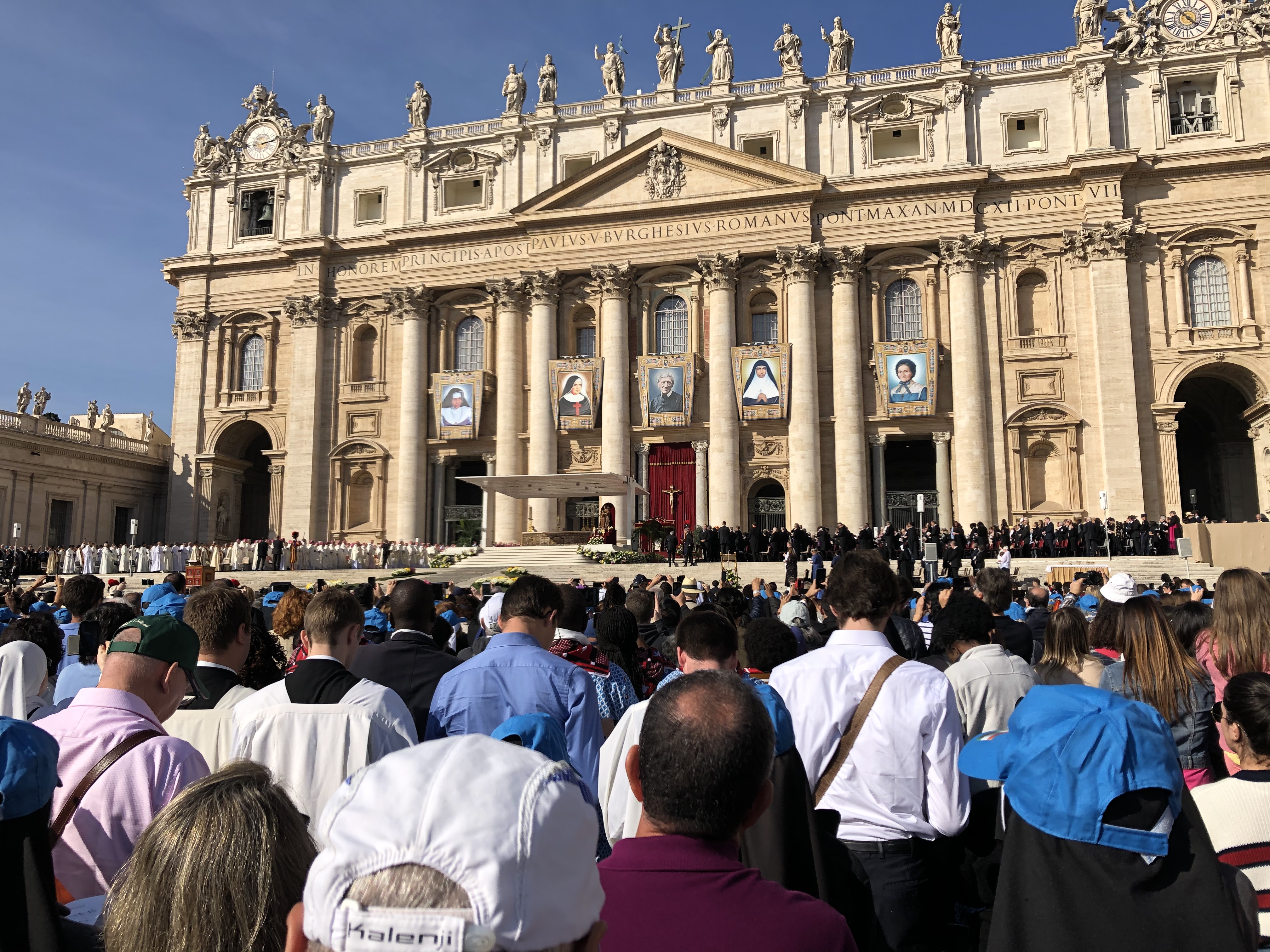
When I was thinking about that, and about what Jesus says about the Comforter, the Advocate, it reminded me of what I had experienced last Sunday when I went to Rome to attend the mass at St Peter’s for the ‘canonisation’ of five new saints in the Roman Catholic Church, John Henry Newman and four other saintly figures, three nuns and a Swiss seamstress, who all had various claims to ‘sainthood’, as the Roman Catholics understand it.

One of the things that comes out, that the Roman Catholics do that we don’t, is that they use saints as intermediaries between themselves and God. They pray to God through the saints, starting with the Blessed Virgin Mary, Mary, the Mother of God, but also then through one of more of the various saints of the church. So a form of prayer in the Catholic Mass is that you name a particular saint, and you ask that saint to pray for you.

The idea is that the saint is almost like what Jesus is describing the Holy Spirit as, if the Holy Spirit is the Advocate. It involves the idea of somebody who speaks for you. You pray through the saint, you invoke the assistance of the saint. The process of becoming a saint in the Roman Catholic Church involves miracles, to show how close the saint is to God. The person to be canonised as a saint, recognised as a saint, therefore needs to have brought about miracles, miracles which have been investigated and found to be genuine by theologians of the church.

I was in Rome particularly to witness the canonisation of one of the new saints, John Henry Newman, Cardinal Newman, who wrote the hymns ‘Praise to the Holiest in the Height’, and ‘Lead, kindly Light’, for example. He started out in the Church of England and was for 20 years a fellow of my old college at Oxford, Oriel. Eventually he changed to Roman Catholicism and became a Cardinal.

Newman was a leader – perhaps the leader – of the spiritual revival in the Church of England called the Tractarians, or the Oxford Movement, in the 1830s. Newman’s great theological message – and he was a prolific author and preacher – he was the vicar of St Mary’s in the High Street in Oxford, the University Church – the heart of his message was a call to the church to abandon what we might call today ‘relativism’, in favour of what we might describe as revealed truth.

He didn’t want the church to base its beliefs and its teaching on whatever was popularly thought to be ‘a good thing’ at the time, but rather on the truth as shown in God’s word in the Bible and in the teaching of the early Christian Fathers. You can see that sort of argument still alive in the church today, in the context, for example, of things like same-sex marriage.

The story of the Tractarians is a story of exciting spiritual revival in parts of the church. It’s not an exaggeration to say that, in the period between 1820 and 1840, the Senior Common Room of Oriel College contained some of the most influential theologians in England: not only Newman, but also Pusey, Keble and Hurrell Froude, who all supported this powerful revival movement in the Church of England, based on going back to what was perceived to be the message of the early fathers, stripped of any of the superstructure built up over the years by attempts to modernise the church in various ways.

Tractarianism (the name came from their series of pamphlets, called Tracts for the Times) came after the earlier Methodist revival, and in both those revivals there was a strong social message. The Tractarians were great believers in the Christian obligation to care for others, and particularly to care for those less fortunate than themselves.

This was a time when the Tractarians founded new congregations, new churches, in, for example, the East End of London and in some of the downtown slum areas of the big industrial cities. Just as Methodism had attacked the gin houses and encouraged people not to become prey to the demon drink, but rather to be able to keep and save their earnings and become more secure financially, so the Tractarians went out into places and founded churches where posh country parsons would never have dreamed of going.

Two healing miracles are attributed to John Henry Newman, one of Deacon Jack Sullivan in 2001, who was healed in a way that defied a normal medical explanation, and involved prayer invoking John Henry Newman, or rather his memory; and the second miracle involved the healing of an unstoppable haemorrhage in a pregnant American woman in 2013, where the woman, Melissa Villalobos, living near Chicago, had offered a prayer for healing, again invoking John Henry Newman to pray for her, and her bleeding suddenly stopped. These two miracles were considered, by the Roman Catholic Church, to be sufficient evidence of Newman’s sainthood.

We in the Church of England don’t reckon much to the idea of saints: Article XXII of the 39 Articles – on p.620 of your Prayer Books – says that the ‘Romish Doctrine concerning … invocation of Saints, is a fond thing vainly invented’, not Biblical and indeed contrary to the word of God.

This reflects the Reformation idea of our not needing to have priests stand between us and God, to pray for us and celebrate the mass on our behalf. By the same token we don’t need to have saints to pray for us. The idea is of a ‘priesthood of all believers’, which came from John Calvin.

But the Church of England is not a wholly Protestant church, although neither is it wholly a Catholic one. Henry VIII wanted to have the best of both worlds. He wanted to uphold all the doctrines of Roman Catholicism, except for the fact that he had some slight local difficulty with the Pope; so instead of the Pope being the head of the church on earth, he arrogated that function to the English monarch. So as it says on our coins, or on some of them, the name of the king or queen is on them and then ‘FD’, or ‘fidei defensor’, defender of the faith, signifying that the monarch is the head of the church on earth. That title started out as a compliment from the Pope for Henry VIII’s support for him against Martin Luther. But after they differed over Henry’s wives, the king kept the title nevertheless.

I have to say that, despite that background, I didn’t think any less of the wonderful service in Rome – there were reckoned to be 50,000 people attending, and we all got the bread of communion. It’s available on YouTube to watch [at https://www.youtube.com/watch?v=uzFObwA79xo], with a gentle but helpful commentary from an American priest. The beautiful illustrated multilingual service book had 125 pages – and everyone, from the Pope and his cardinals downwards, was given one.

In a sense there was a slight flavour of a sporting event – groups of the congregation were cheering on ‘their’ saint as they were canonised – but at bottom it was just a very beautiful Holy Communion service, whose words, and the hymns and their tunes, were familiar to everyone. The music from the choir and organ was beautiful.

Of course the idea of saints performing miracles is very far-fetched to us. But when you saw all those people not going to a football match, but going to church, it was a very happy occasion, when we all felt inspired, caught up in something beyond our own little domestic concerns, something good and wholesome which made us willing to exchange the peace and try to talk to people sitting next to us – all sorts of nationalities, speaking all sorts of languages.

Smiles went a long way – and the fact that the service was in Latin actually helped, because everyone had a little knowledge of some of the words. I was going to use the ‘Kyrie’ as a for-instance – but of course, that’s Greek. But I hope you can see what I mean.

In its basic structure, the wonderful Canonisation Mass was just like our communion service every week here at St Mary’s. It had all the same bits, and only a couple of extras – the ‘Angelus’, Angelus Domini, the Angel of the Lord, the prayer commemorating the angel Gabriel’s coming to Mary, was the most obvious extra bit – but most was word-for-word the same as our service. It made you feel very special, part of a huge family, a huge, warm family. John Henry Newman was truly a saint: and I felt the presence, in that huge crowd, of great comfort; maybe it was even the Holy Spirit, the Comforter. I think it could well have been.

Sermon for Evensong on the Tenth Sunday after Trinity, 25th August 2019 – Prophetic and Theological Considerations in the Brexit Debate

Isaiah 30:8-21; [2 Corinthians 9] – see http://bible.oremus.org/?ql=433650150

The first part of the Book of the Prophet Isaiah, sometimes known as ‘First Isaiah’, (because scholars think that there were three prophets whose work is collectively known as the Book of the Prophet Isaiah), ‘the first book of Isaiah’, was written in the 8th century BCE. It’s been pointed out that that century was one of the pivotal points in the history of modern civilisation.

It was the time when the Homeric legends, the Iliad and the Odyssey, were first being recited by travelling bards; in the British Isles, Celts, refugees from mainland Europe, were pouring into Cornwall; Egypt was where the most sophisticated culture was, and Assyria (Syria, roughly) was the most powerful imperial power. It was a time of religious stirrings. Zoroaster was born in Persia in about 650BCE. The Upanishads were written in India probably between c. 800 BCE and c. 500 BCE. It was the time of Confucius and Tao in China.

E. H. Robertson has written, ‘Over the whole world the spirit of God stirred the spirit of man. In Judah and Israel, four men spoke in the name of the living God, …’ [ Robertson, E. H., Introduction to J.B. Phillips, 1963, ‘Four Prophets’, London, Geoffrey Bles, p. xxv] These were the four prophets, Amos, Hosea, Isaiah and Micah. Just as in the middle of the 19th century it was a time of revolutions, and the end of the 20th century it was the beginning of the digital age, this, in the 8th century BCE, was another turning point in human history.

The spiritual narrative of this historic period was supplied, in Israel and Judah, by the four prophets.The great historical event in this period was the fall of Samaria in 732BCE, when the whole of the Northern Kingdom, Syria and Israel was depopulated and turned into Assyrian provinces. It was a great shock to the people of Israel left in the Southern Kingdom, Judah. Her prophets, particularly Isaiah, were finally listened to. ‘The general line taken by the prophets was, trust in God and keep out of foreign alliances.’ [Robertson, p.xxvi]

Our lesson tonight from chapter 30 of First Isaiah is exactly on this point. The prophet is saying that God has told him to tell the Israelites not to make an alliance with the Egyptians. But he complains that they are not taking any notice. How does God communicate with us?

I heard on the radio an absolutely fascinating programme about the fire in York Minster [http://www.bbc.co.uk/programmes/m0007pws]. This year, of course, we have had the terrible fire in Notre Dame in Paris, but in July 1984 there was a terrible fire in York Minster, which destroyed the roof of the south transept and caused extensive damage to the magnificent mediaeval Rose window.

Just before the fire, a new Bishop of Durham had been consecrated, David Jenkins. He was an academic theologian in the liberal theological tradition; in other words, he did not hold with a literal interpretation of everything in the Bible. Indeed, he went as far as saying that he didn’t think that the Virgin Birth necessarily literally took place.

When he was consecrated as Bishop of Durham, in York Minster, there was an outcry from some parts of the church; today no doubt it would have been a ‘Twitter storm’, protesting that Bishop Jenkins, Prof. Jenkins, was flying in the face of the traditional beliefs of the church over the previous 2,000 years. Some people went as far as to say that the fire in the Cathedral, in the Minster, which was attributed, by the surveyors who came to examine the wreckage, most probably to a lightning strike, that it was an ‘act of God’, literally, in that God had struck the Minster with lightning and set fire to it, as a way of showing His disapproval of the preferment of David Jenkins to the bishopric of Durham.

Isaiah was prophesying to the Israelites in the Southern Kingdom, Judah, against their making an alliance with Egypt. Judah heeded the prophecy, and did not make an alliance with Egypt. The Israelites were able to build the Temple and live in peace for nearly 100 years.

Now we are perhaps at another pivotal time in history – well, certainly in the history of this country; and perhaps if one includes as a key element in this current historical perspective the rise of populism, this pivotal time affects not only our country, but also the USA and Italy at least. We are noticing changes in our society as a result; there have been increases in nationalism and xenophobia, (with an unhealthy interest in where people have come from), leading to opposition to immigration, which also involves a ground-swell of racism.

In the British manifestation of this wave of populism, in the Brexit debate, there is also an emphasis on sovereignty – ‘take back control’, they say – as well as all the other features of populist politics. So in relation to all this, is there an Isaiah out there speaking to us? A prophetic voice, guiding us in relation to this turbulent time? And if there is, are we listening?

We look at some of the prophetic utterances in the Bible, and wonder if they might also be talking about our present age. Last week’s Gospel reading for instance, in which Jesus asks, ‘Do you think that I have come to bring peace to the earth? No, I tell you, but rather division! From now on five in one household will be divided, three against two and two against three. They will be divided father against son and son against father. ..’ [Luke 12:51f.]

Dare I say that Brexit has had very much the same effect? Friends have stopped speaking to each other. Families are divided. Literally billions have been spent on preparing for something which there is no agreement about, either within our population, our Parliament or with our European neighbours; at the same time our hospitals are desperate for resources, our schools, similarly, have often not got enough money for books, and our local authorities can’t afford to fill the potholes – and that’s not saying anything about the need for housing or the closures of our fire stations.

Is this another time when a prophet might say that God is punishing us, or that He may punish us? Revd Dr Jonathan Draper, the General Secretary of Modern Church (which used to be called the Modern Churchmen’s Union), who was the Dean of Exeter, in his conference speech in July, has tried to identify the theological aspects of the Brexit debate. I’ll put a link to his paper on the website with the text of this sermon. [Published written version: https://www.dropbox.com/s/5ees6m98pb25bh9/theology%20after%20brexit%20-%20final.docx?dl=0 – version as delivered: https://www.modernchurch.org.uk/2019/july-2019/1494-how-theology-has-failed-over-brexit]

He says, ‘Our national so-called ‘debate’ on Brexit has exposed deep, damaging, and shocking divisions: divisions that cut across families and friends, divisions that have exposed the raw experience of some of being entirely left out and ignored by the political and ecclesiastical ‘elite’, divisions that pit one part of the nation against others. Without even leaving, a deep and disturbing vein of xenophobia and racism has been exposed and even normalized in our public life.’

He goes on. ’Dr Adrian Hilton wrote ‘A Christian Case for Brexit’ on the website christiansinpolitics.org.uk. … His …. reasons for why Christians should want to be out of the EU [are], he writes, ‘about liberty, democracy, transparency, accountability, and the right to sack those who rule over me’.’ As Dr Draper points out, these are not theological reasons. There is nothing in the Bible to support these reasons.

In relation to the various things we have identified in the Brexit debate, it seems doubtful whether the ‘Christian case’ would in fact elevate ‘liberty, democracy, transparency, accountability, and the right to sack those who rule over me’ over such things as loving one’s neighbour – who, as the Good Samaritan found, might not be of the same nationality – and that anyway there is ‘no such thing as Jew and Greek’ in the Kingdom of God (Galatians 3:28) [https://biblehub.com/kjv/galatians/3.htm]- that nationality is not something which mattered to our Lord; and that political power, democratic or otherwise, wasn’t very important either, in the context of the Kingdom. More important to love (and therefore obey) the Lord your God. ‘Render unto Caesar’, indeed; but in those days democracy was practically non-existent.

Another theologian, Dr Anthony Reddie, has pointed out ‘a rising tide of white English nationalism’ and ‘the incipient sense of White entitlement’; that participants in the Brexit debate seem to have emphasised White English interests to the exclusion of other races and nationalities. Dr Reddie feels that the churches should be speaking out against this. He asks why the churches have not ‘measured Brexit against the standards of justice and equality’, loving God and loving neighbour. Dr Reddie also argues that churches ought to consider ‘not just the rights and wrongs of Brexit, but what it has done to us’. [Quoted in Dr Draper’s written text]

Dr Draper goes on to consider the theology of incarnation, of being the body of Christ, Christ incorporated in His church. It isn’t an individualistic thing. He quotes John Donne’s poem, ‘For Whom the Bell Tolls’:

Entire of itself,
Every man is a piece of the continent,
A part of the main.
If a clod be washed away by the sea,
Europe is the less.
As well as if a promontory were.
As well as if a manor of thy friend’s
Or of thine own were:
Any man’s death diminishes me,
Because I am involved in mankind,
And therefore never send to know for whom the bell tolls; 
It tolls for thee.

He also says this.

‘This is not an argument for saying that we ought to stay in the EU. It is an argument for saying that a Christian theology of the Kingdom of God, being all one in Christ, drives us away from things that divide us and towards things that bring us together. … The impulse to unity ought to be strong for Christians. Walls, barriers that divide, theologies that exclude, have no part of the Christian vision.’

Where do we as a church stand in relation to the concept of human rights, for example? Our own MP, who is now the Foreign Secretary, has recently campaigned to abolish the Human Rights Act. This is something which our country adopted by signing up to a European convention – a convention which was actually drafted by English lawyers. Although the European Court of Human Rights is not an EU institution, it is seen, mistakenly, by some Brexit supporters as interference in our country’s sovereignty by the EU. What do we as Christians have to say about this? Surely, at this pivotal point in our national life, it is too important for us to stay silent. How does Brexit square with Jesus’ great human rights challenge at the end of St Matthew’s Gospel? Dr Draper, [in the version of his paper that he delivered], quoted it in this way.

Lord, when was it that we saw you hungry and gave you food, or thirsty and gave you something to drink? And when was it that we saw a stranger and welcomed you, or naked and gave you clothing? And when was it that we saw you sick or in prison and visited you? And the king will answer them, ‘Truly I tell you, just as you did it to one of the least of these who are members of my family, you did it to me’. [Matt. 25: 37-40]”

He went on.

‘And let’s not spiritualise this either. To feed the hungry is a political act; to welcome the stranger is a political act: enacting, embodying the Christian faith is a political act. And sometimes that means not just praying for everyone but taking sides.’

That’s what Dr Draper said to the Modern Church conference. I don’t think Isaiah would have kept quiet either: but would we have heard him?

Sermon for Evensong on the Fourth Sunday after Trinity, 14th July 2019

Genesis 32:9-30, Mark 7:1-23 (see https://bible.oremus.org/?ql=430034390)

I could tell you a good story about Jacob and Esau and the beginnings of the nation of Israel: how Jacob cheated his brother Esau, as we heard last week; how he in turn was cheated by Laban, his relative, father of Leah and Rachel, so that eventually Jacob managed to marry both of them: how Jacob in his wandering prospered, again through some sharp practice, this time getting his own back on old Laban. He said Laban could have goats and sheep, provided they had certain markings on them, and Jacob would have the others, although quietly he was making sure that he was breeding only the sheep and the goats that had his markings on.

So Jacob became rich and prospered. Still, his brother Esau was out to get him, for taking away their father’s blessing, his birthright. So Jacob went out with a huge gathering of cattle and various other presents for his brother to appease him, and to make him forgive him.

On the night before he was due to meet his brother, (and both of them were accompanied by private armies), he met a mysterious man, with whom he wrestled all night, and who dislocated his hip for him. He wouldn’t tell Jacob his name, although the mysterious man said that Jacob’s name would not be Jacob any more, but Israel, which means ‘God strove’, or ‘God struggled’, so Jacob deduced that he had had God as his opponent. Jacob called the name of the place Peniel, meaning, ‘the face of God’.

I could tell you all that story; Oh, and I could also mention Jacob’s dream, of the angels ascending and descending a ladder to and from heaven.

In the story there’s a real intimacy between Jacob and God. It doesn’t seem to be particularly the case that God is upholding Jacob because he is a good and moral man – which he clearly isn’t; and even after Jacob has stolen his brother’s birthright, nevertheless his father Isaac, too, seems to treat it as just one of those things. He blesses Jacob and he sends him out to start a family. I could tell you that story.

Or, I could go into the other story today in our Bible readings, about washing one’s hands before you eat, and various other Jewish rules which were not part of the law of Moses, which Jesus condemned as forms of hypocrisy.

The part about washing hands doesn’t translate very well into a modern context, but the other half of the story, where Jesus goes on to tick the Pharisees off for relying on the small print, relying on get-out clauses allowing them to avoid having to do good, to avoid having to care for their parents as it is laid down in the Law of Moses, is something we can easily understand.

Apparently a practice had grown up according to which people could get out of looking after their old Mums and Dads and devoting resources to it, if they had first set aside the bulk of their savings for a sacrifice, or sacrificial offering, to God. This is what was called ‘Corban’.

Whatever was set aside as Corban was no longer available to be used to benefit one’s family, one’s aged parents, and so you were excused from having to look after them.

I could spend a long time teasing out all the various bits of meaning in our two Bible lessons. On one level you might possibly find it edifying, even enlightening; just as you would do, if you were watching a documentary film or going to one of the Art Fund lectures at the Yehudi Menuhin School.

But then I think, an hour or so after you come out of church, you might have a moment of dismay, because those stories just don’t bear on all the important things that are going on in our lives.

What on earth has wrestling with a mystery man in the night, or seeing angels climbing up and down to heaven, got to do with our worries about naval threats in the Gulf of Hormuz, or the unpredictability of Pres.Trump and his refusal to follow the norms of statesmanlike behaviour?

What do Jacob’s wanderings and Jesus’ teaching about hypocrisy really have to say to us in today’s world? Some of it is, on its face, out of date or inappropriate. Our children really ought not to think that Jesus says it’s OK not to wash your hands. (I know it’s about ritual washing, but that’s even further away from real life).

We are worried about knife crime. The terrible murder on the train at East Horsley. It was a shock. It seemed to be something that could have happened to any of us who commute on that line, on our local line to London. What has God got to do with that?

What will happen about ‘Brexit’? Our country has already been greatly diminished in the eyes of the rest of the world and the preparations for Brexit have cost billions. Where will it end?

Austerity, over the last ten years, has not made our economy any stronger. But is has meant that the poorer people in our society are now desperately poor, and food banks are everywhere. Our own food bank will supply over 3,000 food parcels, locally, here in this area, in the next twelve months. What would Jesus say?

During the ITV debate between the two candidates for the Conservative leadership, when one was asked about his Christian faith, he said: “I sometimes pray. I’m like regular Church of England folk: it’s part of my life and my identity, but I don’t think it defines my politics.” [https://twitter.com/churchtimes/status/1149735677430390784?s=21]

Why doesn’t his faith in God define his politics? Is there anything more important? How worrying is that? I’m not concerned about who the politician was or that it was one party or another: this could have been said by almost anyone. But he was an MP, an important person, a minister. Why shouldn’t such an MP’s faith influence his politics?

In the Bible, Jacob could talk to God and lament that he had not followed God’s commandments; but nevertheless God kept faith with him. They had this regular contact. In his dream he saw the angels climbing up and down a ladder, Jacob’s Ladder, into heaven. And God met him at night to wrestle with him. Was that a dream as well? Whatever it was, Jacob felt that he had seen the face of God; he had been close to God.

But we, we don’t seem to experience anything like that. Perhaps like the Pharisees, we’ve become too regimented in our approach to God. Perhaps our prayers are too formulaic. Perhaps we are not open enough to see the face of God any more. Perhaps we’re like that politician. Like the one who said, “I sometimes pray. I’m like regular Church of England folk: it’s part of my life and my identity, but I don’t think it defines my politics.”

When Jesus told the Pharisees not just to go through the motions, not just to follow the rules for the sake of following the rules, I think he could have been talking precisely about the ‘regular Church of England folk’ that this politician said he belonged to. The Pharisees went through the motions, but they didn’t actually do anything. It didn’t ‘define their politics’.

I think what Jesus is teaching us in relation to washing one’s hands and setting aside resources that might have gone to look after your parents, is that this is sham love, and it is no good. Jesus wants us to show risky love, real love, the sort of thing he preached about in his Sermon on the Mount.

The love that Jesus was recommending, going the extra mile, loving our enemies, turning the other cheek, being like the Good Samaritan, is generous love and it’s a love which is not calculating in any way. Paul wrote about it in 1 Corinthians 13. ‘Love is patient; love is kind; love is not envious or boastful or arrogant’. It isn’t necessarily love which you can easily afford. It could be like the widow’s mite. Not much, but it could be more than you can easily afford.

But when you do see that kind of giving, giving which does not count the cost, at work, when, (and this seems especially apt today, which is Sea Sunday), when you see the risks that Captain Carola Rackete, the young German sea captain, took in order to rescue refugees in the Mediterranean and take them to a safe port, even though it might result in her going to jail; or more mundanely and closer to home, when you see someone give their entire trolley of purchases from the supermarket to our Foodbank, all for their poor neighbours: it may not be a sensible gift: it may be really extravagant: but it is loving. It is a blessing. A real blessing, and I think we may begin to see the face of God in it.

Just as Jacob was really concerned to be blessed, to have his father’s blessing and then for God to bless him – he said, ‘I will not let you go until you bless me’ – we need to look out for our blessings. If we count our blessings, I am confident that we are going to find, not that we are alone, but that God really is still at work among us.

So may God bless us and keep us, and make His face to shine upon us.

Sermon for Evensong at All Saints’ Day, 4th November 2018

Isaiah 65:17-25; Hebrews 11:32-12:2

As you can see, you’ve got some neighbours in church today. 17 silhouettes, each one representing a soldier from Stoke D’Abernon who died fighting in the First World War. There are little plaques in front of each one of the silhouettes which tell you the name of each of the soldiers and the regiment that he belonged to. There are two pairs of brothers, you will find. All over the country there are churches with these silhouettes in. They have been created by a new charity called ‘Remembered’ and our Vanessa Richards is a trustee of the charity. A number of us have subscribed to buy the silhouettes which are in the pews.

These soldiers are ‘there are but not there’, which is the name of the campaign, launched by this charity called Remembered, to remind people, and especially people like me who have never been in a war, to remind us of the great sacrifice and bravery of our soldiers – in what they had hoped would be the ‘war to end all wars’; and also to raise money for the relief of mental conditions caused by war such as PTSD, combat stress, which used to be called ‘shell shock’.

Our silhouettes were first installed in the pews on Friday, for the All Souls service, when we remembered the dead, our dear departed, and today is All Saints, when we remember and celebrate that ‘cloud of witnesses’ that was mentioned in our second lesson from Hebrews.

We will of course come back and make our main act of remembrance next Sunday. Today we are celebrating All Saints’ Day, which follows very closely after our celebration of All Souls. Using the word ‘souls’ reflects the idea that we are made up of a body and a soul and that in some sense our souls are immortal and eternal, carrying on after our bodies have died. So All Souls is the great commemoration of the dead.

Today we focus on the idea of saints and sainthood. Through both these festivals we may get a glimpse of heaven; this is a chance for us to reflect on what we can understand of heaven, at All Souls on life after death and today on the saints, the great ‘cloud of witnesses,’ in history – and perhaps nearer to home as well.

We can think of ‘saints’ in two ways. On one hand we can understand the expression ‘saint’ to cover all Christian people. St Paul’s letters refer to the ‘saints’ at Ephesus and in Rome and in Jerusalem, meaning the normal members of the congregation in each church. So in that sense we are all saints. We are the saints at Stoke d’Abernon.

The other sense, which is perhaps the one which we would normally think of when we use the word ‘saint’, is to identify people who lead exemplary and virtuous lives, who are witnesses to the gospel of Jesus through the self-denying love which they show.

We should notice that there is a difference between the beliefs of the Protestant churches and the Roman Catholic Church where saints are concerned. Roman Catholics see the saints as being so close to God and to Jesus that they can intercede for us. In other words, Catholics address prayers to one or other of the saints and ask them to pass on their prayers to God. As Protestants we use the same language and perhaps adopt the same thought when we end our prayers with the words ‘through Jesus Christ our Lord’, but this is as far as we go.

Praying through a saint, through a person who speaks for us to God, is a very old idea, a mediaeval idea, but it was one of the things which was attacked by Martin Luther and the Reformation theologians. If you look at the 39 Articles of Religion at the back of your little blue Prayer Book, if you look at article 22 on page 620 and article 31 on page 624, you will see what the reformers were objecting to.

Article 31 was against people saying masses for the dead – at first sight, against what we were doing on Thursday. Before the Reformation, people left money in their wills to pay for masses to be said for them after they had died, to help them to get to heaven and not be stuck in ‘Purgatory’, a kind of half-way house for those whose virtues were not clear enough for them to pass straight through the Pearly Gates. People built ‘chantries’, chapels where they could be remembered and prayed for.

Our Norbury Chapel is an example of a chantry. It was built for Sir John Norbury after the Battle of Bosworth which ended the Wars of the Roses in 1485. Sir John died in 1521, before the Reformation, or more particularly before Henry VIII. His original statue must have been destroyed in the Elizabethan purge on ‘monuments of superstition’, and now his monument is the little figure of a kneeling knight, whose armour is in the style of Charles I’s time, 100 years later.

I think that we can agree with Article 31 that Christ’s sacrifice on the cross is the only thing we need, in order to be reconciled with God and forgiven our sins. We don’t need to make a ritual sacrifice as well, in order to buy forgiveness for someone’s sins. But remembering our dear ones by reading out their names doesn’t go against this, I believe.

Martin Luther, who started the objections to ‘masses for the dead’, was aiming at what he thought was a racket run by the Roman church, getting money for saying masses and building chantries, although there was no theological justification for it. We should remember that Jesus’ salvation is for all, not just for the ones whose names we read out in church – but that’s not a reason for us not to remember our dear departed ones.

Article 22 is even more specific about the worship, or ‘veneration’, as it was called, of saints, their statues and pictures. It reads:

‘The Romish Doctrine concerning Purgatory, Pardons, Worshipping, and Adoration, as well of Images as of Reliques, and also invocation of Saints, is a fond thing vainly invented, and grounded upon no warranty of Scripture, but rather repugnant to the Word of God’.

The reformers thought that there was an element of idolatry, that people were worshipping the saints rather than God, and that there was really no need to use an agent in order to be able to say your prayers to God. There is a reflection of John Calvin’s idea of the ‘priesthood of all believers’ here. Again, in the Jewish faith, only the High Priest could enter the the Holy of Holies, in the Temple, to come close to God, once a year only, without being consumed (cf Moses in Exodus 33:20). This is one place where the idea, that God needs to be approached through somebody, comes from. In our first lesson from Isaiah there is also the example of prophecy, where God speaks through the mouth of a human, a prophet.

Because St Mary’s is so old – its origins are 7th century Saxon – if you look around, it shows you signs of all this historical theology. You will see some images of saints in some of the windows, but the only statue of a saint is the statue of Mary, the Madonna and Child, at the front. Actually pretty well all the images of saints, the windows and the statue, although they are often of mediaeval origin, were imported during Revd John Waterson’s time (1949-1983), because whatever was here before the Reformation was removed or smashed up. In the Baptistry some of the windows contain bits of the remains of pre-Reformation windows, but I think that is all.

The Church of England is often called ‘catholic and reformed’. Henry VIII was a faithful Roman Catholic, except for his little difficulty with the Pope! The question of how we look at saints today is a good example of how our church’s theology and history are combined in a rich mixture. The greatest of the saints is Mary, the mother of Jesus, who was always closest to him, even at the end; his mother stood grieving at the foot of the cross. Who better, who closer, to intercede, if you feel you need someone to do it? The words of the ‘Hail Mary’, which Roman Catholics use almost as much as the Lord’s Prayer, end with

‘Holy Mary, Mother of God,

Pray for us sinners now,

And at the hour of death’.

Indeed Mary is the saint preferred by more people than any other to pray through, in the Roman Catholic Church, where veneration of the saints and praying through them still thrives – they still create saints, for instance recently Archbishop Romero, the Bishop of San Salvador, who was martyred on the steps of his cathedral in 1980, and who was renowned as a liberation theologian, concerned to minister to the poor.

So I have taken you through the story of what it could mean to be a saint. We can be one of the saints at Stoke d’Abernon, one of the people who turn up faithfully in the pews, contribute to good causes and are happy to let people know that this is what we do on a Sunday and indeed, perhaps, what we do on other days. Church saints are involved, involved in church activities.

Or you could be a witness. You could stand up and say to other people what it means to be a Christian in today’s society. You could do things, things which actually take a little bit longer than signing a cheque or turning up to a meeting. You would have to show commitment. The touchstone for being this kind of saint is selfless giving.

Or you might even be a martyr. ‘Martyr’, after all, is just the Greek word for a ‘witness’. Your being a witness may have a price. People may not approve of what you have to say. You may be put to the test as a result. Being a saint, being a witness to the gospel of Christ, may be tough.

There have been occasions when some of you have said to me that my interpretation of what it is to be a practical Christian, to be a practical witness, shades over into politics. Well, on this occasion, I leave it to you. You work out what it would be for you to be a saint. All I would say to you is that I think we all have it in us to be some kind of a saint. Which one are you?

Sermon for the Parish Eucharist by Extension on the Feast of Mary Magdalene, 22nd July 2018

2 Corinthians 5:14-17, John 20:1-2,11-18

Confronting the Miracle

The story of Mary Magdalene might be the most important passage in the Bible.

Mary Magdalene found the tomb empty. What did it mean?

… she turned round and saw Jesus standing there, but she did not know that it was Jesus. Jesus said to her, ‘Woman, why are you weeping? For whom are you looking?’ Supposing him to be the gardener, she said to him, ‘Sir, if you have carried him away, tell me where you have laid him, and I will take him away.’ Jesus said to her, ‘Mary!’ She turned and said to him in Hebrew, ‘Rabbouni!’ (which means Teacher). Jesus said to her, ‘Do not hold on to me, because I have not yet ascended to the Father. But go to my brothers and say to them, “I am ascending to my Father and your Father, to my God and your God.” ’ Mary Magdalene went and announced to the disciples, ‘I have seen the Lord’; and she told them that he had said these things to her.

How to deal with it mentally, in our thought – is it open to reasonable doubt?

Reasoning against other logical possibilities, that, e.g.

– Joseph of Arimathea took his body and reburied it; why? What good would it do to Joseph, or anyone he sympathised with?

– Jesus wasn’t dead when they put him in the tomb;

– The Jews or the Christians took his body; what Mary M initially thought must have happened. Someone would have ‘snitched’ or leaked.

– It was a ‘conjuring trick with bones’. The late David Jenkins, formerly Bishop of Durham, said it was not a …

Rational answers are available to contradict all these theories.

But do we believe? Memo 1 Cor 15:12f. If Jesus wasn’t raised from the dead, our faith is in vain: we are proclaiming a lie.

But what does it mean, to believe in something? To believe that x is true, x is real – but what does that mean? That x is something, or does something? That if I believe that x, x is necessarily true? Not necessarily.

If I believe that something is true, then for me it is true; but someone else might review the exact same proposition that I have said must be an example of God at work, and get the same moral imperatives without a Christian sanction. Do this, because God says it is good, or, if God is not in the picture, because it benefits the most people or makes for the greatest human happiness (if you are a Utilitarian, say).

What if we somehow ‘duck’ the issue and simply carry on? How? I think this is a way of describing what Richard Dawkins thinks. He doesn’t worry about a beginning or an end of creation, but rather sees a process, evolution, which is all we need to know about, from a practical point of view. There is no Creator, no divine force.

Can there be a sort of ‘tribal’ Christianity? Maybe the earliest example of this would be the army of the Emperor Constantine at the Battle of the Milvian Bridge in 325AD [CE]. Constantine, inspired by a dream, ordered that his soldiers should paint on their shields the symbol of the Cross. They then won a victory. Did they believe? Surely not. But Constantine went on to make Christianity the official religion of the Roman Empire. It’s arguable that that was as important in making Christianity a worldwide religion as St Paul’s work among the so-called ‘Gentiles’, the ‘nations’, in a Jewish Bible context, the non-Jews.

If either St Paul’s realisation that the Gospel ought to be preached to the Gentiles, or the Emperor Constantine’s decision to adopt Christianity as his empire’s official religion, had not happened, we might well not be here in church.

But what about today? People talk about having ‘Christian values’, without their being churchgoers. That’s interesting. The way that St Paul thought it worked, as he put it in his letter to the Galatians (chapter 5), and effectively as everyone from John the Baptist onward preached, if you came to believe in the Good News of Christ, you would be changed: you would ‘repent’. And you would start to live a virtuous life.

But what if you skip the believing bit, and just decide to live a virtuous life, because it makes sense to you?

We’ve then got at least two schools of lukewarm moralists. C of E Christians, on the one hand, say, and the ‘spiritual – I mean charitable – but not religious’ on the other.

But are we right to qualify these two groups as ‘lukewarm moralists’? Lukewarm, yes. The early Christians were willing to sacrifice themselves for the Gospel, for the cause. To die for it. Horribly, often. But what about us? Maybe some are willing to risk their lives. Respect to them! But most of us will do good, generous deeds, just so long as rescuing refugees doesn’t involve personal liability or risk.

Is this akin to the current populism, mistrust of ‘experts’ etc? A rejection of reason? Voting for Trump, who is a racist, sexist, xenophobe and liar? Why should these characteristics not weigh more with people?

How do we regard people who definitely don’t believe? Or who are happy to take part in church activities, but ‘I don’t go along with everything in the Creed’? Do we let them ‘belong and then believe?’

What about being ‘inclusive’?

What would Mary Magdalene say? We often ask, ‘What would Jesus say?’ But what would Mary say? If she met one of the lukewarm believers …?

Why is her story the most important in the Bible? Compare the best-known passage, John 3:16:

For God so loved the world, that he gave his only begotten Son, that whosoever believeth in him should not perish, but have everlasting life.

God – the creator – loves us. Only the creator could bring a dead person back to life. Think about that, in the light of the Mary Magdalene story. Really confront it. Confront the miracle. Don’t just duck it, don’t say it’s too hard. Then perhaps being a Christian really will change you. Change you for the better.