Archives for posts with tag: hope

Sermon for Mattins and Morning Prayer (Principal Service) at All Saints Church, Penarth, 5th October 2025

Habakkuk 1.1-4; 2.1-4

Psalm 37.1-9

2 Timothy 1.1-14

Luke 17.5-10

It’s a pity that we don’t have lantern slides at 8 o’clock, because I could show you the picture on the slide which is going to be shown at 10 o’clock when I start to preach the sermon then. It’s a sort of shovel, or it could be a large spoon, with round things in it, quite small.

I wondered whether they were my favourite special-treat breakfast cereal, Grape-Nuts – I should explain that I didn’t choose the pictures, as Susannah is leading the service at 10 as well as this one – but I suspect that at 8 o’clock we need to stay away from pictures and screens and things like that, and just keep our worship simple and our pictures in our heads, where, of course, those of you who listen to the wireless know that the best pictures are.

What is in the big spoon? I asked Susannah and she told me that they were mustard seeds, picking up a reference to the Gospel reading, the New Testament lesson today. I have to say that it rather threw me, because I thought mustard and cress was something which you grew on a face flannel on the bathroom windowsill, but apparently this is what mustard seeds really look like.

The lessons are all about how we confront a world which is going wrong, which is going against us. The Old Testament lesson, from the prophet Habakkuk, comes from a time around 600 BC when the Assyrians had overrun the northern kingdom of Israel, and all that was left of God’s chosen people were the two tribes of Judah and Benjamin, together with the survivors from the massacre when the Assyrians invaded the northern kingdom, who had fled to Jerusalem to take refuge there.

Habakkuk was preaching when the Babylonians were beginning to sweep down on Palestine; they are the Chaldeans, if you read a bit more beyond one of the bits that we have for our lesson, which is in two bits, the first four verses of chapters one and two respectively. If you read on in chapter 1, beyond where it says

Devastation and violence confront me;

strife breaks out, discord raises its head,

……

for the wicked outwit the righteous,

and so justice comes out perverted.

Habbakuk goes on in his prophecy by saying

Look, you treacherous people, look:

here is what will astonish you and stun you,

for there is work afoot in your days

which you will not believe when it is told you.

It is this: I am raising up the Chaldaeans,

that savage and impetuous nation,

who cross the wide tracts of the earth

to take possession of homes not theirs.

Terror and awe go with them;

their justice and judgement are of their own making.

Their horses are swifter than hunting-leopards

And he goes on to say how terrifying they are in all sorts of other ways. Obviously they fulfilled the American strategic objective for a successful army in the invasion of Iraq, ‘shock and awe’.

But this terrible army had its limitations.

Their whole army advances, violence in their hearts;

a sea of faces rolls on;

they bring in captives countless as the sand.

Kings they hold in derision,

rulers they despise;

they despise every fortress,

they raise siege-works and capture it.

A terrifying picture. Who could stand against them? But then –

Then they pass on like the wind and are gone;

and dismayed are all those whose strength was their god.

People who believe that ‘might is right’ turn out to be completely mistaken; and the key words in Habakuk’s prophecy come in the second chapter, in our second part of the lesson, [2:4]

Look at the proud!
 Their spirit is not right in them,
 but the righteous live by their faith.

It’s an idea that St Paul picked up on in two of his letters. In his great letter to the Romans, [1:17], he said that in the gospel of Jesus

is revealed God’s way of righting wrong, a way that starts from faith and ends in faith; he says, as Scripture says, ‘he shall gain life who is justified through faith’.

In the letter to the Galatians [3:11], where St Paul is drawing a distinction between following the provisions of the Jewish law, just carrying out the 10 Commandments, and having faith, saying that the way to salvation is through faith, he says that

It is evident that no one is ever justified before God in terms of law; because we read, ‘he shall gain life who is justified through faith’.

I’m not sure why the compilers of the Lectionary decided that we should have a lesson from the second letter to Timothy rather than one of these passages from Romans or Galatians, (which clearly reference the passage in Habbakuk), but certainly in the passage from the second letter to Timothy, St Paul celebrates that the fact that Timothy and his mother and his granny, Eunice and Lois respectively, all had strong faith.

But you might be a little bit puzzled about exactly what this faith is. It’s pretty clear that it’s not what we would call blind faith, just believing that something is true without any evidence for it. If that was true, you might never take another paracetamol ever again; or even worse, you might try to cure Covid by drinking some bleach. But we are not talking about President Trump’s belief system; this is a word which has more of a connotation of trust about it. It’s not so much about believing that something is the case, but rather, trusting in God to produce a good outcome, to right the wrongs. It’s very close to hope. Hope in the Lord. Trust in the Lord. As Isaiah puts it [14:31]:

but those who look to the Lord will win new strength,

they will grow wings like eagles;

they will run and not be weary,

they will march on and never grow faint.

They will soar, on wings like eagles: they will ‘mount up with wings like eagles’.

Just now our world looks a bit like what it must have looked like to Habakkuk; there is a lot going wrong. There are terrible wars, invasions; the rule of law looks to be under threat in places: –

devastation and violence confront me;

strife breaks out, discord raises its head,

…..

for the wicked outwit the righteous,

and so justice comes out perverted.

We can think of plenty of places and cases today, where those words would be very apt. We are going to have a vigil later on today here to pray for the people of Palestine; equally our prayers should go for the other places in the world where there is no peace and where the rule of law does not securely run: Ukraine and the south of Sudan chief among them, as well as Gaza and the West Bank; and all those places where people are held hostage or are fleeing violence and persecution and are becoming refugees.

We need to trust in the Lord, to pray with confidence and realise the power of prayer, even if our faith is only the size of one of Susannah’s mustard seeds, or a spoonful of Grape-Nuts. It doesn’t matter. You can rely on God to put things right in the end. Let us pray that he will use us in his service to that good end.

Amen.

Hugh Bryant
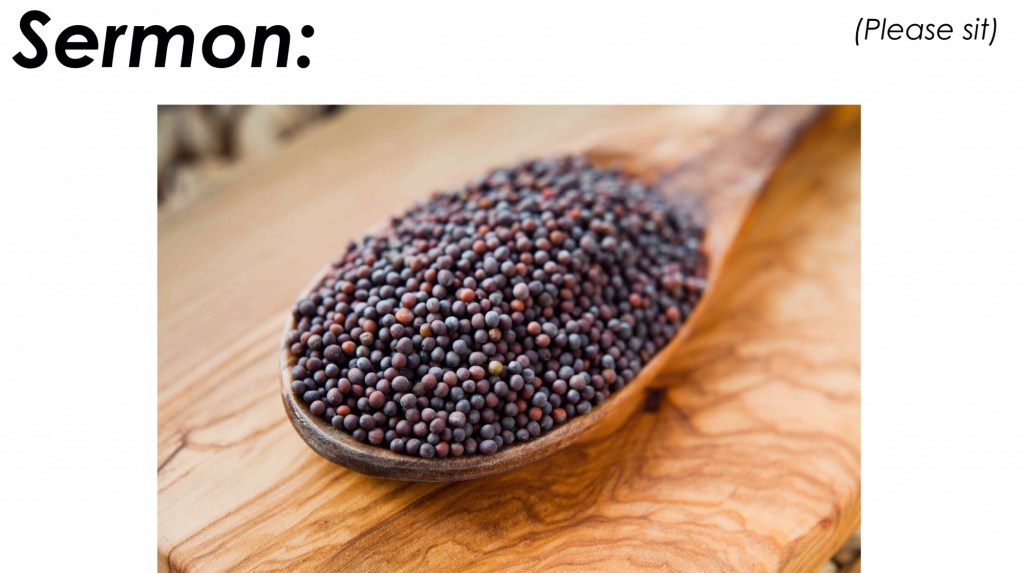
From the PowerPoint slides at the 10 o’clock service. What are those little beads?

Sermon for Mattins on 1st December 2024, the First Sunday of Advent

Advent Reflections

https://bible.oremus.org/?ql=605091724

Isaiah 51:4-11

Romans 13:11-14

We have lit the first Advent candle and begun the new church year with the beginning of Advent. The word ‘advent’ means coming, or ‘coming towards’ somewhere. It is from an old Latin word.

It is supposed to be a penitential season in the church’s year, although probably not quite as serious as the period of Lent. Not for the first time you get the slight feeling that in the church we are sailing against the wind so far as the rest of society is concerned. If you watch ITV and pay any attention to the adverts, essentially the thing that we are coming towards is definitely Christmas, and it’s not a thoughtful time at all except to the extent that you may have to spend a bit of time with your diary making sure that you’re in the right place at the right time for all the Christmas parties and, particularly at Christmas, that you haven’t left any of the family out. But that’s not really what the Christian tradition is all about. The ‘coming’ in Advent is the coming of Jesus, and there are really two comings, coming in the sense of his incarnation, becoming a man, being born in the manger Christmas is one coming.

But there’s also be an idea of the end time, of Jesus’s second coming, and you can see from our readings today in the lesson from Isaiah a prophecy addressed to the people of Israel looking forward to the Messiah, the great saviour who would take them out of captivity, effectively for a second time. The prophet reminds them of the escape from Egypt, the parting of the waters and the entry into the promised land. Isaiah is saying that God can do this again. 

And then in Saint Paul’s letter to the Romans he reflects the belief which was common among the early Christians that the end time, that the second coming, and the time of judgement, was just round the corner. Obviously we realise that that’s not the case, and if there is to be an end time of this type, we don’t know when it will be. 

St Paul nevertheless makes a good point in saying that we should always live our lives as though we would be hauled up before the judge eternal in the next day or so. There is a sort of tension here. For all the last 2000 years we have recognised that the Messiah has come, at Christmas time, but still we are waiting, waiting for him to come again. 

In our church in Wales there is a difference in the holy communion service compared with our brothers and sisters in England. In England the church says, ‘Christ has died, Christ is risen,’ and then, ‘Christ will come again’. The church in Wales, perhaps more realistically, says, not, Christ will come again, but, Christ will come in glory. What we can reflect on is that looking towards this second coming, whenever it may be, isn’t just a question of our hanging around aimlessly, as somebody put it that I read recently, this time of waiting is not devoid of meaning, like time spent waiting at a bus stop. 

This ‘in-between time’ is a time for the church to proclaim the gospel to every nation, to make sense of the present, while never giving up the hope that God’s Messiah, Jesus, will have the last word. We have to acknowledge that, in a very real sense, we do still need salvation. There is still an awful lot wrong with the world, particularly today when we see the terrible wars that are going on in Gaza, Ukraine and south Sudan. 

The world hasn’t faced up to the fact that as well as wars and civil strife, there is a huge gap between the haves and the have-nots, between the rich nations of the northern hemisphere and the global South, that means that there is a huge pressure of migration because people may be fleeing not only from war but also because they can’t make a living and they are moving towards the places which are richer and more likely to give them the means to sustain themselves. 

I watched Angela Merkel, the former German chancellor, being interviewed by the BBC’s Katya Adler – It’s a very interesting interview which you can catch up with on iPlayer [https://www.bbc.co.uk/iplayer/episode/m0025gqj] – and it was really interesting that Dr Merkel identified the biggest problem facing civilisation nowadays as the gap between the rich and poor. If you fix that, there will be far less need for people to migrate, quite apart from all the other benefits that will flow through having a fairer world. 

So we must be awake. We must think and do whatever is needed so that our world looks more like a place where the Messiah has already arrived and less like a place which badly needs him to come again. 

Having said that, I should just share with you that when I was doing my reading in preparation for this sermon, I managed to find one scholarly reference which might tend to suggest that people who see Advent as being just a jolly run up to Christmas might have some historical justification. 

The liturgical scholar Benjamin Gordon Taylor wrote this. ‘Although in historical terms the most recent of the seasons to emerge……, the origin of advent is not clear. It had a penitential character in the middle centuries of the first millennium which may have been linked to epiphany baptism, but neither this nor the alternative view, that it represented a Christianising of the pagan winter fast, can be certain. Contrary to its modern acceptance as the beginning of the liturgical year, Advent may in earlier times have struggled against a persistence in Rome to see Christmas in this role; certainly the emphasis on penitence in Gaul and Spain was contrasted in Rome by a focus on the joyful expectation of the coming of Christ.’ Clearly we are the spiritual successors of the Romans here. 

And he goes on to say, ‘Advent has a rich potential for reflection on powerful themes in the economy of salvation, for example the first and second comings of Christ and, traditionally, the four last things: death, judgement, heaven and hell. And earlier emphasis on penitence, although not universal, tends to be downplayed.’ 

So I think we have scholarly endorsement: it’s okay to enjoy the Waitrose ad, provided you don’t forget all those people who couldn’t afford even to go to Lidl and, more importantly, provided you do something about it. 

Luke 1:46-55 – The Magnificat – see http://bible.oremus.org/?ql=464171095

‘And Mary said, ‘My soul doth magnify the Lord’. Really? Is that really what Mary, the mother of Jesus, said? Now what Mary is reported by Luke as saying, saying to the other rather unlikely mother, Elisabeth, the wife of Zechariah, was, of course, not transcribed from a dictaphone recording. Dr Luke was writing it up, 40 or 50 years later. These are the words that Luke felt that Mary would most likely have said, after the angel Gabriel had visited her and told her that she would have a baby who would be the Son of God. Picture the scene. ‘Hello Mary! I’m an angel. Call me Gabriel. You’re going to have a baby. He is going to be the Son of God.’ Y’know. As you do.

As you do? No – you don’t. It’s not a normal thing. What would you have said, if you were in Mary’s place? Some of Mary’s words are, indeed, what you’d expect her to have said: but other bits are more hypothetical, more speculative; they come more from St Luke, from Luke reflecting on the true meaning of the earth-shattering event which Mary was about to undergo. On the one hand, there is nothing too far-fetched about having Mary say, ‘My spirit rejoices’ because ‘.. he has looked with favour on the lowliness of his servant’. She’s saying, God has chosen me, an ordinary girl, to do the second most important thing for the world after its original creation. That is the sort of thing you’d have expected Mary to have said.

But what about this other bit: ‘… he has scattered the proud in the imagination of their hearts’, or ‘He has brought down the powerful from their thrones, and lifted up the lowly;

he has filled the hungry with good things, and sent the rich away empty’? Is that really something that Mary would have said? Because those are really quite revolutionary ideas. Let’s think a bit about them.

When Mary was visited by the angel Gabriel, so far as we know, the rich were still comfortably situated; the Emperor, the Roman emperor, still had his clothes – and his mighty armies. The lowly were still poor and lowly. The hungry were still hungry. God hadn’t actually done any of the things which Mary was supposed to be celebrating.

St Luke was putting words into Mary’s mouth, thinking what Gabriel’s visit to Mary really meant. It meant that God wanted to upset the established order. Luke knew what Jesus was going to do, what the true values would be, in the Kingdom of God. No more inequality; no more rich people getting more in one day than whole countries’ worth of what ordinary people could earn in their lifetimes.

You know that Jeff Bezos, the boss of Amazon, is said to have ‘earned’ – well, earned; perhaps a better word would be ‘come by’, or ‘trousered’, or ‘blagged’ – $14billion in one day, recently. And, incidentally, he tried to reduce the salaries of his employees on the same day. What a hero. Now God, according to Mary in the Magnificat, would definitely ‘send the rich away empty’. That means Mr Bezos. Amazon Prime to Amazon Zero. God will send the rich away empty.

Mary’s words, Mary’s rant, even, is a vision of the Kingdom of God. What do we think about that? Do we just hope, and pray, that things will eventually, miraculously, become fairer, and no-one will want for anything? Because if so, after 2,000 years, we’re still waiting. Or do we believe that God needs people, people to be His hands and feet, to be his eyes and ears?

If that’s how it’s supposed to work, then what the the Kingdom needs is activists. It needs people who are prepared to work really hard to change things for the better. Maybe their activism will even verge on being revolutionary. Activists. So who are these activists? Are there any activists about today?

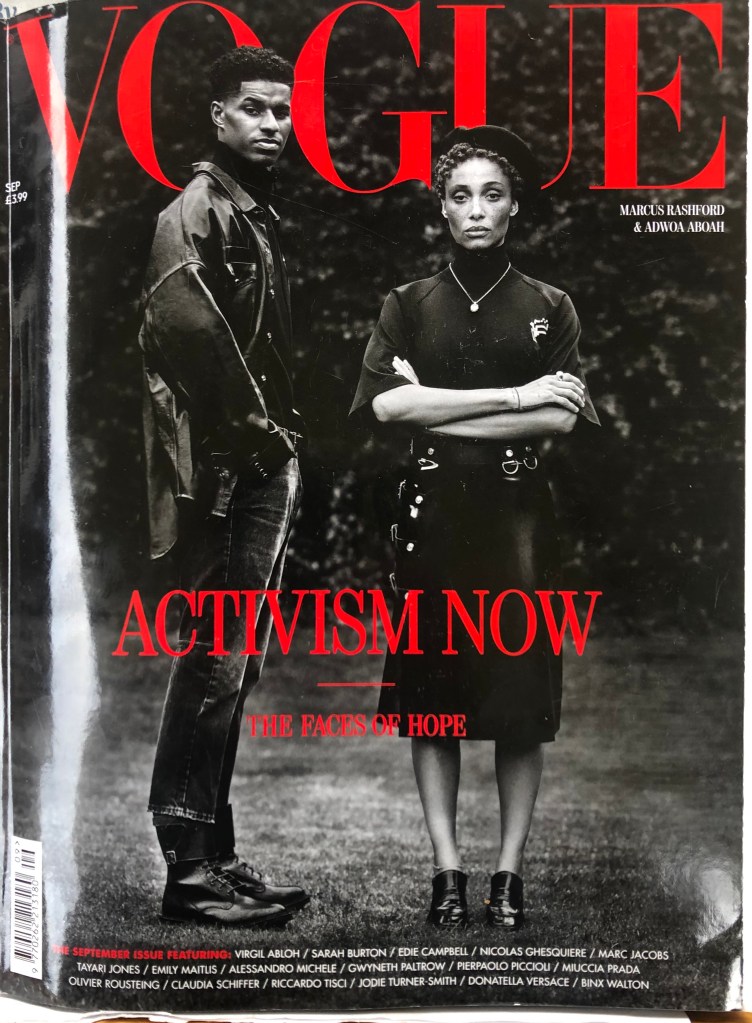
I found some the other day, in what might seem to be a rather unlikely place. They were in ‘Vogue’ magazine. Yes really, ‘Vogue’. I’m hoping we can show the cover of the latest edition on our screen. There it is.

There on the front cover with the supermodel Adwoa Aboah, is Marcus Rashford, the Manchester United footballer, who made a fuss and persuaded the government to provide school meals for poor children during the holidays; and inside there are many more people who are called the ‘faces of hope’, working in many ways as activists to bring hope where previously there was none.

I assure you that I’m not a secret employee of the publishers Condé Nast. I’m not on commission based on how many copies of Vogue you buy. But it is worth a look. There are many inspiring stories – and, reflecting the rise of Black Lives Matter, for once the stars in this glossiest magazine are all black. Beautiful black people.

Hmm. In the Song of Songs the bride sings – as you can hear in Monteverdi’s Vespers of 1610 – ‘Nigra sum, sed formosa’, ‘I am black, but beautiful’. ‘But’ beautiful. That’s the only false note in that beautiful song. Not ‘but’ beautiful, but ‘and’ beautiful is what it should be. And the editor of ‘Vogue’ has celebrated that. He is Edward Enninful, and he is an activist.

What else about these activists? A common feature of all their stories is that they all say their activism builds a sense of community, or having values and friendship in common with each other. So would the Blessed Virgin Mary count as an activist today?

I’m sure she would – maybe in a similar way to some of the beautiful people portrayed in ‘Vogue’, as icons to be followed, to be copied. Faces of hope.

Because what else does this make you think about? Surely we can loop back from our world today to the first century AD. The stories of the activists in Vogue are very reminiscent of the stories of the early Christians. They were activists; they were a community; they had everything in common. They would lift up the lowly and fill the hungry with good things. Build up your community – support your local food bank, say – isn’t that just another way of saying, ‘Love your neighbour’?

That might prompt you to think again about Mary’s song, Mary’s rant, the Magnificat, as it’s called. Because ‘magnificat’ is Latin for ‘bigged up’, ‘magnified’, ‘made more of’; as the hymn puts it: ‘Tell out, my soul, the greatness of the Lord’. And the Magnificat, sung by a cathedral choir, is one of the highlights in Evensong, that lovely service, that you can hear on Radio 3 twice a week – this afternoon at 3 and then on Wednesday at the same time – or on any day in the Cathedral at 5.30 (in normal times). It’s something you might just let flow over you in its beauty. Well, you mustn’t stop enjoying the Magnificat – but do remember that it is a call to action, to be an activist, for God.

Sermon for Evening Prayer on Saturday 7th March 2020 for the Prayer Book Society Guildford Branch, at the Founder’s Chapel, Charterhouse

Jeremiah 7:1-20; John 6:27-40 (see http://bible.oremus.org/?ql=450504242)

And Jesus said unto them, I am the bread of life: he that cometh to me shall never hunger; and he that believeth on me shall never thirst.

I want to speak to you not just about the bread of life, but also about baked beans and sausages. At the same time we can’t ignore that it is the end of the first week in Lent.

The baked beans and sausage, you might be a bit surprised to hear, bring into consideration two theologians, one ancient and one modern, and the bread and the Lent give us a topical Christian context for that food, which is, fasting.

And I suppose that the other ingredient which I need to work in is some reference to our beloved Book of Common Prayer, and the theological developments which Cranmer was influenced by in writing it.

The first thing to reassure you about is that there is no command to fast in the Gospels – except that Jesus said that he did not come to abolish the Law of Moses, but to fulfil it. So the days laid down for fasting in Leviticus, for example on the Day of Atonement, mean that it’s not strictly true that there’s no Biblical justification for fasting.

As you will know, the Reformation, which greatly influenced Cranmer, was led certainly by Martin Luther in Germany but also by Zwingli and Calvin in Switzerland.

Diarmaid MacCulloch has written, ‘It was a sausage that proved to be the rallying-cry for the Swiss Reformation.’ A Zurich printer, Christoph Froschauer, with Zwingli and 12 of his followers in Zurich sat down on the first Sunday in Lent in 1522 and ate two large sausages. Zwingli followed up by preaching a sermon in which he argued that it was unnecessary to follow the church’s traditional teaching about not eating meat during Lent. It was a human command introduced by the Church, which might or might not be observed, but which ‘obscured the real laws of God in the Gospel if it was made compulsory’. [MacCulloch, D., 2003, Reformation, London, Allen Lane, p139]. Cranmer and Zwingli are supposed to have met, and the Swiss reformer is thought to have influenced the English archbishop.

So that’s the sausage. In the Reformation context, according to Zwingli, fasting is not divinely ordained. It’s up to you.

Not but what by the time of the Second Book of Homilies, published in the Church of England in Queen Elizabeth’s time, in 1563, whose author was Bishop Jewel, there was a published sermon – a Homily – called ‘Of Fasting’, Homily number 16. The Homilies were intended for the use of vicars who were not good at preaching, so they didn’t make any theological mistakes. We tend to think of a ‘homily’ as a short sermon – the sort that the vicar doesn’t get into the pulpit to deliver, but perhaps hovers invisibly on the chancel steps for; something like Thought for the Day in size and weight. Not so in 1563! ‘An Homily of Good Works and of Fasting’ is in two parts, the first being about fasting, and in the modern edition which I have, it occupies 8 ½ pages of very dense small type!

Some of the early Christian Fathers such as Irenaeus or Chrysostom or Tertullian or Gregory the Great all debated how long a fast should go on for. The possibilities included one day, as on the Jewish Day of Atonement, or 40 hours, mirroring Jesus’ 40 days in the wilderness, or indeed 40 days of fasting.

The ‘Annotated Book of Common Prayer’, edited by the Revd John Henry Blunt, published in 1872, which I’m very fortunate to have a copy of, says this.

The general mode of fasting seems to have been to abstain from food until after 6 o’clock in the afternoon and even then not to partake of animal food or wine. Yet it may be doubted whether such a mode of life could have been continued day after day for six weeks by those whose duties called upon them for much physical exertion… and although it may seem at first that men ought to be able to fast in the 19th century as strictly as they did in the 16th, the 12th, or the third, yet it should be remembered that the continuous labour of life was unknown to the great majority of persons in ancient days, as it is at the present time in the eastern church and in southern Europe; and that the quantity and quality of the food which now forms a full meal is only equivalent to what would have been an extremely spare one until comparatively modern days.’

The Victorians were too busy safely to fast, and their meals were cuisine minceur by comparison with the groaning boards enjoyed in olden times. Think of what we know of Henry VIII’s diet, or Sir John Falstaff’s. Having a rest from eating was probably very good for them, and there was no risk of starving. Come the industrial revolution, however, and meat and two veg in the works canteen was all you might have. If you gave that up, ‘night starvation’, as the Horlicks advert used to warn, was a real possibility unless you had some nourishment at least.

But it’s at least arguable that Jesus, in our lesson from St John’s Gospel, wasn’t talking about the ins and outs of fasting. [6:27] ‘Labour not for the meat which perisheth, but for that meat which endureth unto everlasting life, which the Son of man shall give unto you..’ This leads up to one of the great ‘I am’ sayings in St John’s Gospel, ‘I am the bread of life’. Just as the name of God as He spoke to Moses in the Old Testament was ‘I am’, so in these sayings, Jesus is using the same form of words, giving a sign of his divine nature. And we are no longer thinking about whether or not to eat a sausage. This is spiritual, divine food, ‘meat which endureth unto everlasting life’.

And that, you’ll be amazed to know, brings us to baked beans, and to our second theologian. He is Jürgen Moltmann, the great German theologian, some time Professor of Systematic Theology at the University of Tübingen. (That is the same university at which Pope Benedict taught, once upon a time.) Moltmann is in his 90s now, and so it was a great honour for me to attend his lecture this week at Westminster Abbey, called ‘Theology of Hope’. This was the title of one of his famous books.

Prof. Moltmann comes originally from Hamburg. His excellent English still has the same accent that I know so well from my friends there in the shipping world. He was a boy when Hamburg was bombed, bombed by us, when there was the terrible ‘fire storm’ about which Kurt Vonnegut and others have written so eloquently. Moltmann was conscripted into the German army, and on Monday night he told us he had carefully learned two words of English, which he used when his platoon encountered the British Army for the first time. They were, ‘I surrender’. He told his audience that the abiding memory of his time as a prisoner of war was baked beans – which like all boys, he liked, and I think he still likes, very much.

So if the sausage in our baked beans and sausage is redolent of the Reformation, and the creation of the Book of Common Prayer, so the baked beans lead us to Jürgen Moltmann, and his Theology of Hope. What is this hope?

Moltmann saw, and still sees in the world today, great challenges in our life. They represent death, or even separation from God, which is another way of describing sin. Climate change, the destruction of God’s creation; nuclear war, where the use of nuclear weapons would end the world as we know it, because no-one could survive the nuclear winter. Division and separation among peoples instead of unity and co-operation; the erection or rebuilding of borders in contravention of God’s creation of all peoples as equals. The end time – what will happen when we die?

Maybe it’s not fanciful to say that this, this climate of despair, is somewhat reminiscent of Jesus being tempted in the wilderness. Lent is the right time for this kind of reflection.

Moltmann has argued that we should not despair or become nihilistic in the face of these challenges. Whereas we are often encouraged to have ‘faith’ when we have to confront these existential threats, Moltmann has suggested that what we really need, and what really reflects the presence of God in our lives, is hope. Hope, rather than faith.

For example, in the committal prayer at a funeral, the body is buried ‘in sure and certain hope of the resurrection to eternal life’. You might think that what you need at that end time, at the end of life, is faith, a strong faith. But Moltmann says no, not faith, but hope is what we need. The fact, the great revelation, of Jesus’ life on earth gives us the grounds for hope. It is more than a bare belief, more than blind faith. If I hope for something, I reasonably expect that it will be possible. It’s more than an intellectual construct.

So there we are. Baked Beans and Sausages. Should we abstain from bread, or meat, or drink? Certainly not from the Bread of Life. But if even our spiritual bread is disappearing, overwhelmed in the apocalypse, in what looks like the end time, then what? 500 years ago Zwingli said, don’t stop enjoying your sausage – give thanks to God for his bounty. In the smoking ruins of that great city of Hamburg at the end of WW2, Moltmann discovered Baked Beans, and with them, divine hope. I hope that that will give you some food for thought this Lent.

Sermon for Evensong on the ninth Sunday after Trinity, 18th August 2019

Isaiah 28:9-22, 2 Corinthians 8:1-9 – see http://bible.oremus.org/?ql=433037279 – Not Just a Crown Jewel

Whom shall he teach knowledge? and whom shall he make to understand doctrine? them that are weaned from the milk, and drawn from the breasts. (Isaiah 28:9)

Sometimes I expect you are slightly puzzled by our Bible readings at Evensong. Even the language of Shakespeare might need a little bit of explanation. This is how the New English Bible renders it.

Who is it that the prophet hopes to teach,

to whom will what they hear make sense?

Are they babes newly weaned, just taken from the breast?

It could be a taunt thrown back by the drunken prophets of Judah at Isaiah. J.B. Phillips has translated it as, ‘Are we just weaned … Do we have to learn that The-law-is-the-law-is-the-law, The rule-is-the-rule-is-the-rule…?’. [Quoted by Derek Kidner in The New Bible Commentary, 4th edition 1994, reprinted 2007, Nottingham, Inter-Varsity Press, p 650.]

The background to this prophecy in Isaiah is the situation in Jerusalem between 740 and 700 BCE the two kingdoms of the Israelites, the North, Samaria, and the South, Judah, were being threatened by Assyria – ‘The Assyrian came down like a wolf on the fold’, if you remember Byron’s poem. In 734 the kings of Damascus and Samaria tried to force Jerusalem to join a coalition against Assyria. This ‘Syro-Ephraimite’ war is the background to the main prophecies of Isaiah. So our passage is prophecy addressed to the rulers in Jerusalem.

14 Listen then to the word of the LORD, you arrogant men

who rule this people in Jerusalem.

15 You say, ‘We have made a treaty with Death

and signed a pact with Sheol:

so that, when the raging flood sweeps by, it shall not touch us;

for we have taken refuge in lies

and sheltered behind falsehood.’

16 These then are the words of the Lord GOD:

Look, I am laying a stone in Zion, a block of granite,

a precious corner-stone for a firm foundation;

he who has faith shall not waver.

17 I will use justice as a plumb-line

and righteousness as a plummet;

hail shall sweep away your refuge of lies,

and flood-waters carry away your shelter.’ (Isaiah 28:14-17, NEB)

Godfrey, in some of his sermons recently, has been introducing a ‘that was then: this is now’ angle on what he is preaching about. It’s perhaps a bit tempting, to compare Isaiah’s criticism of the rulers of Judah, whom he criticised as being ‘liars’, and indeed earlier on as ‘complete drunkards’, tempting to compare them with some contemporary politicians today.

What is our prophetic duty at this time? What would Jesus say? What would Isaiah say if he were around today? One thing seems pretty clear, that God wants nothing to do with lies and deception. It’s perhaps sobering to realise that, in 721, the Assyrians did conquer Samaria, the Northern Kingdom, shortly after Isaiah had prophesied; and just over a century later, the Southern Kingdom also fell and the people were largely deported to Babylon. So these ‘scoffers’, whom Isaiah railed against, didn’t end well.

As has been said very well by Godfrey, this is a time of great anxiety, for just about all of us. Nobody knows what is going to happen with our way of life, with our country, and with our relationships with the rest of the world. We don’t like the signs of xenophobia, racism and extreme nationalism that the populist politicians in this country and abroad seem to have encouraged.

These are not just questions of taste. People are getting hurt; refugees are being abandoned on the high seas by populist politicians who seem to have completely forgotten the milk of human kindness, let alone the law of the sea. On the Mexican border with the USA, our closest allies are separating young children from their parents and putting them in cages without any sanitation.

Where should our church fit in, how should we deal with all this? Our second lesson tonight, from 2 Corinthians, is, in effect, about planned giving to the church. I’m sure everybody will be groaning away at that: but even 2,000 years ago, when St Paul was writing to the congregation in Corinth, he was telling them all about the generosity of other new Christian churches in Macedonia. There’s a wonderful piece of Greek which is really untranslatable in the second verse of our lesson, saying that the Macedonians have excelled in generosity although they are poor – the words mean ‘rich from poverty’ – εἰς τὸ πλοῦτος τῆς ἀπλότητος αὐτῶν· It’s the same idea as in Jesus’ story of the widow’s mite (Mark 12:41-44, Luke 21:1-4).

Not that they gave nothing; but that they gave much more than, as poor people, they might be expected to give. Stephen Chater is speaking to as many of us as possible, encouraging everybody to ‘Count ourselves in’. Count me in, so far as supporting our church’s financial position is concerned.

But I suspect that we ought to consider something a bit wider as well. And if we do consider something wider, it will surely lead us on to the sort of sacrificial giving which St Paul praises here.

On September 8th we will open the church at the beginning of the ‘Crown Jewels of Cobham’ scheme organised by Cobham Heritage. We will encourage people to come and look at our beautiful church, along with the other places locally which have been called ‘crown jewels’, (about which you’ll find a nice booklet on your way out if you haven’t already got one).

There’s absolutely nothing wrong with that. I’m sure it’ll be very enjoyable and everybody will have a wonderful time working out whether our brass knights in front of the altar are the real thing or some very clever reproduction. If you haven’t made up your own mind which it is, and you’d like to come and look close up, do come after the service and have a look in the sanctuary. The Sir Johns, D’Abernon, Senior and Junior, are ready to welcome you!

But the thing is that, as a parish church, we surely have a place in the community. We aren’t just a monument to be admired. We have indeed affirmed that in our PCC and at our parish ‘awayday’ a little while ago now.

What we come to church to do is not just to love God, but it is also to love our neighbour as ourself. And at present we haven’t got any settled outward-social-concern or giving projects. They might not just be questions of money – although it usually does involve some money – but there is also the question of a ‘warm embrace’ for our neighbours, as that wonderful local Christian figure Derek Williams, who has sadly just died, used to put it.

At St Mary’s we do a lot of good already in supporting the Foodbank, for example, not only with money but also by providing three of the five trustees who manage it.

There are other important local charities that do a lot of good in this area, that we might want to involve ourselves more closely with as well.

Oasis – sometimes called Oasis Children’s Charity – exists to put families back together and restore the self-confidence of family members who have suffered from break-ups, in particular involving domestic violence. That’s a terrible scourge, which unfortunately is very prevalent in Surrey. Surrey has, if not the highest level of domestic violence in the country, something very close to it, according to those who work in this field. The local authority delegates some important social work functions to Oasis – but at the same time they have cut their funding. Could we help?

We have now, in and around Cobham, Oxshott, Stoke D’Abernon and the immediate vicinity (meaning the areas that the Foodbank covers), I think there are nine of them, Syrian refugee families, who are being helped in various highly practical ways by the local refugee welcome charity called Elmbridge CAN. Maybe we could get involved there.

I was excited to hear that one of our ‘Mums’ has discovered that some local children, some no more than 11 years old, are being left at home on their own in the holidays because Mum and Dad are both out at work. What about a ‘holiday club’ in St Mary’s Hall, with some interesting things to do with friends around – maybe the odd outing, to Bockett’s Farm perhaps – and all with some responsible adults to supervise? If you’re interested, talk to Kelly McConville or Emma Tomalin. The objective is to have the holiday club ready for the Christmas holiday.

And last on my list of local charitable initiatives, there is the Safe Places scheme, which I mentioned last week. The idea is that there will be a network of places to which somebody feeling vulnerable or in a crisis, who wants to find a quiet, safe place for an hour or so, can go to, directed by an app on their phone and social media publicity. It’s an initiative started by Elmbridge Borough Council in response to a national movement; and the churches have been invited to be at the heart of it. After all, churches have been places of refuge since the beginnings of Christianity.

So far, I’m sad to say, people have reacted rather negatively to the idea of St Mary’s becoming a place of refuge, to the effect that ‘We don’t have many people passing by this church, just to drop in: so really, it isn’t worth the effort’.

The point about not being on the beaten track seems to me to be a misapprehension. The whole point is that we should make our church a beacon, a beacon of hope, to which people are attracted. We can use modern technology and social media to help with this. I hope we can think more about becoming a Safe Space.

And then there are all the things abroad that we could consider getting involved in.

In view of the refugee crisis, perhaps we should look at the work of the United Nations High Commissioner for Refugees, UNHCR, or one of the great Christian overseas charities, Christian Aid (not just for Christian Aid Week, but year-round), or World Vision or Oxfam or Save the Children, for example.

I would like to get us talking about this. These things won’t happen overnight, but, as a growing church, we should have some of them on our agenda. The wonderful thing is that, if we look outside ourselves, we will grow, and God will give us the strength. It’s like that wonderful film ‘Field of Dreams’ and the man who dreamed about bringing the legendary Babe Ruth to life again – ‘If you build it, he will come’. And in a more mundane way, in the church, many people come to faith by ‘doing stuff’ – belonging and then believing.

Remember what Isaiah said:

‘Now therefore be ye not mockers, lest your bands be made strong’

‘Lest your bands be made strong’ – lest all those things you’re worried about overwhelm you.

Instead we must love God – and not forget to love our neighbour – if our church is indeed to become a ‘cornerstone in Zion’, a precious corner-stone, a sure foundation, at this worrying time of uncertainty. I pray that with God’s grace, it will happen. And do let’s talk about it.