One of my friends has started putting pictures of sheep on her Instagram page. Every day she puts up a picture of a different sheep. At first I wondered whether I wasn’t really getting the hang of the Instagram, and that there was a message about the sheep that I wasn’t seeing. Perhaps there were some words somewhere which I was not seeing on my screen. So, after about five different sheep pictures, I asked her, “What’s with all the splendid sheep on your Instagram?” She answered, “I have always loved sheep. I’m fed up with the negative news, so I just set myself a challenge to post at least one sheep each day to remind myself of the Good Shepherd.’ That really says it all. Maybe I should just stop there. Sheep are good animals. They are a Good Thing. But perhaps I should elaborate a little bit.
I have to say that I’m not a country person, so the only times that I have met sheep face-to-face have been at Bockett’s Farm with my children and my grandson, little Jim. Actually, now you come to mention it, when I was little, on holiday in North Wales, I do remember another time: stopping for a picnic on the Horseshoe Pass near Llangollen, when a couple of sheep climbed into Dad’s car and tried to have the picnic that we were having. But they were very nice about it and they didn’t bite anybody; just our sandwiches.
I don’t really know what the ‘sheepfold’ is that our Gospel reading talks about. I thought sheep just roamed about in a field, and every now and again got rounded up by the shepherd and his sheep dog, to be taken off to have their coats shorn and and be put through a sheep dip.
In Jesus’s story, there isn’t a sheepdog. But there is somebody, who is called the ‘door-keeper’ or the ‘gatekeeper’. Where these sheep live, this sheepfold, it sounds a bit like an hotel. Indeed the King James version of the Bible identifies the chap who lets the sheep in and out, this gatekeeper, as the ‘porter’. I’ve got visions of one of those little Paris hotels with a porter at the reception who gives you your key, or of an Oxford college, where again, the man at the door is called the porter. But that’s maybe a bit grand – for a sheep. Maybe they did things differently, in first century Palestine.
Jesus does use sheep quite often in his parables and teaching. Think of the parable of the lost sheep, or the wolf in sheep’s clothing. Or the crowds, that Jesus pities, because they are like ‘sheep without a shepherd’. Immediately after the story which we have as our lesson today, he goes on to talk about being the Good Shepherd.
These references to sheep do give you confidence that God cares for us. Jesus is God, and he is also the good Shepherd; so we can be confident that he will look after us.
Here Jesus says that he is “the gate for the sheep”. Not just the gatekeeper, but the gate itself. Before he came to be the gatekeeper, or the gate, all sorts of people got into the sheepfold, who were not proper shepherds. They may have been just rustlers and thieves.
But when Jesus became the gatekeeper, then he was properly careful about the ones he allowed in. We are reminded about the Great Judgement at the end of time in St Matthew ch 25, the sorting out of the sheep from the goats: remember, you see, the sheep are the good ones. And by the way: just as there aren’t any sheep dogs in these stories, there aren’t any black sheep either; so I don’t have to talk about exceptions that prove the rule.
The straightforward idea is that we are in his Great Congregation – because ‘congregation’ is another sheep-y word. Grex, gregis, in Latin, which is the ‘greg’ bit in the word ‘congregation’, means a herd or a flock. A flock of sheep. We are the great congregation, the great flock. We are the sheep belonging to the Good Shepherd.
And Jesus says, ‘Whoever enters the sheepfold through me will be saved; going out and coming in through me, the sheep will find somewhere good to graze’. …. ‘I am there in order ‘… that you, (the sheep), may have life, and may have it abundantly.’
You can see why lambs are something we often think about at Easter, in the springtime, when they are playing in the fields, when the flowers are coming out; because it is usually a wonderful time of regeneration, a time for having life abundantly.
But it is rather poignant today, when there is so much sadness and worry about the terrible coronavirus epidemic; against that background I think it is especially welcome that we should be able, for a few minutes this morning, to fix our minds on a nice, warm, woolly, sheep. I think Jesus would have approved. That sheep stands for all sorts of good things to come.
‘The language around COVID-19 has sometimes felt trite and misleading. You do not survive the illness through fortitude and strength of character, whatever the Prime Minister’s colleagues’ll tell us. And the disease is not a great leveller, the consequences of which everyone, rich or poor, suffers the same. This is a myth which needs debunking. Those serving on the front line right now, bus drivers and shelf stackers; nurses, care home workers, hospital staff and shopkeepers, are disproportionately the lower-paid members of our workforce. They are more likely to catch the disease because they are more exposed. Those who live in tower blocks and small flats will find the lock-down tougher; those in manual jobs will be unable to work from home. This is a health issue with huge ramifications for social welfare, and it’s a welfare issue with huge ramifications for public health. Tonight, as France goes into recession, and the World Trade Organisation warns the pandemic could provoke the deepest economic downturn of our lifetimes, we ask what kind of social settlement might need to be put in place to stop the inequality becoming even more stark.’ (Emily Maitlis, introducing ‘Newsnight’, BBC Two, 8th April 2020.)
That was such a grown-up and eloquent comment on the COVID-19 plague, that my first reaction was to scratch around to see whether Emily Maitlis had been quoting some eminent philosopher or grand old man or a woman of world affairs when she introduced ‘Newsnight’ on BBC2 on Wednesday night. But my instinct was unworthy. She is a very talented journalist in her own right and those are her words.
Her words are among the most apt and most challenging words in the torrent of verbiage which the first week of lockdown has produced. I can’t really get excited by this procession of metropolitan sophisticates discovering the joys of birdsong and blue-skies-without-aeroplanes, empty roads and silence.
I’m sure there is a place for all those good things, but somehow I don’t think that, when this is all over, historians will look back and celebrate stumbling prose about the unaccustomed joys of birdsong. Instead our generation will be judged on how we dealt with this ‘health issue with huge ramifications for social welfare, [or] …welfare issue with huge ramifications for public health’, as Emily Maitlis so eloquently put it.
It seems extraordinarily apt that Emily Maitlis said what she did on the eve of Maundy Thursday. For Christians, Maundy Thursday is the day when they remember Jesus washing the disciples’ feet. The son of God, arguably the most important man who has ever lived, doing the same sort of thing that a care home worker does, washing the dirty bits, becoming a servant. As we have seen in this COVID-19 plague, the sort of thing that Jesus was doing can become very dangerous. So dangerous that only people who don’t matter are put in the line of risk. Only the expendable ones, although nobody spells this out. As Emily Maitlis said, the bus drivers, the shelf stackers, nurses, care home workers, hospital staff and shopkeepers. The government has advertised jobs in the new Nightingale Hospital at the Excel Centre including receptionists at £37,500 per annum, when at the same time nurses and doctors, after years of training, start at less than £25,000.
Somebody will say that the market justifies this, that there are fewer people willing to be receptionists in the Nightingale hospital than there are willing to be doctors and nurses in that dangerous place. Therefore by the inexorable laws of supply and demand the willing, the brave, are worth less than those in short supply. Put that way, the proposition looks quite indefensible. How could the market, even if it is correct in identifying shortages in that way, be the only guide to the value of these vital people’s work?
But wait a minute. How does the market account for the fact that there is a shortage of doctors and nurses, tens of thousands of doctors and nurses? Either the market is not functioning properly, as their value is not rising to reflect their scarcity, in which case all these political statements based on “realism” and “the market” are not true, or the market as an index of value is not actually accurate. Either way there is a glaring injustice. As Emily Maitlis put it, ‘… what kind of social settlement might need to be put in place to stop the inequality becoming even more stark?’ How are people to be valued in future?
Christians have a number of pointers in front of them, particularly at this time in Holy Week and Easter. So much of what Jesus did and said was counterintuitive and back-to-front. Before he was born, when an angel announced to Mary that she would be the mother of the Messiah, what she said, “My soul doth magnify the Lord, and my spirit hath rejoiced in God my saviour…’: this speech, this aria, this canticle, is one of the most subversive, even one of the most revolutionary, passages in the whole of literature. ‘For he hath regarded the lowliness of his handmaiden’. God chose an ordinary young girl; he selected her knowing that she was one of the little people. ‘He that is mighty hath magnified me’. The omnipotent, the divine, the greatest power, has chosen me, small and insignificant, and made me great.
‘He hath put down the mighty from their seat: and hath exalted the humble and meek.
He hath filled the hungry with good things: and the rich he hath sent empty away.’
This is what God is doing. This is the implication of his having chosen someone not special, just an ordinary girl; but having chosen that person to be the mother of the divine incarnation, God with us. God in human form. She wasn’t in any way rare or perfect or uniquely suited to this job. She was just an ordinary girl from a humble background. God’s choice implies a direct challenge to the value system that we have had and we have in our world today. The Magnificat shows up and challenges head-on the great divide in our society between the rich and the poor, between the great and the little people.
That was before Jesus was born. The Magnificat points to how he is going to operate. It points forward to the Sermon on the Mount, the longest sustained piece of counterintuitive argument that you are ever going to come across. The Beatitudes: ‘blessed are the – poor: blessed are the meek. Not ‘blessed are the people in large houses riding about in Lamborghinis’. (See Matt. 5,6 and 7 http://bible.oremus.org/?ql=453535527)
In one sense I disagree with Emily Maitlis. She says, ‘And the disease is not a great leveller, the consequences of which everyone, rich or poor, suffers the same.’ I know – indeed I passionately agree with – what she means. But in one important sense, there is equality. We are all – wherever in the world we come from – we are all creatures of God, made in His image. The virus is not a leveller, as Emily Maitlis rightly says. It affects all humans – and, unfortunately, tigers too.
Where it does not level us is shown by what happens when the virus has struck someone. Then it depends where you are and how wealthy you are, either as an individual or because you belong to a rich society, whether you will get full treatment. Even so, so far we have not yet discovered a cure, so even with the best treatment in an intensive care unit in a European or American or Far Eastern teaching hospital, you may still die – but you will be made as comfortable as possible, and you will have the very best chance of survival.
If on the other hand Coronavirus strikes and you are in a refugee camp on the border of Syria, in Jordan perhaps, or if you live in the slums of Calcutta or Bombay, or in many parts of Africa, there are far fewer doctors, far fewer hospitals, and no money or National Health Service to pay for your treatment. In the USA, except in one or two enlightened states such as Massachusetts, unless you can afford to buy expensive health insurance, no-one will treat you.
But perhaps the reason why this is so wrong, and why this is a ‘health issue with huge ramifications for social welfare’, is that there is no good reason why some people should be so much better off than others – or rather, that so many people should be so much worse off than the fortunate few. Why should there be any entitlement in an accident of birth? Rich and poor, G7 or Third World, we are all susceptible to COVID-19. But if we are all liable to suffer, should we not all share the means of salvation?
Rowan Williams, former Archbishop of Canterbury, spoke recently about the objective of the Good Life (with a capital G and L) being, not, as theologians and philosophers from Aristotle to Thomas Aquinas have argued, ‘human flourishing’ (ευδαιμονία) but rather, the objective, the objective of the Good Life, is to be safe. Safe. Safe from harm. Safe from disease. Safe from hunger.
Again, Christians can turn to the teaching of Jesus. Think of the Great Judgment in St Matthew chapter 25 (from verse 31), the division of the sheep and the goats, the saved – the ones who are safe – and those condemned to eternal damnation. Hunger. Thirst. Disease. They are at the heart of it. What did you do for them? No suggestion that some hungry people, or thirsty people, or poorly people, might deserve to be safe, to be saved, more than others. Absolutely not. Jesus says that He is in all of us, however lowly.
Again, just as God chose the humble Mary, so ‘the righteous will [say]…, “Lord, when was it that we saw you hungry and fed you, or thirsty and gave you drink, a stranger and took you home, or naked and clothed you? When did we see you ill or in prison, and come to visit you?” And the king will answer, “I tell you this: anything you did for one of my brothers here, however humble, you did for me”. (Matt. 25:37-40, NEB). (Jesus would surely have wanted to be explicitly gender-neutral if he had been saying this today, and would surely have said, ‘anything you did for one of my brothers and sisters here, however humble, you did for me.’)
So at this Easter time, when we remember Jesus’ amazing self-abasement, his humbling himself to wash the disciples’ feet, and then his enduring the most terrible torture and death – being the most important man on earth, but beaten and strung up to die with common criminals, as a common criminal, because that was actually his rank, his lowly position in society – and then rising in triumph, leaving the empty tomb: when we reflect on that extraordinary sequence of events, the Triduum, the Three Days, we can realise that there is an alternative. There is an alternative to the dominion of the market. There is an alternative to people who know the price of things but not their value. The fact that Jesus beat death – and that must be about the most counterintuitive thing he ever did – has given us hope: the ‘sure and certain hope of the resurrection to eternal life’. And that is for everyone, for everyone who could possibly catch COVID, wherever they are and whatever flag they fly.
Emily Maitlis concluded, asking ‘what kind of social settlement might need to be put in place to stop the inequality becoming even more stark’. That is the most important thing we have to do when the medical campaign against COVID-19 has been won. It is a huge challenge: but Jesus has given us hope, hope that we can do it. The Easter message is one of hope, and of salvation, that we can make that Good Life, where all people, everywhere, are safe.
And Jesus said unto them, I am the bread of life: he that cometh to me shall never hunger; and he that believeth on me shall never thirst.
I want to speak to you not just about the bread of life, but also about baked beans and sausages. At the same time we can’t ignore that it is the end of the first week in Lent.
The baked beans and sausage, you might be a bit surprised to hear, bring into consideration two theologians, one ancient and one modern, and the bread and the Lent give us a topical Christian context for that food, which is, fasting.
And I suppose that the other ingredient which I need to work in is some reference to our beloved Book of Common Prayer, and the theological developments which Cranmer was influenced by in writing it.
The first thing to reassure you about is that there is no command to fast in the Gospels – except that Jesus said that he did not come to abolish the Law of Moses, but to fulfil it. So the days laid down for fasting in Leviticus, for example on the Day of Atonement, mean that it’s not strictly true that there’s no Biblical justification for fasting.
As you will know, the Reformation, which greatly influenced Cranmer, was led certainly by Martin Luther in Germany but also by Zwingli and Calvin in Switzerland.
Diarmaid MacCulloch has written, ‘It was a sausage that proved to be the rallying-cry for the Swiss Reformation.’ A Zurich printer, Christoph Froschauer, with Zwingli and 12 of his followers in Zurich sat down on the first Sunday in Lent in 1522 and ate two large sausages. Zwingli followed up by preaching a sermon in which he argued that it was unnecessary to follow the church’s traditional teaching about not eating meat during Lent. It was a human command introduced by the Church, which might or might not be observed, but which ‘obscured the real laws of God in the Gospel if it was made compulsory’. [MacCulloch, D., 2003, Reformation, London, Allen Lane, p139]. Cranmer and Zwingli are supposed to have met, and the Swiss reformer is thought to have influenced the English archbishop.
So that’s the sausage. In the Reformation context, according to Zwingli, fasting is not divinely ordained. It’s up to you.
Not but what by the time of the Second Book of Homilies, published in the Church of England in Queen Elizabeth’s time, in 1563, whose author was Bishop Jewel, there was a published sermon – a Homily – called ‘Of Fasting’, Homily number 16. The Homilies were intended for the use of vicars who were not good at preaching, so they didn’t make any theological mistakes. We tend to think of a ‘homily’ as a short sermon – the sort that the vicar doesn’t get into the pulpit to deliver, but perhaps hovers invisibly on the chancel steps for; something like Thought for the Day in size and weight. Not so in 1563! ‘An Homily of Good Works and of Fasting’ is in two parts, the first being about fasting, and in the modern edition which I have, it occupies 8 ½ pages of very dense small type!
Some of the early Christian Fathers such as Irenaeus or Chrysostom or Tertullian or Gregory the Great all debated how long a fast should go on for. The possibilities included one day, as on the Jewish Day of Atonement, or 40 hours, mirroring Jesus’ 40 days in the wilderness, or indeed 40 days of fasting.
The ‘Annotated Book of Common Prayer’, edited by the Revd John Henry Blunt, published in 1872, which I’m very fortunate to have a copy of, says this.
‘The general mode of fasting seems to have been to abstain from food until after 6 o’clock in the afternoon and even then not to partake of animal food or wine. Yet it may be doubted whether such a mode of life could have been continued day after day for six weeks by those whose duties called upon them for much physical exertion… and although it may seem at first that men ought to be able to fast in the 19th century as strictly as they did in the 16th, the 12th, or the third, yet it should be remembered that the continuous labour of life was unknown to the great majority of persons in ancient days, as it is at the present time in the eastern church and in southern Europe; and that the quantity and quality of the food which now forms a full meal is only equivalent to what would have been an extremely spare one until comparatively modern days.’
The Victorians were too busy safely to fast, and their meals were cuisine minceur by comparison with the groaning boards enjoyed in olden times. Think of what we know of Henry VIII’s diet, or Sir John Falstaff’s. Having a rest from eating was probably very good for them, and there was no risk of starving. Come the industrial revolution, however, and meat and two veg in the works canteen was all you might have. If you gave that up, ‘night starvation’, as the Horlicks advert used to warn, was a real possibility unless you had some nourishment at least.
But it’s at least arguable that Jesus, in our lesson from St John’s Gospel, wasn’t talking about the ins and outs of fasting. [6:27] ‘Labour not for the meat which perisheth, but for that meat which endureth unto everlasting life, which the Son of man shall give unto you..’ This leads up to one of the great ‘I am’ sayings in St John’s Gospel, ‘I am the bread of life’. Just as the name of God as He spoke to Moses in the Old Testament was ‘I am’, so in these sayings, Jesus is using the same form of words, giving a sign of his divine nature. And we are no longer thinking about whether or not to eat a sausage. This is spiritual, divine food, ‘meat which endureth unto everlasting life’.
And that, you’ll be amazed to know, brings us to baked beans, and to our second theologian. He is Jürgen Moltmann, the great German theologian, some time Professor of Systematic Theology at the University of Tübingen. (That is the same university at which Pope Benedict taught, once upon a time.) Moltmann is in his 90s now, and so it was a great honour for me to attend his lecture this week at Westminster Abbey, called ‘Theology of Hope’. This was the title of one of his famous books.
Prof. Moltmann comes originally from Hamburg. His excellent English still has the same accent that I know so well from my friends there in the shipping world. He was a boy when Hamburg was bombed, bombed by us, when there was the terrible ‘fire storm’ about which Kurt Vonnegut and others have written so eloquently. Moltmann was conscripted into the German army, and on Monday night he told us he had carefully learned two words of English, which he used when his platoon encountered the British Army for the first time. They were, ‘I surrender’. He told his audience that the abiding memory of his time as a prisoner of war was baked beans – which like all boys, he liked, and I think he still likes, very much.
So if the sausage in our baked beans and sausage is redolent of the Reformation, and the creation of the Book of Common Prayer, so the baked beans lead us to Jürgen Moltmann, and his Theology of Hope. What is this hope?
Moltmann saw, and still sees in the world today, great challenges in our life. They represent death, or even separation from God, which is another way of describing sin. Climate change, the destruction of God’s creation; nuclear war, where the use of nuclear weapons would end the world as we know it, because no-one could survive the nuclear winter. Division and separation among peoples instead of unity and co-operation; the erection or rebuilding of borders in contravention of God’s creation of all peoples as equals. The end time – what will happen when we die?
Maybe it’s not fanciful to say that this, this climate of despair, is somewhat reminiscent of Jesus being tempted in the wilderness. Lent is the right time for this kind of reflection.
Moltmann has argued that we should not despair or become nihilistic in the face of these challenges. Whereas we are often encouraged to have ‘faith’ when we have to confront these existential threats, Moltmann has suggested that what we really need, and what really reflects the presence of God in our lives, is hope. Hope, rather than faith.
For example, in the committal prayer at a funeral, the body is buried ‘in sure and certain hope of the resurrection to eternal life’. You might think that what you need at that end time, at the end of life, is faith, a strong faith. But Moltmann says no, not faith, but hope is what we need. The fact, the great revelation, of Jesus’ life on earth gives us the grounds for hope. It is more than a bare belief, more than blind faith. If I hope for something, I reasonably expect that it will be possible. It’s more than an intellectual construct.
So there we are. Baked Beans and Sausages. Should we abstain from bread, or meat, or drink? Certainly not from the Bread of Life. But if even our spiritual bread is disappearing, overwhelmed in the apocalypse, in what looks like the end time, then what? 500 years ago Zwingli said, don’t stop enjoying your sausage – give thanks to God for his bounty. In the smoking ruins of that great city of Hamburg at the end of WW2, Moltmann discovered Baked Beans, and with them, divine hope. I hope that that will give you some food for thought this Lent.
‘What is truth?’ You’ll remember Pontius Pilate’s famous question when Jesus was on trial in front of him, in John 18:38. In the context of our Christian faith, what is ‘truth’?
When Nehemiah had gathered all the exiles, who had returned from Babylon, together, and Ezra the scribe had started to read out all the Law of Moses to them, he made the occasion a great holiday. Nothing was more important than knowing what God had commanded – that was the ultimate truth.
It’s interesting that, as well as decreeing that everyone should take the day off and celebrate – or possibly take longer than the day off, so as to go off on a kind of summer camp and live in tents – or booths, or tabernacles – temporary houses – for a week – that also, as well as feasting themselves, they had to make sure that they sent a share of the food to anyone who couldn’t manage to provide for themselves. The two most important commandments in the Law of Moses were to love God, and also, to love your neighbour as yourself.
So there was a social truth as well as a theological one in the law of the Old Testament. Later on, when Jesus is telling his disciples what to expect when he has finally left them – and indeed, telling them that he has got finally to leave them, which they might not necessarily have expected after the huge miracle of his resurrection, (you could understand them not wanting to let him go) – he says that it is to their advantage, for their good, that he is leaving, because then what he describes as the Comforter, the Advocate, the spirit of truth, will come in his place: truth personified, not just a matter of law. Living truth, the Holy Spirit, the Comforter.
What Jesus is saying here, as reported in St John’s Gospel, is one of the first mentions in the Bible of the Holy Trinity. Jesus talks about his father, about his being the son, and then about this third party, the Comforter, the Advocate; somebody who, literally in Greek, shores them up, supports them, perhaps in a forensic context, in court; the Greek word, παρακλητος, sometimes actually said as the ‘Paraclete’, the Comforter, the Advocate, means a sort of barrister: that is how the third member of the Holy Trinity is described.
When I was thinking about that, and about what Jesus says about the Comforter, the Advocate, it reminded me of what I had experienced last Sunday when I went to Rome to attend the mass at St Peter’s for the ‘canonisation’ of five new saints in the Roman Catholic Church, John Henry Newman and four other saintly figures, three nuns and a Swiss seamstress, who all had various claims to ‘sainthood’, as the Roman Catholics understand it.
One of the things that comes out, that the Roman Catholics do that we don’t, is that they use saints as intermediaries between themselves and God. They pray to God through the saints, starting with the Blessed Virgin Mary, Mary, the Mother of God, but also then through one of more of the various saints of the church. So a form of prayer in the Catholic Mass is that you name a particular saint, and you ask that saint to pray for you.
The idea is that the saint is almost like what Jesus is describing the Holy Spirit as, if the Holy Spirit is the Advocate. It involves the idea of somebody who speaks for you. You pray through the saint, you invoke the assistance of the saint. The process of becoming a saint in the Roman Catholic Church involves miracles, to show how close the saint is to God. The person to be canonised as a saint, recognised as a saint, therefore needs to have brought about miracles, miracles which have been investigated and found to be genuine by theologians of the church.
I was in Rome particularly to witness the canonisation of one of the new saints, John Henry Newman, Cardinal Newman, who wrote the hymns ‘Praise to the Holiest in the Height’, and ‘Lead, kindly Light’, for example. He started out in the Church of England and was for 20 years a fellow of my old college at Oxford, Oriel. Eventually he changed to Roman Catholicism and became a Cardinal.
Newman was a leader – perhaps the leader – of the spiritual revival in the Church of England called the Tractarians, or the Oxford Movement, in the 1830s. Newman’s great theological message – and he was a prolific author and preacher – he was the vicar of St Mary’s in the High Street in Oxford, the University Church – the heart of his message was a call to the church to abandon what we might call today ‘relativism’, in favour of what we might describe as revealed truth.
He didn’t want the church to base its beliefs and its teaching on whatever was popularly thought to be ‘a good thing’ at the time, but rather on the truth as shown in God’s word in the Bible and in the teaching of the early Christian Fathers. You can see that sort of argument still alive in the church today, in the context, for example, of things like same-sex marriage.
The story of the Tractarians is a story of exciting spiritual revival in parts of the church. It’s not an exaggeration to say that, in the period between 1820 and 1840, the Senior Common Room of Oriel College contained some of the most influential theologians in England: not only Newman, but also Pusey, Keble and Hurrell Froude, who all supported this powerful revival movement in the Church of England, based on going back to what was perceived to be the message of the early fathers, stripped of any of the superstructure built up over the years by attempts to modernise the church in various ways.
Tractarianism (the name came from their series of pamphlets, called Tracts for the Times) came after the earlier Methodist revival, and in both those revivals there was a strong social message. The Tractarians were great believers in the Christian obligation to care for others, and particularly to care for those less fortunate than themselves.
This was a time when the Tractarians founded new congregations, new churches, in, for example, the East End of London and in some of the downtown slum areas of the big industrial cities. Just as Methodism had attacked the gin houses and encouraged people not to become prey to the demon drink, but rather to be able to keep and save their earnings and become more secure financially, so the Tractarians went out into places and founded churches where posh country parsons would never have dreamed of going.
Two healing miracles are attributed to John Henry Newman, one of Deacon Jack Sullivan in 2001, who was healed in a way that defied a normal medical explanation, and involved prayer invoking John Henry Newman, or rather his memory; and the second miracle involved the healing of an unstoppable haemorrhage in a pregnant American woman in 2013, where the woman, Melissa Villalobos, living near Chicago, had offered a prayer for healing, again invoking John Henry Newman to pray for her, and her bleeding suddenly stopped. These two miracles were considered, by the Roman Catholic Church, to be sufficient evidence of Newman’s sainthood.
We in the Church of England don’t reckon much to the idea of saints: Article XXII of the 39 Articles – on p.620 of your Prayer Books – says that the ‘Romish Doctrine concerning … invocation of Saints, is a fond thing vainly invented’, not Biblical and indeed contrary to the word of God.
This reflects the Reformation idea of our not needing to have priests stand between us and God, to pray for us and celebrate the mass on our behalf. By the same token we don’t need to have saints to pray for us. The idea is of a ‘priesthood of all believers’, which came from John Calvin.
But the Church of England is not a wholly Protestant church, although neither is it wholly a Catholic one. Henry VIII wanted to have the best of both worlds. He wanted to uphold all the doctrines of Roman Catholicism, except for the fact that he had some slight local difficulty with the Pope; so instead of the Pope being the head of the church on earth, he arrogated that function to the English monarch. So as it says on our coins, or on some of them, the name of the king or queen is on them and then ‘FD’, or ‘fidei defensor’, defender of the faith, signifying that the monarch is the head of the church on earth. That title started out as a compliment from the Pope for Henry VIII’s support for him against Martin Luther. But after they differed over Henry’s wives, the king kept the title nevertheless.
I have to say that, despite that background, I didn’t think any less of the wonderful service in Rome – there were reckoned to be 50,000 people attending, and we all got the bread of communion. It’s available on YouTube to watch [at https://www.youtube.com/watch?v=uzFObwA79xo], with a gentle but helpful commentary from an American priest. The beautiful illustrated multilingual service book had 125 pages – and everyone, from the Pope and his cardinals downwards, was given one.
In a sense there was a slight flavour of a sporting event – groups of the congregation were cheering on ‘their’ saint as they were canonised – but at bottom it was just a very beautiful Holy Communion service, whose words, and the hymns and their tunes, were familiar to everyone. The music from the choir and organ was beautiful.
Of course the idea of saints performing miracles is very far-fetched to us. But when you saw all those people not going to a football match, but going to church, it was a very happy occasion, when we all felt inspired, caught up in something beyond our own little domestic concerns, something good and wholesome which made us willing to exchange the peace and try to talk to people sitting next to us – all sorts of nationalities, speaking all sorts of languages.
Smiles went a long way – and the fact that the service was in Latin actually helped, because everyone had a little knowledge of some of the words. I was going to use the ‘Kyrie’ as a for-instance – but of course, that’s Greek. But I hope you can see what I mean.
In its basic structure, the wonderful Canonisation Mass was just like our communion service every week here at St Mary’s. It had all the same bits, and only a couple of extras – the ‘Angelus’, Angelus Domini, the Angel of the Lord, the prayer commemorating the angel Gabriel’s coming to Mary, was the most obvious extra bit – but most was word-for-word the same as our service. It made you feel very special, part of a huge family, a huge, warm family. John Henry Newman was truly a saint: and I felt the presence, in that huge crowd, of great comfort; maybe it was even the Holy Spirit, the Comforter. I think it could well have been.
The first part of the Book of the Prophet Isaiah, sometimes known as ‘First Isaiah’, (because scholars think that there were three prophets whose work is collectively known as the Book of the Prophet Isaiah), ‘the first book of Isaiah’, was written in the 8th century BCE. It’s been pointed out that that century was one of the pivotal points in the history of modern civilisation.
It was the time when the Homeric legends, the Iliad and the Odyssey, were first being recited by travelling bards; in the British Isles, Celts, refugees from mainland Europe, were pouring into Cornwall; Egypt was where the most sophisticated culture was, and Assyria (Syria, roughly) was the most powerful imperial power. It was a time of religious stirrings. Zoroaster was born in Persia in about 650BCE. The Upanishads were written in India probably between c. 800 BCE and c. 500 BCE. It was the time of Confucius and Tao in China.
E. H. Robertson has written, ‘Over the whole world the spirit of God stirred the spirit of man. In Judah and Israel, four men spoke in the name of the living God, …’ [ Robertson, E. H., Introduction to J.B. Phillips, 1963, ‘Four Prophets’, London, Geoffrey Bles, p. xxv] These were the four prophets, Amos, Hosea, Isaiah and Micah. Just as in the middle of the 19th century it was a time of revolutions, and the end of the 20th century it was the beginning of the digital age, this, in the 8th century BCE, was another turning point in human history.
The spiritual narrative of this historic period was supplied, in Israel and Judah, by the four prophets.The great historical event in this period was the fall of Samaria in 732BCE, when the whole of the Northern Kingdom, Syria and Israel was depopulated and turned into Assyrian provinces. It was a great shock to the people of Israel left in the Southern Kingdom, Judah. Her prophets, particularly Isaiah, were finally listened to. ‘The general line taken by the prophets was, trust in God and keep out of foreign alliances.’ [Robertson, p.xxvi]
Our lesson tonight from chapter 30 of First Isaiah is exactly on this point. The prophet is saying that God has told him to tell the Israelites not to make an alliance with the Egyptians. But he complains that they are not taking any notice. How does God communicate with us?
I heard on the radio an absolutely fascinating programme about the fire in York Minster [http://www.bbc.co.uk/programmes/m0007pws]. This year, of course, we have had the terrible fire in Notre Dame in Paris, but in July 1984 there was a terrible fire in York Minster, which destroyed the roof of the south transept and caused extensive damage to the magnificent mediaeval Rose window.
Just before the fire, a new Bishop of Durham had been consecrated, David Jenkins. He was an academic theologian in the liberal theological tradition; in other words, he did not hold with a literal interpretation of everything in the Bible. Indeed, he went as far as saying that he didn’t think that the Virgin Birth necessarily literally took place.
When he was consecrated as Bishop of Durham, in York Minster, there was an outcry from some parts of the church; today no doubt it would have been a ‘Twitter storm’, protesting that Bishop Jenkins, Prof. Jenkins, was flying in the face of the traditional beliefs of the church over the previous 2,000 years. Some people went as far as to say that the fire in the Cathedral, in the Minster, which was attributed, by the surveyors who came to examine the wreckage, most probably to a lightning strike, that it was an ‘act of God’, literally, in that God had struck the Minster with lightning and set fire to it, as a way of showing His disapproval of the preferment of David Jenkins to the bishopric of Durham.
Isaiah was prophesying to the Israelites in the Southern Kingdom, Judah, against their making an alliance with Egypt. Judah heeded the prophecy, and did not make an alliance with Egypt. The Israelites were able to build the Temple and live in peace for nearly 100 years.
Now we are perhaps at another pivotal time in history – well, certainly in the history of this country; and perhaps if one includes as a key element in this current historical perspective the rise of populism, this pivotal time affects not only our country, but also the USA and Italy at least. We are noticing changes in our society as a result; there have been increases in nationalism and xenophobia, (with an unhealthy interest in where people have come from), leading to opposition to immigration, which also involves a ground-swell of racism.
In the British manifestation of this wave of populism, in the Brexit debate, there is also an emphasis on sovereignty – ‘take back control’, they say – as well as all the other features of populist politics. So in relation to all this, is there an Isaiah out there speaking to us? A prophetic voice, guiding us in relation to this turbulent time? And if there is, are we listening?
We look at some of the prophetic utterances in the Bible, and wonder if they might also be talking about our present age. Last week’s Gospel reading for instance, in which Jesus asks, ‘Do you think that I have come to bring peace to the earth? No, I tell you, but rather division! From now on five in one household will be divided, three against two and two against three. They will be divided father against son and son against father. ..’ [Luke 12:51f.]
Dare I say that Brexit has had very much the same effect? Friends have stopped speaking to each other. Families are divided. Literally billions have been spent on preparing for something which there is no agreement about, either within our population, our Parliament or with our European neighbours; at the same time our hospitals are desperate for resources, our schools, similarly, have often not got enough money for books, and our local authorities can’t afford to fill the potholes – and that’s not saying anything about the need for housing or the closures of our fire stations.
He says, ‘Our national so-called ‘debate’ on Brexit has exposed deep, damaging, and shocking divisions: divisions that cut across families and friends, divisions that have exposed the raw experience of some of being entirely left out and ignored by the political and ecclesiastical ‘elite’, divisions that pit one part of the nation against others. Without even leaving, a deep and disturbing vein of xenophobia and racism has been exposed and even normalized in our public life.’
He goes on. ’Dr Adrian Hilton wrote ‘A Christian Case for Brexit’ on the website christiansinpolitics.org.uk. … His …. reasons for why Christians should want to be out of the EU [are], he writes, ‘about liberty, democracy, transparency, accountability, and the right to sack those who rule over me’.’ As Dr Draper points out, these are not theological reasons. There is nothing in the Bible to support these reasons.
In relation to the various things we have identified in the Brexit debate, it seems doubtful whether the ‘Christian case’ would in fact elevate ‘liberty, democracy, transparency, accountability, and the right to sack those who rule over me’ over such things as loving one’s neighbour – who, as the Good Samaritan found, might not be of the same nationality – and that anyway there is ‘no such thing as Jew and Greek’ in the Kingdom of God (Galatians 3:28) [https://biblehub.com/kjv/galatians/3.htm]- that nationality is not something which mattered to our Lord; and that political power, democratic or otherwise, wasn’t very important either, in the context of the Kingdom. More important to love (and therefore obey) the Lord your God. ‘Render unto Caesar’, indeed; but in those days democracy was practically non-existent.
Another theologian, Dr Anthony Reddie, has pointed out ‘a rising tide of white English nationalism’ and ‘the incipient sense of White entitlement’; that participants in the Brexit debate seem to have emphasised White English interests to the exclusion of other races and nationalities. Dr Reddie feels that the churches should be speaking out against this. He asks why the churches have not ‘measured Brexit against the standards of justice and equality’, loving God and loving neighbour. Dr Reddie also argues that churches ought to consider ‘not just the rights and wrongs of Brexit, but what it has done to us’. [Quoted in Dr Draper’s written text]
Dr Draper goes on to consider the theology of incarnation, of being the body of Christ, Christ incorporated in His church. It isn’t an individualistic thing. He quotes John Donne’s poem, ‘For Whom the Bell Tolls’:
Entire of itself, Every man is a piece of the continent, A part of the main. If a clod be washed away by the sea, Europe is the less. As well as if a promontory were. As well as if a manor of thy friend’s Or of thine own were: Any man’s death diminishes me, Because I am involved in mankind, And therefore never send to know for whom the bell tolls; It tolls for thee.
He also says this.
‘This is not an argument for saying that we ought to stay in the EU. It is an argument for saying that a Christian theology of the Kingdom of God, being all one in Christ, drives us away from things that divide us and towards things that bring us together. … The impulse to unity ought to be strong for Christians. Walls, barriers that divide, theologies that exclude, have no part of the Christian vision.’
Where do we as a church stand in relation to the concept of human rights, for example? Our own MP, who is now the Foreign Secretary, has recently campaigned to abolish the Human Rights Act. This is something which our country adopted by signing up to a European convention – a convention which was actually drafted by English lawyers. Although the European Court of Human Rights is not an EU institution, it is seen, mistakenly, by some Brexit supporters as interference in our country’s sovereignty by the EU. What do we as Christians have to say about this? Surely, at this pivotal point in our national life, it is too important for us to stay silent. How does Brexit square with Jesus’ great human rights challenge at the end of St Matthew’s Gospel? Dr Draper, [in the version of his paper that he delivered], quoted it in this way.
“Lord, when was it that we saw you hungry and gave you food, or thirsty and gave you something to drink? And when was it that we saw a stranger and welcomed you, or naked and gave you clothing? And when was it that we saw you sick or in prison and visited you? And the king will answer them, ‘Truly I tell you, just as you did it to one of the least of these who are members of my family, you did it to me’. [Matt. 25: 37-40]”
He went on.
‘And let’s not spiritualise this either. To feed the hungry is a political act; to welcome the stranger is a political act: enacting, embodying the Christian faith is a political act. And sometimes that means not just praying for everyone but taking sides.’
That’s what Dr Draper said to the Modern Church conference. I don’t think Isaiah would have kept quiet either: but would we have heard him?
I could tell you a good story about Jacob and Esau and the beginnings of the nation of Israel: how Jacob cheated his brother Esau, as we heard last week; how he in turn was cheated by Laban, his relative, father of Leah and Rachel, so that eventually Jacob managed to marry both of them: how Jacob in his wandering prospered, again through some sharp practice, this time getting his own back on old Laban. He said Laban could have goats and sheep, provided they had certain markings on them, and Jacob would have the others, although quietly he was making sure that he was breeding only the sheep and the goats that had his markings on.
So Jacob became rich and prospered. Still, his brother Esau was out to get him, for taking away their father’s blessing, his birthright. So Jacob went out with a huge gathering of cattle and various other presents for his brother to appease him, and to make him forgive him.
On the night before he was due to meet his brother, (and both of them were accompanied by private armies), he met a mysterious man, with whom he wrestled all night, and who dislocated his hip for him. He wouldn’t tell Jacob his name, although the mysterious man said that Jacob’s name would not be Jacob any more, but Israel, which means ‘God strove’, or ‘God struggled’, so Jacob deduced that he had had God as his opponent. Jacob called the name of the place Peniel, meaning, ‘the face of God’.
I could tell you all that story; Oh, and I could also mention Jacob’s dream, of the angels ascending and descending a ladder to and from heaven.
In the story there’s a real intimacy between Jacob and God. It doesn’t seem to be particularly the case that God is upholding Jacob because he is a good and moral man – which he clearly isn’t; and even after Jacob has stolen his brother’s birthright, nevertheless his father Isaac, too, seems to treat it as just one of those things. He blesses Jacob and he sends him out to start a family. I could tell you that story.
Or, I could go into the other story today in our Bible readings, about washing one’s hands before you eat, and various other Jewish rules which were not part of the law of Moses, which Jesus condemned as forms of hypocrisy.
The part about washing hands doesn’t translate very well into a modern context, but the other half of the story, where Jesus goes on to tick the Pharisees off for relying on the small print, relying on get-out clauses allowing them to avoid having to do good, to avoid having to care for their parents as it is laid down in the Law of Moses, is something we can easily understand.
Apparently a practice had grown up according to which people could get out of looking after their old Mums and Dads and devoting resources to it, if they had first set aside the bulk of their savings for a sacrifice, or sacrificial offering, to God. This is what was called ‘Corban’.
Whatever was set aside as Corban was no longer available to be used to benefit one’s family, one’s aged parents, and so you were excused from having to look after them.
I could spend a long time teasing out all the various bits of meaning in our two Bible lessons. On one level you might possibly find it edifying, even enlightening; just as you would do, if you were watching a documentary film or going to one of the Art Fund lectures at the Yehudi Menuhin School.
But then I think, an hour or so after you come out of church, you might have a moment of dismay, because those stories just don’t bear on all the important things that are going on in our lives.
What on earth has wrestling with a mystery man in the night, or seeing angels climbing up and down to heaven, got to do with our worries about naval threats in the Gulf of Hormuz, or the unpredictability of Pres.Trump and his refusal to follow the norms of statesmanlike behaviour?
What do Jacob’s wanderings and Jesus’ teaching about hypocrisy really have to say to us in today’s world? Some of it is, on its face, out of date or inappropriate. Our children really ought not to think that Jesus says it’s OK not to wash your hands. (I know it’s about ritual washing, but that’s even further away from real life).
We are worried about knife crime. The terrible murder on the train at East Horsley. It was a shock. It seemed to be something that could have happened to any of us who commute on that line, on our local line to London. What has God got to do with that?
What will happen about ‘Brexit’? Our country has already been greatly diminished in the eyes of the rest of the world and the preparations for Brexit have cost billions. Where will it end?
Austerity, over the last ten years, has not made our economy any stronger. But is has meant that the poorer people in our society are now desperately poor, and food banks are everywhere. Our own food bank will supply over 3,000 food parcels, locally, here in this area, in the next twelve months. What would Jesus say?
During the ITV debate between the two candidates for the Conservative leadership, when one was asked about his Christian faith, he said: “I sometimes pray. I’m like regular Church of England folk: it’s part of my life and my identity, but I don’t think it defines my politics.” [https://twitter.com/churchtimes/status/1149735677430390784?s=21]
Why doesn’t his faith in God define his politics? Is there anything more important? How worrying is that? I’m not concerned about who the politician was or that it was one party or another: this could have been said by almost anyone. But he was an MP, an important person, a minister. Why shouldn’t such an MP’s faith influence his politics?
In the Bible, Jacob could talk to God and lament that he had not followed God’s commandments; but nevertheless God kept faith with him. They had this regular contact. In his dream he saw the angels climbing up and down a ladder, Jacob’s Ladder, into heaven. And God met him at night to wrestle with him. Was that a dream as well? Whatever it was, Jacob felt that he had seen the face of God; he had been close to God.
But we, we don’t seem to experience anything like that. Perhaps like the Pharisees, we’ve become too regimented in our approach to God. Perhaps our prayers are too formulaic. Perhaps we are not open enough to see the face of God any more. Perhaps we’re like that politician. Like the one who said, “I sometimes pray. I’m like regular Church of England folk: it’s part of my life and my identity, but I don’t think it defines my politics.”
When Jesus told the Pharisees not just to go through the motions, not just to follow the rules for the sake of following the rules, I think he could have been talking precisely about the ‘regular Church of England folk’ that this politician said he belonged to. The Pharisees went through the motions, but they didn’t actually do anything. It didn’t ‘define their politics’.
I think what Jesus is teaching us in relation to washing one’s hands and setting aside resources that might have gone to look after your parents, is that this is sham love, and it is no good. Jesus wants us to show risky love, real love, the sort of thing he preached about in his Sermon on the Mount.
The love that Jesus was recommending, going the extra mile, loving our enemies, turning the other cheek, being like the Good Samaritan, is generous love and it’s a love which is not calculating in any way. Paul wrote about it in 1 Corinthians 13. ‘Love is patient; love is kind; love is not envious or boastful or arrogant’. It isn’t necessarily love which you can easily afford. It could be like the widow’s mite. Not much, but it could be more than you can easily afford.
But when you do see that kind of giving, giving which does not count the cost, at work, when, (and this seems especially apt today, which is Sea Sunday), when you see the risks that Captain Carola Rackete, the young German sea captain, took in order to rescue refugees in the Mediterranean and take them to a safe port, even though it might result in her going to jail; or more mundanely and closer to home, when you see someone give their entire trolley of purchases from the supermarket to our Foodbank, all for their poor neighbours: it may not be a sensible gift: it may be really extravagant: but it is loving. It is a blessing. A real blessing, and I think we may begin to see the face of God in it.
Just as Jacob was really concerned to be blessed, to have his father’s blessing and then for God to bless him – he said, ‘I will not let you go until you bless me’ – we need to look out for our blessings. If we count our blessings, I am confident that we are going to find, not that we are alone, but that God really is still at work among us.
So may God bless us and keep us, and make His face to shine upon us.
‘Sing, O daughter of Zion; shout, O Israel; be glad and rejoice with all the heart, O daughter of Jerusalem.’
You can tell, even without reading the whole book, that this passage at the end of the book of the prophet Zephaniah turns things around. The first two chapters of the book are not joyful; they are more like lamentations. The kingdom of Israel, the people who made the exodus from Egypt, who had David and Solomon as kings, had split into two kingdoms, the northern kingdom called Israel, and the southern kingdom, Judah, in which was Jerusalem.
In 721 BC the northern kingdom was destroyed by the Assyrians. Zephaniah was prophesying some time after that, probably about 100 years later, in Jerusalem. The sub-heading in one of my Bibles on this passage is, ‘Doom on Judah and her neighbours’; so the first part of the book is all about how the kingdom of Israel, which has become the province of Judah, has gone to pot.
The great day of the Lord is near, …
That day is a day of wrath, a day of trouble and distress, a day of wasteness and desolation, …. And I will bring distress upon men, that they shall walk like blind men, because they have sinned against the Lord: (Zephaniah 1)
Why is the Lord cross with his people? Zephaniah says,
“Woe to her that is filthy and polluted, to the oppressing city!
She obeyed not the voice; she received not correction; she trusted not in the Lord; she drew not near to her God.’ (Zephaniah 3:1-2)
This was all nearly 3000 years ago, but there are definite resonances with things that are happening here today. I wrote this sermon originally on Friday, and I didn’t think we would know the outcome of the EU election until after 8 o’clock tonight, as we have to wait until all polling stations in all EU member states are closed – and most of the countries are having their vote today.
I suspect that it will turn out to have been a strange business, and whatever the outcome, we will all continue to have a more or less uneasy feeling that something is wrong with our society, and with our country, at the moment.
Whether it goes as far as the sort of thing that Zephaniah was prophesying about is obviously a moot point, but it seems to me that it’s not controversial to say that, wherever you are in relation to modern politics, whatever you believe in, this is a time to be concerned and worried.
The idea that comes from Zephaniah in the part which was our first lesson today, ‘Sing, O daughter of Zion’, … ‘be glad and rejoice’, is something which I think we would all respond very well to. We would love to feel that everything was right with the world, and that we could relax and be joyful.
Unfortunately, we’re not there yet. I don’t think that it’s going to help very much for me to try to spell out to what extent any of the competing parties and interest groups – ‘interest groups’, because the Brexit Party isn’t a political party, it’s actually a limited company – it isn’t going to be easy or productive at this stage to try to relate aspects of each of these people to the eternal verities which we are trying to understand and to carry out in our Christian witness.
It’s no good trying to say whether one or other party or interest group is better or worse at trying to bring the various parts of society back together, so as to finish the various arguments which have so divided people. It isn’t even worth it at this stage to try to express a view on what is going to help people materially, or perhaps more realistically, to hurt them least, in the various proposals advanced by the various parties. People are not listening to rational arguments.
What would Jesus say? I really don’t know. But I think it’s worth reminding everyone that it’s a good question. If we sit down quietly and try to work through the various propositions which have been put to us, from the time of the referendum three years ago until now, it might be a very good exercise to look at each one in the light of that question.
What would Jesus have done? What would Jesus have thought about these various things?
I went on Thursday night to our friends at St Martin’s in East Horsley for a talk which they had organised, by the long-serving former MP, Chris Mullin, who is well known for his many books, including ‘A very British Coup’, which was made into a TV series. After he had given his talk, from the audience a lady stood up and, I think, rather shocked everybody. I should tell you that the audience was about 30 people, and they could easily have been from here. Normal bods, tending towards the middle-aged if not slightly elderly; middle-class, middle-aged, respectable people. When this lady stood up, asked her question and made her point, she looked exactly the same as everyone else. But she wasn’t.
She told us that although she had grown up in this country, had lived here for many years and had worked as a solicitor for a City firm, she was not English. She was German, and her father had been head of the UK division of the great German engineering company Siemens, which has a number of factories here, and has had for many years. She is married to an Englishman. After the referendum result, her husband had said that he thought that it was not going to very nice for their family to carry on living in England – meaning, not very nice for his wife, for his German wife. So they now live in Spain. There they have recently bought a new car. One of their neighbours, she said, wondered whether it was going to be a Range Rover, and said he hoped that it wasn’t – because they didn’t want to see anyone buying anything British for the time being.
And I, as I think some of you will already have heard, had a similar experience shortly after the Brexit referendum when I went to Hamburg, and some of my German friends, several of whom have been friends for 30 or more years, all said more or less the same thing to me, the same simple sentence: they said, ‘But we thought that you were our friends’. Imagine how I felt.
No more comments on that. We all have strong views. But what would Jesus say about it? I wonder.
Let’s move on to our second Bible lesson, from St Matthew’s Gospel. It’s the resurrection story, the empty tomb, which we have read about in St John’s and St Mark’s Gospels already, during this Easter time.
For some reason the compilers of the Lectionary have missed a bit out. You’ll notice that, in St Matthew chapter 28, tonight we have heard verses 1 to 10 and then 16 to 20. The missing bit is a story, which appears only in St Matthew’s Gospel, about the chief priests bribing the Roman soldiers who had been set to guard the tomb – and again, we read about these guards only in this Gospel – bribing these soldiers to spread a story that Jesus’ disciples had come in the dead of night and taken Jesus’ body away. The passage ends, ‘This story is still told among the Jews to this day’. Perhaps that’s why it’s left out now in our lessons, as it could be taken as a a point against Judaism.
That’s one bit which is unique to St Matthew, not too crucial. But the other unique bit is far better known. It is the Great Commission, as it is called.
Go ye therefore, and teach all nations, baptising them in the name of the Father, and of the Son, and of the Holy Ghost:
Teaching them to observe all things whatsoever I have commanded you: and, lo, I am with you always, even unto the end of the world.
It is the great call to Evangelism, to spreading the Good News, the ‘Evangelia’,(Ευαγγελία) the Greek word for good news. Jesus assured us that He is still with us: he said, ‘... lo, I am with you always, even unto the end of the world.’
I began this sermon with a rather gloomy recital of the prophet Zephaniah’s words of lamentation about the godless state of the people of Israel in Jerusalem, and I invited comparisons with the state of our nation today. I invited you to think what Jesus might have to say about it. That is a really tough question.
But what about the Great Commission? How are we doing on that one? Our British reserve tends to make us rather coy about announcing our Christianity to people in public. But increasingly, people are growing up without having read the Bible or been to Sunday School. It’s important, therefore, that we have our family services at St Mary’s and that our PCC is beginning to think about having a youth worker. We invited Esther Holley, the children and young people’s minister from St Andrew’s in Cobham, to come and talk to us about her work, and we all found her account inspiring. As a result of Esther’s work, St Andrew’s has a solid group of children and some teenagers. But nothing stands still. Esther has been accepted for ordination training, so they will be looking for her successor soon. Maybe we should start making moves in this direction too.
And finally, on the question how we are carrying out Jesus’ commission to ‘teach all nations’, I think that it is vitally important that we maintain the warmest welcome, here at St Mary’s, to our services, to our church family, and to our other activities based around St Mary’s Hall, the best church hall for miles around.
I personally would like us to look at joining an organization called ‘Inclusive Church’, which encourages churches not just to be welcoming to all, but to advertise that they are. It’s the old story of the two milkmen competing for business (you can tell it’s an old story, because competition on the same milk round disappeared years ago), and one milkman put a big banner on his milk float saying, ‘We deliver milk every day’. Of course his competitor did the same thing, but they didn’t advertise it. The milkman with the banner doubled his sales!
The same reasoning, I think, would work for us. If I have moved into this area and I’m looking for a church to go to: if I’m going through a tough time in my life and I’d like to find somewhere to say prayers: if I want my kids to learn what’s in the Bible: what will St Mary’s be like inside? Now if there’s a big sign outside saying that everyone is welcome – and I’ve put a picture of an Inclusive Church sign from another church with my sermon on the website [see above] – then people can feel confident, and they will dare to open our door and come in.
I know that not everyone agrees with this idea. Some people say we are already a really welcoming church. No need to join organisations or advertise – although I would gently say that it’s noticeable that we have no black people in our congregation. Somebody once even said to me, in this context, ‘But what about the bigots? We mustn’t upset the bigots!’
Well that perhaps takes me full circle, to the outcome of the European election. What about the bigots? What would Jesus say? I think he would say, ‘Look who I have lunch with already. People get shirty that I sit down with tax gatherers and sinners. But they are welcome!’
‘To be a Christian is to be attentive to signs of God’s action in the world, and this is especially true in Holy Week and at Easter when – the faithful believe – Jesus by his death and resurrection revealed the nature of God’s relationship with humanity.’ Sometimes one finds profound theological statements in unlikely places. That sentence was from the first editorial in the Guardian on Wednesday 17th April. It is perhaps a slightly different way of putting the profound words ‘God so loved the world that He gave His only son …’
The three hours’ devotion service on Good Friday is concerned with sacrifice, about Jesus’ sacrifice, his terrible suffering and death. The service is unlike any other one in our Christian year. What makes it special is that we try to get really close to Jesus in his last hours, to understand what happened to him and what he did; as we often say in a theological context, to walk alongside him, or maybe rather to have him walk alongside us, in his time of trial.
To say the service is unlike any other one is not quite right, because every time we celebrate Holy Communion we remember Jesus’ sacrifice – ‘in the same night that he was betrayed, he took bread, and when he had given thanks to thee, he broke it and gave it to his disciples… and likewise after supper he took the cup; and when he had given thanks to thee, he gave it to them, saying, Drink ye all of this, for this is my blood of the new covenant’. The heart of the Eucharist service is a memorial of the Last Supper, before Jesus’s crucifixion and death. I’m not in any way trying to take away the significance of the holy Eucharist, but I am saying that the Good Friday service takes you further and takes you deeper in understanding, or rather, shall we say, in appreciating, what Jesus went through.
What I am going to try to do now is to address that question of understanding. I hope that you will more fully appreciate what Jesus suffered, what he went through; and to some extent you will understand why, at least in the historical sense of who did what to whom.
I’m not going to touch on the mechanics of the crucifixion or the literal historical data; what I want to concentrate on is trying to explain it. Why did Jesus have to die?
Perhaps today it’s more a question ‘Why did He die?’, not necessarily why he had to die. You could say, following the words of the Creed, that Jesus’ death was for us – ‘who for us men and for our salvation came down from heaven and was incarnate by the Holy Ghost and the Virgin Mary and was made man, and was crucified also for us under Pontius Pilate’. Jesus himself said that ‘greater love hath no man than that he should lay down his life for his friend’. (I am quoting from the Book of Common Prayer, 1662, and the Authorised Version of the Bible, 1611, so it is necessary to point out that ‘man’ means ‘human being’). Or again, we hear that Jesus is the ‘propitiation for our sins’, making up for what we have done that is sinful.
There is a powerful romantic theme that occasionally people do heroic things where they suffer in somebody else’s place. St Paul, in his letter to the Romans [5:7-8], contrasts what you might call ordinary heroism, risking your life or even losing your life, to save someone else whom you might not know particularly well, but have nothing against, and what Jesus appears to have done, which is to give his life not for just anybody but for people who definitely don’t deserve it, who are sinners.
We don’t really talk about ritual sacrifice much these days. The idea of going to a temple and slaughtering some animal to give it ritually to God is completely alien to us in our modern world. But I think we know how it was supposed to work: that nobody could measure up to God’s perfect standard, and to the extent that you fell short – an example of falling short would be Adam and Eve in the garden of Eden – to the extent that you fell short you had to ask God for forgiveness, to make it up to him, to turn away God’s wrath.
This is allied with the idea of the Last Judgement, either at the end of the world, (if we can imagine that), or at the end of a person’s life. And again, although we couldn’t really describe with any certainty what to expect at that End Time, as it is called, there is a very common idea that there will be some kind of last judgement; and indeed in the Bible at the end of St Matthew’s Gospel there is a picture of the last judgement, the division of the sheep from the goats. ‘The Son of Man shall come in his glory and all the holy angels with him. Then shall he sit upon the throne of his glory and before him shall be gathered all nations. And he shall separate them one from another as a shepherd divideth the sheep from the goats’ (Matthew 25:31-32). In that context, Jesus is taking the punishment that sinful man would otherwise deserve.
But there is a little question mark. It is easy to miss this, but particularly in the context of this very solemn, contemplative service, when we are trying to get as close as we can to follow in Jesus’s footsteps on the way to the place of the Skull, Golgotha, where he was crucified, the little niggle, if you like, is quite a major issue in fact. It is this. God gave his only son. What does the word ‘gave’ mean, here? God is, after all, the creator and sustainer of everything and
everyone. Did He give his only son over to be hurt, to be whipped, to be insulted, to be humiliated, to be tortured and ultimately killed in the most bestial way? Because if he did that, how can we say that God is a loving God, that God wants the best for all of us, and if there is evil in the world, it has come in against God?
As you know, sin isn’t just, isn’t really at all, a question of doing bad things. It has a very particular meaning. It is about being separated, divided off from God, cut off from God. And the ‘salvation’ that we talk about, that we believe in, the eternal life – ‘so that everyone who believes in him may not perish but have eternal life’ – that salvation is coming together with God, being united eternally. So in that context how could God give his nearest and dearest over to be horribly hurt and then killed? Something doesn’t add up.
At the very least it looks as though there is a paradox. How could the good God hurt anyone, least of all his own son? And if you were concerned about that, put yourself in Jesus’ position. You would feel uniquely deserted. We will say, towards the end of this service, the terrible words of Psalm 22: ‘My God, my God, why have you forsaken me?’ It’s what Jesus said as he suffered. There is no more terrible protest in the whole of literature. ‘My God, my God, why have you forsaken me?’
But at the end of the Stations of the Cross, these days the last station is usually the station of the Resurrection. These days, particularly since the Roman Catholics dusted off the old idea in their second Vatican Council in the sixties, the most important message to the world from Easter is the message of what they call the Paschal Mystery, the ‘unity of the death and resurrection of Jesus’. The Paschal mystery; the mystery is that unity, that putting together, of opposites; that everything to do with Jesus is the opposite of what you would expect.
Think of the Sermon on the Mount. Love your enemies. Turn the other cheek. Don’t retaliate. The exact opposite of the normal thing to do. In the Beatitudes, everything is back to front. ‘Blessed are the poor in spirit.’ You would have thought in the context of being close to God himself – the most theological situation you could possibly be in – that the last thing you would possibly want, in heaven with God, is to have weedy people round you who have no particular spiritual gifts. But they are blessed. ‘Theirs is the kingdom of heaven’. That’s crazy.
It’s more straightforward to understand ‘Blessed are they that mourn’. For ‘They shall be comforted’. That is a contrast, but it is an understandable one. You might hope for comfort. Jesus assures it.
But ‘Blessed are ye when men shall revile you and persecute you, and shall say all manner of evil against you falsely for my sake. Rejoice and be exceeding glad, for great is your reward in heaven.’ Doesn’t sound happy – but happiness is assured.
Think of the Magnificat, the most revolutionary text this side of Karl Marx. ‘He hath put down the mighty from their seat, and exalted the humble and meek. He hath filled the hungry with good things, and the rich he hath sent empty away.’ ‘The rich man in his castle, the poor man at his gate.’ Why don’t we sing that verse of ‘All things bright and beautiful’ any more? Mrs Alexander wasn’t saying it was right when she wrote that verse. We shouldn’t just shut it away. It’s shocking, and it’s meant to be.
There’s a sort of tension on Good Friday, there’s another sort of paradox; in a very sacramental way, for Jesus to be uniquely alive, alive in a new way that no-one had ever seen before, the opposite had to be true. He had to be very, very dead. But except in the very minimal sense that God, the creator and sustainer of all things, must be behind everything, everything that happens, I think we can explain Jesus’ suffering, not in terms of cruelty by his father, but in terms of the waywardness of sinful man.
When you look at the details of the trial before Pontius Pilate, there isn’t an inevitability about what happens. It is the active badness, the active sinfulness of the chief priests and scribes which catches Jesus. Pilate gave them a good way out if they had got carried away by the mob, by offering Jesus as the prisoner to be released in the traditional way at Passover time. But they positively chose – it was deliberate – to release the bad man and to kill off the good one. It was another paradox, and another counterintuitive.
But as you go through the Good Friday service, metaphorically walking behind the cross with Jesus, I do suggest that you can hold your head high and recognise him truly as your king, because that tomb will definitely be empty. This is Jesus working out the way to salvation: salvation, a relationship with God, a close relationship with God. That tomb will definitely be empty.
One implication of that is that there’s no need for a priest to stand between us and God. Jesus is the great high priest, who has opened the sanctuary to us. In the letter to the Hebrews [chapter 10], we will hear that the Lord says ‘I will remember their sins and their lawless deeds no more,’ and the letter goes on to say, ‘where there is forgiveness there is no longer any offering for sin. Therefore my friends since we have confidence to enter the sanctuary by the blood of Jesus, by the new and living way, that he opened for us through the curtain, let us approach with a true heart in full assurance of faith, with our hearts sprinkled clean from an evil conscience’.
It’s not a question of buying off God’s wrath. It’s the other way round. God will raise Jesus from the dead, in the Easter morning miracle that we will joyfully celebrate. There it is. There is forgiveness and there is no longer any offering for sin. There will no longer be any blood sacrifice.
But first we must follow Jesus. To come out into his blessed light, we must follow him into the darkness.
This is an edited version of a reflection originally given by Hugh Bryant at the Three Hours’ Devotion service at St Mary’s Church, Stoke D’Abernon, on 19th April 2019.
Sermon for the Second Sunday of Lent, 17th March 2019
Genesis 15:1-12, 17-18, Philippians 3:17-4:1, Luke 13:31-35
As we woke up on Friday, to hear the news about the terrible shootings in the mosques in Christchurch in New Zealand, the New Zealand Prime Minister, Mrs Ardern, made a moving statement about the fact that it seems clear that the 50 people killed were the victims of a racist, Islamophobic terrorist. Mrs Ardern said, ‘Many of those who will have been directly affected by this shooting will be migrants, they will be refugees here. They have chosen to make New Zealand their home and it is their home. They are us.’
A bit later on, a picture appeared on Twitter [reproduced above] of a man who, if I can say this, did not look like a Moslem, but rather like Andy Capp in the cartoons, in a flat cap, standing smiling outside a mosque in Manchester with a placard which said, ‘You are my friends. I will keep watch while you pray.’
Terrible atrocities do sometimes seem to bring out beautiful and uplifting thoughts, like those of Mrs Ardern and of the man in the flat cap outside the mosque in Manchester.
In our Lent study groups we are going through the Beatitudes, the ‘blessed are they’ sayings which Jesus spoke at the beginning of the Sermon on the Mount in Matthew 5.
The second one, perhaps the right one at a time of tragedy, is ‘Blessed are those who mourn, for they will be comforted.’ This is one of those short sentences that contains impossibly dense and complicated ideas. On the face of things, for somebody to be mourning, to be sad, to be heartbroken, is not in any sense the same as to be fortunate, which is what the word translated as ‘blessed’ means.
How lucky for you that you are heartbroken; what a wonderful thing it is that you are in floods of tears. Clearly there’s something which doesn’t add up. Try telling the distraught people that were on the TV from New Zealand that they were in some way blessed or fortunate. But really it means, as it says, that those who mourn will be blessed, will be comforted in future: and that is a message of hope after all.
St Paul, in his letter to the Philippians, condemns those who live as enemies of the cross of Christ. Earlier in the chapter we had as our reading, he identifies the people that he condemns. He says, ‘Beware of those dogs and their malpractices. Beware of those who insist on mutilation – I will not call it ‘circumcision’’. Beware of people who tell you you have to become a Jew in order to become a true Christian.
Nevertheless, Paul was proud to tell everybody that he had been circumcised and that he was an Israelite of the tribe of Benjamin, a Hebrew born and bred, and a Pharisee [Phil. 3:5]. He’d thrown it all over, after his Road-to-Damascus experience, and in his letters, for example to the Galatians and to the Romans, he made the point that, in the kingdom of heaven, there is no difference between Greeks, (Gentiles), and Jews.
The Israelites had been the chosen people of God, and the others, the Gentiles, the ‘nations’, were the great unwashed. But St Paul’s mission was to bring the good news of Jesus precisely to those Gentiles, to those who were not circumcised. He said, ‘Our citizenship is in heaven.’ Ordinary nationality doesn’t apply in heaven.
But originally, Paul – and Jesus – were Jews, sons of Abraham, descendants of Abraham. The word of the Lord came to Abraham and said, ‘Look toward heaven and count the stars; because that’s how many your descendants will be.’ The sons of Abraham. They were Israelites, the chosen people of God.
The gunman is supposed to have said that one of his reasons for shooting Moslems was because he saw them as strangers, ‘invaders’. At the beginning of this week in morning prayers we were reading from the Book of Deuteronomy, where Moses speaks the words of the Lord, a prophecy about offering sacrifice of the first fruits of the land, the land of milk and honey, which the Israelites have been led into, the promised land. Moses tells them to say in their prayers that they are descended from ‘a wandering Aramean’, or from ‘a Syrian ready to perish’, that they have been led into Egypt and then eventually out of Egypt again, as strangers in the land. Even they, the chosen people, started out as strangers.
There are many passages in the Book of Deuteronomy, and in the Jewish Law generally, which St Paul would have been very familiar with, which impose on Jews a duty to care for a stranger that is within their gates, to care for strangers along with orphans and widows. That is the spirit that Mrs Ardern has so eloquently reminded us of. It is not a spirit of antipathy towards immigrants and refugees, not against strangers, not against people who are different from ourselves.
This is such a difficult area. There are so many apparent paradoxes. The Jews, refugees, made it to the promised land; they went to the holy city, Jerusalem, and set up the temple there. ‘Jerusalem the golden, with milk and honey blest’.
But Jesus points out that, because that is where the council, the Sanhedrin, is based, it is only in Jerusalem that he can be condemned, and that Jerusalem is a city that kills prophets, that throws stones at people who are sent to it.
Mrs Ardern was one of those world leaders, like Mrs Merkel in Germany, who has dared to extend a welcome to refugees. She still extends that welcome. But what about us? The challenge to us today is surely not to be fixated with ‘taking back control’, with restricting immigration and upholding national identity, however important some of those things might seem to be at first.
Jesus said, ‘Strive to enter in at the strait gate. Struggle to get in through the narrow door. For I tell you that many will try to enter and not be able to. You may stand outside and knock: say, ‘Sir, let us in.’ But he will only answer, ‘I do not know where you come from.’ [Luke 13:24]
Where do we come from? You could say that Jesus makes getting into the kingdom of heaven seem like a refugee trying to come ashore in Italy, or trying to get through at the Hungarian border or even being caught up in our own Government’s ‘hostile environment’ at Heathrow today. Contrast that with what Mrs Ardern said. ‘ … They will be refugees here. They have chosen to make New Zealand their home. It is their home. They are us.’
The challenge for us as Christians is to raise our sights above the earthly ghastliness which stems from narrow nationalism, and to seek what is truly heavenly. ‘Blessed are those who mourn, because they will be comforted.’ Let us pray that, with God’s help, we can become channels of peace, so that we too can say that they are our friends, and that we will keep watch while they pray.
I have to tell you that, when I read the Bible lessons for today, my sermon pretty much wrote itself. That’s because today we are given a sort of potted guide to several key points in our Christian religion. It’s a different angle on some of the most important things we say in the Creed. See if you agree.
Yesterday we had our Marriage Enrichment day, for everyone who is going to get married at St Mary’s this year – I don’t know whether it was Godfrey’s cunning plan, to schedule it nearly on St Valentine’s Day, or whether it just came out that way. Be that as it may, I had a sneak preview when I was helping to set up the lantern slides for it.
I was impressed by one slide which listed ‘Six Topics’ – actually with an exclamation mark, ‘Six Topics!’ in a marriage. They were Money, Time, Sex, Children, Communication and Difficult times/Conflict (which is really two topics, but never mind). But the interesting bit was that on the side of the picture, alongside the list of the six (or seven) topics, was, in big handwritten style, ‘+Faith’, you know, the word ‘Faith’ in big swirly letters, with a plus sign in front of it. Add faith.
That’s the point of lesson number one today, our Old Testament lesson. Add faith. ‘Cursed are those who trust in mere mortals … whose hearts turn away from the Lord.’ But ‘Blessed are those who trust in the Lord. … They shall be like a tree planted by water … in the year of drought it is not anxious, and it does not cease to bear fruit.’ If people didn’t get so bogged down in everyday life, if they didn’t forget to think of God, perhaps to say their prayers a bit, and to read their Bible, things would go better. God will be with them in the difficult times.
But what is the faith which you need to add, for a successful marriage – or, following the prophet Jeremiah, for a fruitful life?
You could just say to our wedding couples – and have we got anyone here this morning who went to the course yesterday? Or was it enough to be going on with? Anyway, you could just say to them, ‘Pay attention to the words of the Creed. I believe …’ – I believe: in what? What do Christians believe in?
Incidentally, I think it’s important not to get too stuck on saying ‘I’. ‘I believe’. It may be more honest to say, ‘We believe. We.’ There may be some less important things that we struggle with, but we can say the Creed all together, if we say ‘we’, and if we mean, ‘This is what Christians as a body subscribe to – and I’m in that group.’ It need not mean that, in order to belong to the church, you have to believe in every detail. You can just be happy to belong.
So back to the question, what do we believe, as Christians? What is our faith? Our other two lessons, from St Paul’s First Letter to the Corinthians, and from St Luke chapter 6, will give us some more important pointers.
You’ll note that, although we’ve just done our marriage enrichment course, the lesson from 1 Corinthians isn’t the normal wedding one, ‘Though I speak with the tongues of men and of angels, and have not charity, I am become a sounding brass, or a tinkling cymbal’. Oh, all right, ‘… if I speak with the tongues of men and of angels, and have not love’. It’s ‘love’ in a wedding, not charity. But we’re not doing that bit. We’re looking at the fifteenth chapter, about the resurrection of the dead. That, that’s a key point in Christian faith. Faith in the resurrection, in life after death. Starting with Jesus himself, and then growing into what in the funeral service we call the ‘sure and certain hope’ of eternal life. We often have 1 Corinthians 15 at funerals. We have it because St Paul really goes into this key bit of faith, faith in eternal life, in a resurrection of the dead.
St Paul’s letter reads a bit like the transcript of one side of a telephone conversation. We can’t hear exactly what the Corinthians were saying: but it’s pretty clear that some of them were poo-pooing the possibility of life after death. St Paul points out the logical implications of that. If there is no chance of resurrection, then the whole basis of our faith, our belief that Jesus was raised from the dead, would be contradicted. So one of the key points in Christian faith is a belief in life after death – and in particular a belief that Jesus was the first one to be resurrected.
It’s such an extraordinary thing, so contrary to all the laws of nature, that it is difficult to believe. So St Paul goes on, after the passage which we have read today, to tackle the question not just that the dead are raised, but how they are raised. It can be your homework today. Read the rest of chapter 15 of 1 Corinthians. Even if you are a Darwinist, there’s nothing in it to upset your scientific understanding. I won’t spoil it.
So in our first two lessons we see two pillars of our Christian faith, that you need faith, if your life is going to be fruitful – that you shouldn’t try to ignore the Divine – and that our Christian faith is centred on Jesus’ resurrection from the dead. It is a sign, a vital sign. We believe that the empty tomb was real. And then, we believe in what Jesus’ death and resurrection meant, in who Jesus really was, and in what he did. That Jesus is God, God with us. But note that as St Paul says, if that really is too much to stomach, then you need to know what it is you are dismissing. You can’t have Jesus without His resurrection. Without it, he’s not God.
And then in St Luke’s Gospel we go on to hear what the effect of Jesus, the effect of His coming, is, and what it still can be. Our lesson is St Luke’s version of the Sermon on the Mount, Jesus’ great statement of what you must do, if you really follow His teaching. First of all he states how contrarian, how back-to-front, Christianity is. Basically in those days, just as it is today, people tended to equate material success and prosperity with virtue. You couldn’t live in such a lovely house; you couldn’t really have such a nice car, unless you were basically doing the right thing, unless you were a good person. Scruffy people must really be pretty useless, you’re tempted to think. No wonder they’re living in damp rented flats if they only bothered to get one GCSE – in some non-subject or other. Feckless.
But Jesus says that if you’re poor, or hungry, or sad, it’s not a question of blame. There’s no such thing as the deserving – or undeserving – poor. They are ‘Μακαριος’ in the Greek, blessed. That’s what the poor are, what the hungry are. Jesus turns things upside-down. This passage of ‘beatitudes’, blessings, ‘Blessed are the .. [whoever it is]’, runs into the really revolutionary bit, ‘Love your enemies, turn the other cheek, lend without expecting to be repaid.’ Don’t rush to judge someone – it could be you next. All those great, generous ideas – but the problem is that no-one really follows them. Because people say that just as resurrection can’t be real, in real life turning the other cheek is a lovely idea in theory, but it can’t be practical.
But what Jesus is advocating is a bit like what St Paul was saying about resurrection, about life after death. If you’ve got no faith in it, you’ve thrown the baby out with the bathwater. If you make faithful-sounding noises, if you tell everyone you’ve been saved, but you still think that rich people must somehow be better people, and poor people must really be a bit useless, a bit feckless – if being saved doesn’t make any difference to what you do, to how you treat people, then Jesus is there to tell you you’re just not getting it yet.
This is a neat way for me to round off what I’m saying. Godfrey and I are going to be running a Lent Bible study course, and the theme is going to be exactly what our Gospel today was about – the Beatitudes. I do hope you will come. We’ll have a session in the daytime and a session in the evening. I hope you will feel blessed at the end of it – and that you will see that being blessed isn’t the same as being comfortably off. You will need to add faith.


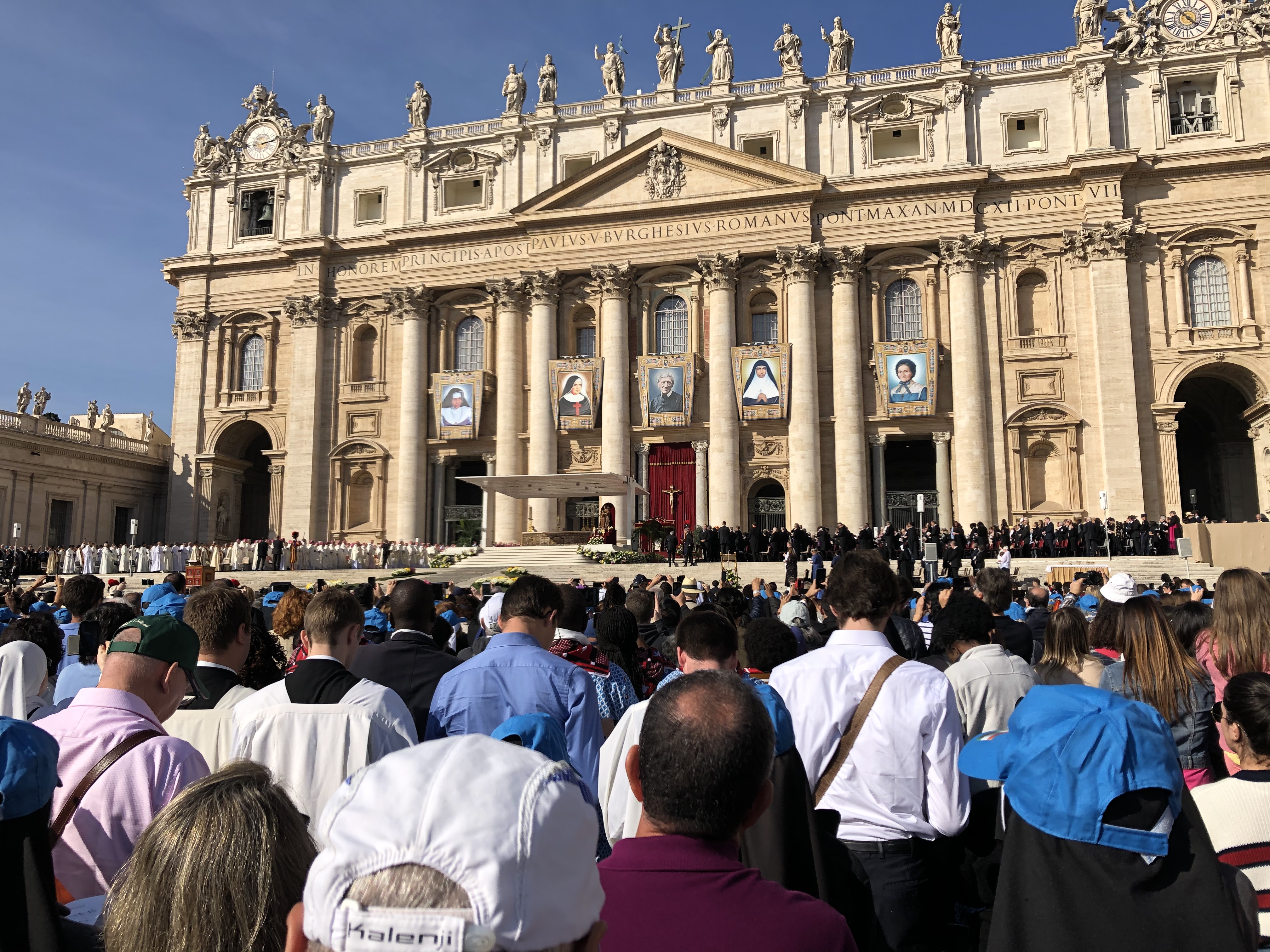
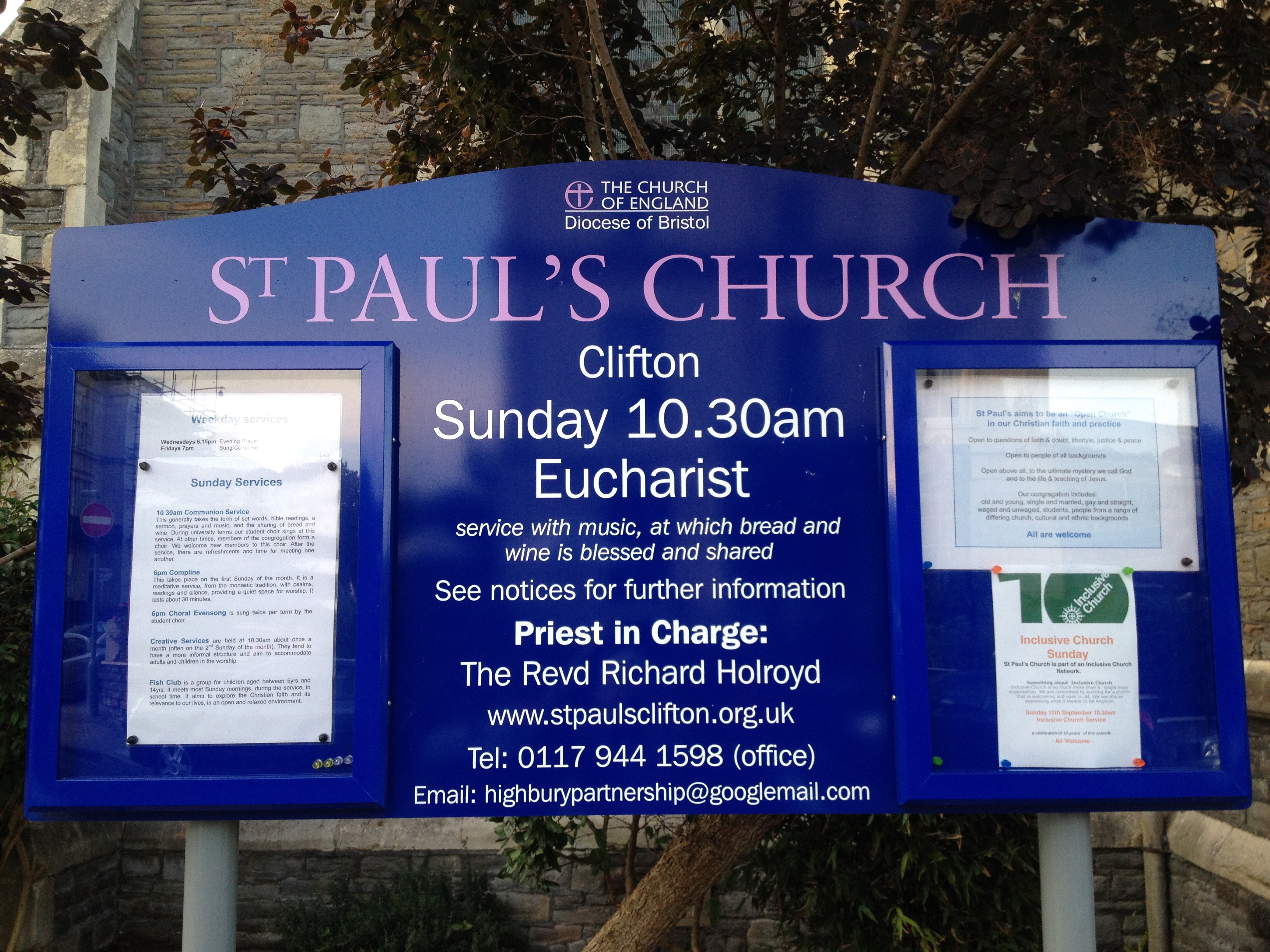
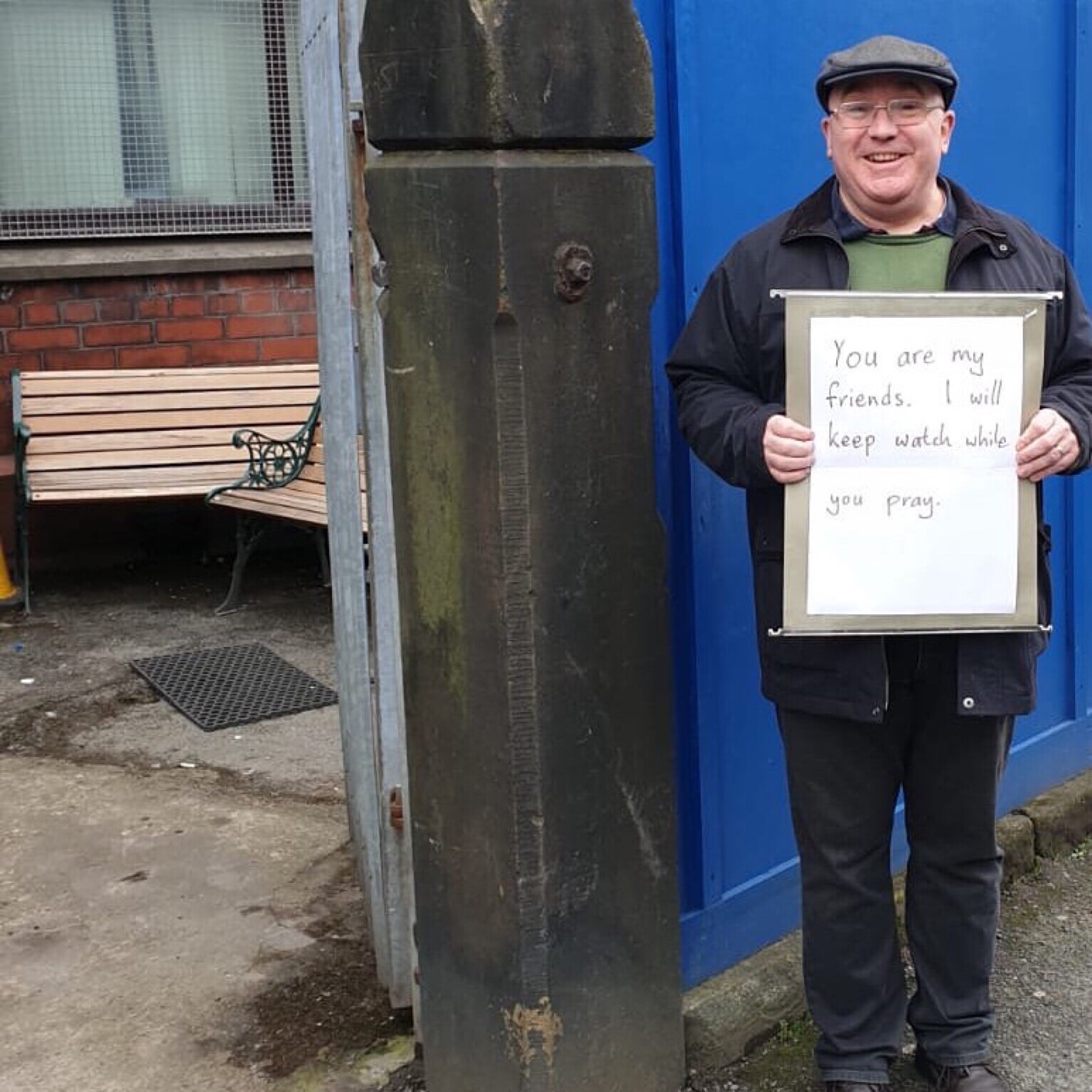
 hughdbryant