Archives for posts with tag: Lent

Sermon for Evensong on Palm Sunday 2025

https://bible.oremus.org/?ql=611300034

Two vineyards. Two stories about vineyards at the start of Holy Week. You might think that we are being exposed to, talking about, another temptation involving wine, but that’s not it. The two vineyard stories in Isaiah and St Luke’s gospel.

Isaiah the prophet singing for his beloved concerning his vineyard – I’m not quite sure how the genders work – the beloved having done all that is necessary to create a fruitful vineyard on a very fertile hill; he expected it to yield grapes, but it yielded, according to our translation here, ‘wild grapes’: although apparently, according to one of the commentaries which I read, the word in Hebrew literally means ‘stinkers’. Heaven knows what a grape has to be like to be described as a stinker; anyway it was not a successful planting of a vineyard. Somehow the vineyard didn’t turn out as it was intended to be.

‘What I will do to my vineyard’ – it’s quite difficult to follow who’s who in this story – it’s somebody and his beloved who builds the vineyard and then it’s me, it’s my vineyard. And because the vineyard produces stinkers I’ll dismantle it and make it a wasteland so that it’s overgrown with briars and thorns. There isn’t really some boyfriend’s Château Musar somewhere which has suddenly stopped producing decent grapes.

Similarly Jesus talks about a man turning his vineyard over to tenants – literally, farmers – in the King James Bible, husbandmen. Where have all these good words gone? I like a world with husbandmen in it. And where are the handmaidens? I ask myself. The word here is γεωργος (Georgos, which is Greek for ‘farmer’). Like a lot of names, George is derived from the Greek, so if you are called George, in Greek you are a farmer. In Jesus’ story, they were tenant farmers of some kind. And he sent members of his staff – literally, his slaves – one at a time to try to collect the rent, or a share of the produce instead, which certainly seems still to be the way that it works in the south of France even today. A friend of mine had a house there including a vineyard. He let the local cooperative manage the vineyard, in return for which they harvested the grapes and gave my friend a share in the wine produced. He took his rent in bottles.

Here, however, the parable is about wicked tenants who didn’t pay their rent and instead, eventually, when the owner sent his own son, the tenants, having kicked out his servants one by one when they called on the farmers to hand over the rent, actually killed the son. So what did the owner of the vineyard do? Obviously he evicted the wicked tenants and passed the vineyard over to other managers to manage.

Again, this is not an actual story about something that actually happened. It’s a parable and it’s very relevant to Easter. Jesus is forecasting what is going to happen, and the scribes and the chief priests, hearing him, get angry because they realise that what he is saying is directed against them, Jesus suggests that if they do behave like the wicked tenants then ‘the stone that the builders rejected has become the cornerstone’, and that stone will trip people up fatally, and it may fall on other people, with similar devastating consequences.

If they, the Pharisees and scribes, are builders, and if they reject a stone while they are building something, if they reject Jesus, then He will become a stumbling block for them, or even fall on them and obliterate them.

Ploughing up a vineyard. Fatal trips and falls. Being crushed by a massive boulder. I’m not sure whether, when we read these lessons in the Bible, even in the context of Lent and even as we look forward to the commemoration of the amazing events of the first Easter, even so, I’m not sure that these lessons really grab us in the way that some of the language used indicates that they are meant to.

Everyone who falls on that stone will be broken to pieces and it will crush anyone on whom it falls. And Isaiah’s friend’s vineyard producing ‘stinkers’ instead of the sweet juicy grapes that he might reasonably have expected and so getting dug up and bulldozed. These are two parables, two stories that are not meant to be taken literally, but which colourfully illustrate, dramatise, an idea or principle; and they have been chosen to be readings for Evensong today because they put you in mind of what we are going to commemorate at Easter.

Jesus is the son who is sent to the vineyard, the vineyard being the human race, the only son, who gets rejected and killed by the people who are looking after his father’s property, the vineyard, the world that his father has created. The Israelites, the Jews, were the bad tenants who threw out the only son and killed him; or rather, they would be, because Jesus is telling the story before he gets crucified.

But so what? Look, there are only 43 of us here – although that’s a really good turn-out: there are only a few thousand, perhaps, in Evensong services all over the UK. Most people couldn’t care less. Most people are snoozing after Sunday lunch or maybe having a nice walk in the park.

Even if they are vaguely aware of Easter having more to it than just a lot of Easter eggs, nevertheless there is nothing vital or urgent about it so far as they are concerned. Even if they’re going to turn up on Easter Sunday, if they are in the habit of coming at Christmas and Easter, say, (which, incidentally, if they were in the Roman Catholic Church would count as regular attendance), but even if they are really rather sparing attenders at church, or if they never come, they presumably don’t feel any compulsion, any need or anything really vital for their life today about this teaching of Jesus or this prophecy of Isaiah.

Nobody much today really thinks that because they might be descendants of the people who cast out the son and killed him, (in these terms), they should worry that a stone might be a stumbling block or that it might fall on them and crush them. It’s probably a metaphor too far, even if they do know a bit about Jesus, because the idea that Jesus would take some dreadful vengeance on people, crush them and grind them into dust, is not consistent with our picture of ‘gentle Jesus, meek and mild’, the suffering servant, who washed the disciples’ feet – as we will wash at least one of your feet, on Thursday at Holy Nativity.

What is our Lent reflection about this? I want to read you something which was written by Dietrich Bonhoeffer, the great German theologian who was executed by the Nazis in the dying days of the Second World War because he was a member of the Stauffenberg Plot to kill Adolf Hitler in 1944. The church remembered the 80th anniversary of his death last Wednesday. He wrote, from prison, what he called an ‘outline for a book’, in which he tackled the idea of a world in which people do not feel they need God any more. He speaks of a God in “religion” as a deus ex machina. Literally it means ‘god from the machinery’. That’s defined in the Oxford Illustrated Dictionary as a ‘power [or] event that comes in the nick of time to solve difficulty.’ The ‘machinery’ was what they had in ancient Greek theatres, to make the actors playing the part of gods fly through the air.

Bonhoeffer felt that religious people had been seeing God in a way as a magic fixer, that “[God] must be ‘there’ to provide answers and explanations beyond the point at which our understanding or our capabilities fail.” But as scientific knowledge has increased, so people have needed God less and less. They may well feel they can get along without needing God at all.

Bonhoeffer felt we ought to accept this, that this was a sign of the world ‘coming of age’. He wrote, ‘The only way to be honest is to recognise that we have to live in the world etsi deus non daretur – even if God is not ‘there’. Like children outgrowing the secure religious, moral and intellectual framework of the home, in which ‘Daddy’ is always there in the background, God is teaching us that we must live as men who can get along very well without him’.

He went on to set out a paradox at the heart of this, which I think leads very well into our reflections for Lent. Bonhoeffer wrote, ‘God allows himself to be edged out of the world, and that is the way, the only way, in which he can be with us and help us. … This is the decisive difference between Christianity and all [other] religions. Man’s religiosity makes him look in his distress to the power of God in the world; he uses God as a deus ex machina. The Bible however [has] directed him to the powerlessness and suffering of God; only a suffering God can help.’

“[Bonhoeffer wrote that he would explain in his book] the experience that a transformation of all human life is given in the fact that Jesus is ‘there only for others.’ His ‘being there for others’ is the experience of transcendence. It is only this ‘being there for others’, maintained till death, that is the ground of his omnipotence, omniscience, and omnipresence.” Those are the essential characteristics of the divine, of God, of what he calls ‘transcendence’. He goes on: “Faith is participation in this being of Jesus (incarnation, cross, and resurrection).” Those are the key things about Jesus: incarnation becoming human, the cross, and resurrection. According to Bonhoeffer,“Our relation to God is not a ‘religious’ relationship to the highest, most powerful, and best Being imaginable – that is not authentic transcendence – but our relation to God is a new life in existence for others, through participation in the being of Jesus. The transcendental is not infinite and unattainable tasks, but the neighbour who is within reach in any given situation.”

We need to think very carefully about this really big mystery. On the one hand we believe in God as a kind of omnipotent father figure, but on the other we read that the first shall be last and the last shall be first. God, Jesus, is in the needy people, the ill people, the homeless people, the naked people who have no clothes.

The sky has turned darker since the joyful procession this morning on a donkey. Donkeys are great, and Jesus was on that donkey. But what else was going on? That’s for us to ponder in this week to come.

Quotations are from ‘Outline for a Book’ in Bonhoeffer, D, (enlarged edition) 1971, ‘Letters and Papers from Prison’, London, SCM Press p.380f., and from Bonhoeffer as quoted in Robinson, J. A. T., 1963, ‘Honest to God’, p36f, ‘Must Christianity be Religious?’

See https://bible.oremus.org/?ql=610162457

Rejoice! Let me speak to you in Latin. ‘Laetare Hierusalem et conventum facite omnes qui diligitis eam: gaudete cum laetitia…’ : it means, ‘ … be ye glad for Jerusalem, all ye that delight in her: exult and sing for joy with her,’..

It says on your pew sheet that today is Mothering Sunday. So what is all this Latin stuff – ‘Laetare’ – all about? This is also, and indeed it has been for a lot longer than it has been Mothering Sunday, what is called ‘refreshment’, or Rejoice! Sunday, which is what the Latin word ‘laetare’ means: laetare, ‘rejoice!’

Traditionally, pink vestments can be worn by the priest on Refreshment Sunday, so it’s also known as Rose Sunday. It’s halfway through Lent, and it’s a chance to relax the rigours of fasting. So if you have been denying yourself, today you have no need to lay off the Ferrero Rocher and vino di tavola rosso di Toscana. Today, you can indulge without feeling guilty.

Mothering Sunday is an old mediaeval concept, which fell into disuse, but was revived during the last century by a lady called Constance Adelaide Smith, a vicar’s daughter, who picked up on plans in the USA to introduce Mother’s Day, which came to fruition in the USA in 1914. Miss Smith wrote a booklet called ‘The Revival of Mothering Sunday’ in 1921, and it started to be celebrated again in the UK around that time, on the fourth Sunday in Lent, Refreshment Sunday.

The rather formidable Miss Smith campaigned for Mothering Sunday to be a celebration of a number of various aspects of motherhood: these were ‘Mother Church’ (the church where you were baptised), ‘mothers of earthly homes’, Mary, the mother of Jesus; and Mother Nature. It is a very wide spread of people and places and things, all to be celebrated as being aspects of motherhood, motherhood to rejoice in on Mothering Sunday.

I think it’s fair to say that these days we mainly think of it as a day to celebrate our mothers, ‘mothers of earthly homes’. It’s a nice opportunity to make a fuss of them, for those of us who still have mothers around, or if not, at least to think about and remember our wonderful mothers.

At this point I must say that in the midst of all this happy celebration, for quite a number of people Mothering Sunday or Mother’s Day are not happy times. If you are a mother who has lost a child, or who has not been able to have a child, this is not a time you want to celebrate. We should pause, and take that to the Lord in prayer. If any of you are suffering in that way, I hope you will excuse my carrying on in a way that may not suit the way you feel. You are not forgotten, and you are in our prayers today.

I don’t think that you really need a homily from me on how to be nice to your mother or to be nice about her. But I would just like to take a minute or two to look at a couple of the things that come up in our Bible readings. I’m struck that in two of them the interesting thing is that the compilers of the Lectionary have selected passages, which come just after, in one case, and just before, in the other, verses which are perhaps more familiar to us and more significant than the ones which have been selected.

The first story, from the first book of Samuel, is the story of the birth of Samuel to his mother, Hannah – obviously today, one of the common themes is stories of mothers – and it is a bit like the story of the birth of John the Baptist to his mother, Elisabeth. Neither woman had been blessed with children for a number of years.

Hannah was praying to the Lord for children, and eventually her prayers were answered. In her prayers, she had said she would dedicate any son who was born to the Lord as what was called a Nazarite. This meant that she would give him over to the priests of the Temple to become somebody who was dedicated, set apart, for the Lord in the Temple. He would not be allowed to cut his hair, touch strong drink, and a whole load of other restrictions, which are all set out in the law of Moses in the book of Numbers.

But the bit which you might expect the story to go on to tell us, is what Hannah did to celebrate, because she sang a song. The song that she sang is very similar to another song in the Bible. She sang:

‘My heart rejoices in the Lord. …

Strong men stand in dismay…

Those who faltered put on new strength …

Those who had plenty sell themselves for a crust,

The hungry grow strong again.’

It has strong echoes of Mary’s song, the Magnificat, that everybody will remember from Evensong.

‘My soul doth magnify the Lord,
and my spirit hath rejoiced in God my Saviour.…..

He hath shewed strength with his arm.
He hath scattered the proud in the imagination of their hearts.
He hath put down the mighty from their seat
and hath exalted the humble and meek. ….

He hath filled the hungry with good things.
And the rich he hath sent empty away.’

Clearly, Mary knew her Bible, and she remembered Hannah’s song from the story of the birth of Samuel. And not only that, but in these songs the two mothers-to-be really forecast the way that God wants us to do things. The last shall be first. The humble and meek shall be raised up. The hungry shall be filled up with good things. A really important message. Think what the world would be like if we really followed it.

And then, in our reading from Saint Paul’s letter to the Colossians, ‘..[C]lothe yourselves with compassion, kindness, humility, meekness, and patience..’, all those lovely ideas about how Christians should treat one another. ‘Clothe yourselves with love, which binds everything together in perfect harmony.’

Wonderful words; but the ones, that are not captured by our reading, come just one verse above.

‘There is no question here of Greek and Jew, circumcised and uncircumcised, barbarian, Scythian, slave and freeman; but Christ is all, and is in all.’

No such thing as Jew and Greek. This is the first sign of Christianity bursting out from being just a small denomination within Judaism.

Anybody could become a Christian. Christ was, is, there to become a saviour for anyone. It’s the origin of Inclusive Church, which is a charity that the Ministry Area Committee have decided to register our churches with. Of course, we know that we are inclusive, we welcome everybody: but we will also have signs outside, and we will do lots of practical things, to let everybody know that they can come in, and that they will be welcome.

The Lord is here. His spirit is with us. His spirit is for everybody, whatever they look like, wherever they come from.

I suppose if you go away and do your homework and read the lessons at home, you will come and tackle me to say that, when I was mentioning things that weren’t in the lessons, I should have mentioned not just the bit that comes before our lesson from Colossians. but also the bit after, because it has St Paul’s rather infamous words, “Wives, be subject to your husbands“, and to be fair, “Husbands, love your wives, … children, obey your parents, for that is pleasing to God, and is the Christian way“, and so on. Given that there is nothing really about mothers in the lesson from Colossians that we heard, it is quite important to remember that St Paul did include, in this great letter, his own ideas on what makes for happy families.

But then perhaps in our Gospel reading, there is the most moving reference to a mother in the Bible, the story of Jesus on the cross, and what he said, while the three Marys were standing there.

More Latin – ‘Stabat Mater dolorosa’: ‘His sad mother was standing there’; the Marian Hymn, as it’s called. Some of us will no doubt be able to hear in our heads one or other of the beautiful musical settings, by Palestrina, or Charpentier or Vivaldi, among many others right up to today, including James McMillan and Karl Jenkins.

When I was looking at this heart-rending scene in my mind, it did slightly remind me of another time when his family was mentioned, in Saint Matthew’s Gospel chapter 12, at the end of the chapter, where he was speaking to the crowd when his mother and brothers appeared, and someone said, “Your mother and brothers are here outside, and want to speak to you”. Jesus said, “Who is my mother? Who are my brothers?” And, pointing to the disciples, he said, “Here are my mother and my brothers. Whoever does the will of my heavenly father is my brother, my sister, my mother.“

This is different; it’s more simple than that; it’s just the story of Jesus, as he was dying on the cross, making sure that his mother was looked after by the disciple whom he loved, (who is sometimes identified with John the Evangelist). It looks as though his earthly father, Joseph, was no longer there, and had perhaps died already.

What a nice example Jesus was setting. Even in a moment of the most acute pain and suffering, he took time and made sure that his mother was looked after. I don’t think there’s anything I can say to improve on that. ‘I was glad’ – and I hope that today, you mothers, and children of mothers, on this Mothering Sunday, are glad too.

Amen.

Hugh Bryant

Sermon for Evensong on the First Sunday in Lent, 9th March 2025

At St Peter’s Church, Old Cogan

Jonah 3

Luke 18:9-14

https://bible.oremus.org/?ql=608348962

Last Wednesday, Ash Wednesday, I did some shopping in one of our local supermarkets. I accidentally walked down the aisle containing wine and beer, and stumbled across Beaujolais Villages from one of the finest Burgundy producers, rather curiously marked as ‘clearance’ – at less than half the normal price. 

Now on the first day of Lent this was rather a challenge. Could I resist buying it at less than half price? On Ash Wednesday it was the start of Lent, and one of the things which one is supposed to do is to give things up, to fast. What was I supposed to do about this wonderful wine bargain? 

At the same time I was starting to think about this service, and what I would say to you in my sermon. I looked at our Bible lessons prescribed for today, and came across the third chapter of the little book of Jonah.

A little like Louis Jadot’s fine Beaujolais, the passage chosen wasn’t quite what I had expected. That was nothing about the whale. If I asked you what you associate with the name of Jonah, I would be mighty impressed if the name ‘Nineveh’ was on your lips instead of something about a whale. 

Our lesson today tells you about Jonah going and uttering a prophecy to the people of Nineveh who have been misbehaving in a sinful way, telling them that God had warned that they would come to a bad end if they did not mend their ways. The ruler of Nineveh told the people to put on sackcloth and ashes, to put on visible signs of repentance, and to turn back to the true God. But you have to know that this is Jonah’s second go at this task from God. The first time around, when God was telling him to give this bad news to the people of Nineveh, he ran away, bought a passage on the ship and then, as a result of the ship being caught in a storm, he drew the short straw and was chucked overboard so as to lighten the load on the ship and to save it from being overwhelmed by the waves. And he was eaten up by a whale.

At this point when I am talking about the book of Jonah, as an ancient maritime lawyer I always use the opportunity to mention this as an early instance of the legal doctrine of general average, an “extraordinary sacrifice made to preserve the safety of the ‘maritime adventure’”, as the Marine Insurance Act1906, which is still good law, puts it; although general average doesn’t involve chucking people over the side as opposed to cargo or the ship’s tackle, of course, or making a special payment for services to prevent the ship being lost. So I won’t mention that particularly here but rather we should concentrate on Jonah’s encounter with the whale.

I’m not sufficiently up on marine biology to be able to express a view on how plausible this is as a literal account, but I think it is fine as a colourful illustration of how God might intervene to persuade somebody who was a bit reluctant. Jonah having been spat out safely, as you are, if you’re eaten by a whale, after three days, he was indeed persuaded, and he went and undertook his task. He told the people of Nineveh how awful they were, how they needed to change their ways, to repent: a bit like what we are supposed to do in Lent, I suppose. 

You can see why Jonah was reluctant. Being the bearer of bad news is never a popular thing to do, especially when you are speaking truth to power. It’s something we’ve noticed in recent days in the way in which our various leaders are not telling President Trump what time of day it is. 

Not but what Jonah, no doubt emboldened by his whaling experience, did deliver his message to the people of Nineveh, and he received a reception which was entirely different from what he had feared. God had noticed the fact that the people of Nineveh had changed their ways, and he did not punish them. 

So – what should we do? How should we change our ways in the 40 days leading up to Easter? What about fasting? Well, another thing to put into the mix is that we mustn’t crow about whatever it is that we do do; so if you are able to write a cheque for an eye-watering amount of money to the United Nations High Commissioner for Refugees, say, or even, maybe, for the Penarth Ministry Area, such that you make that gift instead of treating yourself to a holiday in Gstaad for skiing, you mustn’t talk about it. You mustn’t crow about it. Think about the Pharisee and the publican. All you should do is to ask the Lord for forgiveness because you are a sinner. Whatever sins you have committed, you just say, quietly and privately, ‘Have mercy on me, a sinner.’

I guess that bears on how you should conduct yourself at charity auctions. Maybe you will have to appoint a proxy to bid for you next time you are minded to go and support Welsh Rugby at some appropriate dinner or other, but I leave that to your discretion.

What about that Beaujolais? Well I offer this as a true story which may or may not inspire you. I know that I am very bad at giving things up, but equally I’m not sure that my giving things up really has any benefit to anybody else except possibly me. But I am enormously comforted by a verse in Isaiah about fasting. Let me quote it to you.

‘Is not this the fast that I choose: to loosen the bonds of injustice, to undo the thongs of the yoke, to let the oppressed go free, and to break every yoke? Is it not to share your bread with the hungry, and bring the homeless poor into your house; when you see the naked, to cover them, and not to hide yourself from your own kin?’ (Isaiah 58: 6,7)

Now I do think that that is more my kind of fast. So what I usually do – and I am going to do it this Lent – is, every time I eat out, (and that includes pies on the motorway), I will keep a note of what I spend; and at the end of Lent I will look at all those bills and work out what it would have cost to invite another person to join me each time: an absent guest, if you like. I will tot up the cost of the absent guests and I will give that to the United Nations High Commissioner for Refugees. Maybe that’s a sort of fast that you could undertake too. 

Oh – and, yes, about the Beaujolais. I bought three. 

Amen.

Hugh Bryant

Sermon for Ash Wednesday, 5th March 2025 at All Saints Church, Penarth

Joel 2:1-2, 12-17

2 Cor 5:20b-6:10

John 8:1-11

Psalm 51:1-17  

https://bible.oremus.org/?ql=608110117

‘Remember that you are dust, and to dust you shall return. Turn away from sin and be faithful to Christ’. That’s what Jimmy and Craig are going to be saying to you in a minute, when the ‘ash’ in Ash Wednesday is imposed on your forehead. The imposition of ashes is a symbol, a sign of the spirit of penitence, of repentance for sins; and also it is a symbol of our mortality – ‘ashes to ashes, dust to dust’. You will remember those words from funerals. These symbols lead us into the next 40 days of reflection and repentance in Lent. 

The prophet Joel writes all about the day of the Lord, the coming of the Lord, the moment of the Messiah. It’s portrayed as a pretty terrifying event. The day of the Lord is coming, it is near; a day of darkness and gloom, a day of clouds and thick darkness. In the darkness will come a great and powerful army. 

Joel is prophesying about the coming of the Lord against a backdrop where Israel, the chosen people, have not waited for salvation but they have gone their own way in many instances and worshipped other gods. In Joel’s prophecy, and in the way that Saint Paul emphasised similar ideas, it’s important that we shouldn’t separate ourselves from God. We shouldn’t pretend that we don’t need God, and we should acknowledge that we have strayed from the straight and narrow and we have been sinners in many ways. 

Although the book of Joel begins with the description of a plague of locusts, Joel believes in the end there will be a rapprochement between his chosen people and the Lord; a rapprochement, a coming-together again. ‘Return to the Lord your God, for he is gracious and merciful, slow to anger and abounding in steadfast love; who relents from punishing.’ 

St Paul picks up the idea of the day of the Lord: ’At an acceptable time I have listened to you and on a day of salvation I have helped you’ – it is a quotation from the book of the prophet Isaiah – and Saint Paul says to the Corinthians, ‘See, now is the acceptable time; see, now is the day of salvation!’ The Day of the Lord. 

Almost using the language of Joel, St Paul writes to the Corinthians, ‘We entreat you on behalf of Christ to be reconciled to God, to come back from sin’. He puts himself alongside the prophets, doing a rather similar job. ‘We are ambassadors for Christ’, he says, ‘since God is making his appeal through us’. That’s pretty well what the Old Testament prophets like Joel was doing. They were putting the voice of God into the human language. 

St Paul appeals to the Corinthians to be reconciled to God. He feels they have gone away from God. Saint Paul tells the Corinthians that he and his team have been through tremendous trials as a result of their trying to proclaim the gospel. But it is worth their suffering. Now is the crucial time: now is the moment, now is the moment about which the prophets were prophesying, so now is the time to turn away from sin and be faithful to Christ. 

If you read these passages while you are thinking about the situation in Ukraine or in Gaza, for example, you might well feel that one of those visions of the day of the Lord, the day of vengeance, the End Time, might be an apt description; especially if you reflect on the thought that nobody is really considering a wider perspective, or a higher perspective, than the relative strengths of the humans involved in any of these terrible situations. 

The Israelis can go on killing Palestinians, quite irrespective of any questions of principle, let alone the Ten Commandments. Is it right to do so? Does it break international law? They really don’t seem to be interested. As they see things, it is a question of self defence; although it seems more likely that it is retaliation, and it is extraordinary that in order to attack Hamas they don’t appear to be worried about killing thousands of Palestinians, at least half of whom are children, who haven’t ever done anything to harm them. 

Similarly in Ukraine, if you are at the court of Donald Trump, it doesn’t appear to be a question of what is right or wrong, but rather the only consideration is that might is right. President Trump and his team have said that Russia is entitled to keep the land they have seized from Ukraine, because they have ‘lost a lot of men in the process’. There is nothing about whether it was right or good to invade another country. 

President Zelenskyy is supposed to agree to a form of capitulation because, according to President Trump, he ‘doesn’t hold many cards’ – or maybe, any cards  (I’m not quite sure what was said, because everyone was shouting). Because he doesn’t hold any cards: again no question whether he is doing the right thing, whether it is legitimate to defend your country when it is attacked, but rather just a question whether his relative strength is less than the aggressor. Might is right, although they do not actually say this. If you re-read the passage in Joel about what the Israelites were doing wrong, following other gods, turning away from the true God, it could be a way of describing what is happening now in Ukraine. 

Joel suggests that, if people repent, the Lord will forgive them. But we watch and we see no signs of repentance: so we begin to fear that there is no way out of this. President Trump accuses President Zelenskyy of playing with the possibility of a third world war and it is believable that a third world war would be a form of apocalypse, that it might be the end of human life as we know it. 

In a way, therefore, no wonder that we are at least metaphorically in sackcloth and ashes over this situation. It shames the whole human race. Is it really going to be the case that we are dust, and to dust we shall shortly return? You might wonder how Jesus would deal with such an awful situation. What would Jesus do? When something has gone horribly wrong, when people have clearly behaved totally sinfully, what would Jesus do? 

This is where we have this wonderful story, (which nobody really knows where it properly belongs in the Bible, because it’s in different manuscripts in different places, and indeed is completely missing from some manuscripts), the story of the ‘woman taken in adultery.’  The very words, in their archaic ghastliness, tell you that something extraordinary is going to be played out. The context is a provision in the Jewish law which you will find in the book of Deuteronomy chapter 22 according to which adulterers were to be stoned to death. 

When you read about all the awful punishments that were used in the ancient world and indeed are still sometimes used in the Middle East today, the true horror of what was being proposed might escape us; but this was a truly awful form of killing, right up there with crucifixion in its cruelty and inhumanity. But it’s not necessary to go into all the ghastly details in the story in order to understand that it is another example where Jesus turns things on their head in a marvellous way. 

Who will guard the guards themselves? I wonder if Albert Pierrepoint, the last British executioner, was a good man who never did anything wrong. Jesus is saying that there is room for mercy and room for repentance. The only thing that he asks the woman to do is not to sin again. Don’t miss the mark again; stay close to God. However awful, whatever it is you’ve done, whatever it might be, there is room for forgiveness. 

That’s the second half of the message with the ash. Turn away from sin and be faithful to Christ. That’s good advice. It’s the best advice. But let’s just look again at the beginning. ‘Remember that you are dust and to dust you shall return’. Do you remember what comes next? In the funeral service it is the ‘sure and certain hope of the resurrection to eternal life through our Lord Jesus Christ’. So in our Lenten reflections this isn’t just a time for despair: a time for sadness and fear; a time for regret, although we may have all those things; but it is also a time for that sure and certain hope of the resurrection to eternal life. For the sure and certain hope of Easter. 

So even in the face of a world which seems to have abandoned the Lord and to be headed for that day of darkness and gloom when ‘like blackness spread upon the mountains a great and powerful army comes’, even so we can have a sure and certain hope that ultimately Jesus will be the winner, Jesus will be the conqueror, the conqueror over death and sin. So we are invited to return with all our hearts, with fasting, weeping and mourning; but not to do it just for show: to ‘rend our hearts but not our clothes’. Because ‘the Lord is gracious and merciful, slow to anger and abounding in steadfast love’. Brothers and sisters, we must not lose hope. 

Sermon for Evensong on the third Sunday of Lent, 12 March 2023, at Saint Peter’s, Old Cogan

https://bible.oremus.org/?ql=545542568‘

Put on the whole armour of God…; the breastplate of righteousness…; the shield of faith…; the helmet of salvation, and the sword of the Spirit.’

My favourite toy shop – yes, my favourite toy shop – isn’t Hamleys in Regent Street but it’s in Zürich and in a number of other places in Switzerland under the name Franz Carl Weber. It’s a very old shop; it’s been going since 1881. It is a truly wonderful toy shop. 

The top floor is very well stocked with model railways at one end and dolls at the other end, so there is no sexist hierarchy. Then on the floors going down, are pedal cars and bikes, dressing up clothes, board games and construction toys: there is Lego and Playmobil but, alas, no more Meccano. There’s absolutely everything for kids in there and indeed there is quite a lot for their grandpas to enjoy as well. 

But there is one small category of stuff that Franz Carl Weber does not stock. I wonder if you can imagine what it is. Well, the answer is that Franz Carl Weber, the best toy shop in the world, I think, does not stock anything to do with war or weapons. There isn’t even a spud gun to be had in there. No toy soldiers; no World of Warfare games, no Airfix kits of warplanes; nothing to do with war or weapons. 

I’ll come back to the toy shop without any toy soldiers in a minute. But I just want to look at something else we haven’t got at the moment, which is any hymns today. Sometimes that’s quite a good thing; because it’s rather like listening to the radio – you know, ‘the pictures are much better on the radio’ than on the TV – because they are in your head. That goes for other things that you can hear in your mind’s ear, if I can put it that way. So what would be our hymn?  I would suggest the one that immediately springs to mind is a great one of Charles Wesley’s, 

Soldiers of Christ arise, 

and put your armour on. 

Strong in the strength which God supplies 

through his eternal Son. 

Stand then in his great might, 

with all his strength endued, 

but take to arm you for the fight 

the panoply of God.

The panoply, the complete kit of weapons, the suit of armour; for this is a hymn based on our reading from Saint Paul’s letter to the Ephesians. And it’s a rousing hymn: that I certainly remember being very popular with us when I was at school.

And in one sense, what’s not to like? Either about our lesson, or about Charles Wesley’s poetic rendering of it? Stand up to evil; be armour-plated in your resistance, use the best weapons you have, to stand up for the good guys. It’s pretty topical, in the context of the Ukraine. There’s lots in the newspapers, on the TV and on the radio, comparing the weapons used by the Russians with those supplied to the Ukrainians by the Western nations. 

There’s something quite celebratory about the respective descriptions of the Russian and western tanks that we and some of the other European nations – and, indeed, the United States – will be sending – in fact I think that we are already sending, for the Ukrainians to use. 

There has been quite a lot of learned discussion about the relative merits of the Western weapons as against the weapons used by the Russian invaders. I am sure that most 15-year-old boys would be able to give you a detailed rundown of the respective specifications of the Russian T90 as against the Challenger 2 or the Leopard 2 tanks, or the Abrams.

You know, I used to rather like playing with toy soldiers and those Britain’s model field guns which shot out a sliver of lead as a shell. My friend John DeVille, when we were eight or nine, had the most marvellous model 18 inch ‘naval howitzer’ which reproduced all the main things that a real field gun did. You could lay the barrel at the right elevation and tracking; the shells were little masterpieces of brass with a spring inside them and the lead projectile which you put in the breach and then fired, then ejecting the casing. The whole thing was about eight or 9 inches long and it went with our toy soldiers, which were predominantly lead or die-cast, painted in enamel and colourful in their fine uniforms. 

But there was a problem. The problem was, what to do if there was a battle. Then you would actually shoot your wonderful naval howitzer or model 25-pounder at the army which you had lined up against them. But I didn’t want to break any of my soldiers and I didn’t want to damage the opposition’s half-track truck that I was very proud of. So this was a war without casualties. 

And after a bit it began to dawn on me that there is no such thing, that those beautiful soldiers would get smashed up. Some of them would lose arms and legs – and heads. Some of them would not get up again. 

And I want to suggest to you, in all humility, that St Paul may have been a bit up the pole here, in this famous passage from his letter to the Ephesians. In celebrating weapons of war, even when they are used in a good cause, he is missing what Jesus himself said. ‘Love your enemies. Turn the other cheek.’ 

Oh, but surely, you will say, Saint Paul is being a realist. The way of love is just not practical, and you do need the shield of faith, the helmet of salvation and the sword of the spirit; and indeed you may say that this is exactly in line with the Old Testament as well. 

Look at our lesson from the book of Joshua, where God says to Joshua, 

‘There shall not any man be able to stand before thee all the days of thy life: …Be strong and of a good courage: ..Only be thou strong and very courageous, … that thou mayest prosper whithersoever thou goest.’

And you will remember that this led on, once the Israelites had crossed over the Jordan, to their encounter with the Amalekites where, rather surprisingly, God took them to task for having shown mercy to the people whom they defeated. 

But the thing that perhaps St Paul didn’t really get, but which Franz Carl Weber, when he set up his toy shop in 1881, did understand, is the point about my not wanting any of my toy soldiers to be broken. Mr Weber realised that you can’t have a war without breaking soldiers; that the use of weapons does not bring about victory, but it is, rather, a sign of failure. 

Paul paints a picture which looks like a Roman centurion in his armour, and perhaps, as he was the ‘ambassador in chains’ imprisoned in Rome when he wrote the letter, he might have seen a victorious general coming back from a campaign and being granted what was called a triumph, leading the people whom he had conquered, their kings and generals, in chains through the streets of Rome. His centurions would be in their best uniform.

But war never really leads to triumph. Away from the soldiers marching in their dress uniforms there are the broken ones, maimed and dead on the battlefield. And at this time, when we are now confronting again the feeling that we have to wage war, in order to defend civilisation against the attack of the Russians, we don’t know what victory should really look like. 

And at this time of Lent we have to realise that the conflict that Jesus entered into, in trying to bring about his kingdom of love, ended on the battlefield. Jesus was one of the fallen. 

But the other message of Lent points to the triumph, the real triumph, of Easter. Be of good cheer and I will support you. Do the right thing and I will support you, is God’s message to Joshua. The prophet Isaiah, (or perhaps more correctly the first of the three prophets writing under the name), had a vision of the kingdom in which they would ‘beat their swords into ploughshares, and they would not learn war any more.’ 

Then, on God’s holy mountain, the sword of truth will have more truth than sword; the breastplate of faith, more faith than breastplate, and the helmet of salvation, more salvation than helmet. Let it be so! Let us pray for peace and love in place of war. With that peace and love, we can have the ‘sure and certain hope of the resurrection to eternal life’ which comes at Easter.

Sermon for Evening Prayer on Saturday 7th March 2020 for the Prayer Book Society Guildford Branch, at the Founder’s Chapel, Charterhouse

Jeremiah 7:1-20; John 6:27-40 (see http://bible.oremus.org/?ql=450504242)

And Jesus said unto them, I am the bread of life: he that cometh to me shall never hunger; and he that believeth on me shall never thirst.

I want to speak to you not just about the bread of life, but also about baked beans and sausages. At the same time we can’t ignore that it is the end of the first week in Lent.

The baked beans and sausage, you might be a bit surprised to hear, bring into consideration two theologians, one ancient and one modern, and the bread and the Lent give us a topical Christian context for that food, which is, fasting.

And I suppose that the other ingredient which I need to work in is some reference to our beloved Book of Common Prayer, and the theological developments which Cranmer was influenced by in writing it.

The first thing to reassure you about is that there is no command to fast in the Gospels – except that Jesus said that he did not come to abolish the Law of Moses, but to fulfil it. So the days laid down for fasting in Leviticus, for example on the Day of Atonement, mean that it’s not strictly true that there’s no Biblical justification for fasting.

As you will know, the Reformation, which greatly influenced Cranmer, was led certainly by Martin Luther in Germany but also by Zwingli and Calvin in Switzerland.

Diarmaid MacCulloch has written, ‘It was a sausage that proved to be the rallying-cry for the Swiss Reformation.’ A Zurich printer, Christoph Froschauer, with Zwingli and 12 of his followers in Zurich sat down on the first Sunday in Lent in 1522 and ate two large sausages. Zwingli followed up by preaching a sermon in which he argued that it was unnecessary to follow the church’s traditional teaching about not eating meat during Lent. It was a human command introduced by the Church, which might or might not be observed, but which ‘obscured the real laws of God in the Gospel if it was made compulsory’. [MacCulloch, D., 2003, Reformation, London, Allen Lane, p139]. Cranmer and Zwingli are supposed to have met, and the Swiss reformer is thought to have influenced the English archbishop.

So that’s the sausage. In the Reformation context, according to Zwingli, fasting is not divinely ordained. It’s up to you.

Not but what by the time of the Second Book of Homilies, published in the Church of England in Queen Elizabeth’s time, in 1563, whose author was Bishop Jewel, there was a published sermon – a Homily – called ‘Of Fasting’, Homily number 16. The Homilies were intended for the use of vicars who were not good at preaching, so they didn’t make any theological mistakes. We tend to think of a ‘homily’ as a short sermon – the sort that the vicar doesn’t get into the pulpit to deliver, but perhaps hovers invisibly on the chancel steps for; something like Thought for the Day in size and weight. Not so in 1563! ‘An Homily of Good Works and of Fasting’ is in two parts, the first being about fasting, and in the modern edition which I have, it occupies 8 ½ pages of very dense small type!

Some of the early Christian Fathers such as Irenaeus or Chrysostom or Tertullian or Gregory the Great all debated how long a fast should go on for. The possibilities included one day, as on the Jewish Day of Atonement, or 40 hours, mirroring Jesus’ 40 days in the wilderness, or indeed 40 days of fasting.

The ‘Annotated Book of Common Prayer’, edited by the Revd John Henry Blunt, published in 1872, which I’m very fortunate to have a copy of, says this.

The general mode of fasting seems to have been to abstain from food until after 6 o’clock in the afternoon and even then not to partake of animal food or wine. Yet it may be doubted whether such a mode of life could have been continued day after day for six weeks by those whose duties called upon them for much physical exertion… and although it may seem at first that men ought to be able to fast in the 19th century as strictly as they did in the 16th, the 12th, or the third, yet it should be remembered that the continuous labour of life was unknown to the great majority of persons in ancient days, as it is at the present time in the eastern church and in southern Europe; and that the quantity and quality of the food which now forms a full meal is only equivalent to what would have been an extremely spare one until comparatively modern days.’

The Victorians were too busy safely to fast, and their meals were cuisine minceur by comparison with the groaning boards enjoyed in olden times. Think of what we know of Henry VIII’s diet, or Sir John Falstaff’s. Having a rest from eating was probably very good for them, and there was no risk of starving. Come the industrial revolution, however, and meat and two veg in the works canteen was all you might have. If you gave that up, ‘night starvation’, as the Horlicks advert used to warn, was a real possibility unless you had some nourishment at least.

But it’s at least arguable that Jesus, in our lesson from St John’s Gospel, wasn’t talking about the ins and outs of fasting. [6:27] ‘Labour not for the meat which perisheth, but for that meat which endureth unto everlasting life, which the Son of man shall give unto you..’ This leads up to one of the great ‘I am’ sayings in St John’s Gospel, ‘I am the bread of life’. Just as the name of God as He spoke to Moses in the Old Testament was ‘I am’, so in these sayings, Jesus is using the same form of words, giving a sign of his divine nature. And we are no longer thinking about whether or not to eat a sausage. This is spiritual, divine food, ‘meat which endureth unto everlasting life’.

And that, you’ll be amazed to know, brings us to baked beans, and to our second theologian. He is Jürgen Moltmann, the great German theologian, some time Professor of Systematic Theology at the University of Tübingen. (That is the same university at which Pope Benedict taught, once upon a time.) Moltmann is in his 90s now, and so it was a great honour for me to attend his lecture this week at Westminster Abbey, called ‘Theology of Hope’. This was the title of one of his famous books.

Prof. Moltmann comes originally from Hamburg. His excellent English still has the same accent that I know so well from my friends there in the shipping world. He was a boy when Hamburg was bombed, bombed by us, when there was the terrible ‘fire storm’ about which Kurt Vonnegut and others have written so eloquently. Moltmann was conscripted into the German army, and on Monday night he told us he had carefully learned two words of English, which he used when his platoon encountered the British Army for the first time. They were, ‘I surrender’. He told his audience that the abiding memory of his time as a prisoner of war was baked beans – which like all boys, he liked, and I think he still likes, very much.

So if the sausage in our baked beans and sausage is redolent of the Reformation, and the creation of the Book of Common Prayer, so the baked beans lead us to Jürgen Moltmann, and his Theology of Hope. What is this hope?

Moltmann saw, and still sees in the world today, great challenges in our life. They represent death, or even separation from God, which is another way of describing sin. Climate change, the destruction of God’s creation; nuclear war, where the use of nuclear weapons would end the world as we know it, because no-one could survive the nuclear winter. Division and separation among peoples instead of unity and co-operation; the erection or rebuilding of borders in contravention of God’s creation of all peoples as equals. The end time – what will happen when we die?

Maybe it’s not fanciful to say that this, this climate of despair, is somewhat reminiscent of Jesus being tempted in the wilderness. Lent is the right time for this kind of reflection.

Moltmann has argued that we should not despair or become nihilistic in the face of these challenges. Whereas we are often encouraged to have ‘faith’ when we have to confront these existential threats, Moltmann has suggested that what we really need, and what really reflects the presence of God in our lives, is hope. Hope, rather than faith.

For example, in the committal prayer at a funeral, the body is buried ‘in sure and certain hope of the resurrection to eternal life’. You might think that what you need at that end time, at the end of life, is faith, a strong faith. But Moltmann says no, not faith, but hope is what we need. The fact, the great revelation, of Jesus’ life on earth gives us the grounds for hope. It is more than a bare belief, more than blind faith. If I hope for something, I reasonably expect that it will be possible. It’s more than an intellectual construct.

So there we are. Baked Beans and Sausages. Should we abstain from bread, or meat, or drink? Certainly not from the Bread of Life. But if even our spiritual bread is disappearing, overwhelmed in the apocalypse, in what looks like the end time, then what? 500 years ago Zwingli said, don’t stop enjoying your sausage – give thanks to God for his bounty. In the smoking ruins of that great city of Hamburg at the end of WW2, Moltmann discovered Baked Beans, and with them, divine hope. I hope that that will give you some food for thought this Lent.

Sermon for the Second Sunday of Lent, 17th March 2019

Genesis 15:1-12, 17-18, Philippians 3:17-4:1, Luke 13:31-35

As we woke up on Friday, to hear the news about the terrible shootings in the mosques in Christchurch in New Zealand, the New Zealand Prime Minister, Mrs Ardern, made a moving statement about the fact that it seems clear that the 50 people killed were the victims of a racist, Islamophobic terrorist. Mrs Ardern said, ‘Many of those who will have been directly affected by this shooting will be migrants, they will be refugees here. They have chosen to make New Zealand their home and it is their home. They are us.’

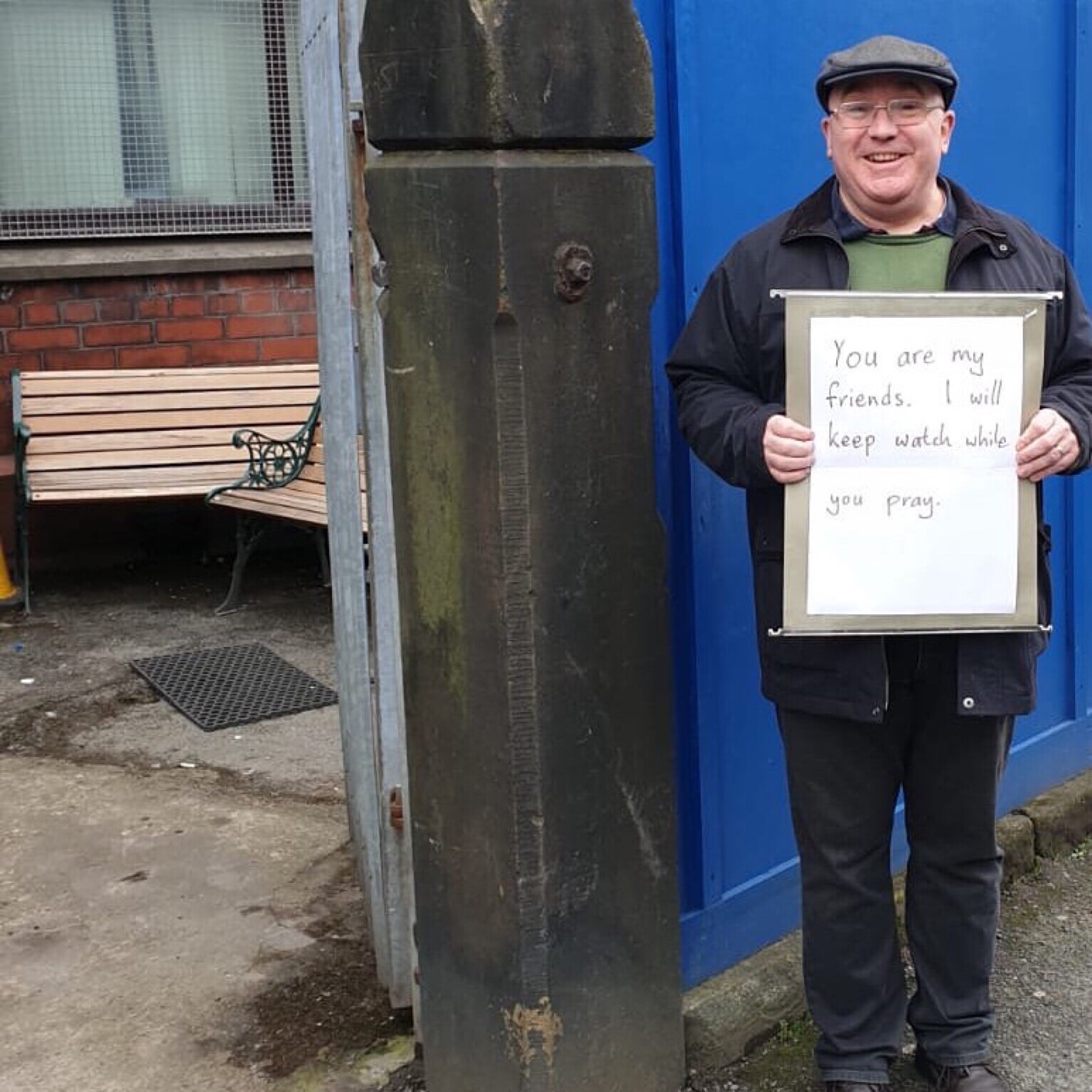
A bit later on, a picture appeared on Twitter [reproduced above] of a man who, if I can say this, did not look like a Moslem, but rather like Andy Capp in the cartoons, in a flat cap, standing smiling outside a mosque in Manchester with a placard which said, ‘You are my friends. I will keep watch while you pray.’

Terrible atrocities do sometimes seem to bring out beautiful and uplifting thoughts, like those of Mrs Ardern and of the man in the flat cap outside the mosque in Manchester.

In our Lent study groups we are going through the Beatitudes, the ‘blessed are they’ sayings which Jesus spoke at the beginning of the Sermon on the Mount in Matthew 5.

The second one, perhaps the right one at a time of tragedy, is ‘Blessed are those who mourn, for they will be comforted.’ This is one of those short sentences that contains impossibly dense and complicated ideas. On the face of things, for somebody to be mourning, to be sad, to be heartbroken, is not in any sense the same as to be fortunate, which is what the word translated as ‘blessed’ means.

How lucky for you that you are heartbroken; what a wonderful thing it is that you are in floods of tears. Clearly there’s something which doesn’t add up. Try telling the distraught people that were on the TV from New Zealand that they were in some way blessed or fortunate. But really it means, as it says, that those who mourn will be blessed, will be comforted in future: and that is a message of hope after all.

St Paul, in his letter to the Philippians, condemns those who live as enemies of the cross of Christ. Earlier in the chapter we had as our reading, he identifies the people that he condemns. He says, ‘Beware of those dogs and their malpractices. Beware of those who insist on mutilation – I will not call it ‘circumcision’’. Beware of people who tell you you have to become a Jew in order to become a true Christian.

Nevertheless, Paul was proud to tell everybody that he had been circumcised and that he was an Israelite of the tribe of Benjamin, a Hebrew born and bred, and a Pharisee [Phil. 3:5]. He’d thrown it all over, after his Road-to-Damascus experience, and in his letters, for example to the Galatians and to the Romans, he made the point that, in the kingdom of heaven, there is no difference between Greeks, (Gentiles), and Jews.

The Israelites had been the chosen people of God, and the others, the Gentiles, the ‘nations’, were the great unwashed. But St Paul’s mission was to bring the good news of Jesus precisely to those Gentiles, to those who were not circumcised. He said, ‘Our citizenship is in heaven.’ Ordinary nationality doesn’t apply in heaven.

But originally, Paul – and Jesus – were Jews, sons of Abraham, descendants of Abraham. The word of the Lord came to Abraham and said, ‘Look toward heaven and count the stars; because that’s how many your descendants will be.’ The sons of Abraham. They were Israelites, the chosen people of God.

The gunman is supposed to have said that one of his reasons for shooting Moslems was because he saw them as strangers, ‘invaders’. At the beginning of this week in morning prayers we were reading from the Book of Deuteronomy, where Moses speaks the words of the Lord, a prophecy about offering sacrifice of the first fruits of the land, the land of milk and honey, which the Israelites have been led into, the promised land. Moses tells them to say in their prayers that they are descended from ‘a wandering Aramean’, or from ‘a Syrian ready to perish’, that they have been led into Egypt and then eventually out of Egypt again, as strangers in the land. Even they, the chosen people, started out as strangers.

There are many passages in the Book of Deuteronomy, and in the Jewish Law generally, which St Paul would have been very familiar with, which impose on Jews a duty to care for a stranger that is within their gates, to care for strangers along with orphans and widows. That is the spirit that Mrs Ardern has so eloquently reminded us of. It is not a spirit of antipathy towards immigrants and refugees, not against strangers, not against people who are different from ourselves.

This is such a difficult area. There are so many apparent paradoxes. The Jews, refugees, made it to the promised land; they went to the holy city, Jerusalem, and set up the temple there. ‘Jerusalem the golden, with milk and honey blest’.

But Jesus points out that, because that is where the council, the Sanhedrin, is based, it is only in Jerusalem that he can be condemned, and that Jerusalem is a city that kills prophets, that throws stones at people who are sent to it.

Mrs Ardern was one of those world leaders, like Mrs Merkel in Germany, who has dared to extend a welcome to refugees. She still extends that welcome. But what about us? The challenge to us today is surely not to be fixated with ‘taking back control’, with restricting immigration and upholding national identity, however important some of those things might seem to be at first.

Jesus said, ‘Strive to enter in at the strait gate. Struggle to get in through the narrow door. For I tell you that many will try to enter and not be able to. You may stand outside and knock: say, ‘Sir, let us in.’ But he will only answer, ‘I do not know where you come from.’ [Luke 13:24]

Where do we come from? You could say that Jesus makes getting into the kingdom of heaven seem like a refugee trying to come ashore in Italy, or trying to get through at the Hungarian border or even being caught up in our own Government’s ‘hostile environment’ at Heathrow today. Contrast that with what Mrs Ardern said. ‘ … They will be refugees here. They have chosen to make New Zealand their home. It is their home. They are us.’

The challenge for us as Christians is to raise our sights above the earthly ghastliness which stems from narrow nationalism, and to seek what is truly heavenly. ‘Blessed are those who mourn, because they will be comforted.’ Let us pray that, with God’s help, we can become channels of peace, so that we too can say that they are our friends, and that we will keep watch while they pray.

Sermon for Evensong on the First Sunday in Lent, 10th March 2019

Psalm 119:73-88; Jonah 3; Luke 18:9-14

Turning is sometimes a bit controversial. ‘The lady is not for turning’ they said about a former Prime Minister. The current Prime Minister is praised for the fact that she ploughs on and does not turn from her desired path. It’s supposed to be a very good thing to be single-minded and steadfast, and not to deviate from your objectives.

But actually, a major theme of Lent is in direct contradiction with this. Lent is, among other things, about repentance, repentance meaning changing your mind, μετανοια in Greek. There’s a good example of it in our first reading from Jonah, about the city of Nineveh, the ancient Assyrian city in upper Mesopotamia, located on the outskirts of the present-day Iraqi city of Mosul. On the banks of the River Tigris, Nineveh was at the heart of the earliest human civilisation.

God didn’t like what was going on in Nineveh. He instructed the prophet Jonah to go there and denounce them, tell them the error of their ways. Jonah didn’t want to face them, and decided to run away to sea instead; but the ship got caught in a storm, and the sailors were deciding, by casting lots, whom they should chuck overboard to lighten the ship. Poor old Jonah drew the short straw. They asked him more about himself: where he came from and what he was supposed to be doing. 

Jonah told them that he worshipped the one true God, who made both sea and land. He also told them that he was escaping from this god. ‘What shall we do with you,’ they asked, ‘to make the sea go down?’ Because the storm was getting worse and worse. Jonah said, ‘Take me and throw me overboard: and the sea will go down.’ Jonah said that he knew it was his fault that their ship had been hit by this great storm, because he, Jonah, had disobeyed God. Well, they chucked Jonah over the side, and Jonah was swallowed up and saved by being in a whale.

Then he emerged from the whale, came back and had another go. This time he did carry out what God had instructed him to do, and he went to Nineveh to tell them the error of their ways. That’s where we come in and pick up the story. When Jonah had warned them that in forty days their city would fall – impliedly, because of their evil deeds – they changed; they repented. The king of Nineveh arose from his throne and covered himself in sackcloth and ashes. He spread a decree through Nineveh, telling the population not to eat or drink, but rather to show their penitence and turn from their evil ways. 

God saw what they’d done, that they’d turned from their evil ways, and ‘God repented of the evil’, he changed his mind about it, and he decided not to destroy the city. Changing your mind, here, is a sign of magnanimity, generosity of heart. God is, by definition, omnipotent. He can do anything. He has no need to change his mind. But he did. It wasn’t a sign of weakness. And so was the way the King of Nineveh reacted to Jonah’s preaching. He didn’t dig in his heels and pretend that what they were doing was right. He was big-hearted enough to admit that they were doing wrong, and they needed to change. 

Knowing that you’re right, and the other fellow is wrong, is all part of this. In the New Testament, Jesus has this telling story about the Pharisee and the publican, the privatised tax-man. Even Margaret Thatcher – of revered memory, of course – never tried to privatise the Inland Revenue: but the ancient Romans did. It was just like Capita or any other other outsourcing people. They incentivised the private tax collectors. You got to keep a percentage of what you collected, so, the more you collected, the more you earned. 

Peter Mandelson and New Labour would have been fine with it. They’re supposed to have said, ‘We’re relaxed about people getting filthy rich’. Just imagine. What a great franchise opportunity. No wonder the people hated the ‘publicans’, the tax collectors. But this publican had an attack of conscience. Although he was working within the rules, he knew it was wrong. 

But the respectable bod, the Pharisee, paraded his virtue and charitable giving. He thanked God that he wasn’t a sinner like the publican, an extortioner, unjust – and sleeping with other men’s wives as well. A thoroughly bad lot. But he, the Pharisee, was just fine. He didn’t do any of the bad things that the publican did. But even so, Jesus reckoned that the bad old taxman was the one who was more worthy of salvation. All he said was, ‘God be merciful to me a sinner’. Jesus reckoned he would get that mercy.

I think this is a lesson for us today. What do we feel about whether we should let people whom we disagree with, or worse, whom we think are doing something evil, worship with us and be part of our church community? There’s an article in this week’s Church Times by the Dean of St Paul’s, Dr David Ison [See https://www.churchtimes.co.uk/articles/2019/8-march/comment/opinion/the-looking-glass-world-of-the-judgemental]. It is focused on the question whether LGBT people can be denied Holy Communion, because allegedly they are sinners, the question whether they are ‘worthy’ to receive. But it could equally be about anyone whose beliefs don’t chime with ours. I know that, for example, I disapprove very strongly of UKIP, and what I think it stands for. I think that in many ways UKIP is actually evil. But I know there are people who come to this church who support UKIP. Dr Ison says, in effect, that when we examine our consciences, we are all to some degree ‘unworthy’. We are all like the people in Jesus’ parable. It would be wrong for me to parade my supposed virtue in contrast with the sins of those whose views I disapprove of. Like the King of Nineveh, I must change my mind, I must repent.

A few years ago I tried to persuade the PCC at Cobham to make St Andrew’s an Inclusive Church, capital I and capital C – part of the Inclusive Church network. It would involve not just being inclusive, welcoming all sorts of people: certainly LGBT, lesbian, gay, bisexual and transsexual – or ‘intersex’, the ‘I’ in LGBTI, but also telling the outside world, putting a statement of welcome for all, in public, outside on the church notice board. 

And not just LGBTI people would be welcome: black people, foreign people, people in scruffy clothes, people who might be homeless dossers, just coming in to be warm. Anyone. If your church belongs to the Inclusive Church network, there’s a sign outside to tell people, whoever they are, that they are welcome.

Do you know how I got on with my proposal to St Andrew’s PCC? Any ideas?  I lost, 19 votes to 2. They said, ‘Of course we’re inclusive. But we mustn’t offend the bigots by making it too obvious’! We mustn’t offend the bigots. Really. That’s what they said. Now I think that Inclusive Church is right within the ambit of what Jesus was talking about with his parable of the Pharisee and the tax-man. Even though the tax-man probably wasn’t ‘worthy’, he was welcome – welcome not just in the church, but even in the Kingdom of Heaven. 

I really think that our churches should be genuinely open and welcoming, and as Dean Ison says, you can’t start to exclude people because they don’t measure up to your personal standards, however apparently scriptural those standards might be. I know from talking to people who have felt shy about coming to a church, because they are worried that they are ‘different’ in some way, that it makes a big difference if the church has a sign outside which confirms publicly that there is a welcome inside for everyone, however different, or even defective, they might appear to some people to be. 

For me, one thing that means is learning to welcome even the UKIP people. It means changing my mind: repenting. During this Lent, what do you think you might change your mind about? Are you like the Pharisee, or like the publican? Or are you like the King of Nineveh, even? I hope and pray that you are.

Amen.

Hugh Bryant

Sermon for Evensong on the Fourth Sunday of Lent, 6th March 2016
Isaiah 40:27-41:13; 2 Timothy 4:1-18.

Among the dreaming spires of Oxford – in the ivory towers – there has been an almighty row between a student movement and my old college, Oriel, which in turn has excited the unwelcome attentions of the Daily Telegraph and some former students, who are so cross that they have stopped giving money to the College – at least that’s what the leak from the Senior Common Room published in the Telegraph said, so it must be true.

It’s all about Cecil Rhodes. There’s a statue of him high up on the bit of Oriel College which faces on to the High Street. The statue is so high up, in fact, that most of us who were there for three or four years in the 1960s can’t say we ever really registered the fact that it was there. Rhodes was an Oriel man, and he left a substantial benefaction to the College in his will, which was used to build the building which has his statue on it. Rhodes also founded the Rhodes Scholarships, which have brought all sorts of scholars from the Commonwealth and the USA to study at Oxford. It’s well documented, incidentally, that among the earliest Rhodes scholars was a black American, and the terms of Rhodes’ gift expressly ruled out discrimination on the grounds of race in awarding the scholarships. [Nigel Biggar (2016): Rhodes, Race and the Abuse of History, http://www.standpointmag.co.uk/node/6388/full%5D

But, the protesters say, Rhodes was a bad man, who was involved in the worst aspects of colonial oppression. He was almost guilty of slavery, and, they say, he was a racist.

So there has been a great argument about whether Oriel should take down the statue. Although it hasn’t been put this way exactly, the point seems to be that people are arguing that if, according to today’s standards, our benefactor was a bad man, that taints his gifts, even though at the time he gave them, he was not judged to be a particularly bad man according to the moral standards then. A bad man can’t give a good gift, they say, even though at the time he gave it, he wasn’t regarded as a bad man.

The argument rages on. I was thinking about it when I saw the Bible lessons for this service. A Christian minister – for instance Timothy, the young man to whom two epistles are addressed – must uphold authentic doctrine and good teaching, and not be led astray by fads and crazes: ‘For the time will come when they will not stand wholesome teaching, but will follow their own fancy and gather a crowd of teachers to tickle their ears.’ (2 Timothy 4:3, NEB)

The young minister must be steadfast, and stand up to hardships in support of his ministry. He will be strengthened in his calling by the Lord. The prophet Isaiah says, ‘But they that wait upon the Lord shall renew their strength; they shall mount up with wings as eagles; they shall run, and not be weary; and they shall walk, and not faint.’ (Isaiah 40:31) The Epistle echoes this. ‘Notwithstanding the Lord stood with me, and strengthened me; that by me the preaching might be fully known, and that all the Gentiles might hear: and I was delivered out of the mouth of the lion.’ (2 Timothy 4:17)

So the young minister, the young evangelist, will be strengthened in his calling, supported by God in his work. Or her work, indeed. This Lent we are being encouraged to consider a calling to ministry in our church. The Diocesan newspaper, The Wey, which you can pick up on your way out tonight, has as its main headline on the front page, ‘Who me …..? A vicar?’ [http://www.cofeguildford.org.uk/about/communications/the-wey/details/the-wey—march-april-2016]

St Paul’s two letters to Timothy and his letter to Titus, called the Pastoral Epistles (‘epistle’ means ‘letter’ – from the Latin epistola) are chiefly concerned with the character which a Christian minister needs to have. As well as being of good character – ‘blameless, the husband of one wife, vigilant, sober, of good behaviour, given to hospitality, apt to teach; not given to wine, …. not greedy of filthy lucre’ [1 Timothy 3:2-3] – a minister must stick to sound doctrine. But how to know what is sound doctrine?

St Paul’s letters are full of controversies, reflecting the various arguments which must have sprung up among the early Christians. Think of all his arguments about whether Christians needed to be circumcised; whether, once baptised, a Christian need not worry about living a morally upright life – because they were already ‘saved’. Could one earn salvation by doing good works? They argued about all these.

What was the right answer? At the time of the Reformation, a thousand years later, the Reformers liked verse 16 of 2 Timothy chapter 3: ‘All scripture is given by inspiration of God, and is profitable for doctrine, for reproof, for correction, for instruction in righteousness’.

‘All scripture is given by inspiration of God.’

So that means, if it’s in the Bible, it must be right. The Bible is the Word of God. But wait: these fine sentiments, in what says it is ‘St Paul’s’ Letter to Timothy, are reckoned by scholars not in fact to have been written by St Paul from his prison cell in Rome at all. These were what are called ‘pseudonymous’ letters, letters written after the style of St Paul, and in order to be more persuasive, claiming to have been written by him, but in fact not. The language, and references to things which the earliest church didn’t have, such as bishops, have led the academic commentators to say that these Pastoral Epistles aren’t really by St Paul.

So what is true? Does the truth – or what is right and good – change over time? Is there merit in the argument put forward by the Rhodes Must Fall campaign, that what may have been good once upon a time, need not still be so? We have to acknowledge, for example, that the Church of England in the late 18th and early 19th centuries saw nothing wrong in slavery. The grand buildings at the heart of Bristol and Liverpool were built with profits from the slave trade, and the traders were church-goers. John Newton, who wrote the great hymn, ‘Amazing Grace’, was originally the captain of a slave ship.

Then gradually people’s understanding – Christian people’s understanding – changed. William Wilberforce and the members of the Clapham Sect, who worshipped at Holy Trinity, Clapham Common, began to understand that their Christian belief would lead them to recognise that all are made in the image of God, that we are all – equally – God’s creatures.

I wonder what people will say about us in 100 years. Adam Gopnik, in his recent radio talk, ‘A Point of View’ [http://bbc.in/1QwPjC9], has suggested that in years to come, our generation will be criticised for extreme cruelty to animals, the animals that we eat, like chickens, cows and sheep.

I wonder whether our inclination towards nationalism, not just in opposition to the EU, but also in relation to migration, might be criticised as being like the Victorians’ attitude to slavery – or at least their attitude towards their colonial subjects. Why are we any more entitled to live in wealth and comfort, just because we have been born in England, than someone who was born in Syria, or Iraq, or Afghanistan? Are we really?

I wonder. I wonder what St Paul – or, dare one say, what Jesus Himself – would say. Have you got itchy ears?

Eve

Sermon for Evensong on the Sunday before Lent, Quinquagesima Sunday, 7th February 2016
John 12:27-36 Walk while ye have the light, lest darkness come upon you.

I was rather shocked to find out that this year the Boat Race is going to be run on Easter Sunday. Not just on a Sunday, but on Easter Sunday of all Sundays! It does seem to me to be quite shocking that the Oxford and Cambridge Boat Clubs have completely ignored the fact that there are an awful lot of people who enjoy the Boat Race, as one of our main national sporting fixtures, but who are also Christians. For us, Sunday, and not just any Sunday, but certainly Easter Sunday, is surely far more important than the Boat Race. They should not be on the same day.

Time for a letter. Dear Mr Raab – ‘Dear Mr Raab’, I want to write, to our MP. ‘I understand that Parliament has very nearly finished considering the Enterprise Bill which started in the House of Lords and which has already received its first and second readings in the House of Commons. On Tuesday the Business Secretary, Mr Javid, announced that provisions would be added – even at this late stage – to the Enterprise Bill to allow local councils to relax Sunday trading restrictions. Parliament hasn’t debated it at all so far. The bishops can’t say anything, because it has already gone through the House of Lords, without this Sunday trading proposal. I am unhappy that this is surreptitiously slipping in yet another watering-down of the idea that Sunday should be special.’ I hope he takes some notice. If only a few Conservatives vote against, this late addition to the Bill can be defeated.

Yes, I know that I often go to Waitrose after Sunday morning service, and I often have a curry from Cobham Tandoori after Evensong. But I think the time has come for us to review the need for there to be a day of rest and the need for those who, because they are doing essential jobs, are not able to rest on the day of rest, the need for them to be paid extra for their trouble, or to be assured of a substitute day of rest as a matter of right. Well, I am going to go on and finish, elegantly, my letter to our MP along those lines. I would ask you to consider writing a letter to him too.

The church is just about to embark on Lent. Lent, the lead up to the high point of the Christian year, Easter. In our Gospel lesson tonight we have heard St John’s slightly different account of the beginning of the Passion story. It’s different from the order of events in the other Gospel accounts, in Matthew, Mark and Luke. Jesus has entered Jerusalem on a donkey after he has raised Lazarus from the tomb, and some Greeks have come, saying, ‘Sir, we would see Jesus’ [John 12:21]. And Jesus starts to tell them, and his disciples, what he has to face in the coming time. That’s the context of tonight’s lesson. It leads us up to Lent.

It will be Ash Wednesday, the start of Lent, this Wednesday, and I hope that you will be able to begin your Lent devotion by coming to the 1030 service that morning. That’s the service with the imposition of ashes. If you are at work and unable to make the morning service, you can come to Saint Andrew’s in the evening for a similar service, at 8 o’clock.

Afterwards, as we pass through Lent, we will have a Lent communion service here every Wednesday morning at 10:30, and there will also be Lent study groups which are being organised ecumenically by all the churches in Churches Together. I will be helping to lead a group on Tuesday evenings. There will be other groups in various places and at various times to suit everyone. The topic which is going to be followed is a course which has been designed by the Archdiocese of York called the ‘Handing on the Torch’, which is all about being Christian in a secular society.

The question of Sunday trading is very much a case in point. Does it make any difference to be a Christian today? Should Sunday be special?

All the churches around here have to deal with the fact that a lot of young people now play sport on Sunday mornings. It can be rugby or hockey or many other sports. These children are put in a difficult position. They either drop out of the sporting activities in order to go to church with their folks, or, as happens more and more, they feel they have to keep up with their contemporaries, if they’re going to have a chance to get into school teams, through taking part in sport at the weekend. That is, not just any old time at the weekend, but very often specifically, on Sunday morning.

Some churches, for example in Great Bookham and West Molesey, have changed the time of family worship to the afternoon, so that people can take part in sporting activities in the morning, but still come to church at, say, 4 o’clock to have a ‘teatime church’. I think that’s probably fine. Otherwise, of course, slightly more grown-up people often go to 8 o’clock service in the morning and then go on to do various activities later on in the day. That’s all right as well. We are making time for God, but it doesn’t mean to say that everything else has to stop. ‘The Sabbath was made for man and not man for the Sabbath’, as Jesus himself said [Mark 2:27].

But as Jesus said in our Gospel reading,’Walk while ye have the light, lest darkness come upon you’. If we don’t keep spaces for the light of the Gospel to shine through, then we will be in darkness.

So going back to my letter to the MP, who does benefit from ever longer opening hours on the Sundays? Not the people who work in shops, for sure. Mr Javid, in his statement on Tuesday, made a point that the rules would be changed, so that employees who wanted to opt out of Sunday working on religious grounds would only have to give a month’s notice, instead of the current three months.

But that does not get over the point that, in many working environments, people who are unavailable, who won’t work whenever their employers want them to, limit their chances of promotion and career advancement, whatever the reason.

We have heard a lot also about the so-called ‘seven day NHS’ in the context of the junior doctors’ fight for decent conditions. As you may know, both my daughters are hospital doctors, so-called junior doctors. One is a house officer in England, at the Royal Devon and Exeter Hospital – and she has been on strike – and the other an ENT surgeon in Wales, at the Royal Glamorgan Hospital. The one in Wales is not in dispute because of the government in Wales has not followed the policies of the Westminster government.

Both my doctor daughters, however, are equally affronted when they see the Secretary of State talking about what he calls ‘the need for doctors to accept seven day working’. Mr Hunt seems oblivious of the fact that all hospital doctors work a seven day rota already. The point is whether or not weekend working should be special. If you work on a day which most other people, including Mr Hunt himself, regard as a normal holiday, then I agree with the doctors in thinking you should be rewarded specially for giving up your holiday time. I don’t think that Mr Hunt has ever worked any of the 13-hour weekend night shifts which my daughters regularly do.

But even if he has, I think that it is very important that the principle of a sabbath, a day of rest, which was part of the law of Moses, the 10 Commandments, and which has come into Christianity on Sunday rather than on Saturday, should be preserved, should be defended. As Christians we ought to take a lead in this.

There is likely to be no real benefit to anyone, other than the owners of big shops, if opening hours on Sunday are extended. I really think that there should be a proper calculation, setting the extra convenience which we are supposed to enjoy through extended Sunday opening, against the disruption to family life it would cause, for very many shop workers, people who live in the centre of town, and small businessmen. My ability to buy a couple of AA batteries, at 5 o’clock on a Sunday afternoon from Sainsbury’s, frankly does not weigh very heavily against the damage to the quality of family life which is likely to result for an awful lot of people if shop hours are extended to make my trivial purchase easier.

I would suggest that, as Christians, not only is it important to us that there should be a day for God, but that also that this day should be a sabbath. It should be a day of rest and recreation, and all those people who have to give up that day, because they are, for example, doctors or other kinds of emergency workers – or indeed because they are working in some of the shops – should have it properly recognised and rewarded.

I don’t think that it is necessarily an answer that Mr Javid, or Mr Hunt, or any other politician, should have to work on a Sunday. I think that the basic principle ought to be that nobody should. Let’s stand up and be counted on this one. ‘Walk while ye have the light, lest darkness come upon you.’ Sunday is special.